Over the last several months I have been tracking AI guys trying to create vibe coded clones of popular apps, especially Adobe’s apps which have always been the most pirated apps since the 90s.
There are now about a dozen vibe coded attempts to clone Photoshop and some other Adobe apps, not including dozens of forks of them. People like this aren't just openly copying Adobe's apps. It's Microsoft, Avid, Autodesk and whoever else is in their sights next including game devs big and small. Here’s just one example from last week of an individual game developer who discovered someone reverse engineered his game, repacked it and added their own strings to it.
Automated or semi-automated cloning to steal revenue away from developers isn’t new. In the early 2000s when Google released Adsense hundreds of Adsense filled spam sites sprung up and cluttered the search engines. If your own site ever had a popular page or article, bots would clone your pages and republish your content on spam sites, stealing traffic away from you. That’s the same unethical and spammy behaviour we are seeing today when AI guys vibe-clone a copy of your apps.
Directly stealing the look and feel of a product but changing the name is what the counterfeit goods market does. This is the same thing but in software.
Feeding in screenshots of Adobe’s apps into Claude and asking Claude to recreate the apps is a violation of Adobe’s General Terms of Use, specifically Section 17 where it says “We invest in our technology and services and don’t allow you to recreate or attempt to recreate our products. Our products are meant to support creativity and productivity, not to create AI training datasets.” If Adobe does take legal action these ‘devs’ will obviously play the David v Goliath card, but that kind of victim cosplay would not work here. They are using Claude, a product of Anthropic whose current valuation is 10X higher than Adobe, and one of the team leaders has said he has big goals including merging his Adobe clones with his business that sells credits for AI generation services. We have heard they are sending media packs around and paying YouTubers and LinkedIn marketers to hype their clone suite. So what is dressed up as a charitable open source project is actually marketing for an AI business.
This browser based clone is broken in dozens of places and barely functions at all when stress testing it, but a random guy said it was great. His bio indicates he has never worked in the creative industry but if he posted on LinkedIn then it must be true /s.
The amount being spent in AI tokens (API costs) is in the thousands of dollars per project. The largest attempt to vibe clone Adobe’s apps has over 70 devs at the time of writing (update: 165 now, it is rising daily) using Claude to submit 100s of pull requests per day. The amount they are spending on tokens must be over $50,000 in the last two weeks. I will not name this project and don’t want to give them traffic that they do not deserve. Those dozens of devs will be spamming all the social media platforms with their alt accounts anyway.
Yet despite this not one of these vibe coded projects has been able to create a brush engine that matches Photoshop’s brush engine. The performance of their brushes collapses once the canvas size is over 8K x 8K pixels. Photoshop’s brushes work smoothly even when you’re working with 100 megapixel images out of a Hasselblad or Phase One camera. If you’re trying to build a Photoshop competitor in the year 2026 you should be building the engine first and then adding all the advanced features on top later, not the other way around. Unless your intention is just to generate headlines and promote an AI business.
In the Photoshop clone that is getting the most attention, on billboard size canvases Copy/Paste operation and the Undo stack are extremely slow and momentarily freezes the application each time. This is basic stuff that decent software developers had working well 25 years ago when we had single core computers and nowhere close to 1GB of memory. If you can't get decent performance today on multicore multi gigahertz computers with many gigabytes of memory you or your AI are not doing a good job.
Likewise transforming selections on very large canvas sizes causes the apps to lock up for up to half a minute. It is also common for the transform tool to initialise on the whole layer (including the transparent pixels) instead of only the layer’s opaque pixels. They seem to be doing this to disguise what would happen if their apps had to detect opaque pixels. Most likely there would be a slow down.
Those defending the poor performance of vibe coded apps have parroted the famous lines AI guys used in the past - “It is only days old” and “this is the worst it gets”. They make the mistake of equating human app development time with generative AI development time (hundreds of times faster). A vibe coded app is, in human hours, not only a few days old but closer to two or three years old. If a brush engine or transform tool works badly after the human equivalent of three years of development that is a demonstration of bad planning or an AI model not doing a good job.
Brush performance aside, each of these projects struggle with 100% file format compatibility and lossless image editing. Image previews while applying filters are downscaled to low res previews to maintain usable speed. Colour profile rendering and soft proofing is hit and miss. Support for the vast number of colour profiles and print profiles is bare. On some platforms many common fonts aren’t available because they require licensing. So instead of innovating and pushing forward they have successfully rewinded the clock back to 1996 when there was a lack of industry standardisation, compatibility and quality.
They’re spending minimum $2K (this is what the dev of Photoshop clone ‘Photon’ claimed to have paid in Claude API costs for his first release version not including further running costs) to vibe code a Photoshop competitor when Affinity Photo is free and Photoshop costs $200 a year. Not very smart economics.
They rant and claim the era of subscription software is finished, but they are subscribed to AI services and AI software. The amount they are paying to AI companies is far higher than the cost of Adobe, Autodesk, Canva or Maxxon applications, and the result is barely usable vibe coded apps that will need to be continually maintained at high cost.
Vibe coders brag about their app binaries being much smaller than Adobe’s app binaries, as if that has something to do with the quality of the code. It does not. Application code (which is just text) takes up very little disk space in any application. What takes up the most amount of disk space are the frameworks, libraries, models and media assets an app ships with. The more advanced and capable an app is the larger it will become. But the size on disk is largely irrelevant in the age of terabyte+ size disks. The size of an app in memory, the app’s performance and its stability are how you judge the quality of an application.
Continuing from the last point, they and internet commenters have often made claims that Adobe’s apps have “bloat” in them, but if you ask them to qualify what they mean by bloat they cannot. They will revert to application binary size again. These are mostly people who have no knowledge of programming and parrot each other. An app either has good quality code that performs well or it doesn’t. An app can have tons of redundant functions in it but functions do not run unless they are called by a tool.
Whether software is vibe coded or not, open source software has rarely challenged commercial software. Krita has been around for years and is a decent application, but Clip Studio Paint’s subscriptions earn Celsys millions of dollars a year. Nobody is giving up Clip Studio Paint for software that has rough edges. A few years ago someone tried to clone Foundry’s Nuke and created Natron. It looked almost like Nuke but has since become abandonware due to bugs the devs did not fix. Blender is a fantastic application, but expensive high end apps like Maya are still the 3D animation applications of choice for larger studios and commercial productions.
In a 2026 survey of 150 CG production companies in Japan, when asked for their main 3D animation suite 58% named Maya, 17% 3ds Max, 12% Blender, and 7% Cinema 4D. The picture is similar elsewhere.
Commercial apps innovate and lead. Open source apps like Blender follow the lead. Innovation costs a lot of money. Clip Paint Studio, Nuke, Maya, 3ds Max and Cinema 4D, btw, are all subscription applications. But because those apps aren’t in demand by pirates Autodesk has not experienced the hate and bullying campaigns that Adobe has received.
And when it comes to customer support things become even sadder looking. One or two guys in a Discord chatroom cannot support a global user base, especially when those two guys are hunting for underage children to speak to on Discord (yes, I have seen what vibe coders do).
It should be noted that IT departments at large creative studios, media companies and fashion companies manage software installs on all in-house systems. They usually will not allow users to install alpha or beta quality software, or applications they are not trained to support, or any software from companies that do not have a support department. Many IT departments will hold off application and operating system updates for as long as possible until the software is stable and requires minimum tech support.
When you critique vibe-coded apps (or AI generated media as I have done in previous blog posts), AI fanatics will pounce on you and treat you like an AI denier or someone who thinks AI models should not exist. They ignore the slop and IP violations which contribute to enshitification. A lot of that is ideological. They naively believe AI is a democratising game changer that will end “corporate greed”. It could be democratising if used properly, for original and high quality production, but in general it hurts everyone and just lines the pockets of chip makers and AI service providers (heavily in debt anyway). Some of these trolls gamble on chip stocks in their trading apps which makes them even more resistant to criticism. We saw the same behaviour during every crypto bubble.
Here we see Photoshop versus vibe-cloned copies of Photoshop. We test brush stroke performance on a billboard-size canvas with the brush set to 1000 pixels size. Photoshop handles this with no issue. The vibe-coded clones perform badly (basically unusable) because Claude can only give them off-the-shelf solutions it was trained on.
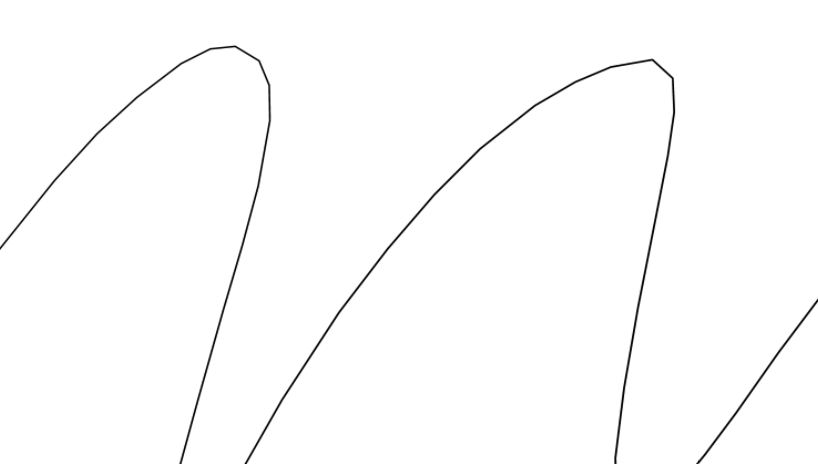
In the latest build of the most talked about vibe-clone we see that even 20 pixel wide strokes have visible segmentation along the corners of strokes instead of tightly spaced dabs. The faster your strokes are the more visible these segments will be. Using interpolated segments instead of dabs isn’t ideal for brush engines, especially if you need to load third party brushes and plugins.
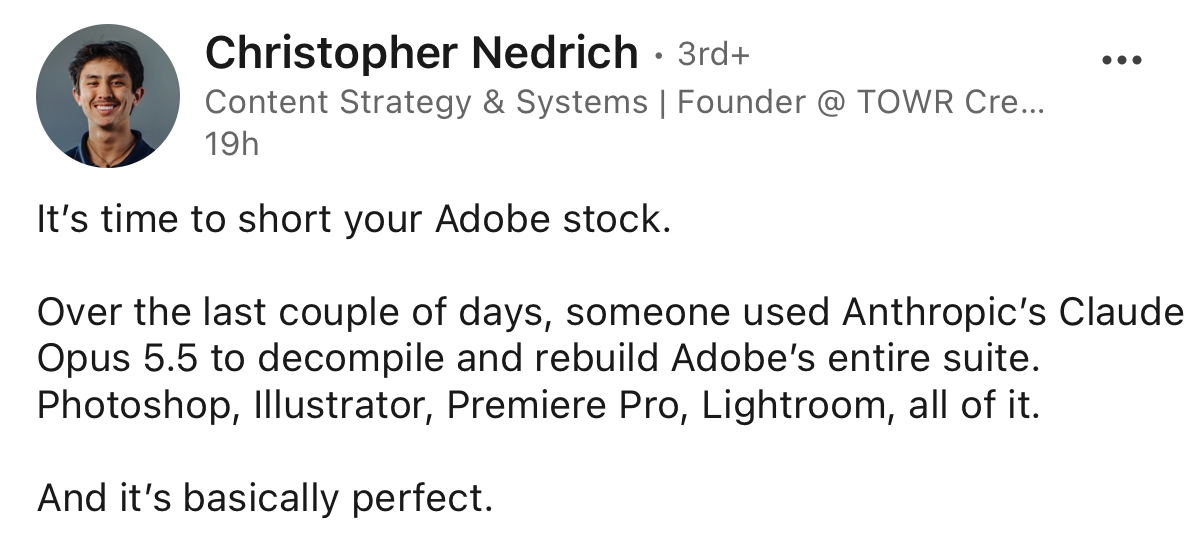
An example above of the kind of misinformation spreading low-lifes that infest Reddit and LinkedIn. Under US law, Rule 10b-5 prohibits material false statements “in connection with” the purchase or sale of securities.
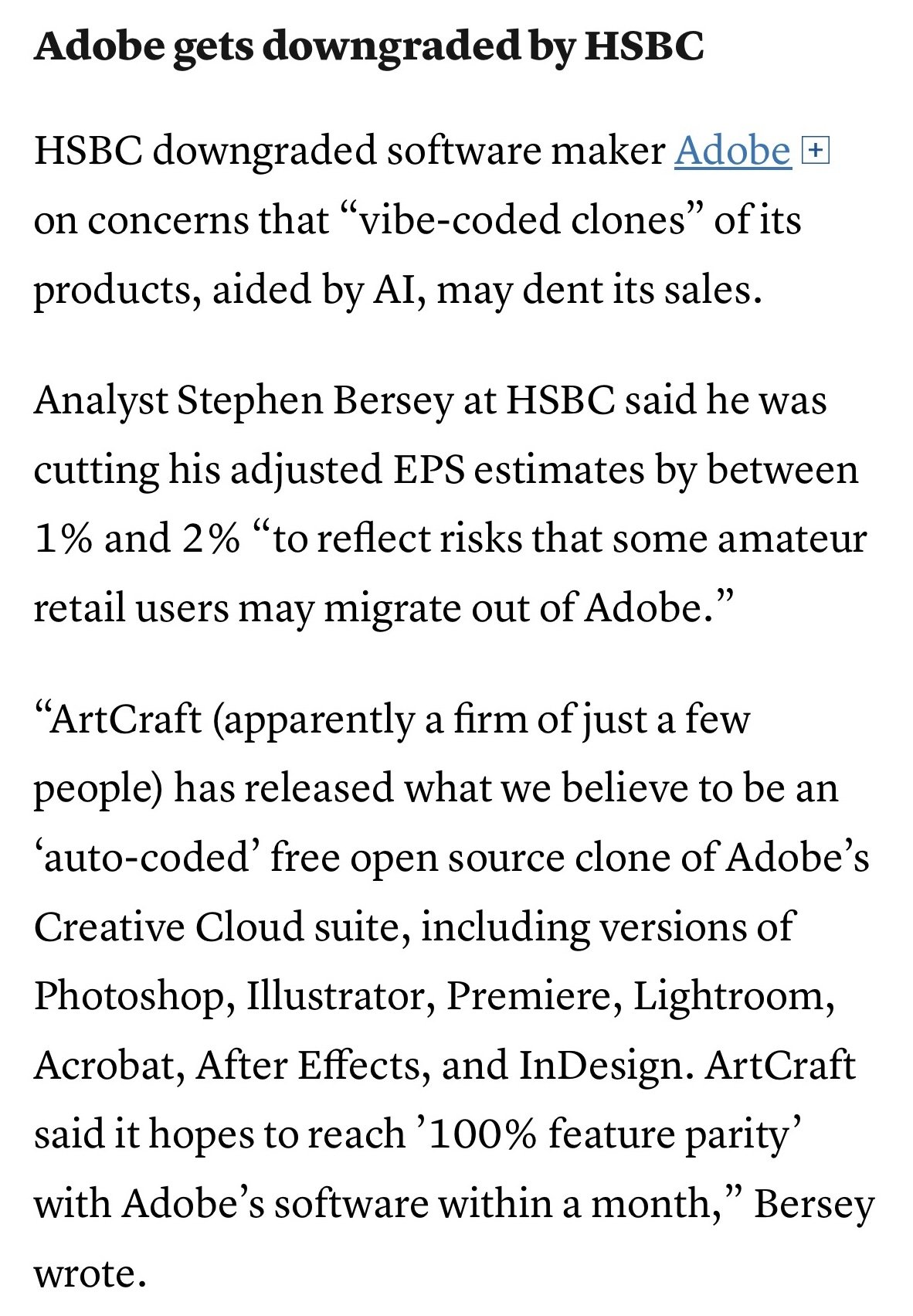
HSBC Analyst Stephen Bersey bizarrely seems to believe these clones are being “auto-coded” by a firm of a “few people” (there are several hundred contributors in the GitHub repo and already hundreds of forks) and doesn’t seem to understand that feature parity and reliability are not the same thing. Whether he is being an intelligent analyst or violating Rule 10b-5 is up to the future to decide.
It almost looks like we are seeing marketing gimmicks and stock market manipulation at work. We have seen enough signs that some in finance want to short established software companies by using the fear that vibe coded apps are going to take over. If that doesn't make much difference they would use Reddit and media outlets to foment a short squeeze situation in first half of 2027.
What Adobe should do in response to this malarkey is partner with Nvidia and AMD to accelerate their apps even more and make their industry standard Photoshop, InDesign and Illustrator file formats harder to reverse engineer. This can be achieved by updating their file formats to require a one-time secret token generated within a legitimate Adobe app if users want to save or open a file with advanced layers and other features. Methods like this will be required by all developers in the future who fear their apps will be vibecloned or ripped off. Thanks to the misbehaviour of AI enthusiasts (and the NSA) we could be entering the era of ‘who can protect their apps the best?’ instead of a more open digital ecosystem that we hoped for.
The saddest part in all this is how it feeds into the ignorance and online hate campaign against Adobe that we have seen in the last 5 or so years. Some have labelled it ‘Adobe derangement syndrome’, but whatever it is it is a mix of stock market manipulation (some admit it) and anger that Photoshop has been getting harder to pirate ever since cloud services were integrated into Adobe’s application suite.
We should clear the air here. Subscription software exists when cloud services and cloud compute are integrated into a software suite. It is the only way to pay for the running costs at wide scale. If you remove these modern services there is limited progress in software development. You'll have to move all high cost compute locally which is impractical because most users cannot afford a high end workstation GPU or cloud server.
Instead of hurling hate speech and bile at thousands of software engineers who lead innovation at large companies (Adobe, Autodesk, Foundry, Canva, Maxon, Celsys, and others), show them some gratitude for their efforts. They are the engineers who innovate and everyone else follows. Just because they work at a big company doesn't mean they are committing human rights abuses. We have a generation brainwashed by envy and hate instead of urging everyone think and build bigger or greater companies. If all software engineers lost their jobs and all software was free, your taxes will likely be up to 30% higher (you would not be able to expense applications and you would have to support an even bigger welfare system) or the government would have to keep printing more money and cause more inflation. Congratulations! Your destructive attacks on software companies made everyone poorer.
So if some people have an issue with companies being large, they now have the tools to compete against them. But instead of vibe cloning poor quality rip offs why not build new original creative applications around fresh ideas that have never been tried before?
But then again, vibe cloned piracy is a demotivating force. It ruins the incentive to create. Why create new original apps and games if someone comes along and rips you off?
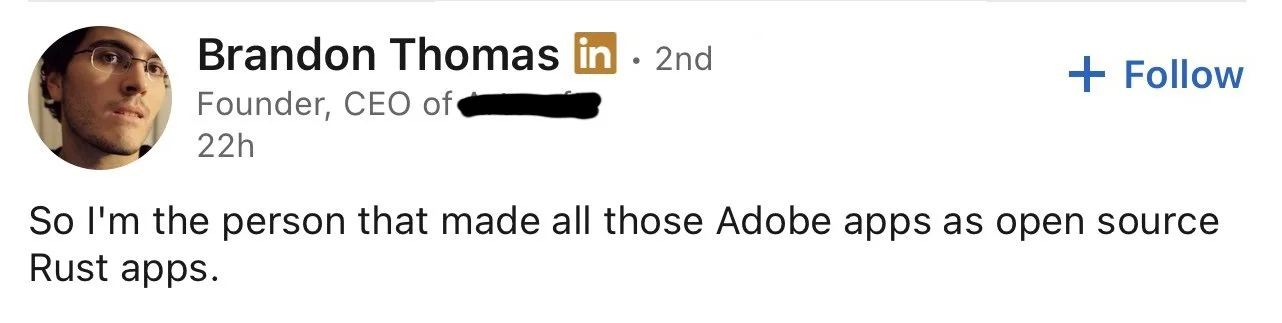
You’re giving yourself too much credit Brandon. There are dozens of people in your GitHub repo and they are all subscribed to a chatbot that is doing almost all the coding after being fed screenshots of Adobe’s apps.
Update: in the last two days the ancap tin foil brigade falsely accused me of being paid by Adobe. This blog post was linked to on ycombinator and the discussion that followed was exactly what I pointed out above - tired parroted talking points, cliché anti-corporate rants and conspiracy theories. Not one comment about the innovation that scientists and engineers pursue at the companies above that benefits millions of users and the economy or the technologies that trickle down to the open source communities. One comment even insisted that Adobe should only add features that ‘people ask for’. If the tech sector worked like that we would be many years behind. If the scientific community worked like that we would still be treating polio and pandemics with magic herbs. Scientific and technological progress should be free from intimidation by the masses.
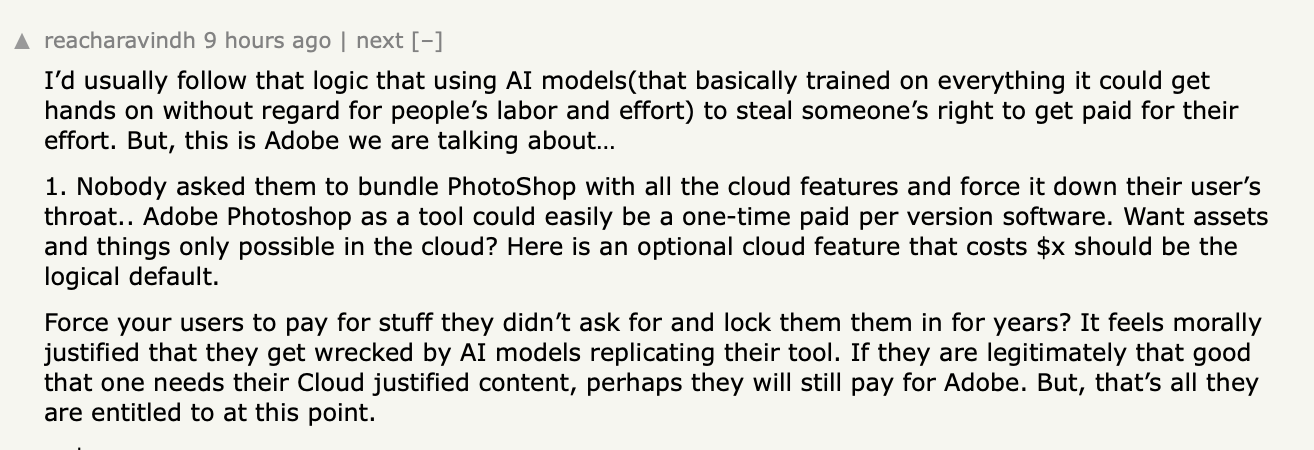
If companies like Adobe needed permission from people like ‘reacharavindh’ there would be no launcher for continual updates, the cost of a 'one-time’ purchase would be too expensive for young influencers who need to edit their online content, there would be no document syncing between computers and tablets, no cloud workflow for teams, no fonts and plugins that can be downloaded from the launcher, it would be harder to find plugins from third party developers without the launcher, and any cloud powered feature such as Subject Select or Generative Fill/Expand would be too compute intensive to do on a laptop or desktop computer without an extremely expensive GPU. On one hand we have AI guys who abuse AI to rip off movies, books and now applications. And then on the other hand we have people like ‘reacharavindh’ who talk nonsense because they don’t need to be accountable for their uneducated opinions and exaggerations behind their internet handle. I’m tempted to believe ‘reacharavindh’ was not around when Photoshop cost over $1000 (around $3000 in today’s money) and was extremely basic compared to today’s version. He probably doesn’t understand how professionals and businesses expense software either. Software is, in general, deflationary - especially if the market keeps expanding.
Update 14th October: Let’s test the Photoshop vibeclone ‘Photocraft’ versus my in-house animation app that was built by me alone without assistance from 300 vibecoders on GitHub like they did.
Here we test brush stroke performance. The canvas is 8000x8000 pixels and the brush size is 250 pixels. Smoothing is disabled in both apps.
This is the most recent build of Photocraft. It struggles to draw smooth fast strokes on this canvas size. Instead of curves the result is jagged lines. The paint brush in my animation app has no problems. It can draw smooth curves easily and at all canvas sizes it can even emulate real time oil brushes, water brushes and mixer brushes.