The most popular hotel booking sites show prices substantially higher to San Franciscans using their online booking platforms — and most Bay Area travelers at large likely have no idea.
This shady phenomenon, known as price discrimination, occurs when online retailers make judgments about what their customer will pay and then hike their rates accordingly.
I set out to compare hotel prices — for the same hotel rooms, during the same spans of time — using different devices and browsers and while browsing from different geographic regions. The goal was to understand how online travel agencies adjusted their prices, and which metrics produce the lowest cost.
Article continues below this ad
Under these controlled browsing conditions, I found consistently that consumers browsing from the Bay Area were offered far higher rates for hotel rooms compared with users browsing from less affluent cities, like Phoenix and Kansas City.
In one shocking case, the Bay Area test user was offered a nightly rate for a Manhattan hotel room that was $500 more per night than the rate offered to consumers in the less affluent cities for the exact same room and dates.

The sun rises behind the skyline of lower Manhattan on Jan. 4, 2025.
Gary Hershorn/Gary Hershorn/Getty Images“The classic definition of price discrimination is when two buyers pay different prices for identical items,” Eric Goldman, a professor at Santa Clara University School of Law, explained in an interview. And while that might feel immoral, it is actually legal in most circumstances. Indeed, you’ve probably experienced price discrimination in ways that don’t bother you: A pub offering a happy hour discount, for instance, is an example of price discrimination, Goldman noted, though not one that consumers usually carp about.
Article continues below this ad
Make SFGATE a preferred source so your search results prioritize writing by actual people, not AI.
Add Preferred Source
Price discrimination can occur in all segments of online marketplaces, but it is particularly egregious in travel — in part because travel is often a luxury good, and because there are numerous online communities built around thrifty travelers obsessed with getting the best deals.
The assumption at the core of online price discrimination is that some consumers are willing to pay more than others and are more likely to pay if unaware of alternatives. This isn’t dissimilar to a car salesperson who sizes you up when you enter the lot. But e-commerce sites often make snap judgments based on unknown and withheld metrics.
The way that companies pull it off is a trade secret and continues to stump researchers. Nofar Duani, a professor of marketing at the USC Marshall School of Business who has studied online price discrimination extensively, told SFGATE she could not “get a straight answer” on how it works. Duani said that the public only gets a hint of how it works when there’s a controversy.
Article continues below this ad
“My understanding is companies don’t particularly want this information out there,” she said.
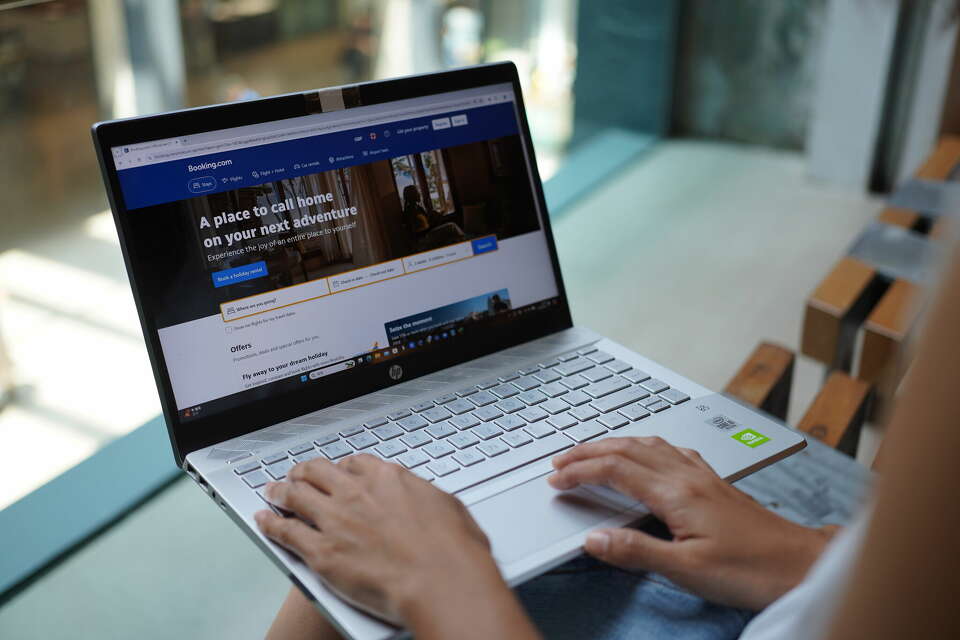
Browsing Booking.com, which, along with Priceline and Kayak, is owned by Booking Holdings.
SOPA Images/SOPA Images/LightRocket via Getty ImagesOren Bar-Gill, a law and economics professor at Harvard Law School, said that “fairness constraints” typically limit the ability of companies to price discriminate. In other words, knowing that you’re being price-gouged “makes consumers upset,” Bar-Gill said. “And if enough consumers are upset, this is bad for business.”
There is good news for Bay Area travelers looking to avoid price discrimination when booking online. There’s a way to evade price discrimination and get a leg up on the hotel sites trying to rip you off. However, the bad news is that it’s not as easy as browsing in “private” or “incognito” mode.
Article continues below this ad
How the tests were structured
Two travel companies dominate the online travel agent industry: Expedia Group and Booking Holdings. Booking Holdings owns Booking.com, Priceline and Kayak, while Expedia Group owns Expedia, Travelocity, Orbitz, Hotels.com and has a majority stake in Trivago.
The brands supposedly operate separately — which probably explains why in the tests, sometimes the same hotels appeared to have different rates on sites owned by the same companies.
Article continues below this ad
I compared hotel room rates for five different sites: Kayak, Booking.com, Trivago, Expedia and Hotels.com. The tests were all performed on Dec. 11, 2024, within a two-hour span, and involved searching for a hotel room in Manhattan For Valentine’s Day weekend, Feb. 14 to 16, 2025.
The hotel price tests I did were designed to gauge the extent to which four factors would affect prices: operating system, browser, cookies and location (based on IP address). When discrepancies were found, I did extra tests to confirm that the offerings were identical — e.g., the same room of the same size.

Michele Rousseau, Expedia Group’s senior vice president of global marketing, speaks on stage at the Explore partner conference on May 14, 2024, in Las Vegas.
Bryan Steffy/Bryan Steffy/Getty Images for Expedia GroupI completed five tests on five different permutations of devices. Device one, the control, was a modern MacBook with a Bay Area IP address and using Firefox. Device two had the same conditions but operated in private browsing mode (meaning there were no residual cookies). Device three was a Mac using a Chrome browser from a Phoenix, Arizona, IP; device four used the same conditions as three, except it browsed from Kansas City, Missouri; and device five used the same conditions as four, except using Windows and Internet Explorer for its OS and browser respectively.
Article continues below this ad
Lesson 1: Abandon all hope, ye who browse incognito
Browsing on private mode versus normal browsing made no difference in any test: The private mode browser was served the same prices every time as the default, cookie-ridden browser perusing from the Bay Area.
There was one curious exception: On Kayak.com, the private mode Bay Area user was offered a room at the Renaissance New York Times Square Hotel for $378 a night — $3 more than the consumer browsing from the bay without private mode.
The same hotel room was offered at $293 per night to the other three test devices browsing from Kansas City and Phoenix IP addresses.
Article continues below this ad
Lesson 2: Older browsers did not get better deals
One of the tests involved a browser running Internet Explorer on Windows — a browser that Microsoft retired in 2023.
Surely, using such old machinery would hint to the pricing algorithms that you’re a lower-income consumer, and accordingly should be charged less ... right?
But in the test, the online travel agencies did not differentiate at all between the consumer browsing from Kansas City on a Mac and the consumer browsing on an old PC. In every test, the room rates were the same for both.
Article continues below this ad
Lesson 3: Geography trumps everything
The biggest single metric that determined how much a consumer was charged for a hotel was geography, as gauged by the test subject’s IP address — the most common way that websites guess your location, unless they explicitly ask for GPS data (which is more normal on phones than computers). Unlike GPS data, which are precise, IP addresses only reveal the region that a consumer browses from, and not the specific block or ZIP code.
Meanwhile, turning on private browsing, browser choice and operating system did not seem to affect prices in the limited tests.
But the differences in price between hotels were staggering for different geographic regions.
Article continues below this ad
For instance, on Hotels.com, the same room in the Little Charlie Hotel was offered at $423 a night for the San Francisco users. For Kansas City users, it was $234 a night; for the lucky Phoenix-based address, it was $181 per night. That’s less than half of what a San Franciscan would be asked to pay.
The most egregious inequality was at Public Hotel in Greenwich Village — a hotel that consistently came up high in search results to our test consumers. San Franciscans browsing on Expedia were quoted $829 a night for a room during Valentine’s Day weekend — while the Phoenix and Kansas City addresses were quoted at $318 a night for the same room. That’s a shocking difference of $511 more that Bay Area consumers were asked to pay.
What’s going on?
I loosely modeled this research on the work of Aniko Hannak, a University of Zürich computer science professor who co-wrote a paper in 2014 titled “Measuring Price Discrimination and Steering on E-commerce Web Sites.” Hannak and her fellow researchers repeatedly tested various e-commerce websites to gauge how price discrimination worked under controlled conditions.
Article continues below this ad
Despite the extensive research, Hannak said that e-commerce websites are so opaque about their practices that she still doesn’t know for sure what the primary identifying markers are that are used to price discriminate. Rather, “the effects came from different variables depending on the website, and I am sure this is still the case,” she wrote over email. “If a company wants to maximize clicks or profit and just include all variables they have about people, who knows what comes out as relevant — it might even change over time for the same company.”

An SFGATE investigation showed that travelers browsing hotel booking sites from the Bay Area were offered far higher rates for rooms compared with users browsing from less affluent cities.
Images via Getty/Illustration by SFGATEHence, while the tests suggest geography is the most important determinant, that might not be true for all e-commerce sites — it could just be online travel agencies. And, it could change in time as a new metric becomes more important.
In an email, Angela Cavis, spokesperson for Booking, said that the rates users see were “determined by our accommodation partners, who have full control over the rates they choose to list on the site.”
Article continues below this ad
Cavis explained that, “Partners also have the flexibility to create specific promotional rates, such as country rates or mobile rates, which are designed to offer discounts, not charge higher prices.”
The implication is that the expensive rate that San Franciscans see is the “real” price — while Kansas City and Phoenix travelers are getting a discount.
A spokesperson for Expedia Group did not answer questions about how price discrimination works in their brands.
How to beat price discrimination
The only thing that seems to defeat price discrimination is browsing from another city — something that is possible (and simple) if you browse with a virtual private network proxy, or VPN.
Article continues below this ad
VPNs route one’s internet traffic through a server in another location. Readers who work from home will likely be familiar with the process of logging into their company VPN as a means of protecting vital company data by encrypting their internet traffic.
Outside of remote logins, commercial VPNs are often touted as a good option for preserving privacy, getting around a national firewall — or for pirating software without getting caught. Though they typically cost a few dollars a month, sophisticated VPN proxy services let users actually choose which city they want to browse from. For the most price-savvy consumer, investing in one of these services might be one’s only hope for getting around this price-gouging.
However, this travel hack may not last. Experts say that there’s an ongoing arms race between consumers trying to dodge price discrimination and e-commerce sites trying to preserve it.
Kirthi Kalyanam, a marketing professor at Santa Clara University, says that consumers are at a disadvantage in the current regime.
Article continues below this ad
A director of communications for Booking told SFGATE that the rates users see are “determined by our accommodation partners, who have full control over the rates they choose to list on the site.”
JHVEPhoto/Getty Images“Right now, companies have an advantage, because they have more technology, machine learning and AI capability — they can deploy these against us,” he said. “I see that as a temporary phenomenon. If too much power is shifted towards the seller, consumers will eventually fight back with technology that reclaims some of that power.”
This could result in something like a special browser that “spoofs” aspects of the consumers’ identity to “draw out the lowest prices out of retail,” Kalyanam said.
Article continues below this ad
In the meantime, it might make sense to invest in a VPN so you can log into a server in a less-wealthy city when booking a hotel. Or, call up your cousin in Missouri and have them book a room for you.
Editor’s note: This story was updated at 3:55 p.m., Feb. 3, to clarify booking platforms show prices set by hotels.