On a sunny July day in 2005, a frog jumped out of a rain gutter to see an unexpected sight: an avalanche of thousands of colorful bouncy balls careening down a San Francisco street.
Although San Francisco has been the setting for plenty of cinematic chase scenes, there had never been any quite like this. Filmed as a British commercial for Sony Bravia TV sets, 250,000 bouncy balls were launched down San Francisco hills in one of the most surreal weeks in the city’s history, resulting in a short film that swept the advertising awards circuit and racked up a cumulative 5 million YouTube views.
You’d think such a spectacle would lean heavily on computer-generated imagery and post-production magic, but after the first ball drop on Filbert Street, the result looked so spectacular that Danish director Nicolai Fuglsig sent the special effects team back to the UK.
“No, we actually did everything in camera,” Fuglsig told SFGATE. “Of course the frog was rigged, but the frog is real.”
Everything in the final cut was shot in-camera, down to that slow-motion frog jump set piece after 1:40, which was staged by production designer Bret Lama by placing a plug in the drainpipe to keep the frog in place until the perfect moment. Then location scout Patrick Ranahan’s son dropped a handful of balls into the pipe from a rooftop as a storm of colorful spheres rushed past. He has kept some of the balls to this day.
How it began
The project had many seemingly impossible logistical elements — from securing city permits to designing propulsion systems to cleaning up and repairing the devastation. But it all began with a brief prompt from creative director Juan Cabral at British ad agency Fallon that revolved around the slogan “Colour like no other,” which resulted in a flood of pitches from directors, including Spike Jonze.
Fuglsig remembers it as something like, “It’s early morning, millions of balls arrive in a city, millions of balls leave a city.” He considered basketballs or beach balls, then landed on the idea of the bouncy ball.
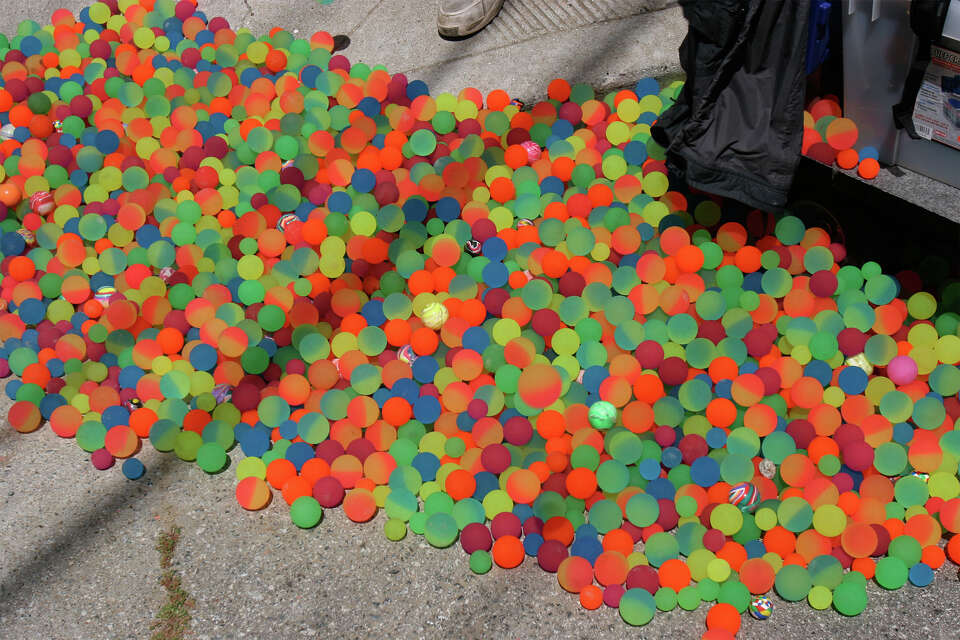
Bouncy balls collected on a San Francisco street during the filming of a Sony Bravia commercial in 2005.
Courtesy of Bret LamaFuglsig chose San Francisco as the setting because he’d been obsessed with the movie “Bullitt” for years and had visited the city as a child. Plus, of course, the hills.
Make SFGATE a preferred source so your search results prioritize writing by actual people, not AI.
Add Preferred Source
“There’s no other place in the world to go if you want to throw stuff down the street. It’s every child’s dream,” he said.
Semitrucks of Superballs
Once Fallon accepted the pitch, the reality of the logistical challenges began to sink in. First, they had to scour the country to acquire the 250,000 bouncy balls needed to create the critical mass.
“They bought every bouncy ball west of the Mississippi,” said Ranahan.
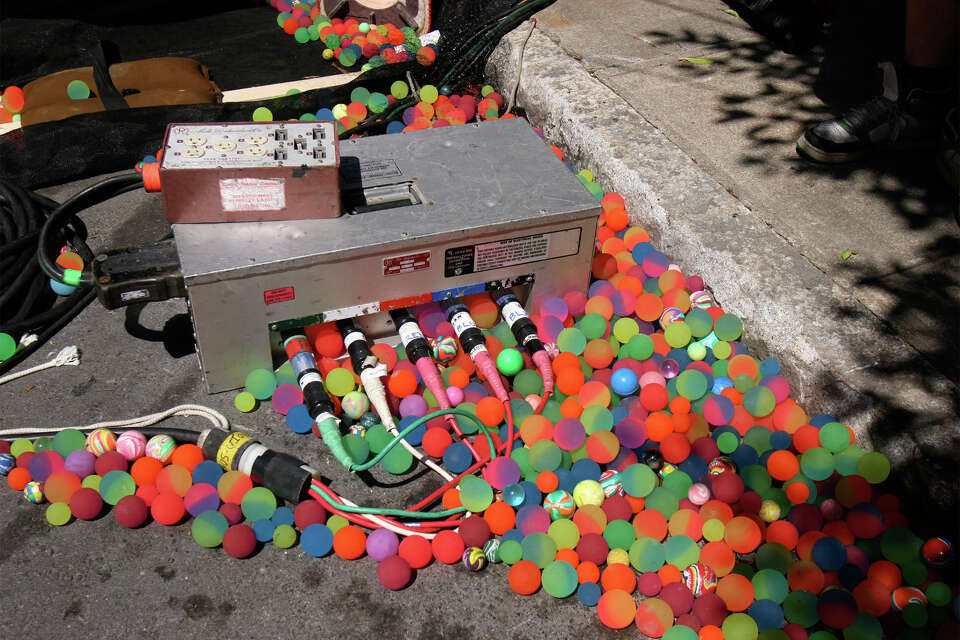
Bouncy balls collected on a San Francisco street during the filming of a Sony Bravia commercial in 2005.
Courtesy of Bret Lama“There was not a single bouncy ball in any machine in America for a couple months. I felt so bad for the poor children,” said Fuglsig.
Although it’d still be a spectacular sight to simply roll the balls down the hill, the maelstrom that Fuglsig envisioned required a substantial height to take advantage of their full bounce potential — which would already be lessened due to the angled slope of a San Francisco hill.
Special effects and production specialist Barry Conner was tasked with creating a launch system, with the caveat that someone else would handle retrieval duties. He rented a soundstage in Culver City to run tests, but didn’t anticipate just how many balls they were dealing with.
“They told us there’s 250,000 bouncy balls coming,” Conner said. “We thought, oh, well, it’ll fill up a few carts. Then these semis started showing up.”
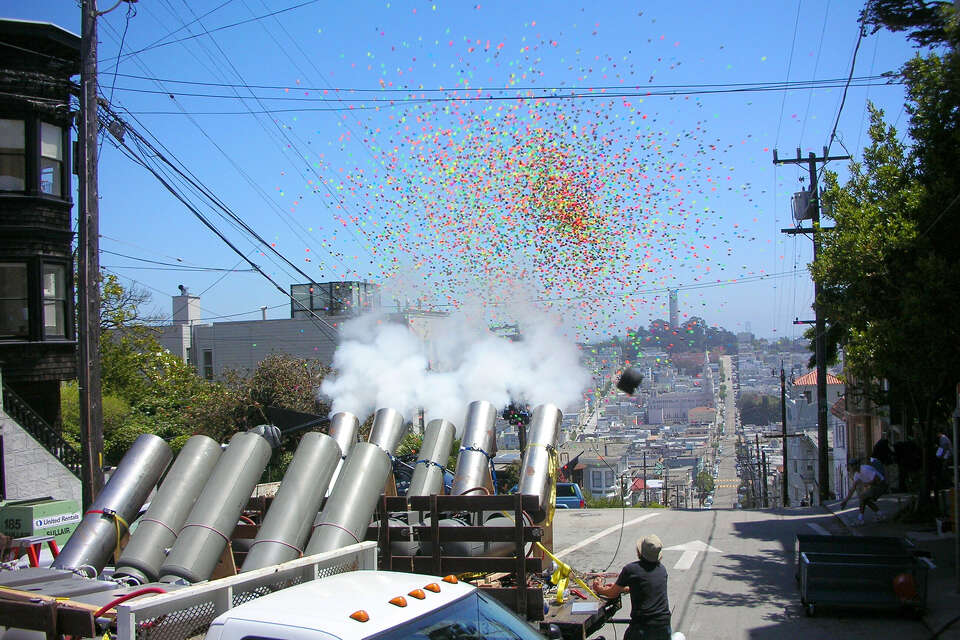
Bouncy balls firing over Filbert Street in San Francisco in 2005.
Courtesy of Barry ConnerTo make matters even more complicated, the director came up with a last-minute ideafor a set piece that used only red balls, requiring Conner to hire additional PAs to sort the balls by color.
In order to get the balls airborne, Conner came up with a proprietary mortar system — essentially truck-mounted cannons designed with an engineer’s mindset.The typical bouncy ball, originally made of the synthetic polymer Zectron and marketed under the name Superball by toy company Wham-O, has a remarkably high coefficient of restitution of 0.92 — meaning if dropped from 100 feet,it bounces back up to 92 feet. If launched from a high-enough height, one could easily clear a Victorian.
“I had math sheets — physics equations, math volumes. How many balls in a tube, how far, what angle, what pressure for it to go what distance,” said Conner.
Early tests ended up destroying the balls. “We’d put 5,000 balls in there, and they’d come out in little tiny pieces. They only went 8 feet.” To solve the problem, Conner’s team created a foam wad connected to the cannon’s hopper by a 12-foot rope. It functioned as a buffer between the balls and the air-powered force of the cannon, with the rope functioning kind of like a rocket booster.
San Francisco says yes
The delivery system was one challenge, but the real trick was convincing the city of San Francisco and neighborhood residents to permit such a disruptive shoot.
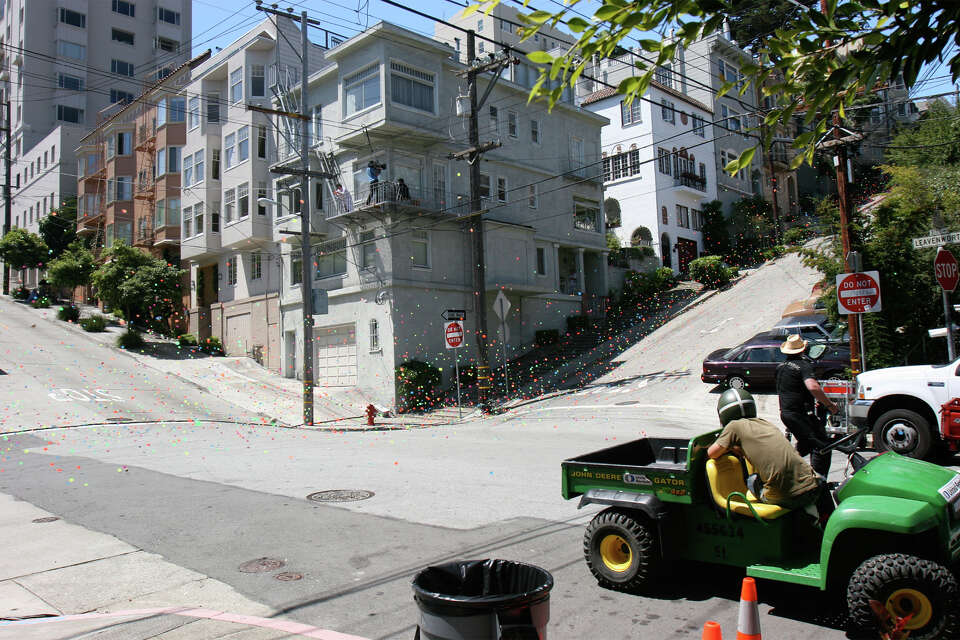
Bouncy balls collide on a San Francisco street during the filming of a Sony Bravia commercial in San Francisco in 2005.
Courtesy of Bret Lama“I really admire and have always been so grateful to[location scout] Patrick Ranahan. This was by far the most difficult location managing job I’ve ever been involved with,” said Fuglsig. “The fact that he managed to convince all the residents in all these neighborhoods to do this — I was very nervous about if we were gonna get a ‘no.’”
“How they got the permits was beyond me,” said Conner.
“When I would go into the mayor’s office and say these things, they would listen,” Ranahan said. “In a lot of places in the world, they won’t even listen. I worked on this Bond film ‘A View to a Kill’ — the worst Bond film — and we saw Dianne Feinstein, we had this meeting. I remember asking, ‘We want to set City Hall on fire, we want to bump a blimp into the Golden Gate Bridge and we want to jump a hook-and-ladder truck over Lefty O’Doul Bridge with Roger Moore on it’ … and they were seriously like, ‘OK.’”
In addition to the mayor, he met with the Board of Supervisors and had to warn everyone living in the neighborhoods. “I said to everyone on the street, ‘We’re not sure exactly what’s gonna happen, but whatever we destroy, we will fix 10 times better,’” Ranahan said. Making good on the promise, the crew had a glass repair company on-site with replacement windowpanes for the inevitable damage.
Action!
On the first day of the shoot, six cannons were mounted on trucks bolted into the ground at Filbert and Hyde streets. Another six were positioned at Jones and Union streets for a second blast. According to Fuglsig's memory, each mortar contained about 25,000 balls.

Bouncy balls cascading down a San Francisco street for a Sony Bravia commercial in 2005.
Courtesy of Bret LamaSix cameras were readied for the shot, each outfitted with a protective plywood casing. To capture the slow-motion effect, they used an older Photo-Sonics camera, which further complicated the production. It filmed at such a high speed that the slightest change in light would compromise the shot, requiring special weather insurance that afforded the crew an extra day of shooting if a cloud happened to move in front of the sun at an inopportune moment. Lama and the production design team had built set pieces in the line of fire like the frog drain, a ledge for a dog to stand on, mailboxes, garbage cans and bushes for the balls to pass through. Crew members wore Kevlar armor, helmets and riot shields. Golf driving-range nets hung at the bottom of the hill to catch stray balls, and sewer drains were covered.
Then they called action.
“The noise it made is nothing like you’ve ever heard, anything, in your whole life. There was nothing to relate it to,” said Conner.
“The sound of it was unbelievable. I couldn’t believe the sound,” said Fuglsig.
“It was like a hailstorm. You could hear them coming. They basically shredded a lot of the foliage on the street. We had 24 picture vehicles — our cars — that were damaged,” said Lama.

A broken car taillight that was struck with a bouncy ball during the filming of a Sony Bravia commercial in San Francisco in 2005.
Courtesy of Bret Lama“I’ll never forget the first cannon shot ... The absolute chaos theory took over — I couldn’t f—king believe it — balls bounced back up the hill a block. It was chaos,” said Ranahan.
Conner calculated that the balls reached a top speed of between 150 and 200 feet per second — or 102 to 136 miles per hour. Some bounced over houses up to three blocks over, falling into storm grates that were thought to be outside the bounce radius (San Francisco Public Works wasn’t too happy). When balls collided with each other, some bounced back uphill and others were simply destroyed. The speed of the balls, combined with the slow-motion camera, created remarkable moments.
“There’s a shot in the commercial that we named ‘the aquarium of mayhem’ because it was in slow motion and it looks so beautiful as you’re tracking left to right,” said Fuglsig. “And in slow motion you just see all these thousands of balls coming at you. It was as if you were underwater, and all these things come down at you. It was incredibly beautiful. We were in tears.”
But in addition to the beauty, there was also destruction. Car doors looked like cottage cheese. Six houses were damaged in the crossfire; one memorable shot captured balls chipping off wooden siding. When Conner was checking in to his hotel later that night, a ball bounced by on the sidewalk. He was 4 or 5 miles away.
“I think our bill was $74,000 on broken windows,” said Ranahan. “And the crazy thing is, everyone loved it. The people, the neighborhood, they still come out to me and talk to me about it.”
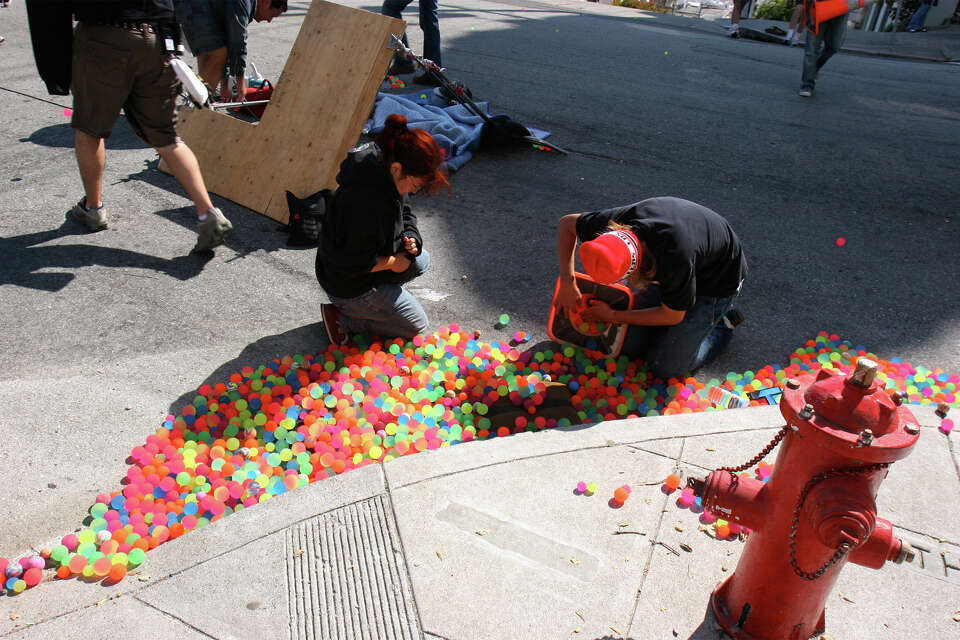
Grates were blocked off to keep bouncy balls from entering sewers during the filming of a TV commercial in San Francisco in 2005.
Courtesy of Bret LamaAfter that first blast, the army of PAs scooped the balls up using specially designed shovels. “It sounded better than fetching lunch or whatever,” said Mike Downey, a production assistant who responded to a job ad to wrangle balls and drive one of the trucks that brought them back uphill. “You had to hold down the balls really well, because we were filming in super hilly areas. I don’t think [Fuglsig] would have liked the shot of all those balls spilling out the back of the moving van. I don’t think that would be as picturesque.”
‘Two things I never want to see in San Francisco again’
The madness continued for several more days, with more cannon blasts from Sanchez and Hill streets in Noe Valley, but it proved to be too much for the city government. Conner received a call from the head of the San Francisco Film Commission restricting them from using the mortars on the next days’ shoots. “[The film commissioner] goes, ‘Here’s two things I never want to see in San Francisco again — air mortars and Barry Conner.’”
With the mortar system forbidden, the crew used a backup plan that entailed filling shipping containers and mounting them on forklifts that hoisted them 65 feet into the air, then dropped them onto street-level plywood ramps that sent the balls soaring. Additional filming took place on two North Beach streets (south down Kearny Street and Romolo Place, from Vallejo Street to Broadway), plus more pickup shots at a garage on Hyde Street, the Hotel del Sol motel pool in Cow Hollow and an opening shot in Potrero Hill at Carolina and Wisconsin streets).
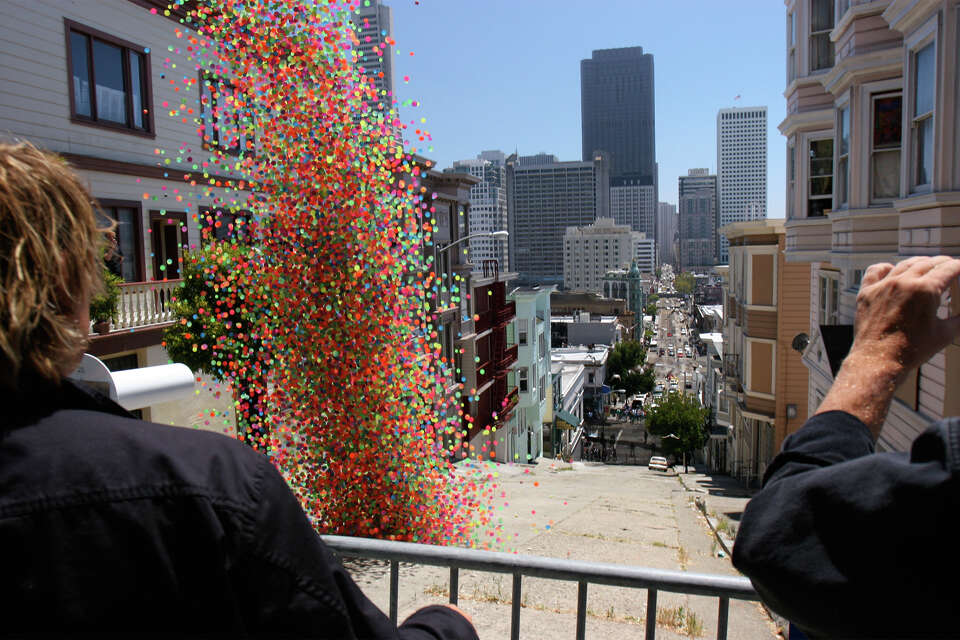
Bouncy balls cascade down a San Francisco street as the crew looks on.
Courtesy of Bret LamaIf this stunt happened today, it’d be viral international news. Back in 2005, however, social media was still nascent and not everyone had a camera in their pocket (the first iPhone wasn’t released until 2007). Fuglsig doesn’t remember any news coverage at all (SFGATE found no archival newspaper records from the San Francisco Chronicle or San Francisco Examiner), but word of mouth still spread throughout the city, drawing small crowds.
“At one point when we were shooting in Noe Valley, up on the hill, I turned around and there were 50 or 60 people from the neighborhood just watching, and it was the biggest smiles on everybody’s face,” said Lama.

Bouncy balls flood down a San Francisco street in 2005.
Courtesy of Bret LamaAs the spectators grew, the number of ball wranglers shrank. Despite the magical nature of the event, retrieving the balls from deep inside foliage wasn’t exactly glamorous work — Conner recalls that by the final day, they were down to five ball wranglers. But thankfully some of the spectators chipped in. Lama remembered one kid who must have gathered a total of 500 balls, using his T-shirt to make a bundle (although they were not returned).
‘It changed my life’
For the music, the team wanted to use “Heartbeats” by José González (a cover of the Knife). Originally González declined, until he was sent some of the dailies. He agreed, and liked the concept so much he used the footage as a backdrop during concerts. The song became a hit in its own right and has now been streamed over 584 million times on Spotify.
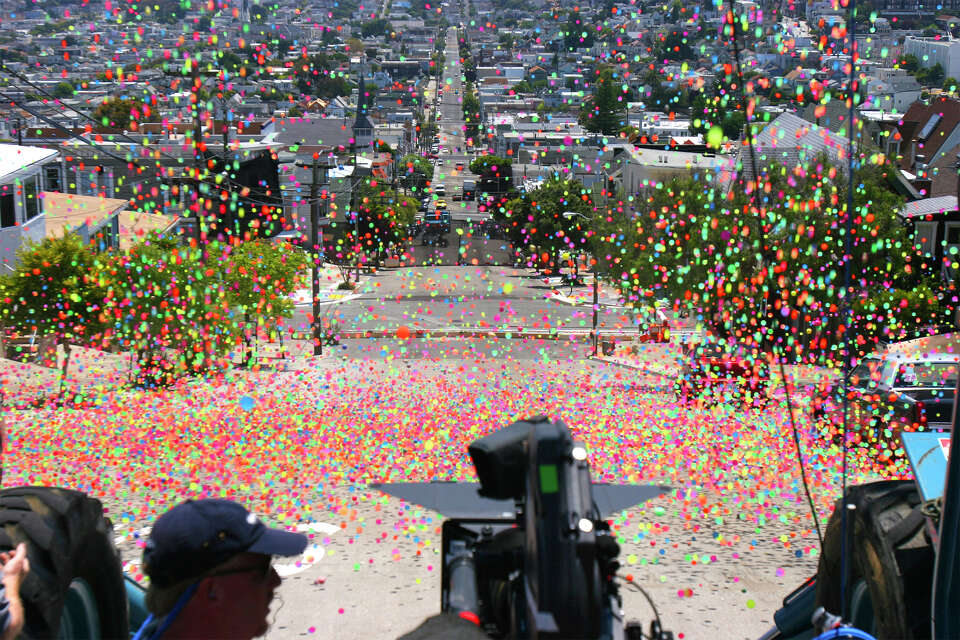
Bouncy balls float over a San Francisco street in 2005.
Courtesy of Bret LamaWhen all was said and done, over a million dollars had been spent. The ad premiered on Nov. 6, 2005, on Sky Sports 1 just prior to the kickoff of the season’s biggest soccer matchup: Manchester United versus Chelsea. Digital ad boards on the perimeter of the field also displayed the bouncy ball footage, and a 60-second cut aired during halftime. It became a phenomenon in the UK, and legend has it that Sony included a bouncy ball at the bottom of the box of every Sony Bravia television.
Twenty years later, it’s been canonized in almost every list of greatest commercials of all time. Parodies have been made with citrus fruit and tennis balls. Influencers have dissected the marketing effects (the following year, Sony overtook Sharp to become the top LCD TV brand). On YouTube, an extended director’s cut version posted 15 years ago has over 2.6 million views and over 1,000 comments. You can also find a 4K remaster, and a short behind-the-scenes documentary. Rumor has it, balls occasionally turn up for sale at San Francisco garage sales.
“To this day when I go to those neighborhoods, in ‘Shang-Chi’ we jumped a BMW on one of the big hills we did the balls on, on Filbert off of Hyde ... People remember me, and they come up and they have balls in their hands — they’ve saved them. And they say they still find them in gutters,” said Ranahan.
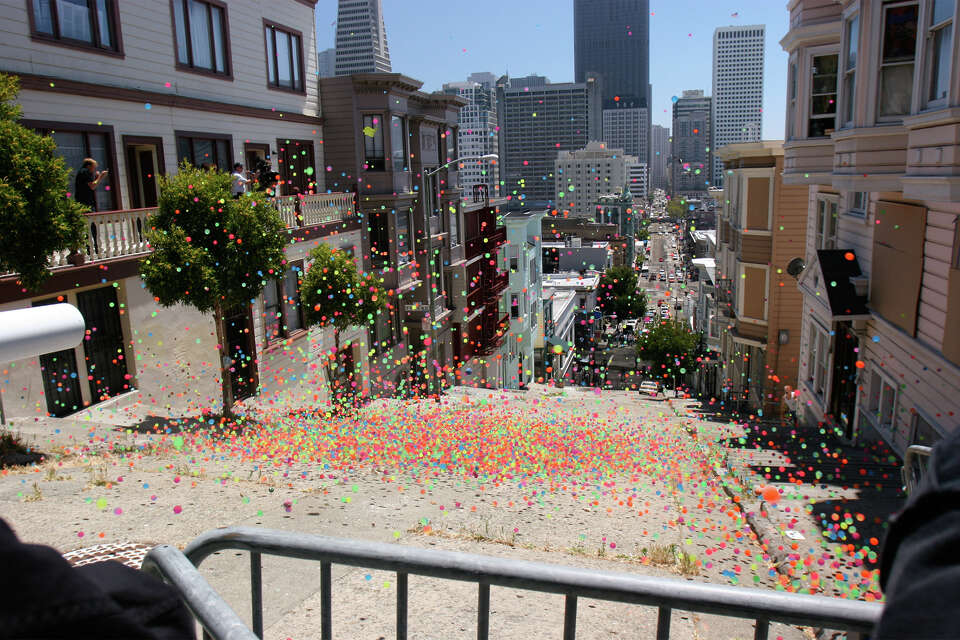
Bouncy balls roll down a San Francisco street for a Sony Bravia commercial in 2005.
Courtesy of Bret LamaFuglsig has gone on to direct countless other commercials, as well as the 2018 feature film “12 Strong,” but the bouncy ball ad still serves as a calling card. “It has changed my life,” he said.
And although the commercial never actually aired in the United States, it serves as a testament not only to the physical beauty of San Francisco, but to the character of a city that would allow such a spectacle to take over its streets.
“Herb Caen always had this thing that this city is special because, ‘It knows how to do it.’ It’s a city that knows how. If you want a demonstration, if you want to fight the war, if you want Beats, or the hippies,” said Ranahan. “It’s a city that says ‘yes’ and can do it.”