As filed with the U.S. Securities and Exchange Commission on July 1, 2025
Registration No. 333-
UNITED STATES
SECURITIES AND EXCHANGE COMMISSION
Washington, D.C. 20549
FORM S-1
REGISTRATION STATEMENT
UNDER
THE SECURITIES ACT OF 1933
FIGMA, INC.
(Exact name of registrant as specified in its charter)
(State or other jurisdiction of incorporation or organization) | (Primary Standard Industrial Classification Code Number) | (I.R.S. Employer Identification Number) |
760 Market Street, Floor 10
San Francisco, California 94102
(415) 890-5404
(Address, including zip code, and telephone number, including area code, of registrant’s principal executive offices)
Dylan Field
Chair of the Board of Directors, Chief Executive Officer, and President
760 Market Street, Floor 10
San Francisco, California 94102
(415) 890-5404
(Name, address, including zip code, and telephone number, including area code, of agent for service)
Michael T. Esquivel Ran D. Ben-Tzur Jennifer J. Hitchcock Aman D. Singh Chance L. Goldberg Fenwick & West LLP Silicon Valley Center 801 California Street Mountain View, California 94041 (650) 988-8500 | Brendan Mulligan Amanda Westendorf Brendan Brown Figma, Inc. 760 Market Street, Floor 10 San Francisco, California 94102 (415) 890-5404 | Richard A. Kline Richard Kim Latham & Watkins LLP 140 Scott Drive Menlo Park, California 94025 (650) 328-4600 |
Approximate date of commencement of proposed sale to the public:
As soon as practicable after the effective date of this registration statement.
If any of the securities being registered on this Form are to be offered on a delayed or continuous basis pursuant to Rule 415 under the Securities Act of 1933, as
amended, or (“Securities Act”), check the following box: ☐
If this Form is filed to register additional securities for an offering pursuant to Rule 462(b) under the Securities Act, please check the following box and list the Securities
Act registration statement number of the earlier effective registration statement for the same offering. ☐
If this Form is a post-effective amendment filed pursuant to Rule 462(c) under the Securities Act, check the following box and list the Securities Act registration
statement number of the earlier effective registration statement for the same offering. ☐
If this Form is a post-effective amendment filed pursuant to Rule 462(d) under the Securities Act, check the following box and list the Securities Act registration
statement number of the earlier effective registration statement for the same offering. ☐
Indicate by check mark whether the registrant is a large accelerated filer, an accelerated filer, a non-accelerated filer, a smaller reporting company, or an emerging
growth company. See the definitions of “large accelerated filer,” “accelerated filer,” “smaller reporting company,” and “emerging growth company” in Rule 12b-2 of the
Securities Exchange Act of 1934, as amended.
Large accelerated filer ☐ | |
Smaller reporting company ☐ | |
Emerging growth company ☒ |
If an emerging growth company, indicate by check mark if the registrant has elected not to use the extended transition period for complying with any new or revised
financial accounting standards provided pursuant to Section 7(a)(2)(B) of the Securities Act. ☐
The registrant hereby amends this registration statement on such date or dates as may be necessary to delay its effective date until the registrant shall file a further amendment
which specifically states that this registration statement shall thereafter become effective in accordance with Section 8(a) of the Securities Act or until the registration statement
shall become effective on such date as the Securities and Exchange Commission, acting pursuant to said Section 8(a), may determine.

This is the initial public offering of shares of Class A common stock of Figma, Inc. We are offering shares of our Class A common stock and the
selling stockholders identified in this prospectus are offering shares of our Class A common stock in this offering.
Prior to this offering, there has been no public market for our Class A common stock. We will not receive any proceeds from the sale of shares of
Class A common stock by any of the selling stockholders. We expect that the initial public offering price per share of our Class A common stock will
be between $ and $ per share.
We have applied to list our Class A common stock on the New York Stock Exchange (“NYSE”) under the symbol “FIG.”
Following this offering, we will have three series of authorized common stock, Class A common stock, Class B common stock, and Class C common
stock. The rights of the holders of our Class A common stock, Class B common stock, and Class C common stock are identical, except with respect
to voting and conversion rights. Each share of Class A common stock is entitled to one vote per share. Each share of Class B common stock is
entitled to 15 votes per share and is convertible into one share of our Class A common stock. Each share of Class C common stock has no voting
rights, except as otherwise required by law, and, subject to satisfaction of certain conditions as described herein, is convertible into one share of our
Class A common stock. Immediately following the completion of this offering, and assuming no exercise of the underwriters’ option to purchase
additional shares to cover over-allotments, if any, Dylan Field, our Chair of our Board of Directors, Chief Executive Officer, and President, will hold or
have the ability to control approximately % of the voting power of our outstanding capital stock, including % of the voting power pursuant
to an irrevocable proxy granted by Evan Wallace, our other co-founder, and the Wu-Wallace Family Trust, an affiliate of Mr. Wallace, to Mr. Field (the
“Wallace Proxy”). As a result, following this offering, Mr. Field will have the ability to control the outcome of matters submitted to our stockholders for
approval, including the election of our directors and the approval of any change of control transaction.
We are an “emerging growth company” as defined under the federal securities laws. As such, in this prospectus we have taken advantage of certain
reduced disclosure obligations that apply to emerging growth companies regarding our financial statements and executive compensation
arrangements.
Investing in our Class A common stock involves risks. See the section titled “Risk Factors” beginning on page 38 to read about factors you should
consider before buying shares of our Class A common stock.
Neither the Securities and Exchange Commission nor any other regulatory body has approved or disapproved of these securities or passed upon the
accuracy or adequacy of this prospectus. Any representation to the contrary is a criminal offense.
Per Share | Total | ||
Initial public offering price ............................................................................................................................................................. | $ | $ | |
Underwriting discounts and commissions (1) ............................................................................................................................ | $ | $ | |
Proceeds, before expenses, to us .............................................................................................................................................. | $ | $ | |
Proceeds, before expenses, to selling stockholders ................................................................................................................ | $ | $ |
__________________
(1)See the section titled “Underwriters (Conflicts of Interest)” for a description of the compensation payable to the underwriters.
The underwriters have the option for a period of 30 days from the date of this prospectus to purchase up to an additional shares of our Class A
common stock from us to cover over-allotments, if any, at the initial public offering price less underwriting discounts and commissions.
The underwriters expect to deliver the shares of our Class A common stock to purchasers on or about , 2025.
Prospectus dated , 2025
The information in this preliminary prospectus is not complete and may be changed. We and the selling stockholders may not sell these securities until the
registration statement filed with the Securities and Exchange Commission is effective. This preliminary prospectus is not an offer to sell these securities
and we and the selling stockholders are not soliciting offers to buy these securities in any jurisdiction where the offer or sale is not permitted.
SUBJECT TO COMPLETION, DATED , 2025
PRELIMINARY PROSPECTUS

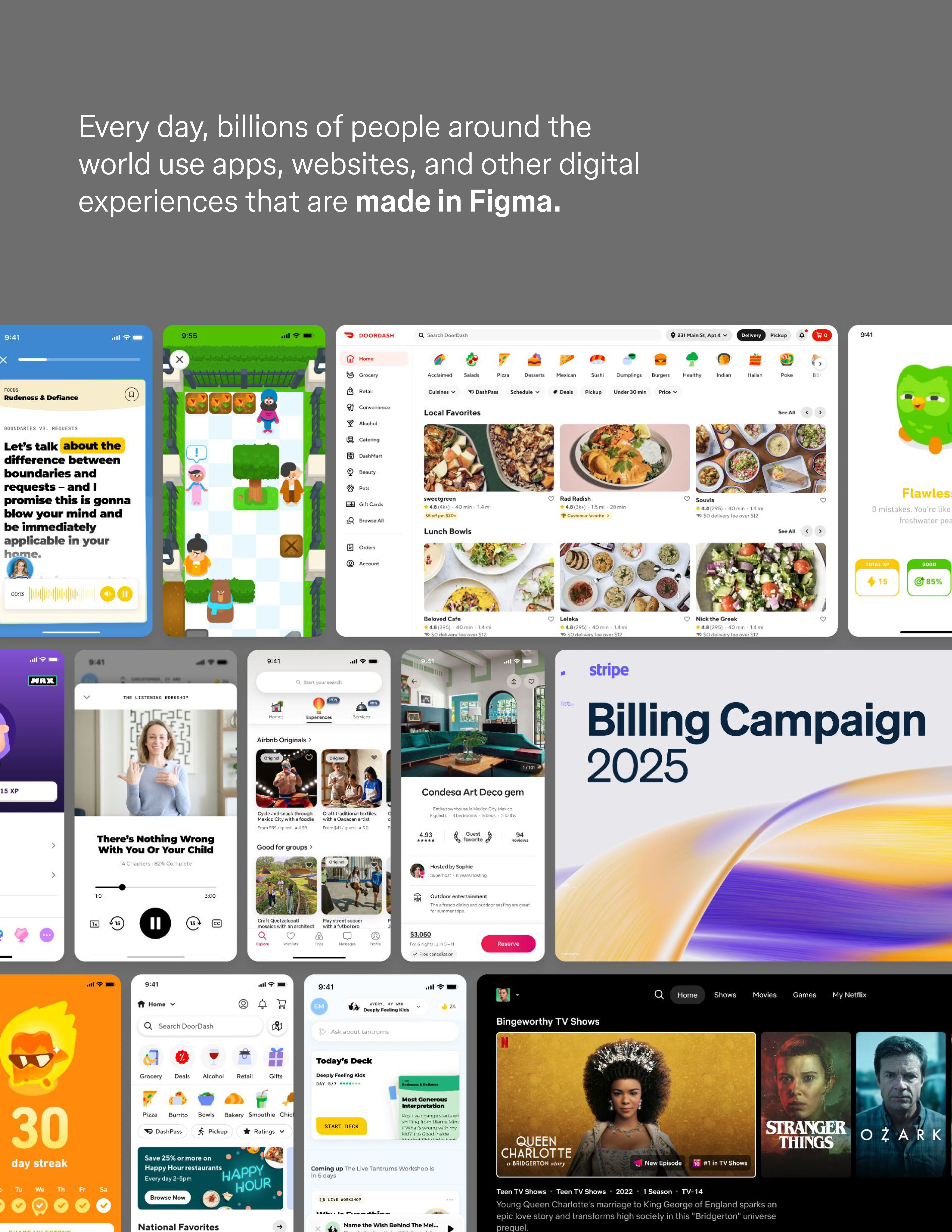


Table of Contents
FOUNDER LETTER ............................................. | ii |
PROSPECTUS SUMMARY ................................ | |
RISK FACTORS ................................................... | |
LOOKING STATEMENTS ............................... | |
INDUSTRY AND MARKET DATA ..................... | |
USE OF PROCEEDS .......................................... | |
DIVIDEND POLICY .............................................. | |
CAPITALIZATION ................................................ | |
DILUTION .............................................................. | |
BUSINESS ............................................................. | |
MANAGEMENT .................................................... | |
EXECUTIVE COMPENSATION ......................... | |
PARTY TRANSACTIONS ............................... | |
STOCKHOLDERS ............................................ | |
DESCRIPTION OF CAPITAL STOCK .............. | |
SHARES ELIGIBLE FOR FUTURE SALE ....... | |
STOCK ............................................................... | |
INTEREST) ........................................................ | |
LEGAL MATTERS ................................................ | |
EXPERTS .............................................................. | |
INFORMATION ................................................. | |
STATEMENTS .................................................. |
Neither we, the selling stockholders, nor the underwriters have authorized anyone to provide any
information or to make any representations other than those contained in this prospectus or in any free
writing prospectuses filed with the Securities and Exchange Commission (the “SEC”). Neither we, the
selling stockholders, nor any of the underwriters take any responsibility for, and can provide no assurance
as to the reliability of, any other information that others may give you. This prospectus is an offer to sell
only the shares offered hereby, but only under circumstances and in jurisdictions where it is lawful to do
so. We and the selling stockholders are offering to sell, and seeking offers to buy, the shares of Class A
common stock offered hereby only in jurisdictions where offers and sales are permitted. The information
contained in this prospectus is accurate only as of the date of this prospectus, regardless of the time of
delivery of this prospectus or of any sale of the shares of our Class A common stock. Our business,
operating results, financial condition, and future prospects may have changed since that date.
For investors outside the United States: Neither we, the selling stockholders, nor any of the underwriters
have taken any action that would permit this offering or possession or distribution of this prospectus in
any jurisdiction where action for that purpose is required, other than in the United States. You are
required to inform yourselves about and to observe any restrictions relating to this offering and the
distribution of this prospectus.
Unless otherwise indicated, the terms “Figma,” the “company,” “we,” “us,” and “our” refer to Figma, Inc.
and our subsidiaries.

(1) We define monthly active users as the number of unique users that access at least one of our products during a given month. A
Paid Customer typically includes multiple unique users. When reporting monthly active users during a quarter or other period of
time, we report the number of monthly active users during the month with the highest number of active users during such
period.
Prospectus Summary
Overview
Figma is where teams come together to turn ideas into the world’s best digital products and
experiences.
Every day, billions of people around the world use apps, websites, and other digital experiences that are
made in Figma. They’re looking up directions on Google Maps; requesting rides with Uber; checking in for
flights on JetBlue; streaming shows on Netflix; learning languages with Duolingo; asking questions of
Claude; connecting on LinkedIn; buying goods on Mercado Libre; or booking stays and experiences with
Airbnb.
Behind each of these products is a cross-functional team responsible for bringing them to life. In Figma,
designers work alongside developers, product managers (“PMs”), researchers, marketers, writers, and
other non-designers who, in the three months ended March 31, 2025, made up two-thirds of our more
than 13 million monthly active users.1 Together, these teams share and explore ideas, align on a vision,
visualize concepts, and translate them into coded products — all on a single, connected, AI-powered
platform that collaborators around the world can access with a URL.
Our focus on the entire lifecycle of software creation reflects our ability to rapidly bring new products onto
Figma’s browser-based platform and our belief that design spans far beyond a single step or role. We
take this expansive view because design is more than how something looks, or even feels; design is also
how something works — and in today’s increasingly digital-first world, what sets brands and companies
apart.
As AI makes software much easier to create, and as organizations across industries and geographies
continue to invest heavily in digital transformation, better-designed digital products and experiences have
become even more critical to a company’s success. That’s why 95% of the Fortune 500 and 78% of the
Forbes Global 2000 used Figma in March 2025. These companies understand deeply that great design is
what attracts and wins user loyalty, especially in a world where a business’ interactions with its customers
are increasingly digital.

(2) See the section titled “Management’s Discussion and Analysis of Financial Condition and Results of Operations” for information
regarding (i) certain one-time events that impacted our operating results for the years ended December 31, 2023 and 2024,
including the $1.0 billion termination fee we received in 2023 in connection with the Abandoned Merger with Adobe (as defined
below) and $889.3 million of stock-based compensation expense, net of amounts capitalized, we recognized in 2024 in
connection with the May 2024 RSU Release and the 2024 Stock Option Grants (each as defined below), (ii) our use of non-
GAAP operating margin and a reconciliation of operating margin to non-GAAP operating margin, and (iii) our definition of Net
Dollar Retention Rate.
Figma has been fortunate to play a part in, and benefit from, the growing global movement to elevate
design and the craft of building software. Millions of people use Figma every week, often for hours a day,
and as more users have come to our platform, our business has grown.
•Our revenue was $749.0 million for the year ended December 31, 2024, representing 48% year-
over-year growth as compared to the year ended December 31, 2023, and our revenue was
$228.2 million for the three months ended March 31, 2025, representing 46% year-over-year
growth as compared to the three months ended March 31, 2024. Our four-year compounded
annual revenue growth rate as of December 31, 2024 was 53%.
•For the year ended December 31, 2024 and for the three months ended March 31, 2025, we
delivered an operating margin of (117)% and 17%, respectively, and a non-GAAP operating
margin of 17% and 18%, respectively. Our 2024 operating margin was impacted by our May 2024
RSU Release and 2024 Stock Option Grant (each as defined below), one-time events.
•We had a Net Dollar Retention Rate (as defined below) of 134% and 132% as of December 31,
2024 and as of March 31, 2025, respectively.
•For the years ended December 31, 2023 and 2024, we had net income of $737.8 million and net
loss of $732.1 million, respectively, and for the three months ended March 31, 2024 and 2025, we
had net income of $13.5 million and $44.9 million, respectively. In addition to our May 2024 RSU
Release and 2024 Stock Options Grant, we also received a $1.0 billion termination fee in 2023 in
connection with the Abandoned Merger with Adobe (as defined below).2

While Figma began as a browser-based tool for designing user interfaces, our platform has expanded to
help teams go from idea to product all in one place. We are quickly becoming the system of record for
design and product development at a time when software is growing exponentially. We believe our pace
of innovation, the breadth and flexibility of our platform, the strength of our team, the community
relationships we have built, and the enduring power of design position us well for future growth.
From design silos to a new software standard
Dylan Field and Evan Wallace started Figma in 2012, after they met as students at Brown University.
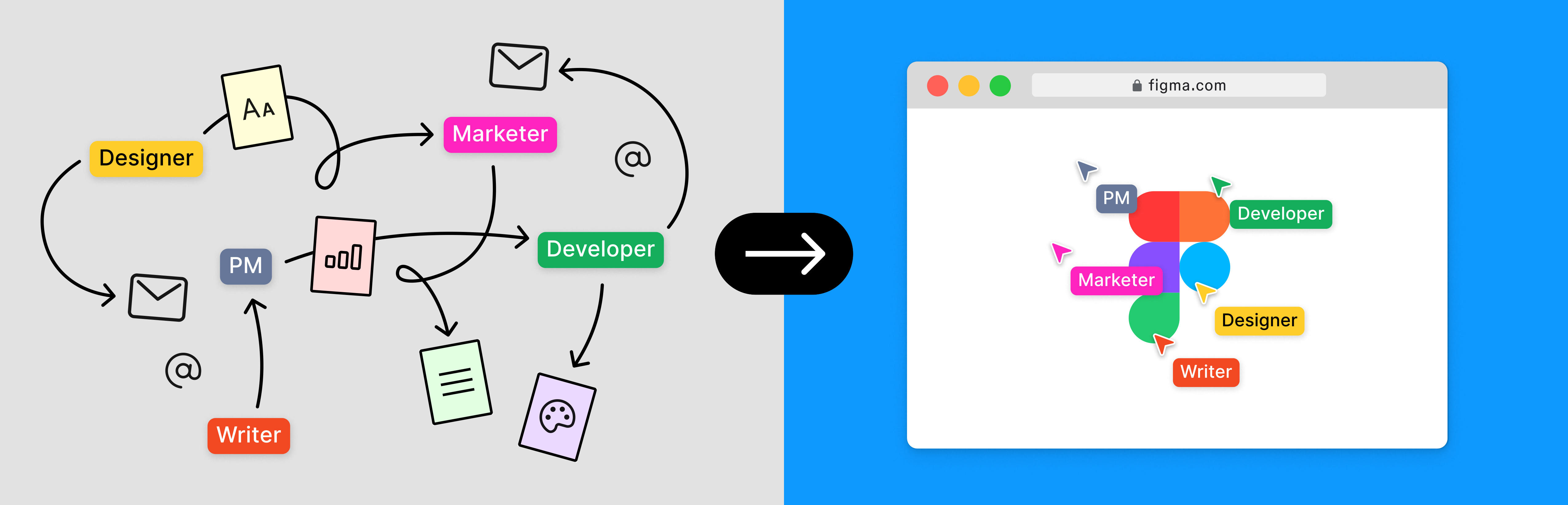
Back then, design looked very different than it does today. Designers worked by themselves in silos
across multiple tools and products. Even if they wanted to design together or with others, technological
constraints and the fragmented nature of the product development toolchain made collaboration a pain.
The most elegant solution to share work? Huge, manually annotated files sent around as email
attachments with indecipherable names like “Draft_Final_V2_FINAL_v13.”
As part of a generation that found community in multiplayer, virtual worlds and grew up on Google Docs,
Dylan and Evan saw an opportunity to bring design to the browser, and in doing so, make it more open
and collaborative. After experimenting with a powerful technology called WebGL, which harnesses the
power of a computer’s Graphics Processing Unit (“GPU”) to render high-performance graphics in the
browser, and spending three years building, testing, and iterating with users, they launched Figma. It was
the first design tool that combined the accessibility of the web with the functionality and performance of a
native desktop app.
Not everyone was as excited as Dylan and Evan were about this new way of working. Despite the product
benefits of a more open design process — seamless version control, real-time collaboration in the file,
and the ability to access designs from any browser or computer anywhere in the world — designers
raised concerns that more transparency and collaborators in the mix would lead to tighter deadlines, more
micro management, and an implicit loss of control over their craft. One person even said that if Figma was
the future of design, they were changing careers.
But as more designers and their teams started using Figma, they began to understand the benefits of
designing together in the browser. It was more fun working collaboratively in the same file; it was also
faster and more efficient to work in a single product that brought storage, asset creation, prototyping, and
other parts of the design toolchain into one place. The ability to easily share work with a URL led people
to bring collaborators into their files earlier, placing more emphasis on co-creation and less on the “big
reveal.” It also led Figma to spread quickly within companies and design communities globally, while
giving teams something they’d never had before: a single source of truth to access the most up-to-date
designs.
Today, the openness and accessibility that Figma helped pioneer is no longer a novelty; it’s the
expectation, a way of working that has spread across teams, tools, countries, and industries — and
transformed the way products are designed and built.
From design tool to product development
platform
As Figma’s open and collaborative way of working pulled more people into the design process, we
expanded to serve the many roles and steps involved in going from an idea to a product in users’ hands.
The early investments we made in our browser-based platform have enabled us to rapidly introduce and
monetize new products.
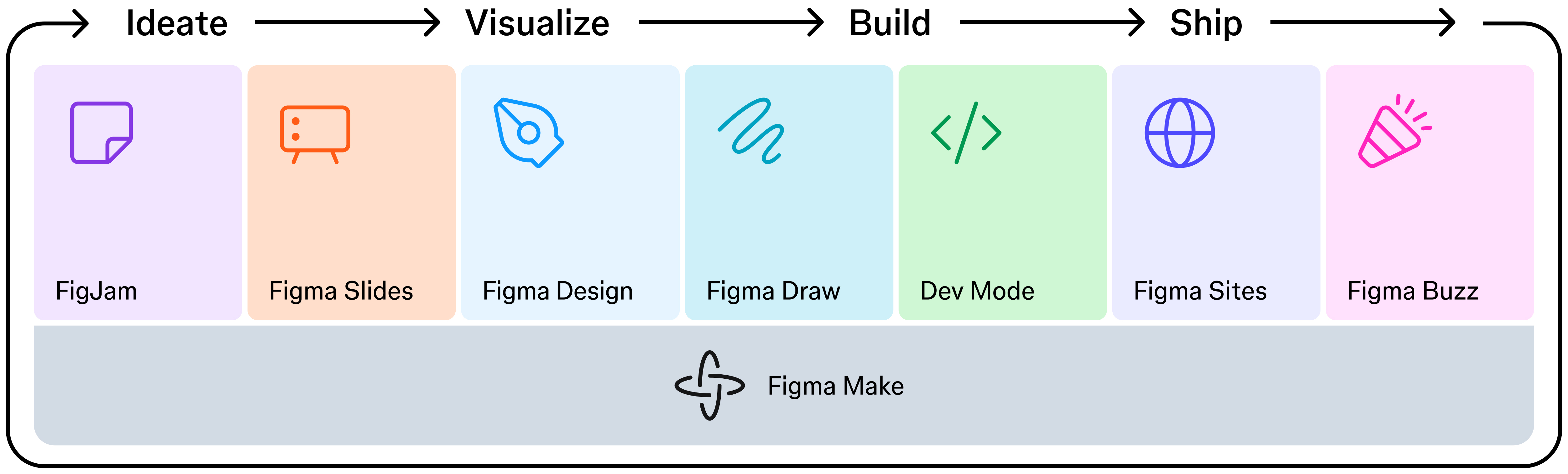
•In 2021, we expanded our platform to serve earlier phases of the product development lifecycle
with the launch of FigJam, an online whiteboard for teams to brainstorm and ideate together.
FigJam grew organically out of the unexpected ways our community was using our first product
Figma Design to meet, connect, and brainstorm product ideas. We tailored FigJam to fit this use
case, creating a more welcoming and lightweight space for designers and their collaborators to
meet and brainstorm what to build together — using the core principles and primitives of Figma.
•In 2023, we released Dev Mode, a dedicated space in Figma that helps teams more efficiently
translate design concepts into coded products. While Figma Design is built for more free-form
design exploration, Dev Mode is tailored to the very specific and structured needs of developers,
who, during the three months ended March 31, 2025, made up approximately 30% of our monthly
active users. Dev Mode organizes information and surfaces data like design specifications and
measurements in ways that are both useful and intuitive for developers. Building on years of
updates in Figma Design to bridge the gap between design and code, Dev Mode is designed to
improve cross-team communication and maximize efficiency at this crucial step in the product
development process.
•In 2024, we launched Figma Slides, a product for designers and their collaborators to drive
alignment through better-designed and more collaborative presentations. Figma Slides was born
from an organic use case in which our users were creating millions of slide presentations in
Figma Design. Seeing that pattern, a team of our employees drew up Figma Slides during our
annual “Maker Week” hackathon. Figma Slides marries the visual fidelity of Figma Design with
the playful interactivity of FigJam, making it easier for designers and non-designers to create
powerful presentations in the same space.
•In 2025, we doubled our product portfolio with the launch of four new products: Figma Sites,
Figma Make, Figma Buzz, and Figma Draw. Figma Sites is a product that lets you design a
website and directly publish it to the web, with a custom URL. Figma Make is an AI-powered
product that turns a prompt into a fully functional prototype. Figma Buzz is a product for easily
creating social media assets, display ads, and other marketing materials at scale that are
consistent with your brand or visual identity. And Figma Draw provides a dedicated space for finer
vector editing required when drawing detailed iconography and product illustrations.
With the additions of these seven products over the last four years, Figma offers an increasingly end-to-
end platform for teams to go from idea to shipped product. Over time, we’ve seen teams adopt our
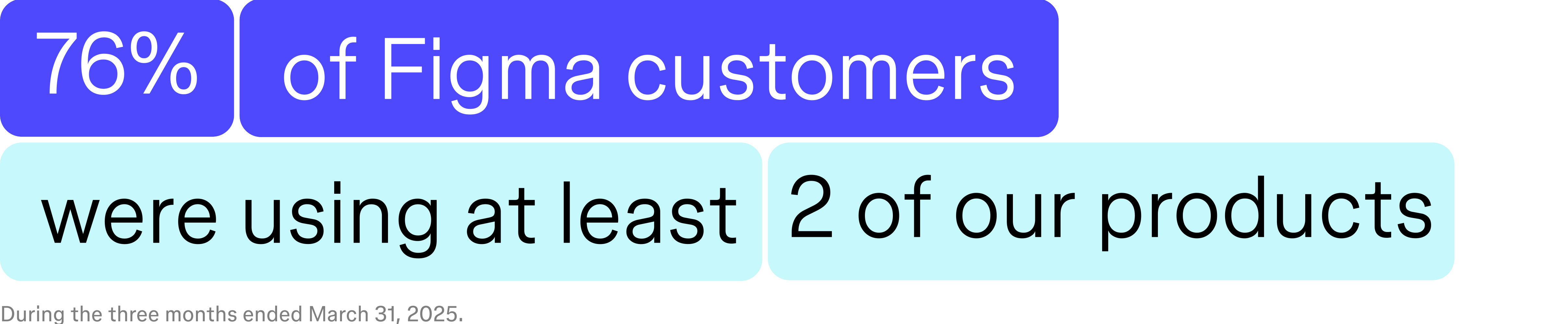
platform for more parts of their product development journey, as evidenced by the fact that 76% of Figma
customers were using at least two of our products during the three months ended March 31, 2025.
AI has the power to accelerate the process of going from idea to product even further by helping users of
all skill levels explore and iterate on ideas more quickly, while automating rote, repetitive tasks. Over the
last few years, we’ve launched AI features that help users generate editable user interfaces with a simple
prompt and rename layers in a design file or instantly summarize sticky notes from team meetings with a
single click.
Figma Make is the most recent launch that shows the potential of AI to accelerate product development,
as it helps users rapidly explore concepts by turning a conversational prompt — optionally augmented
with an existing Figma design — into a working prototype within minutes. This and other Figma AI
features currently rely on off-the-shelf foundational models, though we expect developments of our own
models to accelerate over time as we continue to make significant investments in AI.
Our community has also contributed to the expansion of Figma’s platform in ways that increasingly
position us at the center of design and product development workflows. They have created over 250,000
Community resources, including more than 10,000 plugins and widgets that allow users to customize their
workspaces and speed up their workflows using Figma’s publicly-accessible application programming
interfaces (“APIs”). With the help of our users and trusted partners, we have built a powerful, extensible
ecosystem that keeps evolving to meet the diverse needs of a growing global community and contributes
to our growth.
Through close community ties and a relentless focus on innovation and meeting user needs, Figma has
grown to serve more people and parts of the process of helping teams turn ideas into shipped products
and experiences.
The opportunity ahead
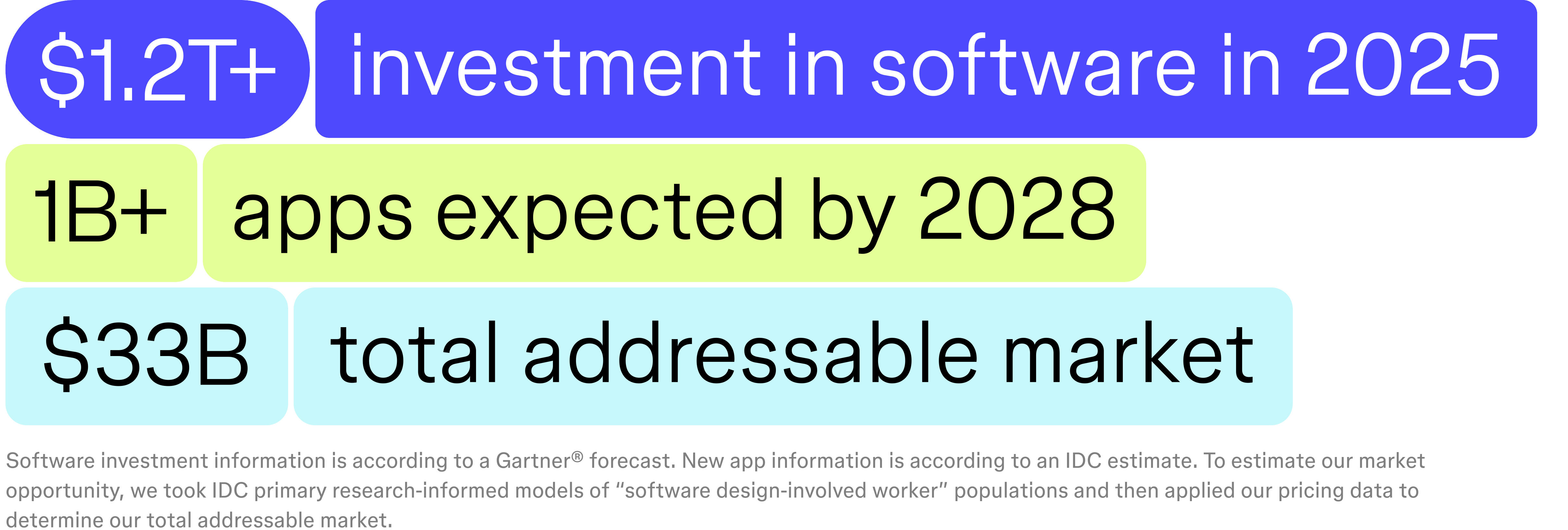
In the 13 years since Figma’s founding, the amount of software in the world has exploded, and according
to a Gartner® forecast, worldwide software spending is expected to exceed $1.2 trillion in 2025.
Meanwhile, generative AI has made digital products more ubiquitous and much easier to build, with
International Data Corporation (“IDC”) estimating there will be more than 1 billion new apps in the world
(3) Per IDC, “apps are defined here as logical applications which include solutions that are entirely made up of brand-new software
but also solutions that leverage existing installed applications as providers of data, decision-making logic, and other services.”
(4) To estimate our market opportunity, we took IDC primary research-informed models of the global workforce population
engaged in software design and then applied our internal pricing data to determine our total addressable market.
by 2028.3 As a platform that’s quickly becoming a system of record for design and product development,
Figma is well positioned to benefit from this growth.
We believe that, in today’s world, design and a company’s brand matter more than ever. The explosion of
software means that companies must increasingly vie for customer attention, and it is the well-crafted,
thoughtfully-designed brands, products, and user experiences that will stand out from the rest. In addition,
companies are still in the early phases of incorporating AI into their products. We expect to see so much
innovation in the years to come around the design of new interfaces and interaction paradigms that are
truly AI-native. Like the shifts to mobile and the cloud, we believe broader usage and adoption of new
technologies will be fueled by great design.
We estimate that our total addressable market is $33 billion today across the “global workforce engaged
in software design,” as identified by IDC. We calculate our total addressable market based on internal
Figma data and the IDC Executive Spotlight sponsored by Figma, “Global Workforce Engaged in
Software Design Expands to 144 Million by 2029.” We commissioned this IDC Executive Spotlight, which
sizes the global number of participants involved in the product development process.4
Figma’s founding vision was to eliminate the gap between imagination and reality. Thirteen years later,
the shift from a physical economy to a digital economy, huge advances in AI, and our own evolution from
design tool to design and product development platform have combined to make this aspiration feel even
more within reach today than it was when we started. This vision inspires us to think bigger about the role
Figma can play in extending the power of design to more people, so that whoever you are, whatever you
want to design, you’ll be able to make it in Figma.
Deep Dive: The product development
process in Figma
While our community has pushed Figma in all kinds of unexpected ways, our primary focus is to help
teams turn ideas into software. We started out as a relatively small part of this larger job to be done, but
Figma was always meant to be more than a tool for designing user interfaces.
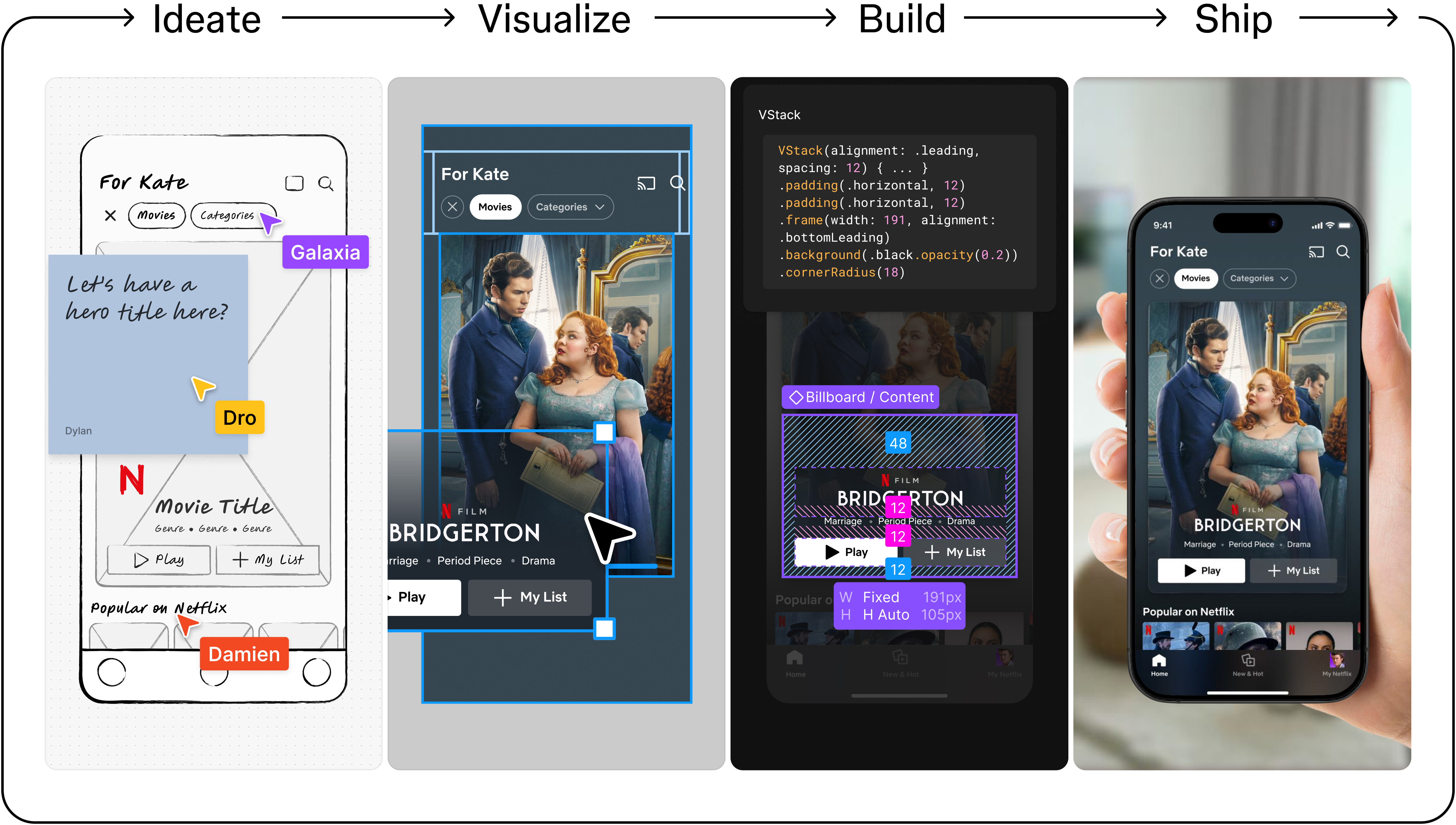
We are a platform for design and product development. And while the workflow of creating software and
other digital products and experiences can take many paths and forms, the process has traditionally
involved the following key phases:
1.Ideate and Align. The team comes together to brainstorm different solutions to user problems
and align on a path forward.
2.Visualize. Designers, PMs, and others bring life to these ideas by visualizing them at different
levels of fidelity, which starts to give a sense of how the overall experience comes together.
3.Build. These ideas and visualizations are turned into code (most often by a developer) and made
production-ready.
4.Ship. The product is launched, so it can end up in users’ hands, and marketed, so more users
adopt it; this kicks off a continuous loop of learning, refinement, and improvement.
These phases have continued to shift as roles have blurred and advances in AI allow more people to
participate in the process of creating digital products and experiences. We see this in our own research,
which found that, as of May 2025, more than half of non-designers reported spending substantial time on
(5) Data from a Figma survey of approximately 1,200 professionals working in digital product and marketing in the United States
conducted from March through May 2025.
design-related work like visual exploration or mapping user flows.5 Over time, we’ve launched and
successfully monetized new products that bring more parts of the overall design and product development
process onto our platform.
Ideate and align with FigJam and Figma Slides

In the early phases of product development, teams come together to brainstorm ideas and eventually
align on potential paths forward. FigJam and Figma Slides are products we have built to facilitate these
activities.
FigJam is our product tailored for ideation, brainstorming, and rapid communication of ideas. Designed for
users of all skill levels, FigJam makes everything from personal projects to solo ideation to team meetings
more engaging and fun. This is made possible by facilitation features like timers and voting, but also fun
features that give participants more ways to express themselves, like ephemeral emoji reactions, a photo
booth that lets you take a quick selfie, or the ability to give high-fives. We also offer rich diagramming
capabilities to make it easy to convey more abstract ideas through user journeys or technical diagrams for
engineering. In FigJam, users can also use AI to generate templates for group brainstorms and
summarize meeting notes in seconds.
Figma Slides helps teams collaboratively make compelling, engaging presentations that drive and
maintain alignment. What makes this product especially effective for product teams is the way it marries
Figma’s powerful design features — such as the ability to embed prototypes, create high-fidelity
animations, or make detailed edits to mock-ups directly in a slide — with strong real-time collaboration
capabilities like seamless multiplayer editing and audience voting.
Often, these products are used side-by-side — what starts in a brainstorm in FigJam can lead to a pitch
deck in Figma Slides. We aim to make the transition between these products easy with features like AI
that can turn FigJam stickies into a Figma Slides presentation.
Visualize with Figma Design and Figma Draw
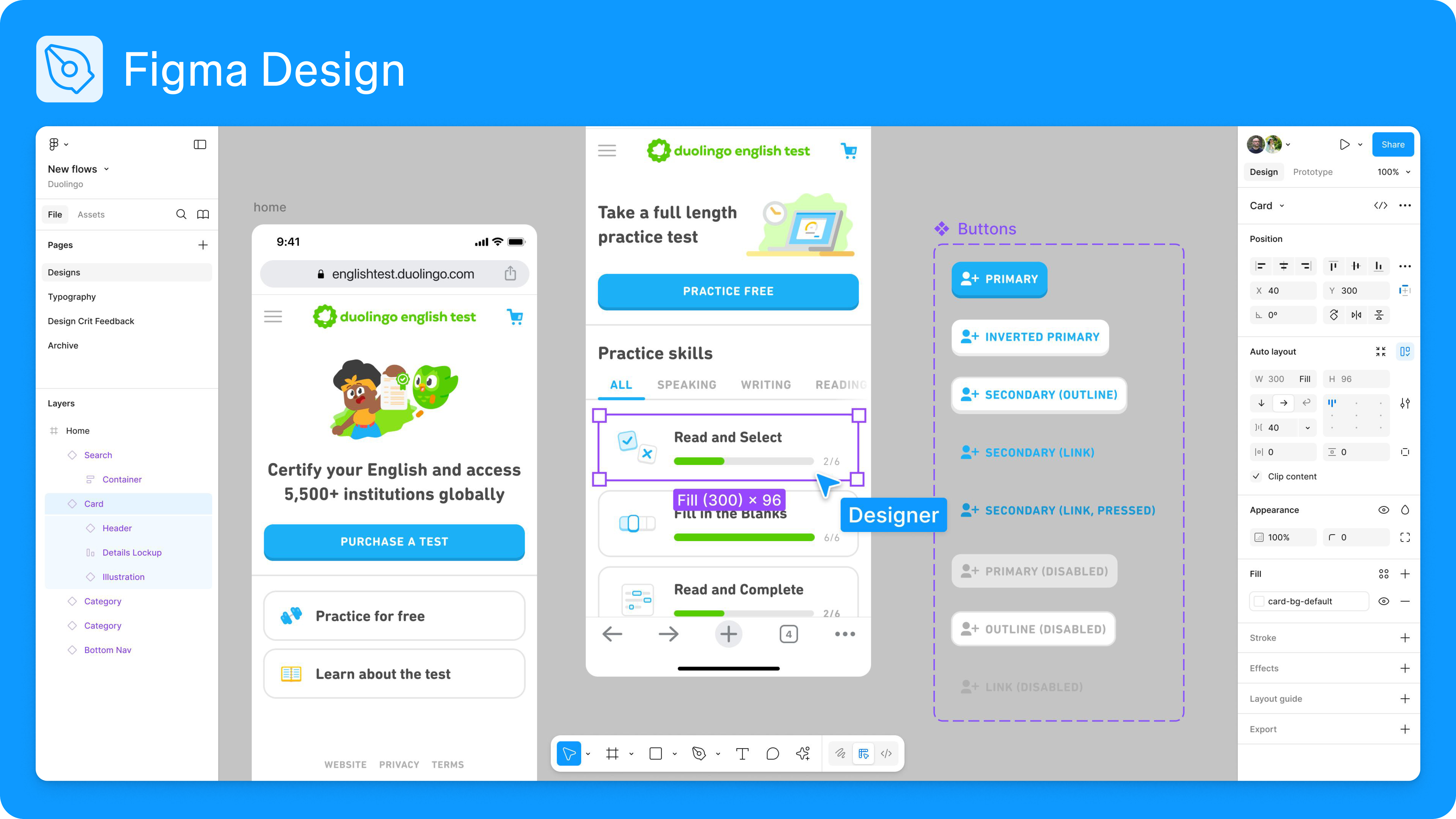
As ideas become more concrete and teams align on a path forward, they move toward visualizing these
ideas at a higher fidelity. Often, they draw mock-ups to explore directions more deeply, or build realistic
prototypes to validate designs. Figma Design is where all of this happens.
Designers at this stage want the freedom to rapidly explore concepts and express their ideas fully without
being constrained by the tools they’re using. This is why Figma Design offers a wide range of features
that make it possible to visualize ideas with high fidelity, including typography features or vector editing
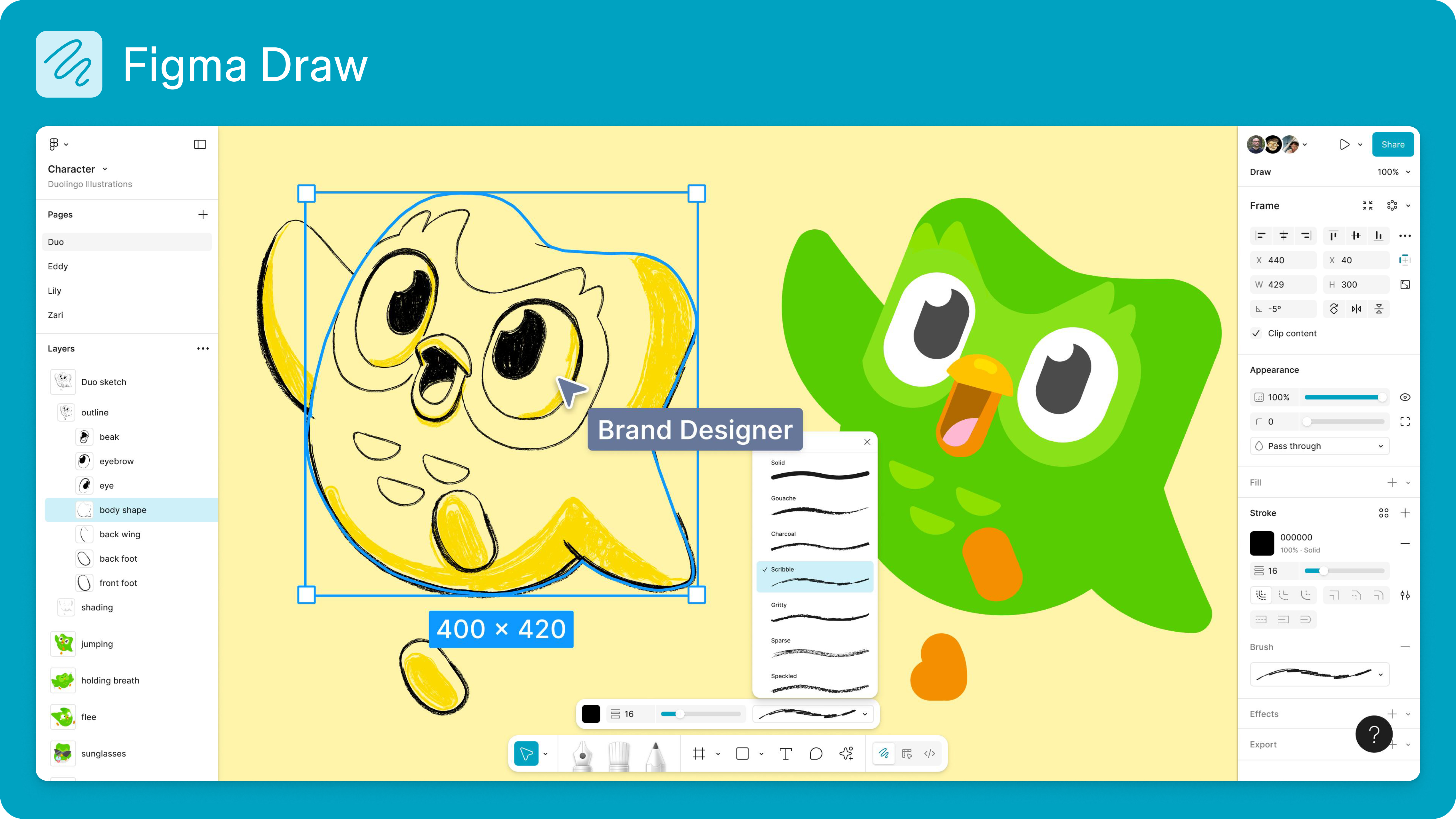
capabilities that add texture and dimension to designs. In some cases, designers want to make more
detailed, finer edits to key assets in their design, like icons and product illustrations. For these users,
we’ve created Figma Draw, which is a dedicated space for vector editing within Figma Design.
To facilitate rapid exploration and iteration at this stage, these tools have a strong focus on ergonomics
and efficiency. Our AI features are examples of this. By automating tedious, repetitive tasks like removing
backgrounds from images or renaming layers in the design, or filling the mock-ups with realistic content to
more closely resemble the final product that ends up in users’ hands (rather than lorem ipsum, for
example). First Draft is an AI feature that allows users to go from blank canvas to editable user interfaces
with a simple prompt.
As designs begin to solidify, designers also seek to add more structure to the design that better maps to
the constraints and requirements of a production environment. Figma Design offers a rich set of “design
systems” features in service of this: capabilities that allow teams to define flexible, reusable building
blocks that make it easy for anyone to assemble a design without ever starting from scratch. We’ve found
that teams are motivated to invest deeply in design systems, as their primary benefit is creating efficiency
and consistency at scale. Teams save time by no longer needing to constantly worry about pixel-level
details, and design systems help remove translation errors between designers and developers by sharing
the same building blocks and language across design and code.
More often than not, though, a static visualization of an idea isn’t enough to validate a direction. That’s
why users take advantage of Figma’s rich prototyping capabilities, which let users string together different
screens into a dynamic, interactive flow. These prototypes are often circulated within an organization to
socialize an idea or put in front of customers in user testing to validate a particular concept in a more
realistic way.
Build with Dev Mode

Once the designs are ready, it’s time to translate them into code. Dev Mode is our dedicated space for
developers where this translation occurs, built to streamline the back and forth between design and
engineering and reduce the miscommunication that often happens during this step.
In Dev Mode, developers can inspect the designs to see key details most relevant to them, like special
annotations left by designers, documentation about the components used, or what’s changed since they
last saw the design.
Importantly, developers can choose to view these designs in the format they understand most: code. Dev
Mode generates platform-specific, ready-to-use code from the designs that developers can directly copy;
teams can also connect their design systems to their codebase via Code Connect which helps ensure the
code snippets developers see are correct, familiar, and production-ready.
Recently, we’ve also added our own Model Context Protocol (“MCP”) server to Dev Mode, which allows
developers to connect an agent in their code editor directly to designs in Figma. Developers can ask the
agent to inspect the design and use this context to convert it into working code in their codebase.
A traditional design-to-development handoff process often involves a spec or document that can quickly
get outdated as teams continue to iterate on designs. One of Dev Mode’s key value propositions is
allowing designers, developers, and even agents to work in the very same file while giving each a
different view of the work tailored to their respective needs. This helps maintain a single source of truth
that literally keeps everyone on the same page.
Ship with Figma Sites, promote in Figma Buzz

The last step of any product development process is shipping the code that’s been written to production,
to get your product launched. Figma Sites represents our first offering that ships a design directly to
production, by allowing you to publish a design as a working website, with a URL of your choice, that
anyone in the world can access.
Figma Sites includes features that help make designs production-ready for the web, like breakpoints that
make websites responsive across different window sizes and devices. It also supports the ability to
augment designs with code (via a feature called code layers) to help make more powerful, dynamic
experiences, like adding special motion effects or an interactive form, that would otherwise have been
impossible to build with just a design tool. Figma Sites also includes a CMS that makes it easy for anyone
to make changes to the content on a website, like a blog post or the price of an item being sold on the
site, without worrying about breaking the underlying code or design.
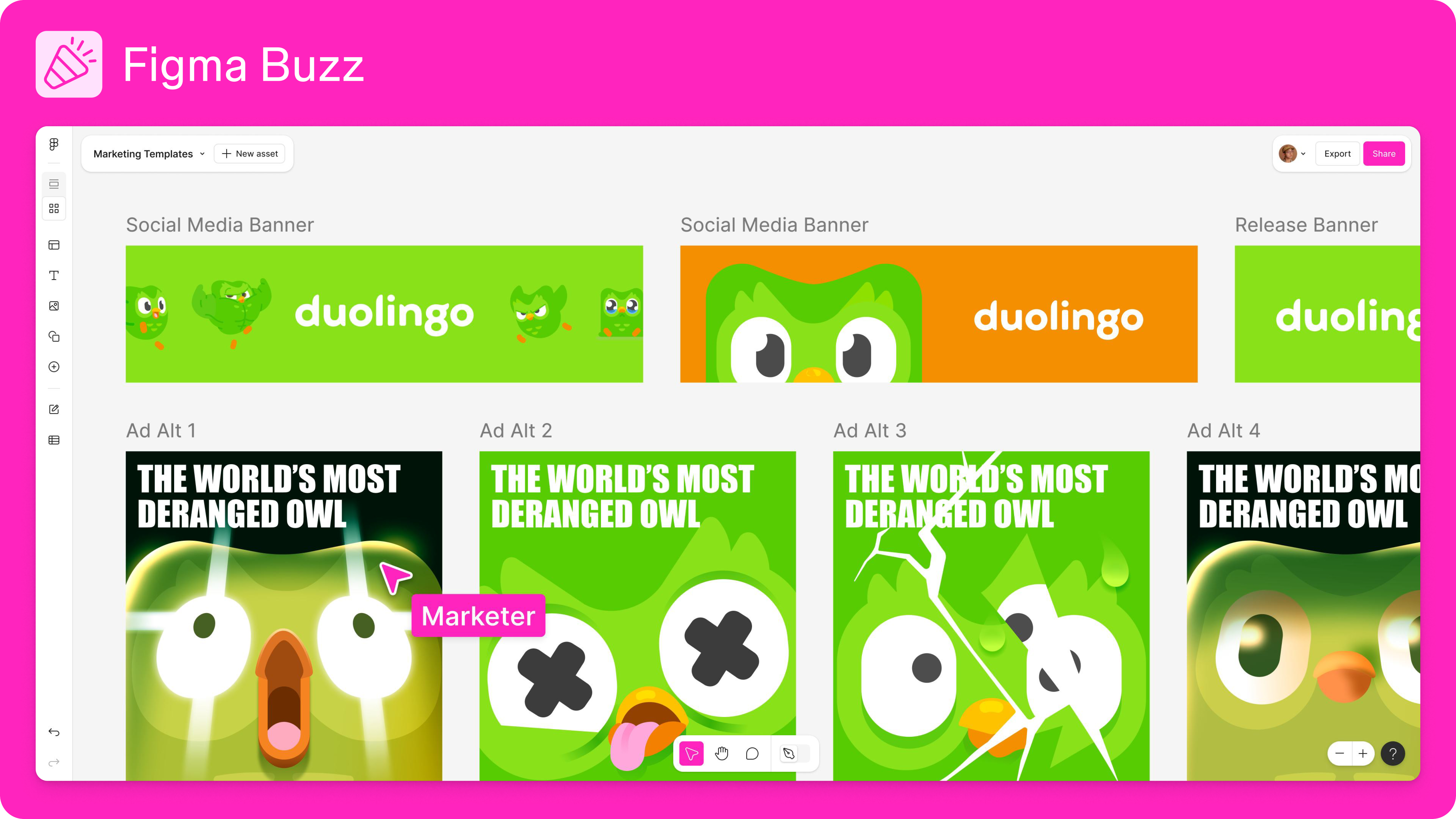
Once a product has been shipped to production, the last step is to actually promote it, to ensure existing
and prospective users are aware of the value of what’s launched. This is where Figma Buzz comes in —
a tool that makes it easy to create on-brand marketing collateral, like social media assets, digital ads, and
more.
Similar to Figma Slides and FigJam, Figma Buzz is designed for users of any skill level. Figma Buzz
makes it easy to take a template and edit its contents, or create assets in bulk from templates (e.g., for
multiple locales or different social media platforms). The product simplifies the collaboration between a
brand designer and a marketer. Designers are able to access the more sophisticated tools necessary to
set up a beautiful template, while marketers can make edits to the simpler view of the content without
worrying about “messing up” the design. In addition to these template capabilities, Figma Buzz has a slew
of other features that marketers may need, like AI features to edit text and images, or easy ways to
generate hundreds of assets from data in a spreadsheet.
Ideate, visualize, build, and ship — all at once, with Figma Make
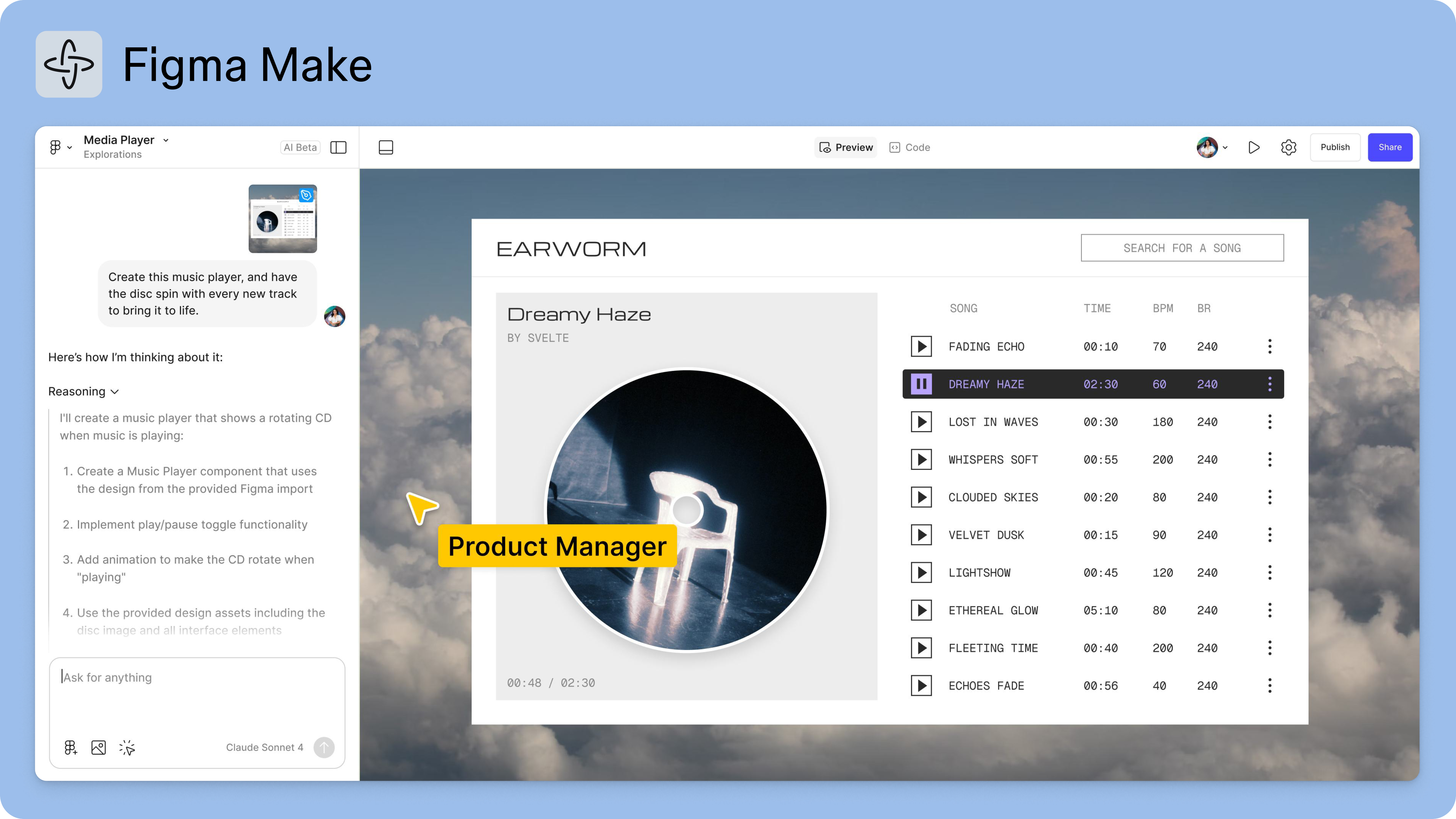
We believe AI is fundamentally transforming the product development process by making it possible for
anyone to quickly turn an idea into a functional prototype, or in some cases, a working product. Figma
Make is our product for this new paradigm.
Instead of going from idea to wireframe to mock-up to prototype iteratively, Figma Make lets users go
directly from prompt to working prototype, at which point they can immediately validate an idea and
choose to iterate on it, or discard it altogether. Like Figma Sites, what’s created in Figma Make —
whether it is a dynamic prototype or web app — can be published to a URL for anyone to use.
While it’s possible for AI to get to working software with a simple prompt, we believe that the most
important differentiator is craft — ensuring that the product looks, feels, and works “just right.” We’ve
designed Figma Make to offer fast and powerful ways to iterate and refine its output. Users are free to
use the best way to improve the design of their product, whether via further prompting, editing code
directly, or visual manipulation. They are also able to easily reference their designs in Figma Design (via
copy-paste or importing) to ensure the output feels consistent and familiar, taking heavy inspiration from
existing styles and patterns.
With Figma Make, we believe even more people will be able to create functional, dynamic prototypes and
software, as it lowers the floor to let absolutely anyone transform their idea into something that works. At
the same time, it raises the ceiling of what’s possible by giving people access to capabilities that weren’t
possible in their current tools, whether that’s allowing designers to tap into the power and expressiveness
of code, or allowing developers to enjoy the freedom and speed of visual manipulation.
The benefits of combining rapid prototyping with a highly performant and sophisticated design tool give
users the best of both worlds: the ability to move quickly while having access to the tools needed to refine
the design.
An integrated design and product development platform
These products come together to serve more parts of the software development lifecycle and truly push
something from an idea all the way to a final product. With these products, Figma has become a design
and product development platform that houses everything from the initial brainstorm to the pitch deck to
the design spec to the final implementation.
Underlying each of our products is the same DNA that makes them uniquely Figma. Each of these
products is built from the ground up with multiplayer in mind — built for the browser with the power of
WebGL to allow our users to engage in real-time collaboration and seamless sharing as team members
work simultaneously in the same document. Each of these products is supercharged with AI capabilities
— ranging from automating rote tasks (like summarizing brainstorms, wiring up prototypes, enhancing
images, or filling mock content) to unlocking new superpowers (like dreaming up brand new designs from
a singular prompt). Each of these products allows for seamless interoperability — making it possible to
allow content to move fluidly between products and modes, or for different personas to have views of the
same content that are tailored to their needs and roles. And all of them are built with extensibility in mind
— allowing our users to leverage our APIs and plugin architecture to customize their experience to their
specific needs, like connecting designs to their own tools, databases, and codebases.
As we’ve built out these new tools, we’ve simultaneously invested in our platform infrastructure, giving us
the ability to incubate, test, and launch new products more easily. While our primary focus will remain on
product teams building software, we believe we have the ingredients needed to explore adjacencies over
time.
Our Community
We exist to serve anyone designing and building products and digital experiences. Customers of all sizes,
spanning industries and geographies, bring their work to life in Figma.
We have focused on creating deep ties with our users and customers since day one. In Figma’s early
days, this meant our founders making house-calls to customers’ offices to troubleshoot a product issue; or
traveling to Nigeria to visit a growing group of Figma users. Our deep community focus has helped fuel
the creation of more than 200 Friends of Figma chapters across the world — from Lagos to Los Angeles
— that organized over 650 events in 2024. Together, they share and collaborate on work, either in person
or virtually on Figma’s Community resources platform. Many spend hours a day in our products as part of
their day jobs and side hustles. Some even get Figma tattoos.

We engage with our community through in-person and virtual touchpoints. Config — our annual
conference that started in 2020 — brings thousands of designers, developers, and product teams to San
Francisco to meet, learn, and get inspired. Our always-on programming, like product livestreams,
community meetups, and our leadership collective events, engage a broad range of customers from
students to executive leaders. And our lively product forums, social channels, and hundreds of Friends of
Figma chapters around the world create active dialogue around our products and provide a peer network
for support.
We know how unique it is for a software company to have such a strong and passionate community
championing its products. This vast, growing, and global community has a deep shared identity as
designers and product builders. Their voices are essential to our own product development process,
pushing the bounds of our existing products and inspiring us to make new ones.
We believe building for and with our users drives revenue and long-term loyalty. The close ties we have
developed with our community since day one have opened lines of communication ingrained in how we
work, helping us respond quickly to customer feedback and innovate for customer needs.
Our Culture
The Figma team (we call ourselves Figmates) is a group of builders, makers, and tinkerers with deep
connections to our users and a passion for building and shipping. We are able to attract incredible talent
because we have the opportunity to shape how teams around the world design and build products.
We feed this maker spirit in many ways including an annual company-wide Maker Week — a full week we
set aside for Figmates to pitch, develop, and execute on new ideas or projects with one another. The only
requirement is that the ideas benefit Figma in some way. A number of products, features, and projects
were born during Maker Week such as Figma Slides, multi-edit, several FigJam features, and our
extensibility API. As these examples show, great ideas can come from anywhere, and any Figmate can
drive impact, regardless of their level or tenure. We find this way of working makes our culture unique and
helps us attract and retain employees with builder DNA.

We drive Figma’s culture by embedding our five cultural values into how we work day to day. These
values serve as an operating system for decision-making and organizational behavior. We chose them to
be in tension with one another and their relative importance varies at different times. Taken together, they
paint a clear picture of what we value and why.
1.Build Community: We’re multiplayer people, and we love the weird, wonderful magic that
happens when humans connect. We bring people together so they can bring new ideas to life.
2.Love Your Craft: We build for builders, and try to make complex things feel simple. In our
products and process, we invest in the details few people see, but everyone feels.
3.Run With It: When you see something that needs doing, do it. When you have a great idea, run
with it. Tackle big, scary, exciting challenges like Figma’s future depends on it. Because it does.
4.Grow As You Go: Everyone’s a work-in-progress, and we’re here to help each other grow. So
along with ❤ and , we share the direct feedback we all need to become great at what we do.

5.Play: Playing is learning. We embrace spontaneous, unstructured exploration — because that’s
where we find our best ideas.
Lastly, in line with our Grow As You Go value, listening to feedback across every touchpoint with users
and customers is deeply embedded in our culture and how we work.
Our Business Model
Our subscription model is designed to meet the diverse and evolving needs of our growing community
and customer base. Access to Figma is sold as an annual or monthly subscription, per seat. Everyone
from independent freelancers to entire product teams at Fortune 500 companies design and build
products and digital experiences in Figma. We offer different seats and plans tailored to the specific
security, product, and administrative needs of different users, organizations, and industries.
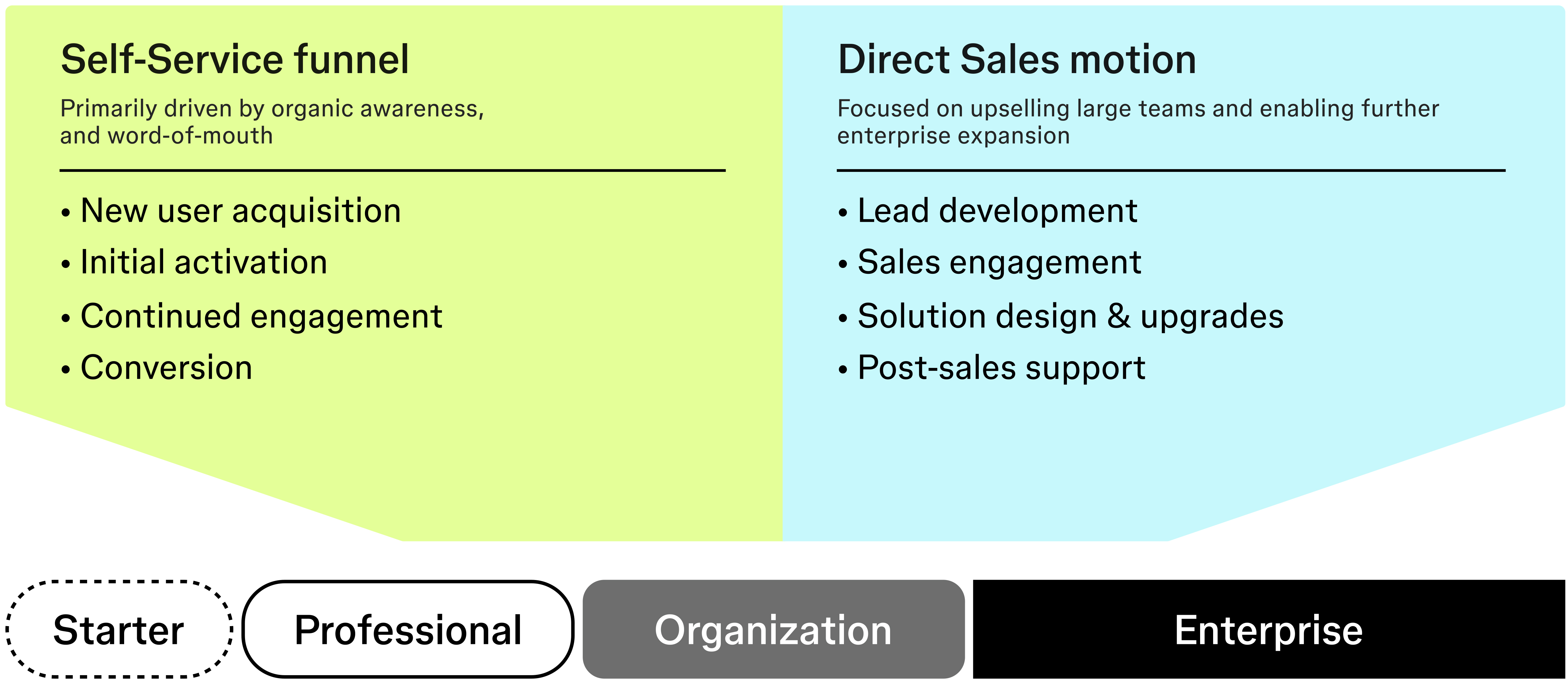
To meet our users where they are, we offer a variety of ways to try, use, and purchase Figma.
•We have an automated and highly efficient self-service option, available through Figma.com. To
support our self-serve offering, our marketing team utilizes organic and paid channels to drive
awareness and usage of all of our products.
•We have a direct sales process through which we partner with customers to set up new accounts,
upgrade customers across plans, and expand existing accounts.
Plans
Our plans range from a more limited free offering to more advanced plans built in partnership with our
customers that meet the specific needs of the larger organizations using our platform.
•Our Starter plan is free and is designed for working on personal projects. It provides an easy
way for new users to try our design and collaboration tools.
•Our Professional plan is designed for individuals and small teams. It provides access to
unlimited files and projects, as well as design libraries for a single team.
•Our Organization plan is designed for businesses with multiple teams. The functionality on this
plan allows everyone to collaborate in one Figma workspace while keeping everything safe and
secure with centralized admin and security features.
•Our Enterprise plan is designed for businesses managing multiple products or brands. This plan
provides custom team workspaces, automated design system management, and enterprise-level
controls and compliance.
(6) The Content seat was announced in May 2025 and is not yet available. Figma Sites CMS is currently in beta and seat access
may change once it becomes generally available.
(7) Figma Make, Figma Buzz, Figma Draw, and Figma Sites are currently in beta. Seat access with respect to these products may
change once they become generally available.
Seats
Rather than a one-size-fits all approach, we offer different seats tailored to specific user needs and
workflows. At the same time, we also see roles continuing to blur as the product-development process
keeps evolving.
•The Viewer seat allows users to view files and leave comments for free.
•The Collab seat gives access to FigJam and Figma Slides.
•The Content seat gives access to Figma Buzz, Figma Sites CMS, FigJam, and Figma Slides.6
•The Dev seat gives access to Dev Mode, in addition to Figma Buzz, Figma Sites CMS, FigJam,
and Figma Slides.
•The Full seat gives access to all of Figma Design, Figma Draw, Figma Make, Dev Mode, Figma
Buzz, Figma Sites, FigJam, and Figma Slides.7

Over time, we expect to introduce products and services that may be billed differently than on a per seat
basis, such as an add-on or pricing with limits on feature usage. We believe these additional options can
provide users with flexibility in how they use and pay for products and features. We also expect that this
type of billing may be less predictable than subscription-based revenue.

Our Go-To-Market Motion
The combination of Figma’s reputation as a product design leader, the product virality inherent to Figma’s
collaborative and browser-based platform, and our integrated marketing efforts have successfully driven
awareness and adoption. Over time, many of our users grow with us into larger, managed accounts that
often include more seats and more products for users within their organizations. During each of the year
ended December 31, 2024 and the three months ended March 31, 2025, approximately 70% of new
Organization and Enterprise plan customers included at least one user who was previously a member of
a Professional plan.
The value Figma’s products have created for our community has helped us earn their trust and support.
It’s not uncommon for Figma users, particularly those who are active members of our community, to
champion the collaborative, design-led way of working that Figma offers to their teams.
While our product-led, bottoms-up adoption contributes to our growth, our direct sales motion helps us
serve larger customers. Our global sales and marketing teams work hand-in-hand with Figma’s
expanding network of customer champions to scale our products within organizations and increase
adoption across plans. In addition to word-of-mouth, our marketing efforts include a variety of digital and
in-person channels that bring new users to our platform. We support new users in the discovery phase by
sharing content across channels like livestreams, YouTube, social media, in-product, and by email. These
resources help new users explore and understand the capabilities of our products.
Our integrated sales motion is collaborative by design, bringing both customer champions and Figmates
with deep product expertise into the conversation. Our sales team works closely with solutions
consultants, who understand how Figma’s products map to specific customer needs, and designer and
developer advocates with deep technical understanding of our products and close ties to the communities
we serve. While approximately 70% of our revenue for each of the year ended December 31, 2024 and
the three months ended March 31, 2025, came from customers on Organization and Enterprise plans, we
continue to build features and products designed to create value for all of our customers.
We believe exceptional customer support is core to a great product experience. This is why we have built
a global support function that provides customer assistance in multiple languages for all paid users. We
encourage all Figmates, including our executive team, to speak with customers and understand their
feedback, whether it’s in person or online. You’ll often see leaders across the company dive into and work
to actively resolve customer issues raised in support forums or on social platforms. Our customer support
associates also use the latest in AI to solve customer needs quickly and efficiently.
Figma’s partner ecosystem, which includes product integrations and distribution partnerships, drives
further retention and adoption of our platform. Through collaborations with companies like Microsoft,
Atlassian, Zoom, Notion, and Linear, and integrations with tools like GitHub, Visual Studio Code, and
Storybook, users are connected to Figma from within their existing workflows. These partnerships
generate awareness and cultivate lasting engagement. Certified service partners around the globe also
provide training, enablement, and specific project support for customers. Additionally, Apple, Google
Material Design, and other organizations make their design resources available natively through Figma’s
user interfaces to facilitate users designing and developing for their respective platforms.
From the beginning, Figma’s Professional plan has been free for educators and students through our
Figma for Education program. This includes higher education institutions, bootcamps, and workshops. We
also make Figma’s Organization plan available for free for K-12 students and educators to help develop
the next generation of product builders.
Growth Strategy
We have focused on building a company for the long-term since day one. We will keep investing in our
platform across our key growth levers.
•Maintaining our rapid and proven pace of product innovation.
•Converting new and existing users into Paid Customers.
•Growing within current customers.
•Extending our platform.
•Expanding our international footprint.
•Making strategic acquisitions and investments.
Risk Factors Summary
Our business is subject to numerous risks and uncertainties of which you should be aware before making
a decision to invest in our Class A common stock. These risks are more fully described in the section
titled “Risk Factors” immediately following this prospectus summary. These risks, among others, include
the following:
•We have experienced rapid growth which may not be indicative of our future growth, and if we do
not effectively manage our future growth, our business, operating results, financial condition, and
future prospects may be adversely affected. Our rapid growth also makes it difficult to evaluate
future prospects.
•Our operating results may fluctuate significantly, which could make our future results difficult to
predict and could cause our operating results to fall below expectations.
•We have a limited operating history at our current scale, which makes it difficult to evaluate our
current business and future prospects and increases the risks associated with your investment.
•Changes in our pricing, packaging, or billing models could adversely affect our business,
operating results, financial condition, and future prospects.
•If we are unable to attract new customers or retain and increase adoption of our products and
services by existing customers, we may not achieve the growth we expect, which would
adversely affect our business, operating results, financial condition, and future prospects.
•If we are not able to effectively introduce enhancements to our platform, including new offerings,
features, and functionality, that achieve widespread market adoption, or keep pace with
technological developments, our business, operating results, and financial condition could be
adversely affected.
•Competitive developments in AI and our inability to effectively respond to such developments
could adversely affect our business, operating results, and financial condition.
•We face intense competition and could lose market share to our competitors, which would
adversely affect our business, operating results, financial condition, and future prospects.
•Our product and investment decisions may negatively impact our short-term financial results and
may not produce the long-term benefits that we expect.
•The markets for our products and services are relatively new and unproven and may not grow,
which would adversely affect our business, operating results, financial condition, and future
prospects.
•Our business is subject to complex and evolving U.S. and foreign laws, regulations, and industry
standards, many of which are subject to change and uncertain interpretations, which uncertainty
could harm our business, operating results, and financial condition.
•The multi-class structure of our common stock has the effect of concentrating voting power with
Dylan Field, our Chair of our Board of Directors, Chief Executive Officer, and President, which will
limit your ability to influence the outcome of important transactions, including a change in control.
If we are unable to adequately address these or the other risks we face, our business, operating results,
financial condition, and future prospects could be adversely affected.
Channels for Disclosure of Information
Following the effectiveness of the registration statement of which this prospectus forms a part, we intend
to announce material information to the public through filings with the SEC, the investor relations page on
our website (www.figma.com), our blog (www.figma.com/blog), our newsroom (www.figma.com/
newsroom), press releases, public conference calls, public webcasts, our social media accounts on X,
LinkedIn, Instagram, Bluesky, Threads, and TikTok as well as Dylan Field’s X account (@zoink) and
LinkedIn profile. The information contained on, or that can be accessed through, these channels is not a
part of this prospectus.
The information disclosed in the foregoing channels could be deemed to be material information. As such,
we encourage investors, the media, and others to follow the channels listed above and to review the
information disclosed through such channels. Any updates to the list of disclosure channels through
which we will announce information will be posted on the investor relations page on our website.
Corporate Information
We were incorporated in the State of Delaware in October 2012. Our principal executive offices are
located at 760 Market Street, Floor 10, San Francisco, California 94102. Our telephone number is (415)
890-5404. Our website address is www.figma.com. The information contained on, or that can be
accessed through, our website is not a part of this prospectus. Investors should not rely on any such
information in deciding whether to purchase shares of our Class A common stock.
Figma, the Figma logo, and other registered or common law trade names, trademarks, or service marks
of Figma appearing in this prospectus are the property of Figma, Inc. This prospectus contains additional
trade names, trademarks, logos, and service marks of ours and of other companies. We do not intend our
use or display of other companies’ trade names, trademarks, logos, or service marks to imply a
relationship with these other companies, or endorsement or sponsorship of us by these other companies.
Other trademarks appearing in this prospectus are the property of their respective holders. Solely for
convenience, our trade names, trademarks, logos, and service marks referred to in this prospectus may
appear without the ® and ™ symbols, but those references are not intended to indicate, in any way, that
we will not assert, to the fullest extent under applicable law, our rights, or the right of the applicable
licensor, to these trademarks, trade names, logos, and service marks.
JOBS Act
As a company with less than $1.235 billion in revenue during our last fiscal year, we qualify as an
“emerging growth company,” as defined in the Jumpstart Our Business Startups Act of 2012 (the “JOBS
Act”).
An emerging growth company may take advantage of reduced reporting requirements that are otherwise
applicable generally to public companies. These provisions include, but are not limited to:
•not being required to comply with the auditor attestation requirements of Section 404 of the
Sarbanes-Oxley Act of 2002, as amended (the “Sarbanes-Oxley Act”);
•reduced obligations with respect to financial data, including presenting only two years of audited
financial statements;
•reduced disclosure obligations regarding executive compensation in our periodic reports, proxy
statements, and registration statements; and
•exemptions from the requirements of holding a nonbinding advisory vote on executive
compensation and any golden parachute payments not previously approved.
We may take advantage of these provisions until the last day of our fiscal year following the fifth
anniversary of the date of the first sale of our Class A common stock in this offering. However, we will
cease to be an emerging growth company prior to the end of such five-year period if (i) we become a
“large accelerated filer,” with at least $700 million of common equity securities held by non-
affiliates; (ii) our annual gross revenue exceeds $1.235 billion; or (iii) we issue more than $1.0 billion
of non-convertible debt in any three-year period, whichever occurs first.
We have elected to take advantage of certain of the reduced disclosure obligations in the registration
statement of which this prospectus is a part and may elect to take advantage of other reduced reporting
requirements in future filings. As a result, the information that we provide to our stockholders may be
different than you might receive from other public reporting companies in which you hold equity interests.
In addition, the JOBS Act provides that an “emerging growth company” can take advantage of an
extended transition period for complying with new or revised accounting standards. This provision allows
an emerging growth company to delay the adoption of some accounting standards until those standards
would otherwise apply to private companies. We have elected to use this extended transition period to
enable us to comply with certain new or revised accounting standards that have different effective dates
for public and private companies until the earlier of the date we (i) are no longer an emerging growth
company or (ii) affirmatively and irrevocably opt out of the extended transition period provided in the
JOBS Act. As a result, our financial statements may not be comparable to companies that comply with
new or revised accounting pronouncements as of public company effective dates. It is possible that some
investors will find our Class A common stock less attractive as a result, which may result in a less active
trading market for our Class A common stock and higher volatility in our stock price.
The Offering
Class A common stock offered by us ....... | shares. | |
Class A common stock offered by the selling stockholders ................................. | shares. | |
Underwriters’ over-allotment option to purchase shares of Class A common stock ........................................................... | The underwriters have the option for a period of 30 days from the date of this prospectus to purchase up to an additional shares of our Class A common stock from us to cover over-allotments, if any, at the initial public offering price less underwriting discounts and commissions. | |
Class A common stock to be outstanding after this offering ................ | shares (or shares if the underwriters exercise their over-allotment option in full). | |
Class B common stock to be outstanding after this offering ................ | shares. | |
Class C common stock to be outstanding after this offering ................ | None. | |
Total Class A, Class B, and Class C common stock to be outstanding after this offering ............................................... | shares (or shares if the underwriters exercise their over-allotment option in full). | |
Use of proceeds .......................................... | We estimate that the net proceeds from the sale of shares of our Class A common stock in this offering will be approximately $ (or approximately $ if the underwriters exercise their over-allotment option in full), based upon the assumed initial public offering price of $ per share, which is the midpoint of the offering price range set forth on the cover page of this prospectus, and after deducting estimated underwriting discounts and commissions and estimated offering expenses. The principal purposes of this offering are to create a public market for our Class A common stock, increase our visibility in the marketplace, increase our capitalization and financial flexibility, and facilitate an orderly distribution of shares for the selling stockholders. We intend to use a portion of the net proceeds from this offering to repay $ million of outstanding indebtedness under the Revolving Credit Facility (as defined below), which we intend to borrow in order to pay our anticipated tax withholding and remittance obligations related to the RSU Net Settlement (as defined below). We intend to use the remaining net proceeds from this offering for working capital and other general corporate purposes, which may include product development, general and administrative matters, and capital expenditures. We may also use a portion of the remaining net proceeds for the acquisition of, or investment in, technologies, solutions, or businesses that complement our business. However, we do not have agreements or commitments for any material acquisitions or investments at this time. See the section titled “Use of Proceeds” for additional information. We will not receive any proceeds from the sale of our Class A common stock in this offering by the selling stockholders. |
Conflicts of Interest ..................................... | Because an affiliate of each of Morgan Stanley & Co. LLC (“Morgan Stanley”), Goldman Sachs & Co. LLC (“Goldman Sachs”), J.P. Morgan Securities LLC (“J.P. Morgan”), BofA Securities, Inc. (“BofA Securities”), Wells Fargo Securities, LLC (“Wells Fargo Securities”), and RBC Capital Markets, LLC (“RBC Capital Markets”) is a lender under the Revolving Credit Facility and will receive 5% or more of the net proceeds of this offering due to the repayment of borrowings under the Revolving Credit Facility, Morgan Stanley, Goldman Sachs, J.P. Morgan, BofA Securities, Wells Fargo Securities, and RBC Capital Markets, each an underwriter in this offering, is deemed to have a “conflict of interest” under Rule 5121 (“Rule 5121”) of the Financial Industry Regulatory Authority, Inc. (“FINRA”). Accordingly, this offering will be conducted in compliance with the requirements of Rule 5121, which requires, among other things, that a “qualified independent underwriter” participate in the preparation of, and exercise the usual standards of “due diligence” with respect to, the registration statement and this prospectus. has agreed to act as a qualified independent underwriter for this offering and to undertake the legal responsibilities and liabilities of an underwriter under the Securities Act of 1933, as amended (the “Securities Act”), specifically including those inherent in Section 11 thereof. will not receive any additional fees for serving as a qualified independent underwriter in connection with this offering. We have agreed to indemnify against liabilities incurred in connection with acting as a qualified independent underwriter, including liabilities under the Securities Act. See the sections titled “Use of Proceeds” and “Underwriters (Conflicts of Interest)” for additional information. | |
Voting rights ................................................ | We have three series of common stock: Class A common stock, Class B common stock, and Class C common stock. Shares of our Class A common stock are entitled to one vote per share. Shares of our Class B common stock are entitled to 15 votes per share. Shares of our Class C common stock have no voting rights, except as otherwise required by law. Holders of our Class A common stock and Class B common stock will generally vote together as a single class, unless otherwise required by law or our restated certificate of incorporation that will become effective immediately prior to the completion of this offering. Each share of Class B common stock will be convertible into one share of our Class A common stock at any time and will convert automatically upon certain transfers and upon the Final Conversion Date (as defined below). Immediately following the completion of this offering, and assuming no exercise of the underwriters’ over-allotment option, Dylan Field, our Chair of our Board of Directors, Chief Executive Officer, and President will hold or have the ability to control approximately % of the voting power of our outstanding capital stock, including % of the voting power pursuant to the Wallace Proxy. As a result, following this offering, Mr. Field will have the ability to control the outcome of matters submitted to our stockholders for approval, including the election of our directors and the approval of any change of control transaction. These risks are more fully described in the section titled “Risk Factors.” See the sections titled “Principal and Selling Stockholders” and “Description of Capital Stock” for additional information. | |
Risk factors ................................................... | See the section titled “Risk Factors” and other information included in this prospectus for a discussion of some of the factors you should consider before deciding to purchase shares of our Class A common stock. | |
Proposed NYSE trading symbol ............... | “FIG” | |
Dividend policy ............................................. | We currently intend to retain all available funds and any future earnings for use in the operation of our business and do not anticipate paying any dividends on our capital stock in the foreseeable future. Any future determination to declare dividends will be made at the discretion of our Board of Directors and will depend, among other things, on our financial condition, operating results, capital requirements, general business conditions, restrictions in our debt instruments, and other factors that our Board of Directors may deem relevant. See the section titled “Dividend Policy” for additional information. |
The number of shares of our Class A common stock, Class B common stock, and Class C common stock
that will be outstanding after this offering is based on shares of our Class A common stock
outstanding, shares of our Class B common stock outstanding, and no shares of our Class C
common stock outstanding as of March 31, 2025 (after giving effect to the Capital Stock Conversion, the
Class B Conversion, the Option Exercise, and the RSU Net Settlement (each as defined below)), and
excludes:
•23,057,048 shares of our Class A common stock issuable upon the exercise of stock options to
purchase shares of our Class A common stock outstanding as of March 31, 2025 under our 2012
Equity Incentive Plan (as amended and restated as of the date hereof, the “2012 Plan”), with a
weighted-average exercise price of $9.77 per share;
•46,166,511 shares of our Class A common stock issuable upon the vesting and settlement of
restricted stock units (“RSUs”) outstanding as of March 31, 2025 under the 2012 Plan for which
the service-based vesting condition was not satisfied as of March 31, 2025 and for which we
expect the performance-based vesting condition will be satisfied in connection with this offering
(we expect that the satisfaction of the service-based vesting condition of certain of these RSUs
through , 2025, the expected date of this offering, will result in the net issuance of
shares of our Class A common stock in connection with this offering, after withholding an
aggregate of shares of Class A common stock to satisfy the associated estimated tax
withholding and remittance obligations (based on the assumed initial public offering price of
$ per share, which is the midpoint of the offering price range set forth on the cover page of
this prospectus, and an assumed % tax withholding rate));
• shares of our Class A common stock issuable upon the vesting and settlement of RSUs
granted after March 31, 2025 under the 2012 Plan;
•15,750,000 shares of our Class B common stock issuable upon the vesting and settlement of
RSUs outstanding as of March 31, 2025 under the 2021 Executive Equity Incentive Plan (the
“2021 Plan”) for which the service-based vesting condition and/or market-based vesting condition,
if applicable, were not satisfied as of March 31, 2025 and for which we expect the performance-
based vesting condition will be satisfied in connection with this offering (we expect that the
satisfaction of the service-based vesting condition of certain of these RSUs through , 2025,
the expected date of this offering, will result in the net issuance of shares of our Class B
common stock in connection with this offering, after withholding an aggregate of shares of
Class B common stock to satisfy the associated estimated tax withholding and remittance
obligations (based on the assumed initial public offering price of $ per share, which is the
midpoint of the offering price range set forth on the cover page of this prospectus, and an
assumed % tax withholding rate));
•28,960,338 shares of our Class B common stock issuable upon the vesting and settlement of
RSUs granted on June 30, 2025 under the 2021 Plan for which the service-based vesting
conditions and/or stock price-based vesting conditions, as applicable, are not anticipated to be
satisfied at the expected date of this offering;
•260,580 shares of our Class A common stock issuable upon the exercise of a warrant to
purchase shares of our Class A common stock outstanding as of March 31, 2025, with an
exercise price of $0.08 per share;
•699,705 shares of our Class A common stock issued after March 31, 2025 in connection with the
acquisition of a technology company that is a self-hosted headless content management system
and application framework; and
•85,053,649 shares of our common stock reserved for future issuance under our equity
compensation plans, consisting of (i) 14,451,482 shares of our Class A common stock available
for future issuance under our 2012 Plan as of March 31, 2025 (which amount does not reflect
RSUs settleable for shares of our Class A common stock granted after March 31, 2025), (ii)
1,002,167 shares of our Class B common stock available for future issuance under our 2021 Plan
as of March 31, 2025 (which amount is prior to an increase of 28,960,338 shares of our Class B
common stock reserved for future issuance under the 2021 Plan after March 31, 2025 and does
not reflect RSUs settleable for shares of our Class B common stock granted after March 31,
2025), (iii) 58,000,000 shares of our Class A common stock available for future issuance under
our 2025 Equity Incentive Plan (the “2025 Plan”), which will become effective on the date
immediately prior to the date of this prospectus, and (iv) 11,600,000 shares of our Class A
common stock reserved for issuance under our 2025 Employee Stock Purchase Plan (the “2025
ESPP”), which will become effective on the date of this prospectus.
On the date of this prospectus, any reserved shares of our Class A common stock available for issuance
under our 2012 Plan and shares of Class B common stock available for issuance under our 2021 Plan will
be added to the shares of our Class A common stock reserved for issuance under our 2025 Plan (and will
solely be available for grant as shares of Class A common stock), and we will cease granting awards
under our 2012 Plan and our 2021 Plan. Our 2025 Plan and 2025 ESPP also provide for automatic
annual increases in the number of shares reserved thereunder. See the section titled “Executive
Compensation—Stock Plans” for additional information.
Unless otherwise noted, the information in this prospectus reflects and assumes the following:
•the automatic conversion of an aggregate of 245,999,103 shares of our convertible preferred
stock outstanding as of March 31, 2025 on a one-for-one basis into shares of Class A common
stock in connection with the closing of this offering pursuant to the terms of our restated certificate
of incorporation, as amended and currently in effect (the “Capital Stock Conversion”);
•the conversion of shares of our Class B common stock into shares of our Class A
common stock by certain holders of our Class B common stock in connection with the sale of
shares of our Class A common stock by certain selling stockholders in this offering as described
in the section titled “Principal and Selling Stockholders” (the “Class B Conversion”);
•the net issuance of shares of our Class A common stock in connection with the vesting
and settlement of RSUs outstanding as of March 31, 2025 subject to a service-based vesting
condition for which (i) the service-based vesting condition was satisfied as of March 31, 2025 and
(ii) we expect the performance-based vesting condition will be satisfied upon the effectiveness of
the registration statement of which this prospectus forms a part (the “Class A IPO Vesting
RSUs”), after giving effect to the withholding of shares of our Class A common
stock to satisfy the associated estimated tax withholding and remittance obligations (based on the
assumed initial public offering price of $ per share, which is the midpoint of the offering
price range set forth on the cover page of this prospectus, and an assumed % tax
withholding rate) (the “Class A RSU Net Settlement”);
•the net issuance of shares of our Class B common stock in connection with the vesting
and settlement of RSUs outstanding as of March 31, 2025 subject to a service-based vesting
condition and market-based vesting condition for which (i) the service-based vesting condition
was satisfied as of March 31, 2025 and (ii) we expect the performance-based vesting condition
will be satisfied upon the effectiveness of the registration statement of which this prospectus
forms a part (the “Class B IPO Vesting RSUs” and, together with the Class A IPO Vesting RSUs,
the “IPO Vesting RSUs”), after giving effect to the withholding of shares of our
Class B common stock to satisfy the associated estimated tax withholding and remittance
obligations (based on the assumed initial public offering price of $ per share, which is the
midpoint of the offering price range set forth on the cover page of this prospectus, and an
assumed % tax withholding rate) (the “Class B RSU Net Settlement” and, together with
the Class A RSU Net Settlement, the “RSU Net Settlement”);
•the cash exercise of stock options to purchase 811,896 shares of our Class B common stock by
Dylan Field, with an exercise price of $23.19 per share, for total gross proceeds to us of
approximately $18.8 million (the “Option Exercise”);
•the filing and effectiveness of our restated certificate of incorporation and the effectiveness of our
restated bylaws, each of which will occur immediately prior to the completion of this offering;
•no exercise of outstanding stock options or warrants or settlement of outstanding RSUs
subsequent to March 31, 2025, except for the Option Exercise and the RSU Net Settlement; and
•no exercise by the underwriters of their over-allotment option to purchase additional
shares of our Class A common stock in this offering.
The assumed % tax withholding rate used in this prospectus is an assumed blended withholding
rate for the IPO Vesting RSUs that are subject to withholding in the RSU Net Settlement. The estimates in
this prospectus relating to the RSU Net Settlement and related share withholding may differ from actual
results due to, among other things, the actual initial public offering price and other terms of this offering
determined at pricing, actual forfeitures through the date of this prospectus, and actual tax withholding
rates.
Summary Consolidated Financial
and Other Data
The following tables summarize our consolidated financial and other data as of the dates and for the
periods indicated. We derived our summary consolidated statements of operations data for the years
ended December 31, 2023 and 2024 (except for pro forma basic and diluted net income per share
attributable to common stockholders and weighted-average shares used in computing pro forma basic
and diluted net income per share attributable to common stockholders), from our audited consolidated
financial statements included elsewhere in this prospectus. The summary consolidated statements of
operations data for the three months ended March 31, 2024 and 2025 (except for pro forma basic and
diluted net income per share attributable to common stockholders and weighted-average shares used in
computing pro forma basic and diluted net income per share attributable to common stockholders) and
summary consolidated balance sheet data as of March 31, 2025 have been derived from our unaudited
interim consolidated financial statements included elsewhere in this prospectus. The unaudited interim
consolidated financial statements have been prepared on the same basis as our audited consolidated
financial statements and, in the opinion of management, reflect all adjustments that are necessary for the
fair statement of such data. Our historical results are not necessarily indicative of the results to be
expected in the future and our interim results are not necessarily indicative of results to be expected for
the full year or any other period.
You should read the following summary consolidated financial and other data in conjunction with the
section titled “Management’s Discussion and Analysis of Financial Condition and Results of Operations,”
and our consolidated financial statements, the accompanying notes, and other financial information
included elsewhere in this prospectus. The summary consolidated financial and other data in this section
are not intended to replace our consolidated financial statements and the related notes and are qualified
in their entirety by our consolidated financial statements and the related notes included elsewhere in this
prospectus.
Year Ended December 31, | Three Months Ended March 31, | ||||||
2023 | 2024 | 2024 | 2025 | ||||
(In thousands, except per share data) | |||||||
Consolidated Statements of Operations Data: | |||||||
Revenue ............................................................. | $504,874 | $749,011 | $156,229 | $228,199 | |||
Cost of revenue(1) ........................................ | 44,500 | 87,514 | 12,790 | 19,452 | |||
Gross profit ........................................................ | 460,374 | 661,497 | 143,439 | 208,747 | |||
Operating expenses(1) | |||||||
Research and development ....................... | 164,774 | 751,120 | 52,711 | 69,925 | |||
Sales and marketing ................................... | 201,377 | 472,076 | 55,334 | 68,840 | |||
General and administrative ........................ | 167,679 | 315,734 | 22,873 | 30,233 | |||
Total operating expenses ................................ | 533,830 | 1,538,930 | 130,918 | 168,998 | |||
Income (loss) from operations ........................ | (73,456) | (877,433) | 12,521 | 39,749 | |||
Other income, net ............................................. | 1,019,375 | 84,362 | 17,185 | 7,274 | |||
Income (loss) before income taxes ............... | 945,919 | (793,071) | 29,706 | 47,023 | |||
Provision for (benefit from) income taxes ..... | 208,078 | (60,951) | 16,181 | 2,141 | |||
Net income (loss) ............................................. | $737,841 | $(732,120) | $13,525 | $44,882 | |||
Less: net income attributable to participating securities ................................. | (451,982) | — | (13,525) | (36,271) | |||
Net income (loss) attributable to common stockholders ................................................... | $285,859 | $(732,120) | $— | $8,611 | |||
Net income (loss) per share, basic and diluted: | |||||||
Net income (loss) per share, basic(2) ............. | $1.70 | $(3.74) | $— | $0.04 | |||
Net income (loss) per share, diluted(2) .......... | $1.62 | $(3.74) | $— | $0.04 | |||
Weighted-average shares outstanding used in computing net income (loss) per share attributable to common stockholders, basic ....................................... | 168,399 | 195,612 | 170,625 | 214,883 | |||
Weighted-average shares outstanding used in computing net income (loss) per share attributable to common stockholders, diluted ..................................... | 187,207 | 195,612 | 170,625 | 231,076 | |||
__________________
(1)Includes stock-based compensation expense as follows:
Year Ended December 31, | Three Months Ended March 31, | ||||||
2023 | 2024 | 2024 | 2025 | ||||
(In thousands) | |||||||
Cost of revenue ......................................... | $37 | $27,893 | $1 | $— | |||
Research and development .................... | 1,890 | 511,259 | 543 | 197 | |||
Sales and marketing ................................. | 253 | 206,830 | 11 | — | |||
General and administrative ...................... | 523 | 201,571 | 52 | — | |||
(2)See Note 11 to our consolidated financial statements included elsewhere in this prospectus for an explanation of the calculation
of our basic and diluted net income (loss) attributable to common stockholders.
The following table sets forth the computation of unaudited pro forma net loss per share, basic and
diluted, for the period presented. Pro forma net loss per share, basic and diluted, for the year ended
December 31, 2024 and the three months ended March 31, 2025, gives effect to the Capital Stock
Conversion, the Option Exercise, and the RSU Net Settlement, as if each had occurred as of the
beginning of the period.
Year Ended December 31, 2024 | Three Months Ended March 31, 2025 | ||
(In thousands, except per share data) | (In thousands, except per share data) | ||
Numerator: | |||
Net income (loss) attributable to common stockholders .............................. | $(732,120) | $8,611 | |
Pro forma adjustment to record stock-based compensation expense related to RSUs for which the service-based and performance- based vesting conditions are expected to be satisfied in connection with this offering ................................................................... | |||
Pro forma net loss attributable to common stockholders ............................. | $ | $ | |
Denominator: | |||
Weighted-average shares outstanding used in computing net income (loss) per share attributable to common stockholders, basic and diluted ............................................................................................................. | |||
Pro forma adjustment to reflect the Capital Stock Conversion .............. | |||
Pro forma adjustment to reflect the Option Exercise ............................... | |||
Pro forma adjustment to reflect the RSU Net Settlement ....................... | |||
Weighted-average shares outstanding used in computing pro forma net loss per share attributable to common stockholders, basic and diluted ......................................................................................................... | |||
Pro forma net loss per share, basic and diluted ............................................ | $ | $ |
As of March 31, 2025 | |||||
Actual | Pro Forma(1) | Pro Forma As Adjusted(2)(3) | |||
(In thousands) | |||||
Consolidated Balance Sheet Data: | |||||
Cash, cash equivalents, and marketable securities ............... | $1,541,805 | $ | $ | ||
Working capital(4) ......................................................................... | 1,230,092 | ||||
Total assets .................................................................................. | 1,914,755 | ||||
Deferred revenue ......................................................................... | 406,636 | ||||
Total debt ...................................................................................... | — | ||||
Total liabilities ............................................................................... | 544,391 | ||||
Convertible preferred stock ........................................................ | 329,441 | ||||
Additional paid-in capital ............................................................. | 1,186,815 | ||||
Accumulated deficit ..................................................................... | (148,028) | ||||
Total stockholders’ equity ........................................................... | 1,370,364 | ||||
____________________
(1)The pro forma column above reflects (i) the Capital Stock Conversion, (ii) the Class B Conversion, (iii) the Option Exercise and
the receipt by us of gross proceeds of approximately $18.8 million in connection with the Option Exercise; (iv) the filing and
effectiveness of our restated certificate of incorporation that will become effective immediately prior to the completion of this
offering, (v) an increase to additional paid-in capital and accumulated deficit related to stock-based compensation of $
million associated with the RSU Net Settlement, (vi) the net issuance of shares of Class A common stock in connection
with the RSU Net Settlement, after withholding shares to satisfy estimated tax withholding obligations of $ million
(based on the assumed initial public offering price of $ per share, which is the midpoint of the offering price range set forth
on the cover page of this prospectus, and an assumed % tax withholding rate), (vii) the net issuance of shares of
Class B common stock in connection with the RSU Net Settlement, after withholding shares to satisfy estimated tax
withholding and remittance obligations of $ million (based on the assumed initial public offering price of $ per
share, which is the midpoint of the offering price range set forth on the cover page of this prospectus, and an assumed %
tax withholding rate), (viii) the borrowing of an aggregate of $ million under the Revolving Credit Facility to pay the
estimated tax withholding and remittance obligations in connection with the RSU Net Settlement prior to the closing of this
offering, and (ix) the related $ million net increase in total debt and total liabilities and the corresponding
$ million decrease in additional paid-in capital resulting from (A) the RSU Net Settlement and related tax withholding and
remittance obligations and (B) the subsequent use of proceeds from the Revolving Credit Facility to repay such tax withholding
and remittance obligations prior to the closing of this offering.
(2)The pro forma as adjusted column above gives effect to (i) the pro forma adjustments set forth in footnote (1) above, (ii) the
sale and issuance of shares of our Class A common stock in this offering at an assumed initial public offering price of
$ per share, which is the midpoint of the offering price range set forth on the cover page of this prospectus, after deducting
estimated underwriting discounts and commissions and estimated offering expenses payable by us, and (iii) the application of
approximately $ million of the net proceeds from this offering to repay the outstanding indebtedness under the Revolving
Credit Facility.
(3)Each $1.00 increase (decrease) in the assumed initial public offering price of $ per share, which is the midpoint of the
offering price range set forth on the cover page of this prospectus, would increase (decrease) the amount of our pro forma as
adjusted cash, cash equivalents, and marketable securities, working capital, total assets, additional paid-in capital, and total
stockholders’ equity by $ million, assuming that the number of shares of our Class A common stock offered by us, as set
forth on the cover page of this prospectus, remains the same, after deducting estimated underwriting discounts and
commissions and estimated offering expenses payable by us. An increase (decrease) of 1.0 million shares in the number of
shares offered by us would increase (decrease) the amount of our pro forma as adjusted cash, cash equivalents, and
marketable securities, working capital, total assets, additional paid-in capital, and total stockholders’ equity by $ million,
assuming the assumed initial public offering price of $ per share, which is the midpoint of the offering price range set forth
on the cover page of this prospectus, remains the same, and after deducting estimated underwriting discounts and
commissions and estimated offering expenses payable by us. Each $1.00 increase (decrease) in the assumed initial public
offering price per share of $ , which is the midpoint of the offering price range set forth on the cover page of this
prospectus, would increase (decrease) the amount of estimated tax withholding and remittance obligations related to the RSU
Net Settlement by $ million. In addition, each 1.0% increase (decrease) in the assumed tax withholding rates would
increase (decrease) the amount of estimated tax withholding and remittance obligations related to the RSU Net Settlement by
$ million. Pro forma adjustments in the footnotes above and the related information in the balance sheet data are
illustrative only and may differ from actual amounts based on, among other things, the actual initial public offering price and
other terms of this offering determined at pricing, the actual tax withholding rates, as well as the actual amount of RSUs settled
in connection with this offering.
(4)Working capital is defined as current assets less current liabilities. Refer to the consolidated financial statements included
elsewhere in this prospectus for additional information regarding our current assets and current liabilities.
Key Business Metrics and Non-GAAP
Financial Measures
We review a number of operating and financial metrics, including the following key business metrics and
non-GAAP financial measures, to evaluate and manage our business, measure our performance, identify
trends affecting our business, formulate business plans, and make strategic decisions. See the sections
titled “Management’s Discussion and Analysis of Financial Condition and Results of Operations—Key
Business Metrics” for additional information regarding our key business metrics and “Management’s
Discussion and Analysis of Financial Condition and Results of Operations—Non-GAAP Financial
Measures” for additional information and reconciliations of our non-GAAP financial measures to the most
directly comparable financial measures prepared in accordance with GAAP.
Key Business Metrics
As of December 31, | As of March 31, | ||||||
2023 | 2024 | 2024 | 2025 | ||||
Paid Customers with more than $10,000 in ARR ................................................................. | 7,233 | 10,517 | 8,007 | 11,107 | |||
Paid Customers with more than $100,000 in ARR ............................................................ | 630 | 963 | 701 | 1,031 | |||
Net Dollar Retention Rate ............................... | 122% | 134% | 125% | 132% | |||
Non-GAAP Financial Measures
Year Ended December 31, | Three Months Ended March 31, | ||||||
2023 | 2024 | 2024 | 2025 | ||||
(In thousands, except percentages) | |||||||
Income (loss) from operations ........................ | $(73,456) | $(877,433) | $12,521 | $39,749 | |||
Non-GAAP operating income ......................... | $27,128 | $127,218 | $18,067 | $40,032 | |||
Operating margin .............................................. | (15)% | (117)% | 8% | 17% | |||
Non-GAAP operating margin .......................... | 5% | 17% | 12% | 18% | |||
Net cash provided by (used in) operating activities .......................................................... | $1,047,334 | $(61,717) | $(18,139) | $97,177 | |||
Net cash provided by (used in) investing activities .......................................................... | $(57,336) | $(784,257) | $(336,630) | $41,251 | |||
Net cash provided by financing activities ..... | $— | $62,450 | $40 | $339 | |||
Free Cash Flow ................................................ | $1,040,967 | $(68,218) | $(19,650) | $94,582 | |||
Adjusted Free Cash Flow ................................ | $91,809 | $181,261 | $48,472 | $94,582 | |||
Operating Cash Flow Margin ......................... | 207.4% | (8.2)% | (11.6)% | 42.6% | |||
Adjusted Free Cash Flow Margin .................. | 18.2% | 24.2% | 31.0% | 41.4% | |||

Risk Factors
Investing in our Class A common stock involves a high degree of risk. You should carefully consider the
risks and uncertainties described below, together with all of the other information in this prospectus,
before making a decision to invest in our Class A common stock. The risks and uncertainties described
below are not the only ones we face. Additional risks and uncertainties that we are unaware of or that
we deem immaterial may also become important factors that adversely affect our business. If any of the
following risks occur, our business, operating results, financial condition, and future prospects could be
materially and adversely affected. In that event, the market price of our Class A common stock could
decline, and you could lose part or all of your investment.
Risks Related to Our Business and Industry
We have experienced rapid growth which may not be indicative of our future growth, and if we do
not effectively manage our future growth, our business, operating results, financial condition, and
future prospects may be adversely affected. Our rapid growth also makes it difficult to evaluate
future prospects.
We have experienced rapid growth and we expect to continue to invest broadly across our organization to
support our growth. Our revenue was $504.9 million and $749.0 million for the years ended December 31,
2023 and 2024, respectively. Our revenue was $156.2 million and $228.2 million for the three months
ended March 31, 2024 and 2025, respectively. The number of our employees has grown from 1,014 as of
December 31, 2022 to 1,646 as of March 31, 2025. Although we have experienced rapid growth
historically, we may not sustain our current growth rates, and we cannot assure you that our investments
to support our growth will be successful. Even if our revenue continues to increase, we expect our
revenue growth rate to decline in the future as our business matures and our platform achieves more
widespread adoption. Accordingly, our historical growth makes it difficult to evaluate our business and
future prospects and you should not rely on the revenue growth of any prior quarterly or annual period as
an indication of our future performance. Overall growth of our revenue will depend on a number of factors,
including, but not limited to, our ability to:
•compete with other companies in our industry, including, but not limited to, those with greater
financial, technical, marketing, sales, and other resources, as well as with startup companies with
innovative products and novel solutions that compete with ours;
•retain and increase adoption of our products and services by existing customers, as well as
attract new customers and grow our customer base;
•develop new offerings and functionality for our platform and successfully optimize our existing
products and services, including through integration of AI into our platform;
•successfully expand our business domestically and internationally;
•effectively expand our sales force and leverage our existing sales capacity;
•attract, retain, and train service partners and expand product integrations;
•successfully hire and retain personnel, including product, design, engineering, and sales
personnel;
•successfully introduce and sell our platform in new markets and for new use cases;
•increase awareness of our brand;
•protect against security incidents;
•successfully price and package our platform in a rapidly changing software industry, including due
to advancements and increasing use of AI; and
•successfully identify and acquire or invest in businesses, products, offerings, or technologies that
we believe could complement or expand our platform and successfully integrate such businesses,
products, offerings, or technologies into our business.
We may not successfully accomplish any of these objectives and, as a result, it may be difficult for us to
accurately forecast our future operating results. If the assumptions that we use to plan our business are
incorrect or change in reaction to fluctuations in our markets, we may be unable to maintain consistent
revenue or revenue growth, the value of our stock could be volatile, and it may be difficult to achieve and
maintain profitability. In addition, changes in the global macroeconomic environment, including, but not
limited to, changes in tariffs or trade restrictions, volatile interest rates and inflation, actual or perceived
global banking and finance related issues, labor shortages, high unemployment rates, labor
displacement, supply chain disruptions, changes in spending environments, geopolitical instability,
warfare and uncertainty, including, but not limited to, the effects of geopolitical conflicts, weak economic
conditions in certain regions, or a reduction in software spending regardless of macroeconomic
conditions, may impact our growth.
As we have grown, our number of customers has also increased, and we have increasingly managed
more complex deployments of our platform. The rapid growth and expansion of our business places a
significant strain on our management, operational, engineering, and financial resources, and rapid
development cycles have also created technical debt within our platform. Addressing technical debt
requires engineering resources that could otherwise be devoted to new features or enhancements. If we
fail to properly manage technical debt, our platform performance may suffer, we may face increased
downtime, and our business, operating results, and financial condition could be harmed. Additionally, as
we integrate AI capabilities and expand our product offerings, technical complexity may increase,
potentially exacerbating these challenges. To manage any future growth effectively, we must continue to
improve and expand our infrastructure, including information technology and financial infrastructure, our
operating and administrative systems and controls, and our ability to manage headcount, capital, and
processes in an efficient manner. If we do not manage future growth effectively, our business, operating
results, financial condition, and future prospects would be adversely impacted.
If we continue to experience rapid growth, we may not be able to successfully implement or scale
improvements to our systems, processes, or controls in an efficient, timely, or cost-effective manner. As
we grow, our existing systems, processes, and controls may not prevent or detect all errors, omissions, or
fraud. For example, we have experienced instances of credential sharing, abuse of our Figma for
Education offerings, credit card fraud, and other instances of misuse or fraud on our platform that result in
bad debt, chargebacks, or other losses to us. Such incidents may increase as we grow. Any future growth
will continue to add complexity to our organization and require effective coordination throughout our
organization. Failure to manage any future growth effectively could result in increased costs, cause
difficulty or delays in deploying our platform to new and existing customers, reduce the quality of our
platform, customer satisfaction and demand for our platform, or cause difficulties in introducing new
offerings or cause other operational challenges. Any of these difficulties would adversely affect our
business, operating results, financial condition, and future prospects.
Our operating results may fluctuate significantly, which could make our future results difficult to
predict and could cause our operating results to fall below expectations.
Our operating results have varied significantly from period to period in the past, and we expect that our
operating results will continue to vary significantly in the future such that period-to-period comparisons of
our operating results may not be meaningful. Accordingly, our financial results in any one quarter should
not be relied upon as indicative of future performance. To the extent that fluctuations in our quarterly
results lead us to underperform relative to market expectations, such fluctuations may negatively impact
the trading price of our Class A common stock. Our quarterly financial results may fluctuate as a result of
a number of factors, many of which are outside of our control and may be difficult to predict, including, but
not limited to:
•the amount and timing of investments and expenditures related to the expansion of our business;
•the impacts on our cost structure, including, but not limited to, a decrease in our gross margins
and operating margins associated with AI-related products and features;
•the impact of AI on the software creation industry and more generally within the software industry
and on the demand for our platform, products, and services;
•general macroeconomic and political conditions, both domestically and in foreign markets where
we operate, including, but not limited to, changes in U.S. federal spending, changes in tariffs or
trade restrictions, global economic slowdowns, actual or perceived global banking and finance
related issues, increased risk of inflation, potential uncertainty with respect to the federal debt
ceiling and budget and potential government shutdowns related thereto, interest rate volatility,
supply chain disruptions, labor shortages, and potential global recession;
•the impact of natural or man-made global events on our business, including, but not limited to,
wars and other geopolitical conflicts;
•market acceptance of our recent changes to our pricing, packaging, and billing models and any
further changes in our billing model or those of our competitors;
•our ability to attract new customers and retain and increase adoption of our products by existing
customers;
•changes in user or customer requirements or market needs;
•the budgeting cycles, seasonal buying patterns, and purchasing practices of our customers and
potential customers;
•the timing and length of our sales cycles;
•the timing of revenue recognition;
•the timing and success of new product and service releases by us or our competitors or any other
competitive developments, including consolidation among our customers or competitors;
•our ability to convert users of our free product offerings into subscribing customers;
•our ability to successfully expand our business domestically and internationally;
•decisions by organizations to purchase competitive products and services from other vendors;
•insolvency, credit difficulties, or other financial issues affecting our customers or potential
customers, which affects their ability to purchase or pay for our products and services;
•significant security breaches of, technical difficulties with, or interruptions to, the use of our
platform or other cybersecurity incidents;
•extraordinary expenses such as litigation or other dispute-related settlement payments or
outcomes, taxes, regulatory fines, or penalties;
•changes in the market value of our investments, including in our marketable securities, in
particular as a result of volatility related to our investments in a Bitcoin exchange-traded fund or
any future investments in alternative asset classes;
•significant charges in our financial statements relating to any impairment of goodwill or intangible
assets;
•changes in the mix of various aspects of our business, including, but not limited to, self-service
and sales led offerings, the proportion of business generated in the United States and
internationally, and the adoption rates among our various pricing packages;
•changes to our effective tax rate;
•future accounting pronouncements or changes in our accounting policies or practices;
•negative media and social media coverage or publicity; and
•increases or decreases in our expenses caused by fluctuations in foreign currency exchange
rates.
Historically, we have experienced seasonal fluctuations in our financial results due to increased expenses
incurred in connection with our annual user conferences, including Config, which we typically host in the
second quarter of each year, as well as in connection with other advertising efforts. We expect that
seasonality may become more pronounced in our business in the future, particularly as a greater
percentage of our business is attributable to larger customers and deals, due to the annual budget
approval process of larger organizations. Moreover, any of the above discussed fluctuations could result
in our failure to meet our operating plan or the expectations of investors or analysts for any period. If we
fail to meet such expectations for the reasons described above or other reasons, our stock price could fall
substantially, and we could face costly lawsuits, including securities class action lawsuits.
We have a limited operating history at our current scale, which makes it difficult to evaluate our
current business and future prospects and increases the risks associated with your investment.
Although we were founded in October 2012, we have evolved our business and platform significantly
since publicly launching our initial product, Figma Design, in 2015, including through the introduction of
new offerings. For example, we introduced FigJam in 2021, Dev Mode in 2023, Figma Slides in 2024, and
Figma Sites, Figma Make, Figma Buzz, and Figma Draw in 2025. In addition, in March 2025, we
implemented significant changes to our pricing, packaging, and billing models. Accordingly, we have a
limited operating history at our current scale of business and with our current pricing, packaging, and
billing models, which makes it difficult to evaluate our current business, future prospects, and other
trends. For example, we experienced an expansion in our Net Dollar Retention Rate throughout 2024
subsequent to our launch of Dev Mode in 2023. We expect our Net Dollar Retention Rate to fluctuate or
decline in the future as a result of a number of factors such as the growing level of our revenue base, the
level of penetration within our customer base, expansion of products and features, our ability to retain our
customers, and any changes to the pricing and packaging of our plans. We expect to continue to make
significant expenditures related to the development and expansion of our business, including, but not
limited to, expenditures related to acquiring new customers, expanding relationships with existing
customers, expanding our global footprint, developing and expanding our platform, growing our sales and
marketing investments, expanding our operations both domestically and internationally, and integrating
AI, including generative AI, into our platform. We also expect to incur expenditures related to legal, tax,
accounting, and other administrative and compliance expenses related to operating as a public company.
We have encountered, and will continue to encounter, risks and uncertainties frequently experienced by
growing companies in rapidly changing industries and sectors, such as the risks and uncertainties
described herein. Any predictions about our future revenue and expenses may not be as accurate as they
would be if we had a longer operating history or operated in more predictable or established markets. If
our assumptions regarding these risks and uncertainties are incorrect or change due to changing
circumstances, or if we do not address these risks successfully, our operating and financial results could
differ materially from our expectations and our business and the trading price of our Class A common
stock may be adversely affected. We cannot assure you that we will be successful in addressing these or
other challenges we may face in the future.
Changes in our pricing, packaging, or billing models could adversely affect our business,
operating results, financial condition, and future prospects.
We have made changes to our pricing, packaging, and billing models in the past, and we expect to make
occasional changes to our pricing, packaging, and billing models in the future. For example, in March
2025, we moved away from user-driven upgrades. Prior to March 2025, seat upgrades were driven by
users by default. Administrators reviewed these new seats retroactively to provision the seats. In the new
model, any seat upgrade needs to be approved by an administrator before the license is provisioned. We
also introduced multi-product seats that include additional functionality with each seat and increased the
price of our most expensive offering, which is now our Full seat. We made these changes to keep pace
with our expanded offerings and features since our platform’s launch and to provide our customers with
more visibility and upfront controls. Our new pricing, packaging, and billing models may not accurately
reflect the optimal pricing, packaging, and billing models necessary to attract new customers and retain
existing customers, which make it difficult to accurately plan and forecast our operating results. Moreover,
over time, we expect to introduce products and services that may be billed differently than on a per seat
basis, such as an add-on or pricing with limits on feature usage. We expect this type of billing may be less
predictable than subscription-based business models because customers have more flexibility in how
they use and pay for products and features, providing us less visibility into the timing of revenue
recognition from such arrangements. As a result, the introduction of alternative billing arrangements may
impact our business, operating results, and financial condition. The changes to our pricing and packaging
plans introduced in March 2025 have made, and any further changes to components of our billing models
that we may introduce in the future may make, forecasting our operating results more difficult and result in
comparisons to periods prior to the updates being less meaningful as some of the drivers underlying our
business model will have changed.
Further, as AI and its integration into software becomes more prevalent and its use cases become more
sophisticated, including with respect to our products and the products of our competitors, there could be a
decrease in the number of designers, developers, and other collaborators that use our platform if such
individuals are able to significantly increase their efficiency through the use of AI capabilities alongside or
instead of our platform. Such a decrease could reduce the number of seats that customers or potential
customers subscribe to, which could lead to a loss of revenue, slower growth, and adversely impact our
business, operating results, and financial condition. In response to any industry changes resulting from
AI, we may need to make further changes to our billing model.
Moreover, as the markets for our products and services mature, as we continue to add additional
offerings to our platform, and as competitors introduce new products and services that compete with ours,
we may be unable to attract new customers and retain existing customers at the same price or based on
the same billing models as we have used historically. We may from time to time decide to make further
changes to our billing models due to a variety of reasons, including, but not limited to, changes to the
markets for our products and services, increased use of AI in the software industry generally, pricing
pressures, and the introduction of new products and services by competitors. Changes to the
components of our billing models, including the changes to our pricing and packaging plans introduced in
March 2025 and any further changes that we may make in the future, may, among other things, result in
customer dissatisfaction, lead to a loss of customers, and negatively impact our business, operating
results, and financial condition. Moreover, our ability to increase or maintain our prices may be
constrained by competitive dynamics, customer expectations or pressure to provide discounts, or
economic conditions. If we are unable to increase prices to offset rising costs, or if price increases
significantly reduce customer demand, our business, operating results, and financial condition could be
negatively impacted.
If we are unable to attract new customers or retain and increase adoption of our products and
services by existing customers, we may not achieve the growth we expect, which would adversely
affect our business, operating results, financial condition, and future prospects.
In order for us to improve our operating results and continue to grow our business, it is important that we
continue to attract new customers and that existing customers continue to renew and increase their
usage of our products, which we currently charge for on a per-user basis. Customers have no obligation
to renew a subscription after the expiration of the contract term, and customers may not renew their
subscriptions with a similar contract period, with the same or greater number of seats, for the same
subscription plan, or at all. If our customers do not renew their subscriptions or if they renew on terms less
favorable to us, our revenue may decline.
Our customer retention may decline or fluctuate as a result of various factors, including, but not limited to,
their satisfaction with our platform, products, and services and satisfaction with those offered by
competitors, our pricing, packaging, and billing models and changes to such models including our recent
pricing changes, and the effects of general economic conditions and uncertainty in financial markets.
Further, our future success depends, in part, on our ability to convert users of our free plan into paying
customers on a paid pricing plan and selling additional offerings to existing paying customers. This may
require us to incur increased sales and marketing expenses, but it may not result in additional sales. The
rate at which our customers convert from our free pricing plan to our paid product plan and the rate at
which our customers purchase additional or premium offerings depend on a number of factors, including,
but not limited to, the features, functionality, and pricing of such offerings, availability of competitive
offerings, as well as general macroeconomic conditions. If our efforts to convert users of our free pricing
plan to our paid pricing plans or sell additional or premium offerings to customers are unsuccessful, our
business, operating results, financial condition, and future prospects may be adversely impacted.
Historically, a significant portion of our revenue growth has been derived from organic growth that occurs
within organizations when new users decide to use our platform based on word-of-mouth
recommendations, as opposed to management driven enterprise-wide procurement processes. As we
increasingly sell to larger organizations, however, such organizations may have more extensive internal
approval requirements that prevent or delay potential users in those organizations from using our
platform, which may delay or prevent the organic growth of potential future customers at the same rate as
in historical periods and could cause the costs associated with new customer acquisition to increase in
future periods. This trend may be even more pronounced due to the changes we made in March 2025 as
part of our billing model update, which included administrator controls that may inhibit the number of seat
upgrades on our platform in the future.
In recent years, we have released a number of new products and feature enhancements intended to
address a broader set of use cases than contemplated by our initial product, Figma Design, and we
expect to continue to release additional products and feature enhancements to our platform. Our future
success will depend in part on the success of these new products and features and our ability to
demonstrate the value of them to a wider set of users, both within current customers and prospective
customers. If we are unable to successfully market new products and features to a wider set of
customers, we may not achieve the return on our initial investments, or long-term growth, expected by
analysts or investors and our business may be adversely affected as a result.
As the markets for our products and services mature, our platform evolves, and competitors introduce
lower cost and/or differentiated products and services that are perceived to compete with our platform,
our ability to maintain or expand usage of our platform could be impaired. The cost of new customer
acquisition and ongoing customer support may prove higher than anticipated, thereby adversely
impacting our profitability.
Other factors, many of which are out of our control, may now or in the future impact our ability to retain
existing customers, attract new customers, and expand usage of our platform by such customers in a
cost-effective manner, including, but not limited to:
•potential customers’ commitments to existing products or services or greater familiarity or comfort
with other products or services;
•our ability to expand, retain, effectively train, and motivate our sales and marketing personnel;
•negative social media, media, industry, or analyst commentary regarding our products and
services;
•decreased spending on product design solutions and other products and services that we offer;
•the impact of AI on the markets for our products and services; and
•general macroeconomic and geopolitical conditions.
If we are not able to effectively introduce enhancements to our platform, including new offerings,
features, and functionality, that achieve widespread market adoption, or keep pace with
technological developments, our business, operating results, and financial condition could be
adversely affected.
The markets for our products and services are characterized by rapidly changing technologies, frequent
new product and service releases, and evolving industry standards. The rapid growth and intense
competition in our industry exacerbate these market characteristics. Our ability to attract new customers
and increase revenue from existing customers depends in large part on our ability to enhance and
improve our platform and introduce compelling new products and services that reflect the changing nature
of our markets. Further, we will need to adapt to rapidly changing technologies by continually improving
the performance, features, and reliability of our platform, products, and services, and by selling in new
markets and for new use cases. The success of any enhancement to our platform depends on several
factors, including, but not limited to, timely completion and delivery, competitive pricing, adequate quality
testing, integration with existing technologies and our platform, and overall market adoption. We may
experience difficulties that could delay or prevent the successful development, introduction, or marketing
of platform updates or new offerings, features, and functionality. Any new product or service that we
develop may not be introduced in a timely or cost-effective manner, may contain bugs, or may not
achieve the market adoption necessary to generate significant revenue. If we are unable to successfully
develop new products, enhance our existing products to meet customer requirements, or otherwise
achieve market adoption, our business, operating results, and financial condition would be harmed.
We have made significant investments to develop, launch, and enhance new products and services, such
as FigJam in 2021, Dev Mode in 2023, Figma Slides in 2024, and Figma Sites, Figma Make, Figma Buzz,
and Figma Draw in 2025. We intend to continue investing significant resources to develop and launch
new products, services, features, and functionality, including enhancements to our platform’s accessibility.
If we do not allocate these resources efficiently, effectively, or in an otherwise commercially successful
manner, we may not realize the expected benefits of our strategy. There can be no assurance that
customer demand for such initiatives will exist or be sustained at the levels that we anticipate, or that any
of these initiatives will gain sufficient traction or market adoption to generate sufficient revenue to offset
any new expenses or liabilities associated with these new investments. It is also possible that products
and services developed by others, including, but not limited to, new technologies integrating AI, or
products and services developed by competitors that employ a consumption-based subscription model,
will render our platform and offerings uncompetitive or obsolete. Further, our development efforts with
respect to new technologies, offerings, features, and functionality could distract management from current
operations, and would divert capital and other resources from our more established offerings. If we do not
realize the expected benefits of our investments, our business, operating results, financial condition, and
future prospects could be adversely affected.
Competitive developments in AI and our inability to effectively respond to such developments
could adversely affect our business, operating results, and financial condition.
Developments in AI are already impacting the software industry significantly, and we expect this impact to
be even greater in the future. AI has become more prevalent in the markets in which we operate and may
result in significant changes in the demand for our platform, including, but not limited to, reducing the
difficulty and cost for competitors to build and launch competitive products, altering how consumers and
businesses interact with websites and apps and consume content in ways that may result in a reduction in
the overall value of interface design, or by otherwise making aspects of our platform obsolete or
decreasing the number of designers, developers, and other collaborators that utilize our platform. Any of
these changes could, in turn, lead to a loss of revenue and adversely impact our business, operating
results, and financial condition.
While we have made, and expect to continue to make, significant investments to integrate AI, including
generative AI, into our platform, AI technologies are rapidly evolving and there can be no guarantee that
our products will remain competitive as new AI technologies are developed, adopted, and integrated into
software solutions. We expect that increased investment will be required in the future to continuously
improve our use of AI technologies. As with many technological innovations, there are significant risks
involved in developing, maintaining, and deploying AI. There can be no assurance that the integration of
such technologies will enhance our products or services or be beneficial to our business, including, but
not limited to, with respect to our efficiency or profitability. Similarly, we cannot guarantee that our
investments in the development and integration of AI will be successful or provide an adequate return,
including, without limitation, with respect to the amount of time, focus, and staffing directed towards these
efforts,
Further, our competitors may incorporate AI into their products more quickly or more successfully than we
do, which would impair our ability to compete effectively. Decisions as to if and how to integrate various AI
technologies are difficult and we may choose not to adopt certain technologies or take advantage of
certain data sets available to us as a result of ethical, legal, regulatory, or reputational concerns, which
could put us at a competitive disadvantage and harm our business, operating results, and financial
condition.
Our failure to successfully develop or commercialize our products or services involving AI technologies
could impact the price of our Class A common stock and impair our ability to raise capital, expand our
business, improve and diversify our product offerings, efficiently manage our operating expenses, and
respond effectively to competitive developments. Moreover, the use of AI technologies and our
investments to integrate AI into our platform may adversely impact our business, operating results, and
financial condition. For example, in the short term, we expect that our AI investments and use of AI
technologies, including as part of Figma Make and our Figma AI features, will negatively impact our gross
margins and operating margins and, given the newness of and rapid development of these technologies,
the impacts on our gross margins and operating margins, and on our business, operating results, financial
condition, and future prospects over the longer term, are currently unknown.
We face intense competition and could lose market share to our competitors, which would
adversely affect our business, operating results, financial condition, and future prospects.
The markets in which we participate are rapidly evolving and highly competitive, and if we do not compete
effectively, our business, operating results, and financial condition could be adversely impacted. We face
competition from a number of companies, including companies that cater to multiple stages of the design
and development process, point tools that address individual parts of the process but can expand to
cover more, and design-to-code and AI-driven companies and tools that compress or accelerate steps in
the workflow or take a different approach to building digital experiences. We may also face competition
from customized or internal solutions used by our customers or potential customers, particularly with AI’s
potential to accelerate the ability to develop and deploy new software. Moreover, we expect to continue to
face intense competition from current competitors, as well as from new entrants into the market, including
as a result of strategic acquisitions and partnerships, increased use of AI, or evolving user and customer
requirements and industry standards. If we are unable to anticipate or react to these challenges, our
competitive position could weaken, and we may experience a decline in revenue, reduced revenue
growth, or a loss of market share, which, individually or collectively, could adversely affect our business,
operating results, and financial condition.
Our ability to compete effectively depends upon numerous factors, many of which are beyond our control,
including, but not limited to:
•our ability to attract new customers and retain existing customers, expand our platform, or
increase adoption of our products and services by new and existing customers;
•market acceptance of our recent, and any future, billing model changes;
•our ability to attract, train, retain, and motivate talented employees;
•the extent of market adoption of our platform, and the timing of such market adoption, which may
be influenced by developments and enhancements we introduce to our platform relative to the
developments and enhancements made to competitive products available in the market;
•the impact of AI on the markets for our products and services, including, but not limited to, our
ability to successfully incorporate AI technologies into our platform and successfully adapt our
billing models to the increased use of AI in the software industry generally;
•the budgeting cycles, seasonal buying patterns, and purchasing practices of our customers,
including, but not limited to, any slowdown in technology spending due to U.S. and global
macroeconomic conditions;
•general macroeconomic and political conditions, both domestically and in foreign markets where
we operate, including, but not limited to, changes in U.S. federal spending, changes in tariffs or
trade restrictions, global economic slowdowns, actual or perceived global banking and finance
related issues, increased risk of inflation, potential uncertainty with respect to the federal debt
ceiling and budget and potential government shutdowns related thereto, interest rate volatility,
supply chain disruptions, labor shortages, and potential global recession;
•changes in user, customer, or market needs or preferences;
•the effectiveness and cost-effectiveness of our customer service and support efforts;
•our product pricing strategies, including any pressure to change our product pricing strategies as
a result of competition;
•the timing and success of new offerings by us or our competitors or any other change in the
competitive landscape of our industry, including, but not limited to, consolidation among our
competitors or customers and strategic partnerships entered into by or between our competitors;
•changes in the mix of our overall business, including in subscription plans and products sold;
•ease of use, performance, reliability, and comprehensiveness of our platform relative to
competitive products and services;
•our reputation and brand strength relative to our competitors;
•our ability to maintain and grow our community of users and customers both domestically and
internationally;
•security breaches of, technical difficulties with, or interruptions to the use of our platform;
•the timing and costs related to the development or acquisition of technologies, businesses, or
strategic partnerships;
•our ability to execute, complete, or efficiently integrate any acquisitions that we may undertake;
•increased expenses, unforeseen liabilities, or write-downs and any impact on our operating
results from any acquisitions we consummate;
•the length and complexity of our sales cycles; and
•insolvency, credit difficulties, or other financial issues affecting our customers or potential
customers, which could increase due to U.S. and global macroeconomic issues, changes in tariffs
or trade restrictions, inflation, and interest rate volatility, and may adversely affect their ability to
purchase or pay for our platform in a timely manner or at all.
Our competitors may have greater financial, technical, marketing, sales, and other resources, greater
name recognition, longer operating histories, and a larger base of customers than we do. Our competitors
may be able to devote greater resources to the development, promotion, and sale of their products and
services than we can, and they may offer lower pricing than we do or bundle certain competing products
and services at lower prices or for free. Our competitors may also have greater resources for research
and development of new technologies, customer support, and to pursue acquisitions, or they may have
other financial, technical, or other resource advantages. Our larger competitors have substantially broader
and more diverse product and service offerings and more mature distribution and go-to-market strategies,
which allows them to leverage their existing customer and distributor relationships to gain business in a
manner that discourages potential customers from purchasing our platform. Furthermore, our current or
potential competitors may be acquired by third parties with greater available resources and the ability to
initiate or withstand substantial price competition. Pricing pressures and increased competition could
result in reduced sales, lower margins, or financial losses, or hinder our ability to maintain or improve our
competitive market position, any of which could adversely affect our business, operating results, and
financial condition.
Our product and investment decisions may negatively impact our short-term financial results and
may not produce the long-term benefits that we expect.
We make product and investment decisions, which we believe are essential to the success of our platform
and in serving the best, long-term interests of Figma and our stockholders. As a result, we may make
business decisions that negatively impact our financial results in the short-term when we believe that the
decisions are consistent with our goal to improve the user experience on our platform, attract new users
and customers, and expand our relationships with our existing users and customers, resulting in the long-
term success of our platform and business. These decisions may not result in the outcomes we expect
and may not be consistent with the expectations of investors and analysts, in which case our business,
operating results, and financial condition could be adversely affected.
The markets for our products and services are relatively new and unproven and may not grow,
which would adversely affect our business, operating results, financial condition, and future
prospects.
Although we launched our initial product, Figma Design, in 2015, the markets for our products and
services, and especially those recently introduced, such as FigJam in 2021, Dev Mode in 2023, Figma
Slides in 2024, and Figma Sites, Figma Make, Figma Buzz, and Figma Draw in 2025, remain relatively
new and unproven. Because the markets for our products and services are relatively new and rapidly
evolving, it is difficult to predict customer adoption, customer and user demand for our products and
services, the size and growth rate of these markets, the entry of competitive products and services, or the
success of existing competitive services. It is also difficult to predict the impact of AI on our markets. Any
expansion or contraction in our markets depends on a number of factors, including, but not limited to, the
cost, performance, and perceived value associated with our platform and the appetite and ability of
customers to pay for and subscribe to our platform. Further, even if the overall markets for the type of
offerings we provide continue to grow, we may face intense competition from larger and more well-
established companies, as well as new entrants, and we may not be able to compete effectively, or
achieve widespread market adoption of our platform. If the markets for our platform do not grow to the
extent that we anticipate or our platform does not achieve widespread adoption within the markets in
which we operate, our business, operating results, financial condition, and future prospects could be
adversely affected.
Our use of AI in our products and services may result in reputational harm, legal liability,
competitive risks, and regulatory concerns that could adversely affect our business, operating
results, and financial condition.
We have made, and expect to continue to make, significant investments to integrate AI, including
generative AI, and machine learning technology into our platform, including as part of our Figma Make
product and Figma AI features. Many AI technologies are relatively new and present ethical, legal,
regulatory, and reputational challenges. The use of datasets to develop AI models, the content generated
by AI systems, or the application of AI systems may be found to be insufficient, offensive, biased, or
harmful, or may violate current or future laws and regulations.
Further, we generally rely on third-party models for the AI features on our platform. Our ability to continue
to use such technologies at scale may be dependent on access to specific third-party software and
infrastructure. We cannot control the availability or pricing of such third-party AI technologies, especially in
a highly competitive environment, and we may be unable to negotiate favorable economic terms with the
applicable providers. If any such third-party AI technologies become incompatible with our platform or
unavailable for use, or if the providers of such models unfavorably change the terms on which their AI
technologies are offered or terminate their relationship with us, our platform may become less appealing
to our customers and our business, operating results, and financial condition could be adversely
impacted. Moreover, the integration of third-party AI models with our platform relies on certain safeguards
implemented by the third-party developers of the underlying AI models, including those related to the
accuracy, bias, and other variables of the training data used for such models, and these safeguards may
be insufficient. If the models underlying our AI technologies are incorrectly designed or implemented;
trained or reliant on incomplete, inadequate, inaccurate, biased or otherwise poor quality data, or on data
to which we do not have sufficient rights or in relation to which we and/or the providers of such data have
not implemented sufficient legal compliance measures; used without sufficient oversight and governance
to ensure their responsible use; and/or adversely impacted by unforeseen defects, technical challenges,
cybersecurity threats, or material performance issues, the performance of our products, services, and
business, as well as our reputation and the reputations of our customers, could suffer, and we could incur
liability resulting from the violation of laws, breach of contract claims, or civil claims. In addition, the use of
AI applications may result in data leakage or unauthorized exposure of data, including, but not limited to,
confidential business information, the personal data of end users, or other sensitive information. Such
leakage or unauthorized exposure of data related to the use of AI applications could result in legal claims
or liability or otherwise adversely affect our reputation and operating results.
Moreover, our generative AI technologies could generate output that infringes on third-party intellectual
property rights, and we could be subject to claims or lawsuits, including, but not limited to, for infringement
of third-party intellectual property rights as a result of the output of such generative AI technologies. While
some providers of AI technologies offer to indemnify their end users for any copyright or other intellectual
property infringement claims arising from the output of their AI technologies, such indemnification may be
inadequate or we may not be successful in adequately recovering our losses in connection with such
claims. Our generative AI technologies could also generate content that is inaccurate, misleading, or
inappropriate, which could harm our reputation, expose us to liability, or cause customers to lose
confidence in our platform.
The regulatory framework for AI technologies is rapidly evolving as many U.S. federal, state, and foreign
government bodies and agencies have introduced or are currently considering additional laws and
regulations. Additionally, existing laws and regulations may be interpreted in ways that would affect the
operation of our AI technologies, or could be rescinded or amended as new administrations take differing
approaches to evolving AI technologies. As a result, implementation standards and enforcement practices
are likely to remain uncertain for the foreseeable future, and we cannot yet completely determine the
impact future laws, regulations, standards, or market perception of their requirements may have on our
business and may not always be able to anticipate how to respond to these laws or regulations.
Already, certain existing legal regimes, for example, relating to data privacy, regulate certain aspects of AI
technologies, and new laws regulating AI technologies either entered into force in the United States and
the European Economic Area (the “EEA”) in 2024 or are expected to enter into force in 2025. U.S.
legislation related to AI technologies has been introduced at the federal level and has passed at the state
level. For example, California enacted seventeen new laws in 2024 that regulate use of AI technologies
and provide consumers with additional protections around companies’ use of AI technologies, such as
requiring companies to disclose certain uses of generative AI. Other states have also passed AI-focused
legislation, such as Colorado’s Artificial Intelligence Act, which will require developers and deployers of
“high-risk” AI systems to implement certain safeguards against algorithmic discrimination, and Utah’s
Artificial Intelligence Policy Act, which establishes disclosure requirements and accountability measures
for the use of generative AI in certain consumer interactions. Such additional regulations may impact our
ability to develop, use, and commercialize AI technologies in the future.
In Europe, the EU Artificial Intelligence Act (the “EU AI Act”), which entered into force in August 2024,
establishes a comprehensive, risk-based governance framework for AI in the EU market. The majority of
the substantive requirements of the EU AI Act are not enforceable yet and will apply from August 2, 2026.
The EU AI Act will have a material impact on the way AI is regulated in the EU, as it applies to companies
that develop, use, and/or provide AI in the EU and, depending on the AI use case, includes requirements
around transparency, conformity assessments and monitoring, risk assessments, human oversight,
security, accuracy, general purpose AI, and foundation models, and imposes fines for breaches of up to
7% of worldwide annual revenues. The EU AI Act, together with developing guidance and/or decisions in
this area, may affect our use of AI technologies and our ability to provide, improve, or commercialize our
services, require additional compliance measures and changes to our operations and processes, result in
increased compliance costs and potential increases in civil claims against us, and could adversely affect
our business, operating results, and financial condition. It is possible that further new laws and regulations
will be adopted in the United States and in other non-U.S. jurisdictions, or that existing laws and
regulations, including competition and antitrust laws, may be interpreted in ways that would limit our ability
to use AI technologies for our business, or require us to change the way we use AI technologies in a
manner that negatively affects the performance of our offerings and the way in which we use AI
technologies. We may need to expend resources to adjust our products or services in certain jurisdictions
if the laws, regulations, or decisions are not consistent across jurisdictions. Further, the cost to comply
with such laws, regulations, or decisions and/or guidance interpreting existing laws, could be significant
and would increase our operating expenses (such as by imposing additional reporting obligations
regarding our use of AI technologies). Such an increase in operating expenses, as well as any actual or
perceived failure to comply with such laws and regulations, could adversely affect our business, operating
results, and financial condition.
Moreover, any changes to the above discussed existing legal regimes with respect to data privacy and AI
technologies within the United States and abroad could require us to expend significant resources to
modify our products, services, or operations to ensure compliance or remain competitive.
Existing and future acquisitions, strategic investments, partnerships, or alliances could be difficult
to identify and integrate, divert the attention of key management personnel, disrupt our business,
dilute stockholder value, and adversely affect our business, operating results, financial condition,
and future prospects.
As part of our business strategy, we have in the past and expect to continue to make investments in or
acquire complementary companies, services, products, technologies, or talent. All of our acquisitions and
investments are subject to a risk of partial or total loss of investment capital. Our ability as an organization
to acquire and integrate other companies, services, or technologies in a successful manner is not
guaranteed.
In the future, we may not be able to find suitable acquisition candidates, and we may not be able to
complete such acquisitions on favorable terms, if at all. Our due diligence efforts may fail to identify all of
the challenges, problems, liabilities, or other shortcomings involved in an acquisition. Further, current and
future changes to the U.S. and foreign regulatory approval processes and requirements related to
acquisitions may cause approvals to take longer than anticipated, not be forthcoming, or contain
burdensome conditions, which may prevent the completion of the transaction or jeopardize, delay, or
reduce the anticipated benefits of the transaction, and impede the execution of our business strategy. For
example, in 2022, we entered into an agreement to be acquired by Adobe, Inc. (“Adobe”). However,
based on our joint assessment that there was no clear path to obtain the required regulatory approvals for
the transaction to close, and in 2023, we mutually agreed with Adobe to terminate the agreement. In
addition, the process of seeking the regulatory approvals necessary to close an acquisition can be long
and burdensome, requiring significant time and attention from the management team and imposing
opportunity costs. If we do complete acquisitions, we may not ultimately strengthen our competitive
position or ability to achieve our business objectives, and any acquisitions we announce or complete
could be viewed negatively by our customers or investors.
In addition, if we are unsuccessful at integrating existing and future acquisitions, or the technologies and
personnel associated with such acquisitions, into our company, the revenue and operating results of the
combined company could be adversely affected. Any integration process may require significant time and
resources, and we may not be able to manage the process successfully. We may not successfully
evaluate or utilize the acquired technology or personnel, or accurately forecast the financial impact of an
acquisition transaction, causing unanticipated write-offs or accounting (including goodwill) charges.
Additionally, integrations could take longer than expected, or if we move too quickly in trying to integrate
an acquisition, strategic investment, partnership, or other alliance, we may fail to achieve the desired
efficiencies. Further, the companies we acquire could have vulnerabilities and/or unsophisticated security
measures, which may expose us to significant cybersecurity, operational, and financial risks.
We have, and may in the future have, to pay cash, incur debt, or issue equity securities to pay for
acquisitions, each of which could adversely affect our financial condition and the market price of our Class
A common stock. The sale of equity or issuance of convertible debt to finance any such acquisitions could
result in dilution to our stockholders, which, depending on the size of the acquisition, may be significant.
The incurrence of indebtedness would result in increased fixed obligations and could also include
covenants or other restrictions that would impede our ability to manage our operations.
Additional risks we may face in connection with acquisitions and strategic investments include:
•diversion of management’s time and focus from operating our business;
•the inability to integrate product and service offerings of an acquired company;
•retention of key employees from the acquired company;
•changes in relationships with strategic partners or the loss of any key customers or partners as a
result of acquisitions or strategic positioning resulting from the acquisition or strategic investment;
•cultural challenges associated with integrating employees from the acquired company into our
organization;
•integration of the acquired company’s finance, accounting, customer relationship management,
management information, human resources, and other administrative systems;
•the need to implement or improve controls, procedures, and policies at a business that prior to
the acquisition may have lacked sufficiently effective controls, procedures, and policies;
•unexpected security risks or higher than expected costs to improve the security posture of the
acquired company;
•higher than expected costs to bring the acquired company’s information technology infrastructure
up to our standards;
•additional legal, regulatory, or compliance requirements;
•financial reporting, revenue recognition, or other financial or control deficiencies of the acquired
company that we do not adequately address and that cause our reported results to be incorrect;
•liability for activities of the acquired company before the acquisition, including, but not limited to,
intellectual property infringement claims, violations of laws, commercial disputes, tax liabilities,
and other known and unknown liabilities;
•failing to achieve the expected benefits of the acquisition or investment; and
•litigation or other claims in connection with the acquired company, including, but not limited to,
claims from or against terminated employees, customers, current and former stockholders, or
other third parties.
Our failure to address these risks or other problems encountered in connection with acquisitions and
investments could cause us to fail to realize the anticipated benefits of these acquisitions or investments,
cause us to incur unanticipated liabilities, and harm our business generally.
In the event that we were to receive an offer to purchase our company, our Board of Directors, subject to
its fiduciary duties, may decide to approve or forego the sale. Certain stockholders may disagree with or
challenge such a decision. Moreover, if we were to engage in a sale of our company, we may experience
risks and uncertainties, including, but not limited to, as a result of the closing conditions to the transaction
being delayed or not obtained, including due to delay or failure to obtain necessary regulatory approvals;
business disruptions due to transaction-related uncertainty or other factors making it more difficult to
maintain relationships with our employees, customers, users, and partners; any litigation resulting from
such transaction, and diversion of management’s attention from our ongoing business operations and
opportunities as a result of the proposed transaction. For example, after entering into the Merger
Agreement with Adobe in 2022, we mutually agreed to terminate the Merger Agreement in 2023 based on
our joint assessment that there was no clear path to obtain the required regulatory approvals.
In addition to our strategic investments, we maintain a portfolio of marketable equity and debt securities.
From time to time, we have also invested excess cash reserves in alternative assets, such as the Bitcoin
exchange-traded fund, and may do so in the future. The investments in our portfolio are subject to our
corporate investment policy, which focuses on the preservation of capital, fulfillment of our liquidity needs,
and maximization of investment performance within the parameters set forth in our corporate investment
policy and subject to market conditions. These investments are subject to general credit, liquidity, market,
and interest rate risks. In particular, the value of our portfolio may decline due to changes in interest rates,
instability in the global financial markets that reduces the liquidity of securities and other assets in our
investment portfolio, volatility, and other factors, including unexpected or unprecedented events. As a
result, we may experience a decline in value or loss of liquidity of our investments, which could materially
and adversely affect our business, operating results, and financial condition.
Adverse global macroeconomic conditions or reduced software spending could adversely affect
our business, operating results, and financial condition.
Our business depends on the overall demand for software technology and on the economic health of our
current and prospective customers. As the landscape for software technology, and for the types of
products that we offer, evolves, the purchase of our products may be considered discretionary and
involve a significant commitment of capital, implementation, and other resources by an organization and,
as a result, prospective customers may decide not to purchase our products and existing customers may
reduce their use of our products. Weak global and regional economic conditions — including, but not
limited to, U.S. and global macroeconomic issues, actual or perceived global banking and finance related
issues, any economic impacts due to changes in U.S. federal spending, changes in tariffs and trade
restrictions, labor shortages, supply chain disruptions, fluctuating interest rates and inflation, changes in
spending environments, geopolitical instability, warfare, and uncertainty, including the effects of
geopolitical conflicts — could result in longer sales cycles, pressure to lower prices for our platform,
reduced sales to new or existing customers, or slower or declining growth of our business or negatively
impact our ability to attract new customers, retain existing customers, or increase the adoption of our
products and services by new and existing customers, any of which would adversely affect our business,
operating results, and financial condition. For example, in 2023, we experienced a decline in usage and
consumption patterns from certain customers, especially larger enterprise customers, longer sales cycles
and downsizing of renewals by existing customers, especially larger enterprise customers. We believe
these trends were due, in part, to uncertainty in macroeconomic conditions and related cost-
consciousness around software budgets at the time. Deterioration in economic conditions in any of the
countries in which we do business could also cause slower or impaired collections on accounts
receivable, which may adversely impact our liquidity and financial condition.
The imposition of tariffs, border taxes, or other barriers to trade may directly or indirectly impact our
business, operating results, financial condition, and stock price, including as a result of any impact on our
customers that may reduce demand for our platform, products, and services. For example, the United
States has recently announced tariffs, certain of which have been temporarily suspended, on imported
goods from most countries and select countries have announced retaliatory tariffs in response,
contributing to volatility in the markets. There can be no assurance that we will be able to mitigate the
impacts of the foregoing or any future changes in global trade dynamics on our business.
Security and privacy breaches may adversely impact our business, operating results, and financial
condition.
Our platform hosts, processes, stores, and transmits our and our customers’ proprietary and sensitive
data, including personal data about customers, employees, business partners and others, and trade
secrets. We also use third-party service providers to help us deliver services to our customers and users.
These vendors may host, process, store, or transmit personal and financial data, or other confidential
information of our employees, consultants, or our users and customers. We collect such information from
individuals located both in the United States and abroad and may host, process, store, or transmit such
information outside the country in which it was collected. While we and our third-party service providers
have implemented security measures designed to protect against privacy and security breaches, these
measures could fail or may be insufficient, resulting in the unauthorized access or disclosure,
modification, misuse, destruction, or loss of our or our customers’ data or other sensitive information. We
have experienced, and may in the future experience, cybersecurity incidents; however, to date, these
incidents have not had a material impact on our business, operating results, and financial condition. Any
security breach of our platform, our operational systems, physical facilities, or the systems of our third-
party processors, or the perception that a breach has occurred, or other adverse impact to the availability,
integrity or confidentiality of such platform and systems, could result in litigation (including class actions),
indemnity obligations, regulatory enforcement actions, investigations, compulsory audits, fines, penalties,
mitigation and remediation costs, disputes, reputational harm, diversion of management’s attention, and
other liabilities and damage to our business.
We face evolving cybersecurity risks that threaten the confidentiality, integrity, and availability of our or
our customers’ confidential or personal data and our and our third-party service providers’ information
technology systems, which could result from human error, system misconfiguration, or from cyber-attacks,
including distributed-denial-of-service attacks, reverse-engineering of AI algorithms, web scraping,
ransomware attacks, business email compromises, computer malware, viruses, and social engineering
(including phishing), malicious code embedded in open-source software, or misconfigurations, “bugs” or
other vulnerabilities in commercial software that is integrated into our and our third-party service
providers’ information technology systems, products or services, which are prevalent in our industry.
These threats may come from a variety of sources including nation-state sponsored espionage and
hacking activities, corporate espionage, organized crime, sophisticated organizations, hacking groups and
individuals, and insider threats. Any security breach or disruption could result in the loss or destruction of,
or unauthorized access to, or use, alteration, disclosure, or acquisition of confidential or personal data,
which may result in damage to our reputation, termination of customer contracts, litigation, regulatory
investigations, or other liabilities. Any circumvention or failure of our cybersecurity defenses or measures
could compromise the confidentiality or integrity of our customers’ data or other sensitive information. If
our, our customers’, or our partners’ security measures are breached as a result of third-party action,
human error, system misconfiguration, malfeasance, or otherwise, and, as a result, someone obtains
unauthorized access to our platform including confidential or personal data of our customers, our
reputation could be damaged, our business may suffer loss of current customers and future opportunities,
and we could incur significant financial liability including fines, cost of recovery, and costs related to
remediation measures.
Techniques used to obtain unauthorized access or to sabotage systems change frequently. As a result,
we may be unable to fully anticipate these techniques or to implement adequate preventative measures.
Further, state-supported and geopolitical-related cyberattacks may rise in connection with regional
geopolitical conflicts which have increased the risk of cyberattacks on various types of infrastructure and
operations. Bad actors are also beginning to utilize AI-based tools, including generative AI-based tools, to
execute attacks, circumvent security controls, evade detection, and remove forensic evidence, creating
unprecedented cybersecurity challenges. As a result, we may be unable to detect, investigate, remediate,
or recover from future attacks or incidents, or to avoid a material adverse impact to our information
technology systems, confidential or personal data, or business. Remote and hybrid working arrangements
at our company (and at many third-party providers) also increase cybersecurity risks due to the
challenges associated with worker fraud, including through the use of a stolen or forged identity to gain
employment, managing remote computing assets and security vulnerabilities that are present in many
non-corporate and home networks. If an actual or perceived security breach occurs, the market
perception of our security measures could be harmed, and we could lose sales and customers. If we are,
or are perceived to be, not in compliance with data protection, consumer privacy, or other legal or
regulatory requirements or operational norms bearing on the collection, processing, storage, or other
treatment of data records, including personal data, our reputation and operating performance may suffer.
Any significant violations of data privacy could result in the loss of business, litigation, regulatory
investigations and processes, and penalties that could damage our reputation and adversely impact our
business, operating results, and financial condition.
We have certain contractual and legal obligations to notify relevant stakeholders of security breaches.
Most jurisdictions have enacted their own laws requiring companies to notify affected individuals,
regulatory authorities, and relevant others of security breaches involving certain types of data, including
personal data. In addition, our agreements with certain customers may require us to notify them in the
event of a security breach. The foregoing mandatory disclosures are costly, could lead to negative
publicity, may cause our customers to lose confidence in the effectiveness of our security measures, and
may require us to expend significant capital and other resources to respond to or alleviate problems
caused by the actual or perceived security breach.
A security breach could lead to claims by our customers or other relevant stakeholders that we have
failed to comply with such legal or contractual obligations. As a result, we could be subject to legal action
or our customers could end their relationships with us. There can be no assurance that any limitations of
liability in our contracts would be enforceable or adequate or would otherwise protect us from liabilities or
damages. While we maintain cybersecurity insurance, our insurance may be insufficient or may not cover
all liabilities incurred by such attacks and insurance may not be available to us in the future on
economically reasonable terms or at all.
Any adverse impact to the availability, integrity, or confidentiality of our data, systems, or physical facilities
could result in disputes, claims, or litigation with our customers and impacted third-parties, or
investigations by government authorities. These proceedings could force us to incur significant
expenditures in defense or settlement, divert management’s time and attention, increase our costs of
doing business, or adversely affect our reputation. We could be required to fundamentally change our
business activities and practices or modify our platform, products, and services in response to such
litigation, which could have an adverse effect on our business. If a security breach were to occur, and the
confidentiality, integrity, or availability of our data or the data of our customers and users was disrupted,
we could incur significant liability, or our platform, products, and services may be perceived as less
desirable, which could negatively affect our business and damage our reputation.
If we do not or cannot maintain the compatibility of our platform with our customers’ existing
technology, including third-party technologies that our customers use in their businesses, our
business, operating results, and financial condition may be adversely affected.
The functionality and popularity of our platform depend, in part, on our ability to integrate our platform with
our customers’ existing technology, including other third-party technologies that our customers use in their
businesses. Our customers, or the third parties whose products and services our customers utilize, may
change the features of their technologies, restrict our access to their technologies, or alter the terms
governing use of their technologies in a manner that makes our platform incompatible with their
technologies, which would adversely impact our ability to service our customers. Such changes could
functionally limit or prevent our ability to use these third-party technologies in conjunction with our
platform, products, and services, which would negatively affect adoption of our platform and harm our
business. Moreover, we may decide to restrict or limit the ability of third parties to access our platform or
APIs for various business, privacy, or security reasons, which may negatively impact the functionality of
our platform and our brand reputation. If we fail to create or maintain a robust developer ecosystem or
otherwise fail to integrate our platform with our customers’ technologies and with third-party technologies
that our customers use, we may not be able to offer the functionality that our customers need, which
could adversely impact our business, operating results, and financial condition. In addition, customers
may require our platform to comply with certain security or other certifications and standards. If we are
unable to achieve, or are delayed in achieving, compliance with these certifications and standards, we
may be disqualified from selling our platform to such customers, or may otherwise be at a competitive
disadvantage, either of which could adversely affect our business, operating results, and financial
condition.
If our platform fails to perform properly, whether due to material defects with the software or
external issues, our reputation could be adversely affected, our market share could decline, and we
could be subject to claims for refunds, credits, damages, indemnity, or other forms of liability,
including lawsuits.
Our platform is inherently complex and may contain material defects, software “bugs,” or errors. Any
defects in functionality or operational procedures that cause interruptions in the availability of our platform,
or cause our platform to function other than intended, could result in:
•loss of, or delayed, market adoption and sales;
•loss of or unintended disclosure of data;
•inaccurate billing of our customers, including over- or under-billing;
•breach of warranty claims;
•sales credits or refunds;
•loss of customers, users, and potential customers;
•diversion of development and customer service resources;
•destruction or compromised integrity of data and/or intellectual property; and
•injury to our brand and reputation.
The costs incurred in correcting any material defects, software “bugs,” or errors in our platform might be
substantial and could adversely affect our operating results.
We rely on information technology systems to process, transmit, and store electronic information,
including those provided by our third-party vendors and service providers. Our ability to effectively
manage our business depends significantly on the reliability and capacity of these systems.
Our information technology systems, and those of the third parties on whom we rely, may be subject to
damage or interruption from telecommunications problems, data corruption, data errors, software errors,
fire, flood, acts of war, terrorism, armed conflicts, global pandemics, natural disasters, power outages,
systems disruptions, system conversions, system updates, or human error. Our existing controls, safety
systems, data backup, access protection, user management, and information technology emergency
planning may not be sufficient to prevent data loss, long-term network outages, or other negative impacts
to the usability of our platform. Our production systems might not be sufficiently resilient against regional
outages and recovery from such an outage might take an extended period of time. While we have in
place a data recovery plan, our data backup systems might fail and our data recovery plans may be
insufficient to fully recover all of our or our customers’ data hosted on our system. In addition, we may
have to upgrade our existing information technology systems or choose to incorporate new information
technology systems from time to time in order to support the requirements of our growing and increasingly
complex business. Introduction of new technology, or upgrades and maintenance to our existing systems,
could result in increased costs or unforeseen problems which may disrupt or reduce our operating
efficacy.
We may also encounter service interruptions, outages, or disruptions due to issues interfacing with our
customers’ information technology systems, including, but not limited to, stack misconfigurations or
improper environment scaling, defective updates or upgrades, our customers’ inability to access the
internet, the failure of our network or software systems, security breaches, variability in user traffic for our
platform or due to cybersecurity attacks on our or our customers’ information technology systems. For
example, if our cloud hosting provider or the hosting provider of any of our third-party technology partners,
including AI partners, were to experience interruptions, delays, outages, or other service interruptions,
including as a result of customer demand, that may impact our ability to provide service to our customers.
We may be required to issue credits or refunds or otherwise be liable to our customers for damages they
may incur resulting from certain of these events.
Certain of our customer agreements contain service level commitments, which contain specifications
regarding the availability of our platform and our support services. Pursuant to these agreements, if we
are unable to meet our stated service level commitments or if we suffer extended periods of poor
performance or unavailability of our platform for any reason, we may be contractually obligated to provide
certain affected customers with credits, partial refunds, or termination rights. For example, from time to
time, we have granted, and in the future may continue to grant, credits, partial refunds, or termination
rights to customers pursuant to the terms of these agreements. Our business, operating results, and
financial condition would be adversely affected if we suffer performance issues or downtime that fails to
meet the service level commitments under our agreements with our customers.
We also have in the past and may in the future, experience issues with respect to our billing processes as
a result of errors in our code or the implementation of our billing logic, user permissioning systems,
internal controls, or information technology infrastructure. For example, in February 2023, we became
aware of an error in our platform that was erroneously causing certain users to be upgraded from free
seats to paid seats whenever they took certain actions on our platform, resulting in the overbilling of
impacted customers. Upon discovery, we remediated the error and issued credits to impacted customers.
We do not currently have any liabilities accrued on our consolidated balance sheets related to this
incident. Although these events have not historically had a material impact on our operating results, any
future issues with respect to our billing processes may be substantial and could adversely affect our
business, operating results, and financial condition.
In addition to potential liability, refunds, or credits, if we experience interruptions in the availability of our
platform or other issues that impact customer satisfaction with our platform, our reputation and brand
could be adversely affected and we could lose customers. While we currently maintain errors and
omissions insurance, it may be inadequate or may not be available in the future on acceptable terms, or
at all. In addition, our policy may not cover all claims made against us and defending a suit, regardless of
its merit, could be costly and divert management’s attention.
If we are not able to maintain and enhance our brand and reputation, our business, operating
results, and financial condition may be adversely affected.
We believe that maintaining and enhancing our brand and reputation is critical to continued adoption of
our platform, our relationship with our existing customers, and our ability to attract new customers. The
successful promotion and maintenance of our brand will depend on a number of factors, including, but not
limited to, our ability to continue to provide reliable products and services that continue to meet the needs
of our customers at competitive prices, our ability to successfully differentiate our platform from those of
competitors, the effectiveness of our marketing and customer support efforts, and the effectiveness of our
communications to our stockholders. Although we believe it is important for our growth, our brand
awareness activities may not be successful or yield increased revenue, and even if they do, any
increased revenue may not offset the expenses we incur in building our brand. If we fail to successfully
promote and maintain our brand, our business, operating results, financial condition, and future prospects
may be adversely impacted. In addition, our users, customers, employees, or the public at large may,
from time to time, disagree with, or find objectionable, organizational decisions, including, but not limited
to, pricing, packaging, and billing changes and changes that we make to our platform, or other actions or
comments by members of our team. As a result of these disagreements and any negative publicity
associated therewith, we could lose users or customers, including loyal members of our community, or we
may have difficulty attracting or retaining employees and such disagreements may divert resources and
the time and attention of management from our business. Additionally, with the importance and impact of
social media, any negative publicity regarding our policies and practices or organizational decisions or
actions by members of our team, may be magnified and reach a large portion of our users, customers,
and employees in a very short period of time, which could harm our brand and reputation and adversely
affect our business, operating results, and financial condition.
In addition, independent industry and research firms have evaluated and provided, and will continue to
evaluate and provide, reviews of our platform, as well as the products and services of our competitors,
and perception of our platform in the marketplace may be significantly influenced by these reviews. If
these reviews are negative, or less positive as compared to those of our competitors’ products and
services, our brand may be adversely affected. Harm to our brand and reputation can also arise from
many other sources, including, but not limited to, customer complaints, allegations of violations of law,
regulatory investigations, security incidents or allegations of security incidents, allegations of employee
misconduct, and allegations of misconduct by our partners, consultants, and third-party service providers.
The effect of negative publicity may be exacerbated to the extent it is disseminated via social media. Any
unfavorable publicity about us or members of our team could negatively impact our brand reputation or
otherwise cause us reputational harm, which could have an adverse effect on our business, operating
results, and financial condition. Additionally, negative publicity from, or with respect to, our partners or
service providers, including, but not limited to, as relating to any decision to restrict or limit access to our
platform or APIs, could negatively impact our brand reputation or otherwise cause us reputational harm,
which could also affect our business, operating results, and financial condition.
We host our platform on Amazon Web Services. Any disruption in the operations of Amazon Web
Services, limitations on capacity, or interference with our use could adversely affect our business,
operating results, and financial condition.
Our platform is hosted by Amazon Web Services (“AWS”). Our software is designed to use computing,
storage capabilities, bandwidth, and other services provided by AWS. We have experienced, and expect
in the future that we may experience from time to time, interruptions, delays, or outages in service
availability due to a variety of factors, including issues with service providers like AWS. Depending on
severity, future disruptions may also result in data security incidents which are notifiable to stakeholders
such as affected individuals and regulators. Capacity constraints could arise from a number of causes
such as technical failures, cyberattacks, contagious diseases, terrorist attacks, and natural disasters,
fraud, or security attacks. The level of service provided by AWS, or regular or prolonged interruptions in
that service, could also impact the use of, and our customers’ satisfaction with, our platform and could
harm our business and reputation. In addition, hosting costs are expected to increase as our customer
base grows, which could adversely affect our business, operating results, and financial condition.
Furthermore, AWS has discretion to change and interpret its terms of service and other policies with
respect to us, including on contract renewal, and those actions may be unfavorable to our business
operations. AWS may also take actions beyond our control that could seriously harm our business,
including, but not limited to, discontinuing or limiting our access to one or more services, increasing
pricing terms, terminating or seeking to terminate our contractual relationship altogether, or altering how
we are able to process data on their system in a way that is unfavorable or costly to us. If our current
arrangement with AWS were to be terminated and we could not find an alternative provider on favorable
terms or in a timely manner, we could experience interruptions on our platform and in our ability to make
our content available to customers, as well as delays and additional expenses in arranging for expansion
and transition to alternative cloud hosting and infrastructure services. Such a transition could require
further technical changes to our platform, including, but not limited to, our cloud service infrastructure
which was initially designed to run on AWS. Making such changes could be costly in terms of time and
financial resources. Any of these factors could reduce our revenue, subject us to liability, and cause our
customers to decline to renew their subscriptions, any of which would harm our business, operating
results, and financial condition.
Our estimates of market opportunity and forecasts of market growth included in this prospectus
may prove to be inaccurate, and even if the markets in which we compete achieve the forecasted
growth, our business could fail to grow at similar rates, if at all.
The estimates of market opportunity and forecasts of market growth included in this prospectus may
prove to be inaccurate. Market opportunity estimates and growth forecasts included in this prospectus,
including those we have generated ourselves, are subject to significant uncertainty and are based on
assumptions and estimates that may not prove to be accurate, including the risks described herein. Even
if the markets in which we compete achieve the forecasted growth, our business could fail to grow at
similar rates, if at all.
Our market opportunity may change over time and there is no guarantee that any particular number or
percentage of addressable customers covered by our market opportunity estimates will purchase our
platform at all or generate any particular level of revenue for us. Any expansion in the markets in which
we operate depends on a number of factors, including, but not limited to, the cost, performance, and
perceived value associated with our platform and those of our competitors. Even if the markets in which
we compete meet the size estimates and growth as forecasted, our business could fail to grow at similar
rates, if at all. Our growth is subject to many factors, including, but not limited to, our success in
implementing our business strategy, which is subject to many risks and uncertainties. Accordingly, our
forecasts of market growth included in this prospectus should not be taken as indicative of our future
growth.
Key business metrics and other estimates are subject to inherent challenges in measurement and
to change as our business evolves, and our business, operating results, financial condition, and
future prospects could be adversely affected by real or perceived inaccuracies in those metrics or
any changes in metrics we disclose.
We regularly review key business metrics to evaluate growth trends, measure our performance, and
make strategic decisions. These key business metrics are calculated using internal company data and
have not been validated by an independent third party. While these numbers are based on what we
believe to be reasonable estimates for the applicable period of measurement at the time of reporting,
there are inherent challenges in such measurements. If we fail to maintain effective processes and
systems, our key business metrics calculations may be inaccurate, and we may not be able to identify
those inaccuracies. We regularly review our processes for calculating these metrics, and from time to time
we make adjustments to improve their accuracy. We generally will not update previously disclosed key
business metrics for any such inaccuracies or adjustments that are immaterial.
We may change our key business metrics from time to time, which may be perceived negatively. Given
the rapid evolution of the software market, we regularly evaluate whether our key business metrics remain
meaningful indicators of the performance of our business. As a result of these evaluations, we may in the
future make changes to our key business metrics, including eliminating or replacing existing metrics.
Further, if investors or the media perceive any changes to our key business metrics disclosures
negatively, our business, operating results, and financial condition could be adversely affected.
Our business involves hosting user-generated and third-party content, which may present certain
legal and reputational risks.
Users of our platform can upload templates, designs, icons, widgets, plugins, and other user-generated
and third-party content for use across our platform. In addition, on our Community webpage, we also host
both free and paid content uploaded by our users. Hosting such user-generated and third-party content
exposes us to certain risks, including, but not limited to, the risk that the content may violate the
intellectual property rights of others, or violate other laws and regulations. Moreover, we could be subject
to the risk of reputational and brand damage if we are perceived to unfairly moderate, monetize, or
otherwise exploit user-generated content, even if such perceptions are inaccurate, which could ultimately
harm our business. We may not effectively detect and address user actions that may violate our terms of
service and community guidelines and we may not effectively review, approve, or otherwise screen
content uploaded to our platform by users. There have been in the past, and there could be in the future,
incidents where users and customers engage in activities on or through our platform that violate our
policies or laws. Our safeguards may not be sufficient or adequate to ensure the safety of our users and
customers and this may harm our reputation and brand.
Our long-term success depends, in part, on our ability to increase sales of our platform to
customers located outside of the United States and our current, and any further, expansion of our
international operations exposes us to risks that could have an adverse effect on our business,
operating results, and financial condition.
We conduct our business activities in various foreign countries and currently have operations in North
America, South America, Europe, Australia, and Asia. In 2024, a majority of our revenue was generated
outside of the United States. Our ability to manage our business and conduct our operations
internationally requires considerable management attention and resources, including financial resources,
and is subject to the particular challenges of supporting a rapidly growing business across multiple
cultures, customs, legal, regulatory and compliance systems, and commercial infrastructures. Our
operations in international markets may not be sufficiently commercially successful to justify our level of
investment. Operating internationally may subject us to new risks that we have not faced before or
increase risks that we currently face, including, but not limited to, risks associated with:
•fluctuations in foreign currency exchange rates, which could add volatility to our operating results;
•recruiting and retaining talented and capable employees in foreign countries;
•new, or changes in, legal and regulatory requirements;
•tariffs, export and import restrictions, restrictions on foreign investments, sanctions, and other
trade barriers or protectionist measures;
•exposure to numerous, increasing, stringent, and potentially inconsistent laws and regulations
relating to, among other things, AI, privacy, data protection, online safety, moderation, and
information security;
•costs of, and challenges with, localizing our platform including, but not limited to, data localization
and other data privacy requirements;
•challenges in successfully pricing our products in a way that meets local expectations while
remaining financially viable to us;
•lack of acceptance of our localized products and services, including due to competition with local
products that compete with our products and services;
•the need to make significant investments in people, offerings, services, and infrastructure,
typically well in advance of revenue generation;
•challenges inherent in efficiently managing an increasing number of employees over large
geographic distances, including, but not limited to, the need to implement appropriate systems,
policies, benefits, and compliance programs;
•difficulties in maintaining our company culture with a dispersed and distant workforce;
•treatment of revenue from international sources, evolving domestic and international tax
environments, and other potential tax issues, including, but not limited to, with respect to our
corporate operating structure and intercompany arrangements;
•different or weaker protection of our intellectual property rights, including, but not limited to,
increased risk of theft of our proprietary technology and other intellectual property;
•economic weakness or currency-related crises;
•longer payment cycles and greater difficulty in collecting accounts receivable;
•our ability to adapt to sales practices and customer requirements in different cultures;
•the lack of reference customers and other marketing assets in regional markets that are new or
developing for us, as well as other adaptations in our market generation efforts that we may be
slow to identify and implement;
•natural disasters, acts of war, terrorism, or pandemics, including, but not limited to, the armed
conflicts in the Middle East and Ukraine, and tensions between China and Taiwan, or responses
to these events;
•actual or perceived instability in the global financial system;
•cybersecurity incidents;
•corporate espionage; and
•political instability and security risks in the countries where we are doing business and changes in
the public perception of governments in the countries where we operate or plan to operate.
Our ability to maintain customer satisfaction depends in part on the quality of our customer
support. Failure to maintain high-quality customer support could have an adverse effect on our
business, operating results, financial condition, and future prospects.
We believe that the successful use of our platform requires a high level of support and engagement for
many of our customers. Increased demand for customer support, without corresponding increases in
revenue, could increase our costs and adversely affect our business, operating results, financial
condition, and future prospects.
There can be no assurance that we will be able to hire sufficient support personnel as and when needed,
particularly if our sales exceed our internal forecasts. Additionally, our customer support team uses third-
party AI tools to assist them with responding to and resolving customer inquiries. To the extent that we
are unsuccessful in hiring, training, and retaining adequate support resources or utilizing AI tools for
customer support, our ability to provide high-quality and timely support to our customers will be negatively
impacted, and our customers’ satisfaction and their usage of our infrastructure could be adversely
affected.
Because we recognize subscription revenue over the subscription term, downturns or upturns in
new sales and renewals are not immediately reflected in full in our operating results.
We recognize revenue from subscriptions to our platform on a straight-line basis over the term of the
contract subscription period beginning on the date access to our platform is granted, provided all other
revenue recognition criteria have been met. Our subscription arrangements generally have monthly or
annual contractual terms. As a result, much of the revenue we report each quarter is the recognition of
deferred revenue from recurring subscriptions. Consequently, a decline in subscriptions in any one
quarter, whether as a result of fewer or smaller new subscriptions, downsized subscription renewals, or
lower subscription renewal rates in the applicable quarter, will not be fully reflected in revenue in that
quarter, and will continue to negatively affect our revenue in future quarters. Accordingly, the effect of
significant downturns in new or renewed sales of our recurring subscriptions are not reflected in full in
operating results until future periods.
We make our platform available to users free of charge on our Starter plan. If this fails to lead to
customers purchasing paid subscriptions, our business, operating results, and financial condition
may be adversely affected.
We offer our Starter plan (our free plan), which gives users limited access to our platform. This may not
lead to customers purchasing subscriptions to our platform, as usage of our Starter plan may not lead to
them or their organization purchasing subscriptions to our platform. To the extent that users do not
become paying customers, or we are unable to successfully attract paying customers, our ability to grow
our revenue may be adversely affected. In addition, making aspects of our platform available free of
charge involves significant expenses, including hosting costs, with no immediate revenue in return. If we
fail to convince users of our free pricing plan to purchase paid subscriptions to our platform our
profitability may be adversely affected.
Our sales cycles can be long and unpredictable, and our sales and post-sales efforts require
considerable time and expense.
Our revenue recognition and operating results may be difficult to predict because of the length and
unpredictability of the sales cycle for our platform, particularly as we increasingly sell to larger
organizations, governmental organizations, regulated entities, and organizations outside of the United
States or to the technology industry that may have different procurement requirements than our historical
customers. For example, we have observed a lengthening of the sales cycle recently for some
prospective customers that we attribute to increased sensitivity to information technology security
concerns, particularly with respect to products that include AI features or otherwise incorporate AI
technologies, such as our platform. In addition, larger customers frequently have rigorous procurement
processes and require considerable time to evaluate, test, and qualify our platform prior to entering into or
expanding a relationship with us.
Our direct sales team develops relationships with our customers, and works on account penetration,
account coordination, sales, and overall market development. We spend substantial time and resources
on our sales efforts without any assurance that our efforts will produce a sale. Sales of our platform may
be subject to budget constraints, multiple approvals, security, accessibility, compliance, legal, and other
reviews, and unanticipated administrative, processing, and other delays. As a result, it is difficult to predict
whether and when a sale will be completed, which, in turn, can make it difficult to accurately plan our
business and forecast our operating results. The failure of our efforts to secure sales after investing
resources in a lengthy sales process, or a failure to accurately forecast our operating results that causes
our actual operating results to fall short of our projections or market expectations, would adversely affect
our business, operating results, and financial condition.
Further, our success depends, in part, on our ability to maintain and expand our relationships with
customers by helping them realize value from our products and services over time. If our post-sales and
customer success efforts are ineffective, our business, operating results, and financial condition could be
adversely affected.
Sales to government entities are subject to a number of challenges and risks.
We sell to U.S. federal, state, and local, as well as foreign governmental agency customers. Although we
anticipate that they may increase in the future, sales to governmental organizations have not accounted
for, and may never account for, a significant portion of our revenue. Sales to governmental organizations
are subject to a number of challenges and risks that may adversely affect our business, operating results,
and financial condition, including, but not limited to, the following risks:
•selling to governmental agencies can be highly competitive, expensive, and time consuming,
often requiring significant upfront time and expense without any assurance that such efforts will
generate a sale;
•government certification, software supply chain or source code transparency requirements
applicable to us or our platform may change and, in doing so, restrict our ability to sell into the
governmental sector until we have attained the revised certification or meet other new
requirements (for example, although we are currently Federal Risk and Authorization
Management Program (“FedRAMP”) authorized, such authorization is costly to maintain and
subject to rigorous compliance and if we lose our authorization, it will restrict our ability to sell to
government customers);
•government demand and payment for our platform may be impacted by public sector budgetary
cycles and funding authorizations, with funding reductions or delays adversely affecting public
sector demand for our platform, including, but not limited to, as a result of sudden, unforeseen,
and disruptive events such as government shutdowns, governmental defaults on indebtedness,
war, regional geopolitical conflicts around the world, incidents of terrorism, natural disasters, and
public health concerns or epidemics;
•governments routinely investigate and audit government contractors’ compliance with
government contract provisions and applicable procurement laws and regulations, and failure to
comply with these laws, regulations, or provisions in our government contracts could result in the
government refusing to continue buying our platform, terminating our contracts, or suspending or
debarring us, which would adversely impact our revenue and operating results, initiating breach
of contract actions, or instituting fines or civil or criminal liability if an investigation, audit, or other
review, were to uncover improper or illegal activities;
•governments may require certain products to be manufactured, produced, hosted, or accessed
solely in their country or in other relatively high-cost locations, and we may not produce or host all
products in locations that meet these requirements, affecting our ability to sell these products to
governmental agencies;
•our governmental agency customers may have more expansive termination rights; and
•refusal to grant certain certifications or clearance by one government agency, or decision by one
government agency that our products do not meet certain standards, may cause reputational
harm and cause concern with other government agencies.
Any pressure on the U.S. federal government’s budget or uncertainty around potential changes in
budgetary priorities could adversely affect the funding for individual programs and our existing and future
contracts with the U.S. government.
Risks Related to Our People
We rely on Dylan Field, our Chair of our Board of Directors, Chief Executive Officer, and President,
other members of our management team, and other key employees and will need additional
personnel to grow our business, and the loss of one or more key employees or our inability to hire,
integrate, train, manage, retain, and motivate qualified personnel, including members of our Board
of Directors, could harm our business.
Our future success is dependent, in part, on our ability to hire, integrate, train, manage, retain, and
motivate the members of our management team and other key employees throughout our organization.
The loss of key personnel, including key members of our management team or members of our Board of
Directors, as well as certain of our key marketing, sales, finance, support, product development, legal,
people team, or technology personnel, could disrupt our operations and have an adverse effect on our
ability to grow our business. In particular, we are highly dependent on the services of Dylan Field, our
Chair of our Board of Directors, Chief Executive Officer, and President, who is critical to the development
of our technology, products, platform, future vision, and strategic direction. Mr. Field is involved in a
number of initiatives aside from his work for Figma. For example, Mr. Field actively invests in technology
companies. This and other initiatives he is, or may become, involved in could divert Mr. Field’s time and
attention from overseeing our business operations, which could have a negative impact on our business,
and may result in potential conflicts of interest. Moreover, from time to time there have been and may in
the future be changes in our management team. While we seek to manage any such transitions carefully,
such changes may result in a loss of institutional knowledge, cause disruptions to our business, and
negatively affect our business.
Competition for highly skilled personnel is intense, especially in markets such as the San Francisco Bay
Area, London, and New York City where we have a substantial presence and need for highly skilled
personnel, and we may not be successful in hiring or retaining qualified personnel to fulfill our current or
future needs. More generally, the technology industry, and the software industry more specifically, is also
subject to substantial and continuous competition for engineers with high levels of experience in
designing, developing, and managing software and related services. This is especially true in the market
for AI talent, which remains extremely competitive. We have, from time to time, experienced, and we
expect to continue to experience, difficulty in hiring and retaining highly skilled employees with
appropriate qualifications at a suitable cost, and this risk may be exacerbated by factors related to,
among other things, increased recruiting efforts by other companies. In the past, we have used stock-
based compensation to recruit and retain qualified employees. If we were to decrease the amount of
stock-based compensation that is granted to employees, or otherwise make changes to our
compensation philosophy, we may have difficulty hiring and retaining qualified individuals. Even if we are
able to recruit and retain qualified personnel, the cost of doing so may impact our profitability and our
ability to meet the expectations of investors and analysts. We also invest significant time and expense in
training our employees, which increases their value to competitors who may seek to recruit them and
increases our costs. Further, the labor market is subject to external factors that are beyond our control,
including, but not limited to, our industry’s highly competitive market for skilled workers and leaders, cost
inflation, overall macroeconomics, and workforce participation rates. Should our competitors recruit our
employees, our level of expertise and ability to execute our business plan would be negatively impacted.
Restrictive immigration policies or legal or regulatory developments relating to immigration in any of the
global markets in which we have employees may also negatively affect our efforts to attract and hire new
personnel as well as retain our existing personnel. For example, we have previously had to make
changes to the way we attract and hire personnel in certain jurisdictions due to changes to the framework
with which employer-sponsored visa applications are assessed in those regions. Our business may be
adversely affected if legislative or administrative changes to immigration or visa laws and regulations
impair our hiring processes.
Moreover, many of the companies with which we compete for experienced personnel have greater
resources than we have. Our competitors also may be successful in recruiting and hiring members of our
management team, sales team, or other key employees, and it may be difficult for us to find suitable
replacements on a timely basis, on competitive terms, or at all. We have in the past, and may in the
future, be subject to allegations that employees we hire have been improperly solicited, or that they have
divulged proprietary or other confidential information, or that their former employers own such employees’
inventions or other work product, or that they have been hired in violation of non-compete provisions or
non-solicitation provisions.
In addition, job candidates and existing employees often consider the value of the equity awards and
other compensation they receive in connection with their employment. If the perceived value of our
compensatory package is viewed as below market or declines, it may adversely affect our ability to attract
and retain highly skilled employees. If we fail to attract new personnel or fail to retain and motivate our
current personnel, our business and future growth prospects would be severely harmed. Further, our
competitors may be successful in recruiting and hiring members of our management team, or other key
employees, and it may be difficult for us to find suitable replacements on a timely basis, on competitive
terms, or at all. In recent years, the increased availability of hybrid or remote working arrangements has
expanded the pool of companies that can compete for our employees and employment candidates.
Although we have entered into employment agreements with our key employees, these agreements are
on an “at-will” basis, meaning they are able to terminate their employment with us at any time. If we fail to
attract new personnel or fail to retain and motivate our current personnel, our business and future growth
prospects would be severely harmed.
Moreover, we have a number of current employees whose equity ownership in our company has given
them a substantial amount of personal wealth, or will shortly after the completion of this offering result in
them having substantial wealth. As a result, it may be difficult for us to continue to retain and motivate
these employees, and this wealth could affect their decisions about whether or not they continue to work
for us. If we do not succeed in attracting, hiring, and integrating excellent personnel, or retaining and
motivating existing personnel, we may be unable to grow effectively.
If we do not effectively integrate, train, manage, and retain product, design, engineering, and sales
personnel, and expand our product, design, engineering, and sales capabilities, we may be unable
to increase our customer base and increase sales to our existing customers.
Our ability to increase our customer base, enhance our platform, and achieve broader market adoption of
our products and services will depend to a significant extent on our ability to continue to hire, integrate,
and retain talented product, design, research, and engineering personnel. We have dedicated, and plan
to continue to dedicate, significant resources to our product, design, and engineering programs to
enhance our platform, including by investing in developing additional features and products, but there is
no guarantee that we will be successful in such endeavors. If we are unable to find efficient ways to
deploy our product, design, and engineering investments or if these programs are not effective, our
business, operating results, and financial condition would be adversely affected.
Additionally, in recent years, we have made significant investments in our sales and marketing teams and
plan to continue expanding our sales force. There is significant competition for sales personnel with the
skills and technical knowledge that we require. Our ability to achieve revenue growth will depend, in part,
on our success in hiring, integrating, training, managing, and retaining sufficient numbers of qualified
sales personnel to support our growth, particularly in international markets.
New hires require significant training and may take extended time before they are productive. Our recent
hires and planned hires may not become productive as quickly as we expect, or at all, and we may be
unable to hire or retain sufficient numbers of qualified individuals in the markets where we do business or
plan to do business. Moreover, our international expansion may be slow or unsuccessful if we are unable
to retain qualified personnel with international experience, language skills, and cultural competencies in
the geographic markets which we target.
We believe that our company culture has contributed to our success, and if we cannot maintain
this culture as we grow, we could lose the innovation, creativity, and teamwork fostered by our
culture, and our business may be harmed.
We believe that our company culture has been and will continue to be vital to our success, including in
attracting, developing, and retaining personnel, as well as our customers. We have worked to develop our
culture, and we strive to empower our employees to continuously learn, evolve, and grow, and treat each
other with respect. If we do not continue to develop our company culture as we grow and evolve,
including maintaining a culture that encourages a sense of ownership by our employees, it could harm our
ability to foster the innovation, creativity, and teamwork that we believe we need to support our growth.
We expect to continue to hire as we expand. As our organization grows and is required to implement
more complex organizational structures, we may find it increasingly difficult to maintain the beneficial
aspects of our company culture, which could negatively impact its future success. Further, maintaining a
cohesive company culture may prove difficult as a significant percentage of our employees work fully
remote or remotely for at least part of the workweek. If we are unable to maintain our company culture,
we could lose the innovation, passion, and dedication of our team and as a result, our business and
ability to focus on our corporate objectives may be harmed.
Risks Related to Our Intellectual Property
Failure to obtain, maintain, protect, or enforce our intellectual property and proprietary rights
could enable others to copy or use aspects of our platform without compensating us, which could
harm our brand, business, and operating results.
We rely on a combination of patent, trademark, copyright, and trade secrets laws, and contractual
provisions, including confidentiality agreements, to establish and protect our intellectual property and
proprietary technology, including from unauthorized use or disclosure by our customers and users, third-
party partners, employees, and consultants. However, the steps we take to obtain, maintain, protect, and
enforce our intellectual property and proprietary rights may be inadequate. We will not be able to protect
our intellectual property rights if we are unable to enforce our rights or if we do not detect unauthorized
use of our intellectual property rights. If we fail to protect our intellectual property rights adequately, our
competitors may gain access to our proprietary technology and develop and commercialize substantially
identical products, services, or technologies, and our business, operating results, and financial condition
may be harmed.
Valid patents may not issue from our pending or future patent applications, and the claims allowed on any
issued patents may not be sufficient to protect our technology or platform. Any issued patents that we
have or may obtain may be challenged or circumvented, invalidated, or held unenforceable through
administrative processes, including re-examination, inter partes review, interference and derivation
proceedings, and equivalent proceedings in foreign jurisdictions (e.g., opposition proceedings) or
litigation, and any rights granted under these patents may not actually provide adequate defensive
protection or competitive advantages to us. In addition, there may be issued patents held by third parties
of which we are not aware, that, if found to be valid and enforceable, could be alleged to be infringed by
our current or future technologies or products. There may also be pending patent applications of which
we are not aware that may result in issued patents, which could be alleged to be infringed by our current
or future technologies or products. Patent applications in the United States are typically not published
until at least 18 months after filing, or, in some cases, not at all, and publications of discoveries in
industry-related literature lag behind actual discoveries. We cannot be certain that we were the first to
make the inventions claimed in our pending patent applications or that we were the first to file for patent
protection. Additionally, the process of obtaining patent protection is expensive and time-consuming, and
we may not be able to prosecute all necessary or desirable patent applications at a reasonable cost or in
a timely manner. Recent changes to patent laws in the United States may also bring into question the
validity of certain software patents and may make it more difficult and costly to prosecute patent
applications.
Furthermore, legal standards relating to the validity, enforceability, and scope of protection of intellectual
property rights are uncertain, which may lead to increased costs and risks surrounding the prosecution,
validity, ownership, enforcement, and defense of our issued patents, patent applications, and other
intellectual property rights, as well as uncertainty regarding the outcome of third-party claims of
infringement, misappropriation, or other violation of intellectual property rights which may be brought
against us and actual or enhanced damages that may be awarded in connection with any such current or
future claims. Such uncertainty could have a material and adverse effect on our business, operating
results, and financial condition.
In particular, we are unable to predict or assure that:
•our intellectual property rights will not lapse or be invalidated, circumvented, challenged, or, in the
case of third-party intellectual property rights licensed to us, be licensed to others;
•our intellectual property rights will be sufficient to protect our products and services or our
business or provide competitive advantages to us;
•rights previously granted by third parties to intellectual property rights licensed or assigned to us,
including portfolio cross-licenses, will not hamper our ability to assert our intellectual property
rights or hinder the settlement of currently pending or future disputes;
•any of our pending or future patent, copyright, or trademark applications will be issued or have
the coverage originally sought;
•we will be able to enforce our intellectual property rights in certain jurisdictions, in particular in
foreign countries where the laws may not be as protective of intellectual property rights as those
in the United States and mechanisms for enforcement may be inadequate.
Despite our efforts to protect our proprietary rights, it may be possible for unauthorized parties to copy our
products and aspects of our platform capabilities or obtain and use information that we regard as
proprietary, including to create products that compete with ours. We enter into confidentiality agreements
or other agreements that contain confidentiality provisions with our employees, consultants, vendors,
users, and customers, and limit access to and distribution of our proprietary information. However, such
agreements may not be enforceable in full or in part in all jurisdictions and no assurance can be given
that such agreements will be effective in controlling access to, or distribution, use, misuse,
misappropriation, reverse-engineering, or disclosure of our proprietary information, know-how, and trade
secrets. In addition, any breach of these agreements could negatively affect our business and our remedy
for such breach may be limited. Further, these agreements may not prevent our competitors from
independently developing technologies that are substantially equivalent or superior to our products and
platform capabilities. As such, we cannot guarantee that the steps taken by us to prevent unauthorized
access, use, disclosure, and distribution of our proprietary information will prevent misappropriation of our
technology.
We pursue the registration of our patents, copyrights, trademarks, service marks, and domain names in
the United States and in certain foreign jurisdictions. These application processes are expensive and may
not be successful in all jurisdictions or for every such application, and we may not pursue such
protections in all jurisdictions that may be relevant, for all our goods or services, or in every class of goods
and services in which we operate. Additionally, we may not be able to obtain, maintain, protect, exploit,
defend, or enforce our intellectual property rights in every foreign jurisdiction in which we operate. For
example, effective trade secret protection may not be available in every country in which our products are
available or where we have employees or independent contractors. The loss of trade secret protection
could make it easier for third parties to compete with our products by copying functionality. Further, many
foreign countries limit the enforceability of patents against certain third parties, including government
agencies or government contractors. In these countries, patents may provide limited or no benefit. In
addition, any changes in the trade secret, employment, and other intellectual property laws in any country
in which we operate may compromise our ability to enforce our trade secrets and other intellectual
property rights. The legal systems of certain foreign countries do not favor the enforcement of patents,
trademarks, copyrights, trade secrets, and other intellectual property and proprietary protection, which
could make it difficult for us to prevent or stop any infringement, misappropriation, dilution, or other
violation of our intellectual property rights. If we fail to maintain, protect, and enhance our intellectual
property rights, our brand, business, operating results, financial condition, and future prospects may be
harmed.
From time to time, legal action by us may be necessary to enforce our patents and other intellectual
property rights, to protect our trade secrets, to determine the validity and scope of the proprietary rights of
others, or to defend against claims of infringement or invalidity. Protecting our intellectual property rights,
both as a defendant and plaintiff, as applicable, through litigation in the United States and internationally
may entail significant time and expense. Such litigation could result in substantial costs and diversion of
resources and could negatively affect our business, operating results, and financial condition. If we are
unable to protect our proprietary rights, including aspects of our software and platform protected other
than by patent rights, we will find ourselves at a competitive disadvantage to others who need not incur
the expense, time, and effort required to create our platform and other innovative products that have
enabled us to be successful to date. Moreover, we may need to expend additional resources to defend
our intellectual property rights in foreign countries, and our inability to do so could impair our business or
adversely affect our international expansion.
Furthermore, the application of intellectual property law to AI technologies is a new and emerging
practice, and there is uncertainty and ongoing litigation in different jurisdictions as to the degree and
extent of protection warranted for AI and machine learning systems and relevant system input and
outputs. The law is also uncertain across jurisdictions regarding the copyright ownership of content that is
produced in whole or in part by generative AI tools. As a result, our use of AI tools in our product
development and engineering processes may make it difficult to assert ownership rights over our
technology. If we fail to obtain protection for the intellectual property rights concerning our AI
technologies, or later have our intellectual property rights invalidated or otherwise diminished, our
competitors may be able to take advantage of our research and development efforts to develop
competing products which could adversely affect our business, reputation, and financial condition. In
addition, given the long history of development of AI technologies, other parties may have, or in the future
may obtain, patents or other proprietary rights that could prevent, limit, or interfere with our ability to
make, use, or sell our own AI technologies.
Third parties have claimed and may claim that our platform infringes, misappropriates, or
otherwise violates their intellectual property rights and such claims could be time-consuming or
costly to defend or settle, result in the loss of significant rights, or harm our relationships with our
customers or reputation in the industry.
We may become subject to intellectual property disputes. Our success depends, in part, on our ability to
develop and commercialize our products and services without infringing, misappropriating, or otherwise
violating the intellectual property rights of third parties. However, we may not be aware that our products
or services are infringing, misappropriating, or otherwise violating third-party intellectual property rights
and such third parties have claimed and may bring claims alleging that our current or future platform
capabilities, products, and services infringe their intellectual property rights. Such claims may also result
in legal claims against our third-party partners and our customers. We cannot predict the outcome of
lawsuits and cannot ensure that the results of any such claims will not have an adverse effect on our
business, operating results, and financial condition. These claims may be time consuming, costly to
defend or settle, damage our brand and reputation, harm our customer relationships, and create liability
for us. Contractually, we are obligated to indemnify our partners and customers for certain expenses or
liabilities they may incur as a result of any such third-party intellectual property infringement claims
associated with our platform. In addition, to the extent that any claim arises as a result of third-party
technology we have licensed for use in our platform, we may be unable to recover from the appropriate
third party any expenses or other liabilities that we incur. We expect the number of such claims, whether
warranted or not, to increase, particularly as a public company with an increased profile and visibility, as
the number of products and services and the level of competition in our market grows, as the functionality
of our platform overlaps with that of other products and services, and as the volume of issued software
patents and patent applications continues to increase.
Companies in the software and technology industries, some of whom may compete with us, own large
numbers of patents, copyrights, trademarks, and trade secrets and frequently engage in litigation based
on allegations of infringement or other violations of intellectual property rights. In addition, many of these
companies have the capability to dedicate substantially greater resources to enforce their intellectual
property rights and to defend claims that may be brought against them. Furthermore, patent holding
companies, non-practicing entities, and other adverse patent owners that are not deterred by our existing
intellectual property protections may seek to assert patent claims against us. From time to time, third
parties have invited us to license their patents and may, in the future, assert patent, copyright, trademark,
or other intellectual property rights against us, our third-party partners, or our customers. We have
received, and may in the future receive, notices that claim we have misappropriated, misused, or infringed
other parties’ intellectual property rights, and, to the extent we gain greater market visibility, we face a
higher risk of being the subject of intellectual property infringement claims.
There may be third-party intellectual property rights, including issued or pending patents and trademarks,
that cover significant aspects of our technologies or business methods and assets. In the event that we
engage software engineers or other personnel who were previously engaged by competitors or other third
parties, we may be subject to claims that those personnel have inadvertently or deliberately incorporated
proprietary technology of third parties into our products or have otherwise improperly used or disclosed
trade secrets or other proprietary information. We may also in the future be subject to claims by
employees or contractors asserting an ownership right in our patents, patent applications, or other
intellectual property rights as a result of the work they performed on our behalf. In addition, we may lose
valuable intellectual property rights or personnel. A loss of key personnel or their work product could
hamper or prevent our ability to develop, market, and support potential products or enhancements, which
could severely harm our business.
Further, we may use AI technologies, including tools provided by third parties, to develop or assist in the
development of our own software code. While use of such tools makes our development process more
efficient, AI technologies have sometimes generated content that is “substantially similar” to proprietary or
open source software code on which the AI tool was trained. If the AI technologies we use generate code
that is too similar to other proprietary code, or to software processes that are protected by patents, we
could be subject to intellectual property infringement claims. We may also not be able to anticipate and
detect security vulnerabilities in such AI-generated software code, including those that could be induced
by a maliciously trained AI model. If our tools generate code that is too similar to open source code, we
risk losing protection of our own proprietary code that is commingled with such code. Finally, to the extent
we use third-party AI technologies to develop software code, the terms of use of these tools may state
that the third-party provider retains rights in the generated code.
Any intellectual property claims, whether with or without merit, could be very time-consuming, could be
expensive to settle or litigate, and could divert our management’s attention and other resources, even if
such claims do not result in litigation or are resolved in our favor. These claims could also subject us to
significant liability for damages, potentially including treble damages if we are found to have willfully
infringed patents or copyrights, and may require us to indemnify our customers for liabilities they incur as
a result of such claims. Although we carry general liability insurance, our insurance may not cover
potential claims of this type or may not be adequate to indemnify us for all liability that may be imposed.
These claims could also result in our having to stop using technology found to be in violation of a third
party’s rights. We might be required to seek a license for the applicable third-party intellectual property
rights, which may not be available on reasonable terms, or at all. Even if a license was available, we
could be required to pay significant royalties, which would increase our operating expenses, or we could
be required to develop alternative non-infringing technology, which may require significant time, effort,
and expense, and may affect the performance or features of our platform. If we cannot license or develop
alternative non-infringing substitutes for any infringing technology used in any aspect of our business, we
may decide to limit or stop sales of our platform and may be unable to compete effectively. Moreover,
there could be public announcements of the results of hearings, motions, or other interim proceedings or
developments, and if securities analysts or investors perceive these results to be negative, it could have a
substantial adverse effect on the price of our Class A common stock. Any of these results would
adversely affect our business, operating results, and financial condition.
Some of our technology incorporates “open source” software, which could under certain
circumstances materially and adversely affect our ability to sell our platform and subject us to
possible litigation.
Certain software used within our products and services is, and certain software of our customers, third-
party partners, and vendors, may be, derived from “open source” software that is made generally
available to the public by its authors or other third parties. Open source software is made available under
licenses that in some instances may subject us to certain unfavorable conditions, including requirements
that we offer our proprietary software, or portions of our proprietary software, which incorporates or links
to such open source software, for no cost, that we make available source code for modifications or
derivative works we create based upon, incorporating, or using such open source software, and that we
license such modifications or derivative works under the terms of the applicable open source licenses.
Our platform contains third-party open source software components, and failure to comply with the terms
of the underlying open source software licenses could restrict our ability to sell our products and services.
The use and distribution of open source software may entail greater risks than the use of third-party
commercial software, as open source licensors generally do not provide warranties or other contractual
protections regarding infringement claims or the quality of the code, which licensors are not typically
required to maintain and update, and licensors can change the license terms on which they offer the open
source software without notice. In addition, some open source projects have known vulnerabilities and
architectural instabilities and are provided on an “as-is” basis which, if not properly addressed, could
negatively affect the performance of our platform. Further, the shared nature of open source software
means the source code for open source software used in our, or our vendors’, offerings is widely available
to the public, and a malicious actor could attempt to identify or create vulnerabilities in this open sourced
code and exploit those security vulnerabilities, which may increase the likelihood of a data breach,
network interruption, or other type of ransomware attack or cyberattack against us or against third parties
who may use open source software, such as our key vendors or technology licensors, any of which could
negatively impact our business. Although we monitor our use of open source software in an effort to
comply with the terms of the applicable open source licenses, to avoid subjecting our platform and
products to conditions we do not intend, and to avoid subjecting our platform and products to security
vulnerabilities, many of the risks associated with use of open source software cannot be eliminated and
such risks could materially and adversely affect our business, operating results, financial condition, and
future prospects, as well as our reputation, including if we are required to take remedial action that may
divert resources away from our development efforts.
Our use and distribution of certain software is subject to open source licenses that may require that we
make certain source code publicly available. If we combine and distribute our proprietary software with
open source software in a certain manner, we could, under certain open source licenses, be required to
release the combined source code of our proprietary software to the public, under terms authorizing
further modification and redistribution, or otherwise be limited in the licensing of our offerings, each of
which could provide an advantage to our competitors or other entrants to the market, create security
vulnerabilities in our platform, require us to re-engineer all or a portion of our platform, and reduce or
eliminate the value of our platform. This would allow our competitors to create similar offerings with lower
development efforts and in less time and ultimately could result in a loss of sales for us. If we
inappropriately use or incorporate open source software subject to certain types of open source licenses
that challenge the proprietary nature of our products, we may be required to re-engineer such products,
discontinue the sale of such products, or take other remedial actions. Any efforts to re-engineer all or a
portion of our platform could result in potentially prolonged periods of reduced usability and accessibility
of our platform, which in turn would adversely affect our business, operating results, and financial
condition.
There is evolving legal precedent for interpreting the terms of certain open source licenses, including the
determination of which works are subject to the terms of such licenses. The terms of many open source
licenses have not been interpreted by U.S. courts, and there is a risk that these licenses could be
construed in ways that could impose unanticipated conditions or restrictions on our ability to
commercialize any offerings incorporating such software. Moreover, we may have incorporated or used
open source software in a manner that is inconsistent with the terms of the applicable license or our
current policies and procedures, and we cannot guarantee that our processes for controlling our use of
open source software in our platform are or will be effective. From time to time, we may face claims from
third parties asserting ownership of, or demanding release of, the open source software or derivative
works that we developed using such software, which could include our proprietary source code, or
otherwise seeking to enforce the terms of the applicable open source license. These claims, regardless of
validity, could result in time consuming and costly litigation, divert management’s time and attention away
from developing the business, expose us to customer indemnity claims, or force us to disclose source
code. Litigation could be costly for us to defend, result in our paying damages or entering into unfavorable
licenses, have a negative effect on our business, operating results, and financial condition, or cause
delays by requiring us to devote additional research and development resources to modify our platform.
We license technology from third parties for the development of our products, and our inability to
maintain those licenses could harm our business.
We currently rely on or incorporate, and will in the future rely on or incorporate, technology that we license
from third parties, including software and large language models, into our products. For example, Figma’s
AI-powered products and features, including our Figma Make product, rely on off-the-shelf foundational AI
models. If we are unable to continue to use or license these technologies on reasonable terms, or if these
technologies become unreliable, unavailable, or fail to operate properly, we may not be able to secure
adequate alternatives in a timely or cost-effective manner, or at all, and our ability to offer our products
and remain competitive in our market would be harmed. Further, licensing technologies from third parties
exposes us to increased risk of being the subject of intellectual property infringement claims due to,
among other things, our lower level of visibility into the development process with respect to such
technology and the care taken to safeguard against infringement risks. We cannot be certain that our
licensors do not or will not infringe on the intellectual property rights of third parties or that our licensors
have or will have sufficient rights to the licensed intellectual property in all jurisdictions in which we may
sell our platform. In addition, some of our third-party license agreements may be terminated by our
licensors for convenience, or otherwise provide for a limited term. If we are unable to continue to license
technology because of intellectual property infringement claims brought by third parties against our
licensors or against us, or if we are unable to continue our license agreements or enter into new licenses
on commercially reasonable terms, our ability to develop and sell products and services containing or
dependent on that technology would be limited, and our business, including our operating results,
financial condition, and cash flows could be harmed. Additionally, if we are unable to license technology
from third parties, we may decide to acquire or develop alternative technology, which we may be unable
to do in a commercially feasible manner, or at all, and may require us to use alternative technology of
lower quality or performance standards. This could limit or delay our ability to offer new or competitive
products and increase our costs. Third-party software we rely on may be updated infrequently,
unsupported, or subject to vulnerabilities that may not be resolved in a timely manner, any of which may
expose our products to vulnerabilities. Any impairment of the technologies of or our relationship with
these third parties could harm our business, operating results, and financial condition.
Risks Related to Legal and Regulatory
Matters
Our business is subject to complex and evolving U.S. and foreign laws, regulations, and industry
standards, many of which are subject to change and uncertain interpretations, which uncertainty
could harm our business, operating results, and financial condition.
We are subject to many U.S. and foreign federal, state, and local laws, regulations, and industry
standards that involve matters central to our business, including laws and regulations that involve data
privacy, data security, intellectual property, including copyright and patent laws, AI technologies, antitrust
and competition, online safety and moderation, employment, labor, immigration, consumer protection,
public health, workplace safety, and taxation. These laws and regulations are constantly evolving and
may be interpreted, applied, created, or amended, in a manner that could harm our business.
The introduction of new products, expansion of our activities in certain jurisdictions, or other actions that
we take may subject us to additional laws, regulations, or other government scrutiny. In light of our recent
geographic expansion, we cannot guarantee that we will be able to comply with all relevant laws and
regulations of every jurisdiction in which our platform can be accessed, including, but not limited to, with
respect to the data privacy or data localization requirements of various jurisdictions. If we are found to be
in violation of the laws, regulations, or standards of any of the jurisdictions where we make our platform
available, we could face legal liability, fines, and costly investigations or regulatory processes, and we
may decide to restrict access to our platform in such jurisdictions, which would harm our growth, revenue,
and operating results.
In certain jurisdictions and situations, we may be subject to consumer protection laws and regulations,
including, but not limited to, laws and regulations related to subscriptions, billing, and auto-renewal.
Additionally, we have in the past, are currently, and may from time-to-time in the future become the
subject of inquiries and other actions by regulatory authorities as a result of our business practices and
product decisions that we make, including our policies and practices around subscriptions, billing, auto-
renewal, intermediary liability, privacy, data protection, and partnerships and integrations. Consumer
protection laws may be interpreted or applied by authorities in a manner that requires us to make changes
to our operations or incur fines, penalties, or settlement expenses, which may result in harm to our
business, operating results, financial condition, and brand.
In addition, we are subject to evolving laws, regulations, policies, and international accords relating to
matters beyond our products and services, including, but not limited to, environmental sustainability,
climate change, human capital, and employment matters. In particular, we face challenges inherent in
effectively and efficiently managing a workforce across a large number of jurisdictions, many of which
have differing labor law requirements, including the need to implement appropriate systems, policies,
benefits, and compliance programs. Compliance with such laws, regulations, and policies may require
significant investment and expense. Further, if we fail to implement the necessary programs, frameworks
and principles for compliance, our reputation, business, operating results, and financial condition may be
adversely affected.
The costs of complying with these laws and regulations, which in some cases can be enforced by private
parties in addition to government entities, are high and likely to increase in the future, particularly as the
degree of regulation increases, our business grows, and our geographic scope expands. The impact of
these laws and regulations may disproportionately affect our business in comparison to our peers in the
technology sector that have greater resources. Any failure or perceived failure of compliance on our part
to comply with the laws and regulations may subject us to significant liabilities or penalties, or otherwise
adversely affect our business, operating results, and financial condition. Furthermore, it is possible that
certain governments may seek to block or limit our platform or otherwise impose other restrictions that
may affect the accessibility or usability of any or all of our platform for an extended period of time or
indefinitely.
We are subject to governmental economic sanctions requirements and export and import controls
that could impair our ability to compete in international markets or subject us to liability if we are
not in compliance with applicable laws.
Our platform and associated products are subject to various restrictions under U.S. and other
jurisdictions’ export control and sanctions laws and regulations, including the U.S. Department of
Commerce’s Export Administration Regulations and various economic and trade sanctions regulations
administered by the U.S. Department of the Treasury’s Office of Foreign Assets Control (“OFAC”). These
U.S. export control and economic sanctions laws include restrictions or prohibitions on the sale or supply
of certain products and services to U.S.-embargoed or sanctioned countries, governments, persons, and
entities and require authorization for the export of certain encryption items. In addition, various countries
regulate the import of certain encryption technology, including through import permitting and licensing
requirements, and have enacted or could enact export control, economic and trade sanctions, or import
laws that could limit our ability to distribute our platform or subject us to liability.
Although we take precautions to prevent our platform and associated products from being accessed or
used in violation of such laws, we may have inadvertently allowed some access to our platform and
associated products in violation of U.S. economic sanctions laws, including by users and customers in
embargoed or sanctioned countries. As a result, we have submitted to OFAC a voluntary self-disclosure
concerning potential violations and the voluntary self-disclosure is still under review. Since becoming
aware of the circumstances leading to our voluntary self-disclosure to OFAC, we have put in place
additional measures designed to prevent our platform and products from being accessed or used in
violation of U.S. economic and trade sanctions laws and will continue to consider enhancements to our
internal controls and monitor our compliance with such laws and regulations, but there can be no
assurance that we will not encounter compliance issues in the future. If we are found to be in violation of
U.S. economic sanctions, it could result in substantial fines and penalties for us and for individuals
working for us. We may also be adversely affected through other penalties, reputational harm, loss of
access to certain markets, or otherwise. No loss has been recognized in our financial statements
contained herein for any loss contingency relating to the pending OFAC enforcement matter, as we
believe it is not probable a loss will be incurred and the range of a possible loss is not yet estimable.
Changes in our platform or future changes in export and import regulations may create delays in the
introduction of our platform in international markets or prevent our customers with international operations
from deploying our platform globally. Any change in export or import regulations, economic sanctions or
related legislation, or change in the countries, governments, persons, or technologies targeted by such
regulations, could result in decreased use of our platform by, or in our decreased ability to export our
technology and services to, existing or potential customers with international operations. Any decreased
use of our platform or limitation on our ability to export our platform would adversely affect our business,
operating results, financial condition, and future prospects.
We are subject to anti-bribery, anti-corruption, and similar laws and non-compliance with such
laws can subject us to criminal penalties or significant fines and harm our business and reputation.
We are subject to anti-bribery and similar laws, such as the U.S. Foreign Corrupt Practices Act of 1977,
as amended, (the “FCPA”), the U.S. domestic bribery statute contained in 18 U.S.C. § 201, the USA
PATRIOT Act, U.S. Travel Act, the U.K. Bribery Act 2010, and Proceeds of Crime Act 2002, and possibly
other anti-corruption, anti-bribery, and anti-money laundering laws in countries in which we conduct
activities. Anti-corruption laws have been enforced with great rigor in recent years and are interpreted
broadly and prohibit companies and their employees and their agents from making or offering improper
payments or other benefits to government officials and others in the private sector. The FCPA or other
applicable anti-corruption laws may also hold us liable for acts of corruption or bribery committed by our
third-party business partners, representatives, and agents, even if we do not authorize such activities. As
we develop our international sales and business, and increase our use of third parties, our risks under
these laws will increase. As a public company, the FCPA will separately require that we keep accurate
books and records and maintain internal accounting controls sufficient to assure management’s control,
authority, and responsibility over our assets.
We have adopted policies and procedures and conducted training designed to prevent improper
payments and other corrupt practices prohibited by applicable laws, but cannot guarantee that
improprieties will not occur. Noncompliance with these laws could subject us to investigations, sanctions,
settlements, prosecution, other enforcement actions, disgorgement of profits, significant fines, damages,
other civil and criminal penalties or injunctions, suspension and/or debarment from contracting with
specified persons, the loss of export privileges, reputational harm, adverse media coverage, and other
collateral consequences. Any investigations, actions, and/or sanctions could harm our reputation,
business, operating results, financial condition, and future prospects.
Compliance with ever evolving U.S. federal, state, and foreign laws relating to the handling of
information about individuals involves significant expenditure and resources and if we fail to
adequately protect personal data or other information we collect, process, share, or maintain
under applicable laws, our business, operating results, and financial condition could be adversely
affected.
We receive, store, and process some personal data from our employees, customers, and the employees
of our customers and third-party vendors. Additionally, our users and customers use our platform to
create and store their proprietary and confidential data. A wide variety of state, national, and international
laws, as well as regulations and industry standards apply to the collection, use, retention, protection,
disclosure, transfer, and other processing of personal information and other data, the scope of which is
changing, subject to differing interpretations, and may be inconsistent across countries or conflict with
other rules. Data protection and privacy-related laws and regulations are evolving and may result in
increasing regulatory and public scrutiny and escalating levels of enforcement and sanctions. Failure or
perceived failure to comply with U.S. or international laws, regulations, and industry standards regarding
personal data or other information could adversely affect our business, operating results, and financial
condition. Moreover, complying with these various laws and regulations could cause us to incur
substantial costs or require us to change our business practices, systems, and compliance procedures in
a manner adverse to our business.
In the United States, there are numerous federal and state consumer, privacy, and data security laws and
regulations governing the collection, use, disclosure, and protection of personal data, including security
breach notification laws and consumer protection laws. Each of these laws is subject to varying
interpretations and constantly evolving. Additionally, the Federal Trade Commission and many state
attorneys general interpret federal and state consumer protection laws to impose standards on the
collection, use, dissemination, and security of data. On the state level, the California Consumer Privacy
Act of 2018 (as amended, the “CCPA”) created new data privacy obligations for covered businesses and
provided new privacy rights to California residents, including the right to opt out of certain disclosures of
their information and receive detailed information about how their personal data is used. The CCPA
provides for civil penalties for violations, as well as a private right of action for certain data breaches that
has increased data breach litigation. Over a third of other U.S. states have enacted consumer privacy
laws comparable to the CCPA and numerous other states have pending consumer privacy legislation
under review, which if enacted, would add additional costs and expense of resources to maintain
compliance.
We are also subject to evolving privacy laws on cookies, tracking technologies and marketing,
advertising, and other activities conducted by telephone, email, mobile devices, and the internet.
Regulation of cookies and similar technologies may lead to broader restrictions on our marketing and
personalization activities, as well as the effectiveness of our marketing. Such regulations may have a
negative effect on our business. We may also be subject to fines and penalties for non-compliance with
any such laws and regulations. The decline of cookies or other online tracking technologies as a means
to identify and target potential customers may increase the cost of operating our business and lead to a
decline in revenues. In addition, legal uncertainties about the legality of cookies and other tracking
technologies may increase regulatory scrutiny and increase potential civil liability under data protection or
consumer protection laws.
We also may be subject to various U.S. federal, state, and foreign laws governing how companies provide
age-appropriate experiences to children and minors, including the collection and processing of children
and minors’ data. These laws include, but are not limited to, the Children’s Online Privacy Protection Act
of 1998, and the Family Educational Rights and Privacy Act of 1974, which address the use and
disclosure of the personal data of children and minors and impose obligations on online services or
products directed to or likely to be accessed by children, such as our Figma for Education offerings. We
are subject to similar laws and regulations governing the collection and processing of children and minors’
data in a number of other jurisdictions, including, but not limited to, the United Kingdom (the “UK”), EEA,
and Japan, and we may be subject to additional similar laws and regulations as we expand our Figma for
Education offerings into new markets.
We are subject to the GDPR, which governs the collection, use, disclosure, transfer, or other processing
of personal data of natural persons located in the EEA and the UK, and it applies extra-territorially and
imposes onerous requirements on controllers and processors of personal data, including, for example,
accountability and transparency requirements, obligations to consider data protection as any new
products or services are developed and to limit the amount of personal data processed, and obligations to
comply with data protection rights of data subjects. We face increased compliance obligations and risk,
including more robust regulatory enforcement of data protection requirements and potential fines for
noncompliance of up to €20 million (£17.5 million in the UK) or four percent of the annual global revenues
of the noncompliant company, whichever is greater. A breach of the GDPR may also result in regulatory
investigations, orders to cease or change our data processing activities, enforcement notices,
assessment notices for a compulsory audit and we may also face civil claims including representative
actions and other class action type litigation (where individuals have suffered harm), potentially amounting
to significant compensation or damages liabilities, as well as associated costs, diversion of internal
resources, and reputational harm.
The GDPR prohibits transfers of personal data from the EEA or the UK to countries not formally deemed
adequate by the European Commission or the UK Information Commission Office, respectively, including
the United States, unless a particular compliance mechanism and, if necessary, certain safeguards, are
implemented. The mechanisms that we and many other companies, including our customers, rely upon
for European and UK data transfers out of the EEA and the UK are the European Commission Standard
Contractual Clauses (“SCCs”), the UK Information Commissioner’s Office’s Addendum to the SCCs, the
EU-US Data Privacy Framework (“EU-US DPF”), and the UK Extension to the EU-US DPF. We also have
the Swiss-US Data Privacy Framework in place to legitimize transfers of personal data from Switzerland
to the United States. All of these transfer mechanisms are the subject of legal challenge, regulatory
interpretation, and judicial decisions by the Court of Justice of the EU. In particular, we expect the
European Commission’s approval of the current EU-US DPF to be challenged, and expect international
transfers to the United States and to other jurisdictions more generally to continue to be subject to
enhanced scrutiny by regulators. Some countries are also considering or have passed legislation
requiring local storage and processing of data, or similar requirements, which could increase the cost and
complexity of delivering our products and services if we were to operate in those countries. If we are
required to implement additional measures to transfer data around the world, this could increase our
compliance costs, and could adversely affect our business, operating results, and financial condition.
We may be subject to data privacy laws and similar laws in a number of other jurisdictions where our
platform is available, including requirements that may require us to process or store customer data in
certain jurisdictions or otherwise restrict our ability to serve customers in certain markets. For example, in
certain circumstances, we may be subject to China’s Personal Information Protection Law (the “PIPL”).
The PIPL’s requirements include extraterritorial application, data localization, and obligations to provide
certain notices and rights to citizens of China. In the event that we are alleged or determined to be not in
compliance with the PIPL or the local data privacy laws of any other jurisdiction where we make our
platform available, including with respect to the data localization, cross-border transfer, or residency
requirements, we may decide to make modifications to our platform, products, and services, increase
costs, or cease operating in that jurisdiction, which would negatively impact our business, operating
results, and financial condition, and may subject us to claims, investigations, regulatory processes, and
penalties.
Further, as we accept debit and credit cards for payment, we are subject to the Payment Card Industry
Data Security Standard (“PCI-DSS”), issued by the Payment Card Industry Security Standards Council.
PCI-DSS contains compliance guidelines with regard to our security surrounding the physical and
electronic storage, processing, and transmission of cardholder data. If we or our service providers are
unable to comply with the security standards established by banks and the payment card industry, we
may be subject to fines, restrictions, and expulsion from card acceptance programs, which could
materially and adversely affect our business.
We depend on a number of third parties in relation to the operation of our business, a number of which
process personal data on our behalf or as our sub-processor. To the extent required by applicable law,
we attempt to mitigate the associated risks of using third parties by performing security assessments and
detailed due diligence, entering into contractual arrangements to ensure that providers only process
personal data according to our instructions or to the instructions of our customers, and ensuring that they
have sufficient technical and organizational security measures in place. There is no assurance that these
contractual measures and our own privacy and security-related safeguards will protect us from the risks
associated with the third-party processing, storage, and transmission of personal data. Any violation of
privacy, data protection, data, or cybersecurity laws by our third-party processors could have an adverse
effect on our business and result in significant fines and penalties.
Our compliance efforts are further complicated by the fact that data privacy and security laws, rules,
regulations, and standards around the world are rapidly evolving, may be subject to uncertain or
inconsistent interpretations and enforcement, and may conflict among various jurisdictions. Any failure or
perceived failure by us to comply with our privacy policies, or applicable U.S. and international data
privacy and security laws, rules, regulations, standards, certifications, or contractual obligations, or any
compromise of security that results in unauthorized access to, or unauthorized loss, destruction, use,
modification, acquisition, disclosure, release, or transfer of personal data, may result in requirements to
modify or cease certain operations or practices, the expenditure of substantial costs, time, and other
resources, proceedings or actions against us, legal liability, governmental investigations, enforcement
actions, claims, fines, judgments, awards, penalties, sanctions, and costly litigation, including class
actions. Any of the foregoing could harm our reputation, distract our management and technical
personnel, increase our costs of doing business, adversely affect the demand for our products and
services, and ultimately result in the imposition of liability, any of which could have an adverse effect on
our business, operating results, and financial condition.
We are subject to European digital services and content moderation regulations, which impose
evolving compliance requirements that may impact how we offer our products in Europe.
The adoption of European laws relating to the internet or other areas of our business could affect the
manner in which we currently conduct our business. On November 16, 2022, the EU Digital Services Act
(“DSA”), came into force in the European Union. The DSA governs, among other things, our potential
liability for illegal services or content on our platform, and requires enhanced transparency measures,
including in relation to any recommendation systems (including the main parameters used by such
systems and any available options for recipients to modify or influence them). The DSA may increase our
compliance costs, require changes to our user interface, processes, operations, and business practices
which may adversely affect our ability to attract, retain and provide our services to users, and may
otherwise adversely affect our business, operating results, and financial condition. Similarly, in the UK,
the Online Safety Act 2023 (“OSA”) establishes a regulatory framework for user-to-user services and
imposes obligations to protect users from illegal content which may increase compliance costs and may
otherwise adversely affect our business, operating results, and financial condition. While obligations
under the OSA are being phased in, and certain obligations, including the conduct of risk assessments,
became applicable starting on March 17, 2025, other OSA obligations will only become enforceable once
regulatory guidance is issued. Failure to comply with the DSA or OSA can result in fines of up to 6% of
total annual worldwide revenue or £18 million, respectively.
We may become involved in litigation that may adversely affect us.
From time to time, we may be subject to claims, suits, and other legal proceedings. Regardless of the
outcome, legal proceedings can have an adverse impact on us because of legal costs and diversion of
management attention and resources, and could cause us to incur significant expenses or liability,
adversely affect our brand recognition, or require us to change our business practices. The expense of
litigation and the timing of this expense from period to period are difficult to estimate, subject to change,
and could adversely affect our business, operating results, financial condition, and future prospects. It is
possible that a resolution of one or more such proceedings could result in substantial damages,
settlement costs, fines, and penalties that would adversely affect our business, operating results, financial
condition, or cash flows in a particular period. These proceedings could also result in reputational harm,
sanctions, consent decrees, or orders requiring a change in our business practices. Because of the
potential risks, expenses, and uncertainties of litigation, we may, from time to time, settle disputes, even
where we have meritorious claims or defenses, by agreeing to settlement agreements. Because litigation
is inherently unpredictable, we cannot assure you that the results of any of these actions will not have an
adverse effect on our business, operating results, financial condition, and future prospects.
Risks Related to Financial and Accounting
Matters
If we fail to maintain an effective system of internal controls, our ability to produce timely and
accurate financial statements or comply with applicable regulations could be impaired.
As a public company, we will be subject to the reporting requirements of the Securities Exchange Act of
1934, as amended (the “Exchange Act”), the Sarbanes-Oxley Act, and the rules and regulations of the
applicable listing standards of the NYSE. The Sarbanes-Oxley Act requires, among other things, that we
maintain effective disclosure controls and procedures, and internal control, over financial reporting. We
are continuing to develop and refine our disclosure controls, internal control over financial reporting, and
other procedures that are designed to ensure information required to be disclosed by us in our financial
statements and in the reports that we will file with the SEC is recorded, processed, summarized, and
reported within the time periods specified in SEC rules and forms, and information required to be
disclosed in reports under the Exchange Act is accumulated and communicated to our principal executive
and financial officers. In order to maintain and improve the effectiveness of our internal controls and
procedures, we have expended, and anticipate that we will continue to expend, significant resources,
including accounting-related costs and significant management oversight.
Our current controls and any new controls we develop may become inadequate because of changes in
conditions in our business. Further, weaknesses in our internal controls may be discovered in the future.
Any failure to develop or maintain effective controls, or any difficulties encountered in their implementation
or improvement, could harm our operating results, result in a restatement of our financial statements for
prior periods, cause us to fail to meet our reporting obligations, and adversely affect the results of periodic
management evaluations and annual independent registered public accounting firm attestation reports
regarding the effectiveness of our internal control over financial reporting that we will be required to
include in the periodic reports we will file with the SEC. Ineffective disclosure controls and procedures and
internal control over financial reporting could also cause investors to lose confidence in our reported
financial and other information, which would likely have a negative effect on the trading price of our Class
A common stock.
We expect our independent registered public accounting firm will be required to formally attest to the
effectiveness of our internal control over financial reporting commencing with our second annual report on
Form 10-K. We expect to incur significant expenses and devote substantial management effort toward
ensuring compliance with the auditor attestation requirements of Section 404 of the Sarbanes-Oxley Act.
As a result of the complexity involved in complying with the rules and regulations applicable to public
companies, our management’s attention may be diverted from other business concerns, which could
harm our business, operating results, financial condition, and future prospects. We have hired and expect
to continue to hire additional employees to assist us in complying with these requirements, and we may
also engage outside consultants, either of which will increase our operating expenses.
We expect operating as a public company to result in a significant diversion of management’s time
and attention from operating our business and to result in significantly increased costs.
As a public company, we will incur significant legal, accounting, compliance, and other expenses that we
did not incur as a private company. Such additional compliance costs will continue to increase our legal,
accounting, and financial compliance costs, make certain activities more difficult, time-consuming, and
costly, and place significant strain on our management, personnel, systems, and resources. For example,
in anticipation of becoming a public company, we will need to adopt additional internal controls and
disclosure controls and procedures, retain a transfer agent, and adopt an insider trading policy. As a
public company, we will bear all of the internal and external costs of preparing and distributing periodic
public reports in compliance with our obligations under the securities laws.
In addition, regulations and standards relating to corporate governance and public disclosure, including
the Exchange Act, Sarbanes-Oxley Act, and rules and regulations implemented by the SEC have
increased legal and financial compliance costs and will make some compliance activities more time-
consuming. We intend to invest resources to comply with evolving laws, regulations, and standards, and
this investment will result in increased general and administrative expenses and may divert
management’s time and attention from our other business activities. If our efforts to comply with new
laws, regulations, and standards differ from the activities intended by regulatory or governing bodies due
to ambiguities related to practice, regulatory authorities may initiate legal proceedings against us, and our
business may be harmed. In connection with this offering, we intend to increase our directors’ and
officers’ insurance coverage, which will increase our insurance costs. In the future, it may be more
expensive or more difficult for us to obtain director and officer liability insurance, and we may be required
to accept reduced coverage or incur substantially higher costs to obtain and maintain the same or similar
coverage. These factors would also make it more difficult for us to attract and retain qualified members of
our Board of Directors, particularly to serve on our audit committee and compensation committee, and
qualified executive officers.
If our estimates or judgments relating to our critical accounting policies prove to be incorrect or
financial reporting standards or interpretations change, our operating results could be adversely
affected.
The preparation of financial statements in conformity with GAAP requires management to make estimates
and assumptions that affect the amounts reported in our consolidated financial statements and
accompanying notes. We base our estimates on historical experience and on various other assumptions
that we believe to be reasonable under the circumstances, as discussed in the section titled
“Management’s Discussion and Analysis of Financial Condition and Results of Operations.” The results of
these estimates form the basis for making judgments about the carrying values of assets, liabilities,
equity, stock-based compensation, the fair value of our Class A common stock, and the amount of
revenue and expenses that are not readily apparent from other sources. Significant assumptions and
estimates used in preparing our consolidated financial statements include, but are not limited to, those
related to, stock-based compensation, including the estimation of the underlying fair value of common
stock and the estimation of the fair value of market-based awards. Our operating results may be
adversely affected if our assumptions change or if actual circumstances differ from those in our
assumptions, which could cause our operating results to fall below the expectations of industry or
financial analysts and investors, potentially resulting in a decline in the market price of our Class A
common stock.
Additionally, we regularly monitor our compliance with applicable financial reporting standards and review
new pronouncements and drafts thereof that are relevant to us. As a result of new standards, changes to
existing standards, and changes in their interpretation, we might be required to change our accounting
policies, alter our operational policies, and implement new or enhance existing systems so that they
reflect new or amended financial reporting standards, or we may be required to restate our published
financial statements. For example, SEC proposals on climate-related disclosures may require us to
update our accounting or operational policies, processes, or systems to reflect new or amended financial
reporting standards. Such changes to existing standards or changes in their interpretation may have an
adverse effect on our reputation, business, financial condition, and profitability, or cause an adverse
deviation from our revenue and operating profit target, which may adversely affect our financial condition.
Our Revolving Credit Facility contains restrictive and financial covenants that may limit our
operational flexibility. If we fail to meet our obligations under the credit facility, our operations may
be interrupted and our business, operating results, and financial condition could be adversely
affected.
On June 27, 2025, we entered into the Revolving Credit Facility (as defined below) by and among us and
certain lenders, some of which are affiliated with certain members of our underwriting syndicate, to fund
working capital and general corporate purpose expenditures. We expect to draw approximately $
million on the Revolving Credit Facility in order to pay our anticipated tax withholding and remittance
obligations in connection with the RSU Net Settlement and we intend to use a portion of the net proceeds
from this offering to repay such indebtedness. The Revolving Credit Facility contains a financial covenant
requiring that Liquidity (defined as unrestricted cash and cash equivalents, plus the undrawn revolver
commitments) is not less than $100 million as of the last day of each fiscal quarter. The Revolving Credit
Facility contains additional customary affirmative and negative covenants, including restrictions on
indebtedness, liens, investments, asset dispositions and affiliate transactions, each subject to customary
exceptions and baskets, and customary events of default. The obligations under the Revolving Credit
Facility are secured by liens on substantially all of our assets.
Various risks, uncertainties, and events beyond our control could affect our ability to comply with these
covenants. Failure to comply with any of the covenants could result in a default under the Revolving
Credit Facility. Such a default could permit lenders to accelerate the maturity of outstanding amounts
under our Revolving Credit Facility, if any, which in turn could result in material adverse consequences
that negatively impact our business, the market price for our Class A common stock, and our ability to
obtain other financing in the future. In addition, the Revolving Credit Facility’s covenants, consent
requirements, and other provisions may limit our flexibility to pursue or fund strategic initiatives or
acquisitions that might be in the long-term interests of us and stockholders.
We may require additional capital to fund our business and support our growth, and any inability to
generate or obtain such capital may adversely affect our business, operating results, and financial
condition.
In order to support our growth and respond to business challenges, such as developing new features or
enhancements to our platform to stay competitive, acquiring new technologies, and improving our
infrastructure, we have made significant financial investments in our business and we intend to continue
to make such investments. As a result, we may need to engage in additional equity or debt financings to
provide the funds required for these investments and other business endeavors. If we raise additional
funds through equity or convertible debt issuances, our existing stockholders may suffer significant
dilution and these securities could have rights, preferences, or privileges that are superior to those of
holders of our Class A common stock. We expect that our existing cash and cash equivalents, and
marketable securities will be sufficient to meet our anticipated cash needs for working capital and capital
expenditures for at least the next twelve months. If we obtain additional funds through debt financing, we
may not be able to obtain such financing on terms favorable to us. Our ability to raise capital in the future
may be impacted by global macroeconomic conditions, which may make it difficult to raise additional
capital on favorable terms, if at all. Such terms may involve restrictive covenants making it difficult to
engage in capital raising activities and pursue business opportunities, including potential acquisitions. The
trading prices of the common stock of technology companies have been highly volatile in recent years as
a result of inflation, interest rate volatility, actual or perceived instability in the banking system, geopolitical
conflicts, and market downturns, which may reduce our ability to access capital on favorable terms or at
all. In addition, a recession, depression, or other sustained adverse market event could adversely affect
our business and the value of our Class A common stock. If we are unable to obtain adequate financing
or financing on terms satisfactory to us when we require it, our ability to continue to support our business
growth and to respond to business challenges could be significantly impaired and our business may be
adversely affected, requiring us to delay, reduce, or eliminate some or all of our operations.
We are exposed to fluctuations in currency exchange rates, which may be exacerbated in the future
and could negatively affect our business, operating results, and financial condition.
Our sales are currently denominated in U.S. dollars, Euros, British pounds, Japanese Yen, and the
Canadian Dollar, and will likely be denominated in other currencies in the future. Because we report our
operating results and revenue in U.S. dollars, we currently face exposure to foreign currency exchange
risk and may in the future face other foreign currency risks. We do not currently hedge against the risks
associated with foreign currency fluctuations. If we are not able to successfully hedge against the risks
associated with currency fluctuations, our operating results could be adversely affected. Further, to the
extent that our customer agreements with our customers outside of the United States are denominated in
U.S. dollars, strengthening of the U.S. dollar increases the real cost of our platform to our customers
outside of the United States, which could lead to delays in the purchase of our platform and the
lengthening of our sales cycle. If the U.S. dollar continues to strengthen, this could adversely affect our
business, operating results, and financial condition. Conversely, if the U.S. dollar weakens relative to the
foreign currencies in the jurisdictions in which we have operations, our cost of revenue and operating
expenses will increase, which would have an adverse impact on our operating results. In addition,
increased international sales in the future, including through continued international expansion and our
partners could result in foreign currency denominated sales, which would increase our foreign currency
risk.
Our operating expenses incurred outside the United States and denominated in foreign currencies are
increasing and are subject to fluctuations due to changes in foreign currency exchange rates. These
expenses are denominated in foreign currencies and are subject to fluctuations due to changes in foreign
currency exchange rates. We do not currently hedge against the risks associated with currency
fluctuations but may do so, or use other derivative instruments, in the future.
Moreover, in addition to risks associated with traditional fiat currency, the emergence of cryptocurrencies,
particularly Bitcoin, as potential alternative mediums of exchange may introduce further risk. If the
adoption of Bitcoin or another cryptocurrency increases to the point where it has the potential to displace
traditional fiat currencies in our markets, this may exacerbate the risks described above.
We could be subject to additional tax liabilities and U.S. federal and global income tax reform
could adversely affect us.
We are subject to U.S. federal, state, and local income taxes, sales, and other taxes in the United States
and income taxes, withholding taxes, transaction taxes, and other taxes in numerous foreign jurisdictions.
Our existing corporate structure has been implemented in a manner that we believe is in compliance with
current prevailing tax laws. Moreover, changes to our corporate structure, including increased headcount
and expanded functions outside of the United States, could impact our worldwide effective tax rate and
adversely affect our operating results and financial condition. Significant judgment is required in
evaluating our tax positions and our worldwide provision for income taxes. During the ordinary course of
business, there are many activities and transactions for which the ultimate tax determination is uncertain.
The relevant taxing authorities may disagree with our determinations as to the income and expenses
attributable to specific jurisdictions. If such a disagreement were to occur, and our position were not
sustained, we could be required to pay additional taxes, interest, and penalties, which could result in one-
time tax charges, higher effective tax rates, reduced cash flows, and lower overall profitability of our
business, with some changes possibly affecting our tax obligations in future or past years. In addition, our
future income tax obligations could be adversely affected by changes in, or interpretations of, tax laws in
the United States or in other jurisdictions in which we operate.
For example, the U.S. tax legislation commonly referred to as the Tax Cuts and Jobs Act of 2017 (the
“TCJA”) significantly reformed the Internal Revenue Code of 1986, as amended (the “Code”), reducing
U.S. federal tax rates, making sweeping changes to rules governing international business operations,
and imposing significant additional limitations on tax benefits, including the deductibility of interest and the
use of net operating loss (“NOL”) carryforwards. In addition, as part of the Organization for Economic
Cooperation and Development’s (“OECD”) Inclusive Framework on Base Erosion and Profit Shifting, 147
jurisdictions have joined a two-pillar plan to reform international taxation rules. The first pillar is focused
on the allocation of taxing rights between countries for in-scope multinational enterprises that sell goods
and services into countries with little or no local physical presence and is intended to apply to
multinational enterprises with global revenues above €20 billion. The second pillar is focused on
developing a global minimum tax rate of at least 15% applicable to in-scope multinational enterprises and
is intended to apply to multinational enterprises with annual consolidated group revenue in excess of
€750 million. We are still evaluating the impact of the OECD pillar one and pillar two rules as they
continue to be refined by the OECD and implemented by various national governments. However, it is
possible that the OECD pillar one and pillar two rules, as implemented by various national governments,
could adversely affect our effective tax rate or result in higher cash tax liabilities.
Due to the expanding scale of our international business activities, these types of changes to the taxation
of our activities could impact the tax treatment of our foreign earnings, increase our worldwide effective
tax rate, increase the amount of taxes imposed on our business, and harm our financial condition. Such
changes may also apply retroactively to our historical operations and result in taxes greater than the
amounts estimated and recorded in our financial statements.
Our ability to use our NOL carryforwards and certain other tax attributes may be limited.
As of December 31, 2024, we had aggregate U.S. federal and state NOL carryforwards of $164.0 million
and $181.5 million, respectively, which may be available to offset future taxable income for U.S. income
tax purposes. Under the TCJA, U.S. federal NOLs we generated in tax years beginning after December
31, 2017 may be carried forward indefinitely but may only be used to offset 80% of our taxable income
annually. If not utilized, our California and other state NOL carryforwards will begin to expire in 2044 and
2029, respectively. As of December 31, 2024, we had federal research and development credit
carryforwards of $0.1 million, which will begin to expire in 2041, and state research and development
credit carryforwards of $24.7 million, which will begin to expire in 2029. California research and
development credit carryforwards do not expire. Realization of these NOL and research and development
credit carryforwards depends on our future taxable income, and there is a risk that certain of our existing
carryforwards could expire unused and be unavailable to offset future income tax liabilities, which could
adversely affect our operating results and financial condition.
In addition, under Sections 382 and 383 of the Code, if a corporation undergoes an “ownership change,”
generally defined as a greater than 50% cumulative change (by value) in ownership by certain “five-
percent shareholders” (as defined in Section 382 of the Code and the Treasury Regulations promulgated
thereunder) over a rolling three-year period, the corporation’s ability to use its pre-change NOLs and other
pre-change tax attributes, such as research and development credits, to offset its post-change income or
taxes may be limited. We may experience ownership changes in the future as a result of shifts in our
stock ownership, including as a result of this offering. As a result, if we earn net taxable income, our ability
to use our pre-change U.S. NOL carryforwards and other tax attributes to offset U.S. federal taxable
income may be subject to limitations, which could potentially result in increased future tax liability to us.
Similar provisions of state tax law may also apply to limit our use of accumulated state tax NOLs. In
addition, at the state level, there may be periods during which the use of NOLs is suspended or otherwise
limited, which could accelerate or permanently increase our state income tax liabilities. As a result of the
foregoing, even if we attain profitability, we may be unable to use all or a material portion of our NOLs and
other tax attributes, which could adversely affect our future cash flows.
Risks Related to Ownership of Our Class A
Common Stock
The market price of our Class A common stock may be volatile, and you could lose all or part of
your investment.
We cannot predict the prices at which our Class A common stock will trade. The initial public offering price
of our Class A common stock will be determined by negotiations between us and the underwriters and
may not bear any relationship to the market price at which our Class A common stock will trade after this
offering. Furthermore, the market price of our Class A common stock following this offering may fluctuate
substantially and may be lower than the initial public offering price. The market price of our Class A
common stock following this offering will depend on a number of factors, including, but not limited to,
those described in this “Risk Factors” section, many of which are beyond our control and may not be
related to our operating results. In addition, the limited public float of our Class A common stock following
this offering will tend to increase the volatility of the trading price of our Class A common stock. These
fluctuations could cause you to lose all or part of your investment in our Class A common stock, since you
might not be able to sell your shares at or above the price you paid in this offering. Factors that could
cause fluctuations in the market price of our Class A common stock include, but are not limited to, the
following:
•actual or anticipated changes or fluctuations in our operating results;
•the global political, economic, and macroeconomic climate, including, but not limited to, tariffs or
trade restrictions, actual or perceived instability in the financial industry, potential uncertainty with
respect to the U.S. federal debt ceiling and budget and potential government shutdowns related
thereto, labor shortages, supply chain disruptions, potential recession, inflation, and interest rate
volatility;
•our incurrence of any material amounts of indebtedness;
•our ability to produce timely and accurate financial statements;
•the financial projections we may provide to the public, any changes in these projections, or our
failure to meet these projections;
•announcements by us or our competitors of new offerings or new or terminated significant
contracts, commercial relationships, acquisitions, or capital commitments;
•industry or financial analyst or investor reaction to our press releases, other public
announcements, and filings with the SEC;
•rumors and market speculation involving us or other companies in our industry;
•price and volume fluctuations in the overall stock market from time to time;
•the overall performance of the stock market or the performance of public technology companies;
•the expiration of market standoff or contractual lock up agreements and sales of shares of our
Class A common stock by us or our stockholders;
•failure of industry or financial analysts to maintain coverage of us, changes in financial estimates
by any analysts who follow our company, or our failure to meet financial analysts’ estimates or the
expectations of investors;
•actual or anticipated developments in our business or our competitors’ businesses or the
competitive landscape generally;
•developments in AI;
•litigation or other proceedings involving us, our industry, or both, or investigations by regulators
into our operations or those of our competitors or others that may be associated with us;
•developments or disputes concerning our intellectual property rights, or third-party intellectual
property or other proprietary rights that we rely on or have implemented into our platform;
•new laws or regulations or new interpretations of existing laws or regulations applicable to our
business;
•any major changes in our management or our Board of Directors;
•other events or factors, including, but not limited to, those resulting from acts of war, terrorism,
armed conflict, including the conflicts in the Middle East and Ukraine and tensions between China
and Taiwan, or responses to these events; and
•actual or perceived cybersecurity incidents.
In addition, the stock market in general, and the market for technology companies in particular, has
experienced price and volume fluctuations that have often been unrelated or disproportionate to the
operating performance of those companies, particularly during the current period of global
macroeconomic uncertainty. These economic, political, regulatory, and market conditions may negatively
impact the market price of our Class A common stock, regardless of our actual operating results. In the
past, securities class action litigation and derivative litigation have often been instituted against
companies following periods of volatility in the market price of a company’s securities. These types of
litigation, if instituted, could result in substantial costs and a diversion of management’s attention and
resources, which could adversely affect our business, operating results, or financial condition.
Additionally, the dramatic increase in the cost of directors’ and officers’ liability insurance may cause us to
opt for lower overall policy limits and coverage or to forgo insurance that we may otherwise rely on to
cover significant litigation defense costs, settlements, and damages awarded to plaintiffs, or incur
substantially higher costs to maintain the same or similar coverage. Any of the above potential effects
relating to potential volatility in the market price of our Class A common stock could have an adverse
effect on our business, operating results, financial condition, and future prospects.
The multi-class structure of our common stock has the effect of concentrating voting power with
Dylan Field, our Chair of our Board of Directors, Chief Executive Officer, and President, which will
limit your ability to influence the outcome of important transactions, including a change in control.
Our Class B common stock has 15 votes per share, and our Class A common stock has one vote per
share. Our Class C common stock has no voting rights, except as required by law.
Following this offering of our Class A common stock, Mr. Field and Mr. Wallace (each a “Founder” and
together the “Co-Founders”) will collectively hold substantially all of the issued and outstanding shares of
our Class B common stock. Moreover, Mr. Wallace and his affiliated trust entered into the Wallace Proxy,
granting Mr. Field complete and unlimited authority to act, in his sole discretion, on their behalf, to vote
any number of shares of our capital stock, owned or beneficially held by them at any time and from time
to time (the “Wallace Proxy Shares”) on all matters submitted to a vote of stockholders at a meeting of
stockholders or through the solicitation of a written consent of stockholders and for any contractual voting
rights that may be applicable to the Wallace Proxy Shares. For additional information, see the section
titled “Description of Capital Stock.”
Accordingly, upon the closing of this offering, and assuming no exercise of the underwriters’ option to
purchase additional shares, Mr. Field will hold approximately % of the voting power of our
outstanding capital stock, including % of the voting power subject to the Wallace Proxy, which
voting power may increase over time upon the exercise or settlement of equity awards held by Mr. Field.
Therefore, Mr. Field will be able to control matters submitted to our stockholders for approval, including
the election of directors, amendments of our organizational documents, and any merger, consolidation,
sale of all or substantially all of our assets, or other major corporate transactions. Mr. Field may have
interests that differ from yours and may vote in a way with which you disagree and which may be adverse
to your interests. This concentrated control may have the effect of delaying, preventing, or deterring a
change in control of our company, could deprive our stockholders of an opportunity to receive a premium
for their capital stock as part of a sale of our company, and might ultimately affect the market price of our
Class A common stock. In addition, we and Mr. Field are party to a Nominating Agreement under which
we and Mr. Field are required to take certain actions to include Mr. Field in the slate of nominees
nominated by our Board of Directors for the applicable class of directors (or the full board of directors if
the board of directors is not classified), include him in our proxy statement, cause our Board of Directors,
subject to their fiduciary duties, to recommend in favor of Mr. Field’s election or re-election to our Board of
Directors and solicit proxies or consents in favor of electing Mr. Field to our Board of Directors. For more
information regarding the Nominating Agreement, see the section titled “Management—Nominating
Agreement.”
Future transfers by the holders of Class B common stock will generally result in those shares converting
into shares of Class A common stock, subject to limited exceptions, such as certain transfers effected for
estate planning or charitable purposes. The conversion of Class B common stock to Class A common
stock will have the effect, over time, of increasing the relative voting power of those holders of Class B
common stock who retain their shares in the long term. As a result, it is possible that one or more of the
persons or entities holding our Class B common stock could increase their voting control as other holders
of Class B common stock sell or otherwise convert their shares into Class A common stock. For
additional information, see the section titled “Description of Capital Stock—Conversion.”
The multi-class structure of our common stock may adversely affect the trading market for our
Class A common stock.
We cannot predict whether our multi-class structure of our common stock will result in a lower or more
volatile market price of our Class A common stock, adverse publicity, or other adverse consequences.
Certain stock index providers exclude or limit the ability of companies with multi-class share structures
from being added to certain of their indices. In addition, several stockholder advisory firms and large
institutional investors oppose the use of multi-class structures. As a result, the multi-class structure of our
common stock may make us ineligible for inclusion in certain indices and may discourage such indices
from selecting us for inclusion, notwithstanding our automatic termination provision, may cause
stockholder advisory firms to publish negative commentary about our corporate governance practices or
otherwise seek to cause us to change our capital structure, and may result in large institutional investors
not purchasing shares of our Class A common stock. Given the sustained flow of investment funds into
passive strategies that seek to track certain indices, any exclusion from certain stock indices could result
in less demand for our Class A common stock. Any actions or publications by stockholder advisory firms
or institutional investors critical of our corporate governance practices or capital structure could also
adversely affect the value of our Class A common stock.
No public market for our Class A common stock currently exists, and an active public trading
market may not develop or be sustained following this offering.
Prior to this offering, there has been no public market or active private market for our Class A common
stock. We have applied to list our Class A common stock on the NYSE. However, an active trading
market may not develop following the completion of this offering or, if developed, may not be sustained.
The lack of an active market may impair your ability to sell your shares at the time you wish to sell them or
at a price that you consider reasonable. The lack of an active market may also reduce the market price of
your shares of Class A common stock. An inactive market may also impair our ability to raise capital by
selling shares and may impair our ability to acquire other companies or technologies by using our shares
as consideration.
Sales of substantial amounts of our Class A common stock in the public markets, or the perception
that they might occur, could cause the market price of our Class A common stock to decline.
Sales of a substantial number of shares of our Class A common stock into the public market, particularly
sales by our directors, executive officers, and principal stockholders, or the perception that these sales
might occur, could cause the market price of our Class A common stock to decline.
All of the shares of Class A common stock sold in this offering will be freely tradable without restrictions or
further registration under the Securities Act, except that any shares held by our affiliates, as defined in
Rule 144 under the Securities Act, would only be able to be sold in compliance with Rule 144 and any
applicable lock-up agreements described below.
In connection with this offering, all of our directors and executive officers, the selling stockholders, and
certain other holders that together represent approximately % of our outstanding Class A common
stock and securities directly or indirectly convertible into or exchangeable or exercisable for our Class A
common stock are subject to lock-up agreements with the underwriters pursuant to which they have
agreed, subject to certain exceptions, that without the prior written consent of Morgan Stanley and
Goldman Sachs, on behalf of the underwriters, they will not, in accordance with the terms of such
agreements during the period ending on the earlier of (i) the commencement of trading on the second
trading day after the date that we publicly announce earnings for the second quarter following the most
recent period for which financial statements are included in this prospectus, and (ii) 180 days after the
date of this prospectus:
(a)offer, pledge, sell, contract to sell, sell any option or contract to purchase, purchase any option or
contract to sell, grant any option, right or warrant to purchase, lend or otherwise transfer or
dispose of, directly or indirectly, any shares of our common stock or any securities directly or
indirectly convertible into or exercisable or exchangeable for our common stock;
(b)enter into any swap, hedging transaction, or other arrangement that transfers to another, in whole
or in part, any of the economic consequences of ownership of our common stock, whether any
such transaction described above is to be settled by delivery of our common stock or such other
securities convertible into or exercisable or exchangeable for our common stock, in cash or
otherwise;
(c)publicly disclose the intention to take any of the actions restricted by clause (a) or (b) above; or
(d)make any demand for, or exercise any right with respect to, the registration of any shares of our
common stock or any securities convertible into or exercisable or exchangeable for our common
stock.
Furthermore, (i) an additional approximately % of our outstanding common stock and securities
directly or indirectly convertible into or exchangeable or exercisable for our common stock are subject to
the market standoff provisions in our Rights Agreement (as defined below), pursuant to which such
holders agreed to not offer, pledge, sell, contract to sell, sell any option or contract to purchase, purchase
any option or contract to sell, grant any option, right, or warrant to purchase, lend, or otherwise transfer or
dispose of, directly or indirectly, any shares of our common stock or any securities convertible into or
exercisable or exchangeable for our common stock held immediately prior to the effectiveness of this
registration statement, or enter into any swap, hedging transaction, or other arrangement that transfers to
another, in whole or in part, any of the economic consequences of ownership of our common stock,
whether any such transaction described above is to be settled by delivery of our common stock or such
other securities convertible into or exercisable or exchangeable for our common stock, in cash or
otherwise, or publicly disclose the intention to take any of the foregoing actions, during the lock-up period
and (ii) an additional approximately % of our outstanding common stock and securities directly or
indirectly convertible into or exchangeable or exercisable for our common stock are subject to the market
standoff agreements with us, pursuant to which such holders agreed to not sell or otherwise dispose of
any shares of our common stock or any securities convertible into or exercisable or exchangeable for our
common stock held immediately prior to the effectiveness of this registration statement during the lock-up
period. The forms and specific restrictive provisions within these market standoff provisions vary among
security holders. For example, although some of these market standoff agreements do not specifically
restrict hedging transactions and others may be subject to different interpretations between us and
security holders as to whether they restrict hedging, our insider trading policy prohibits hedging, short
sales, and certain other transactions involving derivative securities by all of our current directors, officers,
employees, contractors, and consultants. Sales, short sales, or hedging transactions involving our equity
securities, whether before or after this offering and whether or not we believe them to be prohibited, could
adversely affect the price of our Class A common stock.
As a result of the foregoing, substantially all of our outstanding common stock and securities directly or
indirectly convertible into or exchangeable or exercisable for our common stock are subject to a lock-up
agreement or market standoff provisions during the lock-up period. We have agreed to enforce all such
market standoff restrictions on behalf of the underwriters and not to amend or waive any such market
standoff provisions during the lock-up period without the prior written consent of Morgan Stanley and
Goldman Sachs, on behalf of the underwriters, provided that we may release shares from such
restrictions to the extent such shares would be entitled to release under the form of lock-up agreement
with the underwriters entered into by our directors and executive officers, the selling stockholders, and
certain other holders of our securities as described herein.
We anticipate that we will net settle the IPO Vesting RSUs in the RSU Net Settlement. For RSUs that will
vest after the effectiveness of the registration statement of which this prospectus forms a part and prior to
the expiration of the lock-up period, we anticipate that we will continue to net settle the shares underlying
these RSUs. However, we will continue to have discretion to sell-to-cover rather than net settle shares
underlying these RSUs in order to satisfy tax withholding obligations. The lock-up agreements and market
standoff agreements permit sell-to-cover transactions to cover tax withholding obligations in connection
with the vesting and/or settlement of RSUs and stock options during the lock-up period. If we decide to
sell-to-cover rather than net settle shares underlying these RSUs and stock options, up to approximately
shares of our Class A common stock will be eligible for sale in the open market during the lock-up period
in connection with such sell-to-cover transactions.
Furthermore, as further described and subject to the conditions set forth in the sections titled “Shares
Eligible for Future Sale” and “Underwriters (Conflicts of Interest),” at the commencement of trading of the
second trading day after the date that we publicly announce earnings for the first quarter following the
most recent period for which financial statements are included in this prospectus (the “Initial Post-Offering
Earnings Release Date”), if the closing price per share of our Class A common stock on NYSE for at least
five trading days in any ten consecutive trading day period, with at least one of such five trading days
occurring after the Initial Post-Offering Earnings Release Date is at least 25% greater than the initial
public offering price of our Class A common stock set forth on the cover of this prospectus, up to
approximately shares of Class A common stock held by our current employees and service
providers (excluding our directors and any officer within the meaning of Section 16 of the Exchange Act)
will be immediately available for sale in the public market.
When the lock-up period expires, we and our securityholders subject to a lock-up agreement or market
stand-off agreement will be able to sell our shares in the public market. In addition, Morgan Stanley and
Goldman Sachs may release all or some portion of the shares subject to lock-up agreements prior to the
expiration of the lock-up period. See the section titled “Shares Eligible for Future Sale” for more
information. Sales of a substantial number of such shares upon expiration of the lock-up and market
stand-off agreements, or the perception that such sales may occur, or early release of these agreements,
could cause our market price to fall or make it more difficult for you to sell your Class A common stock at
a time and price that you deem appropriate.
As of March 31, 2025, we had stock options and RSUs outstanding that, if fully exercised or vested and
settled, as applicable, would result in the issuance of 23,057,048 shares of Class A common stock
and shares of Class A common stock, respectively, and we also had an outstanding warrant
exercisable for the purchase of 260,580 shares of Class A common stock. In addition, as of March 31,
2025 and before giving effect to the Option Exercise, we had stock options and RSUs outstanding that, if
fully exercised or vested and settled, as applicable, would result in the issuance of 811,896 shares of
Class B common stock and shares of Class B common stock, respectively. All of the shares of
Class A common stock issuable upon the exercise or settlement of stock options, warrants, or RSUs, and
the shares reserved for future issuance under our equity incentive plans, will be registered for public
resale under the Securities Act. Accordingly, these shares will be able to be freely sold in the public
market upon issuance subject to existing lock-up or market standoff agreements and applicable vesting
requirements.
Immediately following this offering, the holders of shares of our common stock will have rights,
subject to some conditions, to require us to file registration statements for the public resale of the Class A
common stock issuable upon conversion of such shares or to include such shares in registration
statements that we may file for us or other stockholders.
We may also issue our shares of common stock or securities convertible into shares of our common stock
from time to time in connection with a financing, acquisition, investment, or otherwise. Any further
issuance could result in substantial dilution to our existing stockholders, especially if the issuance were to
occur at a price below the then-current market price of our Class A common stock. Any future issuances
could cause the market price of our Class A common stock to decline.
Moreover, during the quarter in which this offering is completed, we will begin recording stock-based
compensation expense for RSUs that we have granted to our service providers, which vest upon the
satisfaction of both a service-based vesting condition and a performance-based vesting condition. We
expect the performance condition will be satisfied in connection with this offering. If the performance
vesting condition had occurred on March 31, 2025, we would have recorded $809.8 million of stock-
based compensation, and we would recognize additional stock-based compensation of $735.9 million
over a weighted-average remaining requisite service period of 1.9 years. At the time of the offering, we
expect to recognize stock-based compensation expense of approximately $ million with respect to
RSUs for which the service-based vesting condition was satisfied or partially satisfied as of , 2025
and for which we expect the performance-based vesting condition to be satisfied in connection with this
offering. Following this offering, our future cost of revenue and operating expenses, particularly during the
quarter in which this offering is completed, will include a substantial amount of stock-based compensation
expense with respect to these RSUs, as well as any other equity awards we have granted and may grant
in the future, which will have an adverse impact on our ability to achieve profitability. For additional
information, see the section titled “Management’s Discussion and Analysis of Financial Condition and
Results of Operations—Significant Impacts of Stock-Based Compensation—RSUs.”
If financial analysts issue inaccurate or unfavorable research regarding our Class A common stock,
our stock price and trading volume could decline.
The trading market for our Class A common stock will be influenced by the research and reports that
financial analysts publish about us, our business, our market, and our competitors. We do not control
these analysts or the content and opinions included in their reports. As a new public company, the
analysts who publish information about our Class A common stock will have had relatively little
experience with our company, which could affect their ability to accurately forecast our results and make it
more likely that we fail to meet their estimates. If any of the analysts who cover us issue an inaccurate or
unfavorable opinion regarding our stock price, our stock price would likely decline. In addition, the stock
prices of many companies in the technology industry have declined significantly after those companies
have failed to meet, or significantly exceed, the financial guidance publicly announced by the companies
or the expectations of analysts. If our financial results fail to meet, or significantly exceed, our announced
guidance or the expectations of analysts or public investors, analysts could downgrade our Class A
common stock or publish unfavorable research about us. If one or more of these analysts cease coverage
of our Class A common stock or fail to publish reports on us regularly, our visibility in the financial markets
could decrease, which in turn could cause our stock price or trading volume to decline.
Any future issuance of our Class C common stock may have the effect of further concentrating
voting control in our Class B common stock, may discourage potential acquisitions of our
business, and could have an adverse effect on the market price of our Class A common stock.
Under our restated certificate of incorporation that will become effective immediately prior to the
completion of this offering, we will be authorized to issue up to 1,000,000,000 shares of our Class C
common stock. Although we have no current plans to issue any shares of our Class C common stock, we
may in the future issue shares of our Class C common stock for a variety of corporate purposes, including
financings, acquisitions, investments, and equity incentives to our employees, consultants, and directors.
Any future issuance of our Class C common stock may have the effect of further concentrating voting
control in our Class B common stock, may discourage potential acquisitions of our business, and could
have an adverse effect on the market price of our Class A common stock. Our authorized but unissued
shares of Class C common stock are available for issuance with the approval of our Board of Directors
without stockholder approval, except as may be required by the listing rules of the NYSE. Because our
Class C common stock carries no voting rights (except as otherwise required by law) and is not listed for
trading on an exchange or registered for sale with the SEC, shares of our Class C common stock may be
less liquid and less attractive to any future recipients of these shares than shares of our Class A common
stock, although we may seek to list our Class C common stock for trading and register shares of our
Class C common stock for sale in the future. Further, we could issue shares of Class C common stock to
Mr. Field and, in that event, he would be able to sell such shares of Class C common stock and achieve
liquidity in his holdings without diminishing his voting power. In addition, because our Class C common
stock carries no voting rights (except as otherwise required by law), if we issue shares of our Class C
common stock in the future, the holders of our Class B common stock may be able to hold significant
voting control over most matters submitted to a vote of our stockholders for a longer period of time than
would be the case if we issued our Class A common stock rather than our Class C common stock in such
transactions. Further, any and all outstanding shares of Class C common stock will convert automatically
into Class A common stock, on a share-for-share basis, following both (a) the earliest to occur of (i) the
conversion or exchange of all outstanding shares of our Class B common stock into shares of Class A
common stock, (ii) the Class B Automatic Conversion (as defined below) and (iii) the affirmative vote of
the holders of a majority of the outstanding shares of Class B common stock, voting separately as a
single class and (b) the date and time, or occurrence of an event, specified by the holders of a majority of
the outstanding shares of Class A common stock, voting as a separate class.
We do not intend to pay dividends in the foreseeable future. As a result, your ability to achieve a
return on your investment will depend on appreciation in the price of our Class A common stock.
We have never declared or paid any cash dividends on our capital stock. We currently intend to retain all
available funds and any future earnings for use in the operation of our business and do not anticipate
paying any dividends in the foreseeable future. Any determination to pay dividends in the future will be at
the discretion of our Board of Directors and will depend on our operating results, financial condition,
capital requirements, general business conditions, instruments, and other factors that our Board of
Directors may deem relevant. Additionally, our ability to pay dividends is limited by restrictions on our
ability to pay dividends or make distributions under the terms of our Revolving Credit Facility. Accordingly,
investors must rely on sales of their Class A common stock after price appreciation, which may never
occur, as the only way to realize any future gains on their investments.
We will have broad discretion in the use of the net proceeds to us from this offering and may not
use them effectively.
We will have broad discretion in the application of the net proceeds to us from this offering, including for
any of the purposes described in the section titled “Use of Proceeds,” and you will not have the
opportunity as part of your investment decision to assess whether the net proceeds are being used
appropriately. Because of the number and variability of factors that will determine our use of the net
proceeds from this offering, their ultimate use may vary substantially from their currently intended use. If
we do not use the net proceeds that we receive in this offering effectively, our business, operating results,
financial condition, and prospects could be harmed, and the market price of our Class A common stock
could decline. Pending their use, we may invest the net proceeds from this offering in short-term,
investment-grade interest-bearing securities such as money market accounts, certificates of deposit,
commercial paper, and guaranteed obligations of the U.S. government that may not generate a high yield.
These investments may not yield a favorable return to our investors.
Because the initial public offering price of our Class A common stock will be substantially higher
than the pro forma net tangible book value per share of our outstanding Class A common stock
following this offering, new investors will experience immediate and substantial dilution.
The initial public offering price is substantially higher than the pro forma net tangible book value per share
of our Class A common stock immediately following this offering based on the total value of our tangible
assets less our total liabilities. Therefore, if you purchase shares of our Class A common stock in this
offering, based on the midpoint of the offering price range set forth on the cover page of this prospectus,
and the issuance of shares of Class A common stock in this offering, you will experience
immediate dilution of $ per share, the difference between the price per share you pay for our Class
A common stock and its pro forma net tangible book value per share as of March 31, 2025 after giving
effect to the issuance of shares of our Class A common stock in this offering. Furthermore, if the
underwriters exercise their option to purchase additional shares in full, current or future outstanding
warrants or equity awards are settled in shares of our capital stock, or if we otherwise issue additional
shares of our capital stock, you could experience further dilution. See the section titled “Dilution” for
additional information.
General Risk Factors
We may be adversely affected by natural disasters, pandemics, and other catastrophic events, and
by man-made problems such as war and regional geopolitical conflicts around the world, that
could disrupt our business operations, and our business continuity and disaster recovery plans
may not adequately protect us from a serious disaster.
Natural disasters or other catastrophic events may cause damage or disruption to our operations,
international commerce, and the global economy, and thus could have an adverse effect on us. Our
business operations are also subject to interruption by fire, power shortages, flooding, and other events
beyond our control. In addition, our global operations expose us to risks associated with public health
crises, such as pandemics and epidemics, which could harm our business and cause our operating
results to suffer. Further, acts of war, armed conflict, terrorism, and other geopolitical unrest, such as the
conflicts in the Middle East, and Ukraine and tensions between China and Taiwan, could cause
disruptions in our business, the businesses of our partners or customers, or the economy as a whole.
Moreover, the risks associated with AI technology are still unknown and advances in AI could pose risks,
including, but not limited to, cyberattacks, terrorism, disruption to labor markets, criminal misuse,
autonomous warfare, and catastrophic accidents.
In the event of a natural disaster, including, but not limited to, a major earthquake, blizzard, or hurricane,
or a catastrophic event such as a fire, power loss, cyberattack, or telecommunications failure, we may be
unable to continue our operations and may endure system interruptions, reputational harm, delays in
development of our platform, lengthy interruptions in service, breaches of data security, and loss of critical
data, all of which could have an adverse effect on our future operating results. Climate change could
result in an increase in the frequency or severity of such natural disasters. Moreover, any of our office
locations may be vulnerable to the adverse effects of climate change. For example, our corporate offices
are located in California, a state that frequently experiences earthquakes, wildfires, and resultant air
quality impacts and power shutoffs associated with wildfire prevention, heatwaves, and droughts. These
events can, in turn, have impacts on inflation risk, food security, water security, and on our employees’
health and well-being. Additionally, all the aforementioned risks will be further increased if we do not
implement an effective disaster recovery plan or our partners’ or customers’ disaster recovery plans prove
to be inadequate.
We are an “emerging growth company” and the reduced reporting requirements applicable to
emerging growth companies could make our Class A common stock less attractive to investors.
We are an “emerging growth company” as defined in the JOBS Act. For as long as we continue to be an
emerging growth company, we may take advantage of exemptions from various reporting requirements
that are applicable to other public companies that are not emerging growth companies, including (i) not
being required to comply with the auditor attestation requirements of Section 404 of the Sarbanes-Oxley
Act, (ii) reduced disclosure obligations regarding executive compensation in this prospectus and our
periodic reports and proxy statements, and (iii) exemptions from the requirements of holding nonbinding
advisory stockholder votes on executive compensation and stockholder approval of any golden parachute
payments not previously approved. In addition, as an emerging growth company, we are only required to
provide two years of audited financial statements in this prospectus.
We could be an emerging growth company for up to five years following the completion of this offering,
although circumstances could cause us to lose that status earlier, including if we are deemed to be a
“large accelerated filer,” which occurs when the market value of our common stock that is held by non-
affiliates equals or exceeds $700.0 million as of the prior June 30, or if we have total annual gross
revenue of $1.235 billion or more during any fiscal year before that time, in which cases we would no
longer be an emerging growth company as of the following December 31, or if we issue more than $1.0
billion in non-convertible debt during any three-year period before that time, in which case we would no
longer be an emerging growth company immediately.
Under the JOBS Act, emerging growth companies can also delay adopting new or revised accounting
standards until such time as those standards apply to private companies. We have elected to take
advantage of the benefits of this extended transition period. Our financial statements may therefore not
be comparable to those of companies that comply with such new or revised accounting standards. Until
the date that we are no longer an “emerging growth company” or affirmatively and irrevocably opt out of
the exemption provided by Section 7(a)(2)(B) of the Securities Act, upon issuance of a new or revised
accounting standard that applies to our financial statements and that has a different effective date for
public and private companies, we will disclose the date on which adoption is required for non-emerging
growth companies and the date on which we will adopt the recently issued accounting standard.
Provisions in our charter documents and under Delaware law could make an acquisition of us,
which may be beneficial to our stockholders, more difficult and may limit attempts by our
stockholders to replace or remove our current management.
Provisions in our restated certificate of incorporation and restated bylaws that will be in effect immediately
prior to the completion of this offering may have the effect of delaying or preventing a merger, acquisition,
or other change of control of the company that the stockholders may consider favorable. In addition,
because our Board of Directors is responsible for appointing the members of our management team,
these provisions may frustrate or prevent any attempts by our stockholders to replace or remove our
current management by making it more difficult for stockholders to replace members of our Board of
Directors. Among other things, our restated certificate of incorporation and restated bylaws that will be in
effect immediately prior to the completion of this offering include provisions that:
•from and after the Trigger Date (as defined below), subject to the special rights of the holders of
any preferred stock then-outstanding, provide that our Board of Directors is classified into three
classes of directors with staggered three-year terms;
•permit our Board of Directors to establish the number of directors and fill any vacancies and
newly created directorships, provided that prior to the Trigger Date, vacancies and newly created
directorships may be filled by our stockholders with the approval of a majority of the voting power
of all of the then-outstanding shares of our capital stock;
•from and after the Trigger Date, require supermajority voting to amend some provisions in our
restated certificate of incorporation and restated bylaws;
•authorize the issuance of “blank check” preferred stock that our Board of Directors could use to
implement a stockholder rights plan;
•from and after the Trigger Date, provide that only the chairperson of our Board of Directors, our
chief executive officer, the lead independent director, or a majority of our Board of Directors will
be authorized to call a special meeting of stockholders;
•from and after the Trigger Date, eliminate the ability of our stockholders to call special meetings
of stockholders;
•do not provide for cumulative voting;
•from and after the Trigger Date, subject to the special rights of the holders of any preferred stock
then-outstanding, provide that directors may only be removed “for cause” and only by the
affirmative vote of the holders of at least two-thirds of the voting power of all of the then-
outstanding shares of our capital stock;
•provide for a multi class common stock structure in which holders of our Class B common stock
may have the ability to control the outcome of matters requiring stockholder approval, even if they
own significantly less than a majority of the outstanding shares of our common stock, including
the election of directors and other significant corporate transactions, such as a merger or other
sale of our company or its assets;
•from and after the Trigger Date, subject to the rights of the holders of any preferred stock then-
outstanding, prohibit stockholder action by written consent, which requires all stockholder actions
to be taken at a meeting of our stockholders;
•provide that our Board of Directors is expressly authorized to adopt, amend, or repeal our
restated bylaws; and
•establish advance notice requirements for nominations for election to our Board of Directors or for
proposing matters that can be acted upon by stockholders at annual stockholder meetings.
Moreover, Section 203 of the Delaware General Corporation Law (“DGCL”), may discourage, delay, or
prevent a change in control of our company. Section 203 imposes certain restrictions on mergers,
business combinations, and other transactions between us and holders of 15% or more of our common
stock.
Our restated bylaws contain exclusive forum provisions for certain claims, which may limit our
stockholders’ ability to obtain a favorable judicial forum for disputes with us or our directors,
officers, or employees.
Our restated bylaws that will be in effect immediately prior to the completion of this offering will provide
that the Court of Chancery of the State of Delaware, to the fullest extent permitted by law, will be the
exclusive forum for any derivative action or proceeding brought on our behalf, any action asserting a
breach of fiduciary duty, any action asserting a claim against us arising pursuant to the DGCL, our
restated certificate of incorporation, or our restated bylaws, any action to interpret, apply, enforce or
determine the validity of our restated certificate of incorporation, or our restated bylaws, any action
asserting a claim against us that is governed by the internal affairs doctrine or any action asserting an
internal corporate claim (as defined in the DGCL).
Moreover, Section 22 of the Securities Act creates concurrent jurisdiction for U.S. federal and state courts
over all claims brought to enforce any duty or liability created by the Securities Act or the rules and
regulations thereunder. Our restated bylaws provide that the federal district courts of the United States
will, to the fullest extent permitted by law, be the exclusive forum for resolving any complaint asserting a
cause of action arising under the Securities Act (the “Federal Forum Provision”). Our decision to adopt a
Federal Forum Provision followed a decision by the Supreme Court of the State of Delaware holding that
such provisions are facially valid under Delaware law. While there can be no assurance that U.S. federal
or state courts will follow the holding of the Delaware Supreme Court or determine that the Federal Forum
Provision should be enforced in a particular case, application of the Federal Forum Provision means that
suits brought by our stockholders to enforce any duty or liability created by the Securities Act must be
brought in U.S. federal court and cannot be brought in state court.
Section 27 of the Exchange Act creates exclusive federal jurisdiction over all claims brought to enforce
any duty or liability created by the Exchange Act or the rules and regulations thereunder. Accordingly,
actions by our stockholders to enforce any duty or liability created by the Exchange Act or the rules and
regulations thereunder must be brought in U.S. federal court.
Our stockholders will not be deemed to have waived our compliance with the federal securities laws and
the regulations promulgated thereunder.
Any person or entity purchasing or otherwise acquiring or holding any interest in any of our securities
shall be deemed to have notice of and consented to our exclusive forum provisions, including the Federal
Forum Provision. These provisions may limit a stockholder’s ability to bring a claim in a judicial forum of
their choosing for disputes with us or our directors, officers, or employees, which may discourage lawsuits
against us and our directors, officers, and employees. Alternatively, if a court were to find the choice of
forum provision contained in our restated bylaws to be inapplicable or unenforceable in an action, we may
incur additional costs associated with resolving such action in other jurisdictions, which could harm our
business, operating results, and financial condition.
Special Note Regarding Forward-
Looking Statements
This prospectus contains forward-looking statements about us and our industry that involve substantial
risks and uncertainties. All statements contained in this prospectus other than statements of historical
fact, including statements regarding our future operating results and financial condition, our business
strategy and plans, market growth, and our objectives for future operations, are forward-looking
statements. The words “believe,” “may,” “will,” “potentially,” “estimate,” “continue,” “anticipate,” “intend,”
“could,” “would,” “project,” “target,” “plan,” “expect,” “aspire,” and similar expressions are intended to
identify forward-looking statements.
Forward-looking statements contained in this prospectus include, but are not limited to, statements about:
•our future financial performance, including our expectations regarding our revenue, cost of
revenue, gross profit or gross margin, operating expenses, including changes in operating
expenses, and our ability to achieve and maintain profitability;
•our business plan and our ability to effectively manage our growth;
•our total market opportunity;
•anticipated trends, growth rates, and challenges in our business and in the markets in which we
operate;
•adoption of our platform;
•the impacts of AI on our business;
•beliefs and objectives for future operations;
•our ability to attract new customers and successfully retain, and increase adoption of our platform
and offerings by, existing customers;
•our ability to develop and introduce new products and bring them to market in a timely manner;
•our expectations concerning relationships with third parties;
•our ability to maintain, protect, and enhance our intellectual property rights;
•our ability to expand internationally;
•the effects of increased competition in our markets and our ability to compete effectively;
•our ability to identify, recruit, hire, and retain skilled personnel, including key members of senior
management;
•future acquisitions or investments in complementary companies, products, technologies, or
services;
•our ability to stay in compliance with laws and regulations that currently apply, or may become
applicable to, our business both in the United States and internationally;
•our ability to maintain the security and availability of our platform and protect against data
breaches and other security incidents;
•economic and industry trends, projected growth, or trend analysis;
•general economic conditions in the United States and globally, including the effects of changes in
tariffs or trade restrictions, global geopolitical conflicts, inflation, interest rates, any instability in
the global banking sector, and foreign currency exchange rates;
•our ability to operate and grow our business in light of macroeconomic uncertainty;
•increased expenses associated with being a public company;
•our intended use of the proceeds from this offering; and
•other statements regarding our future operations, financial condition, and prospects and business
strategies.
We have based these forward-looking statements largely on our current expectations and projections
about future events and trends that we believe may affect our financial condition, operating results,
business strategy, and short-term and long-term business operations and objectives. These forward-
looking statements are subject to a number of risks, uncertainties, and assumptions, including those
described in the section titled “Risk Factors” and elsewhere in this prospectus. Moreover, we operate in a
very competitive and rapidly changing environment, and new risks emerge from time to time. It is not
possible for our management to predict all risks, nor can we assess the impact of all factors on our
business or the extent to which any factor, or combination of factors, may cause actual results to differ
materially from those contained in any forward-looking statements we may make. In light of these risks,
uncertainties, and assumptions, the forward-looking events and circumstances discussed in this
prospectus may not occur, and actual results could differ materially and adversely from those anticipated
or implied in the forward-looking statements.
You should not rely upon forward-looking statements as predictions of future events. The events and
circumstances reflected in the forward-looking statements may not be achieved or occur. We undertake
no obligation to update any of these forward-looking statements for any reason after the date of this
prospectus or to conform these statements to actual results or to changes in our expectations, except as
required by law. These forward-looking statements do not reflect the potential impact of any future
acquisitions, mergers, dispositions, joint ventures, or investments.
In addition, statements that “we believe” and similar statements reflect our beliefs and opinions on the
relevant subject. These statements are based on information available to us as of the date of this
prospectus. While we believe such information provides a reasonable basis for these statements, such
information may be limited or incomplete. Such statements should not be read to indicate that we have
conducted an exhaustive inquiry into, or review of, all potentially available relevant information. These
statements are inherently uncertain, and investors are cautioned not to unduly rely on these statements.
You should read this prospectus and the documents that we reference in this prospectus and have filed
with the SEC as exhibits to the registration statement of which this prospectus is a part with the
understanding that our actual future results, performance, and events and circumstances may be
materially different from what we expect.
Industry and Market Data
Unless otherwise indicated, information contained in this prospectus concerning our industry and the
markets in which we operate, including our general expectations, market position, market opportunity, and
market size, is based on information from various sources, including our own estimates, as well as
assumptions that we have made that are based on such data and other similar sources and on our
knowledge of the markets for our platform and offerings. This information involves important assumptions
and limitations, and you are cautioned not to give undue weight to such estimates. Although we are
responsible for all of the disclosure contained in this prospectus and we believe the third-party market
position, market opportunity, and market size data included in this prospectus are reliable, we have not
independently verified the accuracy or completeness of this third-party data. In addition, projections,
assumptions, and estimates of our future performance and the future performance of the industry in which
we operate is necessarily subject to a high degree of uncertainty and risk due to a variety of factors,
including those described in the sections titled “Risk Factors” and “Special Note Regarding Forward-
Looking Statements,” as well as elsewhere in this prospectus. These and other factors could cause
results to differ materially from those expressed in the estimates made by the independent parties and by
us.
This prospectus contains statistical data, estimates, and forecasts that are based on publications or
reports generated by third parties, including reports prepared by Forrester Research, Inc. (“Forrester”)
and IDC, which we commissioned, or other publicly available information, as well as other information
based on our internal sources.
The sources of certain statistical data, estimates, and forecasts contained in this prospectus are provided
below:
•Forrester Consulting, The Total Economic Impact™ of Figma and FigJam, Cost Savings and
Business Benefits Enabled by Figma and FigJam, November 2023 (Figma commissioned).
•Gartner Press Release, “Gartner Forecasts Worldwide IT Spending to Grow 9.8% in 2025,”
January 21, 2025.*
•IDC Executive Spotlight sponsored by Figma, “Global Workforce Engaged in Software Design
Expands to 144 Million by 2029,” DOC#US53309325, May 2025 (Figma commissioned).
•IDC, 1 Billion New Logical Applications: More Background, April 2024.
_______________________________________________________
*The Gartner, Inc. (“Gartner”) content described herein (the “Gartner Content”) represents research opinion or viewpoints
published, as part of a syndicated subscription service, by Gartner, and is not a representation of fact. The Gartner Content
speaks as of its original publication date (and not as of the date of this prospectus), and the opinions expressed in the Gartner
Content are subject to change without notice. GARTNER is a registered trademark and service mark of Gartner, Inc. and/or its
affiliates in the United States and internationally and is used herein with permission. All rights reserved.
Use of Proceeds
We estimate that the net proceeds from the sale of shares of our Class A common stock in this offering at
an assumed initial public offering price of $ per share, which is the midpoint of the offering price range
set forth on the cover page of this prospectus, and after deducting estimated underwriting discounts and
commissions and estimated offering expenses, will be approximately $ (or approximately $ if the
underwriters’ over-allotment option is exercised in full). We will not receive any proceeds from the sale of
Class A common stock by the selling stockholders.
A $1.00 increase (decrease) in the assumed initial public offering price of $ per share, which is the
midpoint of the offering price range set forth on the cover page of this prospectus, would increase
(decrease) the net proceeds to us from this offering by approximately $ million, assuming the number
of shares of our Class A common stock offered by us remains the same and after deducting estimated
underwriting discounts and commissions and estimated offering expenses payable by us. Similarly, each
increase (decrease) of 1.0 million shares in the number of shares of our Class A common stock offered
would increase (decrease) the net proceeds from this offering by approximately $ million, assuming
that the assumed initial public offering price of $ , which is the midpoint of the offering price range set
forth on the cover page of this prospectus, remains the same, and after deducting the estimated
underwriting discounts and commissions and estimated offering expenses payable by us.
The principal purposes of this offering are to create a public market for our Class A common stock,
increase our visibility in the marketplace, increase our capitalization and financial flexibility, and facilitate
an orderly distribution of shares for the selling stockholders. We intend to use a portion of the net
proceeds we receive from this offering to repay $ million of outstanding indebtedness under the
Revolving Credit Facility, which we intend to borrow in order to pay our anticipated tax withholding and
remittance obligations related to the RSU Net Settlement. The Revolving Credit Facility matures on June
27, 2030 and interest on our outstanding balance under the Revolving Credit Facility accrues at a rate per
annum equal to, at our option, either (i) a base rate determined by reference to the highest of (x) the
prime rate, (y) the federal funds effective rate plus 0.50% and (z) the one month term Secured Overnight
Financing Rate (“SOFR”) plus 1.00% or (ii) term SOFR plus 1.00%. Assuming (i) the fair market value of
our common stock at the time of settlement will be equal to the assumed initial public offering price per
share of $ , which is the midpoint of the offering price range set forth on the cover page of this
prospectus, and (ii) an assumed % tax withholding rate, we estimate that these tax withholding and
remittance obligations on the RSU Net Settlement will be $ million in the aggregate. A $1.00
increase (decrease) in the assumed initial public offering price of $ per share, which is the midpoint
offering price range set forth on the cover page of this prospectus, assuming no change to the applicable
tax rate, would increase (decrease) the amount we would be required to pay to satisfy these tax
withholding and remittance obligations by approximately $ million. We intend to use the remaining
net proceeds, if any, from this offering for working capital and other general corporate purposes, which
may include product development, general and administrative matters, and capital expenditures. We may
also use a portion of the net proceeds for the acquisition of, or investment in, technologies, solutions, or
businesses that complement our business. However, we do not have agreements or commitments for any
material acquisitions or investments at this time.
We will have broad discretion over the uses of the net proceeds of this offering. We cannot specify with
certainty all of the particular uses for the remaining net proceeds to us from this offering. Pending their
use as described above, we intend to invest a portion of net proceeds from this offering in one or more
capital-preservation investments, which may include short-term, investment-grade interest-bearing
securities, such as money market funds, certificates of deposit, commercial paper, and guaranteed
obligations of the U.S. government.
Dividend Policy
We currently intend to retain all available funds and any future earnings for use in the operation of our
business and do not have current plans to pay any dividends on our capital stock in the foreseeable
future. In addition, our ability to pay dividends is restricted by the terms of our Revolving Credit Facility, as
described further in “Management’s Discussion and Analysis of Financial Condition and Results of
Operations,” and may be restricted by any agreements we may enter into in the future.
Any future determination to declare dividends will be made at the discretion of our Board of Directors and
will depend, among other things, on our financial condition, operating results, capital requirements,
general business conditions, restrictions in any debt instruments, and other factors that our Board of
Directors may deem relevant.
Capitalization
The following table sets forth our cash, cash equivalents, and marketable securities, and our capitalization
as of March 31, 2025, on:
•an actual basis;
•a pro forma basis, giving effect to (i) the Capital Stock Conversion, (ii) the Class B Conversion,
(iii) the Option Exercise and the receipt by us of gross proceeds of approximately $18.8 million in
connection with the Option Exercise; (iv) the filing and effectiveness of our restated certificate of
incorporation that will become effective immediately prior to the completion of this offering, (v) an
increase to additional paid-in capital and accumulated deficit related to stock-based
compensation of $ million associated with the RSU Net Settlement, (vi) the net issuance of
shares of Class A common stock in connection with the RSU Net Settlement, after
withholding shares to satisfy estimated tax withholding and remittance obligations of
$ million (based on the assumed initial public offering price of $ per share, and an
assumed % tax withholding rate), (vii) the net issuance of shares of Class B common
stock in connection with the RSU Net Settlement, after withholding shares to satisfy
estimated tax withholding and remittance obligations of $ million (based on the assumed
initial public offering price of $ per share, and an assumed % tax withholding rate),
(viii) the borrowing of an aggregate of $ million under the Revolving Credit Facility to pay
the estimated tax withholding and remittance obligations in connection with the RSU Net
Settlement prior to the closing of this offering, and (ix) the related $ million net increase in
total debt and total liabilities and the corresponding $ million decrease in additional paid-in
capital resulting from (A) the RSU Net Settlement and related tax withholding and remittance
obligations and (B) the subsequent use of proceeds from the Revolving Credit Facility to repay
such tax withholding and remittance obligations prior to the closing of this offering; and
•a pro forma as adjusted basis, giving effect to (i) the pro forma adjustments set forth above,
(ii) the sale and issuance of shares of our Class A common stock in this offering at an
assumed initial public offering price of $ per share, which is the midpoint of the offering price
range set forth on the cover page of this prospectus, after deducting estimated underwriting
discounts and commissions and estimated offering expenses payable by us, and (iii) the
application of approximately $ million of the net proceeds from this offering to repay the
entire outstanding amount under the Revolving Credit Facility.
The information below is illustrative only and our capitalization following this offering will be adjusted
based on, among other things, the actual initial public offering price and other terms of this offering
determined at pricing, the actual tax withholding rates, as well as the actual amount of RSUs settled in
connection with this offering. You should read this table together with our consolidated financial
statements and the accompanying notes, and the section titled “Management’s Discussion and Analysis
of Financial Condition and Results of Operations,” that are included elsewhere in this prospectus.
As of March 31, 2025 | |||||
Actual | Pro Forma | Pro Forma as Adjusted(1) | |||
(In thousands, except per share data) | |||||
Cash, cash equivalents, and marketable securities ............... | $1,541,805 | $ | $ | ||
Total debt ...................................................................................... | — | ||||
Total liabilities ............................................................................... | 544,391 | ||||
Stockholders’ equity: | |||||
Convertible preferred stock; $0.00001 par value per share; 247,861 shares authorized, 245,999 shares issued and outstanding, actual; no shares authorized, issued, and outstanding, pro forma and pro forma as adjusted ................................................................................ | 329,441 | ||||
Preferred stock; $0.00001 par value per share; no shares authorized, issued and outstanding, actual; 200,000 shares authorized, no shares issued and outstanding, pro forma and pro forma as adjusted ....... | — | ||||
Class A common stock; $0.00001 par value per share; 586,500 shares authorized, 124,313 shares issued and outstanding, actual; 10,000,000 shares authorized, shares issued and outstanding, pro forma; 10,000,000 shares authorized, shares issued and outstanding, pro forma as adjusted ............. | 1 | ||||
Class B common stock; $0.00001 par value per share; 118,956 shares authorized, 90,747 shares issued and outstanding, actual; 350,000 shares authorized, shares issued and outstanding, pro forma; 350,000 shares authorized, shares issued and outstanding, pro forma as adjusted ................................. | — | ||||
Class C common stock; $0.00001 par value per share; no shares authorized, issued and outstanding, actual; 1,000,000 shares authorized, no shares issued and outstanding, pro forma and pro forma as adjusted ....... | — | ||||
Additional paid-in capital ........................................................ | 1,186,815 | ||||
Accumulated other comprehensive income ...................... | 2,135 | ||||
Accumulated deficit ................................................................ | (148,028) | ||||
Total stockholders’ equity ................................................. | 1,370,364 | ||||
Total capitalization ........................................................ | $1,370,364 | $ | $ | ||
__________________
(1)Each $1.00 increase (decrease) in the assumed initial public offering price of $ per share, which is the midpoint of the
offering price range set forth on the cover page of this prospectus, would increase (decrease) our pro forma as adjusted cash,
cash equivalents, and marketable securities, additional paid-in capital, total stockholders’ equity, and total capitalization by
$ million, assuming that the number of shares offered by us, as set forth on the cover page of this prospectus, remains the
same and after deducting the estimated underwriting discounts and commissions and estimated offering expenses payable by
us. Similarly, each increase (decrease) of 1.0 million shares in the number of shares of our Class A common stock offered by
us would increase (decrease) the amount of our pro forma as adjusted cash, cash equivalents, and marketable securities,
additional paid-in capital, total stockholders’ equity, and total capitalization by $ million, assuming that the assumed initial
public offering price remains the same, and after deducting the estimated underwriting discounts and commissions and
estimated offering expenses payable by us. In addition, each 1.0% increase (decrease) in the tax withholding rate would
increase (decrease) the amount of tax withholding and remittance obligations related to the RSU Net Settlement and increase
(decrease) cash, cash equivalents, and marketable securities, additional paid-in capital, total stockholders’ equity, and total
capitalization by $ million, assuming that the assumed initial public offering price remains the same, that the number of
shares of Class A common stock offered by us, as set forth on the cover page of this prospectus, remains the same, and after
deducting underwriting discounts and commissions and estimated offering expenses payable by us. Each $1.00 increase
(decrease) in the assumed initial public offering price of $ per share, which is the midpoint of the offering price range set
forth on the cover page of this prospectus, would increase (decrease) the amount of tax withholding and remittance obligations
related to the RSU Net Settlement and increase (decrease) cash, cash equivalents, and marketable securities, additional paid-
in capital, total stockholders’ equity, and total capitalization by $ million, assuming that the tax withholding rate remains
the same, that the number of shares of Class A common stock offered by us, as set forth on the cover page of this prospectus,
remains the same, and after deducting underwriting discounts and commissions and estimated offering expenses payable by
us. If the underwriters’ over-allotment option is exercised in full, the pro forma as adjusted amount of each of cash, cash
equivalents, and marketable securities, additional paid-in capital, total stockholders’ equity, and total capitalization would
increase by $ million, and after deducting estimated underwriting discounts and commissions and estimated offering
expenses payable by us, and we would have shares of our Class A common stock issued and outstanding, pro forma
as adjusted.
The number of shares of our Class A common stock, Class B common stock, and Class C common stock
that will be outstanding after this offering is based on shares of our Class A common stock
outstanding, shares of our Class B common stock outstanding, and no shares of our Class C
common stock outstanding as of March 31, 2025 (after giving effect to the Capital Stock Conversion, the
Class B Conversion, the Option Exercise, and the RSU Net Settlement), and excludes:
•23,057,048 shares of our Class A common stock issuable upon the exercise of stock options to
purchase shares of our Class A common stock outstanding as of March 31, 2025 under our 2012
Plan, with a weighted-average exercise price of $9.77 per share;
•46,166,511 shares of our Class A common stock issuable upon the vesting and settlement of
RSUs outstanding as of March 31, 2025 under the 2012 Plan for which the service-based vesting
condition was not satisfied as of March 31, 2025 and for which we expect the performance-based
vesting condition will be satisfied in connection with this offering (we expect that the satisfaction
of the service-based vesting condition of certain of these RSUs through , 2025, the
expected date of this offering, will result in the net issuance of shares of our Class A
common stock in connection with this offering, after withholding an aggregate
of shares of Class A common stock to satisfy the associated estimated tax
withholding and remittance obligations (based on the assumed initial public offering price of
$ per share, which is the midpoint of the offering price range set forth on the cover
page of this prospectus, and an assumed % tax withholding rate));
• shares of our Class A common stock issuable upon the vesting and settlement of RSUs
granted after March 31, 2025 under the 2012 Plan;
•15,750,000 shares of our Class B common stock issuable upon the vesting and settlement of
RSUs outstanding as of March 31, 2025 under the 2021 Plan for which the service-based vesting
condition and/or market-based vesting condition, if applicable, were not satisfied as of March 31,
2025 and for which we expect the performance-based vesting condition will be satisfied in
connection with this offering (we expect that the satisfaction of the service-based vesting
condition of certain of these RSUs through , 2025, the expected date of this offering,
will result in the net issuance of shares of our Class B common stock in connection
with this offering, after withholding an aggregate of shares of Class B common stock
to satisfy the associated estimated tax withholding and remittance obligations (based on the
assumed initial public offering price of $ per share, which is the midpoint of the
offering price range set forth on the cover page of this prospectus, and an
assumed % tax withholding rate));
•28,960,338 shares of our Class B common stock issuable upon the vesting and settlement of
RSUs granted on June 30, 2025 under the 2021 Plan for which the service-based vesting
conditions and/or stock price-based vesting conditions, as applicable, are not anticipated to be
satisfied at the expected date of this offering;
•260,580 shares of our Class A common stock issuable upon the exercise of a warrant to
purchase shares of our Class A common stock outstanding as of March 31, 2025, with an
exercise price of $0.08 per share;
•699,705 shares of our Class A common stock issued after March 31, 2025 in connection with the
acquisition of a technology company that is a self-hosted headless content management system
and application framework; and
•85,053,649 shares of our common stock reserved for future issuance under our equity
compensation plans, consisting of (i) 14,451,482 shares of our Class A common stock available
for future issuance under our 2012 Plan as of March 31, 2025 (which amount does not reflect
RSUs settleable for shares of our Class A common stock granted after March 31, 2025),
(ii) 1,002,167 shares of our Class B common stock available for future issuance under our 2021
Plan as of March 31, 2025 (which amount is prior to an increase of 28,960,338 shares of our
Class B common stock reserved for future issuance under the 2021 Plan after March 31, 2025
and does not reflect RSUs settleable for shares of our Class B common stock granted after
March 31, 2025), (iii) 58,000,000 shares of our Class A common stock available for future
issuance under our 2025 Plan, which will become effective on the date immediately prior to the
date of this prospectus, and (iv) 11,600,000 shares of our Class A common stock reserved for
issuance under our 2025 ESPP, which will become effective on the date of this prospectus.
On the date of this prospectus, any remaining shares of our Class A common stock available for issuance
under our 2012 Plan and shares of Class B common stock available for issuance under our 2021 Plan will
be added to the shares of our Class A common stock reserved for issuance under our 2025 Plan (and will
solely be available for grant as shares of Class A common stock), and we will cease granting awards
under our 2012 Plan and our 2021 Plan. Our 2025 Plan and 2025 ESPP also provide for automatic
annual increases in the number of shares reserved thereunder. See the section titled “Executive
Compensation—Stock Plans” for additional information.
Dilution
If you invest in our Class A common stock in this offering, your ownership interest will be immediately
diluted to the extent of the difference between the initial public offering price per share of our Class A
common stock and the pro forma as adjusted net tangible book value per share of our Class A common
stock immediately after this offering.
As of March 31, 2025, our pro forma net tangible book value was $ million, or $ per share of our
common stock. Our pro forma net tangible book value per share represents the amount of our total
tangible assets reduced by the amount of our total liabilities and divided by the total number of shares of
our common stock outstanding as of March 31, 2025, after giving effect to (i) the Capital Stock
Conversion, (ii) the Class B Conversion, (iii) the Option Exercise and the receipt by us of gross proceeds
of approximately $18.8 million in connection with the Option Exercise; (iv) the filing and effectiveness of
our restated certificate of incorporation that will become effective immediately prior to the completion of
this offering, (v) an increase to additional paid-in capital and accumulated deficit related to stock-based
compensation of $ million associated with the RSU Net Settlement, (vi) the net issuance of
shares of Class A common stock in connection with the RSU Net Settlement, after
withholding shares to satisfy estimated tax withholding and remittance obligations of
$ million (based on the assumed initial public offering price of $ per share, which is the midpoint
of the offering price range set forth on the cover page of this prospectus, and an assumed %
tax withholding rate), (vii) the net issuance of shares of Class B common stock in connection with
the RSU Net Settlement, after withholding shares to satisfy estimated tax withholding and
remittance obligations of $ million (based on the assumed initial public offering price of $ per
share, and an assumed % tax withholding rate), (viii) the borrowing of an aggregate of $
million under the Revolving Credit Facility to pay the estimated tax withholding and remittance obligations
in connection with the RSU Net Settlement prior to the closing of this offering, and (xi) the related
$ million net increase in total debt and total liabilities and the corresponding $ million decrease in
additional paid-in capital resulting from (A) the RSU Net Settlement and related tax withholding and
remittance obligations and (B) the subsequent use of proceeds from the Revolving Credit Facility to repay
such tax withholding and remittance obligations prior to the closing of this offering.
After giving effect to (i) the sale and issuance of shares of our Class A common stock in this offering
at an assumed initial public offering price of $ per share, which is the midpoint of the offering price
range set forth on the cover page of this prospectus, after deducting estimated underwriting discounts
and commissions and estimated offering expenses payable by us and (ii) the use of proceeds to repay
our outstanding $ million of indebtedness under the Revolving Credit Facility, our pro forma as adjusted
net tangible book value as of March 31, 2025 would have been $ million, or $ per share. This
represents an immediate increase in pro forma net tangible book value of $ per share to our existing
stockholders and an immediate dilution in pro forma as adjusted net tangible book value of $ per share
to investors purchasing shares of our Class A common stock in this offering at the assumed initial public
offering price.
The following table illustrates this dilution on a per share basis to new investors:
Assumed initial public offering price per share................................................... | $ | ||
Pro forma net tangible book value per share as of March 31, 2025 before giving effect to this offering ................................................................................ | |||
Increase in pro forma net tangible book value per share attributable to new investors purchasing Class A common stock in this offering ............... | |||
Pro forma as adjusted net tangible book value per share immediately after this offering ........................................................................................................... | |||
Dilution in pro forma as adjusted net tangible book value per share to new investors in this offering ...................................................................................... | $ |
The dilution information discussed above is illustrative only and will change based on, among other
things, the actual initial offering price and other terms of this offering determined at pricing, the actual tax
withholding rates, as well as the actual amount of RSUs settled in connection with this offering. A $1.00
increase (decrease) in the assumed initial public offering price of $ per share, which is the midpoint of
the offering price range set forth on the cover page of this prospectus, would increase (decrease) our pro
forma as adjusted net tangible book value per share after this offering by $ per share and would
increase (decrease) the dilution per share to new investors in this offering by $ per share, assuming the
number of shares of our Class A common stock offered, as set forth on the cover page of this prospectus,
remains the same and after deducting the estimated underwriting discounts and commissions and
estimated offering expenses payable by us. Similarly, each increase of 1.0 million shares in the number of
shares of our Class A common stock offered would increase the pro forma as adjusted net tangible book
value per share after this offering by $ per share and decrease the dilution to new investors by
$ per share, and each decrease of 1.0 million shares in the number of shares of our Class A common
stock offered would decrease the pro forma as adjusted net tangible book value per share after this
offering by $ per share and increase the dilution to new investors by $ per share, in each case
assuming the assumed initial public offering price, which is the midpoint of the offering price range set
forth on the cover page of this prospectus, remains the same and after deducting the estimated
underwriting discounts and commissions and estimated offering expenses payable by us.
If the underwriters exercise their over-allotment option in full, the pro forma as adjusted net tangible book
value per share of our Class A common stock after giving effect to this offering would be $ per share,
and the dilution in pro forma as adjusted net tangible book value per share to investors in this offering
would be $ per share.
The following table summarizes, on a pro forma as adjusted basis as of March 31, 2025, after giving
effect to the pro forma adjustments described above, the difference between existing stockholders and
new investors purchasing shares of our Class A common stock in this offering with respect to the number
of shares purchased from us, the total consideration paid to us, and the average price per share paid by
our existing stockholders or to be paid by investors purchasing shares in this offering at an assumed initial
public offering price of $ per share, which is the midpoint of the offering price range set forth on the
cover page of this prospectus, before deducting the estimated underwriting discounts and commissions
and estimated offering expenses:
Shares Purchased | Total Consideration | Average Price Per Share | |||||||
Number | Percent | Amount | Percent | ||||||
Existing stockholders ............ | % | % | $ | ||||||
New public investors ............. | |||||||||
Total ........................................ | 100% | 100% | |||||||
Sales by the selling stockholders in this offering will cause the number of shares held by existing
stockholders before this offering to be reduced to shares, or % of the total number of
shares of our Class A common stock outstanding immediately after the completion of this offering, and
will increase the number of shares held by new investors to shares, or % of the total
number of shares of our common stock outstanding immediately after the completion of this offering.
A $1.00 increase (decrease) in the assumed initial public offering price of $ per share, which is the
midpoint of the offering price range set forth on the cover page of this prospectus, would increase
(decrease) total consideration paid by new investors and total consideration paid by all stockholders by
approximately $ million, assuming that the number of shares offered by us and the selling
stockholders, as set forth on the cover page of this prospectus remains the same and before deducting
the estimated underwriting discounts and commissions and estimated offering expenses payable by us.
Except as otherwise indicated, the above discussion and tables assume no exercise of the underwriters’
option to purchase additional shares. If the underwriters’ over-allotment option is exercised in full, our
existing stockholders would own % and our new investors would own % of the total number of
shares of our Class A common stock outstanding upon completion of this offering.
In addition, to the extent we issue any additional stock options or RSUs or any outstanding stock options
are exercised or outstanding RSUs vest and settle, or we issue any other securities or convertible debt in
the future, investors will experience further dilution.
The number of shares of our Class A common stock, Class B common stock, and Class C common stock
that will be outstanding after this offering is based on shares of our Class A common stock
outstanding, shares of our Class B common stock outstanding, and no shares of our Class C
common stock outstanding as of March 31, 2025 (after giving effect to the Capital Stock Conversion, the
Class B Conversion, the Option Exercise, and the RSU Net Settlement), and excludes:
•23,057,048 shares of our Class A common stock issuable upon the exercise of stock options to
purchase shares of our Class A common stock outstanding as of March 31, 2025 under our 2012
Plan, with a weighted-average exercise price of $9.77 per share;
•46,166,511 shares of our Class A common stock issuable upon the vesting and settlement of
RSUs outstanding as of March 31, 2025 under the 2012 Plan for which the service-based vesting
condition was not satisfied as of March 31, 2025 and for which we expect the performance-based
vesting condition will be satisfied in connection with this offering (we expect that the satisfaction
of the service-based vesting condition of certain of these RSUs through , 2025, the
expected date of this offering, will result in the net issuance of shares of our Class A
common stock in connection with this offering, after withholding an aggregate of shares
of Class A common stock to satisfy the associated estimated tax withholding and remittance
obligations (based on the assumed initial public offering price of $ per share, which is the
midpoint of the offering price range set forth on the cover page of this prospectus, and an
assumed % tax withholding rate));
• shares of our Class A common stock issuable upon the vesting and settlement of RSUs
granted after March 31, 2025 under the 2012 Plan;
•15,750,000 shares of our Class B common stock issuable upon the vesting and settlement of
RSUs outstanding as of March 31, 2025 under the 2021 Plan for which the service-based vesting
condition and/or market-based vesting condition, if applicable, were not satisfied as of March 31,
2025 and for which we expect performance-based vesting condition will be satisfied in connection
with this offering (we expect that the satisfaction of the service-based vesting condition of certain
of these RSUs through , 2025, the expected date of this offering, will result in the net
issuance of shares of our Class B common stock in connection with this offering, after
withholding an aggregate of shares of Class B common stock to satisfy the associated
estimated tax withholding and remittance obligations (based on the assumed initial public offering
price of $ per share, which is the midpoint of the offering price range set forth on the
cover page of this prospectus, and an assumed % tax withholding rate));
•28,960,338 shares of our Class B common stock issuable upon the vesting and settlement of
RSUs granted on June 30, 2025 under the 2021 Plan for which the service-based vesting
conditions and/or stock price-based vesting conditions, as applicable, are not anticipated to be
satisfied at the expected date of this offering;
•260,580 shares of our Class A common stock issuable upon the exercise of a warrant to
purchase shares of our Class A common stock outstanding as of March 31, 2025, with an
exercise price of $0.08 per share;
•699,705 shares of our Class A common stock issued after March 31, 2025 in connection with the
acquisition of a technology company that is a self-hosted headless content management system
and application framework; and
•85,053,649 shares of our common stock reserved for future issuance under our equity
compensation plans, consisting of (i) 14,451,482 shares of our Class A common stock available
for future issuance under our 2012 Plan as of March 31, 2025 (which amount does not reflect
RSUs settleable for shares of our Class A common stock granted after March 31, 2025), (ii)
1,002,167 shares of our Class B common stock available for future issuance under our 2021 Plan
as of March 31, 2025 (which amount is prior to an increase of 28,960,338 shares of our Class B
common stock reserved for future issuance under the 2021 Plan after March 31, 2025 and does
not reflect RSUs settleable for shares of our Class B common stock granted after March 31,
2025), (iii) 58,000,000 shares of our Class A common stock available for future issuance under
our 2025 Plan, which will become effective on the date immediately prior to the date of this
prospectus, and (iv) 11,600,000 shares of our Class A common stock reserved for issuance
under our 2025 ESPP, which will become effective on the date of this prospectus.
On the date of this prospectus, any remaining shares of our Class A common stock available for issuance
under our 2012 Plan and shares of Class B common stock available for issuance under our 2021 Plan will
be added to the shares of our Class A common stock reserved for issuance under our 2025 Plan (and will
solely be available for grant as shares of Class A common stock), and we will cease granting awards
under our 2012 Plan and our 2021 Plan. Our 2025 Plan and 2025 ESPP also provide for automatic
annual increases in the number of shares reserved thereunder. See the section titled “Executive
Compensation—Stock Plans” for additional information.

Management’s Discussion and
Analysis of Financial Condition
and Results Of Operations
You should read the following discussion and analysis of our financial condition and operating results
together with the section titled “Summary Consolidated Financial and Other Data,” our consolidated
financial statements, and the accompanying notes included elsewhere in this prospectus. Some of the
information contained in this discussion and analysis or set forth elsewhere in this prospectus, including
information with respect to our plans and strategy for our business and related financing, includes
forward-looking statements that involve risks, uncertainties, and assumptions. You should read the
sections titled “Special Note Regarding Forward-Looking Statements” and “Risk Factors” for a
discussion of important factors that could cause actual results to differ materially from the results
described in or implied by the forward-looking statements contained in the following discussion and
analysis.
Figma is where teams come together to turn ideas into the world’s best digital products and
experiences.
We launched Figma Design in 2015 using powerful WebGL technology to bring design into the browser
for the first time. The ability to share and access files with a URL made design more open and
collaborative, a major departure from the historically closed approach that defined design for decades,
and required multiple tools and expensive hardware to bring designs to life. Figma Design made it easier
and more efficient for designers to work alongside developers, PMs, researchers, and other participants
in the product development process.
Since then, we have added products and features to support the process of going from idea to product. In
2021, we launched our second product: FigJam, an online whiteboarding tool. We built FigJam to help
teams brainstorm together — one of the earliest stages of the design and product development process.
Then, in 2023, building on years of bringing design and code closer together, we launched Dev Mode, a
product tailored for developers, who, during the three months ended March 31, 2025, made up
approximately 30% of our monthly active users. In 2024, we introduced Figma Slides to give teams a new
tool to drive strategy and alignment along the way.
In 2025, we doubled our product portfolio with the launch of four new products: Figma Sites, Figma
Make, Figma Buzz, and Figma Draw. Figma Sites is a product that lets you design a website and
directly publish it to the web, with a URL of your choice. Figma Make is an AI-powered tool that turns a
prompt into a fully functional prototype. Figma Buzz is a product for easily creating marketing assets (like
social media assets and digital ads) at scale that are consistent with your brand or visual identity. And
Figma Draw provides a dedicated space for finer vector editing required when drawing detailed
iconography and product illustrations.
With the addition of these new products, Figma has expanded to help teams go from idea to shipped
product faster, all in one place. We believe that AI will accelerate this process even further and allow our
users to continue to push the boundaries of what is possible on our platform. In Figma, AI helps builders
of all skill levels quickly get from an idea to a working prototype with a simple prompt, create action items
out of a brainstorm with a single click, or reduce the time it takes to complete rote, repetitive tasks like
renaming layers to seconds. We were founded to help anyone go from imagination to reality, and we
believe that AI is critical to delivering our vision.
Importantly, we have not only expanded our platform with new products but have also continuously
deepened the capabilities of each of our products. We have also added powerful features and
functionality within existing products like widgets and improved diagramming in FigJam; auto layout, multi-
edit, variables, and interactive components in Figma Design; Code Connect, MCP server, and
annotations in Dev Mode; as well as object animations and video capabilities in Figma Slides. In 2024
alone, we shipped 180 new features and updates. Our customers recognize the benefits of the
interconnectivity across our platform, with 76% of our customers using two or more products during the
three months ended March 31, 2025.
While we have maintained a rapid pace of product innovation, we have also partnered with our
community and customers to adapt and expand our products to meet their evolving needs. In Figma’s
early days, our customers could choose from one of two plans: Starter (our free plan) and Professional
(our paid plan).
As teams grew with Figma, companies started to standardize their systems and processes on our
platform. This was necessary because many of these companies were managing multiple brands and
teams across time zones. Many customers began viewing Figma as their system of record for design and
product development, and needed more features and functionality to support not only their work, but also
to adhere to security and compliance standards. Based on feedback from our customers, in 2018, we
introduced our Organization plan. Our Organization plan allows for unlimited teams, shared libraries, and
centralized admin tools. While these features were sufficient for many of our customers, others needed
more. As a result, in 2022, we launched our Enterprise plan, with features like custom team workspaces,
advanced security, and private APIs to meet the needs of our largest customers. While approximately
70% of our revenue for each of the year ended December 31, 2024 and the three months ended March
31, 2025, came from customers on Organization and Enterprise plans, we continue to build features and
products designed to create value for all of our customers.
Our platform is inherently global. The vast majority of our users have always been outside the United
States, and today we have users in over 150 countries. Customers working in Figma on University
Avenue in Palo Alto use the same product as those building the next big thing in a Bangalore coffee shop.
As Figma has grown, we have continued to invest deeply in the underlying infrastructure that keeps our
platform fast, accessible, and secure for users across the world — aligned with our efforts to make design
accessible to all. As of May 15, 2025, our product was available in English, Japanese, Spanish, Korean,
and Portuguese; we accepted five currencies; and our marketing and support channels were available in
six languages. During the three months ended March 31, 2025, approximately 85% of our monthly active
users were based outside of the United States, and 53% of our revenue came from non-U.S. markets
during the same period.
The growing global importance of design has also led us to expand Figma’s physical footprint to more
cities and countries. In 2020, we opened our first office outside the United States in London, which serves
as our Europe, Middle East, and Africa hub. In 2022, we launched two more offices in Europe, in Paris
and Berlin, and opened our first Japan and Asia-Pacific office in Tokyo. We have continued our
international expansion in the years since, opening offices in Singapore in 2023 and Australia in 2024. As
of March 31, 2025, we had nine offices in seven countries, with local staff spread across 13 countries and
five continents.
Figma also serves a wide array of industries with diverse needs and priorities. Companies across
industries, including banking, consumer-packaged goods, energy, manufacturing and software, use
Figma. Our top ten customers on a combined basis accounted for less than 10% of our revenue for each
of the years ended December 31, 2023 and 2024.
We have also introduced specific products to meet the needs of some of our most security-conscious
customers. Based on feedback from government customers who wanted to build better products for
citizens, we embarked on a process to become FedRAMP authorized, a certification that confirms our
product meets the compliance requirements of the U.S. federal government. We received FedRAMP
authorization in early 2025. As of March 31, 2025, Figma was used by over 100 federal, regional, and
local government agencies in the United States and across the globe. In 2024, we introduced our
Governance+ add-on, which provides centralized control over organizations’ activity and data, advanced
permissioning, and enhanced data governance — answering the requests of our most security-focused
enterprises.
While individuals and organizations have begun to adopt Figma’s platform for more parts of their work, we
have offered them ways to share resources and customize workflows in ways that meet their needs. In
2019, we launched our Community resources for Figma, allowing users to build and browse templates,
plugins, and assets that extend the power of our platform. Powered by the creativity and craft of our
community, these resources broaden the scope of what is possible in Figma by helping users customize
their product experience and close gaps in their workflows. Builders and partners have developed over
250,000 Community resources, including more than 10,000 plugins and widgets that allow users to
personalize their workspaces and speed up their workflows, using Figma’s APIs, extending the power of
our platform for our users. In 2022, we also enabled our community members to monetize the content that
they created and published.
All of these efforts are in service of our approximately 450,000 Paid Customers (as defined in the section
titled “—Key Business Metrics” below) globally as of March 31, 2025. Whether they are building an
application used in a distribution and fulfillment center or designing a suite of products used by billions of
people globally, our customers rely on Figma to design and build the best product and digital
experiences.
We have continued to grow efficiently in recent years, while reaching greater scale.
•Our revenue was $749.0 million for the year ended December 31, 2024, representing 48% year-
over-year growth as compared to the year ended December 31, 2023, and our revenue was
$228.2 million for the three months ended March 31, 2025, representing 46% year-over-year
growth as compared to the three months ended March 31, 2024. Our four-year compounded
annual revenue growth rate as of December 31, 2024 was 53%.
•For the year ended December 31, 2024 and for the three months ended March 31, 2025, we
delivered an operating margin of (117)% and 17%, respectively, and a non-GAAP operating
margin of 17% and 18%, respectively. Our 2024 operating margin was impacted by our May 2024
RSU Release and 2024 Stock Option Grant, one-time events.
•We had a Net Dollar Retention Rate of 134% and 132% as of December 31, 2024 and as of
March 31, 2025, respectively.
•For the years ended December 31, 2023 and 2024, we had net income of $737.8 million and net
loss of $732.1 million, respectively, and for the three months ended March 31, 2024 and 2025, we
had net income of $13.5 million and $44.9 million, respectively. In addition to our May 2024 RSU
(1) See (i) the section titled “—Factors Impacting our 2023 and 2024 Operating Results” regarding the Adobe termination fee, the
May 2024 RSU Release, and the 2024 Stock Option Grants, which impacted our operating results for the years ended
December 31, 2023 and 2024 and (ii) the section titled “—Non-GAAP Financial Measures” regarding our use of non-GAAP
operating margin and a reconciliation of operating margin to non-GAAP operating margin.
(2) A customer agreement is considered active when seats are provisioned to the customer at the start of their subscription. In
cases where contracts are signed but not provisioned prior to the measurement date, the customer agreement is counted as
active if provisioning takes place no more than 15 days after the measurement date. Additionally, ARR is not adjusted for any
terminations or cancellations of customer agreements with an effective date after the measurement date, with the exception of
adjustment for invoices that have been determined to be uncollectible.
Release and 2024 Stock Options Grant, we also received a $1.0 billion termination fee in 2023 in
connection with the Abandoned Merger with Adobe.1
We benefit from strong financial results, driven by our scalable platform and an efficient go-to-market
strategy. This has allowed us to reinvest in product innovation and ecosystem expansion. We intend to
continue investing in innovation to drive durable long-term growth.
Our Go-To-Market Motion
Figma is built for designers and builders, and flexible to the needs of teams of all sizes. Freelancers, for
example, use Figma to easily share concepts with clients and bring their ideas to life. Fortune 500
companies use Figma to help cross-functional teams align and build software more efficiently and ensure
the advanced access and controls that large organizations require.
When we first launched Figma in 2015, early adopters realized the benefit of using a highly performant,
browser-based design tool that was also easy-to-use. Adoption grew organically as designers advocated
for Figma within their organizations and others saw the natural benefits of bringing teams together into
the design process. Users started inviting their collaborators to join them in Figma, and as we began
charging for Figma in 2017, this drove conversions from free to paid plans. The power of the URL,
combined with a self-serve option for new users interested in the product, fueled adoption and community
growth.
While Figma’s product and bottoms-up adoption has historically driven much of our growth — with
community at the core — we quickly recognized that we needed a direct sales model to serve larger
customers. We hired our first sales rep in 2018, the same year we launched our Organization plan. As we
have introduced tailored plans designed to meet the needs of larger companies, we have seen increased
adoption of Figma’s platform among enterprise customers. As of March 31, 2025, we had more than 40
Paid Customers with more than $1 million of ARR. We calculate annual recurring revenue (“ARR”) as the
annualized value of our active customer agreements as of the measurement date, assuming any
agreement that expires during the next twelve months following the measurement date is renewed on
existing terms.2 ARR is not a forecast of future revenue, which can be impacted by contract start and end
dates and renewal rates.
We complement our inbound and outbound demand with a robust marketing program. Our marketing
team drives brand awareness and educates users on the benefits of Figma through community events,
marketing campaigns, owned and earned media, in-product education, and more.
March 2025 Pricing & Packaging Update
We have also evolved our pricing and packaging to meet the evolving needs of our customers, and to
serve the different users involved in designing and building products today. We started with just one
product, Figma Design. As we introduced new products, we sold them individually. Customers purchased
(3) The Content seat was announced in May 2025 and is not yet available. Figma Sites CMS is currently in beta and seat access
may change once it becomes generally available.
(4) Figma Make, Figma Buzz, Figma Draw, and Figma Sites are currently in beta. Seat access with respect to these products may
change once they become generally available.
additional licenses for each product that a team member wanted to use and account administrators had to
manage the type of access on an individual and product basis. As adoption continued to spread quickly
within companies, customers told us that managing licenses, account details, and other administrative
functions became increasingly time-consuming and complex.
In response to this feedback, we made our first-ever changes to our pricing and packaging of our plans in
March 2025. Instead of buying individual products, customers can now buy multi-product seats tailored to
the needs of different users, with FigJam and Figma Slides included in every paid seat:
•The Viewer seat allows users to view files and leave comments for free.
•The Collab seat gives access to FigJam and Figma Slides.
•The Content seat gives access to Figma Buzz, Figma Sites CMS, FigJam, and Figma Slides.3
•The Dev seat gives access to Dev Mode, in addition to Figma Buzz, Figma Sites CMS, FigJam,
and Figma Slides.
•The Full seat gives access to all of Figma Design, Figma Draw, Figma Make, Dev Mode, Figma
Buzz, Figma Sites, FigJam, and Figma Slides.4
We have also made additional modifications to how we sell, price, and package our products. First, we
moved away from user-driven upgrades. Prior to March 2025, seat upgrades were driven by users by
default. Administrators reviewed these new seats retroactively to provision the seats. In the new model,
any seat upgrade needs to be approved by an administrator before the license is provisioned. We also
increased the prices on our Full seat for the first time, ranging from 20-33%. Because these changes went
into effect on March 11, 2025, and will roll out as customers go through their annual or monthly renewals,
the impact to our results of operations for the three months ended March 31, 2025 was minimal.
In April 2025 we also introduced Connected Projects. This feature enables freelancers and agencies to
seamlessly create and co-edit files with clients using their existing Figma seats. Instead of requiring
multiple licenses for each specific domain, Figma customers who are on Connected Projects can
collaborate using their existing Figma seats.
Factors Affecting Our Performance
We believe that the continued growth and future success of our business depends on many factors. While
these factors present significant opportunities for us, they also represent the challenges that we must
successfully address to continue to drive growth and drive operating leverage.
Maintaining Our Rapid and Proven Pace of Product Innovation
Since launching our core product Figma Design in 2015, we have expanded our platform to serve more
parts of the product development process with FigJam, Dev Mode, Figma Slides, Figma Buzz, Figma
Make, Figma Sites, and Figma Draw. In 2024, we introduced a revamped user interface focused on
improving the design experience and providing a consistent foundation for new and existing products.
We’ve also introduced AI capabilities across our products and platform, including Figma Make and other
Figma AI features. And we continue to bring design and coding closer together with our Dev Mode MCP
server. With the expansion of these products and capabilities, our platform is quickly becoming the
system of record for design and product development. Our rapid pace of innovation has been a core
driver of our growth, both winning new customers and expanding adoption within our existing customers
as we meet their evolving needs. We will continue investing significantly in our platform and team so that
we can continue to deliver new products and capabilities to customers.
(5) We define monthly active users as the number of unique users that access at least one of our products during a given month. A
Paid Customer typically includes multiple unique users. When reporting monthly active users during a quarter or other period of
time, we report the number of monthly active users during the month with the highest number of active users during such
period.
Converting New and Existing Users Into Paid Customers
We believe companies of all sizes need to interact with their customers through digital products and
experiences to stay competitive. Converting new and existing users into paying customers is a key driver
of our growth strategy. We have a range of different plans for all types of users, including a free Starter
plan. We also have a free offering for students and educators. We have rapidly grown our user base and
during the three months ended March 31, 2025, we had over 13 million monthly active users5, comprised
of both free users and paying users. Our Starter plan makes it easy for anyone to quickly get started with
Figma and experience the benefits of our platform. More advanced functionality is available on our paid
plans, which are designed to meet the specific and sometimes complex needs of teams. During each of
the year ended December 31, 2024 and the three months ended March 31, 2025, approximately 70% of
new Organization and Enterprise plan customers included at least one user who was previously a
member of a Professional plan. We believe that this represents a material opportunity as more teams
standardize their software development process on Figma.
Growing Within Current Customers
Figma’s user base grew organically as more people began to participate in the design and broader
product development process. We have also been able to grow and expand within our existing customer
base by introducing new products that meet specific user needs and serve different parts of the product
development process. While 78% of the Forbes Global 2000 used Figma in March 2025, only 24% of the
Forbes Global 2000 spent more than $100,000 in ARR on Figma as of March 31, 2025. We believe that
this represents a material expansion opportunity as more companies expand their product usage across
our platform.
A key measure of our ability to successfully expand and grow revenue within our existing customer base
is our Net Dollar Retention Rate (as defined in the section titled “—Key Business Metrics” below). Our Net
Dollar Retention Rate of 132% as of March 31, 2025 underscores the natural expansion of our platform
as well as adoption of new products with our customers. The chart below illustrates the ARR of each
cohort over the periods presented, with each cohort representing Paid Customers who made their first
purchase from us in a given fiscal year. For example, the 2020 cohort represents all Paid Customers that
purchased their first subscription from us during 2020. The compound annual growth rate of ARR for our
2020 cohort, 2021 cohort, and 2022 cohort from the fiscal year of the cohort through March 31, 2025 is
46%, 31%, and 22%, respectively.
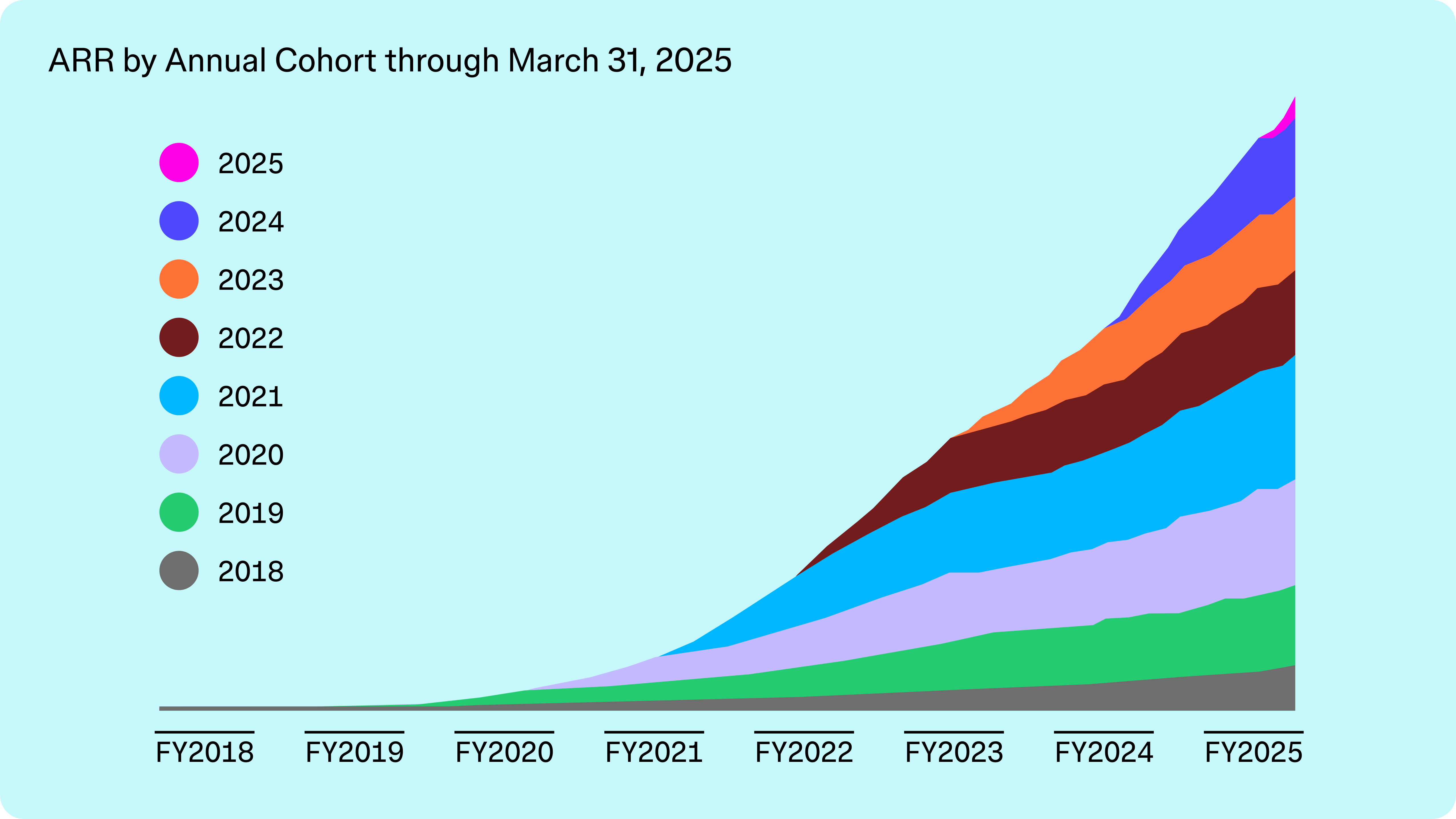
As of March 31, 2025, our Gross Retention Rate was 96%. We calculate our “Gross Retention Rate” as of
the applicable period of measurement by starting with the ARR from Paid Customers with more than
$10,000 in ARR as of twelve months prior to such period (“Prior Period ARR”). We then deduct from the
Prior Period ARR the ARR from Paid Customers with more than $10,000 in ARR who are no longer
customers as of the date of measurement, and divide that figure by the Prior Period ARR to arrive at our
Gross Retention Rate, which is the percentage of ARR from all Paid Customers with more than $10,000
in ARR as of the year prior that is not lost to customer churn. We calculate Gross Retention Rate using
ARR from Paid Customers with more than $10,000 in ARR because we believe that $10,000 in ARR is an
important threshold, as it is a strong indicator of significant paid usage of our products. Our Gross
Retention Rate reflects only customer losses and does not reflect customer expansion or contraction, so it
demonstrates that the vast majority of our customers continue to use our platform and renew their
subscriptions.
Expanding Our International Footprint
Our business has been global from the start. During the three months ended March 31, 2025,
approximately 85% of our monthly active users were based outside of the United States but only 53% of
our revenue came from non-U.S. markets during the same period, which we believe represents an
opportunity for us to continue to drive growth and expansion. As of March 31, 2025, our product was
available in English, Japanese, Spanish, Korean, and Portuguese; we accept five currencies; our
marketing and support channels are available in six languages; and we had nine offices in seven
countries, with local staff spread across 13 countries and five continents. We intend to continue to invest
in our international operations to help our global customers build better products and to meet our
customers where they are as we believe it will contribute to our long-term success.
Factors Impacting our 2023 and 2024
Operating Results
Abandoned Merger with Adobe, Inc.
On September 15, 2022, we entered into an Agreement and Plan of Merger (the “Merger Agreement”)
with Adobe and certain of Adobe’s wholly-owned subsidiaries.
On December 17, 2023, we mutually agreed with Adobe to terminate the Merger Agreement based on the
joint assessment that there was no clear path to obtain the required regulatory approvals for the
transaction to close (the “Abandoned Merger with Adobe”). On December 20, 2023, we received a $1.0
billion termination fee per the terms of the Merger Agreement from Adobe which was recorded within
other income, net on our consolidated statement of operations. We incurred transaction costs and other
related expenses associated with the Abandoned Merger with Adobe of $97.9 million and $18.1 million for
the years ended December 31, 2023 and 2024, respectively. The operating cash outflow associated with
these transaction costs and other related expenses was $50.8 million and $68.5 million for the years
ended December 31, 2023 and 2024, respectively. Additionally, we paid $181.0 million in federal and
state income taxes related to the transaction during the year ended December 31, 2024, which was
included in cash flows used in operating activities in our consolidated financial statements included
elsewhere in this prospectus.
May 2024 Restricted Stock Unit Release and 2024 Stock Option
Grants
Following the Abandoned Merger with Adobe, we wanted to provide existing equity holders, including
holders of RSUs, the opportunity to sell a portion of their eligible equity holdings in a tender offer (the
“2024 Tender Offer”). In order to allow holders of RSUs to participate, in May 2024, we modified certain
RSUs for which the service-based condition was satisfied to remove the performance-based vesting
condition (the “May 2024 RSU Release”), resulting in the recognition of stock-based compensation
expense, net of amounts capitalized, of $801.2 million during the year ended December 31, 2024.
On August 22, 2024, we also granted stock options to purchase shares of our common stock to eligible
employees in connection with our 2024 Tender Offer (the “2024 Stock Option Grants”). These stock
options were fully vested at grant and therefore the related stock-based compensation expense, net of
amounts capitalized, of $88.1 million was recognized during the year ended December 31, 2024.
Our operating expenses increased significantly during the year ended December 31, 2024 as compared
to 2023 as a result of the May 2024 RSU Release and 2024 Stock Option Grants. Refer to Note 10 to our
consolidated financial statements included elsewhere in this prospectus for additional information.
(6) A customer account is considered active when seats are provisioned to the customer at the start of their subscription. In cases
where contracts are signed but not provisioned as of the last date of the applicable period of measurement, the customer
account is counted as active if provisioning takes place no more than 15 days after the last day of the applicable period of
measurement.
Key Business Metrics
We review a number of operating and financial metrics, including the following key metrics to evaluate our
business, measure our performance, identify trends affecting our business, formulate business plans, and
make strategic decisions. The calculation of the key metrics discussed below may differ from other
similarly titled metrics used by other companies, securities analysts, or investors.
As of December 31, | As of March 31, | ||||||
2023 | 2024 | 2024 | 2025 | ||||
Paid Customers with more than $10,000 in ARR ................................................................. | 7,233 | 10,517 | 8,007 | 11,107 | |||
Paid Customers with more than $100,000 in ARR ............................................................ | 630 | 963 | 701 | 1,031 | |||
Net Dollar Retention Rate ............................... | 122% | 134% | 125% | 132% | |||
We define a Paid Customer as a customer account that is billed separately for which we have an active
paid subscription as of the last day of the applicable period of measurement.6 A single organization with
multiple divisions, segments, subsidiaries, or subscribing teams that are each billed separately are
counted as multiple Paid Customers. Our ability to continue to attract and retain new Paid Customers is
important to the success of our business and we had approximately 450,000 Paid Customers globally as
of March 31, 2025.
Paid Customers with more than $10,000 in ARR
We believe that the number of Paid Customers with more than $10,000 in ARR on our platform is an
important indication of the value that our products deliver. We define a Paid Customer with more than
$10,000 in ARR as a Paid Customer with a total of $10,000 or more of ARR as of the last day of the
applicable period of measurement. We believe that $10,000 in ARR is an important threshold, as it is a
strong indicator of significant paid usage of our products. As of each of December 31, 2024 and
March 31, 2025, Paid Customers with more than $10,000 in ARR represented 64% of our ARR.

Paid Customers with more than $100,000 in ARR
We believe that the number of Paid Customers with $100,000 or more in ARR on our platform is
indicative of our ability to scale our platform with our customers as well as our ability to support larger
organizations. We define a Paid Customer with more than $100,000 in ARR as a Paid Customer with
$100,000 or more of ARR as of the last day of the applicable period of measurement. As of December 31,
2024 and March 31, 2025, Paid Customers with more than $100,000 in ARR represented 37% of our
ARR.
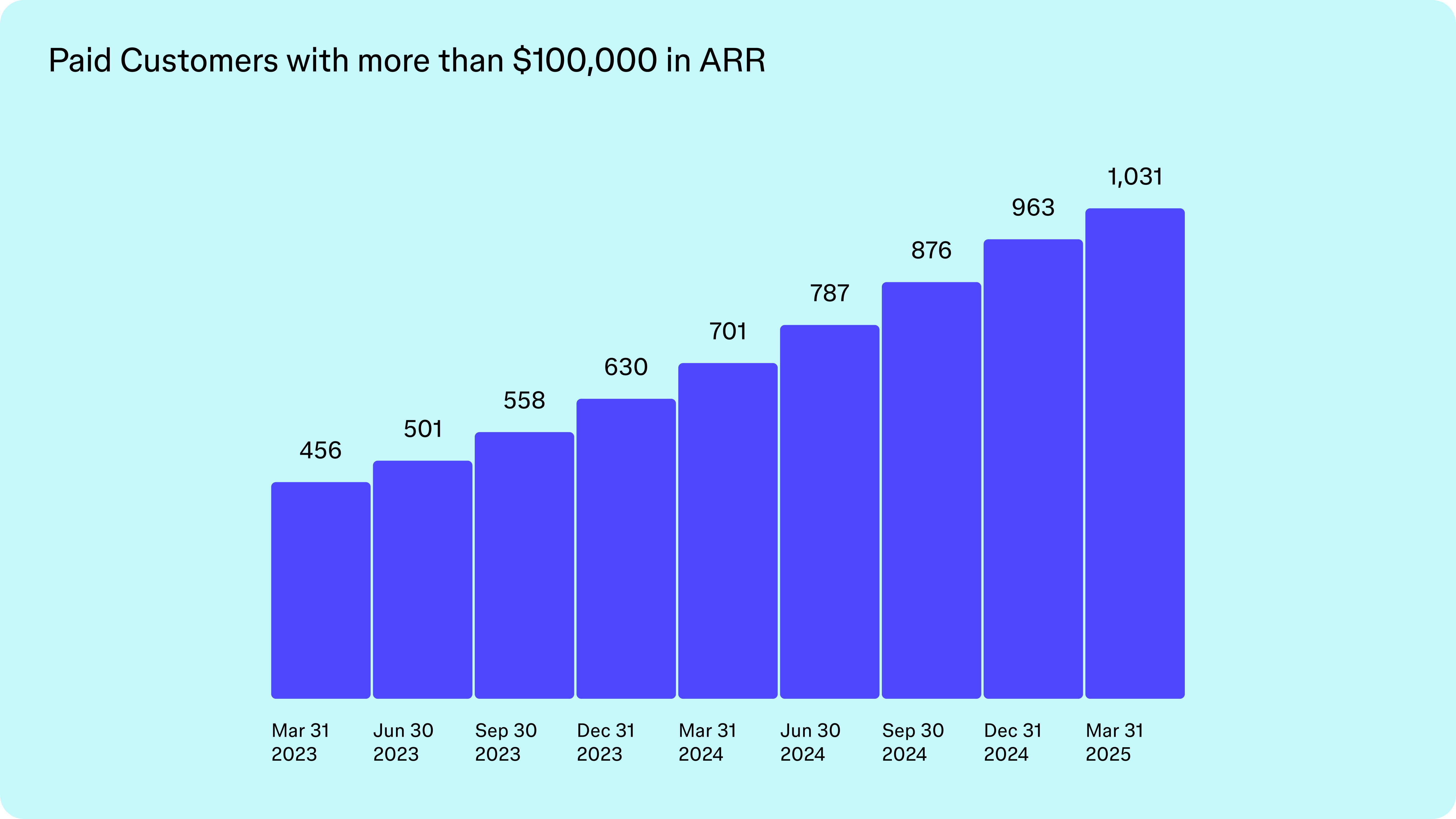
Net Dollar Retention Rate
We believe that Net Dollar Retention Rate is an important metric as it measures our ability to both retain
our existing customers and grow within our customer base. We calculate Net Dollar Retention Rate as of
the applicable period of measurement by starting with the ARR as of the date of measurement from all
Paid Customers with more than $10,000 in ARR that were also Paid Customers with more than $10,000
in ARR as of twelve months prior to such date of measurement (“Current Period ARR”). We then calculate
the ARR for those same customers as of twelve months prior to the date of measurement (“Previous
Period ARR”). We then divide Current Period ARR by Previous Period ARR to calculate our Net Dollar
Retention Rate for the applicable period of measurement. Our Net Dollar Retention Rate was 122% and
134% as of December 31, 2023 and 2024, respectively, and 132% as of March 31, 2025. We calculate
Net Dollar Retention Rate using ARR from Paid Customers with more than $10,000 in ARR because we
believe that $10,000 in ARR is an important threshold, as it is a strong indicator of significant paid usage
of our products.
The most significant drivers of changes in our Net Dollar Retention Rate during each reporting period
have historically been a combination of seat expansion, plan upgrades, and the adoption of new products.
In 2022, our Net Dollar Retention Rate benefited from the introduction of both FigJam and our new
Enterprise plan in the three months ended March 31, 2022. After we passed the one-year anniversary of
rolling out FigJam and the Enterprise plan, our Net Dollar Retention Rate trended down in 2023 because,
unlike the Net Dollar Retention Rate in 2022, the Net Dollar Retention Rate in 2023 reflected the impact
of FigJam and our new Enterprise plan across both 2022 and 2023. In addition, throughout 2023,
continued macroeconomic uncertainty prompted many companies to reduce overall software spending.
As a result, customers became more focused on optimizing seat utilization, which led to seat contraction
for certain of our customers. Following 2023, the level of macroeconomic uncertainty impacting our
customers subsided. In 2024, we experienced an expansion in our Net Dollar Retention Rate subsequent
to our launch of Dev Mode.
We expect our Net Dollar Retention Rate to fluctuate or decline in the future as a result of a number of
factors such as the growing level of our revenue base, the level of penetration within our customer base,
expansion of products and features, our ability to retain and expand within our customer base, and any
changes to the pricing and packaging of our plans. Contractions in customers or seats could negatively
impact our Net Dollar Retention Rate. In addition, we expect our Net Dollar Retention Rate may decline
once we pass the one-year anniversary of the March 2025 price increase for Figma Design. Our
calculation of Net Dollar Retention Rate may differ from similarly titled metrics presented by other
companies.

Non-GAAP Financial Measures
In addition to our results determined in accordance with GAAP, we believe the below non-GAAP financial
measures are useful in evaluating our operating performance. We use the below non-GAAP financial
information, collectively, to evaluate our ongoing operations and for internal planning and forecasting
purposes. We believe that non-GAAP financial information, when taken collectively, may be helpful to
investors because it provides consistency and comparability with past financial performance, and assists
in comparisons with other companies, some of which use similar non-GAAP financial information to
supplement their GAAP results. The non-GAAP financial information is presented for supplemental
informational purposes only, and should not be considered a substitute for financial information presented
in accordance with GAAP, and may be different from similarly-titled non-GAAP measures used by other
companies. A reconciliation is provided below for each non-GAAP financial measure to the most directly
comparable financial measure stated in accordance with GAAP. Investors are encouraged to review the
related GAAP financial measures and the reconciliation of these non-GAAP financial measures to their
most directly comparable GAAP financial measures.
Non-GAAP Operating Income and Non-GAAP Operating Margin
We define non-GAAP operating income and non-GAAP operating margin as loss from operations and
operating margin, respectively, excluding stock-based compensation expense, amortization of stock-
based compensation expense included in capitalized internal use software development costs, and
amortization of acquired intangibles for acquisitions. Additionally, we exclude certain non-recurring
charges, including transaction costs and other related expenses associated with the Abandoned Merger
with Adobe, employer payroll taxes related to the May 2024 RSU Release and 2024 Tender Offer, and
2024 Tender Offer transaction costs. Non-GAAP operating margin represents non-GAAP operating
income as a percentage of revenue.
The following table reflects the reconciliation of loss from operations to non-GAAP operating income and
non-GAAP operating margin for the periods presented:
Year Ended December 31, | Three Months Ended March 31, | ||||||
2023 | 2024 | 2024 | 2025 | ||||
(In thousands, except percentages) | |||||||
Income (loss) from operations ............................ | $(73,456) | $(877,433) | $12,521 | $39,749 | |||
Plus: Stock-based compensation expense(1) ..... | 2,703 | 947,553 | 607 | 197 | |||
Plus: Amortization of stock-based compensation included in capitalized internal use software development costs ...................... | 28 | 186 | 7 | 86 | |||
Plus: Transaction costs and other related expenses associated with the Abandoned Merger with Adobe(2) .......................................... | 97,853 | 18,064 | 4,781 | — | |||
Plus: Employer payroll taxes related to the May 2024 RSU Release and 2024 Tender Offer ...................................................................... | — | 26,703 | — | — | |||
Plus: 2024 Tender Offer transaction costs(3) ...... | — | 12,145 | 151 | — | |||
Non-GAAP operating income .............................. | $27,128 | $127,218 | $18,067 | $40,032 | |||
Operating margin .................................................... | (15)% | (117)% | 8% | 17% | |||
Non-GAAP operating margin ............................... | 5% | 17% | 12% | 18% | |||
__________________
(1)The increase in stock-based compensation expense for the year ended December 31, 2024 primarily related to the May 2024
RSU Release and 2024 Stock Option Grants. See the section titled “—Factors Impacting our 2023 and 2024 Operating Results
—May 2024 Restricted Stock Unit Release and 2024 Stock Option Grants” for further information.
(2)Transaction costs and other related expenses associated with the Abandoned Merger with Adobe include legal, accounting,
professional services fees, local business taxes and non-recurring compensation expenses related to the transaction.
(3)2024 Tender Offer transaction costs includes legal and professional services fees.
Free Cash Flow and Adjusted Free Cash Flow
We define Free Cash Flow as GAAP net cash provided by (used in) operating activities less capital
expenditures and capitalized internal use software development costs, if any. Adjusted Free Cash Flow is
a non-GAAP financial measure that we calculate as Free Cash Flow less the termination fee received
from the Abandoned Merger with Adobe, plus transaction costs and other related expenses associated
with the Abandoned Merger with Adobe and estimated income taxes related to the Abandoned Merger
with Adobe. Adjusted Free Cash Flow Margin represents Adjusted Free Cash Flow divided by revenue.
Transaction costs and other related expenses include legal, accounting, professional services fees, local
business taxes and non-recurring compensation expenses related to the transaction. We believe that
Free Cash Flow and Adjusted Free Cash Flow are useful indicators of liquidity that provide information to
management and investors about the amount of cash generated from our core operations that, after the
purchases of property and equipment and capitalized internal use software development costs, can be
used for strategic initiatives, including investing in our business, making strategic acquisitions, and
strengthening our balance sheet. We have adjusted our Free Cash Flow by the amount of cash received
related to the termination fee, transaction costs and other related expenses associated with the
Abandoned Merger with Adobe, and estimated income taxes attributable to the Abandoned Merger with
Adobe because we do not expect such items to occur when we are a public company and we believe that
this provides greater comparability across periods. Free Cash Flow and Adjusted Free Cash Flow have
limitations as analytical tools, and they should not be considered in isolation or as substitutes for analysis
of other GAAP financial measures, such as net cash provided by operating activities. Some of the
limitations of Free Cash Flow and Adjusted Free Cash Flow are that these metrics do not reflect our
future contractual commitments and may be calculated differently by other companies in our industry,
limiting their usefulness as comparative measures. We expect our Free Cash Flow to fluctuate in future
periods as we invest in our business to support our plans for growth. These activities, along with certain
increased operating expenses as described below, may result in a decrease in Free Cash Flow as a
percentage of revenue in future periods.
The following table presents our cash flows for the periods presented and a reconciliation of Free Cash
Flow and Adjusted Free Cash Flow to net cash provided by (used in) operating activities, the most directly
comparable financial measure calculated in accordance with GAAP:
Year Ended December 31, | Three Months Ended March 31, | ||||||
2023 | 2024 | 2024 | 2025 | ||||
(In thousands, except percentages) | |||||||
Net cash provided by (used in) operating activities ................................................................ | $1,047,334 | $(61,717) | $(18,139) | $97,177 | |||
Less: Capital expenditures ............................ | (3,737) | (1,977) | (503) | (874) | |||
Less: Capitalized internal use software development costs .......................................... | (2,630) | (4,524) | (1,008) | (1,721) | |||
Free Cash Flow .................................................... | $1,040,967 | $(68,218) | $(19,650) | $94,582 | |||
Less: Termination fee received from the Abandoned Merger with Adobe .................... | (1,000,000) | — | — | — | |||
Add: Transaction costs and other related expenses associated with the Abandoned Merger with Adobe(1) ............. | 50,842 | 68,492 | 68,122 | — | |||
Add: Estimated income taxes related to the Abandoned Merger with Adobe(2) ............... | — | 180,987 | — | — | |||
Adjusted Free Cash Flow ................................... | $91,809 | $181,261 | $48,472 | $94,582 | |||
Net cash provided by (used in) investing activities ............................................................. | $(57,336) | $(784,257) | $(336,630) | $41,251 | |||
Net cash provided by financing activities ......... | $— | $62,450 | $40 | $339 | |||
Operating Cash Flow Margin(3) .......................... | 207% | (8)% | (12)% | 43% | |||
Adjusted Free Cash Flow Margin(4) ................... | 18% | 24% | 31% | 41% | |||
__________________
(1)Transaction costs and other related expenses associated with the Abandoned Merger with Adobe include legal, accounting,
professional services fees, local business taxes and non-recurring compensation expenses related to the transaction.
(2)The estimated income taxes related to the Abandoned Merger with Adobe represents our assessment of the transaction’s
impact on our 2023 federal and state income tax payments, which were included in cash provided by operating activities for the
year ended December 31, 2024.
(3)Operating Cash Flow Margin is calculated as net cash provided by (used in) operating activities divided by revenue.
(4)Adjusted Free Cash Flow Margin is a non-GAAP financial measure that is calculated as Adjusted Free Cash Flow divided by
revenue.
Key Components of Results of Operations
Revenue
We generate revenue from sales of subscriptions to our platform. Our subscription agreements generally
have monthly or annual contractual terms. Our agreements are generally non-cancelable and we typically
bill in advance. Amounts that have been billed are initially recorded as deferred revenue and revenue is
recognized ratably over the related contractual term.
Our revenue is driven primarily by the number of paying customers and the price we charge for access to
our platform, which varies based on the type of plan and products to which a customer subscribes.
Costs That May Impact Multiple Line Items
Employee Related Costs and Overhead Allocation. Employee related costs include salaries, bonuses
and benefits, and stock-based compensation for cost of revenue and each operating expense category.
Overhead costs represent shared costs that are not specific to a functional group and are allocated based
on headcount. Such costs include costs associated with office facilities, IT-related personnel expenses,
depreciation of property and equipment, and other expenses, such as software subscription fees. As
such, allocated shared costs are reflected in cost of revenue and each operating expense category.
AI and Related Costs. As a part of our product innovation, we have made and will continue to make
significant investments to integrate AI, including generative AI, into our platform. We expect that the use
of AI technologies and our investments to integrate AI into our platform will impact our business, operating
results, and financial condition. For example, in the short-term, we expect that our AI investments and use
of AI technologies, including spend on AI inference and model training, will impact our cost of revenue,
research and development expenses, and potentially impact our sales and marketing expenses, which we
expect to negatively impact our gross margins and operating margins. Given the newness and rapid
development of these technologies, the impacts on our gross margins and operating margins, and our
business, operating results, financial condition, and future prospects over the longer term are currently
unknown.
Cost of Revenue
Cost of revenue consists primarily of technical infrastructure and hosting costs, including AI inference,
employee-related costs, including stock-based compensation, for infrastructure and product support
teams for paid users of Figma, payment processing fees, amortization of capitalized internal-use software
development costs, amortization of acquired intangible assets, and allocated overhead. Depending on the
timing of investments in our platform, including those related to our AI initiatives, we expect that our cost
of revenue will increase in absolute dollars as our business grows and will fluctuate as a percentage of
our revenue from period-to-period depending on the timing of these investments.
Gross Profit and Gross Margin
Gross profit represents revenue less cost of revenue. Gross margin is gross profit expressed as a
percentage of revenue. Our gross margin may fluctuate from period to period as our revenue fluctuates,
and as a result of the timing and amount of technical infrastructure and hosting costs, AI and related
efforts, and other investments to expand our products and geographical coverage.
Operating Expenses
Research and development. Our research and development expenses consist primarily of employee-
related costs, including stock-based compensation, technical infrastructure and hosting costs,
professional service fees, software subscription fees, and allocated overhead. We expense our research
and development costs as they are incurred, other than capitalized internal-use software development
costs. Our research and development expenses as a percentage of revenue of 100% for the year ended
December 31, 2024 was primarily driven by the May 2024 RSU Release and the 2024 Stock Option
Grants described above and we expect to incur significant research and development expenses in 2025
relating to the expected vesting and settlement of our outstanding RSUs in connection with this offering
and other expenses relating to this offering. Over time, we expect that our research and development
expenses will increase in absolute dollars relative to our research and development expenses in 2023,
which exclude the aforementioned events in 2024 and 2025, as we continue to invest in our platform.
However, depending on the timing of our investments, including those related to our AI initiatives, we
anticipate that research and development expenses may fluctuate as a percentage of our revenue from
period-to-period.
Sales and marketing. Our sales and marketing expenses consist primarily of employee-related costs,
including stock-based compensation, expenses associated with our marketing and brand advertising
campaigns, events, such as annual user conferences, including Config, amortization of sales
commissions, professional service fees, software subscription fees, and allocated overhead. Additionally,
we classify within sales and marketing technical infrastructure and hosting costs as well as overhead
costs for our infrastructure and product support teams related to the users of our free version of Figma.
We capitalize and subsequently amortize sales commissions and related expenses, including associated
payroll taxes and 401(k) contributions, over the estimated period of benefit, which we have determined to
be four years. Our sales and marketing expenses as a percentage of revenue of 63% for the year ended
December 31, 2024 was driven in part by the May 2024 RSU Release and the 2024 Stock Option Grants
described above and we expect to incur significant sales and marketing expenses in 2025 relating to the
expected vesting and settlement of our outstanding RSUs in connection with this offering and other
expenses relating to this offering. Over time, we expect that our sales and marketing expenses will
increase in absolute dollars relative to our sales and marketing expenses in 2023, which exclude the
aforementioned events in 2024 and 2025, as our business grows and we continue to scale our go-to-
market organization. However, depending on the timing of our investments, including those related to our
AI initiatives, we anticipate that sales and marketing expenses will fluctuate as a percentage of revenue
from period-to-period.
General and administrative. Our general and administrative expenses consist primarily of employee-
related costs, including stock-based compensation, for our legal, finance, human resources, and other
administrative teams, as well as certain executives. In addition, general and administrative expenses
include general business expenses, professional service fees, software subscription fees, and allocated
overhead. Following the closing of this offering, we expect to incur additional expenses as a result of
operating as a public company, including costs to comply with the rules and regulations applicable to
companies listed on a national securities exchange, costs related to compliance and reporting obligations,
and increased expenses for insurance, investor relations, and professional services. Our general and
administrative expenses as a percentage of revenue of 42% for the year ended December 31, 2024 was
primarily driven by the May 2024 RSU Release and the 2024 Stock Option Grants described above and
we expect to incur significant general and administrative expenses in 2025 relating to the expected
vesting and settlement of our outstanding RSUs in connection with this offering and other expenses
relating to this offering. Over time, we expect that our general and administrative expenses will increase in
absolute dollars relative to our general and administrative expenses in 2023, which exclude the
aforementioned events in 2024 and 2025, as our business grows. However, we anticipate that general
and administrative expenses will decrease as a percentage of revenue over time, although these
expenses may fluctuate as a percentage of our revenue from period-to-period depending on the timing of
these expenses.
Other Income (Loss), Net
Other income (loss), net consists primarily of interest income earned on our cash, cash equivalents, and
marketable securities, unrealized and realized gains or losses on equity securities, which includes our
investments in a Bitcoin exchange traded fund and strategic investments, gains or losses on foreign
currency exchange, and miscellaneous other expenses. Additionally, other income (loss) includes a $1.0
billion termination fee received due to the Abandoned Merger with Adobe for the year ended December
31, 2023.
Provision for (Benefit From) Income Taxes
Provision for (benefit from) income taxes consists of U.S. federal and state income taxes and income
taxes in certain foreign jurisdictions in which we conduct business and the income taxes related to the
termination fee received due to the Abandoned Merger with Adobe. We maintain a full valuation
allowance on our federal and state deferred tax assets as we have concluded that it is not more likely
than not that the deferred tax assets will be realized.
Results of Operations
The following tables set forth our consolidated statement of operations data for the periods indicated:
Year Ended December 31, | Three Months Ended March 31, | ||||||
2023 | 2024 | 2024 | 2025 | ||||
(In thousands) | |||||||
Revenue ............................................................. | $504,874 | $749,011 | $156,229 | $228,199 | |||
Cost of revenue(1) ........................................ | 44,500 | 87,514 | 12,790 | 19,452 | |||
Gross profit ........................................................ | 460,374 | 661,497 | 143,439 | 208,747 | |||
Operating expenses(1): | |||||||
Research and development ....................... | 164,774 | 751,120 | 52,711 | 69,925 | |||
Sales and marketing ................................... | 201,377 | 472,076 | 55,334 | 68,840 | |||
General and administrative ........................ | 167,679 | 315,734 | 22,873 | 30,233 | |||
Total operating expenses ................................ | 533,830 | 1,538,930 | 130,918 | 168,998 | |||
Income (loss) from operations ........................ | (73,456) | (877,433) | 12,521 | 39,749 | |||
Other income, net(2) .......................................... | 1,019,375 | 84,362 | 17,185 | 7,274 | |||
Income (loss) before income taxes ............... | 945,919 | (793,071) | 29,706 | 47,023 | |||
Provision for (benefit from) income taxes ..... | 208,078 | (60,951) | 16,181 | 2,141 | |||
Net income (loss) ............................................. | $737,841 | $(732,120) | $13,525 | $44,882 | |||
__________________
(1)Includes stock-based compensation, net of amounts capitalized, as follows:
Year Ended December 31, | Three Months Ended March 31, | ||||||
2023 | 2024 | 2024 | 2025 | ||||
(In thousands) | |||||||
Cost of revenue ......................................... | $37 | $27,893 | $1 | $— | |||
Research and development .................... | 1,890 | 511,259 | 543 | 197 | |||
Sales and marketing ................................. | 253 | 206,830 | 11 | — | |||
General and administrative ...................... | 523 | 201,571 | 52 | — | |||
(2)Includes the $1.0 billion termination fee received in 2023 from the Abandoned Merger with Adobe.
The following tables set forth our consolidated statement of operations data expressed as a percentage of
revenue for the periods indicated:
Year Ended December 31, | Three Months Ended March 31, | ||||||
2023 | 2024 | 2024 | 2025 | ||||
(As a % of revenue(1)) | |||||||
Revenue ............................................................. | 100% | 100% | 100% | 100% | |||
Cost of revenue .......................................... | 9 | 12 | 8 | 9 | |||
Gross profit ........................................................ | 91 | 88 | 92 | 91 | |||
Operating expenses: | |||||||
Research and development ....................... | 33 | 100 | 34 | 31 | |||
Sales and marketing ................................... | 40 | 63 | 35 | 30 | |||
General and administrative ........................ | 33 | 42 | 15 | 13 | |||
Total operating expenses ................................ | 106 | 205 | 84 | 74 | |||
Income (loss) from operations ........................ | (15) | (117) | 8 | 17 | |||
Other income, net ............................................. | 202 | 11 | 11 | 3 | |||
Income (loss) before income taxes ............... | 187 | (106) | 19 | 21 | |||
Provision for (benefit from) income taxes ..... | 41 | (8) | 10 | 1 | |||
Net income (loss) ............................................. | 146% | (98)% | 9% | 20% | |||
__________________
(1)Percentages may not foot due to rounding.
Comparison of the Three Months Ended
March 31, 2024 and 2025
Revenue and Cost of Revenue
Three Months Ended March 31, | |||||||
2024 | 2025 | $ Change | % Change | ||||
(In thousands, except percentages) | |||||||
Revenue ............................................................. | $156,229 | $228,199 | $71,970 | 46% | |||
Cost of revenue ............................................... | 12,790 | 19,452 | 6,662 | 52% | |||
Gross profit ........................................................ | $143,439 | $208,747 | $65,308 | 46% | |||
Revenue increased by $72.0 million, or 46%, for the three months ended March 31, 2025 compared to
the three months ended March 31, 2024. The increase in revenue was primarily due to expansion within
our existing Paid Customers, as reflected by our Net Dollar Retention Rate of 132% as of March 31,
2025, compared to 125% as of March 31, 2024, and the addition of new Paid Customers, as our number
of Paid Customers with more than $10,000 in ARR and Paid Customers with more than $100,000 in ARR
increased by 39% and 47%, respectively, as of March 31, 2025 compared to the prior year.
Cost of revenue increased by $6.7 million, or 52%, for the three months ended March 31, 2025 compared
to the three months ended March 31, 2024. The increase was primarily due to $3.5 million of higher
technical infrastructure and hosting costs due to increased usage of our platform as well as AI related
costs for paid users, $2.3 million of higher employee-related costs driven by an increase in headcount and
the implementation of a company-wide annual bonus program, and $1.5 million in higher payment
processing fees.
Research and Development
Three Months Ended March 31, | |||||||
2024 | 2025 | $ Change | % Change | ||||
(In thousands, except percentages) | |||||||
Research and development ............................ | $52,711 | $69,925 | $17,214 | 33% | |||
Research and development expenses increased by $17.2 million, or 33%, for the three months ended
March 31, 2025 compared to the three months ended March 31, 2024. The increase was primarily due to
$12.0 million of higher employee-related costs driven by an increase in headcount and the
implementation of a company-wide annual bonus program, a $2.6 million increase in technical
infrastructure and hosting costs, primarily driven by AI related costs as we improve and extend our
product offerings and develop new technologies, and $1.7 million of higher software subscription fees.
Sales and Marketing
Three Months Ended March 31, | |||||||
2024 | 2025 | $ Change | % Change | ||||
(In thousands, except percentages) | |||||||
Sales and marketing ........................................ | $55,334 | $68,840 | $13,506 | 24% | |||
Sales and marketing expenses increased by $13.5 million, or 24%, for the three months ended March 31,
2025 compared to the three months ended March 31, 2024. The increase was primarily due to $6.0
million of higher employee-related costs driven by an increase in headcount and the implementation of a
company-wide annual bonus program, $2.1 million of higher technical infrastructure and hosting costs for
users of our free version of Figma due to continuing growth in our user base, and $1.8 million of higher
spend related to marketing events and advertising expenses.
General and Administrative
Three Months Ended March 31, | |||||||
2024 | 2025 | $ Change | % Change | ||||
(In thousands, except percentages) | |||||||
General and administrative ............................. | $22,873 | $30,233 | $7,360 | 32% | |||
General and administrative expenses increased by $7.4 million, or 32%, for the three months ended
March 31, 2025 compared to the three months ended March 31, 2024. The increase was primarily due to
$3.9 million of higher professional service fees and $2.9 million of higher employee-related costs, driven
by an increase in headcount and the implementation of a company-wide annual bonus program.
Other Income, Net
Three Months Ended March 31, | |||||||
2024 | 2025 | $ Change | % Change | ||||
(In thousands, except percentages) | |||||||
Other income, net ............................................. | $17,185 | $7,274 | $(9,911) | (58)% | |||
Other income, net decreased by $9.9 million, or 58%, for the three months ended March 31, 2025
compared to the three months ended March 31, 2024. The decrease was primarily due to an $8.6 million
decrease in net unrealized gains related to changes in the fair value of equity securities, which includes
the Company’s investment in a Bitcoin exchange traded fund and a $2.3 million decrease in interest
income.
Provision for Income Taxes
Three Months Ended March 31, | |||||||
2024 | 2025 | $ Change | % Change | ||||
(In thousands, except percentages) | |||||||
Provision for income taxes .............................. | $16,181 | $2,141 | $(14,040) | (87)% | |||
The provision for income taxes decreased by $14.0 million, or 87%, for the three months ended March 31,
2025 compared to the three months ended March 31, 2024. The decrease was primarily due to the
availability of additional income tax deductions in the United States for the three months ended March 31,
2025, related to NOL carryforwards.
Comparison of the Years Ended December
31, 2023 and 2024
Revenue and Cost of Revenue
Year Ended December 31, | |||||||
2023 | 2024 | $ Change | % Change | ||||
(In thousands, except percentages) | |||||||
Revenue ............................................................. | $504,874 | $749,011 | $244,137 | 48% | |||
Cost of revenue ............................................... | 44,500 | 87,514 | 43,014 | 97 | |||
Gross profit ........................................................ | $460,374 | $661,497 | $201,123 | 44 | |||
Revenue increased by $244.1 million, or 48%, for the year ended December 31, 2024 compared to the
year ended December 31, 2023. The increase in revenue was primarily due to expansion within our
existing Paid Customers, as reflected by our Net Dollar Retention Rate of 134% as of December 31,
2024, compared to 122% as of December 31, 2023, and the addition of new Paid Customers, as our
number of Paid Customers with more than $10,000 in ARR and Paid Customers with more than $100,000
in ARR increased by 45% and 53%, respectively, as of December 31, 2024 compared to the prior year.
Cost of revenue increased by $43.0 million, or 97%, for the year ended December 31, 2024 compared to
the year ended December 31, 2023. The increase was primarily due to $31.5 million of higher employee-
related costs driven by a $27.9 million increase in stock-based compensation expense related to the May
2024 RSU Release and 2024 Stock Option Grants. The increase was also due to $6.5 million of higher
technical infrastructure and hosting costs as the usage of our platform increased and $4.8 million in
higher payment processing fees.
Research and Development
Year Ended December 31, | |||||||
2023 | 2024 | $ Change | % Change | ||||
(In thousands, except percentages) | |||||||
Research and development ............................ | $164,774 | $751,120 | $586,346 | 356% | |||
Research and development expenses increased by $586.3 million, or 356%, for the year ended
December 31, 2024 compared to the year ended December 31, 2023. The increase was primarily due to
$578.0 million of higher employee-related costs driven by a $509.4 million increase in stock-based
compensation expenses related to the May 2024 RSU Release and 2024 Stock Option Grants. The
increase was also due to $4.6 million of higher software subscription fees and a $2.7 million increase in
technical infrastructure and hosting costs, primarily driven by AI related costs as we improve and extend
our offerings and develop new technologies.
Sales and Marketing
Year Ended December 31, | |||||||
2023 | 2024 | $ Change | % Change | ||||
(In thousands, except percentages) | |||||||
Sales and marketing ........................................ | $201,377 | $472,076 | $270,699 | 134% | |||
Sales and marketing expenses increased by $270.7 million, or 134%, for the year ended December 31,
2024 compared to the year ended December 31, 2023. The increase was due in part to $244.8 million of
higher employee-related costs driven by a $206.5 million increase in stock-based compensation
expenses related to the May 2024 RSU Release and 2024 Stock Option Grants. The increase was also
due to $8.5 million of higher spend related to marketing events and advertising expenses as we continued
our focus on expansion and enhancing customer adoption, $8.1 million of higher technical infrastructure
and hosting costs for users of our free version of Figma due to continuing growth in our user base, $5.6
million of higher sales commission expense due to the year-over-year sales growth, and $2.0 million of
higher allocated overhead costs to support the growth of our business.
General and Administrative
Year Ended December 31, | |||||||
2023 | 2024 | $ Change | % Change | ||||
(In thousands, except percentages) | |||||||
General and administrative ............................. | $167,679 | $315,734 | $148,055 | 88% | |||
General and administrative expenses increased by $148.1 million, or 88%, for the year ended
December 31, 2024 compared to the year ended December 31, 2023. The increase was primarily due to
$223.8 million of higher employee-related costs driven by a $201.0 million increase in stock-based
compensation expenses related to the May 2024 RSU Release and 2024 Stock Option Grants. The
increase was also due to $3.8 million of higher allocated overhead costs to support the growth of our
business. The increase was partially offset by $80.6 million of lower professional service fees in the year
ended December 31, 2024 as compared to the prior year, related to the Abandoned Merger with Adobe.
Other Income, Net
Year Ended December 31, | |||||||
2023 | 2024 | $ Change | % Change | ||||
(In thousands, except percentages) | |||||||
Other income, net ............................................. | $1,019,375 | $84,362 | $(935,013) | (92)% | |||
Other income, net decreased by $935.0 million, or 92%, for the year ended December 31, 2024
compared to the year ended December 31, 2023. The decrease was primarily due to the $1.0 billion
termination fee received from the Abandoned Merger with Adobe during the year ended December 31,
2023 and a $3.3 million increase in net foreign exchange losses in 2024 as compared to 2023. This
decrease was partially offset by an increase of $44.0 million in interest income, driven by additional
investments made in marketable securities due to the cash received from the Abandoned Merger with
Adobe and a $24.0 million increase in net unrealized gains related to changes in the fair value of equity
securities in the year ended December 31, 2024 compared to the prior year.
Provision for (Benefit from) Income Taxes
Year Ended December 31, | |||||||
2023 | 2024 | $ Change | % Change | ||||
(In thousands, except percentages) | |||||||
Provision for (benefit from) income taxes ..... | $208,078 | $(60,951) | $(269,029) | (129)% | |||
The provision for (benefit from) income taxes decreased by $269.0 million, or 129%, for the year ended
December 31, 2024 compared to the year ended December 31, 2023. The decrease was primarily due to
the income taxes related to the termination fee received from the Abandoned Merger with Adobe in the
year ended December 31, 2023, offset by the recognition of research and development credits in the
United States in the year ended December 31, 2024.
Quarterly Results of Operations
The following tables set forth our unaudited quarterly statements of operations data for each of the nine
quarters ended March 31, 2025, as well as the percentage of revenue that each line item represents for
each quarter. The information for each of these quarters has been prepared on the same basis as the
audited annual financial statements included elsewhere in this prospectus and, in the opinion of
management, includes all adjustments necessary for the fair statement of the results of operations for
these periods. This data should be read in conjunction with our audited consolidated financial statements
and related notes included elsewhere in this prospectus. These quarterly results of operations are not
necessarily indicative of our future results of operations that may be expected for any future period.
Three Months Ended | |||||||||||||||||
March 31, 2023 | June 30, 2023 | September 30, 2023 | December 31, 2023 | March 31, 2024 | June 30, 2024 | September 30, 2024 | December 31, 2024 | March 31, 2025 | |||||||||
(In thousands) | |||||||||||||||||
Revenue ............................................... | $109,544 | $118,668 | $132,216 | $144,446 | $156,229 | $177,198 | $198,639 | $216,945 | $228,199 | ||||||||
Cost of revenue(1) ....................... | 9,125 | 10,187 | 11,887 | 13,301 | 12,790 | 39,558 | 18,703 | 16,463 | 19,452 | ||||||||
Gross profit .......................................... | 100,419 | 108,481 | 120,329 | 131,145 | 143,439 | 137,640 | 179,936 | 200,482 | 208,747 | ||||||||
Operating expenses(1): | |||||||||||||||||
Research and development ...... | 35,324 | 39,050 | 43,894 | 46,506 | 52,711 | 535,676 | 104,182 | 58,551 | 69,925 | ||||||||
Sales and marketing .................. | 39,547 | 66,602 | 43,240 | 51,988 | 55,334 | 276,246 | 79,290 | 61,206 | 68,840 | ||||||||
General and administrative ....... | 32,301 | 29,497 | 33,715 | 72,166 | 22,873 | 220,005 | 43,800 | 29,056 | 30,233 | ||||||||
Total operating expenses .................. | 107,172 | 135,149 | 120,849 | 170,660 | 130,918 | 1,031,927 | 227,272 | 148,813 | 168,998 | ||||||||
Income (loss) from operations .......... | (6,753) | (26,668) | (520) | (39,515) | 12,521 | (894,287) | (47,336) | 51,669 | 39,749 | ||||||||
Other income, net ............................... | 3,980 | 4,225 | 4,156 | 1,007,014 | 17,185 | 10,139 | 17,910 | 39,128 | 7,274 | ||||||||
Income (loss) before income taxes . | (2,773) | (22,443) | 3,636 | 967,499 | 29,706 | (884,148) | (29,426) | 90,797 | 47,023 | ||||||||
Provision for (benefit from) income taxes ............................................... | 2,079 | 818 | 2,384 | 202,797 | 16,181 | (56,294) | (13,828) | (7,010) | 2,141 | ||||||||
Net income (loss) ............................... | $(4,852) | $(23,261) | $1,252 | $764,702 | $13,525 | $(827,854) | $(15,598) | $97,807 | $44,882 | ||||||||
__________________
(1)Includes stock-based compensation, net of amounts capitalized, as follows:
Three Months Ended | |||||||||||||||||
March 31, 2023 | June 30, 2023 | September 30, 2023 | December 31, 2023 | March 31, 2024 | June 30, 2024 | September 30, 2024 | December 31, 2024 | March 31, 2025 | |||||||||
(In thousands) | |||||||||||||||||
Cost of revenue ............... | $12 | $9 | $9 | $7 | $1 | $24,858 | $3,034 | $— | $— | ||||||||
Research and development ............... | 305 | 319 | 665 | 601 | 543 | 463,255 | 47,308 | 153 | 197 | ||||||||
Sales and marketing ....... | 86 | 57 | 71 | 39 | 11 | 186,659 | 20,160 | — | — | ||||||||
General and administrative ............. | 142 | 137 | 127 | 117 | 52 | 183,618 | 17,901 | — | — | ||||||||
Three Months Ended(1) | |||||||||||||||||
March 31, 2023 | June 30, 2023 | September 30, 2023 | December 31, 2023 | March 31, 2024 | June 30, 2024 | September 30, 2024 | December 31, 2024 | March 31, 2025 | |||||||||
(As a % of revenue) | |||||||||||||||||
Revenue ..................................... | 100% | 100% | 100% | 100% | 100% | 100% | 100% | 100% | 100% | ||||||||
Cost of revenue .................. | 8 | 9 | 9 | 9 | 8 | 22 | 9 | 8 | 9 | ||||||||
Gross profit ................................. | 92 | 91 | 91 | 91 | 92 | 78 | 91 | 92 | 91 | ||||||||
Operating expenses: | |||||||||||||||||
Research and development ................... | 32 | 33 | 33 | 32 | 34 | 302 | 52 | 27 | 31 | ||||||||
Sales and marketing .......... | 36 | 56 | 33 | 36 | 35 | 156 | 40 | 28 | 30 | ||||||||
General and administrative ................. | 29 | 25 | 25 | 50 | 15 | 124 | 22 | 13 | 13 | ||||||||
Total operating expenses ......... | 98 | 114 | 91 | 118 | 84 | 582 | 114 | 69 | 74 | ||||||||
Income (loss) from operations . | (6) | (22) | — | (27) | 8 | (505) | (24) | 24 | 17 | ||||||||
Other income, net ...................... | 4 | 4 | 3 | 697 | 11 | 6 | 9 | 18 | 3 | ||||||||
Income (loss) before income taxes ....................................... | (3) | (19) | 3 | 670 | 19 | (499) | (15) | 42 | 21 | ||||||||
Provision for (benefit from) income taxes ......................... | 2 | 1 | 2 | 140 | 10 | (32) | (7) | (3) | 1 | ||||||||
Net income (loss) ...................... | (4)% | (20)% | 1% | 529% | 9% | (467)% | (8)% | 45% | 20% | ||||||||
__________________
(1)Percentages may not foot due to rounding.
Quarterly Trends
Revenue Trends
Revenue increased sequentially in each of the quarters presented primarily due to the growth from
existing Paid Customers and the addition of new Paid Customers. We recognize revenue ratably over the
terms of our subscription contracts. As a result, a substantial portion of the revenue we report in a period
is attributable to orders we received during prior periods. Therefore, increases or decreases in new sales,
customer expansion, or renewals in a period may not be immediately reflected in revenue for the period.
Cost of Revenue Trends
Our cost of revenue has generally increased in the quarters presented as a result of technical
infrastructure and hosting costs as well as increased headcount, which resulted in increased personnel
expenses. The increase in cost of revenue during the three months ended June 30, 2024 and September
30, 2024 was primarily due to higher employee-related costs driven by stock-based compensation
expenses related to the May 2024 RSU Release and 2024 Stock Option Grants. The increase during the
three months ended March 31, 2025 was primarily due to higher employee-related costs driven by the
implementation of a company-wide annual bonus program during the quarter.
Research and Development Trends
Our research and development expenses have generally increased in the quarters presented primarily
due to headcount growth and employee-related costs. The increase in research and development
expenses during the three months ended June 30, 2024 and September 30, 2024 was primarily due to
higher employee-related costs driven by stock-based compensation expenses related to the May 2024
RSU Release and 2024 Stock Option Grants. The increase during the three months ended March 31,
2025 was primarily due to higher employee-related costs driven by the implementation of a company-wide
annual bonus program during the quarter.
Sales and Marketing Trends
Our sales and marketing expenses have generally increased in the quarters presented primarily due to
employee-related expenses and brand advertising campaigns. The timing of brand advertising campaigns
can impact the trends in sales and marketing expenses. The increase in sales and marketing expenses
during the three months ended June 30, 2024 and September 30, 2024 was primarily due to higher
employee-related costs driven by stock-based compensation expenses related to the May 2024 RSU
Release and 2024 Stock Option Grants. Additionally, the increase in sales and marketing expenses
during the three months ended June 30, 2023 and June 30, 2024 was due to increased expenses
incurred in connection with our annual user conferences, including Config, which we typically host in the
second quarter of each year, and other advertising efforts. The increase during the three months ended
March 31, 2025 was primarily due to higher employee-related costs driven by the implementation of a
company-wide annual bonus program during the quarter.
General and Administrative Trends
Our general and administrative expenses have generally increased in the quarters presented primarily
due to employee-related expenses and legal, accounting, and other professional fees. The increase in
general and administrative expenses during the three months ended December 31, 2023 was primarily
due to consulting and professional service fees related to the Abandoned Merger with Adobe. The
increase in general and administrative expenses during the three months ended June 30, 2024 and
September 30, 2024 was primarily due to higher employee-related costs driven by stock-based
compensation expenses related to the May 2024 RSU Release and 2024 Stock Option Grants. The
increase during three months ended March 31, 2025 was primarily due to higher consulting and
professional service fees related to this offering, and employee-related costs driven by an increase in
headcount and the implementation of a company-wide annual bonus program during the quarter.
Other Income, Net Trends
Changes in other income, net in the quarters presented are primarily driven by fluctuations in interest
rates, investment balances and changes in fair value of equity securities, including our investment in a
Bitcoin ETF. The increase in other income, net during the three months ended December 31, 2023 was
primarily due to the $1.0 billion termination fee received from the Abandoned Merger with Adobe.
Quarterly Key Business Metrics
As of | |||||||||||||||||
March 31, 2023 | June 30, 2023 | September 30, 2023 | December 31, 2023 | March 31, 2024 | June 30, 2024 | September 30, 2024 | December 31, 2024 | March 31, 2025 | |||||||||
Paid Customers with more than $10,000 in ARR ..... | 5,945 | 6,365 | 6,727 | 7,233 | 8,007 | 9,071 | 9,762 | 10,517 | 11,107 | ||||||||
Paid Customers with more than $100,000 in ARR .. | 456 | 501 | 558 | 630 | 701 | 787 | 876 | 963 | 1,031 | ||||||||
Net Dollar Retention Rate ........................ | 159% | 143% | 131% | 122% | 125% | 130% | 131% | 134% | 132% | ||||||||
Quarterly Key Metric Trends
Our Paid Customers with more than $10,000 in ARR and Paid Customers with more than $100,000 in
ARR increased sequentially for all quarters presented, primarily due to organic growth as a result of
strong performance, as well as increased expansion of users within our existing Paid Customer base.
Our Net Dollar Retention Rate has fluctuated across the eight quarters presented due to the growing level
of our revenue base and expansion of products and features. For example, we experienced a decline in
our Net Dollar Retention Rate throughout 2023 as macroeconomic pressure impacted seat expansion and
our Net Dollar Retention Rate increased throughout 2024 subsequent to our launch of Dev Mode. We
expect our Net Dollar Retention Rate to fluctuate or decline in the future as a result of a number of factors
such as the growing level of our revenue base, the level of penetration within our customer base,
expansion of products and features, our ability to retain our customers, and any changes to the pricing
and packaging of our plans.
Quarterly Non-GAAP Financial Measures
Three Months Ended | |||||||||||||||||
March 31, 2023 | June 30, 2023 | September 30, 2023 | December 31, 2023 | March 31, 2024 | June 30, 2024 | September 30, 2024 | December 31, 2024 | March 31, 2025 | |||||||||
(In thousands, except percentages) | |||||||||||||||||
Income (loss) from operations ....................... | $(6,753) | $(26,668) | $(520) | $(39,515) | $12,521 | $(894,287) | $(47,336) | $51,669 | $39,749 | ||||||||
Plus: Stock-based compensation expense(1) . | 545 | 522 | 872 | 764 | 607 | 858,390 | 88,403 | 153 | 197 | ||||||||
Plus: Amortization of stock-based compensation included in capitalized internal use software development costs .... | 6 | 7 | 7 | 8 | 7 | 9 | 88 | 82 | 86 | ||||||||
Plus: Transaction costs and other related expenses associated with the Abandoned Merger with Adobe(2) | 15,875 | 11,539 | 15,333 | 55,106 | 4,781 | 4,401 | 4,408 | 4,474 | — | ||||||||
Plus: Employer payroll taxes related to the May 2024 RSU Release and 2024 Tender Offer .............. | — | — | — | — | — | 24,983 | 1,720 | — | — | ||||||||
Plus: 2024 Tender Offer transaction costs(3) ............ | — | — | — | — | 151 | 11,384 | 577 | 33 | — | ||||||||
Non-GAAP operating income (loss) ................... | $9,673 | $(14,600) | $15,692 | $16,363 | $18,067 | $4,880 | $47,860 | $56,411 | $40,032 | ||||||||
Operating margin .................. | (6)% | (22)% | —% | (27)% | 8% | (505)% | (24)% | 24% | 17% | ||||||||
Non-GAAP operating margin ................................ | 9% | (12)% | 12% | 11% | 12% | 3% | 24% | 26% | 18% | ||||||||
__________________
(1)The increase in stock-based compensation expense during the three months ended June 30, 2024 and September 30, 2024
related to the May 2024 RSU Release and 2024 Stock Option Grants. See the section titled “—Factors Impacting our 2023 and
2024 Operating Results—May 2024 Restricted Stock Unit Release and 2024 Stock Option Grants” for more information.
(2)Transaction costs and other related expenses associated with the Abandoned Merger with Adobe include legal, accounting,
professional services fees, local business taxes and non-recurring compensation expenses related to the transaction.
(3)2024 Tender Offer transaction costs includes legal and professional services fees.
Three Months Ended | |||||||||||||||||
March 31, 2023 | June 30, 2023 | September 30, 2023 | December 31, 2023 | March 31, 2024 | June 30, 2024 | September 30, 2024 | December 31, 2024 | March 31, 2025 | |||||||||
(In thousands, except percentages) | |||||||||||||||||
Net cash provided by (used in) operating activities | $9,273 | $(5,899) | $25,774 | $1,018,186 | $(18,139) | $(178,243) | $61,574 | $73,091 | $97,177 | ||||||||
Less: Capital expenditures ... | (257) | (1,402) | (1,604) | (474) | (503) | (399) | (413) | (662) | (874) | ||||||||
Less: Capitalized internal use software development costs ................ | (648) | (748) | (375) | (859) | (1,008) | (1,170) | (742) | (1,604) | (1,721) | ||||||||
Free Cash Flow ........ | $8,368 | $(8,049) | $23,795 | $1,016,853 | $(19,650) | $(179,812) | $60,419 | $70,825 | $94,582 | ||||||||
Less: Termination fee received from the Abandoned Merger with Adobe .............. | — | — | — | (1,000,000) | — | — | — | — | — | ||||||||
Add: Transaction costs and other related expenses associated with the Abandoned Merger with Adobe(1) ........... | 6,439 | 16,073 | 8,920 | 19,410 | 68,122 | 322 | 34 | 14 | — | ||||||||
Add: Estimated income taxes related to the Abandoned Merger with Adobe(2) ........... | — | — | — | — | — | 185,617 | 518 | (5,148) | — | ||||||||
Adjusted Free Cash Flow ....................... | $14,807 | $8,024 | $32,715 | $36,263 | $48,472 | $6,127 | $60,971 | $65,691 | $94,582 | ||||||||
Net cash (used in) provided by investing activities ............... | $(53,706) | $3,015 | $(1,124) | $(5,521) | $(336,630) | $(173,216) | $(210,946) | $(63,465) | $41,251 | ||||||||
Net cash provided by (used in) financing activities ............... | $— | $(2) | $1 | $1 | $40 | $21,860 | $(20,660) | $61,210 | $339 | ||||||||
Operating Cash Flow Margin .................... | 9% | (5)% | 20% | 705% | (12)% | (101)% | 31% | 34% | 43% | ||||||||
Adjusted Free Cash Flow Margin ........... | 14% | 7% | 25% | 25% | 31% | 4% | 31% | 30% | 41% | ||||||||
__________________
(1)Transaction costs and other related expenses associated with the Abandoned Merger with Adobe include legal, accounting,
professional services fees, local business taxes and non-recurring compensation expenses related to the transaction.
(2)The estimated income taxes related to the Abandoned Merger with Adobe represents our assessment of the transaction’s
impact on our 2023 federal and state income tax payments, which were included in cash provided by (used in) operating
activities for the year ended December 31, 2024.
Critical Accounting Estimates
Our consolidated financial statements and the related notes thereto included elsewhere in this prospectus
are prepared in accordance with GAAP. The preparation of consolidated financial statements also
requires us to make estimates and assumptions that affect the reported amounts of assets, liabilities,
revenue, costs and expenses, and related disclosures. We base our estimates on historical experience
and on various other assumptions that we believe to be reasonable under the circumstances, and we
evaluate our estimates and assumptions on an ongoing basis. Actual results could differ significantly from
the estimates made by management. To the extent that there are differences between our estimates and
actual results, our future financial statement presentation, financial condition, results of operations, and
cash flows will be affected.
We believe that the accounting policies described below involve a substantial degree of judgment and
complexity. Accordingly, these are the policies we believe are the most critical to aid in fully
understanding and evaluating our consolidated financial condition and results of operations.
Stock-Based Compensation
We measure stock-based compensation expense related to equity awards, including stock options,
RSUs, and Restricted Stock Awards (“RSAs”), based on the estimated fair value on the date of the grant.
Stock-based compensation expense is recognized on a straight-line basis over the requisite service
period. We account for forfeitures in the period in which they occur.
We have granted certain equity awards to our employees and directors with a service-based and a
performance-based vesting condition. The service-based vesting period for these awards is typically four
years with monthly vesting, subject to a one-year cliff for new hire grants. The performance-based vesting
condition is generally satisfied on the earlier of (i) an acquisition or change in control of us or (ii) the
earlier of (a) six months after our initial public offering or (b) March 15 of the calendar year following our
initial public offering. Our Board of Directors intends to accelerate the performance-based vesting
condition such that it will occur upon the effectiveness of our registration statement related to this offering.
We recognize stock-based compensation expense related to equity awards with a performance-based
vesting condition over the requisite service period using the accelerated attribution method, if it is
probable that the performance-based vesting condition will be satisfied. The performance-based vesting
condition is deemed probable of being satisfied upon either the consummation of an acquisition or
change in control, or the initial public offering of our securities.
We have also granted certain equity awards with market-based vesting conditions in addition to service-
based vesting conditions. The market-based vesting conditions resulted in implied performance-based
vesting conditions satisfied upon the initial public offering or change in control date because no shares
subject to the grant will vest unless one of these two events occurs. We estimated the grant date fair
value of the market-based award using a Monte Carlo simulation, which incorporates into the valuation
the possibility that the public market capitalization targets may not be satisfied. Stock-based
compensation expense associated with market-based awards is recognized over the requisite service
period of each tranche using the accelerated attribution method, regardless of whether the market
conditions are achieved.
The fair value of RSUs and RSAs are determined using the fair value of our stock on the date of grant.
We ceased granting stock options in 2020, except for the 2024 Stock Option Grants in August 2024,
made in connection with our 2024 Tender Offer. The fair value of stock options is estimated using the
Black-Scholes option pricing model.
The use of the Black-Scholes option pricing model requires the input of certain assumptions. These
assumptions involve inherent uncertainties and the application of management’s judgment. These
assumptions are estimated as follows:
•Fair value of common stock. Because our common stock is not yet publicly traded, we must
estimate the fair value of our common stock, as discussed below in the section titled “—Common
Stock Valuations.”
•Expected term. We determine the expected term based on the average period the options are
expected to remain outstanding using the simplified method, calculated as the midpoint of the
options’ vesting term and contractual expiration period, until sufficient historical information to
develop reasonable expectations about future exercise patterns and post-vesting employment
termination behavior becomes available.
•Expected volatility. Since we do not have a trading history of our common stock, we estimate the
expected volatility based on the historical volatilities of a group of comparable publicly traded
companies.
•Risk-free interest rate. We use the U.S. Treasury yield for our risk-free interest rate for a period
that corresponds with the expected term of the award.
•Dividend yield. We utilize a dividend yield of zero, as we do not currently issue dividends and do
not expect to issue dividends on our common stock in the foreseeable future.
Common Stock Valuations
The estimated fair value of the common stock underlying our equity awards has historically been
determined by our Board of Directors. We believe that our Board of Directors has the relevant experience
and expertise to determine the fair value of our common stock. Because there has been no public market
for our common stock, our Board of Directors determined the fair value of the common stock at the time of
the grant of the option, RSU, and RSA by considering a number of objective and subjective factors,
including important developments in our operations, valuations performed by an independent third party,
sales of common stock and convertible preferred stock, secondary market transactions, actual operating
results and financial performance, the conditions in the industry and the economy in general, the stock
price performance and volatility of comparable public companies, and the lack of liquidity of our common
stock, among other factors.
In estimating the fair value of our common stock, we considered several methodologies, including the
market approach. The market approach estimates value based on a comparison of our company to a
group of comparable public companies. From the comparable companies, a representative market value
multiple is determined and then applied to our financial results to estimate the fair value of our business.
In addition, we also considered secondary market transactions involving our capital stock. In our
evaluation of those transactions, we considered the facts and circumstances of each transaction to
determine the extent to which they represented a fair value exchange. Factors considered include
transaction volume, the number of participants, timing, whether the transactions occurred between willing
and unrelated parties, and whether the transactions involved parties with access to our financial
information.
Application of these approaches involved the use of estimates, judgment, and assumptions that are
complex and subjective, such as those regarding our expected future revenue, expenses, and future cash
flows, discount rates, market multiples, the selection of comparable companies, and the probability of
possible future events. Changes in any or all of these estimates and assumptions or the relationships
between those assumptions impact our valuations as of each valuation date and may have a material
impact on the valuation of our common stock.
Upon completion of this offering, our Class A common stock will be publicly traded, and our Board of
Directors will use the closing price of our Class A common stock as reported on the date of grant to
determine the fair value of our Class A common stock.
Subsequent to March 31, 2025, our Board of Directors granted 34.7 million RSUs and 0.7 million RSAs.
These awards will vest upon satisfaction of service-based, performance-based and market-based vesting
conditions.
Liquidity and Capital Resources
As of December 31, 2024 and March 31, 2025, our principal sources of liquidity were cash and cash
equivalents of $487.0 million and $618.6 million, respectively, marketable securities of $970.9 million and
$923.2 million, respectively, and restricted cash of $3.6 million and $9.8 million, respectively. Cash and
cash equivalents are comprised of bank deposits, money market funds, and commercial paper. Restricted
cash consists of unsecured letters of credit outstanding, related to leased office space in San Francisco,
California and New York, New York. Marketable securities are comprised of commercial paper, U.S.
agency securities, U.S. treasury securities, corporate bonds, and a Bitcoin exchange traded fund.
Substantially all cash and cash equivalents are held in the United States. Since our inception, we have
financed our operations primarily through proceeds from the issuance of our convertible preferred stock
and common stock and cash generated from the sale of our products.
We believe that current cash, cash equivalents, and marketable securities will be sufficient to fund our
operations for at least the next twelve months. Our future capital requirements, however, will depend on
many factors, including our subscription growth rate, the timing and extent of spending to support our
research and development efforts, our investments and usage of AI, the expansion of sales and
marketing activities, the introduction of new and enhanced products and features, particularly for large
organizations, and the continuing market adoption of Figma. We may in the future enter into
arrangements to acquire or invest in complementary businesses, services, and technologies, including
intellectual property rights. In the event that additional financing is required from outside sources, we may
seek to raise additional funds at any time through equity, equity-linked arrangements, and debt. If we are
unable to raise additional capital when desired and at reasonable rates, our business, results of
operations, and financial condition would be adversely affected. See the section titled “Risk Factors—
Risks Related to Financial and Accounting Matters—We may require additional capital to fund our
business and support our growth, and any inability to generate or obtain such capital may adversely affect
our operating results and financial condition.”
Revolving Credit Facility
On June 27, 2025, we entered into a credit agreement (the “Revolving Credit Agreement”) with Morgan
Stanley Senior Funding, Inc., as administrative agent and collateral agent, Bank of America, N.A.,
JPMorgan Chase Bank, N.A., Goldman Sachs Bank USA, Wells Fargo Securities, LLC and RBC Capital
Markets, LLC as joint lead arrangers and bookrunners, the letter of credit issuers from time to time party
thereto, and the lenders from time to time party thereto, which provides for a revolving credit facility (the
“Revolving Credit Facility”) of up to $500.0 million and a subfacility of up to $150.0 million for letters of
credit. The Revolving Credit Facility provides us with the right to increase the Revolving Credit Facility
and/or to add one or more tranches of term loans or to increase the amount of any existing term loans in
an aggregate principal amount not to exceed (a) $2.0 billion, plus (b) the amount of any voluntary
prepayments of term loans and/or the Revolving Credit Facility (to the extent accompanied by a
permanent reduction of commitments under the Revolving Credit Facility), plus (c) an additional amount, if
after giving effect to the incurrence of such additional amount, we do not exceed a maximum debt to
EBITDA ratio in accordance with the Revolving Credit Agreement.
Loans under the Revolving Credit Facility will incur interest, at our option at a rate per annum equal to
either (i) a base rate determined by reference to the highest of (x) the prime rate, (y) the federal funds
effective rate plus 0.50% and (z) the one month term SOFR plus 1.00% or (ii) term SOFR plus 1.00%.
Additionally, we will be required to pay commitment fees of 0.15% per annum on the undrawn portion of
the commitments under the Revolving Credit Facility, which decreases to 0.10% per annum upon
achievement of an enhanced debt to EBITDA ratio.
The Revolving Credit Agreement contains a financial covenant requiring that Liquidity (defined as
unrestricted cash and cash equivalents, plus the undrawn revolver commitments) is not less than $100
million as of the last day of each fiscal quarter. Additionally, the Revolving Credit Agreement contains
customary affirmative and negative covenants (including restrictions on indebtedness, liens, investments,
asset dispositions and affiliate transactions, each subject to customary exceptions and baskets) and
customary events of default (including, among other things, non-payment of principal, interest or fees,
inaccuracy of representations and warranties, violation of certain covenants, cross-default to certain other
indebtedness, bankruptcy and insolvency events, material judgments, change of control and certain
material ERISA events). The obligations under the Revolving Credit Facility are secured by liens on
substantially all of our assets. The Revolving Credit Facility matures on June 27, 2030.
We expect to draw approximately $ million on the Revolving Credit Facility in order to pay our
anticipated tax withholding and remittance obligations in connection with the RSU Net Settlement and we
intend to use a portion of the net proceeds from this offering to repay such indebtedness.
The foregoing summary and description of the provisions of the Revolving Credit Agreement do not
purport to be complete and are qualified in their entirety by reference to the full text of the Revolving
Credit Agreement, a copy of which is filed as an exhibit to the registration statement of which this
prospectus forms a part.
Cash Flows
The following table summarizes our cash flows for the periods indicated:
Year Ended December 31, | Three Months Ended March 31, | ||||||
2023 | 2024 | 2024 | 2025 | ||||
(In thousands) | |||||||
Net cash provided by (used in) operating activities .......................................................... | $1,047,334 | $(61,717) | $(18,139) | $97,177 | |||
Net cash provided by (used in) investing activities .......................................................... | (57,336) | (784,257) | (336,630) | 41,251 | |||
Net cash provided by financing activities .... | — | 62,450 | 40 | 339 | |||
Net increase (decrease) in cash, cash equivalents, and restricted cash ................ | $989,998 | $(783,524) | $(354,729) | $138,767 | |||
Cash Provided by (Used in) Operating Activities
Our largest source of operating cash is cash collections from organizations on a paid subscription plan,
except for a one-time termination fee of $1.0 billion received from the Abandoned Merger with Adobe on
December 20, 2023. Our primary uses of cash from operating activities are for employee-related
expenditures, sales and marketing expenses, and technical infrastructure and hosting costs. During the
year ended December 31, 2024 we paid income taxes of $181.0 million, related to the Abandoned Merger
with Adobe.
During the three months ended March 31, 2025, operating activities provided $97.2 million in cash. The
primary factors affecting our cash flows during this period were our net income of $44.9 million and net
cash inflows of $38.5 million from changes in our operating assets and liabilities, adjusted for $13.8
million of non-cash charges. The non-cash charges primarily consisted of an $8.3 million unrealized loss
from remeasurement of equity securities, $4.7 million of amortization of deferred commissions, and $4.1
million of non-cash operating lease costs. The cash provided from changes in our operating assets and
liabilities was primarily due to a $25.3 million increase in deferred revenue related to increased billings
and an $18.0 million decrease in accounts receivable, net, reflecting an increase in collections. These
amounts were partially offset by a $9.2 million increase in prepaid expenses and other current assets,
primarily driven by prepaid hosting services.
During the three months ended March 31, 2024, operating activities used $18.1 million in cash. The
primary factors affecting our cash flows during this period were net cash outflows of $37.5 million from
changes in our operating assets and liabilities, partially offset by our net income of $13.5 million, adjusted
for $5.9 million of non-cash charges. The non-cash charges primarily consisted of $3.2 million of non-
cash operating lease costs, $2.9 million of amortization of deferred commissions, and $2.1 million of
depreciation and amortization. The cash used from changes in our operating assets and liabilities was
primarily due to a $42.8 million decrease in accrued and other current liabilities, primarily driven by
professional service fees related to the Abandoned Merger with Adobe and a $23.6 million increase in
prepaid expenses and other current assets, primarily driven by prepaid hosting services. These amounts
were partially offset by a $15.8 million increase in deferred revenue due to increased billings and a $14.5
million decrease in accounts receivable, net, reflecting an increase in collections.
During the year ended December 31, 2024, operating activities used $61.7 million in cash. The primary
factors affecting our operating cash flows during this period were our net loss of $732.1 million and net
cash outflows of $270.0 million from changes in our operating assets and liabilities, adjusted for $940.4
million in non-cash charges. The non-cash charges primarily consisted of $947.6 million in stock-based
compensation, $14.8 million of amortization of deferred commissions, and $14.1 million of non-cash
operating lease costs, partially offset by a $24.2 million unrealized gain from the remeasurement of equity
securities and $17.1 million in net accretion of discounts on marketable securities. The cash provided
from changes in our operating assets and liabilities was primarily due to a $252.5 million decrease in
accrued and other current liabilities and $86.6 million increase in other assets largely driven by income
taxes paid related to the termination fee received related to the Abandoned Merger with Adobe in
December 2023. These amounts were partially offset by a $127.7 million increase in deferred revenue
due to increased billings and a $11.4 million increase in accrued compensation and benefits as a result of
our increased headcount associated with the growth of our business.
During the year ended December 31, 2023, operating activities provided $1.0 billion in cash inflows. The
primary factors affecting our operating cash flows during this period were our net income of $737.8
million, which included the impact of the $1.0 billion termination fee received from the Abandoned Merger
with Adobe, and net cash inflows of $281.0 million from changes in our operating assets and liabilities,
adjusted for $28.5 million of non-cash charges. The non-cash charges primarily consisted of $12.4 million
of non-cash operating lease costs, $8.7 million of amortization of deferred commissions, and $8.5 million
of depreciation and amortization, partially offset by $4.0 million in net accretion of discounts on
marketable securities. The cash provided from changes in our operating assets and liabilities was
primarily due to a $232.5 million increase in accrued and other current liabilities largely driven by income
taxes payable resulting from the termination fee from the Abandoned Merger with Adobe and a $92.1
million increase in deferred revenue due to increased billings. These amounts were partially offset by a
$39.6 million increase in accounts receivable, net, reflecting increased billings.
Cash Provided by (Used in) Investing Activities
Net cash provided by investing activities during the three months ended March 31, 2025 was $41.3
million, which was primarily due to the proceeds from sales and maturities of marketable securities of
$283.3 million, partially offset by the purchase of additional marketable securities of $238.8 million, the
capitalization of internal-use software development costs of $1.7 million, and capital expenditures of $0.9
million.
Net cash used in investing activities during the three months ended March 31, 2024 was $336.6 million,
which was primarily due to the purchase of marketable securities of $377.2 million, primarily due to the
inflow of cash from the termination fee from the Abandoned Merger with Adobe received during the year
ended December 31, 2023, the capitalization of internal-use software development costs of $1.0 million,
and capital expenditures of $0.5 million, partially offset by proceeds from sales and maturities of
marketable securities of $42.3 million.
Net cash used in investing activities during the year ended December 31, 2024 was $784.3 million, which
was primarily due to the purchase of additional marketable securities of $1.3 billion primarily due to the
inflow of cash from the termination fee from the Abandoned Merger with Adobe received during the year
ended December 31, 2023, the capitalization of internal-use software development costs of $4.5 million,
capital expenditures of $2.0 million, and the purchase of intangible assets of $0.9 million, partially offset
by proceeds from sales and maturities of marketable securities of $547.5 million.
Net cash used in investing activities during the year ended December 31, 2023 was $57.3 million, which
was primarily due to the purchase of marketable securities of $223.9 million, capital expenditures of $3.7
million, the capitalization of internal-use software development costs of $2.6 million, partially offset by
proceeds from sales and maturities of marketable securities of $173.2 million.
Cash Provided by Financing Activities
Net cash provided by financing activities during the quarter ended March 31, 2025 was $0.3 million and
was from proceeds from option exercises. Net cash provided by financing activities during the quarter
ended March 31, 2024 was immaterial.
Net cash provided by financing activities during the year ended December 31, 2024 was $62.5 million,
which was primarily due to the proceeds from the sale of common stock in connection with the May 2024
RSU Release of $419.0 million, proceeds from the issuance of common stock of $60.0 million, and
proceeds from options exercised of $2.4 million, partially offset by $418.1 million used to pay taxes
related to the net share settlement of RSUs and $0.9 million used to repurchase common stock.
There was no net cash provided by or used in financing activities during the year ended December 31,
2023.
Contractual Obligations and Commitments
The following table summarizes our consolidated principal contractual cash obligations, as of March 31,
2025, and is supplemented by the discussion following the table:
Payments due by Periods | |||||||||
Total | Less than 1 Year | 1- 3 Years | 3-5 Years | More than 5 Years | |||||
(In thousands) | |||||||||
Operating lease commitments ...................... | $92,770 | $12,862 | $41,678 | $16,208 | $22,022 | ||||
Cloud hosting commitments | 27,911 | 13,911 | 14,000 | — | — | ||||
Other commitments(1) ........... | 4,506 | 1,911 | 2,595 | — | — | ||||
Total ........................................ | $125,187 | $28,684 | $58,273 | $16,208 | $22,022 | ||||
__________________
(1)Consists of future minimum payments under non-cancelable purchase commitments primarily related to our sales and
marketing activities.
In addition to the contractual obligations set forth above, as of March 31, 2025, we had $9.8 million in
unsecured letters of credit outstanding, related to leased office spaces in San Francisco, California and
New York, New York. The letters of credit renew annually and mature in 2026.
The table above does not reflect our renewed cloud hosting agreement with a third-party provider,
entered into on May 31, 2025. Under the terms of the non-cancellable agreement, we committed to
purchase a minimum of $545.0 million in cloud hosting services over the next five years. This renewed
agreement replaces a previous agreement with the provider.
As of July 1, 2025, there were no other material changes to our purchase commitments since March 31,
2025.
Off-Balance Sheet Arrangements
We did not have during the periods presented, nor do we currently have, any off-balance sheet financing
arrangements or any relationships with unconsolidated entities or financial partnerships. This includes
entities sometimes referred to as structured finance or special purpose entities, that may be established
for the purpose of facilitating off-balance sheet arrangements or other contractually narrow or limited
purposes.
Significant Impacts of Stock-Based
Compensation
RSUs
We have granted RSUs with respect to shares of Class A common stock to our employees and directors
under our 2012 Plan. RSUs granted under the 2012 Plan and outstanding as of March 31, 2025 have
both service-based and performance-based vesting conditions. The service-based vesting period for
these awards is typically four years with monthly vesting, subject to a one-year cliff for new hire grants.
Upon satisfaction of the performance-based vesting condition, RSUs for which the service-based
condition has also been satisfied will vest immediately, and any remaining unvested RSUs will vest
monthly over the remaining service period. The performance-based vesting condition is satisfied on the
earlier of (i) an acquisition or change in control of our company, or (ii) the earlier of (a) six months after
our initial public offering or (b) March 15 of the calendar year following our initial public offering. Our
Board of Directors intends to accelerate the performance-based vesting condition such that the condition
will be satisfied upon the effectiveness of our registration statement related to this offering.
We have also granted RSUs with respect to shares of Class B common stock to Mr. Field, our CEO, in
the form of the 2021 CEO Market Award, the 2021 CEO Service Award, the 2025 CEO Stock Price
Award, and the 2025 CEO Service Award (each as defined and further described in the section titled
“Executive Compensation—CEO Equity Awards”) under our 2021 Plan.
The 2021 CEO Market Award has service-based, market-based, and performance-based vesting
conditions. The award is comprised of three tranches that are eligible to vest based on the achievement
of certain public market capitalization targets. The performance period for each tranche ends on the
earliest to occur of (i) the date on which all shares subject to the 2021 CEO Market Award vest upon
achieving certain public market capitalization targets after our initial public offering, (ii) the date Mr. Field
ceases to satisfy the service-based vesting condition, (iii) the seventh anniversary of the grant date, or (iv)
the occurrence of an acquisition of us before our initial public offering. The 2021 CEO Market Award
contains an implied performance-based vesting condition satisfied upon the date of our initial public
offering or a change in control of us because no shares subject to the grant will vest unless one of these
two events occurs. The 2021 CEO Service Award has service-based and performance-based vesting
conditions. The award is comprised of four tranches that vest annually beginning on July 1, 2022, so long
as Mr. Field is in continuous service through each applicable vesting date. The 2021 CEO Service Award
contains a performance-based vesting condition satisfied upon the earliest to occur of (i) the date of our
initial public offering or (ii) the date we experience an applicable change in control. For more information
regarding these awards, see the section titled “Executive Compensation—CEO Equity Awards.”
The 2025 CEO Stock Price Award has service-based and stock price-based vesting conditions. The stock
price-based vesting condition is comprised of seven tranches that are eligible to vest based on the
achievement of certain specified stock price targets. The performance period for each tranche ends on
the earlier of (i) the tenth anniversary of our initial public offering, or (ii) the occurrence of a change in
control (as defined in the award agreement governing the 2025 CEO Stock Price Award). As to any
portion of the 2025 CEO Stock Price Award that satisfies the stock price-based vesting condition, the
service based vesting condition will be satisfied in seven substantially equal installments on each of the
first seven anniversaries of the vesting commencement date, so long as Mr. Field is in continuous service
through each applicable vesting date as our chief executive officer, or, solely as reasonably determined
by our Compensation Committee in its good faith discretion, as our chairman, executive chairman, or
another C-suite position (referred to as an “Eligible Position”), which change in position may, but need
not, result in a change to the vesting schedule or in forfeiture of any portion of the award. In the event of
a change in control of our company, subject to Mr. Field’s continued service in an Eligible Position
through the closing of such change in control, the degree of achievement of the stock price-based vesting
condition will be based on the per-share deal consideration paid in the transaction. Any portions of the
2025 CEO Stock Price Award for which the stock price-based vesting condition is met in a change in
control will be deemed to have satisfied the service-based vesting condition with respect to a pro rata
portion of such portion of the 2025 CEO Stock Price Award, determined based on the number of days
elapsed since the most recent vesting date, and will vest. Any portions of the 2025 CEO Stock Price
Award that do not vest in accordance with the preceding sentence will remain outstanding and will vest
solely subject to the achievement of the service-based vesting condition on the original schedule following
the closing of the transaction. The 2025 CEO Stock Price Award is also eligible for vesting acceleration
under certain circumstances, as described below in the section titled “Executive Compensation—CEO
Equity Awards.”
The 2025 CEO Service Award has service-based vesting conditions. The award is comprised of five
tranches that vest over five years on the anniversary of the vesting commencement date, of 10%, 20%,
20%, 20%, and 30%, so long as Mr. Field is in continuous service through each applicable vesting date
as our chief executive officer or in an Eligible Position. The 2025 CEO Service Award is also eligible for
vesting acceleration under certain circumstances, as described below in the section titled “Executive
Compensation—CEO Equity Awards.”
In May 2024, to permit eligible RSU holders to participate in the 2024 Tender Offer, we modified and
released 34.6 million RSUs held by employees and former employees (including the 2021 CEO Service
Award, with respect to the portion of the award for which the service-based vesting condition had been
met as of the modification date) by removing the performance-based vesting condition, resulting in their
remeasurement as of the modification date. Accordingly, these RSUs were fully vested as of the
modification date, resulting in the recognition of stock-based compensation expense, net of amounts
capitalized, of $801.2 million during the year ended December 31, 2024, and the release of the underlying
shares of Class A common stock and Class B common stock, as applicable. The remaining outstanding
RSU awards were not modified and continue to be subject to both service-based and performance-based
vesting conditions.
As of March 31, 2025, compensation expense related to RSUs remained unrecognized because the
performance vesting condition was not satisfied. At the time the performance vesting condition becomes
probable, which is not until such condition is satisfied, we will recognize the stock-based compensation
expense for the outstanding RSUs using the accelerated attribution method. If the performance vesting
condition had occurred on March 31, 2025, we would have recorded $809.8 million of stock-based
compensation, and we would recognize additional stock-based compensation of $735.9 million over a
weighted-average remaining requisite service period of 1.9 years. The recognition of stock-based
compensation would affect our cost of revenue, research and development, sales and marketing, and
general and administrative operating expense line items.
2024 Stock Option Grants
On August 22, 2024, we granted 10.5 million stock options with a grant date fair value of $8.50 per share.
The options were granted to eligible employees that elected to not sell any or all of their common stock
holdings as part of the 2024 Tender Offer. These stock options were fully vested at grant and therefore
the related stock-based compensation expense, net of amounts capitalized, of $88.1 million was
recognized during the year ended December 31, 2024.
Qualitative and Quantitative Disclosures
about Market Risk
We are exposed to market risks in the ordinary course of our business. Market risk represents the risk of
loss that may impact our financial position due to adverse changes in financial market prices and rates.
Our market risk exposure is primarily the result of fluctuations in interest rates, foreign currency exchange
rates, and equity prices.
Interest Rate Risk
We had cash and cash equivalents of $618.6 million and marketable securities of $923.2 million as of
March 31, 2025. The cash and cash equivalents are held primarily for working capital purposes. Such
interest-earning instruments carry a degree of interest rate risk. The primary objective of our investment
activities is to preserve principal while maximizing income without significantly increasing risk. We do not
enter into investments for trading or speculative purposes and have not used any derivative financial
instruments to manage our interest rate risk exposure. Due to the short-term nature of our investments,
we have not been exposed to, nor do we anticipate being exposed to, material risks due to changes in
interest rates. A hypothetical 100 basis points change in interest rates would not have had a material
impact on our consolidated financial statements.
Foreign Currency Exchange Risk
Our reporting currency and the functional currency of our wholly owned foreign subsidiaries is the U.S.
dollar. Monetary assets and liabilities are remeasured using foreign currency exchange rates at the end of
the period, and non-monetary assets are remeasured based on historical exchange rates. Gains and
losses due to foreign currency are the result of either the remeasurement of subsidiary balances or
transactions denominated in currencies other than the foreign subsidiaries’ functional currency and are
included in other income (expense), net in our statements of operations. We have foreign currency
exchange risks related to our revenue and operating expenses denominated in currencies other than the
U.S. dollar, principally the British pound sterling, Euro, Japanese yen, and the Canadian dollar. The
volatility of exchange rates depends on many factors that we cannot forecast with reliable accuracy.
Volatile market conditions, including those arising from macroeconomic events, such as fluctuating
interest rates, tightening of credit markets, governmental actions such as tariffs, as well as geopolitical
events have and may in the future result in significant changes in exchange rates, and in particular a
weakening of foreign currencies relative to the U.S. dollar has and may in the future negatively affect our
revenue expressed in U.S. dollars. We have experienced and will continue to experience fluctuations in
foreign exchange gains (losses) related to changes in foreign currency exchange rates. In the event our
foreign currency denominated assets, liabilities, sales, or expenses increase, our results of operations
may be more greatly affected by fluctuations in the exchange rates of the currencies in which we do
business. We do not currently engage in any hedging activity to reduce our potential exposure to currency
fluctuations, although we may choose to do so in the future. A hypothetical 10% change in foreign
currency exchange rates during any of the periods presented would not have had a material impact on
our consolidated financial statements.
Inflation Risk
We do not believe that inflation has had a material effect on our business, results of operations, or
financial condition. Nonetheless, if our costs were to become subject to significant inflationary pressures,
we may not be able to fully offset such higher costs. Our inability or failure to do so could harm our
business, results of operations, or financial condition.
Equity Price Risk
We have an investment in a Bitcoin exchange traded fund. The fair value of this investment was $69.5
million as of March 31, 2025. Changes in the fair value of this exchange traded fund are impacted by the
volatility of Bitcoin and changes in general economic conditions, among other factors. A hypothetical 10%
decrease in the price of the Bitcoin exchange traded fund would decrease the fair value of this investment
as of March 31, 2025 by $7.0 million.
JOBS Act Accounting Election
We are an emerging growth company, as defined in the JOBS Act. Under the JOBS Act, emerging growth
companies can delay adopting new or revised accounting standards until such time as those standards
apply to private companies. We intend to avail ourselves of this exemption from new or revised
accounting standards. Accordingly, we will not be subject to the same new or revised accounting
standards as other public companies that are not emerging growth companies or that have opted out of
using such extended transition period.
Recent Accounting Pronouncements
See the section titled “Description of the Business and Summary of Significant Accounting Policies” in
Note 1 of the notes to our consolidated financial statements included elsewhere in this prospectus for
more information.

Business
Overview
Figma is where teams come together to turn ideas into the world’s best digital products and
experiences.
Every day, billions of people around the world use apps, websites, and other digital experiences that are
made in Figma. They’re looking up directions on Google Maps; requesting rides with Uber; checking in for
flights on JetBlue; streaming shows on Netflix; learning languages with Duolingo; asking questions of
Claude; connecting on LinkedIn; buying goods on Mercado Libre; or booking stays and experiences with
Airbnb.
Behind each of these products is a cross-functional team responsible for bringing them to life. In Figma,
designers work alongside developers, PMs, researchers, marketers, writers, and other non-designers
who, in the three months ended March 31, 2025, made up two-thirds of our more than 13 million monthly
active users. Together, these teams share and explore ideas, align on a vision, visualize concepts, and
translate them into coded products — all on a single, connected, AI-powered platform that collaborators
around the world can access with a URL.
Our focus on the entire lifecycle of software creation reflects our ability to rapidly bring new products onto
Figma’s browser-based platform and our belief that design spans far beyond a single step or role. We
take this expansive view because design is more than how something looks, or even feels; design is also
how something works — and in today’s increasingly digital-first world, what sets brands and companies
apart.
As AI makes software much easier to create, and as organizations across industries and geographies
continue to invest heavily in digital transformation, better-designed digital products and experiences have
become even more critical to a company’s success. That’s why 95% of the Fortune 500 and 78% of the
Forbes Global 2000 used Figma in March 2025. These companies understand deeply that great design is
what attracts and wins user loyalty, especially in a world where a business’ interactions with its customers
are increasingly digital.
Figma has been fortunate to play a part in, and benefit from, the growing global movement to elevate
design and the craft of building software. Millions of people use Figma every week, often for hours a day,
and as more users have come to our platform, our business has grown.
•Our revenue was $749.0 million for the year ended December 31, 2024, representing 48% year-
over-year growth as compared to the year ended December 31, 2023, and our revenue was
(7) See the section titled “Management’s Discussion and Analysis of Financial Condition and Results of Operations” for information
regarding (i) certain one-time events that impacted our operating results for the years ended December 31, 2023 and 2024,
including the $1.0 billion termination fee we received in 2023 in connection with the Abandoned Merger with Adobe (as defined
below) and $889.3 million of stock-based compensation expense, net of amounts capitalized, we recognized in 2024 in
connection with the May 2024 RSU Release and the 2024 Stock Option Grants (each as defined below), (ii) our use of non-
GAAP operating margin and a reconciliation of operating margin to non-GAAP operating margin, and (iii) our definition of Net
Dollar Retention Rate.
$228.2 million for the three months ended March 31, 2025, representing 46% year-over-year
growth as compared to the three months ended March 31, 2024. Our four-year compounded
annual revenue growth rate as of December 31, 2024 was 53%.
•For the year ended December 31, 2024 and for the three months ended March 31, 2025, we
delivered an operating margin of (117)% and 17%, respectively, and a non-GAAP operating
margin of 17% and 18%, respectively. Our 2024 operating margin was impacted by our May 2024
RSU Release and 2024 Stock Option Grant, one-time events.
•We had a Net Dollar Retention Rate of 134% and 132% as of December 31, 2024 and as of
March 31, 2025, respectively.
•For the years ended December 31, 2023 and 2024, we had net income of $737.8 million and net
loss of $732.1 million, respectively, and for the three months ended March 31, 2024 and 2025, we
had net income of $13.5 million and $44.9 million, respectively. In addition to our May 2024 RSU
Release and 2024 Stock Options Grant, we also received a $1.0 billion termination fee in 2023 in
connection with the Abandoned Merger with Adobe.7
While Figma began as a browser-based tool for designing user interfaces, our platform has expanded to
help teams go from idea to product all in one place. We are quickly becoming the system of record for
design and product development at a time when software is growing exponentially. We believe our pace
of innovation, the breadth and flexibility of our platform, the strength of our team, the community
relationships we have built, and the enduring power of design position us well for future growth.
From design silos to a new software standard
Dylan Field and Evan Wallace started Figma in 2012, after they met as students at Brown University.
Back then, design looked very different than it does today. Designers worked by themselves in silos
across multiple tools and products. Even if they wanted to design together or with others, technological
constraints and the fragmented nature of the product development toolchain made collaboration a pain.
The most elegant solution to share work? Huge, manually annotated files sent around as email
attachments with indecipherable names like “Draft_Final_V2_FINAL_v13.”
As part of a generation that found community in multiplayer, virtual worlds and grew up on Google Docs,
Dylan and Evan saw an opportunity to bring design to the browser, and in doing so, make it more open
and collaborative. After experimenting with a powerful technology called WebGL, which harnesses the
power of a computer’s GPU to render high-performance graphics in the browser, and spending three
years building, testing, and iterating with users, they launched Figma. It was the first design tool that
combined the accessibility of the web with the functionality and performance of a native desktop app.
Not everyone was as excited as Dylan and Evan were about this new way of working. Despite the product
benefits of a more open design process — seamless version control, real-time collaboration in the file,
and the ability to access designs from any browser or computer anywhere in the world — designers
raised concerns that more transparency and collaborators in the mix would lead to tighter deadlines, more
micro management, and an implicit loss of control over their craft. One person even said that if Figma was
the future of design, they were changing careers.
But as more designers and their teams started using Figma, they began to understand the benefits of
designing together in the browser. It was more fun working collaboratively in the same file; it was also
faster and more efficient to work in a single product that brought storage, asset creation, prototyping, and
other parts of the design toolchain into one place. The ability to easily share work with a URL led people
to bring collaborators into their files earlier, placing more emphasis on co-creation and less on the “big
reveal.” It also led Figma to spread quickly within companies and design communities globally, while
giving teams something they’d never had before: a single source of truth to access the most up-to-date
designs.
Today, the openness and accessibility that Figma helped pioneer is no longer a novelty; it’s the
expectation, a way of working that has spread across teams, tools, countries, and industries — and
transformed the way products are designed and built.
From design tool to product development
platform
As Figma’s open and collaborative way of working pulled more people into the design process, we
expanded to serve the many roles and steps involved in going from an idea to a product in users’ hands.
The early investments we made in our browser-based platform have enabled us to rapidly introduce and
monetize new products.
•In 2021, we expanded our platform to serve earlier phases of the product development lifecycle
with the launch of FigJam, an online whiteboard for teams to brainstorm and ideate together.
FigJam grew organically out of the unexpected ways our community was using our first product
Figma Design to meet, connect, and brainstorm product ideas. We tailored FigJam to fit this use
case, creating a more welcoming and lightweight space for designers and their collaborators to
meet and brainstorm what to build together — using the core principles and primitives of Figma. A
Forrester study we commissioned found that companies using FigJam and Figma together
experience significant efficiency gains in the ideation phase and a return on investment of 328%.
•In 2023, we released Dev Mode, a dedicated space in Figma that helps teams more efficiently
translate design concepts into coded products. While Figma Design is built for more free-form
design exploration, Dev Mode is tailored to the very specific and structured needs of developers,
who, during the three months ended March 31, 2025, made up approximately 30% of our monthly
active users. Dev Mode organizes information and surfaces data like design specifications and
measurements in ways that are both useful and intuitive for developers. Building on years of
updates in Figma Design to bridge the gap between design and code, Dev Mode is designed to
improve cross-team communication and maximize efficiency at this crucial step in the product
development process.
•In 2024, we launched Figma Slides, a product for designers and their collaborators to drive
alignment through better-designed and more collaborative presentations. Figma Slides was born
from an organic use case in which our users were creating millions of slide presentations in
Figma Design. Seeing that pattern, a team of our employees drew up Figma Slides during our
annual “Maker Week” hackathon. Figma Slides marries the visual fidelity of Figma Design with
the playful interactivity of FigJam, making it easier for designers and non-designers to create
powerful presentations in the same space.
•In 2025, we doubled our product portfolio with the launch of four new products: Figma Sites,
Figma Make, Figma Buzz, and Figma Draw. Figma Sites is a product that lets you design a
website and directly publish it to the web, with a custom URL. Figma Make is an AI-powered
product that turns a prompt into a fully functional prototype. Figma Buzz is a product for easily
creating social media assets, display ads, and other marketing materials at scale that are
consistent with your brand or visual identity. And Figma Draw provides a dedicated space for finer
vector editing required when drawing detailed iconography and product illustrations.
With the additions of these seven products over the last four years, Figma offers an increasingly end-to-
end platform for teams to go from idea to shipped product. Over time, we’ve seen teams adopt our
platform for more parts of their product development journey, as evidenced by the fact that 76% of Figma
customers were using at least two of our products during the three months ended March 31, 2025.
AI has the power to accelerate the process of going from idea to product even further by helping users of
all skill levels explore and iterate on ideas more quickly, while automating rote, repetitive tasks. Over the
last few years, we’ve launched AI features that help users generate editable user interfaces with a simple
prompt and rename layers in a design file or instantly summarize sticky notes from team meetings with a
single click.
Figma Make is the most recent launch that shows the potential of AI to accelerate product development,
as it helps users rapidly explore concepts by turning a conversational prompt — optionally augmented
with an existing Figma design — into a working prototype within minutes. This and other Figma AI
features currently rely on off-the-shelf foundational models, though we expect developments of our own
models to accelerate over time as we continue to make significant investments in AI.
Our community has also contributed to the expansion of Figma’s platform in ways that increasingly
position us at the center of design and product development workflows. They have created over 250,000
Community resources, including more than 10,000 plugins and widgets that allow users to customize their
workspaces and speed up their workflows using Figma’s publicly-accessible APIs. With the help of our
users and trusted partners, we have built a powerful, extensible ecosystem that keeps evolving to meet
the diverse needs of a growing global community and contributes to our growth.
Through close community ties and a relentless focus on innovation and meeting user needs, Figma has
grown to serve more people and parts of the process of helping teams turn ideas into shipped products
and experiences.
The opportunity ahead
In the 13 years since Figma’s founding, the amount of software in the world has exploded, and according
to a Gartner® forecast, worldwide software spending is expected to exceed $1.2 trillion in 2025.
Meanwhile, generative AI has made digital products more ubiquitous and much easier to build, with IDC
(8) Per IDC, “apps are defined here as logical applications which include solutions that are entirely made up of brand-new software
but also solutions that leverage existing installed applications as providers of data, decision-making logic, and other services.”
(9) To estimate our market opportunity, we took IDC primary research-informed models of the global workforce population
engaged in software design and then applied our internal pricing data to determine our total addressable market.
estimating there will be more than 1 billion new apps in the world by 2028.8 As a platform that’s quickly
becoming a system of record for design and product development, Figma is well positioned to benefit
from this growth.
We believe that, in today’s world, design and a company’s brand matter more than ever. The explosion of
software means that companies must increasingly vie for customer attention, and it is the well-crafted,
thoughtfully-designed brands, products, and user experiences that will stand out from the rest. In addition,
companies are still in the early phases of incorporating AI into their products. We expect to see so much
innovation in the years to come around the design of new interfaces and interaction paradigms that are
truly AI-native. Like the shifts to mobile and the cloud, we believe broader usage and adoption of new
technologies will be fueled by great design.
We estimate that our total addressable market is $33 billion today across the “global workforce engaged
in software design,” as identified by IDC. We calculate our total addressable market based on internal
Figma data and the IDC Executive Spotlight sponsored by Figma, “Global Workforce Engaged in
Software Design Expands to 144 Million by 2029.” We commissioned this IDC Executive Spotlight, which
sizes the global number of participants involved in the product development process.9
Figma’s founding vision was to eliminate the gap between imagination and reality. Thirteen years later,
the shift from a physical economy to a digital economy, huge advances in AI, and our own evolution from
design tool to design and product development platform have combined to make this aspiration feel even
more within reach today than it was when we started. This vision inspires us to think bigger about the role
Figma can play in extending the power of design to more people, so that whoever you are, whatever you
want to design, you’ll be able to make it in Figma.
Deep Dive: The product development
process in Figma
While our community has pushed Figma in all kinds of unexpected ways, our primary focus is to help
teams turn ideas into software. We started out as a relatively small part of this larger job to be done, but
Figma was always meant to be more than a tool for designing user interfaces.
We are a platform for design and product development. And while the workflow of creating software and
other digital products and experiences can take many paths and forms, the process has traditionally
involved the following key phases:
1.Ideate and Align. The team comes together to brainstorm different solutions to user problems
and align on a path forward.
2.Visualize. Designers, PMs, and others bring life to these ideas by visualizing them at different
levels of fidelity, which starts to give a sense of how the overall experience comes together.
3.Build. These ideas and visualizations are turned into code (most often by a developer) and made
production-ready.
4.Ship. The product is launched, so it can end up in users’ hands, and marketed, so more users
adopt it; this kicks off a continuous loop of learning, refinement, and improvement.
These phases have continued to shift as roles have blurred and advances in AI allow more people to
participate in the process of creating digital products and experiences. We see this in our own research,
which found that, as of May 2025, more than half of non-designers reported spending substantial time on
(10) Data from a Figma survey of approximately 1,200 professionals working in digital product and marketing in the United States
conducted from March through May 2025.
design-related work like visual exploration or mapping user flows.10 Over time, we’ve launched and
successfully monetized new products that bring more parts of the overall design and product development
process onto our platform.
Ideate and align with FigJam and Figma Slides
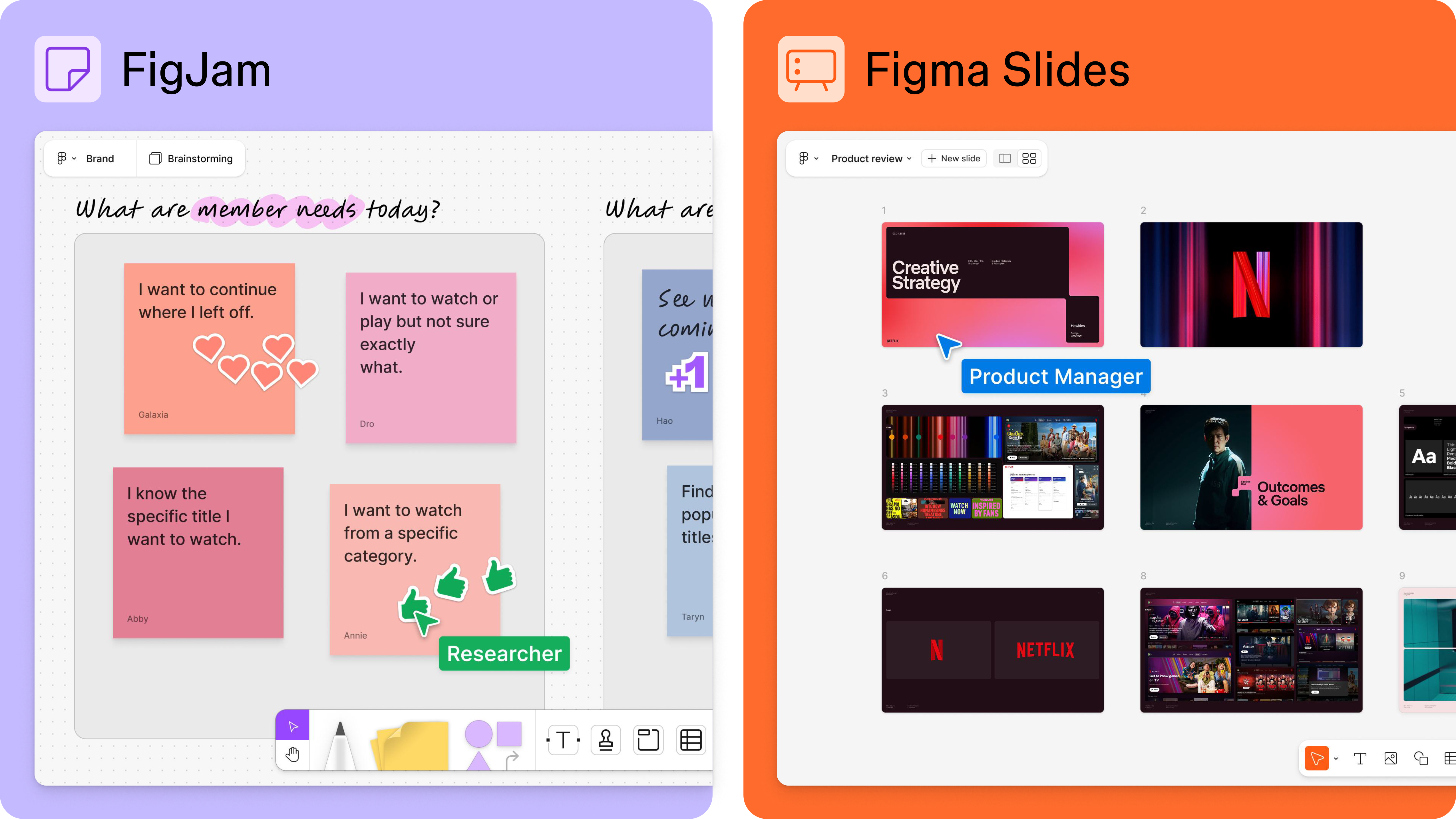
In the early phases of product development, teams come together to brainstorm ideas and eventually
align on potential paths forward. FigJam and Figma Slides are products we have built to facilitate these
activities.
FigJam is our product tailored for ideation, brainstorming, and rapid communication of ideas. Designed for
users of all skill levels, FigJam makes everything from personal projects to solo ideation to team meetings
more engaging and fun. This is made possible by facilitation features like timers and voting, but also fun
features that give participants more ways to express themselves, like ephemeral emoji reactions, a photo
booth that lets you take a quick selfie, or the ability to give high-fives. We also offer rich diagramming
capabilities to make it easy to convey more abstract ideas through user journeys or technical diagrams for
engineering. In FigJam, users can also use AI to generate templates for group brainstorms and
summarize meeting notes in seconds.
Figma Slides helps teams collaboratively make compelling, engaging presentations that drive and
maintain alignment. What makes this product especially effective for product teams is the way it marries
Figma’s powerful design features — such as the ability to embed prototypes, create high-fidelity
animations, or make detailed edits to mock-ups directly in a slide — with strong real-time collaboration
capabilities like seamless multiplayer editing and audience voting.
Often, these products are used side-by-side — what starts in a brainstorm in FigJam can lead to a pitch
deck in Figma Slides. We aim to make the transition between these products easy with features like AI
that can turn FigJam stickies into a Figma Slides presentation.
Visualize with Figma Design and Figma Draw
As ideas become more concrete and teams align on a path forward, they move toward visualizing these
ideas at a higher fidelity. Often, they draw mock-ups to explore directions more deeply, or build realistic
prototypes to validate designs. Figma Design is where all of this happens.
Designers at this stage want the freedom to rapidly explore concepts and express their ideas fully without
being constrained by the tools they’re using. This is why Figma Design offers a wide range of features
that make it possible to visualize ideas with high fidelity, including typography features or vector editing
capabilities that add texture and dimension to designs. In some cases, designers want to make more
detailed, finer edits to key assets in their design, like icons and product illustrations. For these users,
we’ve created Figma Draw, which is a dedicated space for vector editing within Figma Design.
To facilitate rapid exploration and iteration at this stage, these tools have a strong focus on ergonomics
and efficiency. Our AI features are examples of this. By automating tedious, repetitive tasks like removing
backgrounds from images or renaming layers in the design, or filling the mock-ups with realistic content to
more closely resemble the final product that ends up in users’ hands (rather than lorem ipsum, for
example). First Draft is an AI feature that allows users to go from blank canvas to editable user interfaces
with a simple prompt.
As designs begin to solidify, designers also seek to add more structure to the design that better maps to
the constraints and requirements of a production environment. Figma Design offers a rich set of “design
systems” features in service of this: capabilities that allow teams to define flexible, reusable building
blocks that make it easy for anyone to assemble a design without ever starting from scratch. We’ve found
that teams are motivated to invest deeply in design systems, as their primary benefit is creating efficiency
and consistency at scale. Teams save time by no longer needing to constantly worry about pixel-level
details, and design systems help remove translation errors between designers and developers by sharing
the same building blocks and language across design and code.
More often than not, though, a static visualization of an idea isn’t enough to validate a direction. That’s
why users take advantage of Figma’s rich prototyping capabilities, which let users string together different
screens into a dynamic, interactive flow. These prototypes are often circulated within an organization to
socialize an idea or put in front of customers in user testing to validate a particular concept in a more
realistic way.
Build with Dev Mode
Once the designs are ready, it’s time to translate them into code. Dev Mode is our dedicated space for
developers where this translation occurs, built to streamline the back and forth between design and
engineering and reduce the miscommunication that often happens during this step.
In Dev Mode, developers can inspect the designs to see key details most relevant to them, like special
annotations left by designers, documentation about the components used, or what’s changed since they
last saw the design.
Importantly, developers can choose to view these designs in the format they understand most: code. Dev
Mode generates platform-specific, ready-to-use code from the designs that developers can directly copy;
teams can also connect their design systems to their codebase via Code Connect which helps ensure the
code snippets developers see are correct, familiar, and production-ready.
Recently, we’ve also added our own MCP server to Dev Mode, which allows developers to connect an
agent in their code editor directly to designs in Figma. Developers can ask the agent to inspect the design
and use this context to convert it into working code in their codebase.
A traditional design-to-development handoff process often involves a spec or document that can quickly
get outdated as teams continue to iterate on designs. One of Dev Mode’s key value propositions is
allowing designers, developers, and even agents to work in the very same file while giving each a
different view of the work tailored to their respective needs. This helps maintain a single source of truth
that literally keeps everyone on the same page.
Ship with Figma Sites, promote in Figma Buzz
The last step of any product development process is shipping the code that’s been written to production,
to get your product launched. Figma Sites represents our first offering that ships a design directly to
production, by allowing you to publish a design as a working website, with a URL of your choice, that
anyone in the world can access.
Figma Sites includes features that help make designs production-ready for the web, like breakpoints that
make websites responsive across different window sizes and devices. It also supports the ability to
augment designs with code (via a feature called code layers) to help make more powerful, dynamic
experiences, like adding special motion effects or an interactive form, that would otherwise have been
impossible to build with just a design tool. Figma Sites also includes a CMS that makes it easy for anyone
to make changes to the content on a website, like a blog post or the price of an item being sold on the
site, without worrying about breaking the underlying code or design.
Once a product has been shipped to production, the last step is to actually promote it, to ensure existing
and prospective users are aware of the value of what’s launched. This is where Figma Buzz comes in —
a tool that makes it easy to create on-brand marketing collateral, like social media assets, digital ads, and
more.
Similar to Figma Slides and FigJam, Figma Buzz is designed for users of any skill level. Figma Buzz
makes it easy to take a template and edit its contents, or create assets in bulk from templates (e.g., for
multiple locales or different social media platforms). The product simplifies the collaboration between a
brand designer and a marketer. Designers are able to access the more sophisticated tools necessary to
set up a beautiful template, while marketers can make edits to the simpler view of the content without
worrying about “messing up” the design. In addition to these template capabilities, Figma Buzz has a slew
of other features that marketers may need, like AI features to edit text and images, or easy ways to
generate hundreds of assets from data in a spreadsheet.
Ideate, visualize, build, and ship — all at once, with Figma Make
We believe AI is fundamentally transforming the product development process by making it possible for
anyone to quickly turn an idea into a functional prototype, or in some cases, a working product. Figma
Make is our product for this new paradigm.
Instead of going from idea to wireframe to mock-up to prototype iteratively, Figma Make lets users go
directly from prompt to working prototype, at which point they can immediately validate an idea and
choose to iterate on it, or discard it altogether. Like Figma Sites, what’s created in Figma Make —
whether it is a dynamic prototype or web app — can be published to a URL for anyone to use.
While it’s possible for AI to get to working software with a simple prompt, we believe that the most
important differentiator is craft — ensuring that the product looks, feels, and works “just right.” We’ve
designed Figma Make to offer fast and powerful ways to iterate and refine its output. Users are free to
use the best way to improve the design of their product, whether via further prompting, editing code
directly, or visual manipulation. They are also able to easily reference their designs in Figma Design (via
copy-paste or importing) to ensure the output feels consistent and familiar, taking heavy inspiration from
existing styles and patterns.
With Figma Make, we believe even more people will be able to create functional, dynamic prototypes and
software, as it lowers the floor to let absolutely anyone transform their idea into something that works. At
the same time, it raises the ceiling of what’s possible by giving people access to capabilities that weren’t
possible in their current tools, whether that’s allowing designers to tap into the power and expressiveness
of code, or allowing developers to enjoy the freedom and speed of visual manipulation.
The benefits of combining rapid prototyping with a highly performant and sophisticated design tool give
users the best of both worlds: the ability to move quickly while having access to the tools needed to refine
the design.
An integrated design and product development platform
These products come together to serve more parts of the software development lifecycle and truly push
something from an idea all the way to a final product. With these products, Figma has become a design
and product development platform that houses everything from the initial brainstorm to the pitch deck to
the design spec to the final implementation.
Underlying each of our products is the same DNA that makes them uniquely Figma. Each of these
products is built from the ground up with multiplayer in mind — built for the browser with the power of
WebGL to allow our users to engage in real-time collaboration and seamless sharing as team members
work simultaneously in the same document. Each of these products is supercharged with AI capabilities
— ranging from automating rote tasks (like summarizing brainstorms, wiring up prototypes, enhancing
images, or filling mock content) to unlocking new superpowers (like dreaming up brand new designs from
a singular prompt). Each of these products allows for seamless interoperability — making it possible to
allow content to move fluidly between products and modes, or for different personas to have views of the
same content that are tailored to their needs and roles. And all of them are built with extensibility in mind
— allowing our users to leverage our APIs and plugin architecture to customize their experience to their
specific needs, like connecting designs to their own tools, databases, and codebases.
As we’ve built out these new tools, we’ve simultaneously invested in our platform infrastructure, giving us
the ability to incubate, test, and launch new products more easily. While our primary focus will remain on
product teams building software, we believe we have the ingredients needed to explore adjacencies over
time.
Our Community
We exist to serve anyone designing and building products and digital experiences. Customers of all sizes,
spanning industries and geographies, bring their work to life in Figma.
We have focused on creating deep ties with our users and customers since day one. In Figma’s early
days, this meant our founders making house-calls to customers’ offices to troubleshoot a product issue; or
traveling to Nigeria to visit a growing group of Figma users. Our deep community focus has helped fuel
the creation of more than 200 Friends of Figma chapters across the world — from Lagos to Los Angeles
— that organized over 650 events in 2024. Together, they share and collaborate on work, either in person
or virtually on Figma’s Community resources platform. Many spend hours a day in our products as part of
their day jobs and side hustles. Some even get Figma tattoos.
We engage with our community through in-person and virtual touchpoints. Config — our annual
conference that started in 2020 — brings thousands of designers, developers, and product teams to San
Francisco to meet, learn, and get inspired. Our always-on programming, like product livestreams,
community meetups, and our leadership collective events, engage a broad range of customers from
students to executive leaders. And our lively product forums, social channels, and hundreds of Friends of
Figma chapters around the world create active dialogue around our products and provide a peer network
for support.
We know how unique it is for a software company to have such a strong and passionate community
championing its products. This vast, growing, and global community has a deep shared identity as
designers and product builders. Their voices are essential to our own product development process,
pushing the bounds of our existing products and inspiring us to make new ones.
We believe building for and with our users drives revenue and long-term loyalty. The close ties we have
developed with our community since day one have opened lines of communication ingrained in how we
work, helping us respond quickly to customer feedback and innovate for customer needs.
Our Culture
The Figma team (we call ourselves Figmates) is a group of builders, makers, and tinkerers with deep
connections to our users and a passion for building and shipping. We are able to attract incredible talent
because we have the opportunity to shape how teams around the world design and build products.
We feed this maker spirit in many ways including an annual company-wide Maker Week — a full week we
set aside for Figmates to pitch, develop, and execute on new ideas or projects with one another. The only
requirement is that the ideas benefit Figma in some way. A number of products, features, and projects
were born during Maker Week such as Figma Slides, multi-edit, several FigJam features, and our
extensibility API. As these examples show, great ideas can come from anywhere, and any Figmate can
drive impact, regardless of their level or tenure. We find this way of working makes our culture unique and
helps us attract and retain employees with builder DNA.
We drive Figma’s culture by embedding our five cultural values into how we work day to day. These
values serve as an operating system for decision-making and organizational behavior. We chose them to
be in tension with one another and their relative importance varies at different times. Taken together, they
paint a clear picture of what we value and why.
1.Build Community: We’re multiplayer people, and we love the weird, wonderful magic that
happens when humans connect. We bring people together so they can bring new ideas to life.
2.Love Your Craft: We build for builders, and try to make complex things feel simple. In our
products and process, we invest in the details few people see, but everyone feels.
3.Run With It: When you see something that needs doing, do it. When you have a great idea, run
with it. Tackle big, scary, exciting challenges like Figma’s future depends on it. Because it does.
4.Grow As You Go: Everyone’s a work-in-progress, and we’re here to help each other grow. So
along with ❤ and , we share the direct feedback we all need to become great at what we do.
5.Play: Playing is learning. We embrace spontaneous, unstructured exploration — because that’s
where we find our best ideas.
Lastly, in line with our Grow As You Go value, listening to feedback across every touchpoint with users
and customers is deeply embedded in our culture and how we work.
Our Business Model
Our subscription model is designed to meet the diverse and evolving needs of our growing community
and customer base. Access to Figma is sold as an annual or monthly subscription, per seat. Everyone
from independent freelancers to entire product teams at Fortune 500 companies design and build
products and digital experiences in Figma. We offer different seats and plans tailored to the specific
security, product, and administrative needs of different users, organizations, and industries.
To meet our users where they are, we offer a variety of ways to try, use, and purchase Figma.
•We have an automated and highly efficient self-service option, available through Figma.com. To
support our self-serve offering, our marketing team utilizes organic and paid channels to drive
awareness and usage of all of our products.
•We have a direct sales process through which we partner with customers to set up new accounts,
upgrade customers across plans, and expand existing accounts.
Plans
Our plans range from a more limited free offering to more advanced plans built in partnership with our
customers that meet the specific needs of the larger organizations using our platform.
•Our Starter plan is free and is designed for working on personal projects. It provides an easy
way for new users to try our design and collaboration tools.
•Our Professional plan is designed for individuals and small teams. It provides access to
unlimited files and projects, as well as design libraries for a single team.
•Our Organization plan is designed for businesses with multiple teams. The functionality on this
plan allows everyone to collaborate in one Figma workspace while keeping everything safe and
secure with centralized admin and security features.
•Our Enterprise plan is designed for businesses managing multiple products or brands. This plan
provides custom team workspaces, automated design system management, and enterprise-level
controls and compliance.
(11) The Content seat was announced in May 2025 and is not yet available. Figma Sites CMS is currently in beta and seat access
may change once it becomes generally available.
(12) Figma Make, Figma Buzz, Figma Draw, and Figma Sites are currently in beta. Seat access with respect to these products may
change once they become generally available.
Seats
Rather than a one-size-fits all approach, we offer different seats tailored to specific user needs and
workflows. At the same time, we also see roles continuing to blur as the product-development process
keeps evolving.
•The Viewer seat allows users to view files and leave comments for free.
•The Collab seat gives access to FigJam and Figma Slides.
•The Content seat gives access to Figma Buzz, Figma Sites CMS, FigJam, and Figma Slides.11
•The Dev seat gives access to Dev Mode, in addition to Figma Buzz, Figma Sites CMS, FigJam,
and Figma Slides.
•The Full seat gives access to all of Figma Design, Figma Draw, Figma Make, Dev Mode, Figma
Buzz, Figma Sites, FigJam, and Figma Slides.12
Over time, we expect to introduce products and services that may be billed differently than on a per seat
basis, such as an add-on or pricing with limits on feature usage. We believe these additional options can
provide users with flexibility in how they use and pay for products and features. We also expect that this
type of billing may be less predictable than subscription-based revenue.
Our Go-To-Market Motion
The combination of Figma’s reputation as a product design leader, the product virality inherent to Figma’s
collaborative and browser-based platform, and our integrated marketing efforts have successfully driven
awareness and adoption. Over time, many of our users grow with us into larger, managed accounts that
often include more seats and more products for users within their organizations. During each of the year
ended December 31, 2024 and the three months ended March 31, 2025, approximately 70% of new
Organization and Enterprise plan customers included at least one user who was previously a member of
a Professional plan.
The value Figma’s products have created for our community has helped us earn their trust and support.
It’s not uncommon for Figma users, particularly those who are active members of our community, to
champion the collaborative, design-led way of working that Figma offers to their teams.
While our product-led, bottoms-up adoption contributes to our growth, our direct sales motion helps us
serve larger customers. Our global sales and marketing teams work hand-in-hand with Figma’s
expanding network of customer champions to scale our products within organizations and increase
adoption across plans. In addition to word-of-mouth, our marketing efforts include a variety of digital and
in-person channels that bring new users to our platform. We support new users in the discovery phase by
sharing content across channels like livestreams, YouTube, social media, in-product, and by email. These
resources help new users explore and understand the capabilities of our products.
Our integrated sales motion is collaborative by design, bringing both customer champions and Figmates
with deep product expertise into the conversation. Our sales team works closely with solutions
consultants, who understand how Figma’s products map to specific customer needs, and designer and
developer advocates with deep technical understanding of our products and close ties to the communities
we serve. While approximately 70% of our revenue for each of the year ended December 31, 2024 and
the three months ended March 31, 2025, came from customers on Organization and Enterprise plans, we
continue to build features and products designed to create value for all of our customers.
We believe exceptional customer support is core to a great product experience. This is why we have built
a global support function that provides customer assistance in multiple languages for all paid users. We
encourage all Figmates, including our executive team, to speak with customers and understand their
feedback, whether it’s in person or online. You’ll often see leaders across the company dive into and work
to actively resolve customer issues raised in support forums or on social platforms. Our customer support
associates also use the latest in AI to solve customer needs quickly and efficiently.
Figma’s partner ecosystem, which includes product integrations and distribution partnerships, drives
further retention and adoption of our platform. Through collaborations with companies like Microsoft,
Atlassian, Zoom, Notion, and Linear, and integrations with tools like GitHub, Visual Studio Code, and
Storybook, users are connected to Figma from within their existing workflows. These partnerships
generate awareness and cultivate lasting engagement. Certified service partners around the globe also
provide training, enablement, and specific project support for customers. Additionally, Apple, Google
Material Design and other organizations make their design resources available natively through Figma’s
user interfaces to facilitate users designing and developing for their respective platforms.
From the beginning, Figma’s Professional plan has been free for educators and students through our
Figma for Education program. This includes higher education institutions, bootcamps, and workshops. We
also make Figma’s Organization plan available for free for K-12 students and educators to help develop
the next generation of product builders.



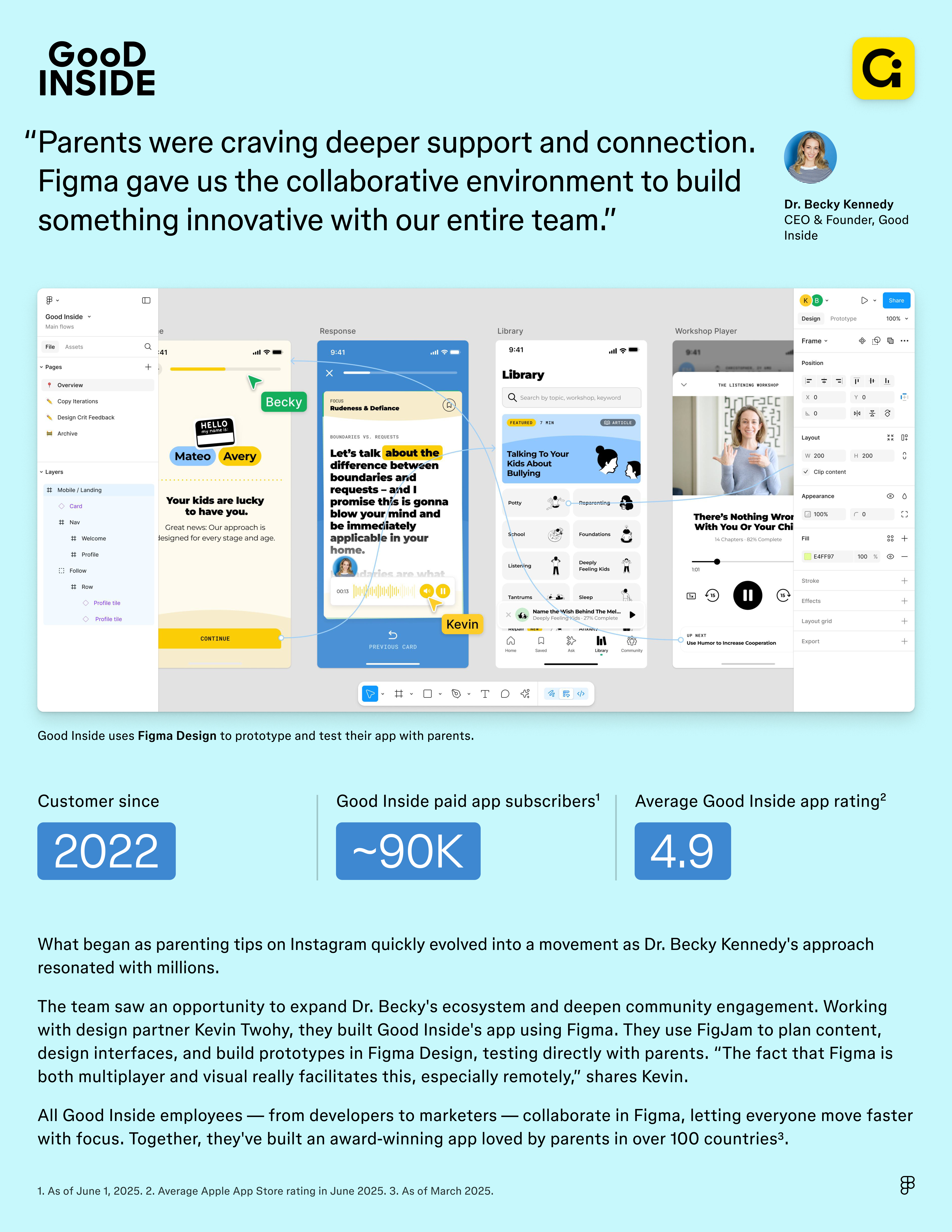
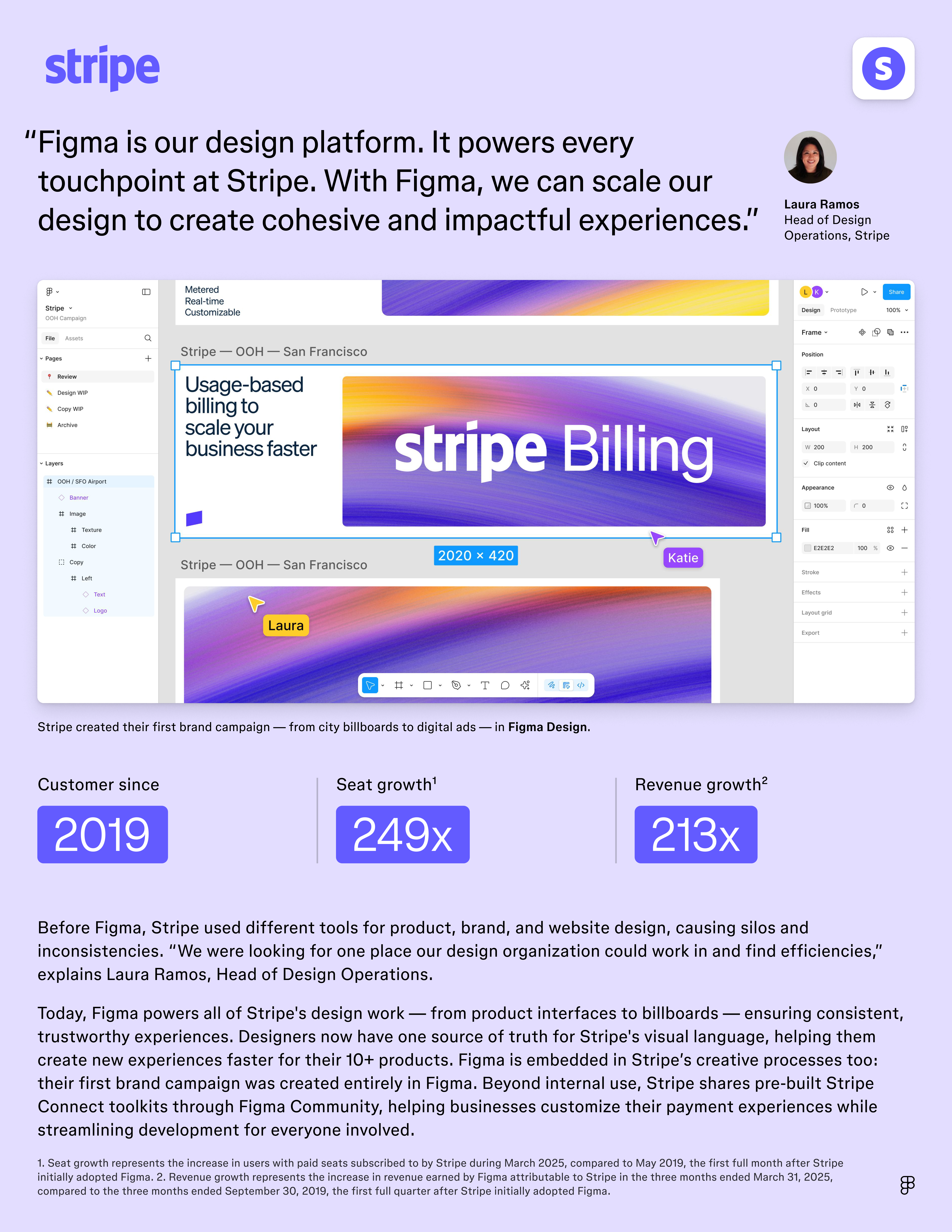

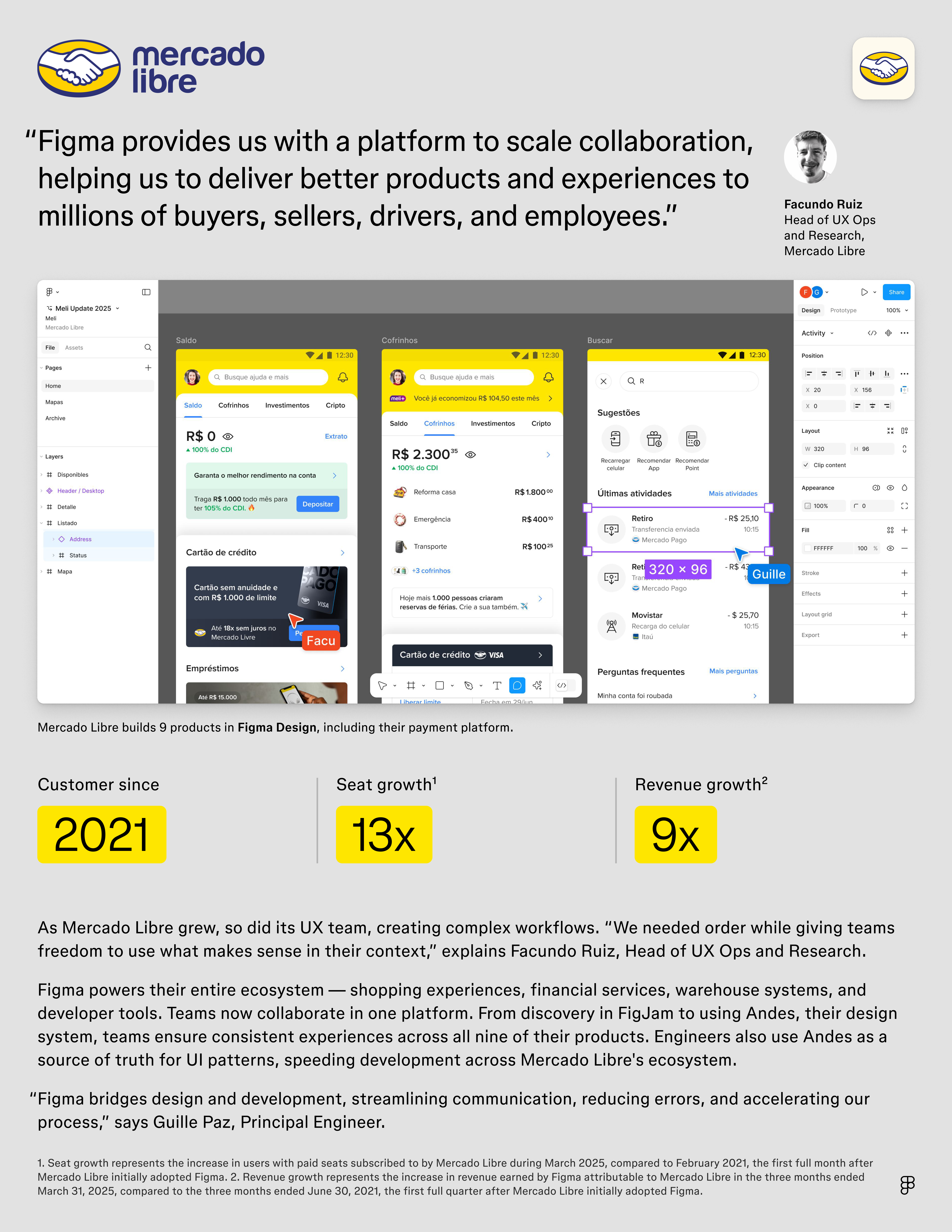
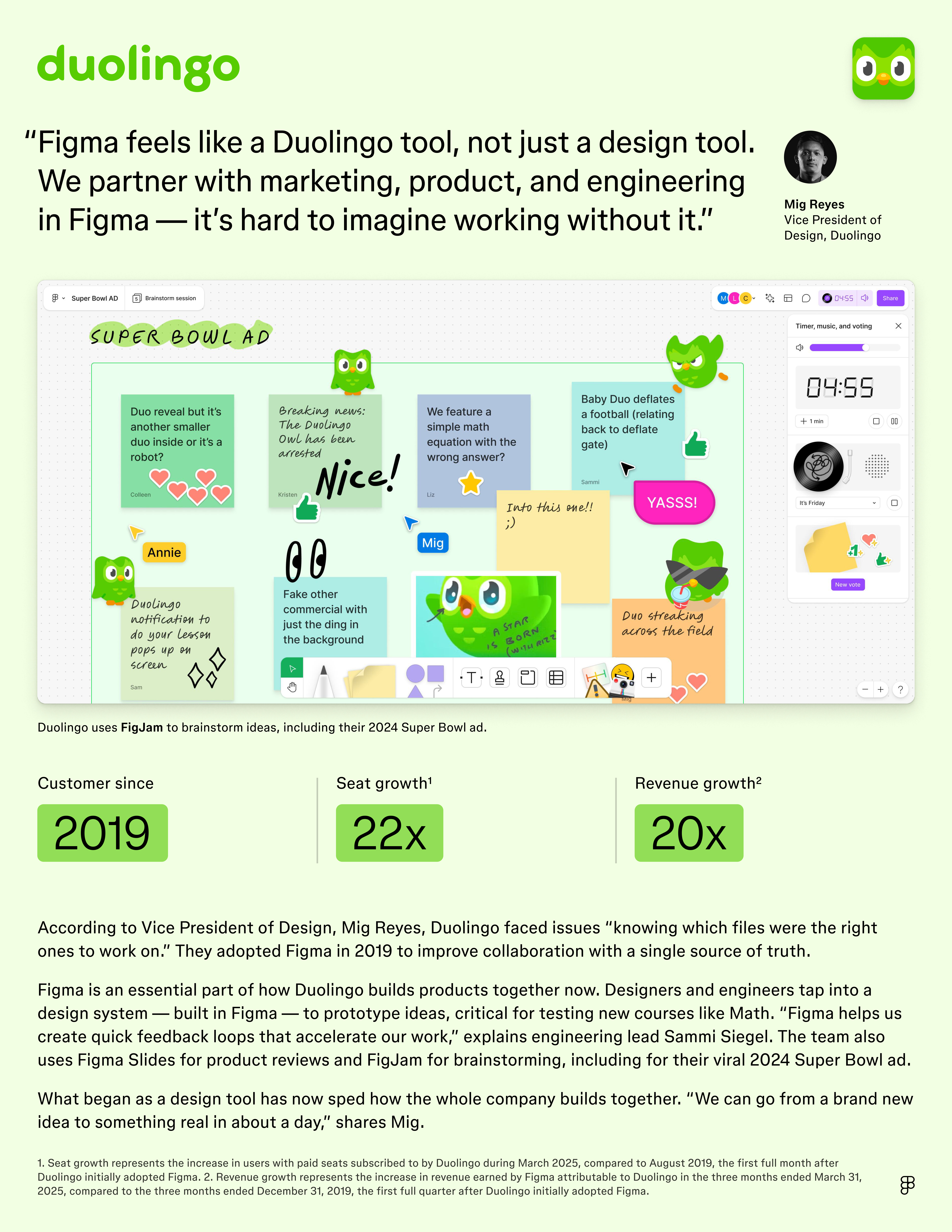
Growth Strategy
We have focused on building a company for the long-term since day one. We will keep investing in our
platform across our key growth levers.
•Maintaining our rapid and proven pace of product innovation: Since launching our core
product Figma Design in 2015, we have expanded our platform to serve more parts of the product
development process with FigJam, Figma Slides, Figma Draw, Figma Make, Dev Mode, Figma
Sites, and Figma Buzz. We’ve also integrated AI functionality extensively across our platform—
from standalone products like Figma Make to native AI features that automate rote, repetitive
tasks in FigJam and Figma Design, to our Dev Mode MCP server, which allows developers to
bring context from Figma into agentic coding tools, resulting in a more efficient and accurate
design-to-code workflow.
We have also added powerful features and functionality within existing products like widgets and
improved diagramming in FigJam; auto layout, grids, multi-edit, variables, and interactive
components in Figma Design; Code Connect, annotations, and status updates in Dev Mode; as
well as object animations and video capabilities, and code layers to bring AI into Figma Sites. In
2024 alone, we shipped 180 new features and updates. At the same time, we have worked to
improve the speed, reliability, and overall performance of our underlying infrastructure. For
example, we improved the median load time for the largest files on our platform by approximately
45% between the quarters ended March 31, 2023 and March 31, 2025. Our proven pace of
innovation and commitment to continuous improvement help our customers do even more, faster
in Figma.
Approximately 46% of employees were in research and development as of March 31, 2025. We
will continue investing significantly in our platform and team so that we can continue to deliver
new products and capabilities to customers.
•Converting new and existing users into Paid Customers: We believe companies of all sizes
need to interact with their customers through software and other digital products to stay
competitive. Customers are building apps and websites, and in many cases their entire digital
relationship with their customers in Figma. Companies have also used Figma to design and build
internal software applications and tools for frontline employees, in-office knowledge workers, and
everyone in between.
Our range of plans offer options for all types of users, including a free Starter plan. We also have
a free offering for students and educators. Our Starter plan makes it easy for anyone to quickly
get started with Figma and experience the benefits of our platform. More advanced functionality is
available on our paid plans, including features like shared libraries and custom workspaces.
These features are designed to meet the specific and complex needs of teams, creating a
compelling reason for our free users to convert into paying customers.
•Growing within current customers: Figma’s user base grew organically as more people began
to participate in the design and broader product development process. We have also been able to
grow and expand within our existing customer base by introducing new products that meet
specific user needs and serve different parts of the product development process. For example,
while developers made up a large portion of Figma’s user base since the beginning, we knew that
Figma was not fully meeting their needs. In response, we built Dev Mode, which is tailor-made for
developer audiences and built with their specific ways of working in mind. Marketers have long
used Figma, and we introduced Figma Buzz to allow them to create on-brand assets at scale.
Our Net Dollar Retention Rate of 132% as of March 31, 2025 shows the natural expansion of our
platform and the adoption of new products by our customers. While 78% of the Forbes Global
2000 used Figma in March 2025, only 24% spend more than $100,000 in ARR on Figma as of
March 31, 2025. This represents a significant opportunity for growth moving forward.
•Extending our platform: We continue to invest in the extensibility of Figma’s platform as a way
to create more value for our users. In 2019, we introduced the ability to build plugins in Figma
Design that help teams fully connect their workflows, bring in real data, and accelerate their
design process. In 2021, we expanded this plugin capability to FigJam, along with the ability to
build custom interactive widgets that enable collaborative and interactive experiences, like voting,
polls, and on-canvas games. In 2025, we made plugins available for Figma Slides. Our
Community platform invites Figma users to share and use widgets and plugins that help extend
the power and functionality of Figma. And we have a number of product integrations that make
users’ workflows more seamless and in line with their needs.
•Expanding our international footprint: Our business has been global from the start. During the
three months ended March 31, 2025, approximately 85% of our monthly active users were based
outside of the United States but only 53% of our revenue came from non-U.S. markets during the
same period, which we believe represents an opportunity for us to continue to drive growth and
expansion. As of March 31, 2025, our product is currently available in English, Japanese,
Spanish, Korean, and Portuguese; we accept five currencies; our marketing and support
channels are available in six languages; and we had nine offices in seven countries, with local
staff spread across 13 countries and five continents. We will continue to invest in localizing our
products and in our international operations to meet our customers where they are.
•Making strategic acquisitions and investments: We have made more than ten acquisitions
since Figma’s founding. Our corporate development framework evaluates opportunities from
small acqui-hires to scaled product acquisitions. We have a history of integrating our acquisitions
to accelerate growth. For example, an acquisition we made in 2021 seeded the team that built
Dev Mode. We will build on our track record of integrating teams to accelerate our roadmap and
to expand our platform.
We also created Figma Ventures as a way to invest in teams building incredible products. In
addition to supporting great companies, we believe that Figma Ventures can help grow the
broader ecosystem and allows us to learn about new tools and ways of working, continuing to
push how we can partner with these companies. As of March 31, 2025, Figma Ventures had
invested in 18 companies.
Security, Privacy, and Data Protection
We have worked hard to build deep ties and trust with our users, and we invest significant time and
resources to protect the privacy and security of our customers’ data.
Security
We devote considerable resources to our security program so that organizations on our platform have
confidence in our custodianship of their data. Our security program is regularly audited by qualified
independent external auditors against recognized audit standards such as ISO 27001 and SOC 2 Type II
(each defined below), as well as by the organizations on our platform.
Our security program consists of the following:
•organizational security including personnel security, security and privacy training, a team of
dedicated security professionals, policies and standards, separation of duties, regular audits,
compliance activities, and third-party assessments;
•secure-by-design principles by which we assess the security risk of each software development
project according to our secure development lifecycle and create a set of requirements that must
be met before the resulting change may be released to production; and
•a public bug bounty program to facilitate responsible disclosure of potential security vulnerabilities
identified by external researchers and reward them for their verified findings.
The focus of our security program is to prevent unauthorized access to the data of organizations on our
platform. Our team of security practitioners, working in partnership with peers across Figma, work to
identify and mitigate risks, implement best practices, and continue to evaluate ways to improve. These
steps include data encryption in transit and storage, network security, classifying and inventorying data,
limiting and authorizing access controls, and multi-factor authentication for access to systems used to
provide our platform to customers. We also employ regular system monitoring, logging, and alerting to
retain and analyze the security state of our technology infrastructure.
In addition, our security program has achieved several internationally-recognized certifications and
industry standard audited attestations of our security controls and maintains a number of compliance
programs.
The International Organization for Standardization (“ISO”) has developed a series of standards for
information security and related areas, and we have received the following ISO certifications:
•ISO/IEC 27001 (Information Security Management);
•ISO/IEC 27701 (Privacy Information Management);
•ISO/IEC 27017 (Security Controls for the Provisions and Use of Cloud Services); and
•ISO/IEC 27018 (Protection of Personally Identifiable Information).
Service Organization Controls (“SOC”) are standards established by the American Institute of Certified
Public Accountants for reporting on internal control environments implemented within an organization. We
have completed SOC 2 and SOC 3 examinations.
We are a member of the Cloud Security Alliance (the “CSA”). The CSA Security, Trust, Assurance, and
Risk Registry (the “STAR”) is a publicly-accessible registry that offers a security assurance program for
cloud services, helping organizations assess the security posture of cloud providers they currently use or
are considering using. We meet the requirements of the STAR Level 1 Self-Assessment.
FedRAMP is a U.S. government program that provides a standardized approach to security assessment,
authorization, and continuous monitoring for cloud products and services and allows federal agencies to
accelerate cloud adoption initiatives. We have achieved a FedRAMP Authority to Operate at the
moderate impact level, issued by the General Services Administration, for our Figma for Government
offering.
Privacy and Data Protection
The privacy and protection of customer and employee data is important to our platform’s continued
growth and success. Privacy is a shared responsibility among all our employees, but we also have a
dedicated privacy team that builds and executes on our privacy program, including the management of
data protection impact assessments, and periodic privacy and security training for our employees. Our
privacy, security, and legal teams work together to conduct product and feature reviews, data inventory,
and support for data protection and privacy-related requests.
We receive, store, process, share, and transfer personal data from individuals including our employees,
customers, and the employees of our customers and third-party vendors including payment card
information. We are therefore subject to U.S. (federal, state, local) and international laws and regulations,
including in the EEA and the UK, regarding data privacy, security, and our use of such data.
In relation to Figma Design and FigJam, we certify ourselves against Level 2 of the EU Cloud Code of
Conduct, and our assessment report is available for download on both the EU Cloud Code of Conduct
Registry and CSA STAR Registry. The EU Cloud Code of Conduct translates GDPR requirements into
practical guidelines for Cloud Service Providers, offering cloud-specific approaches, recommendations,
and a roadmap that aligns with GDPR and international standards like ISO 27001 and ISO 27018. We
also maintain a self-certification under the EU-US DPF, the UK Extension to the EU-US DPF, and Swiss-
US Data Privacy Framework and also put in place the SCCs and/or the UK Information Commissioner’s
Officer’s Addendum to the SCCs as required for the transfer of personal data.
Our Employees
As of March 31, 2025, we had a total of 1,646 Figmates, a substantial majority of whom work in the
United States, in addition to employees working in Australia, Canada, Japan, Singapore, the UK, France,
Germany, and other locations across Europe. To our knowledge, none of our employees are currently
represented by a labor union. In certain countries in which we operate, we are subject to, and comply
with, local labor law requirements which may automatically make our employees subject to industry-wide
collective bargaining agreements. We supplement our workforce with contractors and consultants. We
have not experienced any work stoppages.
Figma has invested substantial time and resources into building a highly-talented team. Our success is
highly dependent on our management and employees, and it is crucial that we continue to attract and
retain top talent. To facilitate the attraction and retention of top talent, we strive to make Figma a place
where everyone can do their best work, with opportunities for our employees to grow and develop in their
careers.
Competition
Our industry is growing, highly competitive, and rapidly evolving. Our platform addresses a broad range of
needs for designing and building software. We face competition from a number of companies. This
ranges from companies that cater to multiple stages of the design and development process to point tools
that address specific parts of the process but can expand to cover more. Our competitive set also
includes design-to-code and AI-driven companies and tools that compress or accelerate steps in the
workflow or take a different approach to building digital experiences, as well as customized or internal
solutions used by our customers or potential customers.
We believe that the principal competitive factors in our industry include:
•breadth of platform and product offerings;
•ease of deployment and use of applications;
•ability to collaborate with other users;
•product features, quality, and functionality;
•ability to automate processes;
•ability to integrate with other applications and systems;
•capability for customization, configurability, integration, security, compliance, scalability, and
reliability of applications and solutions;
•vision for the market;
•speed and consistency of product innovation;
•size of customer base and level of user adoption;
•pricing and total cost of ownership;
•strength of sales and marketing efforts;
•brand awareness and reputation;
•an engaged global community of users; and
•customer experience, including support.
We believe we compete favorably with our competitors on the basis of the factors described above.
Intellectual Property
Our intellectual property is an important aspect of our business and helps us to maintain our competitive
position. To establish and protect our rights in our proprietary technology, we rely on a combination of
patent, copyright, trade secret, and trademark laws, and contractual restrictions such as confidentiality
agreements, licenses, and intellectual property assignment agreements.
As of March 31, 2025, we owned the following issued patents and patent applications related to the
business: 15 issued U.S. patents, 64 U.S. patent applications, and 62 non-U.S. pending patent
applications. Our issued U.S. patents, and any patents that may issue from our pending U.S. patent
applications, are scheduled or likely to expire at dates ranging between 2034 and 2044, which may
exclude any additional term for patent term adjustments or extensions. To protect our brand, as of March
31, 2025, we owned a trademark portfolio comprised of 89 registered trademarks and 16 trademark
applications pending with filings in 27 countries, Hong Kong, and the EU. Finally, we have registered
domain names for websites that we use or hold for use in our business, including our primary website
www.figma.com.
Figma controls access to our intellectual property and confidential information through internal and
external controls. We maintain a policy requiring our employees, contractors, consultants, and other third
parties to enter into confidentiality and proprietary rights agreements. These agreements control access
to, use of, and non-disclosure of, our proprietary information. No assurance can be given that these
agreements will be effective in controlling access to, and non-disclosure and use of, our proprietary
information. We intend to pursue additional intellectual property protection to the extent we believe it
would be beneficial and cost effective. Despite our efforts to protect our intellectual property rights, they
may not be sufficient, effective, or respected in the future, or may be circumvented or challenged, which
could result in such rights being narrowed in scope or declared invalid or unenforceable. In addition, the
laws of various foreign countries where our products are distributed may not protect our intellectual
property rights to the same extent as laws in the United States.
Regulatory Matters
We are subject to the laws and regulations of various jurisdictions and governmental agencies affecting
our operations and the sale of our platform in areas including, but not limited to: intellectual property; data
privacy and security requirements; AI; tax; import and export controls; anti-bribery and corruption;
economic and trade sanctions; national security and foreign investment; competition; advertising;
employment; product regulations; and consumer laws.
See the section titled “Risk Factors” for additional information regarding risks we face related to regulatory
matters.
Facilities
We are headquartered in San Francisco, California, where we occupy approximately 98,000 square feet
of office space pursuant to a lease that is expected to expire in 2028, subject to the terms thereof. We
also lease or purchase service memberships to additional facilities in New York, New York; London, U.K.;
Berlin, Germany; Tokyo, Japan; Paris, France; Singapore; Seattle, Washington; and Sydney, Australia.
These offices are leased and we do not own any real property.
We believe that our current facilities are adequate to meet our current needs and that, should it be
needed, suitable additional or alternative space will be available to accommodate our operations.
Legal Proceedings
We are not currently a party to any material pending legal proceedings, including unresolved regulatory
investigations and inquiries. From time to time, we may be subject to legal proceedings and claims arising
in the ordinary course of business. The results of any current or future litigation cannot be predicted with
certainty, and regardless of the outcome, litigation can have an adverse impact on us because of defense
and settlement costs, diversion of management resources, and other factors.
Management
Executive Officers and Non-Employee
Directors
The following table provides information regarding our executive officers and non-employee directors as
of July 1, 2025:
Name | Age | Position(s) | ||
Executive Officers: | ||||
Dylan Field ......................................... | 33 | Chair of our Board of Directors, Chief Executive Officer, and President | ||
Praveer Melwani ................................ | 35 | Chief Financial Officer and Treasurer | ||
Brendan Mulligan .............................. | 42 | General Counsel and Secretary | ||
Kris Rasmussen ................................ | 42 | Chief Technology Officer | ||
Shaunt Voskanian ............................. | 42 | Chief Revenue Officer | ||
Non-Employee Directors: | ||||
Mamoon Hamid(1)(2) ........................... | 47 | Director | ||
Kelly A. Kramer(1)(2) ........................... | 57 | Director | ||
John Lilly(1)(3)(4) ................................... | 54 | Director | ||
William R. McDermott ...................... | 63 | Director | ||
Andrew Reed(3) .................................. | 35 | Director | ||
Danny Rimer(2)(3) ................................ | 54 | Director | ||
Lynn Vojvodich Radakovich(1)(2) ...... | 57 | Director |
__________________
(1)Member of the audit committee.
(2)Member of the compensation committee.
(3)Member of the nominating and corporate governance committee.
(4)Lead independent director.
Executive Officers
Dylan Field is our Co-Founder and has served as our Chief Executive Officer, President, and a member
of our Board of Directors since October 2012, and Chair of our Board of Directors since April 2025. Mr.
Field attended Brown University for two and a half years before accepting a Thiel Fellowship to pursue
entrepreneurial projects. We believe Mr. Field is qualified to serve as a member of our Board of Directors
because of his operational expertise, industry knowledge, leadership, and the continuity that he brings to
our Board of Directors as our Co-Founder, Chief Executive Officer, and President.
Praveer Melwani has served as our Chief Financial Officer since March 2022 and Treasurer since
February 2024. Mr. Melwani previously served as our Head of Business Operations and Finance from
July 2017 to March 2022. Mr. Melwani previously held positions in Business Operations at NerdWallet,
Inc., a financial technology company, from September 2016 to June 2017, in Strategic Finance at
Dropbox, Inc., a cloud-based data technology platform, from February 2014 to September 2016, and in
investment banking at Union Square Advisors, an investment bank, from July 2012 to January 2014. Mr.
Melwani holds a B.A. in Business Administration from Ivey Business School at Western University.
Brendan Mulligan has served as our General Counsel and Secretary since February 2024. Mr. Mulligan
previously served as our VP of Legal from April 2022 to January 2024 and as our Director of Legal from
July 2019 to March 2022. Prior to that, Mr. Mulligan held legal positions of increasing responsibility at
Uber Technologies, Inc., a technology platform company, from September 2014 to July 2019. From
November 2010 to September 2014, Mr. Mulligan served as an Associate at Morrison & Foerster LLP, a
global law firm. Mr. Mulligan holds a J.D. from Columbia Law School and a B.S. in Animal Physiology and
Neuroscience from the University of California, San Diego.
Kris Rasmussen has served as our Chief Technology Officer since March 2022. Mr. Rasmussen
previously served as our Vice President of Engineering from April 2017 to March 2022. Prior to that, Mr.
Rasmussen served as an Engineering Lead at Asana, Inc., a software development company, from April
2010 to June 2013, as Co-Founder of RivalSoft Inc., a business-to-business mobile application company,
from February 2007 to June 2010 and as Chief Architect at Aptana, Inc., a web application company,
from August 2008 to April 2010. Mr. Rasmussen holds a B.A. in Computer Science from the University of
California, Los Angeles.
Shaunt Voskanian has served as our Chief Revenue Officer since October 2021. From January 2018 to
October 2021, Mr. Voskanian served in various sales leadership roles at Datadog, Inc., a cloud
technology company, including as Senior Vice President of Global Sales from January 2021 to October
2021, Vice President of Sales, America and EMEA, from January 2020 to January 2021, and as Vice
President of Sales, Americas, from January 2018 to January 2020. From August 2014 to January 2018,
Mr. Voskanian served in various sales roles at Oracle Corporation, a computer technology company. His
prior experience also includes sales roles at Google Inc., a technology company, Citrix Systems, Inc., a
computer technology company, and Experian plc, a data analytics and consumer credit reporting
company. Mr. Voskanian holds a B.S. in Communications from Boston University.
Non-Employee Directors
Mamoon Hamid has served as a member of our Board of Directors since December 2017. Mr. Hamid
has served as a Managing Member at Kleiner Perkins, a venture capital firm, since August 2017. Prior to
joining Kleiner Perkins, Mr. Hamid was Co-Founder and General Partner at Social Capital LP, a venture
capital fund, from October 2011 to August 2017. He currently serves on the boards of directors of several
privately held companies. Mr. Hamid holds a B.Sc. in Electrical and Computer Engineering from Purdue
University, an M.Sc. in Management Science & Engineering from Stanford University, and an M.B.A. from
Harvard Business School. We believe Mr. Hamid is qualified to serve as a member of our Board of
Directors because of his extensive experience in the technology and venture capital fields, including his
experience as a director of several privately held companies in the technology industry.
Kelly A. Kramer has served as a member of our Board of Directors since December 2021. From January
2015 to December 2020, Ms. Kramer served as Executive Vice President & Chief Financial Officer of
Cisco Systems, Inc. (“Cisco”), a technology company, where she previously served in finance roles of
increasing responsibility from January 2012 to January 2015. From February 2002 to February 2012, Ms.
Kramer served in various finance roles at GE Healthcare Systems, including as Vice President & Chief
Financial Officer, as well as in various finance roles at GE Healthcare Diagnostic Imaging and GE
Healthcare Biosciences, all divisions of General Electric Company, a multinational conglomerate focusing
on aviation, power, renewable energy, and digital industry. Ms. Kramer also has served on the boards of
directors of Coinbase Global, Inc., a technology company, since December 2020, Snowflake, Inc., a
cloud-data platform company, since January 2020, and Gilead Sciences, Inc., a biopharmaceutical
company, since August 2016. Ms. Kramer holds a B.S. in Mathematics from Purdue University. We
believe Ms. Kramer is qualified to serve as a member of our Board of Directors because of her extensive
financial and management experience.
John Lilly has served as a member of our Board of Directors since December 2014. Mr. Lilly has served
as a General Partner and Venture Partner at Greylock Partners, a venture capital firm, since January
2011. Prior to joining Greylock Partners, Mr. Lilly held roles of increasing seniority at the Mozilla
Corporation, a technology company, from 2005 to 2010, including as Chief Executive Officer from
January 2008 to December 2010. Prior to joining Mozilla Corporation, he co-founded and held executive
leadership positions at Reactivity, a software company acquired by Cisco in August 2007. Previously, he
held staff positions at Apple, Sun Microsystems, and Trilogy Software. He currently serves on the board
of directors of Duolingo, Inc., an education technology company. Mr. Lilly is also a Lecturer at Stanford’s
Graduate School of Business. Mr. Lilly holds a B.Sc. in Computer Systems Engineering and an M.Sc. in
Computer Science, both from Stanford University. We believe Mr. Lilly is qualified to serve as a member
of our Board of Directors because of his executive leadership experience and extensive experience with
the venture capital and technology industries.
William R. McDermott has served as a member of our Board of Directors since July 2025. Mr.
McDermott has served as Chief Executive Officer and President at ServiceNow, Inc., a public digital
workflow company (“ServiceNow”), since November 2019. Prior to joining ServiceNow, Mr. McDermott
served as Co-Chief Executive Officer from 2010 to 2014, and as sole Chief Executive Officer from May
2014 until October 2019 of SAP SE (“SAP”), a multinational software company that provides enterprise
software. Mr. McDermott joined SAP in 2002 as Chief Executive Officer of SAP America, Inc., and served
on the SAP Executive Board from 2010 until October 2019. Prior to joining SAP, Mr. McDermott served
as Executive Vice President of Worldwide Sales and Operations at Siebel CRM Systems, Inc. from 2001
to 2002 and served as President of Gartner, Inc. from 2000 to 2001. Mr. McDermott has also served on
the boards of directors of ServiceNow since November 2019, including as Chairman since October 2022,
and Zoom Communications, Inc., a cloud video communications company, since March 2022. Mr.
McDermott previously served on the boards of directors of Fisker Inc., an automotive technology
company, Under Armour, Inc., a sporting goods company, ANSYS, Inc., a provider of engineering and
simulation software and technologies, and SecureWorks Corp., a provider of intelligence-driven
information security solutions. Mr. McDermott holds a B.A. in business management from Dowling
College and an M.B.A from Northwestern University’s Kellogg School of Management, and has completed
the Executive Development Program at the Wharton School of Business. We believe Mr. McDermott is
qualified to serve as a member of our Board of Directors because of his executive leadership experience,
extensive experience with publicly traded technology companies as well as his service on the boards of
directors of other publicly held companies.
Andrew Reed has served as a member of our Board of Directors since February 2024. Mr. Reed has
served as a Partner at Sequoia Capital, a venture capital firm, since February 2014. Prior to joining
Sequoia, he served as an Analyst at Goldman Sachs, an investment bank, from July 2012 to February
2014. Mr. Reed also currently serves on the board of directors of several privately held companies
including Klarna Group plc, Vanta Inc., Bolt Technology OU, Strava, Inc., and others. Mr. Reed was
previously involved in Sequoia’s investments in Robinhood Markets, Inc., Loom, Inc., and GitHub, Inc. Mr.
Reed holds a B.A. in Economics and Classics from Amherst College. We believe Mr. Reed is qualified to
serve as a member of our Board of Directors because of his extensive experience in the technology and
venture capital fields, including his experience as a director of several privately held companies in the
technology industry.
Danny Rimer has served as a member of our Board of Directors since December 2014. Mr. Rimer is a
Partner at Index Ventures, a venture capital firm, where he has been a Partner since March 2002. Prior to
joining Index Ventures, Mr. Rimer served as General Partner at Barksdale Group, an investment firm,
from 2000 to 2002. Mr. Rimer currently serves on the boards of directors of several privately held
companies. He previously served on the board of directors of Farfetch Limited, a publicly traded e-
commerce company, from February 2015 to August 2020, in addition to several other privately held
companies. Mr. Rimer holds a B.A. in History and Literature from Harvard University. We believe Mr.
Rimer is qualified to serve as a member of our Board of Directors because of his extensive leadership
and business experience within the venture capital and technology industries, as well as his service on
the boards of directors of other privately and publicly held companies.
Lynn Vojvodich Radakovich has served as a member of our Board of Directors since December 2019.
From September 2013 to February 2017, Ms. Vojvodich Radakovich served as Executive Vice President
and Chief Marketing Officer for Salesforce, Inc., a cloud-based software company. Prior to that, from 2006
to 2016, she founded and served as Chief Executive Officer and Chair of Take3 LLC, a marketing
strategy company. From 2012 to August 2013, Ms. Vojvodich Radakovich served as a Partner at
Andreessen Horowitz, a venture capital firm. Ms. Vojvodich Radakovich has also served on the board of
directors of Dell Technologies Inc., a technology company, since April 2019, Ford Motor Company, an
automobile company, since April 2017, and Booking Holdings Inc., a travel company, since January 2016.
Ms. Vojvodich Radakovich holds a B.S in Product Design from Stanford University and an M.B.A. from
Harvard Business School. We believe Ms. Vojvodich Radakovich is qualified to serve as a member of our
Board of Directors because of her business expertise in marketing and sales, and her extensive
experience as a director of public companies.
Family Relationships
There are no family relationships among any of our executive officers or directors.
Code of Business Conduct and Ethics
Our Board of Directors has adopted a code of conduct that applies to all of our employees, officers, and
directors, including our Chief Executive Officer, Chief Financial Officer, and other executive and senior
financial officers. The full text of our code of conduct will be posted on the investor relations page on our
website. We intend to disclose any amendments to our code of conduct, or waivers of its requirements,
on our website or in filings under the Exchange Act.
Board of Directors
Our business and affairs are managed under the direction of our Board of Directors. Our Board of
Directors currently consists of eight directors. Pursuant to our restated certificate of incorporation, as
amended and currently in effect, and the amended and restated voting agreement by and among us and
other parties, dated May 15, 2024 (the “Voting Agreement”), our current directors were elected as follows:
•Mr. Field and Mr. Reed were elected by holders of our Class B common stock as the designees
nominated by certain holders of Class A common stock, Class B common stock, and options,
warrants, or other rights to acquire common stock identified as Key Holders in the Voting
Agreement;
•Mr. Rimer was elected by holders of our Series Seed convertible preferred stock as the designee
nominated by Index Ventures;
•Mr. Lilly was elected by holders of Series A convertible preferred stock as the designee
nominated by Greylock Partners;
•Mr. Hamid was elected by holders of Series B convertible preferred stock as the designee
nominated by Kleiner Perkins; and
•Ms. Vojvodich Radakovich, Ms. Kramer and Mr. McDermott were elected as independent
directors nominated by unanimous approval of each other member of our Board of Directors.
Our Voting Agreement will terminate and the provisions of our current restated certificate of incorporation
by which our directors were elected will be amended and restated in connection with this offering and,
following this offering, these contractual obligations regarding the election of our directors will no longer
be effective. After this offering, the number of directors will be fixed by our Board of Directors, subject to
the terms of our restated certificate of incorporation and restated bylaws that will become effective
immediately prior to the completion of this offering. Each of our current directors will continue to serve as
a director until the election and qualification of their successor, or until their earlier death, resignation, or
removal.
Classified Board of Directors
Upon the completion of this offering, our Board of Directors will consist of eight members who each shall
serve for a term expiring at the next annual meeting of stockholders following their election, subject to the
rights of the holders of any preferred stock then-outstanding to elect directors. Each director’s term
continues until the election and qualification of his or her successor, or his or her earlier death,
resignation, or removal.
On the date on which the voting power of all of the then-outstanding shares of our Class B common stock
represents less than a majority of the total voting power of all of the then-outstanding shares of our capital
stock (such date, the “Trigger Date”), our Board of Directors shall be divided into three classes of
directors that will serve staggered three-year terms. At each annual meeting of stockholders following the
Trigger Date, a class of directors will be elected for a three-year term to succeed the same class whose
term is then expiring. As a result, following the Trigger Date, only one class of directors will be elected at
each annual meeting of our stockholders, with the other classes continuing for the remainder of their
respective three-year terms. Upon the Trigger Date, the Board of Directors will be authorized to assign
directors already in office to among three classes as follows:
•Class I directors will serve terms that expire at the first annual meeting of stockholders to be held
after the Trigger Date;
•the Class II directors will serve terms that expire at the second annual meeting of stockholders to
be held after the Trigger Date; and
•the Class III directors (who will include Dylan Field pursuant to the terms of the Nominating
Agreement described below) will serve terms that expire at the third annual meeting of
stockholders to be held after the Trigger Date.
Once in effect, the classification of our Board of Directors may have the effect of delaying or preventing
changes in control of our company. See the section titled “Description of Capital Stock—Anti-Takeover
Provisions.”
Pursuant to our restated certificate of incorporation and restated bylaws that will become effective
immediately prior to the completion of this offering, upon the Trigger Date, subject to the special rights of
the holders of any preferred stock then-outstanding, only our Board of Directors may fill vacancies on our
Board of Directors. Prior to the Trigger Date, vacancies or newly created directorships may also be filled
by the affirmative vote of the holders of a majority of the voting power of all of the then-outstanding shares
of our capital stock.
Nominating Agreement
On , 2025, we entered into a nominating agreement (the “Nominating Agreement”) with Dylan
Field, our Chair of our Board of Directors, Chief Executive Officer, and President. Pursuant to the
Nominating Agreement, we have agreed to include Mr. Field in the slate of nominees recommended by
our Board of Directors for election or re-election at each stockholder meeting following this offering, and to
include Mr. Field in the proxy statement for each such stockholder meeting. If our Board of Directors is
classified at the time of such stockholder meeting, Mr. Field is to be nominated as a Class III director. The
Nominating Agreement also provides that, subject to any limitations imposed by applicable law and our
Board of Directors’ fiduciary duties to our stockholders, our Board of Directors and the Nominating and
Corporate Governance Committee of our Board of Directors will take all necessary action to recommend
in favor of Mr. Field’s election or re-election as a director and to solicit proxies or consents in favor
thereof. The Nominating Agreement shall automatically terminate upon the earliest of (a) Mr. Field’s
resignation as a director, (b) Mr. Field’s death, (c) Mr. Field’s removal from the Board of Directors for
cause by our stockholders, (d) the expiration of Mr. Field’s term as director if he has given notice of his
intention not to stand for re-election, (e) the date upon which Mr. Field fails to satisfy his Minimum Class B
Share Ownership Condition (as defined below), (f) the Final Conversion Date (as defined below) and (g)
immediately prior to the sale of all or substantially all of our assets, our liquidation or dissolution, or a
merger or consolidation where our stockholders cease to hold a majority of the voting power of the
surviving entity or its parent.
Director Independence
In connection with this offering, we have applied to list our Class A common stock on the NYSE. Under
the rules of the NYSE, independent directors must comprise a majority of a listed company’s board of
directors within a specified period after the completion of this offering. In addition, the rules of the NYSE
require that, subject to specified exceptions, each member of a listed company’s audit, compensation,
and nominating and corporate governance committees be independent. Under the rules of the NYSE, a
director will only qualify as an “independent director” if, in the opinion of that company’s board of directors,
that person does not have a relationship that would interfere with the exercise of independent judgment in
carrying out the responsibilities of a director.
Additionally, compensation committee members must not have a relationship with us that is material to
the director’s ability to be independent from management in connection with the duties of a compensation
committee member.
Audit committee members must also satisfy the independence criteria set forth in Rule 10A-3 under the
Exchange Act. In order to be considered independent for purposes of Rule 10A-3, a member of an audit
committee of a listed company may not, other than in his or her capacity as a member of the audit
committee, the board of directors, or any other board committee: accept, directly or indirectly, any
consulting, advisory, or other compensatory fee from the listed company or any of its subsidiaries; or be
an affiliated person of the listed company or any of its subsidiaries. We intend to satisfy the audit
committee independence requirements of Rule 10A-3 as of the completion of this offering.
Our Board of Directors has undertaken a review of the independence of each director and considered
whether each director has a material relationship with us that could compromise his or her ability to
exercise independent judgment in carrying out his or her responsibilities. As a result of this review, our
Board of Directors determined that each director other than Dylan Field is an “independent director” as
defined under the applicable rules and regulations of the SEC and the listing requirements and rules of
the NYSE. In making these determinations, our Board of Directors reviewed and discussed information
provided by the directors and by us with regard to each director’s business and personal activities and
relationships as they may relate to us and our management, including the beneficial ownership of our
common stock by each non-employee director and the transactions involving them described in the
section titled “Certain Relationships and Related Party Transactions.”
Lead Independent Director
Our Board of Directors has adopted corporate governance guidelines which will become effective upon
the effectiveness of this registration statement that provide that one of our independent directors will
serve as our lead independent director. Our Board of Directors has appointed John Lilly to serve as our
lead independent director. As lead independent director, Mr. Lilly will provide leadership to our Board of
Directors if circumstances arise in which the role of Chief Executive Officer and chair of our Board of
Directors may be, or may be perceived to be, in conflict, and perform such additional duties as our Board
of Directors may otherwise determine and delegate.
Role of Board in Risk Oversight
Risk assessment and oversight are an integral part of our governance and management processes. Our
Board of Directors encourages management to promote a culture that incorporates risk management into
our corporate strategy and day-to-day business operations. Management discusses strategic and
operational risks at regular management meetings and conducts specific strategic planning and review
sessions during the year that include a focused discussion and analysis of the risks we face. Throughout
the year, senior management reviews these risks with our Board of Directors at regular board meetings
as part of management presentations that focus on particular business functions, operations, or
strategies, and presents the steps taken by management to mitigate or eliminate such risks.
Our Board of Directors does not have a standing risk management committee. Our Board of Directors
administers this oversight function directly and through various standing committees that address risks in
their respective areas of oversight. While our Board of Directors is responsible for monitoring and
assessing strategic risk exposure, our audit committee is responsible for overseeing our major financial
risk exposures and the steps our management has taken to monitor and control these exposures. The
audit committee also reviews any related person transactions. Our nominating and corporate governance
committee monitors the effectiveness of our corporate governance guidelines. Our compensation
committee assesses and monitors whether any of our compensation policies and programs has the
potential to encourage excessive risk-taking.
Committees of the Board of Directors
Our Board of Directors has an audit committee, a compensation committee, and a nominating and
corporate governance committee, each of which, pursuant to its respective charter, will have the
composition and responsibilities described below upon the completion of this offering. Following the
completion of this offering, copies of the charters for each committee will be available on the investor
relations portion of our website. Members serve on these committees until their resignation or until
otherwise determined by our Board of Directors.
Audit Committee
Our audit committee is composed of Kelly Kramer, John Lilly, Mamoon Hamid, and Lynn Vojvodich
Radakovich. Ms. Kramer is the chair of our audit committee. The members of our audit committee meet
the independence requirements under NYSE and SEC rules. Each member of our audit committee is
financially literate. In addition, our Board of Directors has determined that Ms. Kramer is an “audit
committee financial expert” as that term is defined in Item 407(d)(5)(ii) of Regulation S-K promulgated
under the Securities Act, and that simultaneous service by Ms. Kramer on the audit committees of more
than three public companies does not impair her ability to effectively serve on our audit committee. The
designation as an “audit committee financial expert” does not, however, impose on her any supplemental
duties, obligations, or liabilities beyond those that are generally applicable to the other members of our
audit committee and Board of Directors. Our audit committee’s principal functions are to assist our Board
of Directors in its oversight of:
•selecting a firm to serve as our independent registered public accounting firm to audit our
consolidated financial statements;
•ensuring the independence of the independent registered public accounting firm;
•discussing the scope and results of the audit with the independent registered public accounting
firm, and reviewing, with management and that firm, our interim and year-end operating results;
•establishing procedures for employees to anonymously submit concerns about questionable
accounting or audit matters;
•considering the adequacy of our internal controls and internal audit function;
•reviewing related party transactions that are material or otherwise implicate disclosure
requirements;
•approving, or as permitted, pre-approving all audit and non-audit services to be performed by the
independent registered public accounting firm; and
•overseeing any program relating to corporate responsibility and sustainability, including
environmental, social, and governance matters.
Compensation Committee
Our compensation committee is composed of Kelly Kramer, Mamoon Hamid, Danny Rimer, and Lynn
Vojvodich Radakovich. Ms. Vojvodich Radakovich is the chair of our compensation committee. The
members of our compensation committee meet the independence requirements under NYSE and SEC
rules. Our compensation committee is responsible for, among other things:
•reviewing and approving, or recommending that our Board of Directors approve, the
compensation of our executive officers;
•reviewing and recommending to our Board of Directors to approve the compensation of our non-
employee directors;
•reviewing and approving, or recommending that our Board of Directors approve, the terms of any
compensatory agreements with our executive officers;
•administering our stock and equity incentive plans;
•reviewing and approving, or making recommendations to our Board of Directors with respect to,
incentive compensation and equity plans; and
•reviewing our overall compensation philosophy.
Nominating and Corporate Governance Committee
Our nominating and corporate governance committee is composed of John Lilly, Andrew Reed, and
Danny Rimer. Mr. Lilly is the chair of our nominating and corporate governance committee. The members
of our nominating and corporate governance committee meet the independence requirements under
NYSE and SEC rules. Our nominating and corporate governance committee’s principal functions include:
•identifying and recommending candidates for membership on our Board of Directors;
•recommending directors to serve on board committees;
•reviewing and recommending to our Board of Directors any changes to our corporate governance
guidelines;
•reviewing proposed waivers of the code of conduct for directors and executive officers;
•overseeing the process of evaluating the performance of our Board of Directors; and
•advising our Board of Directors on corporate governance matters.
Compensation Committee Interlocks and
Insider Participation
None of the members of the compensation committee is currently, or has been at any time, one of our
officers or employees. None of our executive officers has served as a member of the board of directors,
or as a member of the compensation or similar committee, of any entity that has one or more executive
officers who served on our Board of Directors or compensation committee during the year ended
December 31, 2024.
Director Compensation
The table below provides information regarding the total compensation of the non-employee directors who
served on our Board of Directors during the year ended December 31, 2024. All compensation paid to
Dylan Field, our only employee director, is set forth below in the section titled “Executive Compensation—
2024 and 2023 Summary Compensation Table.”
During the year ended December 31, 2024, we did not pay any fees or provide any other compensation
to the non-employee members of our Board of Directors, other than certain equity awards as described in
the footnotes to table below.
Name | Stock Awards ($) | Total | |||
Mamoon Hamid ...................................................................................................... | — | — | |||
Kelly A. Kramer ...................................................................................................... | — | (1) | — | ||
John Lilly ................................................................................................................. | — | — | |||
Andrew Reed .......................................................................................................... | — | — | |||
Danny Rimer ........................................................................................................... | — | — | |||
Lynn Vojvodich Radakovich ................................................................................. | — | (1) | — | ||
__________________
(1)In December 2024, Msses. Kramer and Vojvodich Radakovich were each granted 13,292 RSUs that are subject to (i) a
service-based vesting condition which will be satisfied as to 100% of the shares subject to the award so long as Ms. Kramer or
Ms. Vojvodich Radakovich, as applicable, remains in continuous service to us through December 1, 2025 and (ii) a
performance-based vesting condition, which we expect will be satisfied upon the completion of this offering. Additionally, the
RSUs, granted to Msses. Kramer and Vojvodich Radakovich will fully vest upon a change of control of our company. As of the
applicable grant date, we had not recognized stock-based compensation expense for these RSUs because achievement of the
performance-based vesting condition was not deemed probable. As a result, no value is included in the table for these awards.
Assuming achievement of the performance-based vesting condition, which we expect will occur in connection with this offering,
the aggregate grant-date fair values of the RSUs for each of Msses. Kramer and Vojvodich Radakovich would have been
$372,176, computed in accordance with ASC Topic 718 (“ASC 718”). See Note 1 to our consolidated financial statements
included elsewhere in this prospectus for the assumptions used in calculating the fair value of these awards.
The table below shows the aggregate numbers of shares of Class A common stock underlying
outstanding RSUs and options held by each of our non-employee directors as of December 31, 2024.
Name | Number of Shares Underlying RSUs | Number of Shares Underlying Options | ||||
Mamoon Hamid ...................................................................................................... | — | — | ||||
Kelly A. Kramer ...................................................................................................... | 69,638 | (1) | — | |||
John Lilly ................................................................................................................. | — | — | ||||
Andrew Reed .......................................................................................................... | — | — | ||||
Danny Rimer ........................................................................................................... | — | — | ||||
Lynn Vojvodich Radakovich ................................................................................. | 69,638 | (1) | 572,001 | (2) | ||
__________________
(1)Consists of (i) an RSU for 13,292 shares of Class A common stock, which vests subject to (a) a service-based vesting
condition which will be satisfied as to 100% of the shares subject to the award so long as Ms. Kramer or Ms. Vojvodich
Radakovich, as applicable, remains in continuous service to us between December 1, 2024 and December 1, 2025 and (b) a
performance-based vesting condition, which we expect will be satisfied upon the completion of this offering, and (ii) an RSU for
56,346 shares of Class A common stock, which vests subject to (a) a service-based vesting condition which has been satisfied
as to 100% of the shares subject to the award and (b) a performance-based vesting condition, which we expect will be satisfied
upon the completion of this offering. Each of the RSUs reflected in the table above will fully vest upon a change of control of our
company.
(2)Consists of a stock option for 572,001 shares of Class A common stock, which was fully vested as of December 31, 2024.
William R. McDermott was appointed to our Board of Directors in July 2025. In addition to any awards that
he will be granted as described below under “—Outside Director Compensation Policy,” Mr. McDermott
will be granted an RSU award for 48,179 shares of Class A common stock as compensation for Mr.
McDermott’s service as a member of our Board of Directors. This RSU will vest in accordance with the
vesting schedule applicable to initial awards, as described below under “—Outside Director
Compensation Policy—Equity Compensation—Initial Award.”
Outside Director Compensation Policy
Before this offering, we did not have a formal policy to provide any cash or equity compensation to our
non-employee directors for their service on our Board of Directors or committees of our Board of
Directors. Employee directors will receive no additional compensation for their service as a director. See
the section titled “Director Compensation” above for a description of compensation paid to our non-
employee directors during the year ended December 31, 2024.
In connection with this offering, our Board of Directors approved a non-employee director compensation
policy, pursuant to which our non-employee directors will be eligible to receive the fees and equity awards
described below. Compensation payable to non-employee directors under the non-employee director
compensation policy will also be subject to the annual limitations set forth in the 2025 Plan.
Cash Compensation
Following the completion of this offering, each non-employee director will be entitled to receive the annual
cash compensation set forth below, payable quarterly in arrears and prorated for partial quarters of
service, provided the non-employee director provides services for at least one month of such quarter.
General Board Service Fee: $40,000
Lead Independent Director Fee (in addition to the General Board Service Fee): $20,000
Committee Chair Service Fee (in addition to the General Board Service Fee):
•Audit Committee Chair: $25,000
•Compensation Committee Chair: $20,000
•Nominating and Corporate Governance Committee Chair: $12,000
Committee Member Service Fee (in addition to the General Board Service Fee, not in addition to the
Committee Chair Service Fee)
•Audit Committee Member: $12,500
•Compensation Committee Member: $10,000
•Nominating and Corporate Governance Committee Member: $6,000
Equity Compensation
Following the completion of this offering, each non-employee director will be entitled to receive certain
equity awards as set forth below. All such equity awards will be granted under the 2025 Plan and subject
to the terms of the 2025 Plan.
Initial Award. Each non-employee director who initially joins our Board of Directors following the
completion of this offering (other than any person who transitions from an employee role to a non-
employee director role) will be granted, upon the date of his or her initial election or appointment to be a
non-employee director (or, if such date is not a trading day, the first trading day thereafter), an initial
award of a number of restricted stock units determined by dividing (i) $530,000 by (ii) by the average
closing price of our Class A common stock for the last completed full calendar month occurring
immediately prior to the calendar month in which the initial award is granted, rounded down to the nearest
whole share. The initial award will vest as to 1/3rd of the RSUs subject to the initial award on each of the
first, second and third annual anniversaries of the date of grant, so long as the non-employee director
provides continuous service to us through each vesting date.
Annual Award. On the date of each annual meeting of our stockholders that occurs following the
completion of this offering, each non-employee director who has provided at least six (6) months of
service as a non-employee director as of such date, and will continue to serve on our Board of Directors,
will be granted an annual award of a number of RSUs determined by dividing (i) $265,000 by (ii) by the
average closing price of our Class A common stock for the last completed full calendar month occurring
immediately prior to the calendar month in which the annual award is granted, rounded down to the
nearest whole share. The annual award shall vest in full on the earlier of (i) the one-year anniversary of
the grant date and (ii) the date of the next annual meeting of our stockholders, in each case subject to the
non-employee director’s continuous service through such date.
Bridge Awards. Outside of the non-employee director compensation policy, on December 1, 2025,
subject to the effectiveness of this offering, each of Lynn Vojvodich Radakovich and Kelly Kramer will be
granted an award of a number of RSUs determined by dividing (i) $110,417 by (ii) by the average closing
price of our Class A common stock for the full month of November 2025, rounded down to the nearest
whole share. The bridge award shall vest in full on May 1, 2026, in each case subject to the non-
employee director’s continuous service through such date.
Change in Control. Each non-employee director’s then-outstanding equity awards granted under the non-
employee director compensation policy, and the bridge awards granted to each of Lynn Vojvodich
Radakovich and Kelly Kramer, will become fully vested upon a corporate transaction (as defined in the
2025 Plan), subject to the non-employee director remaining in continuous service until immediately prior
to the closing of the corporate transaction.
Reimbursements. We will reimburse non-employee directors for reasonable out-of-pocket expenses
incurred to travel to and from and participate in meetings of our Board of Directors and committees, in
accordance with our applicable travel and expense policy, as in effect from time to time.
Executive Compensation
Our named executive officers, consisting of our principal executive officer and the next two most highly
compensated executive officers, as of December 31, 2024, were:
•Dylan Field, Chair of our Board of Directors, Chief Executive Officer, and President;
•Praveer Melwani, Chief Financial Officer and Treasurer; and
•Shaunt Voskanian, Chief Revenue Officer.
2024 and 2023 Summary Compensation
Table
The following table presents summary information regarding the total compensation for services rendered
in all capacities that was awarded to, earned by, or paid to our named executive officers in 2024 and
2023. The compensation data for 2023 is provided for informational purposes only.
Stock Awards(1) | ||||||||||||||||||||||
Name and Principal Position | Fiscal Year | Salary ($) | Bonus ($)(2) | New Stock Awards ($) | Modification of Previously Granted Stock Awards in Connection with May 2024 RSU Release ($) | Option Awards ($)(3) | Non-Equity Incentive Plan Compensation ($) | All Other Compensation ($)(4) | Total per SEC Rules ($) | Total Excluding Amounts Relating to May 2024 RSU Release ($)(5) | ||||||||||||
Dylan Field Chief Executive Officer and President ........ | 2024 | 495,833 | 5,000,000 | — | 78,276,375 | 6,901,116 | — | 10,350 | 90,683,674 | 5,506,183 | ||||||||||||
2023 | 450,000 | — | — | N/A | — | — | 9,900 | 459,900 | 459,900 | |||||||||||||
Praveer Melwani Chief Financial Officer and Treasurer ........ | 2024 | 470,833 | 1,000,000 | — | (6) | 17,064,690 | 3,361,563 | — | 10,350 | 21,907,436 | 1,481,183 | |||||||||||
2023 | 425,000 | — | — | N/A | — | — | 9,900 | 434,900 | 434,900 | |||||||||||||
Shaunt Voskanian Chief Revenue Officer ............. | 2024 | 393,750 | 150,000 | — | (6) | 28,630,251 | 3,551,258 | 478,382 | (7) | 10,350 | 33,213,991 | 1,032,482 | ||||||||||
2023 | 325,000 | — | — | N/A | — | 295,550 | (7) | 9,900 | 630,450 | 630,450 | ||||||||||||
__________________
(1)Our named executive officers did not receive stock awards or RSU awards in 2023. For 2024, the amounts reflected in the
Modification of Previously Granted Stock Awards In Connection with May 2024 RSU Release column represent the fair value
of RSU awards that were released to our named executive officers in May 2024, which was determined based on the fair value
of the RSUs as of the date of the modification in accordance with ASC 718 (given the original award fair value was no longer
relevant as of the date of modification in accordance with ASC 718). In order to allow holders of RSUs, including our named
executive officers, to participate in the 2024 Tender Offer we modified all RSUs held by employees and former employees for
which the service-based condition was satisfied, to remove the performance-based vesting condition as further described
below under the section titled “—RSU Modifications In Connection With 2024 Tender Offer.” These amounts reflect the
accounting cost for these RSU awards and do not necessarily represent the actual economic value that may be realized by the
named executive officer from the RSU awards. For information on the assumptions used to calculate the grant date fair value of
the RSU awards, refer to Note 10 to our consolidated financial statements included elsewhere in this prospectus. For Mr. Field,
the RSU awards that were released in May 2024 and reflected in this column are a part of Mr. Field’s 2021 CEO Service Award
that was granted by our Board of Directors, including all of the disinterested directors, in October 2021, as described in further
detail below. See the section titled “—CEO Equity Awards—2021 CEO Service Award.” For Mr. Melwani, the RSU awards that
were released in May 2024 and reflected in this column relate to RSUs that were granted to Mr. Melwani by our Board of
Directors in January 2021, April 2021, March 2022, May 2022, and February 2024. For Mr. Voskanian, the RSU awards that
were released in May 2024 and reflected in this column relate to RSUs that were granted to Mr. Voskanian by our Board of
Directors in October 2021 and February 2024.
(2)The amounts presented represent discretionary bonuses that were recommended by the disinterested members of our Board
of Directors, and paid for the named executive officers’ efforts in connection with the Abandoned Merger with Adobe. For more
information regarding these bonuses see the section titled “—Narrative to 2024 and 2023 Summary Compensation Table—
Special Bonuses.”
(3)Our named executive officers did not receive stock option grants in 2023. For 2024, the amounts in this column represent the
grant date fair value of the stock options granted to our named executive officers in August 2024. The stock options granted in
2024 to eligible employees, including our named executive officers, were granted to compensate them for the shares that were
withheld by us to satisfy tax withholding liabilities in connection with the May 2024 RSU Release. The stock options granted to
our named executive officers were granted on the same terms, using the same formula to calculate the size of the option grant,
as those granted to all eligible employees. For additional information on the stock option granted to Mr. Field, see the section
titled “—CEO Equity Awards—2024 CEO Option Award.” These amounts reflect the accounting cost for these option awards
and do not necessarily represent the actual economic value that may be realized by the named executive officer from the
option awards. For information on the assumptions used to calculate the grant date fair value of the option awards, refer to
Note 10 to our consolidated financial statements included elsewhere in this prospectus.
(4)Amounts reported in this column for each of Messrs. Field, Melwani, and Voskanian represent our contributions to each named
executive officer’s 401(k) plan.
(5)The amounts in this column exclude payments made to our named executive officers related to the impacts of the RSU
modifications and the stock options granted in connection with the May 2024 RSU Release. The amounts in this column are
calculated by subtracting the 2024 values reported in the Modifications of Previously Granted Stock Awards In Connection with
May 2024 RSU Release and the Option Awards columns, from the Total per SEC Rules column. The amounts reported in this
column differ substantially from, and are not a substitute for, the amounts reported in the Total per SEC Rules column.
(6)In 2024, Mr. Melwani and Mr. Voskanian were each granted RSUs that were subject to service-based vesting conditions and
performance-based vesting conditions. As of the applicable grant date, we had not recognized stock-based compensation
expense for these awards because achievement of the performance-based vesting component was not deemed probable. As a
result, no value is included in the table for these awards other than with respect to any such awards that were granted in 2024
and which were modified in connection with the May 2024 RSU Release as described in footnote (1) above. Assuming
achievement of the performance-based vesting condition, the aggregate grant-date fair values of the RSU awards for each of
Mr. Melwani and Mr. Voskanian for 2024 would have been $15,207,438 and $25,383,926, respectively, computed in
accordance with ASC 718. For information on the assumptions used to calculate the grant date fair value of the equity awards,
refer to Note 1 to our consolidated financial statements included elsewhere in this prospectus.
(7)Amounts reported in this column for Mr. Voskanian represent commissions earned pursuant to an incentive sales commission
program. For additional information, see the section titled “—Narrative to 2024 and 2023 Summary Compensation Table—Non-
Equity Incentive Plan Compensation.”
Narrative to Summary Compensation Table
Base Salaries
Our named executive officers receive a base salary to provide a fixed component of compensation
reflecting the executive’s skill set, experience, role, and responsibilities. In February 2024, our Board of
Directors, including all of the disinterested directors, approved an increase in Mr. Field’s annual base
salary from $450,000 to $500,000, an increase in Mr. Melwani’s annual base salary from $425,000 to
$475,000, and an increase in Mr. Voskanian’s annual base salary from $325,000 to $400,000, in each
case effective February 1, 2024.
Special Bonuses
In 2024, following the recommendation and approval by our Board of Directors, including all of the
disinterested directors, we awarded each of our named executive officers a one-time cash bonus in
recognition of their efforts with respect to the Abandoned Merger with Adobe. Messrs. Field, Melwani, and
Voskanian received special bonuses of $5.0 million, $1.0 million, and $150,000, respectively.
Equity Compensation
From time to time, we have granted equity awards in the form of RSUs to our named executive officers.
The RSUs which are subject to vesting based on service-based and performance-based vesting
conditions. In addition, Mr. Field has been granted RSUs with market-based vesting conditions in addition
to service-based and performance-based vesting conditions.
In August 2024, we granted stock options to all of our employees, including our named executive officers,
who had shares withheld in connection with the May 2024 RSU Release to compensate them for the
shares that were withheld by us to satisfy tax withholding liabilities. These stock options granted to our
named executive officers were granted on the same terms, using the same formula to calculate the size
of the option grant, as those granted to all eligible employees, and they were fully vested at grant. For
additional information regarding the stock options granted to Mr. Field, see the section below titled “—
CEO Equity Awards—2024 CEO Option Award.”
For additional information regarding equity compensation to our named executive officers, see the
sections below titled “—Outstanding Equity Awards at Fiscal 2024 Year-End” and, with respect to Mr.
Field, “—CEO Equity Awards.”
Non-Equity Incentive Plan Compensation
In 2024, Mr. Voskanian participated in an incentive sales commission program based on the achievement
of certain sales targets. The amount earned by Mr. Voskanian for 2024 under the incentive sales
commission program is set forth in the 2024 and 2023 Summary Compensation Table above in the Non-
Equity Incentive Plan Compensation column.
Other Elements of Compensation
Welfare and Other Benefits
We provide health, dental, vision, life, and disability insurance benefits to our named executive officers,
on the same terms and conditions as provided to all other eligible U.S. employees.
We also sponsor a broad-based 401(k) plan intended to provide eligible U.S. employees with an
opportunity to defer eligible compensation up to certain annual limits. As a tax-qualified retirement plan,
contributions (if any) made by us are deductible by us when made, and contributions and earnings on
those amounts are generally not taxable to the employees until withdrawn or distributed from the 401(k)
plan, unless contributions are made to a Roth 401(k). Our named executive officers are eligible to
participate in our employee benefit plans, including our 401(k) plan, on the same basis as our other
eligible employees. We currently automatically contribute 3% of each employee’s eligible compensation,
not to exceed $10,500 per plan year and with such amount not counting against an employee’s annual
limit. Participants vest 50% of the employer contributions following one year of service and the remaining
50% after two years of service. Contributions to our named executive officers’ 401(k) plans in 2024 are
disclosed in the section titled “—2024 and 2023 Summary Compensation Table.”
Outstanding Equity Awards at Fiscal 2024
Year-End
The following table presents, for each of our named executive officers, information regarding outstanding
equity awards held as of December 31, 2024.
Option Awards(1) | Stock Awards(1) | ||||||||||||||
Name | Vesting Commencement Date | Grant Date | Number of Securities Underlying Unexercised Options (#) Exercisable | Option Exercise Price($) | Option Expiration Date | Equity Incentive Plan Awards: Number of Unearned Shares, Units or Other Rights That Have Not Vested (#) | Equity Incentive Plan Awards: Market or Payout Value of Unearned Shares, Units or Other Rights That Have Not Vested ($)(2) | ||||||||
Dylan Field(3) ............. | 6/23/2021 | (4) | 10/27/2021 | 11,250,000 | |||||||||||
7/1/2021 | (5) | 10/27/2021 | 7,875,000 | ||||||||||||
8/22/2024 | (6) | 8/22/2024 | 811,896 | $23.19 | 08/21/2029 | ||||||||||
Praveer Melwani ...... | 2/1/2021 | (7) | 1/20/2021 | 5,391 | |||||||||||
3/1/2021 | (7) | 4/12/2021 | 41,667 | ||||||||||||
3/1/2022 | (7) | 3/2/2022 | 430,427 | ||||||||||||
12/1/2022 | (8) | 5/27/2022 | 191,736 | ||||||||||||
2/1/2024 | (8) | 2/5/2024 | 91,563 | ||||||||||||
8/22/2024 | (6) | 8/22/2024 | 395,478 | $23.19 | 08/21/2029 | ||||||||||
2/1/2025 | (7) | 12/29/2024 | 134,995 | ||||||||||||
2/1/2025 | (8) | 12/29/2024 | 332,294 | ||||||||||||
Shaunt Voskanian ... | 11/1/2021 | (9) | 10/27/2021 | 739,253 | |||||||||||
2/1/2024 | (8) | 2/5/2024 | 91,563 | ||||||||||||
8/22/2024 | (6) | 8/22/2024 | 417,795 | $23.19 | 08/21/2029 | ||||||||||
2/1/2025 | (8) | 12/29/2024 | 519,209 | ||||||||||||
2/1/2025 | (7) | 12/29/2024 | 311,526 | ||||||||||||
__________________
(1)All of the outstanding stock options and stock awards held by Mr. Field were granted under the 2021 Plan and are for shares of
Class B common stock. All of the outstanding stock options and stock awards held by Mr. Melwani and Mr. Voskanian were
granted under the 2012 Plan and are for shares of Class A common stock.
(2)There was no public market for our Class A common stock or Class B common stock as of December 31, 2024. As there was
no public market for our common stock on December 31, 2024, we have assumed that the fair market value on such date was
$ , which represents the midpoint of the estimated price range set forth on the cover page of this prospectus.
(3)For additional detail on each of the awards granted to Mr. Field by our Board of Directors, including all of the disinterested
directors, see the section below titled “—CEO Equity Awards.”
(4)Comprised of three tranches that vest on satisfaction of a service-based, a market-based, and a performance-based vesting
condition as described further under the section titled “—CEO Equity Awards—2021 CEO Market Award.”
(5)Comprised of four tranches that vest on satisfaction of (i) a service-based vesting condition and (ii) a performance-based
vesting condition. The service-based vesting condition is satisfied as to 10%, 20%, 30%, and 40% of the shares subject to the
award on each of July 1, 2022, July 1, 2023, July 1, 2024, and July 1, 2025, respectively, subject to Mr. Field’s continued
service to us through each applicable vesting date. The performance-based vesting condition is expected to be satisfied upon
the completion of this offering.
(6)The stock option was fully vested at grant. The stock option expires on the earlier of (i) August 21, 2029 and (ii) the date that is
one year after the completion of this offering.
(7)Vests on satisfaction of a service-based vesting condition and a performance-based vesting condition. The service-based
vesting condition is satisfied as follows: vests as to 1/48th of the total award on each monthly anniversary of the vesting
commencement date, subject to the executive’s continued service on each such vesting date. We expect the performance-
based vesting condition will be satisfied in connection with this offering.
(8)Vests on satisfaction of a service-based vesting condition and a performance-based vesting condition. The service-based
vesting condition is satisfied as follows: (i) 10% of the total award in the first year following the vesting commencement date in
equal monthly installments, (ii) 20% of the total award in the second year following the vesting commencement date in equal
monthly installments, (iii) 20% of the total award in the third year following the vesting commencement date in equal monthly
installments, (iv) 20% of the total award in the fourth year following the vesting commencement date in equal monthly
installments, and (v) 30% of the total award in the fifth year following the vesting commencement date in equal monthly
installments, in each case subject to the executive’s continued service on each such vesting date, such that on the five-year
anniversary of the vesting commencement date the award will be fully vested. We expect the performance-based vesting
condition will be satisfied in connection with this offering.
(9)Vests on satisfaction of a service-based vesting condition and a performance-based vesting condition. The service-based
vesting condition is satisfied as follows: vested as to 25% of the shares subject to the award on November 1, 2022 and vests
as to 1/48th of the total remaining award on each monthly anniversary of the vesting commencement date thereafter, subject to
the executive’s continued service on each such vesting date. We expect the performance-based vesting condition will be
satisfied in connection with this offering.
RSU Modifications In Connection With 2024
Tender Offer
In May 2024, to permit eligible RSU holders to participate in the 2024 Tender Offer, we modified and
released 34.6 million RSUs held by employees and former employees, including our named executive
officers, by removing the performance-based vesting condition, resulting in their remeasurement as of the
modification date. The service-based vesting condition related to these RSUs had been met as of the
modification date. Accordingly, these RSUs were fully vested as of the modification date, resulting in the
recognition of stock-based compensation expense, net of amounts capitalized, of $801.2 million during
the year ended December 31, 2024, and the release of the underlying shares of Class A common stock
and Class B common stock, as applicable. In connection with the foregoing, the performance-based
vesting condition was removed from 3,375,000 RSUs held by Mr. Field, 735,769 RSUs held by Mr.
Melwani, and 1,234,435 RSUs held by Mr. Voskanian, resulting in the recognition of $78,276,375,
$17,064,690, and $28,630,251 in stock-based compensation expense, respectively.
CEO Equity Awards
2021 CEO Market Award
In October 2021, our Board of Directors, including all of the disinterested directors, approved the grant to
Mr. Field, our Chair of our Board of Directors, Chief Executive Officer, and President, of RSUs with
respect to 11,250,000 shares of Class B common stock (the “2021 CEO Market Award”) under our 2021
Plan. We believe the 2021 CEO Market Award serves to align Mr. Field’s interests with those of our
stockholders by creating a strong and visible link between Mr. Field’s incentives and our performance.
The term of the 2021 CEO Market Award is seven years. The vesting of the 2021 CEO Market Award is
conditioned on satisfaction of (i) a service-based vesting condition, (ii) a market-based vesting condition,
and (iii) a performance-based vesting condition. For so long as Mr. Field remains in continuous service on
the date we exceed the public market capitalization targets set forth in the table below, the service-based
and market-based vesting conditions will be satisfied as to the number of RSUs allocable to such tranche:
Tranche | Public market capitalization targets(1) | Shares of Class B common stock vested | ||
1 | $15 billion | 1,875,000 | ||
2 | $20 billion | 3,750,000 | ||
3 | $25 billion | 5,625,000 | ||
11,250,000 |
__________________
(1)Calculated on a fully-diluted basis implied by the volume weighted-average price for any 30-day trading period after the
completion of this offering. In the case of an acquisition of our company, the public market capitalization will be the aggregate
amount actually distributed to holders of our capital stock; provided that (i) to the extent that any consideration is subjected to
an escrow or holdback as security for indemnification obligations or purchase price obligations, the total proceeds of an
acquisition will be valued as though such consideration were paid at closing; and (ii) any non-cash transaction proceeds or
other contingent proceeds will be valued reasonably and in good faith by our Board of Directors, and without discounts for lack
of marketability or liquidity in the case of consideration that consists of securities of a class that is publicly traded,
notwithstanding that the securities received as consideration may not be freely traded as of the closing of the acquisition.
Achievement will be determined as a step function, meaning that there will be no interpolated or additional vesting to the extent
our company achieves a public market capitalization hurdle that is in between the hurdle valuations specified in the tranches
above. However, solely with respect to an acquisition, vesting will be determined based on the public market capitalization
hurdle achieved in such acquisition and if the public market capitalization achieved in the acquisition falls between two hurdles,
a pro rata portion of the shares associated with the next tranche to vest will be deemed to satisfy the service-based vesting
requirement based on linear interpolation.
The performance period for each tranche begins on the first trading day following the later of (a) the date
of this offering, or (b) October 27, 2021 and ends on the earliest to occur of (i) the date on which all
shares subject to the 2021 CEO Market Award vests, (ii) the date Mr. Field ceases to satisfy the service-
based vesting condition, (iii) the seventh anniversary of the grant date, or (iv) the occurrence of an
acquisition of our company prior to the date of this offering.
The performance-based vesting condition will be satisfied upon the completion of this offering.
2021 CEO Service Award
In October 2021, our Board of Directors, including all of the disinterested directors, approved a second
grant to Mr. Field of RSUs with respect to 11,250,000 shares of Class B common stock (the “2021 CEO
Service Award”) under our 2021 Plan. We believe the 2021 CEO Service Award serves to further align
Mr. Field’s interests with those of our stockholders.
The term of the 2021 CEO Service Award is seven years. The vesting of the 2021 CEO Service Award is
conditioned on satisfaction of (i) a service-based vesting condition and (ii) a performance-based vesting
condition. The 2021 CEO Service Award is comprised of four tranches, equaling 10%, 20%, 30%, and
40% of the award, respectively, that vest annually beginning on July 1, 2022, so long as Mr. Field is in
continuous service to us through each applicable vesting date.
As of December 31, 2024, RSUs with respect to 7,875,000 shares of Class B common stock remained
outstanding under the 2021 CEO Service Award. The performance-based vesting condition in respect of
these RSUs will be satisfied upon the completion of this offering.
In May 2024, we modified all outstanding RSU awards held by our current and former employees,
including the 2021 CEO Service Award, to remove the performance-based vesting condition satisfied
upon the completion of our initial public offering or change in control date for RSUs for which the service-
based vesting condition had been met as of the modification date. Accordingly, the RSUs subject to the
2021 CEO Service Award that were modified were re-measured and fully vested as of the modification
date, resulting in the recognition of stock-based compensation expense of $78.3 million, and the release
of 3,375,000 shares of Class B common stock. The remaining outstanding RSU awards were not
modified and continue to be subject to both a service-based vesting condition and a performance-based
vesting condition. We had $84.1 million of total remaining unrecognized stock-based compensation
related to the 2021 CEO Service Award as of December 31, 2024 that will continue to be deferred until
the performance-based vesting condition is deemed probable of being achieved.
2024 CEO Option Award
In connection with the May 2024 RSU Release, we determined to grant stock options to eligible
employees, including our named executive officers, who had shares withheld for tax purposes in
connection with the May 2024 RSU Release to compensate them for the shares that were withheld by us
to satisfy tax withholding liabilities. These stock options granted to our named executive officers were
granted on the same terms, using the same formula to calculate the size of the option grant, as those
granted to all eligible employees. In August 2024, our Board of Directors, including all of the disinterested
directors, approved the stock option grants to eligible employees, including Mr. Field. Mr. Field was
granted an option to purchase 811,896 shares of Class B common stock (the “2024 CEO Option Award”).
As with other employees, 100% of the shares subject to the 2024 CEO Option Award were vested and
exercisable as of the grant date of the 2024 CEO Option Award. The award expires on the earlier of (i)
August 21, 2029 and (ii) the date that is one year after the completion of this offering. The 2024 CEO
Option Award was fully exercised in June 2025.
2025 CEO Stock Price Award
In June 2025, our Compensation Committee approved a grant to Mr. Field of RSUs with respect to
14,480,169 shares of Class B common stock (the “2025 CEO Stock Price Award”) under our 2021 Plan.
We believe the 2025 CEO Stock Price Award serves to align Mr. Field’s interests with those of our
stockholders by creating a strong, direct and visible link between Mr. Field’s incentives and our
performance.
The performance period of the 2025 CEO Stock Price Award is ten years. The vesting of the 2025 CEO
Stock Price Award is conditioned on satisfaction of certain service-based and stock price-based vesting
conditions.
The stock price-based vesting conditions are comprised of seven tranches that are eligible to vest based
on the achievement of certain specified stock price targets, set forth in the table below:
Tranche | Stock Price Target (1) | Percentage of 2025 CEO Stock Price Award That Will Vest on Satisfaction of Stock Price Condition | ||
1 | $60 per share | 15% | ||
2 | $70 per share | 15% | ||
3 | $80 per share | 15% | ||
4 | $90 per share | 15% | ||
5 | $100 per share | 14.5% | ||
6 | $110 per share | 13.5% | ||
7 | $130 per share | 12% |
__________________
(1)Calculated based on the volume-weighted average trading price of our Class A common stock over any consecutive 60-day
period during the term of the 2025 CEO Stock Price Award. In the case of a change in control of our company, the stock price
will be the price per share of our Class A common stock paid in accordance with the definitive agreement providing for the
change in control. Achievement will be determined as a step function, meaning that there will be no interpolated or additional
vesting to the extent our stock price is in between the values set forth above. However, solely with respect to a change in
control, vesting will be determined based on the price per share payable in such change in control and if the price per share
falls between two values, a pro rata portion of the shares associated with the next tranche to vest will be eligible to vest based
on linear interpolation.
The performance period for each tranche ends on the earlier of (i) the tenth anniversary of our initial
public offering or (ii) the occurrence of a change in control (as defined in the award agreement governing
the 2025 CEO Stock Price Award).
As to any portion of the 2025 CEO Stock Price Award that satisfies the stock price-based vesting
condition, the service based vesting condition will be satisfied in seven substantially equal installments on
each of the first seven anniversaries of the vesting commencement date, so long as Mr. Field is in
continuous service through each applicable vesting date as our chief executive officer or in an Eligible
Position.
In the event of a change in control of our company, subject to Mr. Field’s continued service in an Eligible
Position through the closing of such change in control, the degree of achievement of the stock price-
based vesting condition will be based on the per-share deal consideration paid in the transaction. Any
portions of the 2025 CEO Stock Price Award for which the stock price-based vesting condition is met in a
change in control will be deemed to have satisfied the service-based vesting condition with respect to a
pro rata portion of such portion of the 2025 CEO Stock Price Award, determined based on the number of
days elapsed since the most recent vesting date, and will vest. Any portions of the 2025 CEO Stock Price
Award that do not vest in accordance with the preceding sentence will remain outstanding and will vest
subject to the achievement of the service-based vesting on the original schedule following the closing of
the transaction (referred to as “converted RSUs”).
In the event that Mr. Field’s employment is terminated without cause or Mr. Field resigns employment for
good reason not in connection with a change in control, as described below (in each case, as defined in
the award agreement governing the 2025 CEO Stock Price Award), then subject to Mr. Field’s timely
execution and non-revocation of a release of claims, the service-based vesting condition for the 2025
CEO Stock Price Award will be deemed satisfied as to all portions of the 2025 CEO Stock Price Award
that have satisfied the stock price-based vesting condition as of the date of Mr. Field’s cessation of
employment.
In the event that Mr. Field’s employment is terminated without cause or Mr. Field resigns employment for
good reason, in either case within the three month period prior to, or the twenty-four month period
following, a change in control (in each case, as defined in the applicable award agreement), then, subject
to Mr. Field’s timely execution and non-revocation of a release of claims, the vesting of the converted
RSUs, as described above, will accelerate in full.
In the event that Mr. Field’s employment ends due to his death or disability (as defined in our 2021 Plan)
then the service-based vesting condition for the 2025 CEO Stock Price Award will be deemed satisfied in
full and the 2025 CEO Stock Price Award will remain outstanding and eligible to satisfy the stock price-
based vesting condition for twelve months following the date of such death or disability.
In the event that an acquiror in a change in control refuses to assume, convert, continue, replace, or
substitute the 2025 CEO Stock Price Award, then the vesting of the 2025 CEO Stock Price Award will
accelerate in full.
2025 CEO Service Award
In June 2025, our Compensation Committee approved the grant to Mr. Field of RSUs with respect to
14,480,169 shares of Class B common stock (the “2025 CEO Service Award”) under our 2021 Plan. We
believe the 2025 CEO Service Award serves to further align Mr. Field’s interests with those of our
stockholders.
The 2025 CEO Service Award is conditioned on satisfaction of a service-based vesting condition over a
five year period and is comprised of five tranches, equaling 10%, 20%, 20%, 20%, and 30% of the award,
respectively, that vest annually beginning on the first anniversary of the vesting commencement date, so
long as Mr. Field is in continuous service through each applicable vesting date as our chief executive
officer or in an Eligible Position.
In the event that Mr. Field’s employment is terminated without cause or Mr. Field resigns employment for
good reason, in either case within the three month period prior to, or the twenty-four month period
following, a change in control (in each case, as defined in the applicable award agreement), then, subject
to Mr. Field’s timely execution and non-revocation of a release of claims, the vesting of the 2025 CEO
Service Award will accelerate in full.
In the event that Mr. Field’s employment ends due to his death or disability (as defined in our 2021 Plan)
then the then-ongoing tranche of the 2025 CEO Service Award will be subject to prorated vesting based
on Mr. Field’s actual period of employment.
In the event that an acquiror in a change in control refuses to assume, convert, continue, replace, or
substitute the 2025 CEO Service Award, then the vesting of the 2025 CEO Service Award will accelerate
in full.
Executive Compensation Arrangements
Executive Offer Letters
In connection with this offering, we will enter into amended and restated executive offer letters with our
officers, including our named executive officers. Each of these agreements will provide for at-will
employment, continued payment of his or her annual base salary and standard employee benefit plan
participation on the same terms and conditions as provided to all other eligible U.S. employees. Mr.
Voskanian will also be eligible to receive additional variable cash compensation in accordance with our
sales compensation plans then in effect.
Change of Control and Severance Agreements
In connection with this offering, we will enter into change in control and severance agreements (“CIC
Severance Agreements”), with our officers, including our named executive officers. The CIC Severance
Agreements will become effective upon the completion of this offering.
Mr. Field. Under his CIC Severance Agreement with us, if Mr. Field is terminated by us without
“cause” (as defined in his CIC Severance Agreement) or he resigns for “good reason” (as defined in his
CIC Severance Agreement), he will receive (i) a lump sum payment equal to 18 months of his base salary
and (ii) continued payment of Consolidated Omnibus Budget Reconciliation Act (“COBRA”) premiums for
18 months (or, if earlier, until the date that he is eligible for substantially equivalent coverage under a
subsequent employer’s plan). If Mr. Field is terminated by us without “cause” or he resigns for “good
reason,” in each case within three months prior to, or 12 months following, a “change in control” (as
defined in his CIC Severance Agreement), he will instead receive (i) a lump sum payment equal to 18
months of base salary, (ii) 150% of his target bonus opportunity, (iii) continued payment of COBRA
premiums for 18 months (or, if earlier, when he is eligible for substantially equivalent coverage under a
subsequent employer’s plan), and (iv) full accelerated vesting of all outstanding and unvested equity
awards held by him, provided that any outstanding and unvested equity awards subject to the 2021 CEO
Market Award, 2021 CEO Service Award, 2025 CEO Stock Price Award, and 2025 CEO Service Award
will instead be subject to the terms set forth in the applicable award agreements. In addition, in the event
of a change in control in which the successor or acquiring corporation does not assume, convert,
continue, replace or substitute unvested equity awards then, such equity awards accelerate vesting in full
immediately prior to such change in control, with any performance-based equity awards to be subject to
the treatment set forth in the grant agreement.
In addition, as discussed above in the section titled “CEO Equity Awards,” the 2025 CEO Service Award
and the 2025 CEO Stock Price Award may be subject to vesting acceleration in connection with certain
events relating to Mr. Field’s termination of service with us without cause or due to a resignation for good
reason, a change in control of our company, and/or a combination thereof.
Mr. Melwani and Mr. Voskanian. Under their respective CIC Severance Agreements with us, if Mr.
Melwani or Mr. Voskanian is terminated by us without “cause” (as defined in the applicable CIC
Severance Agreement), he will receive (i) a lump sum payment equal to 12 months of his base salary and
(ii) continued payment of COBRA premiums for 12 months (or, if earlier, until the date that he is eligible
for substantially equivalent coverage under a subsequent employer’s plan). If Mr. Melwani or Mr.
Voskanian is terminated by us without “cause” or he resigns for “good reason” (as defined in the
applicable CIC Severance Agreement), in each case within three months prior to, or 12 months following,
a “change in control” (as defined in the applicable CIC Severance Agreement), he will instead receive (i) a
lump sum payment equal to 12 months of base salary, (ii) 100% of his target bonus opportunity, (iii)
continued payment of COBRA premiums for 12 months (or, if earlier, when he is eligible for substantially
equivalent coverage under a subsequent employer’s plan), and (iv) full accelerated vesting of all
outstanding and unvested equity awards held by him, provided that any outstanding and unvested equity
awards subject to performance conditions will instead be subject to the terms set forth in the applicable
award agreements. In addition, in the event of a change in control in which the successor or acquiring
corporation does not assume, convert, continue, replace or substitute unvested equity awards then, such
equity awards accelerate vesting in full immediately prior to such change in control, with any
performance-based equity awards to be subject to the treatment set forth in the grant agreement.
The benefits provided under the CIC Severance Agreements will supersede and replace any benefits to
which our named executive officers are entitled to under other arrangements or agreements with us,
except for equity vesting acceleration provisions applicable to performance based awards, as described
above. All such severance payments and benefits under the CIC Severance Agreements will be subject
to each executive’s execution of a general release of claims against us.
Stock Plans
We believe that our ability to grant equity-based awards is a valuable compensation tool that enables us
to attract, retain, and motivate our employees, consultants, and members of our Board of Directors by
aligning their financial interests with those of our stockholders. The principal features of our equity
incentive plans are summarized below. These summaries are qualified in their entirety by reference to the
actual text of the plans, which are filed as exhibits to the registration statement of which this prospectus is
a part.
Amended & Restated 2012 Equity Incentive Plan
In October 2012, we adopted our 2012 Plan, which was amended and restated in December 2022, and
most recently amended in February 2025. The purpose of the 2012 Plan is to attract, retain, and motivate
eligible employees, directors, and consultants whose contributions are important to the success of our
business.
Share Reserve. As of March 31, 2025, we had 196,359,256 shares of our Class A common stock
reserved for issuance pursuant to grants under our 2012 Plan of which 14,451,482 shares remained
available for grant. As of March 31, 2025, options to purchase 85,979,097 shares had been exercised
and options to purchase 23,057,048 shares remained outstanding, with a weighted-average exercise
price of $9.77 per share. As of March 31, 2025, awards of RSUs covering 103,703,536 shares of our
Class A common stock had been granted under the 2012 Plan and awards of RSUs covering 58,739,038
shares of our Class A common stock remained outstanding. As of March 31, 2025, no shares of restricted
stock or stock appreciation rights (“SARs”) were granted under the 2012 Plan, and no such awards are
expected to be granted prior to this offering. No new awards will be granted under the 2012 Plan after this
offering.
Administration. Our 2012 Plan is administered by our Board of Directors or a committee appointed by our
Board of Directors, referred to herein as the “administrator.” Subject to the terms of the 2012 Plan, the
administrator has the authority to, among other things, select the persons to whom awards will be
granted, construe and interpret our 2012 Plan as well as to prescribe, amend, and rescind the 2012 Plan
and awards granted thereunder. The administrator may modify awards subject to the terms of the 2012
Plan.
Eligibility. Pursuant to the 2012 Plan, we may grant incentive stock options (“ISOs”) only to our
employees or the employees of our parent or subsidiaries, as applicable (including officers and directors
who are also employees). We may grant non-statutory stock options (“NSOs”), RSUs, SARs, and shares
of restricted stock to our employees (including officers and directors who are also employees), non-
employee directors, and consultants, or the employees, directors, and consultants of our parent and
subsidiaries, as applicable.
Stock Options. The 2012 Plan provides for the grant of both (i) ISOs, which are intended to qualify for tax
treatment as set forth under Section 422 of the Code and (ii) NSOs to purchase shares of our Class A
common stock. The exercise price of each option is determined by the administrator and must equal at
least the fair market value of our Class A common stock on the date of grant, unless otherwise
determined by the administrator. However, the exercise price of ISOs granted to an individual who owns
more than ten percent of the total combined voting power of all classes of our capital stock must be at
least equal to 110% of the fair market value of our common stock on the date of grant. The administrator
will determine the vesting schedule applicable to each option. The maximum term of options granted
under our 2012 Plan is ten years from the date of grant, except that the maximum permitted term of ISOs
granted to an individual who owns more than ten percent of the total combined voting power of all classes
of our capital stock is five years from the date of grant.
Restricted Stock Units. The 2012 Plan also allows for the grant of RSUs with terms as generally
determined by the administrator in accordance with the 2012 Plan and set forth in an award agreement.
RSUs granted under the 2012 Plan represent the right to receive shares of our Class A common stock at
a specified date in the future, subject to satisfaction of certain vesting conditions.
Restricted Stock Awards. Awards of restricted stock represent an offer by us to sell shares of our
common stock subject to restrictions which may lapse based on terms and conditions determined by our
Board of Directors or applicable committee. Holders of restricted stock are entitled to vote and, unless
otherwise determined by our Board of Directors, are entitled to receive all dividends and distributions with
respect to such shares. Any dividends or stock distributions paid pursuant to any unvested shares of
restricted stock will be subject to the same restrictions on transferability and forfeiture as the restricted
stock.
Other Awards. The 2012 Plan also provides for the grant of SARs, which may be settled in cash, shares
of common Class A common stock, RSUs, or a combination thereof. SARs must be granted with an
exercise price not lower than fair market value at the grant date, as determined by the administrator, and
for a term no longer than ten years from the grant date. We have not granted SARs as of March 31, 2025.
Limited Transferability. Unless otherwise determined by the administrator, awards granted under the 2012
Plan generally may not be sold, pledged, assigned, hypothecated, transferred, or disposed of in any
manner other than by will, the laws of descent and distribution and, with respect to NSOs, by instrument
to an inter vivos or testamentary trust in which the NSOs are to be passed to beneficiaries upon the death
of the trustor, or by gift to a qualified family member.
Acquisition or Other Combination. In the event of an acquisition or other combination (each as defined in
the 2012 Plan), the 2012 Plan provides that outstanding awards will be treated in the manner provided in
the acquisition agreement, and may (i) be continued, assumed, or substituted with substantially
equivalent awards of any successor corporation or affiliate, with appropriate adjustments as to the
number of shares and exercise or purchase prices; (ii) become vested or exercisable, in full or in part; (iii)
be terminated for no consideration or in exchange for an amount of cash or securities followed by the
cancellation of such awards; or (iv) any combination of the foregoing. After giving effect to the foregoing,
any awards outstanding under the 2012 Plan that are not assumed or substituted will terminate if not
exercised, as applicable, immediately following the consummation of the acquisition or other combination.
Adjustments. In the event that the number of outstanding shares of our Class A common stock is
changed by a stock dividend, recapitalization, stock split, reverse stock split, subdivision, combination,
reclassification, or other change in our capital structure affecting our shares without consideration, then in
order to prevent diminution or enlargement of the benefits or potential benefits intended to be made
available under the 2012 Plan (i) the number and class of shares reserved for issuance under the 2012
Plan, (ii) the exercise prices of and number and class of shares subject to outstanding options and SARs,
and (iii) the purchase prices of and/or number and class of shares subject to other outstanding awards will
(to the extent appropriate) be proportionately adjusted (subject to any required action by our Board of
Directors or stockholders).
Exchange, repricing and buyout of awards. The administrator may modify, extend, or renew awards or
issue new awards in exchange for the surrender and cancellation of any or all outstanding awards,
provided that any such action will require the consent of the respective participants to the extent that any
such action would impair any of the participants’ existing rights. The administrator may, without prior
stockholder approval, reduce the exercise price of options or SARs or buy an award previously granted
with payment in cash, shares, or other consideration, in each case, subject to the terms of the 2012 Plan.
Amendment; Termination. Our Board of Directors may amend or terminate the 2012 Plan at any time and
may terminate any and all outstanding options, RSUs, or SARs upon a dissolution or liquidation of us,
provided that certain amendments will require stockholder approval or participant consent. We expect to
terminate the 2012 Plan and will cease issuing awards thereunder upon the effectiveness of our 2025
Plan (described below), which will occur on the date immediately prior to the date of the effectiveness of
the registration statement of which this prospectus forms a part. Any outstanding awards granted under
the 2012 Plan will remain outstanding following this offering, subject to the terms of our 2012 Plan and
applicable award agreements, until such awards are exercised, terminate, or expire by their terms.
2021 Executive Equity Incentive Plan
In June 2021, we adopted our 2021 Plan. The purpose of the 2021 Plan is to attract, retain, and motivate
eligible executives whose contributions are important to the success of our business.
Share Reserve. As of March 31, 2025, we had 22,500,000 shares of our Class B common stock reserved
for issuance pursuant to grants under our 2021 Plan of which 1,002,167 shares remained available for
grant. As of March 31, 2025 and before giving effect to the Option Exercise, no options to purchase
shares had been exercised and options to purchase 811,896 shares remained outstanding, with an
exercise price of $23.19 per share. As of March 31, 2025, awards of RSUs covering 22,500,000 shares of
our Class B common stock had been granted under the 2021 Plan and awards of RSUs covering
19,125,000 shares of our Class B common stock remained outstanding. As of March 31, 2025, no RSAs
or SARs were granted under the 2021 Plan, and no such awards are expected to be granted prior to this
offering. No new awards will be granted under the 2021 Plan after this offering. On June 30, 2025, our
Compensation Committee approved an increase in the share reserve under our 2021 Plan by 28,960,338
additional shares of our Class B common stock. Following this increase, our Compensation Committee
approved the grant of the 2025 CEO Service Award and the 2025 CEO Stock Price Award to Mr. Field,
covering an aggregate of 28,960,338 shares of our Class B common stock, each as defined and further
described in the section titled “Executive Compensation—CEO Equity Awards.”
Administration. Our 2021 Plan is administered by our Board of Directors or a committee appointed by our
Board of Directors, referred to herein as the “administrator.” Subject to the terms of the 2021 Plan, the
administrator has the authority to, among other things, select the persons to whom awards will be
granted, construe and interpret our 2021 Plan as well as to prescribe, amend, and rescind rules and
regulations relating to the 2021 Plan and awards granted thereunder. The administrator may modify
awards, including amending the vesting schedules of awards, subject to the terms of the 2021 Plan.
Eligibility. Pursuant to the 2021 Plan, we may grant ISOs only to our employees or the employees of our
parent or subsidiaries, as applicable (including officers and directors who are also employees). We may
grant NSOs, RSUs, SARs, and shares of restricted stock to our employees (including officers and
directors who are also employees), non-employee directors, and consultants, or the employees, directors,
and consultants of our parent and subsidiaries, as applicable.
Stock Options. The 2021 Plan provides for the grant of both (i) ISOs, which are intended to qualify for tax
treatment as set forth under Section 422 of the Code and (ii) NSOs to purchase shares of our Class B
common stock. The exercise price of each option is determined by the administrator and must equal at
least the fair market value of our Class B common stock on the date of grant (unless otherwise
determined by the administrator). However, the exercise price of ISOs granted to an individual who owns
more than ten percent of the total combined voting power of all classes of our capital stock must be at
least equal to 110% of the fair market value of our common stock on the date of grant. The administrator
will determine the vesting schedule applicable to each option. The maximum term of options granted
under our 2021 Plan is ten years from the date of grant, except that the maximum term of ISOs granted to
an individual who owns more than ten percent of the total combined voting power of all classes of our
capital stock is five years from the date of grant.
Restricted Stock Units. The 2021 Plan also allows for the grant of RSUs with terms as generally
determined by the administrator in accordance with the 2021 Plan and set forth in an award agreement.
RSUs granted under the 2021 Plan represent the right to receive shares of our Class B common stock at
a specified date in the future, subject to satisfaction of certain vesting conditions.
Other Awards. The 2021 Plan also provides for the grant of RSAs and SARs, with terms as generally
determined by the administrator (in accordance with the 2021 Plan) and to be set forth in an award
agreement. SARs granted under the 2021 Plan may be settled in cash, shares of common Class B
common stock, restricted stock, RSUs, or a combination thereof. SARs must be granted with an exercise
price not lower than fair market value at the grant date, as determined by the administrator, and for a term
no longer than ten years from the grant date. We have not granted any shares of restricted stock or any
SARs under the 2021 Plan and no such awards are expected to be granted prior to this offering.
Limited Transferability. Unless otherwise determined by the administrator, awards granted under the 2021
Plan generally may not be sold, pledged, assigned, hypothecated, transferred, or disposed of in any
manner other than by will, the laws of descent and distribution, and, with respect to NSOs, by instrument
to an inter vivos or testamentary trust in which the NSOs are to be passed to beneficiaries upon the death
of the trustor, or by gift to a qualified family member.
Acquisition or Other Combination. In the event of an acquisition or other combination (each as defined in
the 2021 Plan), the 2021 Plan provides that outstanding awards will be treated in the manner determined
by our Board of Directors, and may (i) be continued, assumed, or substituted with substantially equivalent
awards of any successor corporation or affiliate, with appropriate adjustments as to the number of shares
and exercise or purchase prices; (ii) become vested or exercisable, in full or in part; (iii) be terminated for
no consideration or in exchange for an amount of cash or securities followed by the cancellation of such
awards; or (iv) any combination of the foregoing. After giving effect to the foregoing, any awards
outstanding under the 2021 Plan that are not assumed or substituted will terminate if not exercised, as
applicable, immediately following the consummation of the acquisition or other combination.
Adjustments. In the event that the number of outstanding shares of our Class B common stock is
changed by a stock dividend, recapitalization, stock split, reverse stock split, subdivision, combination,
reclassification, or other change in our capital structure affecting our shares without consideration, then in
order to prevent diminution or enlargement of the benefits or potential benefits intended to be made
available under the 2021 Plan (i) the number and class of shares reserved for issuance under the 2021
Plan, (ii) the exercise prices of and number and class of shares subject to outstanding options and SARs,
and (iii) the purchase prices of and/or number and class of shares subject to other outstanding awards will
(to the extent appropriate) be proportionately adjusted (subject to any required action by our Board of
Directors or stockholders).
Exchange, repricing, and buyout of awards. The administrator may modify, extend, or renew awards or
issue new awards in exchange for the surrender and cancellation of any or all outstanding awards,
provided that any such action will require the consent of the respective participants to the extent that any
such action would impair any of the participants’ existing rights. The administrator may, without prior
stockholder approval, reduce the exercise price of options or SARs or buy an award previously granted
with payment in cash, shares, or other consideration, in each case, subject to the terms of the 2021 Plan.
Amendment; Termination. Our Board of Directors may amend or terminate the 2021 Plan at any time and
may terminate any and all outstanding options, RSUs, or SARs upon a dissolution or liquidation of us,
provided that certain amendments will require stockholder approval or participant consent. We expect to
terminate the 2021 Plan and will cease issuing awards thereunder upon the effectiveness of our 2025
Plan (described below), which will occur on the date immediately prior to the date of the effectiveness of
the registration statement of which this prospectus forms a part. Any outstanding awards granted under
the 2021 Plan will remain outstanding following this offering, subject to the terms of our 2021 Plan and
applicable award agreements, until such awards are exercised or until they terminate or expire by their
terms.
2025 Equity Incentive Plan
In June 2025, our Board of Directors and our stockholders approved our 2025 Plan as a successor to our
2012 Plan and 2021 Plan, which will become effective on the date immediately prior to the effectiveness
of the registration statement of which this prospectus forms a part. The 2025 Plan authorizes the award of
both ISOs, which are intended to qualify for tax treatment under Section 422 of the Code, and NSOs, as
well for the award of RSAs, SARs, RSUs, and performance and stock bonus awards. Pursuant to the
2025 Plan, ISOs may be granted only to our employees. We may grant all other types of awards to our
employees, directors, and consultants.
Share Reserve. We have initially reserved 58,000,000 shares of our Class A common stock, plus (i) any
reserved shares of Class A common stock not issued or subject to outstanding grants under the 2012
Plan on the effective date of the 2025 Plan and (ii) any reserved shares of Class B common stock not
issued or subject to outstanding grants under the 2021 Plan on the effective date of the 2025 Plan, for
issuance as Class A common stock pursuant to awards granted under our 2025 Plan. The number of
shares reserved for issuance under our 2025 Plan will increase automatically on January 1 of each of
2026 through 2035 by the number of shares equal to the lesser of (A) 5% of the aggregate number of
outstanding shares of all classes of our common stock as of the immediately preceding December 31 or
(B) a number as may be determined by our Board of Directors (the “2025 Plan Evergreen Provision”).
The 2025 Plan Evergreen Provision is calculated using the number of legally outstanding shares of
common stock and includes shares, such as unvested shares pursuant to early exercised stock options,
that are not considered outstanding for accounting purposes.
In addition, the shares set forth below will again be available for issuance pursuant to awards granted
under our 2025 Plan:
•shares subject to options or SARs granted under our 2025 Plan that cease to be subject to the
option or SAR for any reason other than exercise of the option or SAR;
•shares subject to awards granted under our 2025 Plan that are subsequently forfeited or
repurchased by us at the original issue price;
•shares subject to awards granted under our 2025 Plan that otherwise terminate without such
shares being issued;
•shares subject to awards granted under our 2025 Plan that are surrendered, canceled, or
exchanged for cash or a different award (or combination thereof);
•shares issuable upon the exercise of options granted under our 2012 Plan and 2021 Plan that,
after the effective date of the 2025 Plan, are forfeited;
•shares subject to awards granted under our 2012 Plan and 2021 Plan that are forfeited or
repurchased by us at the original price after the effective date of the 2025 Plan; and
•shares subject to awards under our 2012 Plan, 2021 Plan, or our 2025 Plan that are used to pay
the exercise price of an option or withheld to satisfy the tax withholding obligations related to any
award.
Shares of our common stock that were either reserved, but not issued under the 2012 Plan and 2021
Plan as of the date of this prospectus, or issued under the 2012 Plan and 2021 Plan and later become
available for grant under our 2025 Plan, either as set forth above, shall be issued under the 2025 Plan
only as shares of Class A common stock.
Administration. Our 2025 Plan will be administered by our compensation committee or by our Board of
Directors acting in place of our compensation committee. Subject to the terms and conditions of the 2025
Plan, the administrator will have the authority, among other things, to select the persons to whom awards
may be granted, construe and interpret our 2025 Plan as well as to determine the terms of such awards
and prescribe, amend, and rescind the rules and regulations relating to the plan or any award granted
thereunder. The 2025 Plan provides that the administrator may delegate its authority, including the
authority to grant awards, to one or more executive officers to the extent permitted by applicable law,
provided that awards granted to non-employee directors may only be determined by our Board of
Directors.
Options. The 2025 Plan provides for the grant of both ISOs intended to qualify under Section 422 of the
Code, and NSOs to purchase shares of our Class A common stock at a stated exercise price. ISOs may
only be granted to employees, including officers and directors who are also employees. The exercise
price of stock options granted under the 2025 Plan must be at least equal to the fair market value of our
Class A common stock on the date of grant. ISOs granted to an individual who holds, directly or by
attribution, more than ten percent of the total combined voting power of all classes of our capital stock
must have an exercise price of at least 110% the fair market value of our Class A common stock on the
date of grant.
Options may vest based on service and/or achievement of performance conditions, as determined by the
administrator. The administrator may provide for options to be exercised only as they vest or to be
immediately exercisable, with any shares issued on exercise being subject to our right of repurchase that
lapses as the shares vest. No more than 58,000,000 shares may be issued pursuant to ISOs. The
maximum term of options granted under our 2025 Plan is ten years from the date of grant, except that the
maximum permitted term of ISOs granted to an individual who holds, directly or by attribution, more than
ten percent of the total combined voting power of all classes of our capital stock is five years from the
date of grant.
Restricted Stock Awards. An RSA is an offer by us to grant or sell shares of our Class A common stock
subject to restrictions, which may lapse based on the satisfaction of service and/or achievement of
performance conditions. The price, if any, of an RSA will be determined by the administrator. Holders of
RSAs, unlike holders of options, will have the right to vote and any dividends or distributions paid with
respect to such shares will be subject to the same vesting terms and other restrictions as the RSA and
will be accrued and paid when the vesting terms on such shares lapse. Unless otherwise determined by
the administrator, vesting will cease on the date the participant no longer provides services to us and
unvested shares may be forfeited to or repurchased by us.
Stock Appreciation Rights. A SAR provides for a payment, in cash or shares of our Class A common
stock up to a specified maximum of shares, if determined by the administrator, to the participant based
upon the difference between the fair market value of our Class A common stock on the date of exercise
and a predetermined exercise price, multiplied by the number of shares. SARs may vest based on service
and/or achievement of performance conditions. No SAR may have a term that is longer than ten years
from the date of grant.
Restricted Stock Units. RSUs represent the right to receive shares of our Class A common stock at a
specified date in the future and may be subject to vesting based on service and/or achievement of
performance conditions. RSUs may be settled in cash, shares of our Class A common stock, or a
combination of both as soon as practicable following vesting or on a later date subject to the terms of the
2025 Plan and any applicable award agreement, which may provide for settlement only in shares. No
RSU may have a term that is longer than ten years from the date of grant.
Performance Awards. Performance awards granted pursuant to the 2025 Plan may be in the form of a
cash bonus, or an award of performance shares or performance units denominated in shares of our Class
A common stock that may be settled in cash, property, or by issuance of those shares, subject to the
satisfaction or achievement of specified performance conditions.
Stock Bonus Awards. A stock bonus award provides for payment in the form of cash, shares of our Class
A common stock or a combination thereof, based on the fair market value of shares subject to such award
as determined by the administrator. The awards may be granted as consideration for services already
rendered, or at the discretion of the administrator, may be subject to vesting restrictions based on
continued service and/or performance conditions.
Dividend Equivalent Rights. Dividend equivalent rights may be granted at the discretion of the
administrator and represent the right to receive the value of dividends, if any, paid by us in respect of the
number of shares of our Class A common stock underlying an award. Dividend equivalent rights will be
subject to the same vesting or performance conditions as the underlying award and will be paid only when
the underlying award becomes vested or may be deemed to have been reinvested by us.
Change of Control. Our 2025 Plan provides that, in the event of a corporate transaction that constitutes a
change of control of our company under the terms of the plan, outstanding awards will be subject to the
agreement evidencing the change of control, which need not treat all outstanding awards in an identical
manner, and may include one or more of the following: (1) the continuation of the outstanding awards,
(2) the assumption of the outstanding awards by the surviving corporation or its parent, (3) the
substitution by the surviving corporation or its parent of new options or equity awards for the outstanding
awards, (4) the full or partial acceleration of exercisability or vesting or lapse of our right to repurchase or
other terms of forfeiture and accelerated expiration of the award, (5) the settlement of the full value of the
outstanding awards, whether or not then vested or exercisable, in cash, cash equivalents, or securities of
the successor entity with a fair market value equal to the required amount, as determined in accordance
with the 2025 Plan, which payments may be deferred until the date or dates the award would have
become exercisable or vested, or (6) the cancellation of outstanding awards for no consideration.
Notwithstanding the foregoing, upon a change of control the vesting of all awards granted to our non-
employee directors will accelerate and such awards will become exercisable, to the extent applicable, and
vested in full immediately prior to the consummation of the change of control. In the event the successor
refuses to assume, convert, replace, or substitute awards as provided above pursuant to a corporate
transaction, our compensation committee will notify each participant that such award will, if exercisable,
be exercisable or vested for a period of time determined by the committee and expire after such period.
Adjustment. In the event of a change in the number or class of outstanding shares of our Class A
common stock by reason of a stock dividend, extraordinary dividend or distribution (other than a regular
cash dividend), recapitalization, stock split, reverse stock split, subdivision, combination, consolidation
reclassification, spin-off, or similar change in our capital structure, proportional adjustments will be made
to (1) the number and class of shares reserved for issuance under our 2025 Plan, (2) the exercise prices,
number, and class of shares subject to outstanding options or SARs, (3) the number and class of shares
subject to other outstanding awards, and (4) the maximum number of shares that may be issued as ISOs
under the 2025 Plan, subject to any required action by the board or our stockholders and compliance with
applicable laws.
Exchange, Repricing, and Buyout of Awards. The administrator may, without prior stockholder approval,
(1) reduce the exercise price of outstanding options or SARs without the consent of any participant and
(2) pay cash or issue new awards in exchange for the surrender and cancellation of any, or all,
outstanding awards, subject to the consent of any affected participant to the extent required by the terms
of the 2025 Plan.
Director Compensation Limits. No non-employee director may receive awards under our 2025 Plan with a
grant date value that when combined with cash compensation received for his or her service as a director,
exceed $875,000 in a calendar year or $1,750,000 in the calendar year of his or her initial service as a
non-employee director on our Board of Directors.
Clawback; Transferability. All awards will be subject to clawback or recoupment pursuant to any
compensation clawback or recoupment policy adopted by our Board of Directors or required by law, to the
extent set forth in such policy or applicable agreement. Except in limited circumstances, awards granted
under our 2025 Plan may generally not be transferred in any manner other than by will or by the laws of
descent and distribution.
Sub-plans. Subject to the terms of the 2025 Plan, the plan administrator may establish a sub-plan under
the 2025 Plan and/or modify the terms of awards granted to participants outside of the United States to
comply with any laws or regulations applicable to any such jurisdiction.
Amendment; Termination. Our Board of Directors or compensation committee may amend our 2025 Plan
at any time, subject to stockholder approval as may be required. Our 2025 Plan will terminate ten years
from the date our Board of Directors adopts the plan, unless it is terminated earlier by our Board of
Directors. No termination or amendment of the 2025 Plan may adversely affect any then-outstanding
award without the consent of the affected participant, except as is necessary to comply with applicable
laws or as otherwise provided by the terms of the 2025 Plan.
2025 Employee Stock Purchase Plan
In June 2025, our Board of Directors and our stockholders approved our 2025 ESPP, which will become
effective upon the date the registration statement of which this prospectus forms a part becomes effective
to enable eligible employees to purchase shares of our Class A common stock with accumulated payroll
deductions.
The 2025 ESPP includes two components: a “423 Component” and a “Non-423 Component.” We intend
the 423 Component to qualify as options issued under an “employee stock purchase plan” as that term is
defined in Section 423(b) of the Code. Except as otherwise provided in the 2025 ESPP or determined by
our Board of Directors or the compensation committee, the Non-423 Component (if any) will operate and
be administered in the same manner as the 423 Component.
Share Reserve. We have initially reserved 11,600,000 shares of our Class A common stock for issuance
and sale under our 2025 ESPP. The number of shares reserved for issuance and sale under our 2025
ESPP will increase automatically on January 1 of each of 2026 through 2035 by the number of shares
equal to 1% of the aggregate number of outstanding shares of all classes of our common stock as of the
immediately preceding December 31, or a lesser number as may be determined by our Board of Directors
(the “2025 ESPP Evergreen Provision”). The 2025 ESPP Evergreen Provision is calculated using the
number of legally outstanding shares of common stock and includes shares, such as unvested shares
pursuant to early exercised stock options, that are not considered outstanding for accounting purposes.
Subject to stock splits, recapitalizations, or similar events, no more than 100,000,000 shares of our Class
A common stock may be issued over the term of our 2025 ESPP.
Administration. Our 2025 ESPP will be administered by our compensation committee or by our Board of
Directors acting in place of our compensation committee, subject to the terms and conditions of our 2025
ESPP. Among other things, the administrator will have the authority to determine eligibility for participation
in our 2025 ESPP (to the extent permitted by applicable law), designate separate offerings under the
plan, determine the length of such offerings, and construe, interpret, and apply the terms of the plan.
Eligibility. Employees eligible to participate in any offering pursuant to our 2025 ESPP generally include
any employee that is employed by us or certain of our designated subsidiaries at the beginning of the
offering period. However, the administrator may exclude employees who have been employed for less
than two years, are customarily employed for 20 hours or less per week, are customarily employed for
five months or less in a calendar year, certain highly compensated employees as determined in
accordance with applicable tax laws, and certain employees who are citizens or residents of a foreign
jurisdiction if such participation is prohibited under applicable local laws or would violate the requirements
of Section 423 of the Code (with respect to an offering under a 423 Component). In addition, any
employee who owns, or is deemed to own because of attribution rules, 5% or more of the total combined
voting power or value of all classes of our capital stock, or the capital stock of one of our qualifying
subsidiaries, or who will own such amount because of participation in our 2025 ESPP, will not be eligible
to participate in our 2025 ESPP. The administrator may impose additional restrictions on eligibility from
time to time.
Offerings. Under our 2025 ESPP, eligible employees will be offered the option to purchase shares of our
Class A common stock at a discount over a series of offering periods through accumulated payroll
deductions over the period. Each offering period may itself consist of one or more purchase periods. No
offering period may be longer than 27 months. The purchase price for shares purchased under our 2025
ESPP during any given purchase period will be 85% of the lesser of the fair market value of our Class A
common stock on (1) the first trading day of the applicable offering period or (2) the last trading day of the
applicable purchase period.
No participant may purchase more than 2,500 shares of our Class A common stock during any one
purchase period and may not subscribe for more than $25,000 in fair market value of shares of our Class
A common stock, determined as of the date the offering period commences, in any calendar year in which
the offering is in effect. The administrator in its discretion may set a lower maximum number of shares
which may be purchased.
Adjustments Upon Recapitalization. If the number or class of outstanding shares of our Class A common
stock is changed by stock dividend, recapitalization, stock split, reverse stock split, subdivision,
combination, reclassification or similar change in our capital structure without consideration, then the
administrator will proportionately adjust the number or class of shares of our Class A common stock that
are available under our 2025 ESPP, the purchase price and number or class of shares any participant
has elected to purchase as well as the maximum number of shares which may be purchased by
participants.
Change of Control. If we experience a change of control transaction as determined under the terms of our
2025 ESPP, any offering period then in effect will be shortened and terminated on a final purchase date
established by the administrator. The final purchase date will occur on or prior to the effective date of the
change of control transaction, and our 2025 ESPP will terminate on the closing of the change of control.
Transferability. Participants may generally not assign, transfer, pledge, or otherwise dispose of payroll
deductions credited to their account or any rights regarding an election to purchase shares pursuant to
our 2025 ESPP other than by will or the laws of descent or distribution.
Amendment; Termination. Our Board of Directors or compensation committee may amend, suspend, or
terminate our 2025 ESPP at any time without stockholder consent, except as required by law. Unless
earlier terminated, our 2025 ESPP will terminate upon the earlier to occur of the issuance of all shares of
Class A common stock reserved for issuance under our 2025 ESPP, or the tenth anniversary of the
effective date.
Compensation Recovery Policy
In June 2025, we adopted a Compensation Recovery Policy (the “Compensation Recovery Policy”) which
will become effective upon the effectiveness of this registration statement. The Compensation Recovery
Policy is in accordance with the final rules regarding recovery of erroneously awarded executive officer
compensation in connection with an accounting restatement, as adopted by the SEC in October 2022,
and consistent with the corresponding listing standards (together, the “Clawback Rules”). Pursuant to the
Compensation Recovery Policy, and subject to certain limited exceptions in the Clawback Rules, in the
event we are required to restate our financial statements, we are required to recoup erroneously awarded
incentive-based compensation (as described in the Clawback Rules), including both cash and equity
compensation paid to any current or former executive officer (as described in the Clawback Rules) during
the three completed fiscal years immediately prior to the date the accounting restatement was required.
The amount recoverable is the amount of any incentive-based compensation received by the executive
officer based on the financial statements prior to the restatement that exceeds the amount that such
executive officer would have received had the incentive-based compensation been determined based on
the financial restatement.
Limitations on Liability and Indemnification
Matters
Our restated certificate of incorporation that will become effective immediately prior to the completion of
this offering contains provisions that will limit the liability of our directors and officers for monetary
damages to the fullest extent permitted by the DGCL. Consequently, our directors and officers will not be
personally liable to us or our stockholders for monetary damages for any breach of fiduciary duties as
directors or officers, except liability for:
•any breach of the director’s or officer’s duty of loyalty to us or our stockholders;
•any act or omission not in good faith or that involves intentional misconduct or a knowing violation
of law;
•unlawful payments of dividends or unlawful stock repurchases or redemptions as provided in
Section 174 of the DGCL;
•any transaction from which the director or officer derived an improper personal benefit; and
•with respect to officers, any action by or in the right of the corporation.
Our restated certificate of incorporation and our restated bylaws that will become effective immediately
prior to the completion of this offering will require us to indemnify our directors and officers to the
maximum extent not prohibited by the DGCL and allow us to indemnify other employees and agents as
set forth in the DGCL. Subject to certain limitations, our restated bylaws will also require us to advance
expenses incurred by our directors and officers for the defense of any action for which indemnification is
required or permitted, subject to very limited exceptions.
We have entered, and intend to continue to enter, into separate indemnification agreements with our
directors, officers, and certain of our other employees. These agreements, among other things, require us
to indemnify our directors, officers, and key employees for certain expenses, including attorneys’ fees,
judgments, fines, and settlement amounts actually and reasonably incurred by such director, officer, or
key employee in any action or proceeding arising out of their service to us or any of our subsidiaries or
any other company or enterprise to which the person provides services at our request. Subject to certain
limitations, our indemnification agreements also require us to advance expenses incurred by our
directors, officers, and key employees for the defense of any action for which indemnification is required
or permitted.
We believe that these provisions in our restated certificate of incorporation and indemnification
agreements are necessary to attract and retain qualified persons such as directors, officers, and key
employees. We also maintain directors’ and officers’ liability insurance.
The limitation of liability and indemnification provisions in our restated certificate of incorporation and
restated bylaws may discourage stockholders from bringing a lawsuit against our directors and officers for
breaches of their fiduciary duties. They may also reduce the likelihood of derivative litigation against our
directors and officers, even though an action, if successful, might benefit us and other stockholders.
Further, a stockholder’s investment may be adversely affected to the extent that we pay the costs of
settlement and damage awards against directors and officers as required by these indemnification
provisions.
Insofar as indemnification for liabilities arising under the Securities Act may be permitted to directors,
executive officers, or persons controlling us, we have been informed that in the opinion of the SEC such
indemnification is against public policy as expressed in the Securities Act and is therefore unenforceable.
Certain Relationships And Related
Party Transactions
In addition to the compensation arrangements discussed in the sections titled “Management” and
“Executive Compensation,” the following is a description of each transaction since January 1, 2022 and
each currently proposed transaction in which:
•we have been or are to be a participant;
•the amount involved exceeded or will exceed $120,000; and
•any of our directors, executive officers, or holders of more than 5% of our outstanding capital
stock, or any immediate family member of, or person sharing the household with, any of these
individuals, had or will have a direct or indirect material interest.
2024 Class A Common Stock Financing
In May and June 2024 in connection with the RSU Release, we sold an aggregate of 18,064,377 shares
of our Class A common stock at a purchase price of $23.19 per share for an aggregate purchase price of
approximately $419.0 million.
The following table summarizes the Class A common stock purchased by entities affiliated with certain of
our directors and holders of more than 5% of our outstanding capital stock:
Stockholder | Shares of Class A Common Stock | Total Purchase Price | ||
Entities Affiliated with Kleiner Perkins(1) ............................................................. | 172,465 | $3,999,981 | ||
Entities Affiliated with Sequoia(2) ......................................................................... | 269,477 | $6,249,980 |
__________________
(1)Consists of shares held by affiliates of Kleiner Perkins. Kleiner Perkins and certain of its affiliates beneficially own more than
5% of our capital stock. Mamoon Hamid, a member of our Board of Directors, is a Partner at Kleiner Perkins, and as such may
be deemed to have voting and dispositive power with respect to shares held by Kleiner Perkins and its affiliates.
(2)Consists of shares held by certain affiliates of Sequoia. Certain entities affiliated with Sequoia beneficially own more than 5% of
our outstanding capital stock. Andrew Reed, a member of our Board of Directors, is a General Partner of Sequoia, and as such
may be deemed to have voting and dispositive power with respect to shares held by such entities.
2024 Tender Offer
In June 2024, following the May 2024 RSU Release, we facilitated the 2024 Tender Offer whereby certain
existing stockholders and new stockholders commenced a tender offer to purchase shares of our Class A
common stock, including certain shares of common stock issued upon exercise of vested options to
purchase common stock and certain shares of common stock issued upon conversion of shares of our
convertible preferred stock from certain of our security holders for $23.19 per share in cash. An aggregate
of 24,435,280 shares of our Class A common stock were tendered pursuant to the 2024 Tender Offer for
an aggregate purchase price of approximately $566.7 million. Included in the shares of Class A common
stock sold were 1.8 million shares of convertible preferred stock, which were converted to Class A
common stock at a 1:1 ratio immediately prior to closing of the 2024 Tender Offer.
We did not receive any consideration from the sale proceeds of the 2024 Tender Offer, except for
amounts received upon the net exercise of employee stock options by certain of our employees who
concurrently exercised vested options to sell in the 2024 Tender Offer.
Certain entities affiliated with certain of our directors and holders of more than 5% of our outstanding
capital stock participated in the 2024 Tender Offer as purchasers of our Class A common stock. The
following table summarizes the shares of Class A common stock purchased by holders of more than 5%
of our outstanding capital stock:
Stockholder | Shares of Class A Common Stock | Total Purchase Price | ||
Entities Affiliated with Kleiner Perkins(1) ............................................................................ | 1,121,028 | $26,000,002 | ||
Entities Affiliated with Sequoia(2) ........................................................................................ | 2,779,449 | $64,463,761 |
__________________
(1)Consists of shares held by affiliates of Kleiner Perkins. Kleiner Perkins and certain of its affiliates beneficially own more than
5% of our capital stock. Mamoon Hamid, a member of our Board of Directors, is a Partner at Kleiner Perkins, and as such may
be deemed to have voting and dispositive power with respect to shares held by Kleiner Perkins and its affiliates.
(2)Consists of shares held by certain affiliates of Sequoia. Certain entities affiliated with Sequoia beneficially own more than 5% of
our outstanding capital stock. Andrew Reed, a member of our Board of Directors, is a General Partner of Sequoia, and as such
may be deemed to have voting and dispositive power with respect to shares held by such entities.
Certain of our directors and executive officers and their affiliates participated as sellers in the 2024
Tender Offer.
The following table summarizes the shares of common stock sold by our directors and executive officers
and their affiliated parties in the 2024 Tender Offer. The amounts set forth in the column titled “Total
Sales Price” represent the gross sales proceeds realized by the seller, before any reduction for
transaction costs, tax withholding, or amounts remitted to us in respect of the net exercise of employee
stock options:
Stockholder | Shares of Common Stock | Total Sales Price | ||
Dylan Field(1) ......................................................................................................................... | 862,329 | $19,999,997 | ||
Praveer Melwani(2) ................................................................................................................ | 310,570 | $7,203,050 | ||
Brendan Mulligan(3) .............................................................................................................. | 220,675 | $5,118,115 | ||
Kris Rasmussen(4) ................................................................................................................ | 862,329 | $19,999,997 | ||
Shaunt Voskanian(5) ............................................................................................................. | 191,275 | $4,436,241 |
__________________
(1)Consists of shares of Class B common stock directly held of record and sold by Dylan Field, which were converted into 862,329
shares of Class A common stock in connection with the transfer. Mr. Field is our Chair of our Board of Directors, Chief
Executive Officer, and President, and he and certain entities and individuals affiliated with him beneficially own more than 5%
of our issued and outstanding equity securities.
(2)Consists of shares of Class A common stock directly held of record and sold by Praveer Melwani. Mr. Melwani is our Chief
Financial Officer and Treasurer.
(3)Consists of shares of Class A common stock directly held of record and sold by Brendan Mulligan. Mr. Mulligan is our General
Counsel and Secretary.
(4)Consists of shares of Class A common stock directly held of record and sold by Kris Rasmussen. Mr. Rasmussen is our Chief
Technology Officer.
(5)Consists of shares of Class A common stock directly held of record and sold by Shaunt Voskanian. Mr. Voskanian is our Chief
Revenue Officer.
Commercial Arrangements
We have a commercial relationship with Modern Life, Inc. (“Modern Health”). Kleiner Perkins, a beneficial
owner of greater than 5% of our Class A common stock, holds a greater than 10% equity interest in
Modern Health. Mamoon Hamid, a member of our Board of Directors, is a Partner at Kleiner Perkins, and
as such may be deemed to have voting and dispositive power with respect to shares held by Kleiner
Perkins and its affiliates. Mr. Hamid’s wife also holds an equity interest in Modern Health through an
investment that pre-dated Kleiner Perkins’ investment. Mr. Hamid has not been involved in any
discussions regarding the commercial relationship between us and Modern Health. During the years
ended December 31, 2023 and 2024 and the three months ended March 31, 2025, we made payments to
Modern Health of approximately $165,000, $245,000, and $270,000, respectively.
We have a commercial relationship with Common Room, Inc. (“Common Room”). Index Ventures, a
beneficial owner of greater than 5% of our Class A common stock, holds a greater than 10% equity
interest in Common Room. Danny Rimer, a member of our Board of Directors, is a member of the
Common Room Board of Directors and a Partner within the Index Ventures Group but does not hold
voting or dispositive power over the shares held by the Index Ventures funds. Mr. Rimer has not been
involved in any discussions regarding the commercial relationship between us and Common Room.
During the years ended December 31, 2023 and 2024, we made payments to Common Room of
approximately $135,000 and $150,000, respectively. We made no payments to Common Room during
the three months ended March 31, 2025.
We have a commercial relationship with Loom, Inc. (“Loom”). Sequoia, which, together with its affiliates, is
a beneficial owner of greater than 5% of our Class A common stock, held a greater than 10% equity
interest in Loom prior to Loom’s acquisition in December 2024. Andrew Reed, a member of our Board of
Directors, is a Partner at Sequoia, and as such may be deemed to have voting and dispositive power with
respect to shares held by Sequoia and its affiliates. Mr. Reed has not been involved in any discussions
regarding the commercial relationship between us and Loom. During the years ended December 31, 2023
and 2024 and the three months ended March 31, 2025, we made payments to Loom of approximately
$155,000, $198,000, and $203,000, respectively.
We have a commercial relationship with Klarna Group plc (“Klarna”). Sequoia, which, together with its
affiliates, is a beneficial owner of greater than 5% of our Class A common stock, holds a greater than 10%
equity interest in Klarna. Andrew Reed, a member of our Board of Directors, is a Partner at Sequoia, and
as such may be deemed to have voting and dispositive power with respect to shares held by Sequoia and
its affiliates. Mr. Reed has not been involved in any discussions regarding the commercial relationship
between us and Klarna. During the years ended December 31, 2023 and 2024 and the three months
ended March 31, 2025, Klarna made payments to us of approximately $246,000, $218,000, and $84,000,
respectively.
Stock Transfers
In April 2022, entities affiliated with Greylock Partners, a holder of more than 5% of our outstanding
capital stock and where John Lilly, a member of our Board of Directors, serves as a Venture Partner,
purchased an aggregate of 78,125 shares of our outstanding Series C preferred stock from an existing
stockholder, at a purchase price of $32.00 per share, for an aggregate purchase price of $2.5 million.
In April 2022, entities affiliated with Kleiner Perkins, a holder of more than 5% of our outstanding capital
stock and where Mamoon Hamid, a member of our Board of Directors, is a Partner, purchased an
aggregate of 78,125 shares of our outstanding Series C preferred stock from an existing stockholder, at a
purchase price of $32.00 per share, for an aggregate purchase price of $2.5 million.
In April 2022, entities affiliated with Sequoia, a holder of more than 5% of our outstanding capital stock
and where Andrew Reed, a member of our Board of Directors, is a General Partner, purchased an
aggregate of 78,125 shares of our outstanding Series C preferred stock from an existing stockholder, at a
purchase price of $32.00 per share, for an aggregate purchase price of $2.5 million.
Figma Ventures
From time to time, through Figma Ventures, we invest in companies identified by Figma Ventures. Certain
of those investments are into companies in which entities affiliated with our directors, executive officers or
holders of more than 5% of our capital stock have also invested or otherwise have a material interest.
Below is a list of our investments with an amount involved that exceeded $120,000 in companies in which
entities affiliated with our directors, executive officers, or holders of more than 5% of our capital stock
hold, in the aggregate, a 10% or greater equity interest.
In April 2022, we entered into a Series A Preferred Stock Purchase Agreement with Stackblitz, Inc.
(“Stackblitz”), pursuant to which we invested an aggregate of approximately $200,000 in Stackblitz.
Greylock Partners, a holder of more than 5% of our outstanding capital stock and where John Lilly, a
member of our Board of Directors, serves as a Venture Partner, is an investor in Stackblitz.
Investors’ Rights Agreement
We are party to an amended and restated investors’ rights agreement, dated May 15, 2024 (the “Rights
Agreement”), which provides, among other things, that certain holders of our capital stock, including
entities affiliated with Sequoia Capital, Index Ventures, Greylock Partners, and Kleiner Perkins, which
each hold more than 5% of our outstanding capital stock, have the right to demand that we file a
registration statement or request that their shares of our capital stock be included on a registration
statement that we are otherwise filing. See the section titled “Description of Capital Stock—Registration
Rights” for more information regarding these registration rights.
Voting Agreement
Pursuant to the Voting Agreement, certain holders of our capital stock have agreed to vote their shares
on certain matters, including with respect to the election of members of our Board of Directors. See the
section titled “Management—Board of Directors” for more information regarding the election of members
of our Board of Directors pursuant to our Voting Agreement. Holders of our capital stock, including entities
affiliated with Sequoia, Index Ventures, Greylock Partners, and Kleiner Perkins, which each hold more
than 5% of our outstanding capital stock, as well as Dylan Field and certain other stockholders of which
Dylan Field is an affiliate, are parties to our Voting Agreement. The Voting Agreement will terminate upon
the completion of this offering.
Nominating Agreement
On , 2025, we entered into the Nominating Agreement with Dylan Field, our Chair of our
Board of Directors, Chief Executive Officer, and President. Pursuant to the Nominating Agreement, we
have agreed to include Mr. Field in the slate of nominees recommended by our Board of Directors for
election or re-election at each stockholder meeting following this offering, and to include Mr. Field in the
proxy statement for each such stockholder meeting. The Nominating Agreement also provides that,
subject to any limitations imposed by applicable law and our Board of Directors’ fiduciary duties to our
stockholders, we will take all necessary action to support Mr. Field’s election or re-election as a director,
including by soliciting proxies or consents in his favor. The Nominating Agreement and Mr. Field’s right to
be nominated to serve on our Board of Directors shall automatically terminate upon the earliest of (a) Mr.
Field’s resignation as a director, (b) Mr. Field’s death, (c) Mr. Field’s removal from the Board of Directors
for cause by our stockholders, (d) the expiration of Mr. Field’s term as director if he has given notice of his
intention not to stand for re-election, (e) the date upon which Mr. Field fails to satisfy his Minimum Class B
Share Ownership Condition, (f) the Final Conversion Date and (g) immediately prior to the sale of all or
substantially all of our assets, our liquidation or dissolution, or a merger or consolidation where our
stockholders cease to hold a majority of the voting power of the surviving entity or its parent.
Indemnification Agreements
We have entered into, and intend to continue to enter into, separate indemnification agreements with
each of our executive officers and directors, including those affiliated with certain of our 5% stockholders.
The indemnification agreements and our restated bylaws will require us to indemnify our directors to the
fullest extent not prohibited by DGCL. Subject to very limited exceptions, our restated bylaws will also
require us to advance expenses incurred by our directors and officers. For more information regarding
these agreements, see the section titled “Executive Compensation—Limitations on Liability and
Indemnification Matters.”
Policies and Procedures for Related Party
Transactions
Following the completion of this offering, our audit committee will have the primary responsibility for
reviewing and approving or disapproving “related party transactions,” which are transactions between us
and related persons in which the aggregate amount involved exceeds or may be expected to exceed
$120,000 and in which a related person has or will have a direct or indirect material interest.
Upon completion of this offering, our policy regarding transactions between us and related persons will
provide that a related person is defined as a director, executive officer, nominee for director, or greater
than 5% beneficial owner of our securities, in each case since the beginning of the most recently
completed year, and any of their immediate family members. Our audit committee charter that will be in
effect upon completion of this offering will provide that our audit committee shall review and approve or
disapprove any related party transactions.
Principal and Selling Stockholders
The following table sets forth certain information with respect to the beneficial ownership of our common
stock as of June 15, 2025 and as adjusted to reflect the sale of our Class A common stock in this offering
assuming no exercise of the underwriters’ option to purchase additional shares, for:
•each of our named executive officers;
•each of our directors;
•all of our current directors and executive officers as a group;
•each of the selling stockholders; and
•each person known by us to be the beneficial owner of more than 5% of the outstanding shares
of our Class A common stock or Class B common stock.
We have determined beneficial ownership in accordance with the rules of the SEC, and the information is
not necessarily indicative of beneficial ownership for any other purpose. Except as indicated by the
footnotes below, we believe, based on information furnished to us, that the persons and entities named in
the table below have sole voting and sole investment power with respect to all shares of common stock
that they beneficially owned, subject to applicable community property laws.
Applicable percentage ownership of our common stock before this offering is based on 392,790,668
shares of our Class A common stock, 79,897,343 shares of our Class B common stock, and no shares of
our Class C common stock outstanding as of June 15, 2025. For purposes of the table below, we have
assumed (i) the occurrence of the Capital Stock Conversion, the Class B Conversion, the Option
Exercise, and the RSU Net Settlement, and (ii) that shares of Class A common stock will be
issued in this offering. The exact number of shares of our Class A common stock that will be withheld
from a stockholder in connection with the RSU Net Settlement may differ based on the stockholder’s
personal tax rates. In computing the number of shares of common stock beneficially owned by a person
and the percentage ownership of that person, we deemed to be outstanding all shares of common stock
subject to options held by that person or entity that are currently exercisable or that will become
exercisable within 60 days of June 15, 2025 and RSUs that are expected to vest and settle within 60 days
of June 15, 2025 (without giving effect to any expected net share settlement). Unless otherwise indicated,
the address of each beneficial owner in the table below is c/o Figma, Inc., 760 Market Street, Floor 10,
San Francisco, California 94102.
Shares Beneficially Owned Before this Offering Class A | Shares Beneficially Owned Before this Offering Class B | % Total Voting Power before this Offering | Number of Shares Being Offered | Shares Beneficially Owned After this Offering Class A | Shares Beneficially Owned After this Offering Class B | % Total Voting Power after this Offering | ||||||||||||||||
Name of Beneficial Owner | Shares | % | Shares | % | Shares | % | Shares | % | ||||||||||||||
Named Executive Officers and Directors: | ||||||||||||||||||||||
Dylan Field(1) ........................................ | — | — | 56,553,591 | 67.0% | 51.1% | |||||||||||||||||
Shares subject to voting proxy(2) ...................................... | 10,306 | * | 26,730,324 | 33.5% | 25.2% | |||||||||||||||||
Total ............................................... | 10,306 | * | 83,283,915 | 98.7% | 75.3% | |||||||||||||||||
Praveer Melwani(3) .............................. | 1,527,125 | * | — | — | * | |||||||||||||||||
Shaunt Voskanian(4) ........................... | 1,268,960 | * | — | — | * | |||||||||||||||||
Mamoon Hamid(5) ................................ | 55,120,394 | 14.0% | — | — | 3.5% | |||||||||||||||||
Kelly A. Kramer(6) ................................ | 56,346 | * | — | — | * | |||||||||||||||||
John Lilly(7) ........................................... | — | — | — | — | — | |||||||||||||||||
William R. McDermott ........................ | — | — | — | — | — | |||||||||||||||||
Andrew Reed(8) .................................... | 34,186,651 | 8.7% | — | — | 2.1% | |||||||||||||||||
Danny Rimer(9) .................................... | — | — | — | — | — | |||||||||||||||||
Lynn Vojvodich Radakovich(10) ......... | 628,347 | * | — | — | * | |||||||||||||||||
All executive officers and directors as a group (12 persons)(11) ........... | 98,625,022 | 25.0% | 83,283,915 | 98.7% | 81.2% | |||||||||||||||||
Other 5% or Greater Stockholders: | ||||||||||||||||||||||
Entities affiliated with Index Ventures(12) ..................................... | 65,865,525 | 16.8% | — | — | 4.1% | |||||||||||||||||
Entities affiliated with Greylock Partners(13) ...................................... | 61,495,120 | 15.7% | — | — | 3.9% | |||||||||||||||||
KPCB Holdings, Inc., as nominee(14) ...................................... | 55,120,394 | 14.0% | — | — | 3.5% | |||||||||||||||||
Entities affiliated with Sequoia Capital(15) ......................................... | 34,186,651 | 8.7% | — | — | 2.1% | |||||||||||||||||
Wu-Wallace Family Trust(16) .............. | — | — | 26,730,324 | 33.5% | 25.2% | |||||||||||||||||
Other Selling Stockholders | ||||||||||||||||||||||
All selling stockholders who beneficially own, in the aggregate, less than 1% of our common stock ................................ | ||||||||||||||||||||||
__________________
*Represents beneficial ownership of less than one percent of the shares of our common stock.
(1)Consists of (i) 32,337,816 shares of Class B Common Stock held directly by Mr. Field; (ii) 1,703,025 shares of Class B
Common Stock issuable upon net settlement of RSUs for which the service-based condition has been satisfied and for which
the performance-based condition will be satisfied in connection with this offering as of June 15, 2025; (iii) 1,135,325 shares of
Class B Common Stock held by the Dylan Field 2024 Annuity Trust, of which Mr. Field is the trustee; (iv) 1,122,908 shares of
Class B Common Stock held by Field 2021 Descendants Trust, of which Bryn Mawr Trust Company of Delaware is the trustee
and may be replaced as trustee at Mr. Field’s discretion; (v) 15,754,517 shares of Class B Common Stock held of record by
LLL Investments LLC which is associated with Mr. Field; and (vi) 4,500,000 shares of Class B Common Stock that may be
acquired upon the settlement of vested RSUs within 60 days of June 15, 2025. Any potential shares that may vest after this
offering pursuant to Mr. Field’s 2021 CEO Market Award based on market capitalization are not included in this table.
(2)Consists of shares of our Class B Common Stock held by the Wu-Wallace Family Trust and Class A Common Stock held by
Mr. Wallace over which Mr. Field holds an irrevocable proxy pursuant to the Wallace Proxy. See “Description of Capital Stock—
Wallace Proxy” for more information. We do not believe that the parties to the Irrevocable Proxy Agreements constitute a
“group” under Section 13 of the Exchange Act, as Mr. Field exercises voting control over these shares.
(3)Consists of (i) 724,663 shares of Class A Common Stock held directly by Mr. Melwani; (ii) 195,734 shares of Class A Common
Stock issuable upon net settlement of RSUs for which the service-based condition has been satisfied and for which the
performance-based condition will be satisfied in connection with this offering as of June 15, 2025; (iii) 150,000 shares of Class
A Common Stock held by APM33, LLC of which Mr. Melwani is a manager; (iv) 395,478 shares underlying stock options to
purchase Class A Common Stock that are exercisable within 60 days of June 15, 2025; and (v) 61,250 shares of Class A
Common Stock that may be acquired upon the settlement of vested RSUs within 60 days of June 15, 2025.
(4)Consists of (i) 446,309 shares of Class A Common Stock held directly by Mr. Voskanian; (ii) 297,954 shares of Class A
Common Stock issuable upon net settlement of RSUs for which the service-based condition has been satisfied and for which
the performance-based condition will be satisfied in connection with this offering as of June 15, 2025; (iii) 417,795 shares
underlying stock options to purchase Class A Common Stock that are exercisable within 60 days of June 15, 2025; and (iv)
106,902 shares of Class A Common Stock that may be acquired upon the settlement of vested RSUs within 60 days of June
15, 2025.
(5)Consists of the shares described in footnote 14 below. Mamoon Hamid, who is a member of our Board of Directors, is a
managing member of KPCB XVII Associates and KP Select Associates, and as such may be deemed to have voting and
dispositive power with respect to such shares.
(6)Consists of 56,346 shares of Class A Common Stock issuable upon settlement of RSUs for which the time-based vesting
condition will be satisfied in connection with this offering as of June 15, 2025.
(7)Mr. Lilly, who is a member of our Board of Directors, is an affiliate of Greylock Partners, but does not have voting or dispositive
power with respect to any of the shares described in footnote 13 below.
(8)Mr. Reed, who is a member of our Board of Directors, shares voting and dispositive power with respect to the shares held by
entities affiliated with Sequoia Capital, as described in footnote 15 below. Mr. Reed expressly disclaims beneficial ownership of
the shares held by these entities, except to the extent of his pecuniary interest in such shares.
(9)Mr. Rimer, who is a member of our Board of Directors, is a partner within the Index Ventures Group, but does not hold voting or
dispositive power over the shares held by the Index funds. The address for each of these entities is 44 Esplanade, St. Helier,
Jersey, Channel Islands JE4 9WG.
(10)Consists of (i) 56,346 shares of Class A Common Stock issuable upon settlement of RSUs for which the time-based vesting
condition will be satisfied in connection with this offering as of June 15, 2025; and (ii) 572,001 shares underlying stock options
to purchase Class A Common Stock that are exercisable within 60 days of June 15, 2025.
(11)The reported amounts represent the total of all securities beneficially owned by our directors and officers, consisting of (i)
95,595,595 shares of our Class A common stock, (ii) 77,080,890 shares of our Class B common stock; (iii) 858,392 shares of
Class A Common Stock issuable upon net settlement of RSUs for which the service-based condition has been satisfied and for
which the performance-based condition will be satisfied in connection with this offering as of June 15, 2025; (iv) 112,692 shares
of Class A Common Stock issuable upon settlement of RSUs for which the time-based vesting condition is expected to be
satisfied within 60 days of June 15, 2025; (v) 1,703,025 shares of Class B Common Stock issuable upon net settlement of
RSUs for which the service-based condition has been satisfied and for which the performance-based condition will be satisfied
in connection with this offering as of June 15, 2025; (vi) 1,761,958 shares of our Class A common stock issuable upon the
exercise of stock options that are exercisable within 60 days of June 15, 2025; (vii) 296,385 shares of Class A Common Stock
that may be acquired upon the settlement of vested RSUs within 60 days of June 15, 2025; and (ix) 4,500,000 shares of Class
B Common Stock that may be acquired upon the settlement of vested RSUs within 60 days of June 15, 2025.
(12)Consists of (i) 58,998,575 shares of Class A Common Stock held by Index Ventures VI (Jersey), L.P.(“Index VI”); (ii) 2,521,618
shares of Class A Common Stock held by Index Ventures Growth IV (Jersey), L.P. (“Index Growth IV”); (iii) 2,278,486 shares of
Class A Common Stock held by Index Ventures Growth V (Jersey), L.P. (“Index Growth V”); (iv) 1,190,880 shares of Class A
Common Stock held by Index Ventures VI Parallel Entrepreneur Fund (Jersey), L.P. (“Index VI Parallel”); (v) 761,890 shares of
Class A Common Stock held by Yucca (Jersey) SLP on behalf of the Index Co-Investment Scheme (“Yucca IV VI”); (vi) 70,469
shares of Class A Common Stock held by Yucca (Jersey) SLP on behalf of Index Growth V Coinvestment Scheme (“Yucca IG
V”); and (vii) 43,607 shares of Class A Common Stock held by Yucca (Jersey) SLP on behalf of Index Growth IV Coinvestment
Scheme (“Yucca IG IV”). Index Venture Associates VI Limited (“IVA VI”) is the managing general partner of Index VI and Index
VI Parallel and may be deemed to have voting and dispositive power over the shares held by those funds. Yucca IV VI is the
administrator of the Index co-investment vehicles that are contractually required to mirror the relevant Index funds’ investment,
and IVA VI may be deemed to have voting and dispositive power over their respective allocation of shares held by Yucca IV VI.
Index Venture Growth Associates IV Limited (“IGA IV”) is the managing general partner of Index Growth IV and may be
deemed to have voting and dispositive power over the shares held by such fund. Yucca IG IV is the administrator of the Index
co-investment vehicles that are contractually required to mirror the relevant Index funds’ investment, and IGA IV may be
deemed to have voting and dispositive power over their respective allocation of shares held by Yucca IG IV. Index Ventures
Growth Associates V Limited (“IGA V”) is the managing general partner of Index Growth V and may be deemed to have voting
and dispositive power over the shares held by those funds. Yucca IG V is the administrator of the Index co-investment vehicles
that are contractually required to mirror the relevant Index funds’ investment, and IGA V may be deemed to have voting and
dispositive power over their respective allocation of shares held by Yucca IG V. David Hall, Phil Balderson, Brendan Boyle and
Nigel Greenwood are the members of the board of directors of IVA VI, IGA IV and IGA V, and investment and voting decisions
with respect to the shares over which IVA VI, IGA IV and IGA V may be deemed to have voting and dispositive power are made
by such directors collectively. Danny Rimer, a member of the Company’s Board of Directors, is a partner within the Index
Ventures Group but does not hold voting or dispositive power over the shares held by the Index Ventures funds. The address
for each of these entities is 44 Esplanade, St. Helier, Jersey, Channel Islands JE4 9WG.
(13)Consists of (i) 55,345,586 shares of Class A Common Stock held by Greylock XIV Limited Partnership (“Greylock XIV”); (ii)
3,074,767 shares of Class A Common Stock held by Greylock XIV-A Limited Partnership (“Greylock XIV-A”); and (iii) 3,074,767
shares of Class A Common Stock held by Greylock XIV Principals LLC (“Greylock XIV Principals”). Greylock XIV GP LLC
(“Greylock XIV GP”) is the general partner of Greylock XIV and Greylock XIV-A, and the manager of Greylock XIV Principals.
Greylock XIV GP may be deemed to share voting and dispositive power with regard to the shares held directly by Greylock
XIV, Greylock XIV-A, and Greylock XIV Principals and may be deemed to have indirect beneficial ownership of an
indeterminate number of such shares. William W. Helman, Reid Hoffman, Donald A. Sullivan, and David Sze, share voting and
investment power over the shares held by Greylock XIV, Greylock XIV-A and Greylock XIV Principals. The address for the
Greylock entities is 2550 Sand Hill Road, Menlo Park, CA 94025.
(14)Consists of (i) 50,308,466 shares of Class A Common Stock held by Kleiner Perkins Caufield & Byers XVII, LLC (“KPCB XVII”);
(ii) 1,646,988 shares of Class A Common Stock held by KPCB XVII Founders Fund, LLC (“KPCB XVII Founders”); (iii)
3,086,524 shares of Class A Common Stock held by Kleiner Perkins Select Fund, LLC (“KP Select”); and (iv) 78,416 shares of
Class A Common Stock held by Kleiner Perkins Select Founders, LLC (“KP Select Founders”). All shares are held for
convenience in the name of “KPCB Holdings, Inc., as nominee” for the accounts of such individuals and entities. The Managing
Member of KPCB XVII and KPCB XVII Founders is KPCB XVII Associates, LLC (“KPCB XVII Associates”). Theodore E.
Schlein, Beth Seidenberg, Mamoon Hamid, and Ilya Fushman, the Managing Members of KPCB XVII Associates, exercise
shared voting and dispositive control over the shares held by KPCB XVII and KPCB XVII Founders. Such Managing Members
disclaim beneficial ownership of all the shares held by KPCB XVII and KPCB XVII Founders except to the extent of their
pecuniary interest therein. The Managing Member of KP Select and KP Select Founders is Kleiner Perkins Select Associates,
LLC (“KP Select Associates”). Ilya Fushman and Mamoon Hamid, the Managing Members of KP Select Associates, exercise
shared voting and dispositive control over the shares held by KP Select and KP Select Founders. Such Managing Members
disclaim beneficial ownership of all shares held by KP Select and KP Select Founders except to the extent of their pecuniary
interest therein. The principal business address for all entities and individuals affiliated with Kleiner Perkins Caufield & Byers is
2750 Sand Hill Road, Menlo Park, CA 94025.
(15)Consists of (i) 23,439,105 shares of Class A Common Stock held by Sequoia Capital U.S. Growth Fund VIII, L.P. (“GFVIII”); (ii)
1,971,015 shares of Class A Common Stock held by SC US/E GROWTH FUND X MANAGEMENT, L.P.; (iii) 1,077,911 shares
of Class A Common Stock held by GROWTH IX MANAGEMENT, L.P. (iv) 7,544,850 shares of Class A Common Stock held by
Sequoia Grove II, LLC (“Grove II”); and (v) 153,770 shares of Class A Common Stock held by Sequoia Grove UK, L.P. (“Grove
UK”). SC US (TTGP), Ltd. is (i) the general partner of SC U.S Growth VIII Management, L.P. which is the general partner of
GFVIII, (ii) the general partner of GFX MGMT, and (iii) the general partner of GFIX MGMT. As a result, SC US (TTGP), Ltd.
may be deemed to share voting and dispositive power with respect to the shares held by GFVIII, GFX MGMT, and GFIX
MGMT. Sequoia Grove Manager, LLC is the manager of Grove II and the general partner of Grove UK. As a result, Sequoia
Grove Manager, LLC may be deemed to share voting and beneficial ownership with respect to the shares held by Grove II and
Grove UK. The address for each of the Sequoia entities is 2800 Sand Hill Road, Suite 101 Menlo Park, CA 94025.
(16)Consists of 26,730,324 shares of Class B Common Stock over which Mr. Field holds an irrevocable proxy, pursuant to an
irrevocable proxy and power of attorney between Mr. Field, Evan Wallace, and the Wu-Wallace Family Trust, referred to in
footnote 2 above.
Description of Capital Stock
General
The following description summarizes the most important terms of our capital stock, as they will be in
effect following this offering. Because it is only a summary, it does not contain all the information that may
be important to you. We expect to adopt a restated certificate of incorporation and restated bylaws that
will become effective immediately prior to the completion of this offering, and this description summarizes
provisions that are expected to be included in these documents. For a complete description, you should
refer to our restated certificate of incorporation, restated bylaws, our Rights Agreement, and Nominating
Agreement, which are included as exhibits to the registration statement of which this prospectus forms a
part, and to the applicable provisions of Delaware law.
Upon the completion of this offering, our authorized capital stock will consist of (a) 11,350,000,000 shares
of common stock, $0.00001 par value per share, (i) of which 10,000,000,000 shares will be designated as
Class A common stock, $0.00001 par value per share, (ii) of which 350,000,000 shares will be designated
as Class B common stock, $0.00001 par value per share, and (iii) of which 1,000,000,000 shares will be
designated as Class C common stock, $0.00001 par value per share, and (b) 200,000,000 shares of
undesignated preferred stock, $0.00001 par value per share. We have no current plans to issue shares of
our Class C common stock or shares of preferred stock.
Assuming the occurrence of the Capital Stock Conversion, the Class B Conversion, the Option Exercise,
and the RSU Net Settlement, as of March 31, 2025, there were outstanding:
• shares of our Class A common stock, held by stockholders of record;
• shares of our Class B common stock, held by stockholders of record;
• shares of our Class A common stock issuable upon the exercise of stock options, with a
weighted-average exercise price of $ per share;
• shares of our Class A common stock issuable upon the vesting and settlement of RSUs
outstanding;
• shares of our Class B common stock issuable upon the exercise of stock options, with an
exercise price of $ per share;
• shares of our Class B common stock issuable upon the vesting and settlement of RSUs
outstanding; and
• shares of our Class A common stock issuable upon the exercise of a warrant to purchase
shares of our Class A common stock, with an exercise price of $ per share.
Common Stock
We have three series of authorized common stock, Class A common stock, Class B common stock, and
Class C common stock. The rights of the holders of Class A common stock, Class B common stock, and
Class C common stock are identical, except with respect to voting and conversion.
Dividend Rights
Subject to preferences that may apply to any shares of preferred stock outstanding at the time, the
holders of shares of our Class A common stock, Class B common stock, and Class C common stock are
entitled to receive dividends out of funds legally available if our Board of Directors, in its discretion,
determines to issue dividends and then only at the times and in the amounts that our Board of Directors
may determine. See the section titled “Dividend Policy.”
Voting Rights
Holders of shares of our Class A common stock are entitled to one vote for each share of Class A
common stock held on all matters submitted to a vote of stockholders, holders of our Class B common
stock are entitled to 15 votes for each share of Class B common stock held on all matters submitted to a
vote of stockholders, and holders of our Class C common stock are not entitled to vote on all matters
submitted to a vote of stockholders, unless otherwise required by law.
Following this offering, Dylan Field, our Chair of our Board of Directors, Chief Executive Officer, and
President, will hold or have the ability to control approximately % of the voting power of our
outstanding capital stock, including % of the voting power pursuant to the Wallace Proxy.
Holders of shares of our Class A common stock and Class B common stock vote together as a single
class on all matters (including the election of directors) submitted to a vote of stockholders, unless
otherwise required by Delaware law. Delaware law could require either holders of our Class A common
stock, our Class B common stock, or our Class C common stock to vote separately as a single class if we
were to seek to amend our restated certificate of incorporation in a manner that alters or changes the
powers, preferences, or special rights of a series of our capital stock in a manner that affected its holders
adversely.
In addition, our restated certificate of incorporation will provide that a separate vote of the holders of our
Class B common stock will be required in connection with any amendment to the Certificate of
Incorporation that would alter the rights of the Class B common stock, reclassify any shares of Class A
common stock into shares senior to the Class B common stock, or authorize the issuance of any shares
of capital stock with voting rights greater than one vote per share (other than the Class B common stock).
We have not provided for cumulative voting for the election of directors in our restated certificate of
incorporation that will become effective immediately prior to the completion of this offering.
Wallace Proxy
In March 2022, Evan Wallace and the Wu-Wallace Family Trust (each a “Grantor” and together, the
“Grantors”) and Dylan Field entered into the Wallace Proxy pursuant to which each Grantor irrevocably
appointed Mr. Field, with full power of substitution, as their proxy, agent, and attorney-in-fact, with
complete and unlimited authority to act, in his sole discretion, on their behalf, to vote any number of
Wallace Proxy Shares at any time and from time to time on all matters submitted to a vote of stockholders
at a meeting of stockholders or through the solicitation of a written consent of stockholders and for any
contractual voting rights that may be applicable to the Wallace Proxy Shares. Prior to any transfer, sale,
pledge, encumbrance, assignment, option, distribution, or disposition, or any agreement or commitment
providing therefor, of Wallace Proxy Shares or any interest in Wallace Proxy Shares, as a condition to
such transfer, the transferees shall execute an irrevocable proxy in the form and on the terms of the
Wallace Proxy. The Wallace Proxy shall not apply to any Wallace Proxy Shares transferred by a Grantor
if, at the time of the transfer, the Grantor is transferring (i) shares of Class B common stock that, upon
completion of such transfer, automatically convert into shares of Class A common stock, or (ii) shares of
Class A common stock. The Wallace Proxy shall terminate upon the earlier of: (a) the liquidation,
dissolution, or winding up of the business operations of our company; (b) the explicit written consent of
Mr. Field; or (c) such time as no Wallace Proxy Shares are held by (x) the Grantors, (y) Mr. Wallace’s
Family Members (as defined in our restated certificate of incorporation), or (z) the Grantors’ Permitted
Entities (as defined in our restated certificate of incorporation).
No Preemptive or Similar Rights
Our Class A common stock, Class B common stock, and Class C common stock are not entitled to
preemptive rights and are not subject to redemption or sinking fund provisions.
Right to Receive Liquidation Distributions
Upon our liquidation, dissolution, or winding-up, the assets legally available for distribution to our
stockholders would be distributable ratably among the holders of our Class A common stock, Class B
common stock, and Class C common stock and any participating preferred stock outstanding at that time,
subject to prior satisfaction of all outstanding debt and liabilities and the preferential rights of and the
payment of liquidation preferences, if any, on any outstanding shares of preferred stock.
Conversion
Each outstanding share of Class B common stock is convertible at any time at the option of the holder
into one share of Class A common stock. In addition, each share of Class B common stock will convert
automatically into one share of Class A common stock (i) upon any transfer by the holder, whether or not
for value, which occurs after the closing of this offering, except for certain permitted transfers described in
our restated certificate of incorporation, including transfers to family members, certain trusts, estate
planning vehicles or similar entities over which a Qualified Stockholder (as defined in our restated
certificate of incorporation) holds dispositive power and voting control with respect to the shares of Class
B common stock held thereby, certain Individual Retirement Accounts as defined in Section 408(a) of the
Code, and certain partnerships, corporations, and other entities over which a Qualified Stockholder holds
dispositive power and voting control with respect to the shares of Class B common stock held thereby and
(ii) upon the Final Conversion Date (the “Class B Automatic Conversion”). The Final Conversion Date is
(a) the date fixed by our Board of Directors, which date will be no less than 61 days and no more than
180 days following the first date on which the Co-Founders each fail to satisfy the requirement that the
applicable Founder, such Founder’s family members, and certain of such Founder’s permitted entities and
transferees hold at least 30% of the issued and outstanding shares of Class B common stock (excluding
any shares of Class B common stock that remain subject to vesting requirements at such time) owned of
record thereby on the date on which this registration statement is declared effective by the SEC (the
“Minimum Class B Share Ownership Condition”), it being understood that this clause (a) shall not be met
if only one Founder fails to satisfy his Minimum Class B Share Ownership Condition; (b) the date that is
twenty-four months after the death or Disability (as defined in our restated certificate of incorporation) of
Dylan Field, provided, that such date may be extended but not for a total period of longer than twelve
months, to a date approved by a majority of the independent directors then in office; (c) the date specified
by the holders of at least eighty percent (80%) of the then outstanding shares of Class B Common Stock,
voting as a separate class (the “Requisite Class B Holders”), or in the affirmative written election executed
by the Requisite Class B Holders; or (d) the date that is 24 months following the date on which the Co-
Founders each have ceased providing services to the corporation as a director, officer, employee, and/or
consultant on a continuous basis for period of more than three consecutive years; it being understood that
this clause (d) shall not be met if only one Founder has ceased providing services to the corporation as a
director, officer, employee, and/or consultant on a continuous basis for a period of more than three
consecutive years.
Any and all outstanding shares of Class C common stock will convert automatically into Class A common
stock, on a share-for-share basis, following both (a) the earliest to occur of (i) the conversion or exchange
of all outstanding shares of our Class B common stock into shares of Class A common stock, (ii) the
Class B Automatic Conversion, and (iii) the affirmative vote of the holders of a majority of the outstanding
shares of Class B common stock, voting separately as a single class and (b) the date and time, or
occurrence of an event, specified by the holders of a majority of the outstanding shares of Class A
common stock, voting as a separate class.
Following such conversions, each share of Class A common stock will have one vote per share and the
rights of the holders of all outstanding common stock will be identical. Once converted into Class A
common stock, the Class B common stock, and Class C common stock may not be reissued.
Preferred Stock
Pursuant to the provisions of our currently in effect restated certificate of incorporation, each currently
outstanding share of convertible preferred stock will automatically be converted into one share of Class A
common stock in connection with the closing of this offering. Following this offering, no shares of
convertible preferred stock will be outstanding.
Following this offering, our Board of Directors will be authorized, subject to limitations prescribed by
Delaware law, to issue preferred stock in one or more series, to establish from time to time the number of
shares to be included in each series, and to fix the designation, powers, preferences, and rights of the
shares of each series and any of its qualifications, limitations, or restrictions, in each case without further
vote or action by our stockholders. Our Board of Directors can also increase or decrease the number of
shares of any series of preferred stock, but not below the number of shares of that series then
outstanding, without any further vote or action by our stockholders. The number of authorized shares of
our preferred stock may be increased or decreased (but not below the number of shares thereof then
outstanding) by a vote of the holders of stock entitled to vote thereon, without a separate vote of the
holders of the preferred stock, irrespective of the provisions of Section 242(b)(2) of the DGCL, unless a
separate vote of the holders of one or more series is required pursuant to the terms of any applicable
certificate of designation. Our Board of Directors may authorize the issuance of preferred stock with
voting or conversion rights that could adversely affect the voting power or other rights of the holders of
our common stock. The issuance of preferred stock, while providing flexibility in connection with possible
acquisitions and other corporate purposes, could, among other things, have the effect of delaying,
deferring, or preventing a change in our control and might adversely affect the market price of our Class A
common stock and the voting and other rights of the holders of our common stock. We have no current
plan to issue any shares of preferred stock.
Options
As of March 31, 2025, we had outstanding stock options to purchase an aggregate of 23,057,048 shares
of our Class A common stock under our 2012 Plan, with a weighted-average exercise price of $9.77 per
share.
As of March 31, 2025 (before giving effect to the Option Exercise), we had outstanding stock options to
purchase an aggregate of 811,896 shares of our Class B common stock under our 2021 Plan, with an
exercise price of $23.19 per share.
Warrants
As of March 31, 2025, we had an outstanding warrant to purchase 260,580 shares of our Class A
common stock, with a weighted-average exercise price of $0.08 per share.
RSUs
As of March 31, 2025, we had outstanding RSUs that may be settled for an aggregate of 58,739,038
shares of our Class A common stock under our 2012 Plan. After March 31, 2025 (without giving effect to
the RSU Net Settlement), we granted RSUs that may be settled for an aggregate of 5,638,759 shares of
our Class A common stock under our 2012 Plan.
As of March 31, 2025, we had outstanding RSUs that may be settled for an aggregate of 19,125,000
shares of our Class B common stock under our 2021 Plan. After March 31, 2025 (without giving effect to
the RSU Net Settlement), we granted RSUs that may be settled for an aggregate of 28,960,338 shares of
our Class B common stock under our 2021 Plan.
In connection with the RSU Net Settlement, we will issue shares of our Class A common stock,
after withholding an aggregate of shares of Class A common stock, to satisfy associated
estimated tax withholding and remittance obligations.
Registration Rights
Following the completion of this offering, certain holders of shares of our Class A common stock and
Class B common stock or their permitted transferees will be entitled to rights with respect to the
registration of their shares under the Securities Act. These rights are provided under the terms of our
Rights Agreement, which was entered into in connection with our convertible preferred stock financings,
and include demand registration rights, Form S-3 registration rights, and piggyback registration rights. In
any registration made pursuant to our Rights Agreement, all fees, costs, and expenses of underwritten
registrations will be borne by us and all selling expenses, including estimated underwriting discounts,
selling commissions, stock transfer taxes, and fees and disbursements of counsel for any holder will be
borne by the holders of the shares being registered, provided, however, that we will pay the reasonable
fees and disbursements of one counsel to any selling holders not to exceed $50,000.
The registration rights terminate (i) five years following the completion of this offering, (ii) upon a
Liquidation Event (as defined in our current restated certificate of incorporation), or (iii) with respect to any
particular stockholder, at the time that such stockholder (a) can sell all of its registrable securities (as
defined in our Rights Agreement) under Rule 144(b)(1)(i) of the Securities Act or any successor rule
thereto, or (b) owns less than 1% of our securities and can sell all of its registrable securities without any
restriction on volume or manner of sale in any three-month period pursuant to Rule 144 of the Securities
Act or any successor rule thereto.
Demand Registration Rights
Following the completion of this offering, holders of shares of our Class A common stock will be
entitled to demand registration rights at any time after 180 days after the effective date of the registration
statement of which this prospectus forms a part. Under the terms of our Rights Agreement, we will be
required, upon the request of holders representing a majority of the then-outstanding shares that are
entitled to registration rights under our Rights Agreement, to file a registration statement on Form S-1 to
register, as soon as practicable and in any event within 40 days of the date of the request, all or a portion
of these shares for public resale, if the aggregate price to the public of the shares offered is at least $25.0
million, net of selling expenses. We are required to effect only two registrations pursuant to this provision
of the Rights Agreement. We may postpone the filing of a registration statement no more than once
during any twelve-month period for a period of not more than 90 days if our Board of Directors determines
that the filing would be seriously detrimental to us. We are not required to effect a demand registration
under certain additional circumstances specified in our Rights Agreement.
Form S-3 Registration Rights
Following the completion of this offering, holders of shares of our Class A common stock will be
entitled to Form S-3 registration rights. The holders representing at least 25% of the then-outstanding
shares having registration rights can request that we register all or part of their shares on Form S-3 if we
are eligible to file a registration statement on Form S-3 and if the aggregate price to the public of the
shares offered is at least $5.0 million. The holders may only require us to effect at most two registration
statements on Form S-3 in any twelve-month period. We may postpone the filing of a registration
statement on Form S-3 no more than once during any twelve-month period for a period of not more than
90 days if our Board of Directors determines that the filing would be seriously detrimental to us.
Piggyback Registration Rights
If we register any of our securities for public sale, holders of shares of our Class A common stock
having registration rights will have the right to include their shares in the registration statement. However,
this right does not apply to a registration relating to employee benefit plans, a registration relating to an
SEC Rule 145 transaction, a registration on any form that does not include substantially the same
information as would be required to be included in a registration statement covering the sale of our
common stock, or a registration in which the only common stock being registered is common stock
issuable upon conversion of debt securities that are also being registered. The underwriters of any
underwritten offering will have the right to limit the number of shares registered by these holders if they
determine that marketing factors require limitation, in which case the number of shares to be registered
will be apportioned pro rata among these holders, according to the total amount of securities entitled to be
included by each holder. However, the number of shares to be registered by these holders cannot be
reduced (i) unless all other securities (other than securities to be sold by us) are first excluded from the
offering or (ii) below 30% of the total shares covered by the registration statement, other than in the initial
public offering.
Anti-Takeover Provisions
The provisions of the DGCL, our restated certificate of incorporation, and our restated bylaws that will
become effective immediately prior to the completion of this offering could have the effect of delaying,
deferring or discouraging another person from acquiring control of our company. These provisions, which
are summarized below, are expected to discourage certain types of coercive takeover practices and
inadequate takeover bids and encourage persons seeking to acquire control of our company to first
negotiate with our Board of Directors. We believe that the benefits of increased protection of our potential
ability to negotiate with an unfriendly or unsolicited acquirer outweigh the disadvantages of discouraging a
proposal to acquire us because negotiation of these proposals could result in an improvement of their
terms.
Delaware Law
We are subject to the provisions of Section 203 of the DGCL regulating corporate takeovers. In general,
Section 203 prohibits a publicly held Delaware corporation from engaging in a “business combination”
with an “interested stockholder” for a three-year period following the time that this stockholder becomes
an interested stockholder, unless the business combination is approved in a prescribed manner. Under
Section 203, a business combination between a corporation and an interested stockholder is prohibited
unless it satisfies one of the following conditions:
•before the stockholder became interested, our Board of Directors approved either the business
combination or the transaction, which resulted in the stockholder becoming an interested
stockholder;
•upon consummation of the transaction, which resulted in the stockholder becoming an interested
stockholder, the interested stockholder owned at least 85% of the voting stock of the corporation
outstanding at the time the transaction commenced, excluding for purposes of determining the
voting stock outstanding, shares owned by persons who are directors and also officers, and
employee stock plans in some instances, but not the outstanding voting stock owned by the
interested stockholder; or
•at or after the time the stockholder became interested, the business combination was approved
by our Board of Directors and authorized at an annual or special meeting of the stockholders by
the affirmative vote of at least two-thirds of the outstanding voting stock, which is not owned by
the interested stockholder.
Section 203 defines a business combination to include:
•any merger or consolidation involving the corporation and the interested stockholder;
•any sale, transfer, lease, pledge, or other disposition involving the interested stockholder of 10%
or more of the assets of the corporation;
•subject to exceptions, any transaction that results in the issuance of transfer by the corporation of
any stock of the corporation to the interested stockholder;
•subject to exceptions, any transaction involving the corporation that has the effect of increasing
the proportionate share of the stock of any class or series of the corporation beneficially owned
by the interested stockholder; and
•the receipt by the interested stockholder of the benefit of any loans, advances, guarantees,
pledges, or other financial benefits provided by or through the corporation.
In general, Section 203 defines an interested stockholder as any entity or person beneficially owning 15%
or more of the outstanding voting stock of the corporation and any entity or person affiliated with or
controlling or controlled by the entity or person.
Restated Certificate of Incorporation and Restated Bylaw Provisions
Our restated certificate of incorporation and our restated bylaws that will become effective immediately
prior to the completion of this offering will include a number of provisions that may have the effect of
deterring hostile takeovers, or delaying or preventing changes in control of our management team or
changes in our Board of Directors or our governance or policy, including the following:
•Multi-Class Common Stock. As described above in the section titled “—Common Stock—Voting
Rights,” our restated certificate of incorporation will provide for a multi-class common stock
structure pursuant to which holders of our Class B common stock will have the ability to control
the outcome of matters requiring stockholder approval, even if they own significantly less than a
majority of the shares of our outstanding common stock, including the election of directors and
significant corporate transactions, such as a merger or other sale of our company or its assets or
a redomestication. As a result, Mr. Field will have the ability to exercise control over those
matters.
•Board of Directors Vacancies. Our restated certificate of incorporation and our restated bylaws
will authorize generally only our Board of Directors to fill vacant directorships resulting from any
cause or created by the expansion of our Board of Directors, provided that, prior to the Trigger
Date, vacancies and newly created directorships may also be filled by our stockholders with the
approval of a majority of the voting power of all of the then-outstanding shares of our capital
stock. In addition, the number of directors constituting our Board of Directors may be set only by
resolution adopted by a majority vote of our entire Board of Directors. These provisions prevent a
stockholder from increasing the size of our Board of Directors and, following the Trigger Date, will
prevent a stockholder from gaining control of our Board of Directors by filling the resulting
vacancies with its own nominees.
•Classified Board. Our restated certificate of incorporation and our restated bylaws will provide
that, prior to the Trigger Date, each director shall serve for a term expiring at the next annual
meeting of stockholders following such director’s election. From and after the Trigger Date,
subject to the special rights of the holders of any preferred stock then-outstanding, our Board of
Directors will be divided into three classes of directors that will serve staggered three-year terms.
The existence of a classified Board of Directors could delay a successful tender offeror from
obtaining majority control of our Board of Directors, and the prospect of that delay might deter a
potential offeror. For additional information, see the section titled “Management—Classified Board
of Directors.”
•Directors Removed Only for Cause. Our restated certificate of incorporation will provide that, prior
to the Trigger Date, stockholders may remove directors with or without cause by the affirmative
vote of the holders of a majority of the voting power of the then-outstanding shares of our capital
stock. From and after the Trigger Date, subject to the special rights of the holders of any
preferred stock then-outstanding, stockholders may remove directors only “for cause” and only by
the affirmative vote of the holders of at least two-thirds of the voting power of all of the then-
outstanding shares of our capital stock.
•Supermajority Requirements for Amendments of Our Restated Certificate of Incorporation and
Restated Bylaws. Our restated certificate of incorporation will further provide that, from and after
the Trigger Date, the affirmative vote of holders of at least two-thirds of the voting power of all of
the then outstanding shares of capital stock will be required to amend certain provisions of our
restated certificate of incorporation, including provisions relating to the classified board, the size
of our Board of Directors, removal of directors, special meetings, actions by written consent, and
designation of our preferred stock. The affirmative vote of holders of at least two-thirds of the
voting power of all of the then outstanding shares of capital stock will be required to amend or
repeal our restated bylaws, although our restated bylaws may be adopted, amended or repealed
by a simple majority vote of our Board of Directors. Additionally, in the case of any proposed
adoption, amendment, or repeal of any provisions of the restated bylaws or restated certificate of
incorporation that is approved by our Board of Directors and submitted to the stockholders for
adoption, if two-thirds of our Board of Directors has approved such adoption, amendment, or
repeal of any provisions of our restated bylaws or restated certificate of incorporation, then only
the affirmative vote of a majority of the voting power of all of the then outstanding shares of
capital stock shall be required to adopt, amend, or repeal any provision of our restated bylaws or
restated certificate of incorporation. Prior to the Trigger Date, our restated certificate of
incorporation and restated bylaws may be amended by the affirmative vote of the holders of a
majority of the voting power of the then-outstanding shares of our capital stock.
•Stockholder Action; Special Meetings of Stockholders. Our restated certificate of incorporation
will provide that, from and after the Trigger Date, subject to the rights of the holders of any
preferred stock then-outstanding, our stockholders may not take action by written consent but
may only take action at annual or special meetings of our stockholders. As a result, holders of our
capital stock would not be able to amend our restated bylaws or remove directors without holding
a meeting of our stockholders called in accordance with our restated bylaws. Our restated
certificate of incorporation and our restated bylaws will provide that, from and after the Trigger
Date, special meetings of our stockholders may be called only by a majority of our Board of
Directors, the chairperson of our Board of Directors, our chief executive officer or the lead
independent director thus prohibiting a stockholder from calling a special meeting. These
provisions might delay the ability of our stockholders to force consideration of a proposal or for
stockholders to take any action, including the removal of directors. Prior to the Trigger Date,
stockholders will be permitted to take action without a meeting if a majority of the voting power of
the then-outstanding shares of our capital stock consent thereto in writing or by electronic
transmission. In addition, prior the Trigger Date, special meetings of our stockholders may be
called by a majority of the voting power of the then-outstanding shares of our capital stock.
•Advance Notice Requirements for Stockholder Proposals and Director Nominations. Our
restated bylaws will provide advance notice procedures for stockholders seeking to bring
business before our annual meeting of stockholders or to nominate candidates for election as
directors at our annual meeting of stockholders. Our restated bylaws also will specify certain
requirements regarding the form and content of a stockholder’s notice. These provisions may
preclude our stockholders from bringing matters before our annual meeting of stockholders or
from making nominations for directors at our annual meeting of stockholders. We expect that
these provisions might also discourage or deter a potential acquirer from conducting a solicitation
of proxies to elect the acquirer’s own slate of directors or otherwise attempting to obtain control of
our company.
•No Cumulative Voting. The DGCL provides that stockholders are not entitled to the right to
cumulate votes in the election of directors unless a corporation’s certificate of incorporation
provides otherwise. Our restated certificate of incorporation and restated bylaws will not provide
for cumulative voting.
•Issuance of Undesignated Preferred Stock. We anticipate that after the filing of our restated
certificate of incorporation, our Board of Directors will have the authority, without further action by
the stockholders, to issue up to 200,000,000 shares of undesignated preferred stock with rights
and preferences, including voting rights, designated from time to time by our Board of Directors.
The existence of authorized but unissued shares of preferred stock enables our Board of
Directors to render more difficult or to discourage an attempt to obtain control of us by means of a
merger, tender offer, proxy contest, or otherwise.
•Choice of Forum. In addition, our restated bylaws will provide that, to the fullest extent permitted
by law, the Court of Chancery of the State of Delaware will be the exclusive forum for any
derivative action or proceeding brought on our behalf; any action asserting a breach of fiduciary
duty; any action asserting a claim against us arising pursuant to the DGCL, our restated
certificate of incorporation, or our restated bylaws; any action asserting a claim against us that is
governed by the internal affairs doctrine; any action to interpret, apply, enforce, or determine the
validity of the restated certificate of incorporation or restated bylaws or any action asserting an
internal corporate claim (as defined in the DGCL). The enforceability of similar choice of forum
provisions in other companies’ certificates of incorporation has been challenged in legal
proceedings, and it is possible that a court could find these types of provisions to be inapplicable
or unenforceable. Our restated bylaws will also contain a Federal Forum Provision. While there
can be no assurance that federal or state courts will follow the holding of the Supreme Court of
the State of Delaware which recently found that such provisions are facially valid under Delaware
law or determine that the Federal Forum Provision should be enforced in a particular case,
application of the Federal Forum Provision means that suits brought by our stockholders to
enforce any duty or liability created by the Securities Act must be brought in federal court and
cannot be brought in state court. As Section 22 of the Securities Act creates concurrent
jurisdiction for U.S. federal and state courts over all suits brought to enforce any duty or liability
created by the Securities Act or the rules and regulations thereunder, there is uncertainty as to
whether a court would enforce such provision. Further, Section 27 of the Exchange Act creates
exclusive federal jurisdiction over all claims brought to enforce any duty or liability created by the
Exchange Act or the rules and regulations thereunder. Accordingly, actions by our stockholders to
enforce any duty or liability created by the Exchange Act or the rules and regulations thereunder
must be brought in federal court. Our stockholders will not be deemed to have waived our
compliance with the federal securities laws and the regulations promulgated thereunder. Any
person or entity purchasing or otherwise acquiring or holding any interest in any of our securities
shall be deemed to have notice of and consented to our exclusive forum provisions, including the
Federal Forum Provision. These provisions may limit a stockholder’s ability to bring a claim in a
judicial forum of their choosing for disputes with us or our directors, officers, or other employees,
which may discourage lawsuits against us and our directors, officers, and other employees. If a
court were to find the Federal Forum Provision in our restated bylaws to be inapplicable or
unenforceable in an action, we may incur further significant additional costs associated with
resolving the dispute in other jurisdictions, all of which could harm our business.
Transfer Agent and Registrar
Upon the completion of this offering, the transfer agent and registrar for our Class A common stock, Class
B common stock, and Class C common stock will be Computershare Trust Company, N.A. The transfer
agent’s address is 250 Royall Street, Canton, Massachusetts 02021.
Exchange Listing
We have applied to list our Class A common stock on the NYSE under the symbol “FIG.”
Shares Eligible for Future Sale
Before this offering, there has been no public market for our Class A common stock, and we cannot
predict the effect, if any, that market sales of shares of our Class A common stock or the availability of
shares of our Class A common stock for sale will have on the market price of our Class A common stock
prevailing from time to time.
Nevertheless, sales of substantial amounts of our Class A common stock, including shares issued upon
exercise of outstanding stock options or settlement of RSUs, in the public market following this offering, or
the possibility of these sales or issuances occurring, could adversely affect market prices prevailing from
time to time and could impair our ability to raise equity capital.
Upon the completion of this offering, based on the shares of our capital stock outstanding as of
March 31, 2025, and after giving effect to (i) the filing and effectiveness of our restated certificate of
incorporation, which will occur immediately prior to the completion of this offering, (ii) the Capital Stock
Conversion, (iii) the Class B Conversion, (iv) the Option Exercise, and (v) the RSU Net Settlement, we will
have a total of shares of our Class A common stock outstanding, shares of our Class B
common stock outstanding, and no shares of our Class C common stock outstanding. Of these
outstanding shares, all of the shares of the Class A common stock sold in this offering will be freely
tradable, except that any shares purchased in this offering by our affiliates, as that term is defined in Rule
144 under the Securities Act, only would be able to be sold in compliance with the Rule 144 limitations
described below.
The remaining outstanding shares of our Class A and Class B common stock will be deemed “restricted
securities” as defined in Rule 144. Restricted securities may be sold in the public market only if they are
registered under the Securities Act or if they qualify for an exemption from registration under Rule 144 or
Rule 701 promulgated under the Securities Act, which rules are summarized below.
As a result of the lock-up and market standoff agreements described herein and the provisions of our
Rights Agreement described in the section titled “Description of Capital Stock—Registration Rights,” and
subject to the provisions of Rule 144 or Rule 701, shares of our common stock will be available for sale in
the public market as follows:
Earliest Date Available for Sale in the Public Market | Number of Shares of Common Stock |
The commencement of trading on the second trading day immediately following our public release of earnings for the first quarter following the most recent period for which financial statements are included in this prospectus; provided that the closing price of our Class A common stock on NYSE for at least five trading days in any ten consecutive trading day period, with at least one of such five trading days occurring after the Initial Post-Offering Earnings Release Date, is at least 25% greater than the initial public offering price per share set forth on the cover page of this prospectus. | Approximately shares. Includes shares held by our current employees and other service providers (excluding our directors and any officer within the meaning of Section 16 of the Exchange Act). Includes all available for sale shares described above. |
The earlier of (i) the commencement of trading on the second trading day immediately following our public release of earnings for the second quarter following the most recent period for which financial statements are included in this prospectus and (ii) the 180th day after the date of this prospectus. | All remaining shares held by our stockholders not previously eligible for sale, subject to volume limitations applicable to “affiliates” under Rule 144 as described below. |
Lock-Up and Market Standoff Agreements
Lock-Up and Market Standoff Agreements
In connection with this offering, all of our directors and executive officers, the selling stockholders, and
certain other holders that together represent approximately % of our outstanding common stock
and securities directly or indirectly convertible into or exchangeable or exercisable for our common stock
are subject to lock-up agreements with the underwriters pursuant to which they have agreed, subject to
certain exceptions, that without the prior written consent of Morgan Stanley and Goldman Sachs, on
behalf of the underwriters, they will not, in accordance with the terms of such agreements during the
period ending on the earlier of (i) the commencement of trading on the second trading day after the date
that we publicly announce earnings for the second quarter following the most recent period for which
financial statements are included in this prospectus, and (ii) 180 days after the date of this prospectus:
(a)offer, pledge, sell, contract to sell, sell any option or contract to purchase, purchase any option or
contract to sell, grant any option, right, or warrant to purchase, lend, or otherwise transfer or
dispose of, directly or indirectly, any shares of our common stock or any securities directly or
indirectly convertible into or exercisable or exchangeable for our common stock;
(b)enter into any swap, hedging transaction, or other arrangement that transfers to another, in whole
or in part, any of the economic consequences of ownership of our common stock, whether any
such transaction described above is to be settled by delivery of our common stock or such other
securities convertible into or exercisable or exchangeable for our common stock, in cash or
otherwise;
(c)publicly disclose the intention to take any of the actions restricted by clause (a) or (b) above; or
(d)make any demand for, or exercise any right with respect to, the registration of any shares of our
common stock or any securities convertible into or exercisable or exchangeable for our common
stock.
Furthermore, (i) an additional approximately % of our outstanding common stock and securities
directly or indirectly convertible into or exchangeable or exercisable for our common stock are subject to
the market standoff provisions in our Rights Agreement, pursuant to which such holders agreed to not
offer, pledge, sell, contract to sell, sell any option or contract to purchase, purchase any option or contract
to sell, grant any option, right, or warrant to purchase, lend, or otherwise transfer or dispose of, directly or
indirectly, any shares of our common stock or any securities convertible into or exercisable or
exchangeable for our common stock held immediately prior to the effectiveness of this registration
statement, or enter into any swap, hedging transaction, or other arrangement that transfers to another, in
whole or in part, any of the economic consequences of ownership of our common stock, whether any
such transaction described above is to be settled by delivery of our common stock or such other
securities convertible into or exercisable or exchangeable for our common stock, in cash or otherwise, or
publicly disclose the intention to take any of the foregoing actions, during the lock-up period and (ii) an
additional approximately % of our outstanding common stock and securities directly or indirectly
convertible into or exchangeable or exercisable for our common stock are subject to the market standoff
agreements with us, pursuant to which such holders agreed to not sell or otherwise dispose of any shares
of our common stock or any securities convertible into or exercisable or exchangeable for our common
stock held immediately prior to the effectiveness of this registration statement during the lock-up period.
The forms and specific restrictive provisions within these market standoff provisions vary among security
holders. For example, although some of these market standoff agreements do not specifically restrict
hedging transactions and others may be subject to different interpretations between us and security
holders as to whether they restrict hedging, our insider trading policy prohibits hedging, short sales, and
certain other transactions involving derivative securities by all of our current directors, officers,
employees, contractors, and consultants. Sales, short sales, or hedging transactions involving our equity
securities, whether before or after this offering and whether or not we believe them to be prohibited, could
adversely affect the price of our Class A common stock.
As a result of the foregoing, substantially all of our outstanding common stock and securities directly or
indirectly convertible into or exchangeable or exercisable for our common stock are subject to a lock-up
agreement or market standoff provisions during the lock-up period. We have agreed to enforce all such
market standoff restrictions on behalf of the underwriters and not to amend or waive any such market
standoff provisions during the lock-up period without the prior written consent of Morgan Stanley and
Goldman Sachs, on behalf of the underwriters, provided that we may release shares from such
restrictions to the extent such shares would be entitled to release under the form of lock-up agreement
with the underwriters entered into by our directors and executive officers, the selling stockholders, and
certain other holders of our securities as described herein.
We anticipate that we will net settle the IPO Vesting RSUs in the RSU Net Settlement. For RSUs that will
vest after the effectiveness of the registration statement of which this prospectus forms a part and prior to
the expiration of the lock-up period, we anticipate that we will continue to net settle the shares underlying
these RSUs. However, we will continue to have discretion to sell-to-cover rather than net settle shares
underlying these RSUs in order to satisfy tax withholding obligations. The lock-up agreements and market
standoff agreements permit sell-to-cover transactions to cover tax withholding obligations in connection
with the vesting and/or settlement of RSUs and stock options during the lock-up period. If we decide to
sell-to-cover rather than net settle shares underlying these RSUs and stock options, up to approximately
shares of our Class A common stock will be eligible for sale in the open market during the lock-up period
in connection with such sell-to-cover transactions.
Furthermore, approximately shares of our outstanding Class A common stock and securities directly
or indirectly convertible into or exchangeable or exercisable for our Class A common stock held by our
current employees and service providers (excluding our directors and any officer within the meaning of
Section 16 of the Exchange Act) may be sold at the commencement of trading of the second trading day
after the date that we publicly announce earnings for the first quarter following the most recent period for
which financial statements are included in this prospectus, if the closing price per share of our Class A
common stock on NYSE for at least five trading days in any ten consecutive trading day period, with at
least one of such five trading days occurring after the Initial Post-Offering Earnings Release Date, is at
least 25% greater than the initial public offering price of our Class A common stock set forth on the cover
of this prospectus.
The restrictions imposed by the lock-up agreements and market standoff provisions are subject to certain
exceptions, including with respect to:
(a)transactions relating to shares of our common stock or other securities convertible into or
exercisable or exchangeable for our common stock acquired in this offering or in open market
transactions after the completion of this offering, provided that no public announcement or filing
under Section 16(a) of the Exchange Act shall be required or shall be voluntarily made during the
lock-up period in connection with subsequent sales of our Class A common stock or other
securities convertible into or exercisable or exchangeable for our common stock acquired either
in this offering or in such open market or other transactions after the completion of this offering;
(b)transfers of shares of our common stock or any securities convertible into or exercisable or
exchangeable for shares of our common stock (i) as a bona fide gift or to a charitable
organization or educational institution or (ii) for bona fide estate planning purposes, in each case,
in a transfer not involving a disposition for value;
(c)transfers or dispositions of shares of our common stock or any securities convertible into or
exercisable or exchangeable for our common stock, if the lock-up party is a natural person, to any
member of the immediate family of the lock-up party or any trust for the direct or indirect benefit of
the lock-up party or the immediate family of the lock-up party, or if the lock-up party is a trust, to a
trustor, trustee or any beneficiary (including such trustor, trustee or beneficiary’s estate) in a
transaction not involving a disposition for value;
(d)distributions, transfers or dispositions of shares of our common stock or other securities
convertible into or exercisable or exchangeable for our common stock to any corporation,
partnership, limited liability company, or other entity that is an affiliate of the lock-up party, or of
which all of the beneficial ownership interests are held by the lock-up party or the immediate
family of the lock-up party in a transaction not involving a disposition for value;
(e)transfers or dispositions of shares of our common stock or any securities convertible into or
exercisable or exchangeable for our common stock (i) by will, other testamentary document or
intestate succession and (ii) by operation of law including, without limitation, pursuant to orders of
a court or regulatory agency, in connection with a negotiated divorce settlement, pursuant to a
qualified domestic relations order or by other court order;
(f)to a nominee or custodian of a person or entity to whom a disposition or transfer would be
permissible under clauses (b) through (e) above;
(g)if the lock-up party is a corporation, partnership, limited liability company, trust or other entity, (x)
transfers or dispositions of shares of our common stock or other securities convertible into or
exercisable or exchangeable for our common stock to another corporation, member, managers,
partnership, limited liability company, trust or other entity (or in each case its nominee or
custodian) that is a direct or indirect affiliate (as defined under Rule 12b-2 of the Exchange Act) of
the lock-up party, or to an investment fund or other entity that controls or is controlled by,
manages or is managed by, or is under common control with, the lock-up party or affiliates of the
lock-up party, or (y) distributions of shares of our common stock or any securities convertible into
or exercisable or exchangeable for our common stock to current or former partners (general or
limited), members, managers, stockholders, beneficiaries or other equity holders of the lock-up
party (or in each case its nominee or custodian) or to the estate of any such partners, members,
managers, stockholders, beneficiaries or other equity holders;
(h)the receipt by the lock-up party from us of shares of our common stock or any securities
convertible into or exercisable or exchangeable for common stock upon the exercise of options,
settlement of RSUs or other equity awards or the exercise of warrants which are outstanding as
of the date of this prospectus and are disclosed in this prospectus, or (ii) transfers or dispositions
to us in connection with the vesting, settlement or exercise of RSUs, options, warrants or other
rights to purchase shares of our common stock or any securities convertible into or exercisable or
exchangeable for our common stock (including, in each case, by way of “net” or “cashless”
exercise), including any transfer to us for the payment of tax withholdings or remittance payments
due as a result of the vesting, settlement or exercise of such RSUs, options, warrants or other
rights, or in connection with the conversion of convertible securities, in all such cases pursuant to
equity awards granted under a stock incentive plan or other equity award plan, or pursuant to the
terms of convertible securities, each as described in herein; provided that (1) any such shares of
our common stock or any securities convertible into or exercisable or exchangeable for our
common stock received by the lock-up party shall be subject to the terms of the lock-up
agreement, (2) except as set forth in (3), no public announcement or filing under Section 16(a) of
the Exchange Act, or any other public filing or disclosure reporting a reduction in beneficial
ownership of shares of our common stock, shall be voluntarily made during the lock-up period
and (3) to the extent a filing under Section 16(a) of the Exchange Act is required during the lock-
up period as a result of such transfers or dispositions pursuant to clause (h)(2), it shall clearly
indicate that the filing relates to the circumstances described in this clause (h)(2);
(i)sales in open market transactions during the lock-up period to generate such amount of net
proceeds to the lock-up party from such sales (after deducting commissions) in an aggregate
amount up to the total amount of taxes or estimated taxes (as applicable) that become due as a
result of the vesting and/or settlement of equity awards held by the lock-up party and issued
pursuant to a plan or arrangement described herein that vest and/or settle during the lock-up
period, provided that, for the avoidance of doubt, any shares of our common stock or other
securities convertible into or exercisable or exchangeable for our common stock retained by the
lock-up party after giving effect to this provision shall be subject to the terms of the lockup
agreement; provided that in the case of any sale pursuant to this clause (i), filings under Section
16(a) of the Exchange Act shall only be permissible during the lock-up period if such filing clearly
indicates in the footnotes thereto that the filing relates to securities being sold to generate net
proceeds solely to cover taxes or estimated taxes (as applicable) that became due as a result of
the vesting and/or settlement of an equity award;
(j)transfers of shares of our common stock or any securities convertible into or exercisable or
exchangeable for our common stock to us pursuant to arrangements under which we have the
option to repurchase such shares of our common stock or any securities convertible into or
exercisable or exchangeable for our common stock or a right of first refusal with respect to such
securities; provided to the extent a public announcement or filing under the Exchange Act, if any,
is required of or voluntarily made by or on behalf of the lock-up party or by us regarding such
transfer, such announcement or filing shall include a statement to the effect such transfer was to
us in connection with the repurchase of shares of our common stock;
(k)the conversion of the outstanding preferred stock or warrants to acquire preferred stock into
shares of our common stock or the exercise of warrants to acquire shares of our common stock
prior to or in connection with the consummation of this offering, or the conversion exchange,
retirement or reclassification of the outstanding shares of preferred stock or other classes of
capital stock into shares of our common stock, provided that any such shares of our common
stock received upon such conversion, exchange, retirement or reclassification shall be subject to
the terms of the lock-up agreement, provided further that for the avoidance of doubt, no transfers
are permitted under this clause (k) except for transfers to and from us;
(l)(i) transfers of shares of our common stock or any securities convertible into or exercisable or
exchangeable for our common stock pursuant to a bona fide third-party tender offer, merger,
consolidation or other similar transaction, that is approved by the Board of Directors, made to all
holders of our capital stock involving a Change of Control (as defined below) and (ii) entry into
any lock-up, voting or similar agreement pursuant to which the lock-up party may agree to
transfer, sell, tender or otherwise dispose of shares of our common stock or such other securities
convertible into or exercisable or exchangeable for our common stock in connection with a
transaction described in (i) above; provided, that, in the event that such tender offer, merger,
consolidation or other similar transaction is not completed, the shares of our common stock or
any securities convertible into or exercisable or exchangeable for our common stock beneficially
owned by the lock-up party shall remain subject to the restrictions contained in the lock-up
agreement. For purposes of this clause (l), “Change of Control” shall mean the transfer (whether
by tender offer, merger, consolidation or other similar transaction), in one transaction or a series
of related transactions, the result of which is that any “person” (as defined in Section 13(d)(3) of
the Exchange Act), or group of persons, other than us or an underwriter pursuant to this offering,
becomes the beneficial owner (as defined in Rules 13d-3 and 13d-5 of the Exchange Act) of more
than 50% of the total voting power of our voting stock (or the surviving entity);
(m)to the underwriters pursuant to the underwriting agreement;
(n)any transfer of shares of our common stock or any securities convertible into or exercisable or
exchangeable for our common stock pledged in a bona fide transaction to third parties as
collateral to secure obligations pursuant to lending or other arrangements in effect as of the date
the lock-up agreement is signed by the lock-up party between such third parties (or their affiliates
or designees) and the lock-up party and/or its affiliates or any existing or future similar
arrangement relating to a financing arrangement for the benefit of the lock-up party and/or its
affiliates, provided that in the case of pledges or similar arrangements under this clause (n), any
such pledgee or other party shall, upon foreclosure on the pledged securities, sign and deliver a
lock-up agreement substantially in the form of the lock-up agreement, and provided further that
no filing under the Exchange Act, or any other public filing or disclosure, of such transfer by or on
behalf of the lock-up party, shall be voluntarily made during the lock-up period and to the extent a
filing under Section 16(a) of the Exchange Act is required during the lock-up period as a result of
such transfers or dispositions pursuant to clause (n), it shall clearly indicate that the filing relates
to the circumstances described in this clause (n); or
(o)facilitating the establishment of a trading plan on behalf of a stockholder, officer or director
pursuant to Rule 10b5-1 under the Exchange Act for the transfer of shares of our common stock,
provided that (i) such plan does not provide for the transfer of our common stock during the lock-
up period (except as otherwise allowed pursuant to clause (i) above) and (ii) to the extent a public
announcement or filing under the Exchange Act, if any, is required of or voluntarily made by or on
behalf of the lock-up party or us regarding the establishment of such plan, such announcement or
filing shall include a statement to the effect that no transfer of our common stock may be made
under such plan during the lock-up period (except as otherwise allowed pursuant to clause (i)
above);
provided, in the case of any transfer, disposition or distribution pursuant to clauses (b) through (g), that (i)
each transferee, donee or distributee, as the case may be, shall sign and deliver a lock-up agreement
substantially in the form of the lock-up agreement and (ii) no public announcement or filing under Section
16(a) of the Exchange Act or any other public filing or disclosure reporting a reduction in beneficial
ownership of shares of our common stock, shall be required or shall be voluntarily made during the lock-
up period other than any Schedule 13G, 13D or Form 13F (or any amendments to such schedules or
forms) with respect to such transfer, disposition or distribution (other than, in the case of a transfer or
other disposition pursuant to clause (b), (e), (f), to the extent such transfer or other disposition is to a
nominee or custodian of a person or entity to whom a disposition or transfer would be permissible under
clause (b) or (e), and (g), above, if the lock-up party is subject to Section 16 reporting with us under the
Exchange Act and any Form 4 or Form 5 is required to be filed under the Exchange Act, any such filing
will indicate by footnote disclosure or otherwise the nature of the transfer, disposition, or distribution).
Upon the expiration of the lock-up period, substantially all of the shares subject to such lock-up
restrictions will become eligible for sale, subject to the limitations discussed above. For a further
description of these lock-up agreements, please see “Underwriters (Conflicts of Interest).”
In connection with this offering, and during the period ending on the earlier of (i) the commencement of
trading on the second trading day immediately following our release of earnings for the second quarter
following the most recent period for which financial statements are included in this prospectus and (ii) 180
days after the lock-up period, we will be subject to certain restrictions on our ability to: (1) offer, pledge,
sell, contract to sell, sell any option or contract to purchase, purchase any option or contract to sell, grant
any option, right or warrant to purchase, lend, or otherwise transfer or dispose of, directly or indirectly, any
shares of our common stock or any securities convertible into or exercisable or exchangeable for
common stock or (2) enter into any swap or other arrangement that transfers to another, in whole or in
part, any of the economic consequences of ownership of our common stock, whether any such
transaction described in clause (1) or (2) above is to be settled by delivery of common stock or such other
securities convertible into or exercisable or exchangeable for our common stock, in cash or otherwise or
(3) file any registration statement with the SEC relating to the offering of any shares of our common stock
or any securities convertible into or exercisable or exchangeable for common stock, subject to certain
exceptions as described in “Underwriters (Conflicts of Interest).”
The remaining holders of our outstanding common stock and securities directly or indirectly convertible
into or exchangeable or exercisable for our common stock, have not entered into lock-up agreements with
the underwriters and, therefore, are not subject to the restrictions described above. These holders are
subject to market standoff agreements with us that restrict their ability to transfer shares of our
outstanding common stock and securities directly or indirectly convertible into or exchangeable or
exercisable for our common stock, and we will not waive any of the restrictions of such market standoff
agreements with respect to our employees prior to .
Rule 144
In general, under Rule 144 as currently in effect, once we have been subject to public company reporting
requirements of Section 13 or Section 15(d) of the Exchange Act for at least 90 days, a person who is not
deemed to have been one of our affiliates for purposes of the Securities Act at any time during the 90
days preceding a sale and who has beneficially owned the shares proposed to be sold for at least six
months, including the holding period of any prior owner other than our affiliates, is entitled to sell those
shares without complying with the manner of sale, volume limitation or notice provisions of Rule 144,
subject to compliance with the public information requirements of Rule 144. If such a person has
beneficially owned the shares proposed to be sold for at least one year, including the holding period of
any prior owner other than our affiliates, then that person would be entitled to sell those shares without
complying with any of the requirements of Rule 144.
In general, under Rule 144, as currently in effect, our affiliates or persons selling shares on behalf of our
affiliates are entitled to sell upon expiration of the lock-up and market standoff agreements described
above, within any three-month period, a number of shares that does not exceed the greater of:
•1% of the number of shares of our Class A common stock then outstanding, which will equal
approximately shares immediately after this offering; or
•the average weekly trading volume of our Class A common stock during the four calendar weeks
preceding the filing of a notice on Form 144 with respect to that sale.
Sales under Rule 144 by our affiliates or persons selling shares on behalf of our affiliates are also subject
to certain manner of sale provisions and notice requirements and to the availability of current public
information about us.
Rule 701
Rule 701 generally allows a stockholder who purchased shares of our capital stock pursuant to a written
compensatory plan or contract and who is not deemed to have been an affiliate of our company during
the immediately preceding 90 days to sell these shares in reliance upon Rule 144, but without being
required to comply with the public information, holding period, volume limitation, or notice provisions of
Rule 144. Rule 701 also permits affiliates of our company to sell their Rule 701 shares under Rule 144
without complying with the holding period requirements of Rule 144. All holders of Rule 701 shares,
however, are required by that rule to wait until 90 days after the date of this prospectus before selling
those shares pursuant to Rule 701, subject to the expiration of the lock-up and market standoff
agreements described herein.
Registration Statements
As soon as practicable after the completion of this offering, we intend to file one or more registration
statements on Form S-8 under the Securities Act covering all of the shares of our Class A common stock
subject to outstanding options and RSUs and the shares of our Class A common stock reserved for
issuance under our equity incentive plans. We expect to file this registration statement as soon as
permitted under the Securities Act. However, the shares registered on Form S-8 may be subject to the
volume limitations and the manner of sale, notice, and public information requirements of Rule 144 and
will not be eligible for resale until expiration of the lock-up and market standoff agreements to which they
are subject.
Registration Rights
We have granted demand, piggyback, and Form S-3 registration rights to certain of our stockholders to
sell our common stock. Registration of the sale of these shares under the Securities Act would result in
these shares becoming freely tradable without restriction under the Securities Act immediately upon the
effectiveness of the registration, except for shares purchased by affiliates. For a further description of
these rights, see the section titled “Description of Capital Stock—Registration Rights.”
Material U.S. Federal Income Tax
Consequences for Non-U.S.
Holders of Our Class A Common
Stock
The following summary describes the material U.S. federal income tax consequences of the acquisition,
ownership and disposition of our Class A common stock acquired in this offering by Non-U.S. Holders (as
defined below). This discussion does not address all aspects of U.S. federal income taxes, does not
discuss the potential application of the alternative minimum tax, the Medicare contribution tax on net
investment income, or the special tax accounting rules under Section 451(b) of the Code, and does not
deal with any state or local taxes, U.S. federal gift or estate tax laws (except to the limited extent provided
below), or any non-U.S. tax consequences that may be relevant to Non-U.S. Holders in light of their
particular circumstances.
Special rules different from those described below may apply to certain Non-U.S. Holders that are subject
to special treatment under the Code, such as:
•insurance companies, banks, and other financial institutions;
•tax-exempt organizations, including private foundations, and tax-qualified retirement plans;
•“qualified foreign pension funds” as defined in Section 897(l)(2) of the Code and entities all of the
interests of which are held by qualified foreign pension funds;
•non-U.S. governments and international organizations;
•dealers and traders in securities;
•U.S. expatriates and certain former citizens or long-term residents of the United States;
•persons that own, or are deemed to own, more than 5% of our Class A common stock;
•“controlled foreign corporations,” “passive foreign investment companies,” and corporations that
accumulate earnings to avoid U.S. federal income tax;
•persons that hold our Class A common stock as part of a “straddle,” “hedge,” “conversion
transaction,” “synthetic security,” or integrated investment or other risk reduction strategy;
•persons who do not hold our Class A common stock as a capital asset within the meaning of
Section 1221 of the Code (generally, for investment purposes); and
•partnerships and other pass-through entities and arrangements, and investors in such pass-
through entities and arrangements, regardless of their places of organization or formation.
Such Non-U.S. Holders are urged to consult their tax advisors to determine the U.S. federal, state, local,
and other tax consequences that may be relevant to them of the acquisition, ownership, and disposition of
our Class A common stock.
Furthermore, the discussion below is based upon the provisions of the Code, Treasury Regulations
promulgated thereunder, judicial decisions thereunder, and rulings and administrative pronouncements of
the Internal Revenue Service (the “IRS”) all as of the date hereof, and such authorities may be repealed,
revoked, or modified, possibly retroactively, and are subject to differing interpretations which could result
in U.S. federal income tax consequences different from those discussed below. We have not requested a
ruling from the IRS with respect to the statements made and the conclusions reached in the following
summary, and there can be no assurance that the IRS will not take a contrary position regarding the tax
consequences described herein or that any such contrary position would not be sustained by a court.
PERSONS CONSIDERING THE PURCHASE OF OUR CLASS A COMMON STOCK PURSUANT TO
THIS OFFERING SHOULD CONSULT THEIR TAX ADVISORS CONCERNING THE U.S. FEDERAL
INCOME TAX CONSEQUENCES OF ACQUIRING, OWNING, AND DISPOSING OF OUR CLASS A
COMMON STOCK IN LIGHT OF THEIR PARTICULAR SITUATIONS AS WELL AS ANY TAX
CONSEQUENCES ARISING UNDER THE LAWS OF ANY OTHER TAXING JURISDICTION,
INCLUDING ANY STATE, LOCAL, OR NON-U.S. TAX CONSEQUENCES OR ANY U.S. FEDERAL
NON-INCOME TAX CONSEQUENCES, AND THE POSSIBLE APPLICATION OF TAX TREATIES.
For purposes of this discussion, a Non-U.S. Holder is a beneficial owner of our Class A common stock
that is not a U.S. Holder or a partnership or other pass-through entity or arrangement for U.S. federal
income tax purposes. A U.S. Holder means a beneficial owner of our Class A common stock that is, for
U.S. federal income tax purposes, (1) an individual who is a citizen or resident of the United States, (2) a
corporation or other entity taxable as a corporation for U.S. federal income tax purposes created or
organized in or under the laws of the United States, any state thereof, or the District of Columbia, (3) an
estate the income of which is subject to U.S. federal income taxation regardless of its source, or (4) a
trust if it (i) is subject to the primary supervision of a court within the United States and one or more U.S.
persons (within the meaning of Section 7701(a)(30) of the Code) have the authority to control all
substantial decisions of the trust or (ii) has a valid election in effect under applicable U.S. Treasury
Regulations to be treated as a U.S. person.
If you are an individual non-U.S. citizen, you may be deemed to be a resident alien (as opposed to a
nonresident alien) by virtue of being present in the United States for at least 31 days in the calendar year
and for an aggregate of at least 183 days during a three-year period ending in the current calendar year.
Generally, for this purpose, all the days present in the current year, one-third of the days present in the
immediately preceding year, and one-sixth of the days present in the second preceding year are counted.
Resident aliens are generally subject to U.S. federal income tax as if they were U.S. citizens. Individuals
who are uncertain of their status as resident or nonresident aliens for U.S. federal income tax purposes
are urged to consult their tax advisors regarding the U.S. federal income tax consequences of the
acquisition, ownership, and disposition of our Class A common stock.
Distributions
We do not have current plans to pay any dividends on our capital stock in the foreseeable future (see the
section titled “Dividend Policy” above). If we do make distributions on our Class A common stock,
however, such distributions made to a Non-U.S. Holder will constitute dividends for U.S. tax purposes to
the extent paid out of our current or accumulated earnings and profits (as determined under U.S. federal
income tax principles). Distributions in excess of our current and accumulated earnings and profits will
constitute a return of capital that is applied against and reduces, but not below zero, a Non-U.S. Holder’s
adjusted tax basis in our Class A common stock. Any remaining excess will be treated as gain realized on
the sale or exchange of our Class A common stock as described below under the section titled “—Gain
on Disposition of Our Class A Common Stock.”
Any distribution on our Class A common stock that is treated as a dividend paid to a Non-U.S. Holder that
is not effectively connected with the holder’s conduct of a trade or business in the United States will
generally be subject to withholding tax at a 30% rate or such lower rate as may be specified by an
applicable income tax treaty. To obtain a reduced rate of withholding tax under an applicable income tax
treaty, a Non-U.S. Holder generally will be required to provide the applicable withholding agent with a
properly executed IRS Form W-8BEN, IRS Form W-8BEN-E, or other appropriate form, certifying the
Non-U.S. Holder’s entitlement to benefits under that income tax treaty. Such form must be provided prior
to the payment of dividends and must be updated periodically. If a Non-U.S. Holder holds stock through a
financial institution or other agent acting on the holder’s behalf, the holder will be required to provide
appropriate documentation to such agent. The holder’s agent will then be required to provide certification
to the applicable withholding agent, either directly or through other intermediaries. A Non-U.S. Holder that
does not timely furnish the required documentation, but that qualifies for a reduced treaty rate, may obtain
a refund of any excess amounts withheld by timely filing an appropriate claim for refund with the IRS. If
you are eligible for a reduced rate of U.S. withholding tax under an income tax treaty, you should consult
with your tax advisor to determine if you are able to obtain a refund or credit of any excess amounts
withheld by timely filing an appropriate claim for a refund with the IRS.
We generally are not required to withhold tax on dividends paid to a Non-U.S. Holder that are effectively
connected with the holder’s conduct of a trade or business within the United States (and, if required by an
applicable income tax treaty, are attributable to a permanent establishment that the holder maintains in
the United States) if a properly executed IRS Form W-8ECI, stating that the dividends are so connected,
is furnished to the applicable withholding agent. In general, such effectively connected dividends will be
subject to U.S. federal income tax on a net income basis at the regular rates applicable to U.S. persons.
A corporate Non-U.S. Holder receiving effectively connected dividends may also be subject to an
additional “branch profits tax,” which is imposed, under certain circumstances, at a rate of 30%, or such
lower rate as may be specified by an applicable income tax treaty, on the corporate Non-U.S. Holder’s
effectively connected earnings and profits, subject to certain adjustments. Non-U.S. Holders should
consult their tax advisors regarding any applicable tax treaties that may provide for different rules.
See also the section titled “—Foreign Accounts” for additional withholding rules that may apply to
dividends paid to certain foreign financial institutions or non-financial foreign entities.
Gain on Disposition of Our Class A Common
Stock
Subject to the discussions below under the sections titled “—Backup Withholding and Information
Reporting” and “—Foreign Accounts,” a Non-U.S. Holder generally will not be subject to U.S. federal
income or withholding tax with respect to gain realized on a sale or other disposition of our Class A
common stock unless (1) the gain is effectively connected with a trade or business of the Non-U.S. Holder
in the United States (and, if required by an applicable income tax treaty, is attributable to a permanent
establishment that the Non-U.S. Holder maintains in the U.S.), (2) the Non-U.S. Holder is a nonresident
alien individual and is present in the United States for 183 or more days in the taxable year of the
disposition and certain other conditions are met, or (3) we are or have been a “United States real property
holding corporation” within the meaning of Section 897(c)(2) of the Code at any time within the shorter of
the five-year period preceding such disposition or the Non-U.S. Holder’s holding period in the Class A
common stock.
If you are a Non-U.S. Holder, gain described in (1) above will be subject to tax on the net gain derived
from the sale at the regular U.S. federal income tax rates applicable to U.S. persons. If you are a
corporate Non-U.S. Holder, gain described in (1) above may also be subject to the additional branch
profits tax at a 30% rate or such lower rate as may be specified by an applicable income tax treaty. If you
are an individual Non-U.S. Holder described in (2) above, you will be required to pay a flat 30% income
tax on the gain derived from the sale, which gain may be offset by certain U.S. source capital losses
(even though you are not considered a resident of the United States), provided you have timely filed U.S.
federal income tax returns with respect to such losses. With respect to (3) above, in general, we would be
a United States real property holding corporation if United States real property interests (as defined in the
Code and the Treasury Regulations) comprised (by fair market value) at least half of our worldwide real
property and our other assets which are used or held for use in a trade or business. We believe that we
are not, and do not anticipate becoming, a U.S. real property holding corporation. However, there can be
no assurance that we will not become a U.S. real property holding corporation in the future. Even if we
are treated as a U.S. real property holding corporation, gain realized by a Non-U.S. Holder on a
disposition of our Class A common stock will not be subject to U.S. federal income tax so long as (1) the
Non-U.S. Holder owned, directly, indirectly, and constructively, no more than five percent of our Class A
common stock at all times within the shorter of (i) the five-year period preceding the disposition or (ii) the
Non-U.S. Holder’s holding period and (2) our Class A common stock is regularly traded on an established
securities market for purposes of the relevant rules. There can be no assurance that our Class A common
stock will qualify as regularly traded on an established securities market for this purpose.
U.S. Federal Estate Tax
The estates of nonresident alien individuals generally are subject to U.S. federal estate tax on property
with a U.S. situs. Because we are a U.S. corporation, our Class A common stock will be U.S. situs
property and, therefore, will be included in the taxable estate of a nonresident alien decedent, unless an
applicable estate tax treaty between the United States and the decedent’s country of residence provides
otherwise. The terms “resident” and “nonresident” are defined differently for U.S. federal estate tax
purposes than for U.S. federal income tax purposes. Investors are urged to consult their tax advisors
regarding the U.S. federal estate tax consequences of the acquisition, ownership, or disposition of our
Class A common stock.
Backup Withholding and Information
Reporting
Generally, we or an applicable withholding agent must report information to the IRS with respect to any
distributions we pay on our Class A common stock, including the amount of any such distributions, the
name and address of the recipient, and the amount, if any, of tax withheld. A similar report is sent to the
holder to whom any such distributions are paid. Pursuant to tax treaties or certain other agreements, the
IRS may make its reports available to tax authorities in the recipient’s country of residence.
Dividends paid by us or our paying agents to a Non-U.S. Holder may also be subject to U.S. backup
withholding. U.S. backup withholding generally will not apply to a Non-U.S. Holder who provides a
properly executed IRS Form W-8BEN or IRS Form W-8BEN-E, as applicable, or otherwise establishes an
exemption, provided that the applicable withholding agent does not have actual knowledge or reason to
know the holder is a U.S. person.
Under current U.S. federal income tax law, U.S. information reporting and backup withholding
requirements generally will apply to the proceeds of a disposition of our Class A common stock effected
by or through a U.S. office of any broker, U.S. or non-U.S., unless the Non-U.S. Holder provides a
properly executed IRS Form W-8BEN or IRS Form W-8BEN-E, as applicable, or otherwise meets
documentary evidence requirements for establishing non-U.S. person status or otherwise establishes an
exemption. Generally, U.S. information reporting and backup withholding requirements will not apply to a
payment of disposition proceeds to a Non-U.S. Holder where the transaction is effected outside the U.S.
through a non-U.S. office of a non-U.S. broker. Information reporting and backup withholding
requirements may, however, apply to a payment of disposition proceeds if the broker has actual
knowledge, or reason to know, that the holder is, in fact, a U.S. person. For information reporting
purposes only, certain brokers with substantial U.S. ownership or operations will generally be treated in a
manner similar to U.S. brokers.
Backup withholding is not an additional tax. If backup withholding is applied to you, you should consult
with your tax advisor to determine whether you are able to obtain a tax refund or credit of the overpaid
amount.
Foreign Accounts
In addition, U.S. federal withholding taxes may apply under the Foreign Account Tax Compliance Act
(“FATCA”) on certain types of payments, including dividends on our Class A common stock, made to non-
U.S. financial institutions and certain other non-U.S. entities. Specifically, a 30% withholding tax may be
imposed on dividends on our Class A common stock paid to a “foreign financial institution” or a “non-
financial foreign entity” (each as defined in the Code), unless (1) the foreign financial institution agrees to
undertake certain diligence and reporting obligations, (2) the non-financial foreign entity either certifies it
does not have any “substantial United States owners” (as defined in the Code) or furnishes identifying
information regarding each substantial U.S. owner, or (3) the foreign financial institution or non-financial
foreign entity otherwise qualifies for an exemption from these rules. If the payee is a foreign financial
institution and is subject to the diligence and reporting requirements in (1) above, it must enter into an
agreement with the U.S. Department of the Treasury requiring, among other things, that it undertake to
identify accounts held by certain “specified United States persons” or “United States owned foreign
entities” (each as defined in the Code), annually report certain information about such accounts, and
withhold 30% tax on certain payments to non-compliant foreign financial institutions and certain other
account holders. The 30% federal withholding tax described in this paragraph is not generally subject to
reduction under income tax treaties with the United States. However, foreign financial institutions located
in jurisdictions that have an intergovernmental agreement with the U.S. governing FATCA may be subject
to different rules. While under the applicable Treasury Regulations and administrative guidance,
withholding taxes under FATCA generally also would have applied to payments of gross proceeds from
the sale or other disposition of Class A common stock, proposed Treasury Regulations eliminate FATCA
withholding on payments of gross proceeds entirely. The preamble to the proposed regulations specifies
that taxpayers are permitted to rely on such proposed regulations pending finalization.
Prospective investors should consult their tax advisors regarding the potential application of withholding
taxes under FATCA to their investment in our Class A common stock.
EACH PROSPECTIVE INVESTOR SHOULD CONSULT ITS TAX ADVISOR REGARDING THE TAX
CONSEQUENCES OF ACQUIRING, OWNING, AND DISPOSING OF OUR CLASS A COMMON
STOCK, INCLUDING THE CONSEQUENCES OF ANY PROPOSED CHANGE IN APPLICABLE LAW,
AS WELL AS TAX CONSEQUENCES ARISING UNDER ANY STATE, LOCAL, NON-U.S. OR U.S.
FEDERAL NON-INCOME TAX LAWS SUCH AS ESTATE AND GIFT TAX, AND THE POSSIBLE
APPLICATION OF TAX TREATIES.
Underwriters (Conflicts of Interest)
Under the terms and subject to the conditions in an underwriting agreement to be dated the date of this
prospectus, the underwriters named below, for whom Morgan Stanley & Co. LLC, Goldman Sachs & Co.
LLC, and Allen & Company LLC are acting as representatives, will severally agree to purchase, and we
and the selling stockholders will agree to sell to them, severally, the number of shares of Class A common
stock indicated below:
Name | Number of Shares | |
Morgan Stanley & Co. LLC .............................................................................................................. | ||
Goldman Sachs & Co. LLC ............................................................................................................. | ||
Allen & Company LLC ...................................................................................................................... | ||
J.P. Morgan Securities LLC ............................................................................................................. | ||
BofA Securities, Inc. ......................................................................................................................... | ||
Wells Fargo Securities, LLC ............................................................................................................ | ||
RBC Capital Markets, LLC .............................................................................................................. | ||
William Blair & Company, L.L.C. .................................................................................................... | ||
Nomura Securities International, Inc. ............................................................................................. | ||
WR Securities, LLC .......................................................................................................................... | ||
Total ............................................................................................................................................. |
“Wolfe | Nomura Alliance” is the marketing name used by Wolfe Research Securities and Nomura
Securities International, Inc. in connection with certain equity capital markets activities conducted jointly
by the firms. Both Nomura Securities International, Inc. and WR Securities, LLC are serving as
underwriters in the offering described herein. In addition, WR Securities, LLC and certain of its affiliates
may provide sales support services, investor feedback, investor education, and/or other independent
equity research services in connection with this offering.
The underwriters and the representatives are collectively referred to as the “underwriters” and the
“representatives,” respectively. The underwriters will offer the shares of Class A common stock subject to
their acceptance of the shares from us and the selling stockholders and subject to prior sale. The
underwriting agreement will provide that the obligations of the several underwriters to pay for and accept
delivery of the shares of Class A common stock offered by this prospectus are subject to the approval of
certain legal matters by their counsel and to certain other conditions. The underwriters will be obligated to
take and pay for all of the shares of Class A common stock offered by this prospectus if any such shares
are taken. However, the underwriters will not be required to take or pay for the shares covered by the
underwriters’ over-allotment option described below.
The underwriters initially propose to offer part of the shares of Class A common stock directly to the public
at the offering price listed on the cover page of this prospectus and part to certain dealers. After the initial
offering of the shares of Class A common stock, the offering price and other selling terms may from time
to time be varied by the representatives.
We will grant to the underwriters an option, exercisable for 30 days from the date of this prospectus, to
purchase up to additional shares of Class A common stock at the public offering price listed on
the cover page of this prospectus, less underwriting discounts and commissions. The underwriters may
exercise this option solely for the purpose of covering over-allotments, if any, made in connection with the
offering of the shares of Class A common stock offered by this prospectus. To the extent the option is
exercised, each underwriter will become obligated, subject to certain conditions, to purchase about the
same percentage of the additional shares of Class A common stock as the number listed next to the
underwriter’s name in the preceding table bears to the total number of shares of Class A common stock
listed next to the names of all underwriters in the preceding table.
The following table shows the per share and total public offering price, underwriting discounts and
commissions, and proceeds before expenses to us and the selling stockholders. These amounts are
shown assuming both no exercise and full exercise of the underwriters’ option to purchase up to an
additional shares of Class A common stock.
Total | |||||
Per Share | No Exercise | Full Exercise | |||
Public offering price ..................................................................... | $ | $ | $ | ||
Underwriting discounts and commissions to be paid by us .. | $ | $ | $ | ||
Underwriting discounts and commissions to be paid by the selling stockholders ................................................................. | $ | $ | $ | ||
Proceeds, before expenses, to us ............................................ | $ | $ | $ | ||
Proceeds, before expenses, to the selling stockholders ....... | $ | $ | $ | ||
The estimated offering expenses payable by us, exclusive of the underwriting discounts and
commissions, are approximately $ . We will agree to reimburse the underwriters for certain of their
expenses up to $ . In addition, the underwriters are expected to reimburse us for approximately
$ million of our expenses in connection with this offering.
The underwriters have informed us that they do not intend sales to discretionary accounts to exceed 5%
of the total number of shares of Class A common stock offered by them.
We have applied to list our Class A common stock on the NYSE under the trading symbol “FIG.” This
offering is contingent upon final approval of our listing of our Class A common stock on the NYSE.
In connection with this offering, all of our directors and executive officers, the selling stockholders, and
certain other holders that together represent approximately % of our outstanding Class A common
stock and securities directly or indirectly convertible into or exchangeable or exercisable for our Class A
common stock are subject to lock-up agreements with the underwriters pursuant to which they have
agreed, subject to certain exceptions, that without the prior written consent of Morgan Stanley and
Goldman Sachs, on behalf of the underwriters, they will not, in accordance with the terms of such
agreements during the period ending on the earlier of (i) the commencement of trading on the second
trading day after the date that we publicly announce earnings for the second quarter following the most
recent period for which financial statements are included in this prospectus, and (ii) 180 days after the
date of this prospectus:
(a)offer, pledge, sell, contract to sell, sell any option or contract to purchase, purchase any option or
contract to sell, grant any option, right, or warrant to purchase, lend, or otherwise transfer or
dispose of, directly or indirectly, any shares of our common stock and securities directly or
indirectly convertible into or exercisable or exchangeable for our common stock;
(b)enter into any swap, hedging transaction, or other arrangement that transfers to another, in whole
or in part, any of the economic consequences of ownership of our common stock, whether any
such transaction described above is to be settled by delivery of our common stock or such other
securities convertible into or exercisable or exchangeable for our common stock, in cash or
otherwise;
(c)publicly disclose the intention to take any of the actions restricted by clause (1) or (2) above; or
(d)make any demand for, or exercise any right with respect to, the registration of any shares of our
common stock or any securities convertible into or exercisable or exchangeable for our common
stock.
Furthermore, an additional approximately % of our outstanding common stock and securities
directly or indirectly convertible into or exchangeable or exercisable for our common stock are subject to
market standoff provisions, pursuant to which such holders agreed to not lend, offer, pledge, sell,
contract to sell, sell any option or contract to purchase, purchase any option or contract to sell, grant any
option, right, or warrant to purchase, lend, or otherwise transfer or dispose of, directly or indirectly, any
shares of our common stock or any securities convertible into or exercisable or exchangeable for our
common stock held immediately prior to the effectiveness of this registration statement, or enter into any
swap or other arrangement that transfers to another, in whole or in part, any of the economic
consequences of ownership of such common stock during the lock-up period. The forms and specific
restrictive provisions within these market standoff provisions vary among security holders. For example,
although some of these market standoff agreements do not specifically restrict hedging transactions and
others may be subject to different interpretations between us and security holders as to whether they
restrict hedging, our insider trading policy prohibits hedging by all of our current directors, officers,
employees, contractors, and consultants. Sales, short sales, or hedging transactions involving our equity
securities, whether before or after this offering and whether or not we believe them to be prohibited, could
adversely affect the price of our Class A common stock.
As a result of the foregoing, substantially all of our outstanding common stock and securities directly or
indirectly convertible into or exchangeable or exercisable for our common stock are subject to a lock-up
agreement or market standoff provisions during the lock-up period. We have agreed to enforce all such
market standoff restrictions on behalf of the underwriters and not to amend or waive any such market
standoff provisions during the lock-up period without the prior written consent of Morgan Stanley and
Goldman Sachs, on behalf of the underwriters, provided that we may release shares from such
restrictions to the extent such shares would be entitled to release under the form of lock-up agreement
with the underwriters entered into by our directors and executive officers, the selling stockholders, and
certain other record holders of our securities as described herein.
The restrictions imposed by the lock-up agreements and market standoff provisions are subject to certain
exceptions, including with respect to:
(a)transactions relating to shares of our common stock or other securities convertible into or
exercisable or exchangeable for our common stock acquired in this offering or in open market
transactions after the completion of this offering, provided that no public announcement or filing
under Section 16(a) of the Exchange Act, or any other public filing or disclosure reporting a
reduction in beneficial ownership of shares of our common stock, shall be required or shall be
voluntarily made during the lock-up period in connection with subsequent sales of our Class A
common stock or other securities convertible into or exercisable or exchangeable for our common
stock acquired either in this offering or in such open market transactions after the completion of
this offering;
(b)transfers of shares of our common stock or any securities convertible into or exercisable or
exchangeable for shares of our common stock (i) as a bona fide gift or to a charitable
organization or educational institution or (ii) for bona fide estate planning purposes, in each case,
in a transfer not involving a disposition for value;
(c)transfers or dispositions of shares of our common stock or any securities convertible into or
exercisable or exchangeable for our common stock, if the lock-up party is a natural person, to any
member of the immediate family of the lock-up party or any trust for the direct or indirect benefit of
the lock-up party or the immediate family of the lock-up party, or if the lock-up party is a trust, to a
trustor, trustee or any beneficiary (including such trustor, trustee or beneficiary’s estate), in a
transaction not involving a disposition for value;
(d)distributions, transfers or dispositions of shares of our common stock or other securities
convertible into or exercisable or exchangeable for our common stock to any corporation,
partnership, limited liability company, or other entity that is an affiliate of the lock-up party, or of
which all of the beneficial ownership interests are held by the lock-up party or the immediate
family of the lock-up party in a transaction not involving a disposition for value;
(e)transfers or dispositions of shares of our common stock or any securities convertible into or
exercisable or exchangeable for our common stock (i) by will, other testamentary document or
intestate succession and (ii) by operation of law including, without limitation, pursuant to orders of
a court or regulatory agency, in connection with a negotiated divorce settlement, pursuant to a
qualified domestic relations order or by other court order;
(f)to a nominee or custodian of a person or entity to whom a disposition or transfer would be
permissible under clauses (b) through (e) above;
(g)if the lock-up party is a corporation, partnership, limited liability company, trust or other entity, (x)
transfers or dispositions of shares of our common stock or other securities convertible into or
exercisable or exchangeable for our common stock to another corporation, member, managers,
partnership, limited liability company, trust or other entity (or in each case its nominee or
custodian) that is a direct or indirect affiliate (as defined under Rule 12b-2 of the Exchange Act) of
the lock-up party, or to an investment fund or other entity that controls or is controlled by,
manages or is managed by, or is under common control with, the lock-up party or affiliates of the
lock-up party, or (y) distributions of shares of our common stock or any securities convertible into
or exercisable or exchangeable for our common stock to current or former partners (general or
limited), members, managers, stockholders, beneficiaries or other equity holders of the lock-up
party (or in each case its nominee or custodian) or to the estate of any such partners, members,
managers, stockholders, beneficiaries or other equity holders;
(h)(i) the receipt by the lock-up party from us of shares of our common stock or any securities
convertible into or exercisable or exchangeable for common stock upon the exercise of options,
settlement of RSUs or other equity awards or the exercise of warrants which are outstanding as
of the date of this prospectus and are disclosed in this prospectus, or (ii) transfers or dispositions
to us in connection with the vesting, settlement or exercise of RSUs, options, warrants or other
rights to purchase shares of our common stock or any securities convertible into or exercisable or
exchangeable for our common stock (including, in each case, by way of “net” or “cashless”
exercise), including any transfer to us for the payment of tax withholdings or remittance payments
due as a result of the vesting, settlement or exercise of such RSUs, options, warrants or other
rights, or in connection with the conversion of convertible securities, in all such cases pursuant to
equity awards granted under a stock incentive plan or other equity award plan, or pursuant to the
terms of convertible securities, each as described in herein; provided that (1) any such shares of
our common stock or any securities convertible into or exercisable or exchangeable for our
common stock received by the lock-up party shall be subject to the terms of the lock-up
agreement, (2) except as set forth in (3), no public announcement or filing under Section 16(a) of
the Exchange Act, or any other public filing or disclosure reporting a reduction in beneficial
ownership of shares of our common stock, shall be voluntarily made during the lock-up period
and (3) to the extent a filing under Section 16(a) of the Exchange Act is required during the lock-
up period as a result of such transfers or dispositions pursuant to clause (h)(2), it shall clearly
indicate that the filing relates to the circumstances described in this clause (h)(2);
(i)sales in open market transactions during the lock-up period to generate such amount of net
proceeds to the lock-up party from such sales (after deducting commissions) in an aggregate
amount up to the total amount of taxes or estimated taxes (as applicable) that become due as a
result of the vesting and/or settlement of equity awards held by the lock-up party and issued
pursuant to a plan or arrangement described herein that vest and/or settle during the lock-up
period, provided that, for the avoidance of doubt, any shares of our common stock or other
securities convertible into or exercisable or exchangeable for our common stock retained by the
lock-up party after giving effect to this provision shall be subject to the terms of the lockup
agreement; provided that in the case of any sale pursuant to this clause (i), filings under Section
16(a) of the Exchange Act shall only be permissible during the lock-up period if such filing clearly
indicates in the footnotes thereto that the filing relates to securities being sold to generate net
proceeds solely to cover taxes or estimated taxes (as applicable) that became due as a result of
the vesting and/or settlement of an equity award;
(j)transfers of shares of our common stock or any securities convertible into or exercisable or
exchangeable for our common stock to us pursuant to arrangements under which we have the
option to repurchase such shares of our common stock or any securities convertible into or
exercisable or exchangeable for our common stock or a right of first refusal with respect to such
securities; provided to the extent a public announcement or filing under the Exchange Act, if any,
is required of or voluntarily made by or on behalf of the lock-up party or by us regarding such
transfer, such announcement or filing shall include a statement to the effect such transfer was to
us in connection with the repurchase of shares of our common stock;
(k)the conversion of the outstanding preferred stock or warrants to acquire preferred stock into
shares of our common stock or the exercise of warrants to acquire shares of our common stock
prior to or in connection with the consummation of this offering, or the conversion exchange,
retirement or reclassification of the outstanding shares of preferred stock or other classes of
capital stock into shares of our common stock, provided that any such shares of our common
stock received upon such conversion, exchange, retirement or reclassification shall be subject to
the terms of the lock-up agreement, provided further that for the avoidance of doubt, no transfers
are permitted under this clause (k) except for transfers to and from us;
(l)(i) transfers of shares of our common stock or any securities convertible into or exercisable or
exchangeable for our common stock pursuant to a bona fide third-party tender offer, merger,
consolidation or other similar transaction, that is approved by the Board of Directors, made to all
holders of our capital stock involving a Change of Control (as defined below) and (ii) entry into
any lock-up, voting or similar agreement pursuant to which the lock-up party may agree to
transfer, sell, tender or otherwise dispose of shares of our common stock or such other securities
convertible into or exercisable or exchangeable for our common stock in connection with a
transaction described in (i) above; provided, that, in the event that such tender offer, merger,
consolidation or other similar transaction is not completed, the shares of our common stock or
any securities convertible into or exercisable or exchangeable for our common stock beneficially
owned by the lock-up party shall remain subject to the restrictions contained in the lock-up
agreement. For purposes of this clause (l), “Change of Control” shall mean the transfer (whether
by tender offer, merger, consolidation or other similar transaction), in one transaction or a series
of related transactions, the result of which is that any “person” (as defined in Section 13(d)(3) of
the Exchange Act), or group of persons, other than us or an underwriter pursuant to this offering,
becomes the beneficial owner (as defined in Rules 13d-3 and 13d-5 of the Exchange Act) of more
than 50% of the total voting power of our voting stock (or the surviving entity);
(m)to the underwriters pursuant to the underwriting agreement;
(n)any transfer of shares of our common stock or any securities convertible into or exercisable or
exchangeable for our common stock pledged in a bona fide transaction to third parties as
collateral to secure obligations pursuant to lending or other arrangements in effect as of the date
the lock-up agreement is signed by the lock-up party between such third parties (or their affiliates
or designees) and the lock-up party and/or its affiliates or any existing or future similar
arrangement relating to a financing arrangement for the benefit of the lock-up party and/or its
affiliates, provided that in the case of pledges or similar arrangements under this clause (n), any
such pledgee or other party shall, upon foreclosure on the pledged securities, sign and deliver a
lock-up agreement substantially in the form of the lock-up agreement, and provided further that
no filing under the Exchange Act, or any other public filing or disclosure, of such transfer by or on
behalf of the lock-up party, shall be voluntarily made during the lock-up period and to the extent a
filing under Section 16(a) of the Exchange Act is required during the lock-up period as a result of
such transfers or dispositions pursuant to clause (n), it shall clearly indicate that the filing relates
to the circumstances described in this clause (n); or
(o)facilitating the establishment of a trading plan on behalf of a stockholder, officer or director
pursuant to Rule 10b5-1 under the Exchange Act for the transfer of shares of our common stock,
provided that (i) such plan does not provide for the transfer of our common stock during the lock-
up period (except as otherwise allowed pursuant to clause (i) above) and (ii) to the extent a public
announcement or filing under the Exchange Act, if any, is required of or voluntarily made by or on
behalf of the lock-up party or us regarding the establishment of such plan, such announcement or
filing shall include a statement to the effect that no transfer of our common stock may be made
under such plan during the lock-up period (except as otherwise allowed pursuant to clause (i)
above);
provided, in the case of any transfer, disposition or distribution pursuant to clauses (b) through (g), that (i)
each transferee, donee or distributee, as the case may be, shall sign and deliver a lock-up agreement
substantially in the form of the lock-up agreement and (ii) no public announcement or filing under Section
16(a) of the Exchange Act or any other public filing or disclosure reporting a reduction in beneficial
ownership of shares of our common stock, shall be required or shall be voluntarily made during the lock-
up period other than any Schedule 13G, 13D or Form 13F (or any amendments to such schedules or
forms) with respect to such transfer, disposition or distribution (other than, in the case of a transfer or
other disposition pursuant to clause (b), (e), (f), to the extent such transfer or other disposition is to a
nominee or custodian of a person or entity to whom a disposition or transfer would be permissible under
clause (b) or (e), and (g), above, if the lock-up party is subject to Section 16 reporting with us under the
Exchange Act and any Form 4 or Form 5 is required to be filed under the Exchange Act, any such filing
will indicate by footnote disclosure or otherwise the nature of the transfer, disposition, or distribution).
In connection with this offering, and during the period ending on the earlier of (i) the commencement of
trading on the second trading day immediately following our release of earnings for the second quarter
following the most recent period for which financial statements are included in this prospectus and (ii) 180
days after the lock-up period (such period, the “Restricted Period”), we will be subject to certain
restrictions on our ability to: (1) offer, pledge, sell, contract to sell, sell any option or contract to purchase,
purchase any option or contract to sell, grant any option, right or warrant to purchase, lend, or otherwise
transfer or dispose of, directly or indirectly, any shares of our common stock or any securities convertible
into or exercisable or exchangeable for common stock or (2) enter into any swap or other arrangement
that transfers to another, in whole or in part, any of the economic consequences of ownership of our
common stock, whether any such transaction described in clause (1) or (2) above is to be settled by
delivery of common stock or such other securities, in cash or otherwise or (3) file any registration
statement with the SEC relating to the offering of any shares of our common stock or any securities
convertible into or exercisable or exchangeable for common stock.
The foregoing restrictions on issuances by us during the Restricted Period are subject to certain
exceptions, including with respect to: (a) shares to be sold pursuant to the underwriting agreement, (b)
the issuance of shares upon the exercise of an option or warrant or the conversion of a security
outstanding as of the date of this prospectus or the settlement of RSUs (including net settlement) as
described herein, (c) grants of stock options, stock awards, restricted stock, restricted stock units or other
equity awards, and the issuance of our common stock or securities convertible into or exercisable for our
common stock (whether upon the exercise of stock options or otherwise) to our employees, officers,
directors, advisors, or consultants pursuant to the terms of a plan in effect on the date of this prospectus
and described herein, (d) the filing of a registration statement on Form S-8 relating to the issuance,
vesting, exercise, settlement, or resale of equity awards granted or to be granted pursuant to any
employee benefit plan in effect on the date of this prospectus and described herein, (e) the sale or
issuance of or entry into an agreement to sell or issue our common stock or any securities convertible into
or exercisable or exchangeable for our common stock in connection with one or more mergers;
acquisitions of securities, businesses, property or other assets, products, or technologies; joint ventures;
commercial relationships, or other strategic corporate transactions or alliances; provided that the
aggregate amounts of our common stock or any securities convertible into or exercisable or
exchangeable for our common stock (on an as-converted, as-exercised, or as-exchanged basis) that we
may sell or issue or agree to sell or issue shall not exceed 10% of the total number of shares of our
common stock issued and outstanding immediately following the completion of this offering determined on
a fully-diluted basis, (f) facilitating the establishment of a trading plan on behalf of a stockholder, officer, or
director pursuant to Rule 10b5-1 under the Exchange Act for the transfer of shares of our common stock,
provided that (A) such plan does not provide for the transfer of our common stock during the Restricted
Period (except as otherwise permitted under the form of lock-up agreement) and (B) to the extent a public
announcement or filing under the Exchange Act, if any, is required of or voluntarily made by us regarding
the establishment of such plan, such announcement or filing shall include a statement to the effect that no
transfer of our common stock may be made under such plan during the Restricted Period; provided that,
with respect to clauses (b) and (e) above, the recipients thereof provide to the underwriters a signed lock-
up agreement.
In order to facilitate the offering of the Class A common stock, the underwriters may engage in
transactions that stabilize, maintain, or otherwise affect the price of the Class A common stock.
Specifically, the underwriters may sell more shares than they are obligated to purchase under the
underwriting agreement, creating a short position. A short sale is covered if the short position is no
greater than the number of shares available for purchase by the underwriters under the over-allotment
option. The underwriters can close out a covered short sale by exercising the over-allotment option or
purchasing shares in the open market. In determining the source of shares to close out a covered short
sale, the underwriters will consider, among other things, the open market price of shares compared to the
price available under the over-allotment option. The underwriters may also sell shares in excess of the
over-allotment option, creating a naked short position. The underwriters must close out any naked short
position by purchasing shares in the open market. A naked short position is more likely to be created if
the underwriters are concerned that there may be downward pressure on the price of the Class A
common stock in the open market after pricing that could adversely affect investors who purchase in this
offering. As an additional means of facilitating this offering, the underwriters may bid for, and purchase,
shares of Class A common stock in the open market to stabilize the price of the Class A common stock.
These activities may raise or maintain the market price of the Class A common stock above independent
market levels or prevent or slow a decline in the market price of the Class A common stock. The
underwriters are not required to engage in these activities and may end any of these activities at any
time.
We, the selling stockholders, and the underwriters will agree to indemnify each other against certain
liabilities, including liabilities under the Securities Act.
A prospectus in electronic format may be made available on websites maintained by one or more
underwriters, or selling group members, if any, participating in this offering. The representatives may
agree to allocate a number of shares of Class A common stock to underwriters for sale to their online
brokerage account holders. Internet distributions will be allocated by the representatives to underwriters
that may make Internet distributions on the same basis as other allocations.
Conflicts of Interest
An affiliate of each of Morgan Stanley, Goldman Sachs, J.P. Morgan, BofA Securities, Wells Fargo
Securities, and RBC Capital Markets is a lender under the Revolving Credit Facility. As described in “Use
of Proceeds,” net proceeds from this offering will be used to repay outstanding borrowings under the
Revolving Credit Facility, and an affiliate of each of Morgan Stanley, Goldman Sachs, JPMorgan Chase,
Wells Fargo Securities, BofA Securities, and RBC Capital Markets will receive 5% or more of the net
proceeds of this offering due to the repayment of borrowings under the Revolving Credit Facility.
Therefore, each of Morgan Stanley, Goldman Sachs, J.P. Morgan, BofA Securities, Wells Fargo
Securities, and RBC Capital Markets is deemed to have a “conflict of interest” under FINRA Rule 5121.
Accordingly, this offering is being conducted in compliance with the requirements of Rule 5121, which
requires, among other things, that a “qualified independent underwriter” participate in the preparation of,
and exercise the usual standards of “due diligence” with respect to, the registration statement and this
prospectus. has agreed to act as a qualified independent underwriter for this offering and to
undertake the legal responsibilities and liabilities of an underwriter under the Securities Act, specifically
including those inherent in Section 11 thereof. will not receive any additional fees for serving as a
qualified independent underwriter in connection with this offering. We have agreed to indemnify
against liabilities incurred in connection with acting as a qualified independent underwriter, including
liabilities under the Securities Act. Each of Morgan Stanley, Goldman Sachs, JPMorgan Chase, Wells
Fargo Securities, BofA Securities, and RBC Capital Markets will not confirm any sales to any account
over which it exercises discretionary authority without the specific written approval of the account holder.
See “Use of Proceeds” for additional information.
Other Relationships
The underwriters and their respective affiliates are full service financial institutions engaged in various
activities, which may include securities trading, commercial and investment banking, financial advisory,
investment management, investment research, principal investment, hedging, financing, and brokerage
activities. Certain of the underwriters and their respective affiliates have, from time to time, performed,
and may in the future perform, various financial advisory and investment banking services for us, for
which they received or will receive customary fees and expenses. An affiliate of Morgan Stanley is the
administrative agent under our Revolving Credit Facility.
In addition, in the ordinary course of their various business activities, the underwriters and their respective
affiliates may make or hold a broad array of investments and actively trade debt and equity securities (or
related derivative securities) and financial instruments (including bank loans) for their own account and for
the accounts of their customers and may at any time hold long and short positions in such securities and
instruments. Such investment and securities activities may involve our securities and instruments. The
underwriters and their respective affiliates may also make investment recommendations or publish or
express independent research views in respect of such securities or instruments and may at any time
hold, or recommend to clients that they acquire, long or short positions in such securities and instruments.
Pricing of the Offering
Prior to this offering, there has been no public market for our Class A common stock. The initial public
offering price will be determined by negotiations between us and the representatives. Among the factors
to be considered in determining the initial public offering price will be our future prospects and those of
our industry in general, our sales, earnings, and certain other financial and operating information in recent
periods, and the price-earnings ratios, price-sales ratios, market prices of securities, and certain financial
and operating information of companies engaged in activities similar to ours.
Selling Restrictions
Other than in the United States, no action has been taken by us or the underwriters that would permit a
public offering of the securities offered by this prospectus in any jurisdiction where action for that purpose
is required. The shares of Class A common stock offered by this prospectus may not be offered or sold,
directly or indirectly, nor may this prospectus or any other offering material or advertisements in
connection with the offer and sale of Class A common stock be distributed or published in any jurisdiction,
except under circumstances that will result in compliance with the applicable rules and regulations of that
jurisdiction. Persons into whose possession this prospectus comes are advised to inform themselves
about and to observe any restrictions relating to this offering and the distribution of this prospectus. This
prospectus does not constitute an offer to sell or a solicitation of an offer to buy Class A common stock
offered by this prospectus in any jurisdiction in which such an offer or a solicitation is unlawful.
Notice to prospective investors in the European Economic Area
In relation to each Member State of the EEA (each a “Relevant State”), no shares of Class A common
stock have been offered or will be offered pursuant to this offering to the public in that Relevant State
prior to the publication of a prospectus in relation to the shares of Class A common stock which has been
approved by the competent authority in that Relevant State or, where appropriate, approved in another
Relevant State and notified to the competent authority in that Relevant State, all in accordance with the
Prospectus Regulation, except that offers of shares of Class A common stock may be made to the public
in that Relevant State at any time under the following exemptions under the Prospectus Regulation:
1.to any legal entity which is a qualified investor as defined under Article 2 of the Prospectus
Regulation;
2.to fewer than 150 natural or legal persons (other than qualified investors as defined under Article
2 of the Prospectus Regulation), subject to obtaining the prior consent of the underwriters; or
3.in any other circumstances falling within Article 1(4) of the Prospectus Regulation;
provided that no such offer of shares of Class A common stock shall require us or any underwriter to
publish a prospectus pursuant to Article 3 of the Prospectus Regulation or supplement a prospectus
pursuant to Article 23 of the Prospectus Regulation, and each person who initially acquires any shares of
Class A common stock or to whom any offer is made will be deemed to have represented, acknowledged,
and agreed to and with each of the underwriters and to us that it is a “qualified investor” within the
meaning of Article 2(e) of the Prospectus Regulation. In the case of any shares of Class A common stock
being offered to a financial intermediary as that term is used in the Prospectus Regulation, each such
financial intermediary will be deemed to have represented, acknowledged, and agreed that the shares of
Class A common stock acquired by it in the offer have not been acquired on a non-discretionary basis on
behalf of, nor have they been acquired with a view to their offer or resale to, persons in circumstances
which may give rise to an offer of any shares of Class A common stock to the public other than their offer
or resale in a Relevant State to qualified investors as so defined or in circumstances in which the prior
consent of the underwriters have been obtained to each such proposed offer or resale.
For the purposes of this provision, the expression an “offer to the public” in relation to shares of Class A
common stock in any Relevant State means the communication in any form and by any means of
sufficient information on the terms of the offer and any shares of Class A common stock to be offered so
as to enable an investor to decide to purchase or subscribe for any shares of Class A common stock, and
the expression “Prospectus Regulation” means Regulation (EU) 2017/1129.
Notice to prospective investors in the UK
No shares of Class A common stock have been offered or will be offered pursuant to this offering to the
public in the UK prior to the publication of a prospectus in relation to the shares of Class A common stock
which (i) has been approved by the Financial Conduct Authority or (ii) is to be treated as if it had been
approved by the Financial Conduct Authority in accordance with the transitional provisions in Article 74
(transitional provisions) of the Prospectus Amendment etc (EU Exit) Regulations 2019/1234, except that
the shares of Class A common stock may be offered to the public in the UK at any time:
1.to any legal entity which is a qualified investor as defined under Article 2 of the UK Prospectus
Regulation;
2.to fewer than 150 natural or legal persons (other than qualified investors as defined under Article
2 of the UK Prospectus Regulation), subject to obtaining the prior consent of underwriters for any
such offer; or
3.in any other circumstances falling within Section 86 of the FSMA;
provided that no such offer of the shares of Class A common stock shall require the Issuer or any
Manager to publish a prospectus pursuant to Section 85 of the FSMA or supplement a prospectus
pursuant to Article 23 of the UK Prospectus Regulation. For the purposes of this provision, the expression
an “offer to the public” in relation to the shares of Class A common stock in the UK means the
communication in any form and by any means of sufficient information on the terms of the offer and any
shares to be offered so as to enable an investor to decide to purchase or subscribe for any shares of
Class A common stock and the expression “UK Prospectus Regulation” means Regulation (EU)
2017/1129 as it forms part of domestic law by virtue of the European Union (Withdrawal) Act 2018.
In addition, in the UK, this document is being distributed only to, and is directed only at, and any offer
subsequently made may only be directed at persons who are “qualified investors” (as defined in the
Prospectus Regulation) (i) who have professional experience in matters relating to investments falling
within Article 19(5) of the Financial Services and Markets Act 2000 (Financial Promotion) Order 2005, as
amended (the “Order”) and/or (ii) who are high net worth companies (or persons to whom it may
otherwise be lawfully communicated) falling within Article 49(2)(a) to (d) of the Order (all such persons
together being referred to as “relevant persons”) or otherwise in circumstances which have not resulted
and will not result in an offer to the public of the shares of Class A common stock in the UK within the
meaning of the Financial Services and Markets Act 2000.
Any person in the UK that is not a relevant person should not act or rely on the information included in
this document or use it as basis for taking any action. In the UK, any investment or investment activity that
this document relates to may be made or taken exclusively by relevant persons.
Notice to prospective investors in Canada
The shares of Class A common stock may be sold only to purchasers purchasing, or deemed to be
purchasing, as principal that are accredited investors, as defined in National Instrument 45-106
Prospectus Exemptions or subsection 73.3(1) of the Securities Act (Ontario), and are permitted clients, as
defined in National Instrument 31-103 Registration Requirements, Exemptions and Ongoing Registrant
Obligations. Any resale of the shares of Class A common stock must be made in accordance with an
exemption from, or in a transaction not subject to, the prospectus requirements of applicable securities
laws.
Securities legislation in certain provinces or territories of Canada may provide a purchaser with remedies
for rescission or damages if this prospectus (including any amendment thereto) contains a
misrepresentation, provided that the remedies for rescission or damages are exercised by the purchaser
within the time limit prescribed by the securities legislation of the purchaser’s province or territory. The
purchaser should refer to any applicable provisions of the securities legislation of the purchaser’s
province or territory for particulars of these rights or consult with a legal advisor.
Pursuant to section 3A.3 of National Instrument 33-105 Underwriting Conflicts (“NI 33-105”), the
underwriters are not required to comply with the disclosure requirements of NI 33-105 regarding
underwriter conflicts of interest in connection with this offering.
Notice to prospective investors in Switzerland
This prospectus does not constitute an offer to the public or a solicitation to purchase or invest in any
shares of Class A common stock. No shares of Class A common stock have been offered or will be
offered to the public in Switzerland, except that offers of shares of Class A common stock may be made
to the public in Switzerland at any time under the following exemptions under the Swiss Financial
Services Act (“FinSA”):
1.to any person which is a professional client as defined under the FinSA;
2.to fewer than 500 persons (other than professional clients as defined under the FinSA), subject to
obtaining the prior consent of the representatives of the underwriters for any such offer; or
3.in any other circumstances falling within Article 36 FinSA in connection with Article 44 of the
Swiss Financial Services Ordinance, provided that no such offer of shares shall require us or any
investment bank to publish a prospectus pursuant to Article 35 FinSA.
The shares of Class A common stock have not been and will not be listed or admitted to trading on a
trading venue in Switzerland.
Neither this document nor any other offering or marketing material relating to the shares of Class A
common stock constitutes a prospectus as such term is understood pursuant to the FinSA and neither
this document nor any other offering or marketing material relating to the shares of Class A common
stock may be publicly distributed or otherwise made publicly available in Switzerland.
Notice to prospective investors in the Dubai International Financial
Centre
This document relates to an Exempt Offer in accordance with the Markets Law, DIFC Law No. 1 of 2012,
as amended. This document is intended for distribution only to persons of a type specified in the Markets
Law, DIFC Law No. 1 of 2012, as amended. It must not be delivered to, or relied on by, any other person.
The Dubai Financial Services Authority (“DFSA”) has no responsibility for reviewing or verifying any
documents in connection with Exempt Offers. The DFSA has not approved this prospectus supplement
nor taken steps to verify the information set forth herein and has no responsibility for this document. The
shares of Class A common stock to which this document relates may be illiquid and/or subject to
restrictions on their resale. Prospective purchasers of the shares of Class A common stock offered should
conduct their own due diligence on such shares. If you do not understand the contents of this document,
you should consult an authorized financial advisor.
In relation to its use in the Dubai International Financial Centre (the “DIFC”), this document is strictly
private and confidential and is being distributed to a limited number of investors and must not be provided
to any person other than the original recipient, and it may not be reproduced or used for any other
purpose. The interests in the shares of Class A common stock may not be offered or sold directly or
indirectly to the public in the DIFC.
Notice to prospective investors in the United Arab Emirates
The shares of Class A common stock have not been, and are not being, publicly offered, sold, promoted,
or advertised in the United Arab Emirates (including the DIFC) other than in compliance with the laws of
the United Arab Emirates (and the DIFC) governing the issue, offering, and sale of securities. Further, this
prospectus does not constitute a public offer of securities in the United Arab Emirates (including the
DIFC) and is not intended to be a public offer. This prospectus has not been approved by or filed with the
Central Bank of the United Arab Emirates, the Securities and Commodities Authority, Financial Services
Regulatory Authority, or the DFSA.
Notice to prospective investors in Australia
This prospectus:
1.does not constitute a disclosure document or a prospectus under Chapter 6D.2 of the
Corporations Act 2001 (Cth) (the “Corporations Act”);
2.has not been, and will not be, lodged with the Australian Securities and Investments Commission
(“ASIC”), as a disclosure document for the purposes of the Corporations Act and does not purport
to include the information required of a disclosure document for the purposes of the Corporations
Act; and
3.may only be provided in Australia to select investors who are able to demonstrate that they fall
within one or more of the categories of investors, available under section 708 of the Corporations
Act (“Exempt Investors”).
The shares of Class A common stock may not be directly or indirectly offered for subscription or
purchased or sold, and no invitations to subscribe for or buy the shares of Class A common stock may be
issued, and no draft or definitive offering memorandum, advertisement, or other offering material relating
to any shares of Class A common stock may be distributed in Australia, except where disclosure to
investors is not required under Chapter 6D of the Corporations Act or is otherwise in compliance with all
applicable Australian laws and regulations. By submitting an application for the shares of Class A
common stock, you represent and warrant to us that you are an Exempt Investor.
As any offer of shares of Class A common stock under this prospectus will be made without disclosure in
Australia under Chapter 6D.2 of the Corporations Act, the offer of those shares for resale in Australia
within twelve months may, under section 707 of the Corporations Act, require disclosure to investors
under Chapter 6D.2 if none of the exemptions in section 708 applies to that resale. By applying for the
shares of Class A common stock you undertake to us that you will not, for a period of twelve months from
the date of issue of such shares, offer, transfer, assign, or otherwise alienate those shares of Class A
common stock to investors in Australia except in circumstances where disclosure to investors is not
required under Chapter 6D.2 of the Corporations Act or where a compliant disclosure document is
prepared and lodged with ASIC.
Notice to prospective investors in Japan
The shares of Class A common stock have not been and will not be registered pursuant to Article 4,
Paragraph 1 of the Financial Instruments and Exchange Act. Accordingly, none of the shares of Class A
common stock nor any interest therein may be offered or sold, directly or indirectly, in Japan or to, or for
the benefit of, any “resident” of Japan (which term as used herein means any person resident in Japan,
including any corporation or other entity organized under the laws of Japan), or to others for re-offering or
resale, directly or indirectly, in Japan or to or for the benefit of a resident of Japan, except pursuant to an
exemption from the registration requirements of, and otherwise in compliance with, the Financial
Instruments and Exchange Act and any other applicable laws, regulations and ministerial guidelines of
Japan in effect at the relevant time.
Notice to prospective investors in Hong Kong
The shares of Class A common stock have not been offered or sold and will not be offered or sold in
Hong Kong, by means of any document, other than (i) to “professional investors” as defined in the
Securities and Futures Ordinance (Cap. 571 of the Laws of Hong Kong) (the “SFO”) of Hong Kong and
any rules made thereunder; or (ii) in other circumstances which do not result in the document being a
“prospectus” as defined in the Companies (Winding Up and Miscellaneous Provisions) Ordinance (Cap.
32) of Hong Kong (the “CO”) or which do not constitute an offer to the public within the meaning of the
CO. No advertisement, invitation, or document relating to the shares of Class A common stock has been
or may be issued or has been or may be in the possession of any person for the purposes of issue,
whether in Hong Kong or elsewhere, which is directed at, or the contents of which are likely to be
accessed or read by, the public of Hong Kong (except if permitted to do so under the securities laws of
Hong Kong) other than with respect to shares of our Class A common stock which are or are intended to
be disposed of only to persons outside Hong Kong or only to “professional investors” as defined in the
SFO and any rules made thereunder.
Notice to prospective investors in Singapore
Each underwriter has acknowledged that this prospectus has not been registered as a prospectus with
the Monetary Authority of Singapore. Accordingly, each underwriter has represented and agreed that it
has not offered or sold any shares of Class A common stock or caused such shares to be made the
subject of an invitation for subscription or purchase and will not offer or sell any shares of Class A
common stock or cause such shares to be made the subject of an invitation for subscription or purchase,
and has not circulated or distributed, nor will it circulate or distribute, this prospectus or any other
document or material in connection with the offer or sale, or invitation for subscription or purchase, of the
shares of Class A common stock, whether directly or indirectly, to any person in Singapore other than:
1.to an institutional investor (as defined in Section 4A of the Securities and Futures Act (Chapter
289) of Singapore, as modified or amended from time to time (the “SFA”)) pursuant to
Section 274 of the SFA;
2.to a relevant person (as defined in Section 275(2) of the SFA) pursuant to Section 275(1) of the
SFA, or any person pursuant to Section 275(1A) of the SFA, and in accordance with the
conditions specified in Section 275 of the SFA; or
3.otherwise pursuant to, and in accordance with the conditions of, any other applicable provision of
the SFA.
Where the shares of Class A common stock are subscribed or purchased under Section 275 of the SFA
by a relevant person which is:
1.a corporation (which is not an accredited investor (as defined in Section 4A of the SFA)) the sole
business of which is to hold investments and the entire share capital of which is owned by one or
more individuals, each of whom is an accredited investor; or
2.a trust (where the trustee is not an accredited investor) whose sole purpose is to hold
investments and each beneficiary of the trust is an individual who is an accredited investor,
securities or securities-based derivatives contracts (each term as defined in Section 2(1) of the SFA) of
that corporation or the beneficiaries’ rights and interest (howsoever described) in that trust shall not be
transferred within six months after that corporation or that trust has acquired the shares pursuant to an
offer made under Section 275 of the SFA except:
1.to an institutional investor or to a relevant person, or to any person arising from an offer referred
to in Section 275(1A) or Section 276(4)(c)(ii) of the SFA;
2.where no consideration is or will be given for the transfer;
3.where the transfer is by operation of law;
4.as specified in Section 276(7) of the SFA; or
5.as specified in Regulation 37A of the Securities and Futures (Offers of Investments) (Securities
and Securities-based Derivatives Contracts) Regulations 2018.
Singapore SFA Product Classification—In connection with Section 309B of the SFA and the CMP
Regulations 2018, unless otherwise specified before an offer of shares of Class A common stock, we
have determined, and hereby notify all relevant persons (as defined in Section 309A(1) of the SFA), that
the shares of Class A common stock are “prescribed capital markets products” (as defined in the CMP
Regulations 2018) and Excluded Investment Products (as defined in MAS Notice SFA 04-N12: Notice on
the Sale of Investment Products and MAS Notice FAA-N16: Notice on Recommendations on Investment
Products).
Notice to prospective investors in Bermuda
Shares of Class A common stock may be offered or sold in Bermuda only in compliance with the
provisions of the Investment Business Act of 2003 of Bermuda which regulates the sale of securities in
Bermuda. Additionally, non-Bermudian persons (including companies) may not carry on or engage in any
trade or business in Bermuda unless such persons are permitted to do so under applicable Bermuda
legislation.
Notice to prospective investors in Saudi Arabia
This document may not be distributed in the Kingdom of Saudi Arabia except to such persons as are
permitted under the Rules on the Offer of Securities and Continuing Obligations Regulations as issued by
the board of the Saudi Arabian Capital Market Authority (“CMA”) pursuant to resolution number
3-123-2017 dated 27 December 2017, as amended. The CMA does not make any representation as to
the accuracy or completeness of this document and expressly disclaims any liability whatsoever for any
loss arising from, or incurred in reliance upon, any part of this document. Prospective purchasers of the
shares of Class A common stock offered hereby should conduct their own due diligence on the accuracy
of the information relating to the shares of Class A common stock. If you do not understand the contents
of this document, you should consult an authorised financial adviser.
Notice to prospective investors in the British Virgin Islands
The shares of Class A common stock are not being, and may not be, offered to the public or to any
person in the British Virgin Islands for purchase or subscription by or on behalf of us. The shares of
Class A common stock may be offered to companies incorporated under the BVI Business Companies
Act, 2004 (British Virgin Islands) (“BVI Companies”), but only where the offer will be made to, and
received by, the relevant BVI Company entirely outside of the British Virgin Islands.
Notice to prospective investors in China
This prospectus will not be circulated or distributed in the PRC and the shares of Class A common stock
will not be offered or sold, and will not be offered or sold to any person for re-offering or resale directly or
indirectly, to any residents of the PRC (for such purposes, not including the Hong Kong and Macau
Special Administrative Regions or Taiwan), except pursuant to any applicable laws and regulations of the
PRC. Neither this prospectus nor any advertisement or other offering material may be distributed or
published in the PRC, except under circumstances that will result in compliance with applicable laws and
regulations.
Notice to prospective investors in Korea
The shares of Class A common stock have not been and will not be registered under the Financial
Investments Services and Capital Markets Act of Korea and the decrees and regulations thereunder (the
“FSCMA”), and the shares of Class A common stock have been and will be offered in Korea as a private
placement under the FSCMA. None of the shares of Class A common stock may be offered, sold or
delivered directly or indirectly, or offered or sold to any person for re-offering or resale, directly or
indirectly, in Korea or to any resident of Korea except pursuant to the applicable laws and regulations of
Korea, including the FSCMA and the Foreign Exchange Transaction Law of Korea and the decrees and
regulations thereunder (the “FETL”). Furthermore, the purchaser of the shares of Class A common stock
shall comply with all applicable regulatory requirements (including but not limited to requirements under
the FETL) in connection with the purchase of the shares of Class A common stock. By the purchase of
the shares of Class A common stock, the relevant holder thereof will be deemed to represent and warrant
that if it is in Korea or is a resident of Korea, it purchased the shares of Class A common stock pursuant
to the applicable laws and regulations of Korea.
Notice to prospective investors in Malaysia
No prospectus or other offering material or document in connection with the offer and sale of the shares
of Class A common stock has been or will be registered with the Securities Commission of Malaysia (the
“Commission”) for the Commission’s approval pursuant to the Capital Markets and Services Act 2007.
Accordingly, this prospectus and any other document or material in connection with the offer or sale, or
invitation for subscription or purchase, of the shares of Class A common stock may not be circulated or
distributed, nor may the shares of Class A common stock be offered or sold, or be made the subject of an
invitation for subscription or purchase, whether directly or indirectly, to persons in Malaysia other than (i) a
closed end fund approved by the Commission; (ii) a holder of a Capital Markets Services Licence; (iii) a
person who acquires the shares, as principal, if the offer is on terms that the shares may only be acquired
at a consideration of not less than RM250,000 (or its equivalent in foreign currencies) for each
transaction; (iv) an individual whose total net personal assets or total net joint assets with his or her
spouse exceeds RM3 million (or its equivalent in foreign currencies), excluding the value of the primary
residence of the individual; (v) an individual who has a gross annual income exceeding RM300,000 (or its
equivalent in foreign currencies) per annum in the preceding twelve months; (vi) an individual who, jointly
with his or her spouse, has a gross annual income of RM400,000 (or its equivalent in foreign currencies),
per annum in the preceding twelve months; (vii) a corporation with total net assets exceeding
RM10 million (or its equivalent in a foreign currencies) based on the last audited accounts; (viii) a
partnership with total net assets exceeding RM10 million (or its equivalent in foreign currencies); (ix) a
bank licensee or insurance licensee as defined in the Labuan Financial Services and Securities Act 2010;
(x) an Islamic bank licensee or takaful licensee as defined in the Labuan Financial Services and
Securities Act 2010; and (xi) any other person as may be specified by the Commission; provided that, in
the each of the preceding categories (i) to (xi), the distribution of the shares is made by a holder of a
Capital Markets Services License who carries on the business of dealing in securities. The distribution in
Malaysia of this prospectus is subject to Malaysian laws. This prospectus does not constitute and may not
be used for the purpose of public offering or an issue, offer for subscription or purchase, invitation to
subscribe for, or purchase any securities requiring the registration of a prospectus with the Commission
under the Capital Markets and Services Act 2007.
Notice to prospective investors in Taiwan
The shares of Class A common stock have not been and will not be registered with the Financial
Supervisory Commission of Taiwan pursuant to relevant securities laws and regulations and may not be
sold, issued, or offered within Taiwan through a public offering or in circumstances which constitutes an
offer within the meaning of the Securities and Exchange Act of Taiwan that requires a registration or
approval of the Financial Supervisory Commission of Taiwan. No person or entity in Taiwan has been
authorised to offer, sell, give advice regarding, or otherwise intermediate the offering and sale of the
shares of Class A common stock in Taiwan.
Notice to prospective investors in South Africa
Due to restrictions under the securities laws of South Africa, no “offer to the public” (as such term is
defined in the South African Companies Act, No. 71 of 2008 (as amended or re-enacted) (the “South
African Companies Act”)) is being made in connection with the issue of the shares of Class A common
stock in South Africa. Accordingly, this document does not, nor is it intended to, constitute a “registered
prospectus” (as that term is defined in the South African Companies Act) prepared and registered under
the South African Companies Act and has not been approved by, and/or filed with, the South African
Companies and Intellectual Property Commission or any other regulatory authority in South Africa. The
shares of Class A common stock are not offered, and the offer shall not be transferred, sold, renounced,
or delivered, in South Africa or to a person with an address in South Africa, unless one or other of the
following exemptions stipulated in section 96 (1) applies:
Section 96 (1) (a). The offer, transfer, sale, renunciation or delivery is to:
(i).persons whose ordinary business, or part of whose ordinary business, is to deal in securities,
as principal or agent;
(ii).the South African Public Investment Corporation;
(iii).persons or entities regulated by the Reserve Bank of South Africa;
(iv).authorised financial service providers under South African law;
(v).financial institutions recognized as such under South African law;
(vi).a wholly-owned subsidiary of any person or entity contemplated in (iii), (iv) or (v), acting as
agent in the capacity of an authorised portfolio manager for a pension fund, or as manager for a
collective investment scheme (in each case duly registered as such under South African law);
or
(vii).any combination of the person in (i) to (vi); or
Section 96 (1) (b). The total contemplated acquisition cost of the securities, for any single addressee
acting as principal is equal to or greater than ZAR1,000,000 or such higher amount as may be
promulgated by notice in the Government Gazette of South Africa pursuant to section 96(2)(a) of the
South African Companies Act.
Information made available in this prospectus should not be considered as “advice” as defined in the
South African Financial Advisory and Intermediary Services Act, 2002.
Notice to prospective investors in Israel
This prospectus does not constitute a prospectus under the Israeli Securities Law, 5728-1968 (the “Israeli
Securities Law”), and has not been filed with or approved by the Israel Securities Authority. In Israel, this
prospectus is being distributed only to, and is directed only at, and any offer of the shares is directed only
at, (i) a limited number of persons in accordance with the Israeli Securities Law and (ii) investors listed in
the first addendum (the “Addendum”) to the Israeli Securities Law, consisting primarily of joint investment
in trust funds, provident funds, insurance companies, banks, portfolio managers, investment advisors,
members of the Tel Aviv Stock Exchange, underwriters, venture capital funds, entities with equity in
excess of NIS 50 million, and “qualified individuals,” each as defined in the Addendum (as it may be
amended from time to time), or, collectively referred to as qualified investors (in each case, purchasing for
their own account or, where permitted under the Addendum, for the accounts of their clients who are
investors listed in the Addendum). Qualified investors are required to submit written confirmation that they
fall within the scope of the Addendum, are aware of the meaning of the same and agree to it.
Notice to prospective investors in Brazil
The offer and sale of the securities have not been and will not be registered with the Brazilian securities
commission (Comissão de Valores Mobiliários, or “CVM”) and, therefore, will not be carried out by any
means that would constitute a public offering in Brazil under CVM resolution no 160, dated 13 July 2022,
as amended (“CVM resolution 160”) or unauthorized distribution under Brazilian laws and regulations.
The securities may only be offered to Brazilian professional investors (as defined by applicable CVM
regulation), who may only acquire the securities through a non-Brazilian account, with settlement outside
Brazil in non-Brazilian currency. The trading of these securities on regulated securities markets in Brazil is
prohibited.
Legal Matters
Fenwick & West LLP, Mountain View, California, which has acted as our counsel in connection with this
offering, will pass upon the validity of the issuance of the shares of our Class A common stock offered by
this prospectus. As of the date of this prospectus, individuals and entities associated with Fenwick & West
LLP beneficially own an aggregate of 866,138 shares of our Class A common stock. Latham & Watkins
LLP, Menlo Park, California, is acting as counsel to the underwriters. Whalen LLP, Newport Beach,
California, has acted as counsel for the selling stockholders in connection with certain legal matters
related to this offering.
Experts
Ernst & Young LLP, independent registered public accounting firm, has audited our consolidated financial
statements at December 31, 2023 and 2024, and for each of the two years in the period ended December
31, 2024, as set forth in their report. We have included our financial statements in the prospectus and
elsewhere in the registration statement in reliance on Ernst & Young LLP’s report, given on their authority
as experts in accounting and auditing.
Where You Can Find Additional
Information
We have filed with the SEC a registration statement on Form S-1 under the Securities Act with respect to
the shares of Class A common stock offered hereby. This prospectus, which constitutes a part of the
registration statement, does not contain all of the information set forth in the registration statement or the
exhibits filed therewith. For further information about us and our Class A common stock offered hereby,
reference is made to the registration statement and the exhibits filed therewith. Statements contained in
this prospectus regarding the contents of any contract or any other document that is filed as an exhibit to
the registration statement are not necessarily complete, and in each instance, we refer you to the copy of
such contract or other document filed as an exhibit to the registration statement. We currently do not file
periodic reports with the SEC.
Upon completion of this offering, we will be required to file periodic reports, proxy statements and other
information with the SEC pursuant to the Exchange Act. The SEC maintains a website that contains
reports, proxy and information statements, and other information regarding registrants that file
electronically with the SEC. The address of the website is www.sec.gov.
We also maintain a website at www.figma.com. Upon the completion of this offering, you may access
these materials at our website free of charge as soon as reasonably practicable after they are
electronically filed with, or furnished to, the SEC. Information contained in, or that can be accessed
through, our website is not a part of, and is not incorporated into, this prospectus.
Index to the Consolidated
Financial Statements
Page | |
REPORT OF INDEPENDENT REGISTERED PUBLIC ACCOUNTING FIRM .................................... | |
CONSOLIDATED BALANCE SHEETS ...................................................................................................... | |
CONSOLIDATED STATEMENT OF OPERATIONS ................................................................................ | |
CONSOLIDATED STATEMENTS OF COMPREHENSIVE INCOME (LOSS) .................................... | |
CONSOLIDATED STATEMENTS OF STOCKHOLDERS’ EQUITY ..................................................... | |
CONSOLIDATED STATEMENTS OF CASH FLOWS ............................................................................. | |
NOTES TO THE CONSOLIDATED FINANCIAL STATEMENTS .......................................................... |
Report Of Independent Registered Public Accounting Firm
To the Stockholders and the Board of Directors of Figma, Inc.
Opinion on the Financial Statements
We have audited the accompanying consolidated balance sheets of Figma, Inc. (the Company) as of
December 31, 2023 and 2024, the related consolidated statements of operations, comprehensive income
(loss), stockholders’ equity and cash flows for each of the two years in the period ended December 31,
2024, and the related notes (collectively referred to as the “consolidated financial statements”). In our
opinion, the consolidated financial statements present fairly, in all material respects, the financial position
of the Company at December 31, 2023 and 2024, and the results of its operations and its cash flows for
each of the two years in the period ended December 31, 2024, in conformity with U.S. generally accepted
accounting principles.
Basis for Opinion
These financial statements are the responsibility of the Company’s management. Our responsibility is to
express an opinion on the Company’s financial statements based on our audits. We are a public
accounting firm registered with the Public Company Accounting Oversight Board (United States)
(PCAOB) and are required to be independent with respect to the Company in accordance with the U.S.
federal securities laws and the applicable rules and regulations of the Securities and Exchange
Commission and the PCAOB.
We conducted our audits in accordance with the standards of the PCAOB. Those standards require that
we plan and perform the audit to obtain reasonable assurance about whether the financial statements are
free of material misstatement, whether due to error or fraud. The Company is not required to have, nor
were we engaged to perform, an audit of its internal control over financial reporting. As part of our audits,
we are required to obtain an understanding of internal control over financial reporting but not for the
purpose of expressing an opinion on the effectiveness of the Company’s internal control over financial
reporting. Accordingly, we express no such opinion.
Our audits included performing procedures to assess the risks of material misstatement of the financial
statements, whether due to error or fraud, and performing procedures that respond to those risks. Such
procedures included examining, on a test basis, evidence regarding the amounts and disclosures in the
financial statements. Our audits also included evaluating the accounting principles used and significant
estimates made by management, as well as evaluating the overall presentation of the financial
statements. We believe that our audits provide a reasonable basis for our opinion.
/s/ Ernst & Young LLP
We have served as the Company’s auditor since 2019.
San Jose, California
April 15, 2025
Figma, Inc.
Consolidated Balance Sheets
(In thousands, except for par value)
As of December 31, | |||||
2023 | 2024 | As of March 31, 2025 | |||
(unaudited) | |||||
Assets | |||||
Current assets | |||||
Cash and cash equivalents ............................................................................ | $1,270,178 | $486,954 | $618,581 | ||
Marketable securities ...................................................................................... | 148,973 | 970,883 | 923,224 | ||
Accounts receivable, net ................................................................................ | 90,092 | 131,315 | 113,133 | ||
Prepaid expenses and other current assets ................................................ | 28,364 | 48,873 | 59,596 | ||
Total current assets ............................................................................................... | 1,537,607 | 1,638,025 | 1,714,534 | ||
Property and equipment, net ................................................................................ | 11,632 | 15,017 | 16,994 | ||
Intangible assets, net ............................................................................................ | 3,116 | 2,511 | 2,264 | ||
Goodwill ................................................................................................................... | 11,398 | 11,398 | 11,398 | ||
Operating lease right-of-use assets .................................................................... | 13,674 | 28,806 | 66,687 | ||
Restricted cash ...................................................................................................... | 3,931 | 3,631 | 9,799 | ||
Other assets ........................................................................................................... | 20,555 | 93,760 | 93,079 | ||
Total assets ............................................................................................................ | $1,601,913 | $1,793,148 | $1,914,755 | ||
Liabilities and stockholders’ equity | |||||
Accounts payable ............................................................................................ | $3,687 | $4,163 | $3,936 | ||
Accrued and other current liabilities .............................................................. | 268,329 | 31,119 | 39,780 | ||
Accrued compensation and benefits............................................................. | 6,948 | 19,377 | 22,880 | ||
Operating lease liabilities, current ................................................................. | 12,455 | 10,937 | 11,210 | ||
Deferred revenue ............................................................................................. | 253,635 | 381,363 | 406,636 | ||
Total current liabilities ........................................................................................... | 545,054 | 446,959 | 484,442 | ||
Operating lease liabilities, non-current ............................................................... | 2,141 | 17,833 | 55,572 | ||
Other non-current liabilities .................................................................................. | 11,572 | 4,303 | 4,377 | ||
Total liabilities ......................................................................................................... | 558,767 | 469,095 | 544,391 | ||
Commitments and contingencies (Note 8) | |||||
Stockholders’ equity: | |||||
Convertible preferred stock, $0.00001 par value per share; 247,861 shares authorized; 247,819, 245,999, and 245,999 shares issued and outstanding as of December 31, 2023 and 2024, and March 31, 2025 (unaudited), respectively .................................................................. | 332,185 | 329,441 | 329,441 | ||
Class A common stock, $0.00001 par value per share; 567,000, 571,000, and 586,500 shares authorized; 80,087, 124,159, and 124,313 shares issued and outstanding as of December 31, 2023 and 2024, and March 31, 2025 (unaudited), respectively .................... | — | 1 | 1 | ||
Class B common stock, $0.00001 par value per share; 118,956 shares authorized; 90,911, 90,747, and 90,747 shares issued and outstanding as of December 31, 2023 and 2024, and March 31, 2025 (unaudited), respectively .................................................................. | — | — | — | ||
Additional paid-in capital ................................................................................. | 170,628 | 1,186,207 | 1,186,815 | ||
Accumulated other comprehensive income ............................................... | 265 | 1,314 | 2,135 | ||
Retained earnings (accumulated deficit) ...................................................... | 540,068 | (192,910) | (148,028) | ||
Total stockholders’ equity .............................................................................. | 1,043,146 | 1,324,053 | 1,370,364 | ||
Total liabilities and stockholders’ equity ................................................... | $1,601,913 | $1,793,148 | $1,914,755 | ||
See accompanying notes to the consolidated financial statements.
Figma, Inc.
Consolidated Statements of Operations
(In thousands, except per share amounts)
Year Ended December 31, | Three Months Ended March 31, | ||||||
2023 | 2024 | 2024 | 2025 | ||||
(unaudited) | |||||||
Revenue ............................................................. | $504,874 | $749,011 | $156,229 | $228,199 | |||
Cost of revenue(1) ........................................ | 44,500 | 87,514 | 12,790 | 19,452 | |||
Gross profit ........................................................ | 460,374 | 661,497 | 143,439 | 208,747 | |||
Operating expenses(1): | |||||||
Research and development ....................... | 164,774 | 751,120 | 52,711 | 69,925 | |||
Sales and marketing ................................... | 201,377 | 472,076 | 55,334 | 68,840 | |||
General and administrative ........................ | 167,679 | 315,734 | 22,873 | 30,233 | |||
Total operating expenses ................................ | 533,830 | 1,538,930 | 130,918 | 168,998 | |||
Income (loss) from operations ........................ | (73,456) | (877,433) | 12,521 | 39,749 | |||
Other income, net ............................................. | 1,019,375 | 84,362 | 17,185 | 7,274 | |||
Income (loss) before income taxes ............... | 945,919 | (793,071) | 29,706 | 47,023 | |||
Provision for (benefit from) income taxes ..... | 208,078 | (60,951) | 16,181 | 2,141 | |||
Net income (loss) ............................................. | $737,841 | $(732,120) | $13,525 | $44,882 | |||
Less: net income attributable to participating securities ................................. | (451,982) | — | (13,525) | (36,271) | |||
Net income (loss) attributable to common stockholders ................................................... | $285,859 | $(732,120) | $— | $8,611 | |||
Net income (loss) per share, basic and diluted: | |||||||
Net income (loss) per share, basic ................ | $1.70 | $(3.74) | $— | $0.04 | |||
Net income (loss) per share, diluted ............. | $1.62 | $(3.74) | $— | $0.04 | |||
Weighted-average shares outstanding used in computing net income (loss) per share attributable to common stockholders, basic ....................................... | 168,399 | 195,612 | 170,625 | 214,883 | |||
Weighted-average shares outstanding used in computing net income (loss) per share attributable to common stockholders, diluted ..................................... | 187,207 | 195,612 | 170,625 | 231,076 | |||
__________________
(1) Includes stock-based compensation, net of amounts capitalized, as follows:
Year Ended December 31, | Three Months Ended March 31, | ||||||
2023 | 2024 | 2024 | 2025 | ||||
(unaudited) | |||||||
Cost of revenue ................................................ | $37 | $27,893 | $1 | $— | |||
Research and development ............................ | 1,890 | 511,259 | 543 | 197 | |||
Sales and marketing ........................................ | 253 | 206,830 | 11 | — | |||
General and administrative .............................. | 523 | 201,571 | 52 | — | |||
See accompanying notes to the consolidated financial statements.
Figma, Inc.
Consolidated Statements of Comprehensive Income (Loss)
(In thousands)
Year Ended December 31, | Three Months Ended March 31, | ||||||
2023 | 2024 | 2024 | 2025 | ||||
(unaudited) | |||||||
Net income (loss) ............................................. | $737,841 | $(732,120) | $13,525 | $44,882 | |||
Other comprehensive income, net of tax: ... | |||||||
Change in unrealized gain on available- for-sale securities ..................................... | 706 | 1,049 | (624) | 821 | |||
Comprehensive income (loss) ........................ | $738,547 | $(731,071) | $12,901 | $45,703 | |||
See accompanying notes to the consolidated financial statements.
Figma, Inc.
Consolidated Statements of Stockholders’ Equity
(In thousands)
Convertible preferred stock | Class A and Class B Common stock | Additional paid-in capital | Accumulated other comprehensive (loss) income | Retained earnings (accumulated deficit) | Total stockholders’ equity | ||||||||||
Shares | Amount | Shares | Amount | ||||||||||||
Balance at December 31, 2022 .............................. | 247,819 | $332,185 | 170,377 | $— | $151,809 | $(441) | $(197,421) | $286,132 | |||||||
Cumulative effect of adoption of ASC 326 .................. | — | — | — | — | — | — | (352) | (352) | |||||||
Exercise of stock options ............................................... | — | — | 7 | — | 2 | — | — | 2 | |||||||
Vesting of early exercised stock options ..................... | — | — | — | — | 1,131 | — | — | 1,131 | |||||||
Repurchases of common stock .................................... | — | — | (9) | — | — | — | — | — | |||||||
Stock issued in connection with acquisitions .............. | — | — | 623 | — | 14,887 | — | — | 14,887 | |||||||
Stock-based compensation ........................................... | — | — | — | — | 2,799 | — | — | 2,799 | |||||||
Other comprehensive income ....................................... | — | — | — | — | — | 706 | — | 706 | |||||||
Net income ....................................................................... | — | — | — | — | — | — | 737,841 | 737,841 | |||||||
Balance at December 31, 2023 .............................. | 247,819 | $332,185 | 170,998 | $— | $170,628 | $265 | $540,068 | $1,043,146 | |||||||
Exercise of stock options ............................................... | — | — | 5,116 | — | 2,394 | — | — | 2,394 | |||||||
Vesting of early exercised stock options ..................... | — | — | — | — | 139 | — | — | 139 | |||||||
Repurchases of common stock .................................... | — | — | (131) | — | (3) | — | (858) | (861) | |||||||
Stock-based compensation ........................................... | — | — | — | — | 950,427 | — | — | 950,427 | |||||||
Issuance of common stock upon the vesting of restricted stock units .................................................. | — | — | 34,614 | — | — | — | — | — | |||||||
Shares withheld for taxes upon the vesting of restricted stock units ................................................. | — | — | (18,067) | — | (419,032) | — | — | (419,032) | |||||||
Issuance of common stock to investors upon closing of RSU release primary financing .............. | — | — | 18,064 | 1 | 418,967 | — | — | 418,968 | |||||||
Conversion of convertible preferred stock to Class A common stock in connection with tender offer ... | (1,820) | (2,744) | 1,820 | — | 2,744 | — | — | — | |||||||
Proceeds from issuance of common stock, net of issuance costs ............................................................ | — | — | 2,492 | — | 59,943 | — | — | 59,943 | |||||||
Other comprehensive income ...................................... | — | — | — | — | — | 1,049 | — | 1,049 | |||||||
Net loss ............................................................................. | — | — | — | — | — | — | (732,120) | (732,120) | |||||||
Balance at December 31, 2024 .............................. | 245,999 | $329,441 | 214,906 | $1 | $1,186,207 | $1,314 | $(192,910) | $1,324,053 | |||||||
Convertible preferred stock | Class A and Class B Common stock | Additional paid-in capital | Accumulated other comprehensive (loss) income | Retained earnings (accumulated deficit) | Total stockholders’ equity | ||||||||||
Shares | Amount | Shares | Amount | ||||||||||||
Balance at December 31, 2023 ....................................... | 247,819 | $332,185 | 170,998 | $— | $170,628 | $265 | $540,068 | $1,043,146 | |||||||
Exercise of stock options (unaudited) .............................. | — | — | 137 | — | 40 | — | — | 40 | |||||||
Vesting of early exercised stock options (unaudited) ...... | — | — | — | — | 139 | — | — | 139 | |||||||
Stock-based compensation (unaudited) ............................ | — | — | — | — | 694 | — | — | 694 | |||||||
Other comprehensive loss (unaudited) ............................ | — | — | — | — | — | (624) | — | (624) | |||||||
Net income (unaudited) ....................................................... | — | — | — | — | — | — | 13,525 | 13,525 | |||||||
Balance at March 31, 2024 (unaudited) ........................ | 247,819 | $332,185 | 171,135 | $— | $171,501 | $(359) | $553,593 | $1,056,920 | |||||||
Convertible preferred stock | Class A and Class B Common stock | Additional paid-in capital | Accumulated other comprehensive (loss) income | Retained earnings (accumulated deficit) | Total stockholders’ equity | ||||||||||
Shares | Amount | Shares | Amount | ||||||||||||
Balance at December 31, 2024 ....................................... | 245,999 | $329,441 | 214,906 | $1 | $1,186,207 | $1,314 | $(192,910) | $1,324,053 | |||||||
Exercise of stock options (unaudited) .............................. | — | — | 154 | — | 339 | — | — | 339 | |||||||
Stock-based compensation (unaudited) ............................ | — | — | — | — | 281 | — | — | 281 | |||||||
Other (unaudited) .................................................................. | — | — | — | — | (12) | — | — | (12) | |||||||
Other comprehensive income (unaudited) ........................ | — | — | — | — | — | 821 | — | 821 | |||||||
Net income (unaudited) ....................................................... | — | — | — | — | — | — | 44,882 | 44,882 | |||||||
Balance at March 31, 2025 (unaudited) ........................ | 245,999 | $329,441 | 215,060 | $1 | $1,186,815 | $2,135 | $(148,028) | $1,370,364 | |||||||
See accompanying notes to the consolidated financial statements.
Figma, Inc.
Consolidated Statements Of Cash Flows
(In thousands)
Year Ended December 31, | Three Months Ended March 31, | ||||||
2023 | 2024 | 2024 | 2025 | ||||
(unaudited) | |||||||
Cash flows from operating activities: | |||||||
Net income (loss) ...................................................... | $737,841 | $(732,120) | $13,525 | $44,882 | |||
Adjustments to reconcile net income (loss) to net cash provided by operating activities: | |||||||
Depreciation and amortization ........................... | 8,497 | 7,691 | 2,119 | 1,521 | |||
Non-cash operating lease costs ........................ | 12,432 | 14,130 | 3,235 | 4,105 | |||
Stock-based compensation, net of amounts capitalized ......................................................... | 2,703 | 947,553 | 607 | 197 | |||
Amortization of deferred commissions ............. | 8,666 | 14,820 | 2,921 | 4,706 | |||
Net accretion of discounts on available-for- sale securities ................................................... | (3,957) | (17,059) | (1,704) | (4,846) | |||
Unrealized (gains) losses on equity investments, net ............................................... | — | (24,177) | (312) | 8,266 | |||
Other non-cash adjustments .............................. | 148 | (2,590) | (1,000) | (186) | |||
Changes in assets and liabilities: | |||||||
Accounts receivable, net ............................... | (39,578) | (42,668) | 14,458 | 17,991 | |||
Prepaid expenses and other current assets ........................................................... | 450 | (20,567) | (23,592) | (9,164) | |||
Other assets .................................................... | (14,036) | (86,632) | (5,518) | (2,434) | |||
Accounts payable ........................................... | (2,673) | 525 | (2,203) | (883) | |||
Accrued and other current liabilities ............ | 232,489 | (252,530) | (42,802) | 4,386 | |||
Accrued compensation and benefits ........... | 695 | 11,447 | 4,577 | 3,289 | |||
Deferred revenue ........................................... | 92,086 | 127,728 | 15,764 | 25,273 | |||
Other non-current liabilities ........................... | 11,571 | (7,268) | 1,786 | 74 | |||
Net cash provided by (used in) operating activities ................................................................... | 1,047,334 | (61,717) | (18,139) | 97,177 | |||
Cash flows from investing activities: | |||||||
Purchase of intangible assets ............................ | (88) | (920) | (72) | — | |||
Capital expenditures ........................................... | (3,737) | (1,977) | (503) | (874) | |||
Capitalized internal-use software development costs ........................................... | (2,630) | (4,524) | (1,008) | (1,721) | |||
Purchases of marketable securities .................. | (223,869) | (1,323,305) | (377,212) | (238,805) | |||
Proceeds from maturities of marketable securities ........................................................... | 156,374 | 447,562 | 41,624 | 255,111 | |||
Proceeds from sale of marketable securities .. | 16,810 | 99,889 | 700 | 28,201 | |||
Other cash flows from investing activities ........ | (196) | (982) | (159) | (661) | |||
Net cash provided by (used in) investing activities ............................................................... | (57,336) | (784,257) | (336,630) | 41,251 | |||
Year Ended December 31, | Three Months Ended March 31, | ||||||
2023 | 2024 | 2024 | 2025 | ||||
Cash flows from financing activities: | |||||||
Repurchase of common stock ........................... | (2) | (861) | — | — | |||
Proceeds from options exercised ...................... | 2 | 2,394 | 40 | 339 | |||
Proceeds from issuance of common stock ...... | — | 60,000 | — | — | |||
Taxes paid related to net share settlement of restricted stock units ........................................... | — | (418,051) | — | — | |||
Proceeds from sale of common stock in connection with RSU release primary financing ............................................................ | — | 418,968 | — | — | |||
Net cash provided by financing activities ....... | — | 62,450 | 40 | 339 | |||
Change in cash, cash equivalents, and restricted cash ....................................................... | 989,998 | (783,524) | (354,729) | 138,767 | |||
Cash, cash equivalents, and restricted cash— beginning of year ................................................... | 284,111 | 1,274,109 | 1,274,109 | 490,585 | |||
Cash, cash equivalents, and restricted cash —end of year ....................................................... | $1,274,109 | $490,585 | $919,380 | $629,352 | |||
Reconciliation of cash, cash equivalents and restricted cash to the consolidated balance sheets: | |||||||
Cash and cash equivalents ..................................... | $1,270,178 | $486,954 | $915,749 | $618,581 | |||
Restricted cash .......................................................... | 3,931 | 3,631 | 3,631 | 10,771 | |||
Total cash, cash equivalents and restricted cash ........................................................................ | $1,274,109 | $490,585 | $919,380 | $629,352 | |||
Supplemental cash flow data: | |||||||
Cash paid during the period for: | |||||||
Cash paid for income taxes .......................... | $7,041 | $195,757 | $317 | $1,491 | |||
Non-cash investing and financing activities: | |||||||
Stock-based compensation included in capitalized internal-use software development costs .................................... | $96 | $2,874 | $86 | $85 | |||
Fair value of shares issued in connection with business combinations ..................... | $12,847 | $— | $— | $— | |||
Right-of-use assets obtained in exchange for lease liabilities ...................................... | $9,653 | $27,727 | $21,933 | $41,100 | |||
Unpaid deferred offering costs ..................... | $— | $— | $— | $587 | |||
See accompanying notes to the consolidated financial statements.
Figma, Inc.
Notes To The Consolidated Financial Statements
(Amounts in tables are in thousands except per share data, percentages, or as otherwise noted)
Note 1. Description of the Business and Summary of
Significant Accounting Policies
Business
Figma, Inc. and its subsidiaries (together, the “Company” or “Figma”) is where teams come together to
design and build the world’s best digital products and experiences. Figma was incorporated in October of
2012 as a Delaware corporation. The Company is headquartered in San Francisco, California.
Abandoned merger with Adobe, Inc.
On September 15, 2022, Figma, Inc. entered into an Agreement and Plan of Merger (the “Merger
Agreement”) with Adobe, Inc. (“Adobe”) and certain of Adobe’s wholly-owned subsidiaries.
On December 17, 2023, Figma mutually agreed with Adobe to terminate the Merger Agreement based on
the joint assessment that there was no clear path to obtain the required regulatory approvals for the
transaction to close (“Abandoned Merger with Adobe”). On December 20, 2023, Figma received $1.0
billion in termination fees per the terms of the Merger Agreement from Adobe which was recorded within
other income, net on the Company’s consolidated statement of operations.
For the year ended December 31, 2023, the Company incurred $97.9 million in transaction costs related
to the Abandoned Merger with Adobe, of which $95.8 million is recorded in general and administrative
expense, with the remainder recorded in sales and marketing expense and research and development
expense in the accompanying consolidated statements of operations. The Company incurred immaterial
expense related to the Abandoned Merger with Adobe for the year ended December 31, 2024.
Basis of presentation and consolidation
The accompanying consolidated financial statements have been prepared in accordance with the U.S.
generally accepted accounting principles (“GAAP”). The accompanying consolidated financial statements
include the accounts of Figma and its wholly owned subsidiaries. All intercompany balances and
transactions have been eliminated in consolidation.
Unaudited Interim Consolidated Financial Information
The accompanying interim consolidated balance sheet as of March 31, 2025, the consolidated
statements of operations, comprehensive income (loss), stockholders’ equity, and cash flows for the three
months ended March 31, 2024 and 2025, and the related footnote disclosures are unaudited. These
unaudited interim consolidated financial statements have been prepared in accordance with U.S. GAAP.
In management’s opinion, the unaudited interim consolidated financial statements have been prepared on
the same basis as the audited consolidated financial statements for the years ended December 31, 2023
and 2024, and include all adjustments necessary to state fairly the financial position as of March 31,
2025; the results of operations and cash flows for the three months ended March 31, 2024 and 2025; and
the statement of stockholders’ equity for the three months ended March 31, 2024 and 2025. The financial
data and the other information disclosed in these notes to the unaudited interim consolidated financial
statements related to these three-month periods are unaudited. The results for the three months ended
March 31, 2024 and 2025 are not necessarily indicative of the operating results to be expected for the full
fiscal year or any future period.
Figma, Inc.
Notes To The Consolidated Financial Statements
(Amounts in tables are in thousands except per share data, percentages, or as otherwise noted)
Use of estimates
The preparation of the consolidated financial statements in conformity with GAAP requires management
to make estimates and assumptions that affect the amounts reported and disclosed in the Company’s
consolidated financial statements and accompanying notes. These estimates are based on information
available as of the date of the consolidated financial statements. Management evaluates these estimates
and assumptions on a regular basis. Actual results may differ materially from these estimates.
The Company’s most significant estimates and judgments involved the measurement of the Company’s
stock-based compensation, including the estimation of the fair value of the underlying common stock and
the estimation of the fair value of market-based awards, reserves for uncertain tax positions, and the
realizability of deferred tax assets.
Foreign currency transactions
The functional currency of each of the Company’s foreign subsidiaries is the U.S. dollar. Monetary assets
and liabilities denominated in a foreign currency are remeasured into U.S. dollars at the exchange rate on
the balance sheet date. Non-monetary assets and liabilities are remeasured at the historical rate.
Revenue and expenses are remeasured at the average exchange rate for the period. Remeasurement
adjustments are recognized in the accompanying consolidated statements of operations as transaction
gains or losses in the year of occurrence as part of other income, net. Foreign currency transaction gains
or losses were immaterial for all periods presented.
Financial information about segments and geographic areas
The Company manages its operations and allocated resources as a single operating segment. Further,
the Company manages, monitors, and reports its financial information as a single reportable segment.
See Note 15 “Segment and Geographic Information” for additional information.
Revenue recognition
The Company derives its revenue from sales of subscriptions for access to its platform. The Company’s
policy is to exclude sales and other indirect taxes when measuring the transaction price of its subscription
agreements. The Company accounts for revenue contracts with customers by applying the requirements
of Accounting Standards Codification (“ASC”) 606, Revenue from Contracts with Customers.
The Company’s subscription agreements generally have monthly or annual contractual terms. The
Company typically bills in advance for contracts and payment terms and conditions vary by contract type,
although terms generally include a requirement of payment within 30 to 60 days of the invoice date.
Access to the platform represents a series of distinct services as the Company continually provides
access to and fulfills its obligation to the customer over the subscription term. The series of distinct
services represent a single performance obligation that is satisfied over time. The Company recognizes
revenue ratably over the contract term because the customer receives and consumes the benefits of the
platform throughout the contract period. Deferred revenue consists of customer billings in advance of
revenue being recognized from the Company’s contracts. The price of subscriptions is dependent on the
number of users and the subscription plan those users have. The Company’s contracts typically do not
contain variable consideration given the price is fixed at contract inception.
Figma, Inc.
Notes To The Consolidated Financial Statements
(Amounts in tables are in thousands except per share data, percentages, or as otherwise noted)
Stock-based compensation
The Company measures compensation for stock options based on the estimated fair value of the awards
on the date of grant. The fair value of each stock option is estimated using the Black-Scholes option
pricing model. The Company grants stock options to its employees with a service-based vesting
condition. The service-based vesting period for these awards is typically four years with monthly vesting,
subject to a one-year cliff for new hire grants. Stock-based compensation for stock options is recognized
on a straight-line basis over the requisite service period of each award and the Company accounts for
forfeitures in the period in which they occur.
The Company measures compensation for restricted stock units (“RSUs”) based on the estimated fair
value of the Company’s common stock on the date of grant. The Company grants RSUs to its employees
and directors with a service-based and a performance-based vesting condition. The service-based
vesting period for these awards is typically four years with monthly vesting, subject to a one-year cliff for
new hire grants. The performance-based vesting condition is typically satisfied on the earlier of (i) an
acquisition or change in control of the Company or (ii) the earlier of (A) six months following the effective
date of the Company’s initial public offering and (B) March 15 of the calendar year following the effective
date of the initial public offering. Compensation cost related to these RSUs must be recognized over the
requisite service period using the accelerated attribution method, if it is probable that the performance-
based vesting condition will be satisfied. The performance-based vesting condition will be deemed
probable of being satisfied upon either the consummation of an acquisition or change in control or the
Company’s initial public offering.
The Company also has granted certain RSUs with market-based vesting conditions in addition to a
service-based vesting conditions. The market-based vesting conditions result in implied performance-
based vesting conditions satisfied upon an initial public offering or change in control date because no
shares subject to the grant will vest unless one of these two events occurs. The Company estimated the
grant date fair value of the market-based awards using a Monte Carlo simulation that incorporates into the
valuation the possibility that the market conditions may not be satisfied. The Company will recognize
stock-based compensation expense regardless of whether the market conditions are achieved, when the
implied performance-based vesting condition is deemed probable of being satisfied.
Cost of revenue
Cost of revenue consists primarily of expenses related to third-party hosting and infrastructure-related
costs, providing ongoing customer experience support for paid customers, including employee
compensation and other employee-related expenses for technical operations staff, payment processing
fees, allocated overhead, amortization of capitalized internal-use software development costs and
amortization of acquired intangible assets.
Research and development
Research and development costs are expensed as incurred, unless they qualify as capitalizable internal-
use software development costs. Research and development expense consists primarily of employee
compensation, allocated overhead, infrastructure-related costs for internal development, third-party
services and consulting expenses.
Figma, Inc.
Notes To The Consolidated Financial Statements
(Amounts in tables are in thousands except per share data, percentages, or as otherwise noted)
Advertising costs
Advertising costs are expensed as incurred and were $15.8 million and $19.9 million for the years ended
December 31, 2023 and 2024, respectively, and $4.9 million (unaudited) and $3.6 million (unaudited) for
the three months ended March 31, 2024 and 2025, respectively. Advertising costs are included in sales
and marketing expense in the accompanying consolidated statements of operations.
Income taxes
The Company uses the asset and liability method of accounting for income taxes. Under this method, the
Company recognizes deferred tax assets and liabilities for the expected future tax consequences of
temporary differences between the carrying amounts and the tax bases of assets and liabilities using
enacted tax rates in effect for the year in which the differences are expected to reverse. The effect on
deferred tax assets and liabilities of a change in tax laws is recognized in the consolidated statements of
operations in the period that includes the enactment date.
A valuation allowance is provided against deferred tax assets unless it is more likely than not that they will
be realized based on all available positive and negative evidence. Such evidence includes, but is not
limited to, recent cumulative earnings or losses, expectations of future taxable income by taxing
jurisdiction, and the carry-forward periods available for the utilization of deferred tax assets.
The Company uses a two-step approach to recognizing and measuring uncertain income tax positions.
The first step is to evaluate the tax position for recognition by determining if the weight of available
evidence indicates it is more likely than not that the position will be sustained on audit. The second step is
to measure the tax benefit as the largest amount, which is more than 50% likely of being realized upon
ultimate settlement. The Company recognizes interest and penalties related to unrecognized tax benefits
as income tax expense.
Although the Company believes that it has adequately reserved for its uncertain tax positions, it can
provide no assurance that the final tax outcome of these matters will not be materially different. The
Company evaluates its uncertain tax positions on a regular basis and evaluations are based on a number
of factors, including changes in facts and circumstances, changes in tax law, correspondence with tax
authorities during the course of an audit, and effective settlement of audit issues.
To the extent that the final tax outcome of these matters is different than the amounts recorded, such
differences will affect the provision for income taxes in the period in which such determination is made
and could have a material impact on the Company’s financial condition and results of operations.
The Tax Cuts and Jobs Act of 2017 subjects a U.S. shareholder to current tax on global intangible low-
taxed income (“GILTI”) earned by foreign subsidiaries. The Company accounts for GILTI as a period cost
as incurred.
Cash, cash equivalents, and restricted cash
Cash consists of cash on deposit with banks and amounts in transit from payment processors. The
Company considers all highly liquid investments with an original maturity of three months or less when
purchased to be cash equivalents. Cash equivalents consist of funds deposited into money market funds,
commercial paper and corporate bonds. Amounts in transit from payment processors were $4.2 million,
$9.4 million and $9.2 million (unaudited) as of December 31, 2023, December 31, 2024, and March 31,
2025, respectively. Restricted cash balances consist of cash deposited with financial institutions as
Figma, Inc.
Notes To The Consolidated Financial Statements
(Amounts in tables are in thousands except per share data, percentages, or as otherwise noted)
collateral for the Company’s obligations under its facility leases and cash deposited with financial
institutions as collateral for the Company’s credit card limit.
The Company monitors its credit risk by considering factors such as historical experience, credit ratings,
current economic conditions, and reasonable and supportable forecasts.
Marketable securities
The Company’s marketable securities are comprised of debt and equity securities.
The Company’s debt securities are primarily comprised of commercial paper, corporate bonds, U.S.
treasury securities, and U.S. agency securities. The Company has classified and accounted for its debt
securities as available-for-sale securities as the Company may sell these securities at any time for use in
its current operations or for other purposes, even prior to maturity. The Company determines the
appropriate classification of its debt securities at the time of purchase and reevaluates such designation
at each balance sheet date.
The Company carries its available-for-sale debt securities at fair value and reports the unrealized gains
and losses as a component of stockholders’ equity through accumulated other comprehensive income
(loss) each reporting period. Realized gains and losses related to sales of available-for-sale debt
securities are recorded as part of other income, net. Unrealized losses for any debt securities that
management intends to sell or it is more likely than not that management will be required to sell prior to
their anticipated recovery are recorded in other income, net. The Company regularly reviews the
securities in an unrealized loss position and evaluates whether a portion of the unrealized loss is a result
of a credit loss by considering factors such as credit ratings, issuer-specific factors, current economic
conditions, and reasonable and supportable forecasts.
On March 3, 2024, the Board of Directors approved an investment of $55.0 million into a Bitcoin
exchange-traded fund (“ETF”) investment fund operated by Bitwise, Inc. The investment is classified as
an equity security within marketable securities for the periods presented. The Company’s equity securities
are initially measured at the transaction price plus transaction costs. The Company carries its equity
securities at fair value because they have readily determinable fair values and reports the unrealized
gains and losses as part of other income, net.
The Company classifies its marketable securities, including securities with stated maturities beyond
twelve months, within current assets in the consolidated balance sheets.
Concentrations of risk
Financial instruments that potentially subject the Company to significant concentrations of credit risk
consist primarily of cash, cash equivalents, restricted cash, marketable securities, and accounts
receivable. The Company places its cash, cash equivalents, marketable securities, and restricted cash
with financial institutions that management believes are of high credit quality, although such deposits may
at times exceed federally insured limits. The Company has not experienced any losses on its deposits of
cash and restricted cash to date. Cash equivalents and marketable debt securities are invested in highly
rated investments.
No customer accounted for 10% or greater of total accounts receivable as of December 31, 2023 and
December 31, 2024, and March 31, 2025 (unaudited). There were no customers representing 10% or
greater of revenue for the years ended December 31, 2023 and 2024, or the three months ended
March 31, 2024 (unaudited) and 2025 (unaudited).
Figma, Inc.
Notes To The Consolidated Financial Statements
(Amounts in tables are in thousands except per share data, percentages, or as otherwise noted)
The Company relies upon a third-party hosted infrastructure partner globally to serve customers and
operate certain aspects of its services, such as environments for development testing, training, sales
demonstrations, and production usage. Accordingly, any disruption of or interference at its hosted
infrastructure partner would impact its operations and its business could be adversely impacted.
Fair value of financial instruments
The Company records its financial assets and liabilities at fair value. Fair value is defined as the price that
would be received to sell an asset or paid to transfer a liability (an exit price) in an orderly transaction
between market participants at the measurement date. When determining fair value measurements for
assets and liabilities, the Company considers the principal or most advantageous market in which it would
transact and the market-based risk measurements or assumptions that market participants would use in
pricing the asset or liability, such as risks inherent in valuation techniques, transfer restrictions, and credit
risk. Valuation techniques used to measure fair value must maximize the use of observable inputs and
minimize the use of unobservable inputs. Measurements are classified in the following three-tiered
hierarchy based on the lowest level input that is available and significant to the fair value measurement:
•Level 1 inputs: Unadjusted quoted prices in active markets for identical assets or liabilities
accessible to the reporting entity at the measurement date.
•Level 2 inputs: Other than quoted prices included in Level 1 inputs that are observable for the
asset or liability, either directly or indirectly, for substantially the full term of the asset or liability.
•Level 3 inputs: Unobservable inputs for the asset or liability used to measure fair value and
typically reflect management’s estimate of assumptions that market participants would use in
pricing the asset or liability.
Accounts receivable, net
Accounts receivable, net are recorded at invoiced amounts, net of an allowance for expected credit
losses, and do not bear interest.
The Company regularly monitors collections and payments from customers and maintains an allowance
for expected credit losses for estimated losses resulting from the inability of customers to make required
payments. The allowance for expected credit losses reflects the Company’s consideration of current
market conditions which may affect customer financial condition, and reasonable and supportable
forecasts of future credit losses. Additionally, management considered factors such as historical credit
loss experience and current conditions, such as the length of time accounts receivable were past due,
customer payment histories, and any specific customer collection issues identified. The Company writes
off accounts receivable that have become uncollectible. To date, the allowance for credit losses and
related activity was not material to the consolidated financial statements.
Property and equipment, net
Property and equipment, net is stated at cost less accumulated depreciation. Depreciation is computed
using the straight-line method over the estimated useful life of the related asset, which is generally three
to five years. Leasehold improvements are amortized on a straight-line basis over the shorter of their
estimated useful lives or the term of the related lease. Expenditures for repairs and maintenance are
charged to expense as incurred.
Figma, Inc.
Notes To The Consolidated Financial Statements
(Amounts in tables are in thousands except per share data, percentages, or as otherwise noted)
The following table presents the estimated useful lives of property and equipment:
Property and equipment | Useful life | |
Computer equipment | 3 years | |
Furniture and fixtures | 5 years | |
Leasehold improvements | Lesser of estimated useful life or remaining lease term |
Internal-use software development costs
The Company capitalizes qualifying internal and external software development costs that are incurred
during and directly related to the application development stage. Capitalization of costs begins when two
criteria are met: (i) the preliminary project stage is completed and (ii) it is probable that the software will
be completed and used for its intended function. Capitalization ceases when the software is substantially
complete and ready for its intended use, including the completion of all significant testing. Costs related to
preliminary project activities and post-implementation operating activities are expensed as incurred.
Capitalized internal-use software costs are included in property and equipment, net. These costs are
amortized over the estimated useful life of the internal-use software (generally three years) on a straight-
line basis. The amortization of internal-use software development costs related to capitalized projects is
included in cost of revenue.
Business combinations
The Company uses best estimates and assumptions, including but not limited to, future expected cash
flows, expected asset lives, and discount rates, to assign fair value to tangible and intangible assets
acquired and liabilities assumed in business combinations as of the acquisition date. These estimates are
inherently uncertain and subject to refinement. During the measurement period, which may be up to one
year from the acquisition date, adjustments to the fair value of these tangible and intangible assets
acquired and liabilities assumed may be recorded, with the corresponding offset to goodwill. Upon the
conclusion of the measurement period or final determination of the fair value of assets acquired or
liabilities assumed, whichever comes first, any subsequent adjustments are recorded to the Company’s
consolidated statements of operations.
Impairment of long-lived assets, including other acquired intangible
assets, net
The Company evaluates long-lived assets, such as property and equipment and finite-lived intangible
assets, for impairment whenever events or changes in circumstances indicate that the carrying amount of
an asset may not be recoverable. The evaluation is performed at the lowest level for which identifiable
cash flows are largely independent of the cash flows of other assets and liabilities. Recoverability of these
assets is measured by comparing the carrying amount of an asset or an asset group to estimated
undiscounted future net cash flows expected to be generated by the asset or asset group. If such review
determines that the carrying amount of specific property and equipment or intangible assets is not
recoverable, the carrying amount of such assets is reduced to its fair value. The Company did not record
any impairment charges of its long-lived assets for the years ended December 31, 2023 and 2024 or for
the three months ended March 31, 2025 (unaudited).
Figma, Inc.
Notes To The Consolidated Financial Statements
(Amounts in tables are in thousands except per share data, percentages, or as otherwise noted)
Goodwill
Goodwill is not amortized, but rather is tested for impairment at least annually in the fourth quarter or
more frequently if events or changes in circumstances would more likely than not reduce the fair value of
its single reporting unit below its carrying value. The Company did not recognize any impairment of
goodwill during the years ended December 31, 2023 and 2024 or for the three months ended March 31,
2025 (unaudited).
Lease obligations
The Company’s lease obligations relate to operating leases pertaining to the Company’s corporate office
space. Certain of these leases include options to extend the lease term.
Right-of-use assets and lease liabilities are recognized based on the present value of the future minimum
lease payments over the lease term at the commencement date. The right-of-use assets include minimum
lease payments and are reduced by lease incentives. The incremental borrowing rate is used in
determining the present value of future payments. The Company utilizes its incremental borrowing rate,
which is the rate incurred to borrow on a collateralized basis over a similar term of an amount equal to the
lease payments in a similar economic environment, as the interest rate implicit in the lease is typically not
readily determinable. The estimated incremental borrowing rate is derived from information available at
the lease commencement date. The Company factors in publicly available data for instruments with
similar characteristics when calculating its incremental borrowing rates. Lease terms may include options
to extend or terminate the lease. The Company generally uses the non-cancelable lease term when
determining its lease liabilities, unless it is reasonably certain that the option will be exercised. The
Company reassesses the lease term if and when a significant event or change in circumstances occurs
within the control of the Company.
Lease incentives, rent concession, and rent escalation provisions are considered in determining the single
lease cost to be recorded on a straight-line basis over the non-cancellable lease term, commencing on
the date the Company has the right to use the leased property.
The Company’s operating leases have typically not included material non-lease components. The
Company elected the practical expedient to combine lease and non-lease components for purposes of
calculating the corresponding lease right-of-use assets and liabilities.
The Company applies the practical expedient to not recognize a right-of-use asset and lease liability for
short-term leases. A short-term lease is a lease with an expected lease term of twelve months or less and
which does not include an option to purchase the underlying asset that the lessee is reasonably certain to
exercise.
Deferred commissions, net
Deferred commissions, net is stated as gross deferred commissions less accumulated amortization. Sales
commissions earned by the Company’s sales force and related expenses, including associated payroll
taxes and 401(k) contributions attributable to earned sales commissions are deferred when they are
considered to be incremental and recoverable costs of obtaining customer contracts. Deferred
commissions, net of accumulated amortization, and are included within prepaid expenses and other
current assets and other assets on the consolidated balance sheets.
Figma, Inc.
Notes To The Consolidated Financial Statements
(Amounts in tables are in thousands except per share data, percentages, or as otherwise noted)
The Company capitalized incremental costs of obtaining a contract of $17.2 million and $34.1 million
during the years ended December 31, 2023 and 2024, respectively, and $7.0 million (unaudited) and $5.1
million (unaudited) during the three months ended March 31, 2024 and 2025, respectively.
Deferred commissions, net included in prepaid and other current assets were $10.9 million, $17.9 million
and $18.6 million (unaudited) as of December 31, 2023, December 31, 2024, and March 31, 2025,
respectively. Deferred commissions, net included in other assets were $18.7 million, $31.0 million and
$30.7 million (unaudited) as of December 31, 2023, December 31, 2024, and March 31, 2025,
respectively.
Deferred commissions, net are amortized over a period of benefit of four years. The period of benefit is
estimated by considering factors such as the length of the Company’s customer contracts, the impact of
competition in the Company’s industry, historical attrition rates, and the useful life of the Company’s
technology among other factors. Amortization of deferred commissions totaled $8.7 million and $14.8
million for the years ended December 31, 2023 and 2024, respectively, and $2.9 million (unaudited) and
$4.7 million (unaudited) for the three months ended March 31, 2024 and 2025, respectively, which is
included in sales and marketing expense in the accompanying consolidated statement of operations.
There was no impairment loss in relation to deferred commissions, net for the years ended December 31,
2023 and 2024 or for the three months ended March 31, 2024 (unaudited) and 2025 (unaudited).
Deferred Offering Costs
Deferred offering costs, which consist of direct incremental legal, accounting, consulting and other fees
relating to the initial public offering are capitalized. The deferred offering costs will be offset against initial
public offering proceeds upon the consummation of the initial public offering. In the event the planned
initial public offering is terminated, the deferred offering costs will be expensed. There were no deferred
offering costs incurred as of December 31, 2023 and 2024. As of March 31, 2025, there were $0.6 million
(unaudited) of deferred offering costs recorded within prepaid and expenses and other current assets on
the Company’s interim unaudited consolidated Balance Sheet.
Recently adopted accounting standards
In November 2023, the Financial Accounting Standards Board (“FASB”) issued ASU 2023-07, “Segment
Reporting (Topic 280): Improvements to Reportable Segment Disclosures,” which requires disclosure of
incremental segment information on an annual and interim basis. The guidance is to be applied
retrospectively to all prior periods presented in the financial statements. The Company adopted ASU
2023-07 for the year ended December 31, 2024. The adoption of the standard did not result in significant
change to the Company’s consolidated financial statement disclosures. See Note 15 “Segment and
Geographic Information.”
In June 2016, the FASB issued ASU 2016-13, “Financial Instruments-Credit Losses (Topic 326):
Measurement of Credit Losses on Financial Instruments,” including subsequent amendments, which
requires the measurement and recognition of expected credit losses for financial assets held at amortized
cost. It also eliminates the concept of other-than-temporary impairment and requires credit losses related
to available-for-sale debt securities to be recorded through an allowance for credit losses rather than as a
reduction in the amortized cost basis of the securities. The Company adopted Topic 326 effective January
1, 2023. The adoption of the ASU did not have a material impact on the Company’s consolidated financial
statements.
Figma, Inc.
Notes To The Consolidated Financial Statements
(Amounts in tables are in thousands except per share data, percentages, or as otherwise noted)
Recently issued accounting standards not yet adopted
In November 2024, the FASB issued ASU 2024-3, “Income Statement (Topic 220): Reporting
Comprehensive Income — Expense Disaggregation Disclosures, Disaggregation of Income Statement
Expenses,” to expand expense disclosures by requiring disaggregated disclosure of certain income
statement line items, including those that contain purchases of inventory, employee compensation,
depreciation, and amortization. ASU 2024-03 is effective for fiscal years beginning after December 15,
2026, and interim reporting periods beginning after December 15, 2027, with early adoption permitted.
The amendments should be applied prospectively. The Company is currently evaluating the impact of this
standard on the Company’s consolidated financial statement disclosures.
In December 2023, the FASB issued ASU 2023-09, Income Taxes (Topic 740): “Improvements to Income
Tax Disclosures,” to enhance income tax disclosures primarily through changes in rate reconciliation and
income taxes paid disclosures. The amendments in ASU 2023-09 are effective for public business entities
for annual periods beginning after December 15, 2024 and for all other entities for annual periods
beginning after December 15, 2025. This change requires application on a prospective basis. Early
adoption is permitted. The Company is currently evaluating the impact of this standard on the Company’s
consolidated financial statement disclosures.
Note 2. Revenue
Deferred revenue
The changes in deferred revenue were as follows for both periods presented:
Year Ended December 31, | Three Months Ended March 31, | ||||||
2023 | 2024 | 2024 | 2025 | ||||
(unaudited) | |||||||
Balance, beginning of period .......................... | $161,549 | $253,635 | $253,635 | $381,363 | |||
Billings and other(1) ........................................... | 596,960 | 876,739 | 171,993 | 253,472 | |||
Revenue ............................................................. | (504,874) | (749,011) | (156,229) | (228,199) | |||
Balance, end of period ..................................... | $253,635 | $381,363 | $269,399 | $406,636 | |||
__________________
(1)Other primarily includes amounts for which the Company had a contractual right to bill and receive payment from the customer.
Approximately 32% of revenue recognized during the year ended December 31, 2023 was from the
deferred revenue balance as of December 31, 2022 and 34% of revenue recognized during the year
ended December 31, 2024 was from the deferred revenue balance as of December 31, 2023.
Approximately 69% (unaudited) of revenue recognized during the three months ended March 31, 2024
was from the deferred revenue balance as of December 31, 2023 and 70% (unaudited) of revenue
recognized during the three months ended March 31, 2025 was from the deferred revenue balance as of
December 31, 2024.
Remaining performance obligations
As of March 31, 2025, the aggregate balance of remaining performance obligations that were unsatisfied
or partially unsatisfied was $421.4 million (unaudited). The substantial majority of the remaining
Figma, Inc.
Notes To The Consolidated Financial Statements
(Amounts in tables are in thousands except per share data, percentages, or as otherwise noted)
performance obligations will be satisfied over the twelve months following March 31, 2025, with the
balance to be recognized as revenue thereafter (unaudited).
Note 3. Cash, Cash Equivalents, and
Marketable Securities
The amortized cost, unrealized gains and losses and estimated fair value of the Company’s cash, cash
equivalents, and marketable securities as of December 31, 2023, December 31, 2024, and March 31,
2025 (unaudited) consisted of the following:
As of December 31, 2023 | Amortized cost | Unrealized gains | Unrealized losses | Fair value | |||
Cash and cash equivalents: | |||||||
Cash .............................................................. | $1,175,840 | $— | $— | $1,175,840 | |||
Money market funds .................................... | 21,938 | — | — | 21,938 | |||
Commercial paper ....................................... | 71,854 | — | (31) | 71,823 | |||
Corporate bonds .......................................... | 577 | — | — | 577 | |||
Total cash and cash equivalents ................... | 1,270,209 | — | (31) | 1,270,178 | |||
Debt securities: | |||||||
U.S. agency securities ................................ | 50,761 | 171 | (38) | 50,894 | |||
U.S. treasury securities .............................. | 67,919 | 109 | (67) | 67,961 | |||
Commercial paper ....................................... | 12,096 | 8 | (2) | 12,102 | |||
Corporate bonds .......................................... | 17,932 | 91 | (7) | 18,016 | |||
Total debt securities ......................................... | 148,708 | 379 | (114) | 148,973 | |||
Total cash, cash equivalents, and marketable securities ................................... | $1,418,917 | $379 | $(145) | $1,419,151 |
Figma, Inc.
Notes To The Consolidated Financial Statements
(Amounts in tables are in thousands except per share data, percentages, or as otherwise noted)
As of December 31, 2024 | Amortized cost | Unrealized gains | Unrealized losses | Fair value | |||
Cash and cash equivalents: | |||||||
Cash .............................................................. | $398,910 | $— | $— | $398,910 | |||
Money market funds .................................... | 1,865 | — | — | 1,865 | |||
Commercial paper ....................................... | 86,184 | 2 | (7) | 86,179 | |||
Total cash and cash equivalents ................... | 486,959 | 2 | (7) | 486,954 | |||
Debt securities: | |||||||
U.S. agency securities ................................ | 100,793 | 285 | (18) | 101,060 | |||
U.S. treasury securities .............................. | 371,209 | 915 | (200) | 371,924 | |||
Commercial paper ....................................... | 190,072 | 93 | (10) | 190,155 | |||
Corporate bonds .......................................... | 228,706 | 555 | (308) | 228,953 | |||
Total debt securities ......................................... | 890,780 | 1,848 | (536) | 892,092 | |||
Total cash, cash equivalent, and debt securities ........................................................ | $1,377,739 | $1,850 | $(543) | $1,379,046 | |||
Other: | |||||||
Bitcoin exchange traded fund(1) ................. | 78,791 | ||||||
Total cash, cash equivalents, and marketable securities ................................... | $1,457,837 |
As of March 31, 2025 | Amortized cost | Unrealized gains | Unrealized losses | Fair value | |||
(unaudited) | |||||||
Cash and cash equivalents: | |||||||
Cash .............................................................. | $473,983 | $— | $— | $473,983 | |||
Money market funds .................................... | 5,690 | — | — | 5,690 | |||
Commercial paper ....................................... | 131,346 | — | (18) | 131,328 | |||
Corporate bonds .......................................... | 597 | — | — | 597 | |||
U.S. treasury securities .............................. | 6,983 | — | — | 6,983 | |||
Total cash and cash equivalents ................... | 618,599 | — | (18) | 618,581 | |||
Debt securities: | |||||||
U.S. agency securities ................................ | 96,205 | 270 | (11) | 96,464 | |||
U.S. treasury securities .............................. | 342,691 | 1,204 | (57) | 343,838 | |||
Commercial paper ....................................... | 158,215 | 27 | (13) | 158,229 | |||
Corporate bonds .......................................... | 254,482 | 775 | (97) | 255,160 | |||
Total debt securities ......................................... | 851,593 | 2,276 | (178) | 853,691 | |||
Total cash, cash equivalent, and debt securities ........................................................ | $1,470,192 | $2,276 | $(196) | $1,472,272 | |||
Other: | |||||||
Bitcoin exchange traded fund(1) ............... | 69,533 | ||||||
Total cash, cash equivalents, and marketable securities ................................... | $1,541,805 | ||||||
__________________
(1)The Bitcoin exchange traded fund was initially measured at the transaction price and is carried at fair value.
Figma, Inc.
Notes To The Consolidated Financial Statements
(Amounts in tables are in thousands except per share data, percentages, or as otherwise noted)
Debt securities were designated as available-for-sale and equity securities had readily determinable fair
values as of December 31, 2023, December 31, 2024, and March 31, 2025 (unaudited).
Debt securities
The following table presents debt securities, including debt securities classified as cash equivalents, by
contractual maturities:
As of December 31, 2023 | |||
Amortized Cost | Fair Value | ||
Due in less than one year ...................................................................................... | $168,823 | $168,769 | |
Due in more than one year .................................................................................... | 52,316 | 52,604 | |
Total .......................................................................................................................... | $221,139 | $221,373 | |
As of December 31, 2024 | |||
Amortized Cost | Fair Value | ||
Due in less than one year ...................................................................................... | $624,748 | $625,326 | |
Due in more than one year .................................................................................... | 352,216 | 352,945 | |
Total .......................................................................................................................... | $976,964 | $978,271 | |
As of March 31, 2025 | |||
Amortized Cost | Fair Value | ||
(unaudited) | |||
Due in less than one year ...................................................................................... | $612,283 | $612,727 | |
Due in more than one year .................................................................................... | 378,236 | 379,872 | |
Total .......................................................................................................................... | $990,519 | $992,599 | |
The Company had 76, 117, and 118 (unaudited) marketable debt securities in unrealized loss positions
as of December 31, 2023, December 31, 2024, and March 31, 2025, respectively. There were no material
gains or losses that were reclassified out of accumulated other comprehensive income (loss) for any
period presented.
As of December 31, 2023, December 31, 2024, and March 31, 2025 (unaudited), the Company’s
marketable debt securities portfolio consisted of four security types, all of which contained investments
that were in an unrealized loss position. The following tables present the breakdown of the marketable
debt securities, including debt securities classified as cash equivalents, that had been in a continuous
Figma, Inc.
Notes To The Consolidated Financial Statements
(Amounts in tables are in thousands except per share data, percentages, or as otherwise noted)
unrealized loss position aggregated by investment category as of December 31, 2023, December 31,
2024, and March 31, 2025 (unaudited):
As of December 31, 2023 | |||||||||||
Less than twelve months | More than twelve months | Total | |||||||||
Fair Value | Gross Unrealized Loss | Fair Value | Gross Unrealized Loss | Fair Value | Gross Unrealized Loss | ||||||
U.S. agency securities ..................... | $29,993 | $(37) | $458 | $(1) | $30,451 | $(38) | |||||
U.S. treasury securities .................... | 18,989 | (67) | 349 | — | 19,338 | (67) | |||||
Commercial paper ............................ | 76,354 | (33) | — | — | 76,354 | (33) | |||||
Corporate bonds ............................... | 3,889 | (7) | — | — | 3,889 | (7) | |||||
Total .................................................. | $129,225 | $(144) | $807 | $(1) | $130,032 | $(145) | |||||
As of December 31, 2024 | |||||||||||
Less than twelve months | More than twelve months | Total | |||||||||
Fair Value | Gross Unrealized Loss | Fair Value | Gross Unrealized Loss | Fair Value | Gross Unrealized Loss | ||||||
U.S. agency securities ..................... | $11,892 | $(18) | $— | $— | $11,892 | $(18) | |||||
U.S. treasury securities .................... | 68,843 | (195) | 7,527 | (5) | 76,370 | (200) | |||||
Commercial paper ............................ | 131,268 | (17) | — | — | 131,268 | (17) | |||||
Corporate bonds ............................... | 71,854 | (308) | — | — | 71,854 | (308) | |||||
Total .................................................. | $283,857 | $(538) | $7,527 | $(5) | $291,384 | $(543) | |||||
As of March 31, 2025 | |||||||||||
Less than twelve months | More than twelve months | Total | |||||||||
Fair Value | Gross Unrealized Loss | Fair Value | Gross Unrealized Loss | Fair Value | Gross Unrealized Loss | ||||||
(unaudited) | |||||||||||
U.S. agency securities ..................... | $18,786 | $(11) | $— | $— | $18,786 | $(11) | |||||
U.S. treasury securities .................... | 62,222 | (57) | — | — | 62,222 | (57) | |||||
Commercial paper ............................ | 225,361 | (31) | — | — | 225,361 | (31) | |||||
Corporate bonds ............................... | 62,259 | (97) | — | — | 62,259 | (97) | |||||
Total .................................................. | $368,628 | $(196) | $— | $— | $368,628 | $(196) | |||||
The Company periodically evaluates its debt securities for expected credit losses. The unrealized losses
on the debt securities were largely due to changes in interest rates. The credit ratings associated with
corporate notes and obligations are highly rated and in line with the Company’s investment policy and the
issuers continue to make timely principal and interest payments. The Company expects to recover the full
carrying value of the debt securities in an unrealized loss position as it does not intend or anticipate a
need to sell these securities prior to recovering the associated unrealized losses, and expects any credit
losses would be immaterial based on the high-grade credit rating for the investments. As a result, the
Company does not consider any portion of the unrealized losses on debt securities as of December 31,
2023, December 31, 2024, or March 31, 2025 (unaudited) to be unrecoverable.
Figma, Inc.
Notes To The Consolidated Financial Statements
(Amounts in tables are in thousands except per share data, percentages, or as otherwise noted)
Equity securities
Any unrealized losses on the Company’s Bitcoin exchange traded fund, classified as equity securities, are
related to the Company’s investment in the Bitcoin ETF investment fund. The fair value of the investment
is directly driven by the price of Bitcoin and therefore, it is more volatile in nature, but is not driven by
credit specific factors and thus no expected credit losses have been recorded on the investment in any
period presented.
Unrealized gains recognized on equity investments held were $23.8 million and $0.3 million (unaudited)
for the year ended December 31, 2024, and for the three months ended March 31, 2024, respectively.
Unrealized losses recognized were $9.3 million (unaudited) for the three months ended March 31, 2025.
Interest income from cash, cash equivalents, and marketable securities was $19.9 million and $63.7
million for the years ended December 31, 2023 and 2024, respectively, and $17.8 million (unaudited) and
$15.5 million (unaudited) for the three months ended March 31, 2024 and 2025, respectively. Interest
income is included in other income, net in the accompanying consolidated statements of operations.
Note 4. Fair Value Measurements
The following table provides the financial instruments measured at fair value on a recurring basis, within
the fair value hierarchy as of December 31, 2023, December 31, 2024, and March 31, 2025 (unaudited):
As of December 31, 2023 | Level 1 | Level 2 | Level 3 | Total | |||
Cash equivalents: | |||||||
Money market funds ............................................ | $21,938 | $— | $— | $21,938 | |||
Commercial paper ................................................ | — | 71,823 | — | 71,823 | |||
Corporate bonds .................................................. | — | 577 | — | 577 | |||
Total cash equivalents .................................... | $21,938 | $72,400 | $— | $94,338 | |||
Marketable securities: | |||||||
U.S. agency securities ........................................ | $— | $50,894 | $— | $50,894 | |||
U.S. treasury securities ....................................... | — | 67,961 | — | 67,961 | |||
Commercial paper ................................................ | — | 12,102 | — | 12,102 | |||
Corporate bonds .................................................. | — | 18,016 | — | 18,016 | |||
Total marketable securities ............................ | $— | $148,973 | $— | $148,973 |
Figma, Inc.
Notes To The Consolidated Financial Statements
(Amounts in tables are in thousands except per share data, percentages, or as otherwise noted)
As of December 31, 2024 | Level 1 | Level 2 | Level 3 | Total | |||
Cash equivalents: | |||||||
Money market funds ............................................ | $1,865 | $— | $— | $1,865 | |||
Commercial paper ................................................ | — | 86,179 | — | 86,179 | |||
Total cash equivalents ............................................. | $1,865 | $86,179 | $— | $88,044 | |||
Marketable securities: | |||||||
U.S. agency securities ........................................ | $— | $101,060 | $— | $101,060 | |||
U.S. treasury securities ....................................... | — | 371,924 | — | 371,924 | |||
Commercial paper ................................................ | — | 190,155 | — | 190,155 | |||
Corporate bonds .................................................. | — | 228,953 | — | 228,953 | |||
Bitcoin exchange traded fund ............................ | 78,791 | — | — | 78,791 | |||
Total marketable securities ............................ | $78,791 | $892,092 | $— | $970,883 |
As of March 31, 2025 | Level 1 | Level 2 | Level 3 | Total | |||
(unaudited) | |||||||
Cash equivalents: | |||||||
Money market funds ............................................ | $5,690 | $— | $— | $5,690 | |||
Commercial paper ................................................ | — | 131,328 | — | 131,328 | |||
Corporate bonds .................................................. | — | 597 | — | 597 | |||
U.S. treasury securities ....................................... | — | 6,983 | — | 6,983 | |||
Total cash equivalents ............................................. | $5,690 | $138,908 | $— | $144,598 | |||
Marketable securities: | |||||||
U.S. agency securities ........................................ | $— | $96,464 | $— | $96,464 | |||
U.S. treasury securities ....................................... | — | 343,838 | — | 343,838 | |||
Commercial paper ................................................ | — | 158,229 | — | 158,229 | |||
Corporate bonds .................................................. | — | 255,160 | — | 255,160 | |||
Bitcoin exchange traded fund ............................ | 69,533 | — | — | 69,533 | |||
Total marketable securities ............................ | $69,533 | $853,691 | $— | $923,224 | |||
The Company had no transfers between levels of the fair value hierarchy during any period presented.
The carrying amounts of the Company’s cash, restricted cash, accounts receivable, and accounts
payable, approximate their fair values due to their short-term nature and are excluded from the fair value
table above.
Figma, Inc.
Notes To The Consolidated Financial Statements
(Amounts in tables are in thousands except per share data, percentages, or as otherwise noted)
Note 5. Property and Equipment, Net
Property and equipment, net consisted of the following:
As of December 31, | |||||
2023 | 2024 | As of March 31, 2025 | |||
(unaudited) | |||||
Computer equipment ................................................................... | $4,326 | $5,327 | $5,388 | ||
Furniture and fixtures .................................................................. | 6,097 | 5,752 | 6,056 | ||
Leasehold improvements ........................................................... | 5,196 | 5,272 | 5,431 | ||
Capitalized internal-use software development costs ........... | 6,565 | 11,755 | 13,774 | ||
Construction in progress ............................................................. | — | — | 65 | ||
Total property and equipment ............................................... | 22,184 | 28,106 | 30,714 | ||
Accumulated depreciation and amortization ........................... | (10,552) | (13,089) | (13,720) | ||
Property and equipment, net ..................................................... | $11,632 | $15,017 | $16,994 | ||
Depreciation expense related to property and equipment, excluding amortization expense of capitalized
internal-use software development costs, was $3.9 million and $4.5 million for the years ended
December 31, 2023 and 2024, respectively and was not material for the three months ended March 31,
2024 and 2025 (unaudited).
Amounts capitalized as internal-use software development costs and the related amortization expense of
capitalized internal-use software development costs were not material for the years ended December 31,
2023 and December 31, 2024 and the three months ended March 31, 2025 (unaudited). The net carrying
value of capitalized internal-use software development costs at December 31, 2023 and 2024 and
March 31, 2025 was $4.1 million, $9.7 million, and $11.2 million (unaudited), respectively.
Note 6. Goodwill and Intangible Assets, Net
Intangible assets, net consisted of the following (in thousands):
December 31, 2023 | |||||||
Gross Carrying Amount | Accumulated Amortization | Net Carrying Amount | Weighted- average remaining useful life | ||||
Assembled workforce in asset acquisitions . | $3,372 | $(2,525) | $847 | 0.6 | |||
Licenses, domain names and other .............. | 458 | (124) | 334 | 3.7 | |||
Developed technology ..................................... | 300 | (175) | 125 | 0.4 | |||
In-process technology ..................................... | 1,810 | — | 1,810 | ||||
Total intangible assets ................................ | $5,940 | $(2,824) | $3,116 | ||||
Figma, Inc.
Notes To The Consolidated Financial Statements
(Amounts in tables are in thousands except per share data, percentages, or as otherwise noted)
December 31, 2024 | |||||||
Gross Carrying Amount | Accumulated Amortization | Net Carrying Amount | Weighted- average remaining useful life | ||||
Assembled workforce in asset acquisitions . | $725 | $(24) | $701 | 2.9 | |||
Licenses, domain names and other .............. | 474 | (170) | 304 | 2.2 | |||
Developed technology ..................................... | 1,810 | (304) | 1,506 | 2.5 | |||
Total intangible assets ................................ | $3,009 | $(498) | $2,511 | ||||
During the year ended December 31, 2024, the Company made several immaterial purchases of
intangibles assets. Amortization expense was not material for the years ended December 31, 2023 and
2024.
As of December 31, 2024, future amortization expense by year is expected to be as follows (in
thousands):
Amount | |
(unaudited) | |
2025 ...................................................................................................................................................... | $999 |
2026 ...................................................................................................................................................... | 954 |
2027 ...................................................................................................................................................... | 558 |
Total .................................................................................................................................................... | $2,511 |
Goodwill represents the excess of the purchase price in a business combination over the fair value of net
assets acquired. The changes in the carrying amounts of goodwill were as follows:
As of December 31, | |||
2023 | 2024 | ||
Balance, beginning ............................................................................................. | $807 | $11,398 | |
Additions during the period .................................................................................... | 10,591 | — | |
Balance, ending ................................................................................................... | $11,398 | $11,398 | |
Additions during the year-ended December 31, 2023 relate to two business combinations, in connection
with which the Company issued $12.8 million of Class A common stock as purchase consideration.
Note 7. Leases
Operating leases
The Company has non-cancelable operating leases for its corporate offices. Certain of these leases
include options to extend the lease term. As of March 31, 2025, the Company’s operating leases had
remaining lease terms of under one year to 8.3 years (unaudited).
In March 2024, the Company entered into four non-cancelable operating leases to extend use of its
existing office space for its corporate headquarters in San Francisco. The lease amendment was
accounted for as a lease modification in accordance with ASC 842. The monthly payments escalate over
Figma, Inc.
Notes To The Consolidated Financial Statements
(Amounts in tables are in thousands except per share data, percentages, or as otherwise noted)
the lease term which expires in October 2028 and total minimum lease payments associated with the
amended lease agreement are $31.3 million. Lease incentives, which relate to rent abatement, were
considered in the calculation of the straight-line lease expense to be recognized over the lease term.
In March 2025, the Company entered into an amendment to extend the term of its New York corporate
office lease through July 2033, including the addition of floors. The amendment was accounted for as a
lease modification in accordance with ASC 842. The total minimum lease payments associated with the
amended lease agreement are $58.8 million (unaudited). Lease incentives were in the form of an
allowance for tenant improvements related to future design and build out of the space and total $7.1
million (unaudited). The lease incentives were considered in the calculation of the straight-line lease
expense to be recognized over the lease term.
The components of lease costs were as follows for the years ended December 31, 2023 and 2024 and for
the three months ended March 31, 2024 and 2025 (unaudited):
Year Ended December 31, | Three Months Ended March 31, | ||||||
2023 | 2024 | 2024 | 2025 | ||||
(unaudited) | |||||||
Operating lease costs ...................................... | $12,612 | $14,405 | $3,454 | $3,859 | |||
Short-term lease costs ..................................... | 1,828 | 1,050 | 267 | 162 | |||
Variable lease costs ......................................... | 1,777 | 2,386 | 451 | 1,116 | |||
Total lease costs ............................................... | $16,217 | $17,841 | $4,172 | $5,137 | |||
The following tables set forth a summary of other information pertaining to the Company’s operating
leases:
Year Ended December 31, | Three Months Ended March 31, | ||||||
2023 | 2024 | 2024 | 2025 | ||||
(unaudited) | |||||||
Supplemental Cash Flow Information: | |||||||
Cash paid for amounts included in the measurement of lease liabilities: | |||||||
Payments for operating leases included in cash from operating activities ............ | $13,677 | $15,088 | $3,971 | $3,974 | |||
Year Ended December 31, | Three Months Ended March 31, | ||||||
2023 | 2024 | 2024 | 2025 | ||||
(unaudited) | |||||||
Weighted-Average Remaining Lease Term (in years) ........................................................ | 1.10 | 3.13 | 3.85 | 6.42 | |||
Weighted-Average Discount Rate ................. | 6.22% | 6.29% | 6.22% | 5.84% | |||
Figma, Inc.
Notes To The Consolidated Financial Statements
(Amounts in tables are in thousands except per share data, percentages, or as otherwise noted)
Future minimum lease payments as of March 31, 2025 were as follows:
Year ending December 31, | Amount |
(unaudited) | |
2025 ...................................................................................................................................................... | $12,862 |
2026 ...................................................................................................................................................... | 14,072 |
2027 ...................................................................................................................................................... | 13,974 |
2028 ...................................................................................................................................................... | 13,632 |
2029 ...................................................................................................................................................... | 8,014 |
Thereafter ............................................................................................................................................ | 30,216 |
Total undiscounted future minimum lease payments ................................................................... | 92,770 |
Less: present value discount ....................................................................................................... | (17,929) |
Total discounted future minimum lease payments ....................................................................... | 74,841 |
Less: prepaid rent .......................................................................................................................... | (919) |
Less: tenant improvement allowances ....................................................................................... | (7,140) |
Total operating lease liabilities ......................................................................................................... | $66,782 |
Note 8. Commitments and Contingencies
Hosting commitments
The Company executed agreements with certain vendors in the data processing, hosting, and artificial
intelligence (“AI”) spaces whereby the Company agreed to certain minimum purchase commitments and
subscription fees. As of March 31, 2025, the future minimum payment obligations related to these
agreements were $27.9 million (unaudited). The agreements run through January 31, 2028 and the
Company expects to utilize the remaining purchase commitments under these agreements over the
remainder of the respective terms of the agreements.
Other commitments
As of March 31, 2025, the Company has $4.5 million (unaudited) in other non-cancelable purchase
commitments related to sales and marketing activities.
Letters of credit
As of March 31, 2025 the Company had a total of $9.8 million (unaudited) in unsecured letters of credit
outstanding, respectively, related to leased office spaces. The letters of credit renew annually and mature
in 2026.
Legal matters
From time to time, the Company may become a party to a variety of claims, lawsuits, and proceedings
which arise in the ordinary course of business, including claims of alleged infringement of intellectual
property rights. The Company records a liability when it believes that it is probable that a loss will be
Figma, Inc.
Notes To The Consolidated Financial Statements
(Amounts in tables are in thousands except per share data, percentages, or as otherwise noted)
incurred and the amount of loss or range of loss can be reasonably estimated. The Company believes
that resolution of pending matters is not likely to have a material adverse impact on its consolidated
results of operations, cash flows, or its financial position. Given the unpredictable nature of legal
proceedings, the Company bases its estimate on the information available at the time of the assessment.
As additional information becomes available, the Company reassesses the potential liability and may
revise its estimates. The Company has not accrued for any liabilities in the consolidated financial
statements as a result of legal matters as of December 31, 2023, December 31, 2024, and March 31,
2025 (unaudited).
Indemnification and warranties
The Company’s arrangements generally include certain provisions for indemnifying customers against
liabilities if its products infringe a third party’s intellectual property rights. To date, the Company has not
incurred any material costs nor has it accrued any liabilities in its consolidated financial statements as a
result of these obligations.
Certain of the Company’s product offerings include service-level agreements warranting defined levels of
uptime reliability and performance, which permit those customers to receive credits for future services in
the event that the Company fails to meet those levels.
As of December 31, 2023, December 31 2024, and March 31, 2025 (unaudited), the Company has not
accrued for any liabilities in the consolidated financial statements as a result of these service-level
agreements.
In addition, the Company has agreed to indemnify its directors and officers for costs associated with any
fees, expenses, judgments, fines, and settlement amounts incurred by any of these persons in any action
or proceeding to which any of those persons is, or is threatened to be, made a party by reason of the
person’s service as a director or officer, including any action by the Company, arising out of that person’s
services as the Company’s director or officer or that person’s services provided to any other company or
enterprise at the Company’s request. The Company maintains director and officer insurance coverage
that may enable the Company to recover a portion of any future amounts paid.
Figma, Inc.
Notes To The Consolidated Financial Statements
(Amounts in tables are in thousands except per share data, percentages, or as otherwise noted)
Note 9. Accrued and Other Current Liabilities
Accrued and other current liabilities consisted of the following:
As of December 31, | |||||
2023 | 2024 | As of March 31, 2025 | |||
(unaudited) | |||||
Non-income based taxes payable ............................................. | $11,486 | $9,562 | $9,994 | ||
Income taxes payable(1) .............................................................. | 190,713 | 511 | 939 | ||
Customer deposits ....................................................................... | 7,857 | 4,507 | 6,776 | ||
Accrued consulting fees related to Abandoned Adobe Merger(2) .................................................................................... | 40,000 | — | — | ||
Other current liabilities ................................................................ | 18,273 | 16,539 | 22,071 | ||
Total accrued and other current liabilities ................................ | $268,329 | $31,119 | $39,780 | ||
__________________
(1)On December 20, 2023, the Company received a $1.0 billion termination fee from Adobe in connection with the Abandoned
Merger with Adobe. Receipt of the termination fee resulted in a substantial increase to the Company’s income tax payable as of
December 31, 2023. The related income taxes payable were paid during the year ended December 31, 2024. Refer to Note 13
“Income Taxes,” for additional information.
(2)The Company recorded a $40.0 million accrual in general and administrative expense as of December 31, 2023 related to fees
for consulting services provided in connection with the planned merger with Adobe. The fees were subsequently paid in
January 2024.
Note 10. Stockholders’ Equity
Convertible preferred stock
Issued and outstanding convertible preferred stock as of December 31, 2024 and March 31, 2025
(unaudited), and its principal terms as of the period ended were as follows:
Shares authorized | Shares issued and outstanding | Original issue price per shares | Liquidation preference | Net carrying value | |||||
Series Seed ......................... | 45,569 | 44,309 | $0.0878 | $3,889 | $3,845 | ||||
Series A ................................ | 70,262 | 69,812 | $0.1993 | 13,910 | 13,852 | ||||
Series B ................................ | 75,378 | 75,365 | $0.3317 | 24,995 | 24,897 | ||||
Series C ................................ | 36,435 | 36,435 | $1.0978 | 40,000 | 39,884 | ||||
Series D ................................ | 10,826 | 10,801 | $4.6185 | 49,883 | 49,692 | ||||
Series E ................................ | 9,391 | 9,277 | $21.2967 | 197,574 | 197,271 | ||||
Total ...................................... | 247,861 | 245,999 | $330,251 | $329,441 |
Figma, Inc.
Notes To The Consolidated Financial Statements
(Amounts in tables are in thousands except per share data, percentages, or as otherwise noted)
The holders of convertible preferred stock have various rights and preferences, including the following:
Liquidation preference
Upon a liquidation event, as defined in the restated certificate of incorporation, the holders of Series
Seed, Series A, Series B, Series C, Series D, and Series E convertible preferred stock are entitled to
receive, prior to and in preference to any distribution of the proceeds of such liquidation to common
stockholders, an amount per share equal to $0.0878, $0.1993, $0.3317, $1.0978, $4.6185, and $21.2967,
respectively, plus any declared but unpaid dividends on such shares. If the proceeds distributed among
the holders of the preferred stock are insufficient to permit the holders of Series Seed, Series A, Series B,
Series C, Series D, and Series E convertible preferred stock to receive the full payment noted above, then
the entire proceeds legally available for distribution shall be distributed ratably among the holders of the
preferred stock in proportion to the full preferential amount that each such holder is otherwise entitled to
receive.
Dividends
Holders of the Company’s preferred stock are entitled to receive dividends, when, as, and if declared by
the Board of Directors, at the applicable dividend rate of $0.0070, $0.0159, $0.0265, $0.0878, $0.3695,
and $1.7037 for each share of Series Seed, Series A, Series B, Series C, Series D, and Series E
convertible preferred stock, respectively, prior to and in preference of any dividend paid to holders of the
Company’s common stock (other than those payable in common stock or other securities and rights
convertible into or entitling the holder thereof to receive additional shares of common stock). Such
dividends shall not be cumulative. After payment of such dividends, any additional dividends or
distributions of the Company will be distributed among all holders of common stock and preferred stock in
proportion to the number of shares of common stock that would be held by each such holder if all shares
of preferred stock were converted to common stock at the then effective conversion rate. No dividends
have been declared in any period presented.
Voting
Each holder of preferred stock shall have the right to one vote for each share of Class A common stock
into which the shares of preferred stock held by such holder could then be converted. In addition, (i) so
long as at least 5.7 million shares of Series Seed preferred stock remain outstanding, the holders of the
Series Seed preferred stock, exclusively and as a separate class, shall be entitled to elect one director of
the Company; (ii) so long as at least 10.4 million shares of Series A preferred stock remain outstanding,
the holders of the Series A preferred stock, exclusively and as a separate class, shall be entitled to elect
one director of the Company; (iii) so long as at least 11.3 million shares of Series B preferred stock
remain outstanding, the holders of the Series B preferred stock, exclusively and as a separate class, shall
be entitled to elect one director of the Company; and (iv) the holders of outstanding common stock,
exclusively and as a separate class, shall be entitled to elect two directors of the Company. The holders
of the preferred stock and common stock, voting together as a single class and on an as-converted basis,
shall be entitled to elect any remaining directors of the Company. On matters voted upon by the Board of
Directors, one of the common stock directors (currently the Company’s Chief Executive Officer) is entitled
to nine votes, while the Series Seed, Series A, and Series B preferred directors and the other common
stock director, as well as any directors elected by preferred and common holders together, are each
entitled to one vote.
Figma, Inc.
Notes To The Consolidated Financial Statements
(Amounts in tables are in thousands except per share data, percentages, or as otherwise noted)
Conversion
At the option of the holder thereof, each share of preferred stock is convertible into a number of shares of
Class A common stock that results from dividing the applicable original issue price for such series by the
applicable conversion price in effect on the date of conversion (the “Conversion Rate”). Each share of
preferred stock will be automatically converted into shares of Class A common stock at the Conversion
Rate at the time in effect for such series of preferred stock upon the earlier of (i) the closing of the
Company’s sale of its common stock in a firm commitment underwritten public offering pursuant to a
registration statement on Form S-1 under the Securities Act of 1933, as amended (the “Securities Act”),
resulting in gross proceeds of no less than $30.0 million in the aggregate (a “Qualified Initial Public
Offering”), (ii) the effectiveness of the registration statement filed under the Securities Act in connection
with a direct listing, as defined in the restated certificate of incorporation, that is approved by the Board of
Directors, or (iii) the date, or the occurrence of an event, specified by vote or written consent or
agreement of the holders of a majority of the then outstanding preferred stock, voting together as a single
class and on an as-converted basis.
Class A and Class B common stock
The Company had two series of common stock outstanding as of December 31, 2023, December 31,
2024, and March 31, 2025, Class A and Class B. The rights of the holders of Class A and Class B
common stock are identical, except with respect to voting, conversion and transfer. Each share of Class A
common stock is entitled to one vote per share and each share of Class B common stock is entitled to 15
votes per share. Shares of Class B common stock may be converted into Class A common stock at the
option of the stockholder and are automatically converted upon (i) the final conversion date defined under
the restated certificate of incorporation as (1) the date fixed by the Board of Directors that is no less than
61 days and no more than 180 days following the date on which the Co-Founders each fail to satisfy the
Minimum Class B Share Ownership Condition (as defined in the restated certificate of incorporation), (2)
the date that is twelve months after the death or disability of the Co-Founders, (3) the date specified by
the holders of at least eighty percent of the then outstanding shares of Class B common stock or (4) the
date that is twenty four months following the date on which the Co-Founders each have ceased providing
services to the corporation, or (ii) upon the occurrence of a transfer of such shares of Class B common
stock, other than a permitted transfer under the restated certificate of incorporation.
As of December 31, 2023, the Company was authorized to issue 567.0 million Class A common stock
and 119.0 million shares of Class B common stock, each at a par value of $0.00001, of which 80.1 million
shares of Class A common stock and 90.9 million shares of Class B common stock were issued and
outstanding. Included in the total number of shares outstanding as of December 31, 2023 are 0.5 million
shares of Class A common stock and 0.2 million shares of Class B common stock subject to vesting,
which are not considered outstanding for accounting purposes. As of December 31, 2024, the Company
was authorized to issue 571.0 million shares of Class A common stock and 119.0 million shares of Class
B common stock, each at a par value of $0.00001 per share, of which 124.2 million shares of Class A
common stock and 90.7 million shares of Class B common stock were issued and outstanding. Included
in the total number of Class A and Class B shares outstanding as of December 31, 2024 are 0.1 million
shares of Class A common stock subject to vesting, which are not considered outstanding for accounting
purposes. As of March 31, 2025, the Company was authorized to issue 586.5 million (unaudited) shares
of Class A common stock and 119.0 million (unaudited) shares of Class B common stock, each at a par
value of $0.00001, of which 124.3 million (unaudited) shares of Class A common stock and 90.7 million
(unaudited) shares of Class B common stock were issued and outstanding.
Figma, Inc.
Notes To The Consolidated Financial Statements
(Amounts in tables are in thousands except per share data, percentages, or as otherwise noted)
Holders of the Company’s common stock are entitled to dividends, if and when declared by the Board of
Directors and after any convertible preferred stock dividends are fully paid. As of December 31, 2023,
December 31, 2024, and March 31, 2025 (unaudited), no dividends were declared.
As of December 31, 2024 and March 31, 2025, the Company had reserved shares of common stock for
future issuance, on an as converted basis, as follows:
December 31, 2024 | March 31, 2025 | ||
(unaudited) | |||
Convertible preferred stock ................................................................................... | 245,999 | 245,999 | |
RSUs (including CEO Equity Awards) outstanding ........................................... | 73,951 | 77,864 | |
Stock options outstanding ..................................................................................... | 24,023 | 23,869 | |
Common stock warrants ....................................................................................... | 261 | 261 | |
Remaining shares authorized for future issuance ............................................. | 2,864 | 15,454 | |
Total .................................................................................................................... | 347,098 | 363,447 |
Equity incentive plans
The Company maintains two equity incentive plans: the 2012 Equity Incentive Plan (the “2012 Plan”) and
the 2021 Executive Equity Incentive Plan (the “2021 Plan,” and together, “the Plans”).
The 2012 Plan allows the Company to grant stock options, RSUs, and restricted stock awards (“RSAs”) to
employees, directors, and consultants of the Company. Stock options granted under the 2012 Plan expire
no later than ten years from the date of grant. Stock options and RSUs granted under the 2012 Plan have
a service-based vesting period of four years with monthly vesting, subject to a one-year cliff for new hire
grants. The 2012 Plan includes provisions for early exercisability, however, shares obtained by early
exercise are subject to a repurchase right, wherein the Company may repurchase any unvested shares at
their original exercise price in the event of an employee’s termination prior to full vesting.
Under the 2012 Plan, RSUs granted have both a service-based vesting condition and a performance-
based vesting condition. Upon satisfaction of the performance vesting condition, these awards will vest as
the service-based vesting condition is satisfied. The performance vesting condition is satisfied on the
earlier of (i) an acquisition or change in control of the Company or (ii) the earlier of (a) six months after the
Company’s initial public offering or (b) March 15 of the calendar year following the Company’s initial
public offering.
The 2021 Plan was established in June 2021 to allow the Company to grant stock options, RSUs, stock
appreciation rights, and RSAs to the Company’s Chief Executive Officer (“CEO”). Awards granted under
the 2021 Plan expire no later than ten years from the date of grant. Awards granted under the 2021 Plan
in 2021 were all RSU awards that contain service-based, performance-based, and market-based vesting
conditions, further discussed below in the section titled “CEO Equity Awards”.
As of December 31, 2023 and 2024, there were 71.4 million and 78.0 million stock-based awards
outstanding and 3.3 million and 2.9 million shares available for issuance under the 2012 Plan,
respectively.
As of December 31, 2023 and 2024, there were 22.5 million and 19.9 million, stock-based awards
outstanding and zero and 1.0 million shares available for issuance under the 2021 Plan, respectively.
Figma, Inc.
Notes To The Consolidated Financial Statements
(Amounts in tables are in thousands except per share data, percentages, or as otherwise noted)
On February 13, 2025, the Board of Directors approved an increase to the number of shares of Class A
common stock reserved for issuance under the 2012 Plan by 15.5 million (unaudited) shares.
As of March 31, 2025, there were 81.8 million (unaudited) stock-based awards outstanding and 14.5
million (unaudited) shares available for issuance under the 2012 Plan.
As of March 31, 2025, there were 19.9 million (unaudited) stock-based awards outstanding and 1.0 million
(unaudited) shares available for issuance under the 2021 Plan.
Fair value of common stock
The fair value of common stock underlying stock options and RSUs has historically been determined by
the Company’s Board of Directors. Because there has been no public market for the Company’s common
stock, the Board of Directors determined the fair value of the common stock at the time of grant of the
option or RSU by considering a number of objective and subjective factors including important
developments in the Company’s operations, valuations performed by an independent third party, sales of
common stock and convertible preferred stock, secondary market transactions, actual operating results
and financial performance, the conditions in the industry and the economy in general, the stock price
performance and volatility of comparable public companies, and the lack of liquidity of the Company’s
common stock, among other factors.
RSU release
In May 2024, the Company modified and released 34.6 million RSUs held by employees and former
employees (including the CEO Equity Awards further discussed below) to remove the performance-based
vesting condition (“the RSU Release”), resulting in their remeasurement as of the modification date. The
service-based vesting condition related to such RSUs had been met as of the modification date.
Accordingly, these RSUs were fully vested as of the modification date, resulting in the recognition of
stock-based compensation expense, net of amounts capitalized, of $801.2 million, and the release of the
underlying common stock. A total of 1,486 grantees were affected by this modification. The remaining
outstanding RSU awards were not modified and continue to be subject to both service-based and
performance-based vesting conditions.
Tender offer
In order to provide its employees with liquidity subsequent to the Abandoned Merger with Adobe, the
Company facilitated a tender offer (the “2024 Tender Offer”), which opened on June 5, 2024 and closed
on July 3, 2024, under which new and existing investors purchased an aggregate of 24.4 million shares of
Class A common stock from investors, employees, and former employees of the Company at a purchase
price of $23.19 per share for an aggregate purchase price of $566.7 million. Included in the shares of
Class A common stock sold were 1.8 million shares of convertible preferred stock which were converted
to Class A common stock at a 1:1 ratio immediately prior to closing. The Company determined that as a
result of this transaction it had established a pattern of cash settlement of immature shares and stock
options, resulting in a modification to its equity incentive plans. The Company made this determination
when considering that it had previously facilitated two prior tender offer transactions in its fiscal years
ended December 31, 2021 and December 31, 2020. The ability for employees to cash settle equity
awards is contingent on the Company facilitating a third-party tender offer. As such, as of the date of the
opening of the 2024 Tender Offer, the fair value of the maximum number of immature shares of common
stock and stock options eligible to participate in the 2024 Tender Offer was reclassified from additional
paid-in-capital and recorded as a liability as of the date of the opening of the 2024 Tender Offer. To the
Figma, Inc.
Notes To The Consolidated Financial Statements
(Amounts in tables are in thousands except per share data, percentages, or as otherwise noted)
extent that the fair value of the immature shares of common stock and stock options exceeded the
amount of stock-based compensation expense previously recognized, the excess was recognized as
additional stock-based compensation expense. Accordingly, the Company recorded incremental stock-
based compensation expense of $56.6 million in connection with this Tender Offer during the year ended
December 31, 2024. Following the close of the 2024 Tender Offer in July 2024, the liability of $225.5
million representing the fair value of the immature shares of common stock and stock options that were
eligible to participate was reclassified to additional paid-in capital. The Company did not recognize any
other stock-based compensation expense related to the 2024 Tender Offer as the purchase price was
equal to the fair value of the common stock on the date of the transaction.
A summary of stock-based compensation expense recognized in the consolidated statement of
operations related to the RSU release and the incremental stock-based compensation expense from the
2024 Tender Offer is as follows (in thousands), net of amounts capitalized as internal-use software:
Year Ended | |
December 31, 2024 | |
Cost of revenue .................................................................................................................................. | $24,858 |
Research and development .............................................................................................................. | 462,683 |
Sales and marketing .......................................................................................................................... | 186,659 |
General and administrative ............................................................................................................... | 183,618 |
Total ...................................................................................................................................................... | $857,818 |
Stock options
2024 stock option grants
On August 22, 2024, the Company granted 10.5 million stock options with a grant date fair value of $8.50
per share, which expire five years after the grant date. The options were granted to eligible employees
that elected to not tender all of their common stock received by them in connection with RSU Release as
part of the Company’s 2024 Tender Offer. These stock options were fully vested at grant and therefore
the related stock-based compensation expense was recognized on the grant date. A summary of the
related stock-based compensation expense recognized in the consolidated statement of operations
related to the issuance of these stock option awards is as follows (in thousands), net of amounts
capitalized as internal-use software:
Year Ended | |
December 31, 2024 | |
Cost of revenue .................................................................................................................................. | $3,034 |
Research and development .............................................................................................................. | 47,024 |
Sales and marketing .......................................................................................................................... | 20,160 |
General and administrative ............................................................................................................... | 17,901 |
Total ...................................................................................................................................................... | $88,119 |
Valuation assumptions
Estimating the grant date fair value of stock options requires the Company to make assumptions and
judgments regarding the variables used in the calculation. These variables include the expected term
Figma, Inc.
Notes To The Consolidated Financial Statements
(Amounts in tables are in thousands except per share data, percentages, or as otherwise noted)
(weighted-average period of time that the stock options granted are expected to be outstanding), the
expected volatility of the Company’s common stock, expected risk-free interest rate, expected dividends
and the fair value of the Company’s common stock.
The Company uses the simplified calculation of expected term, based on the midpoint between the
vesting date and the end of the contractual term, as the Company does not have sufficient historical data
to use any other method to estimate expected term. Expected volatility is based on an average of the
historical volatilities of the common stock of several entities with characteristics similar to those of the
Company. The expected risk-free rate is based on the U.S. Treasury yield curve in effect at the time of
grant for periods corresponding with the expected term of the option. The expected dividend yield is 0%
as the Company has not paid, and does not expect to pay, cash dividends in the near future.
The following table summarizes the assumptions used in the valuation of the make-whole stock options
granted to employees during the year ended December 31, 2024. No other stock options were granted
during the year.
Year Ended | |
December 31, 2024 | |
Expected term ..................................................................................................................................... | 2.5 years |
Expected volatility .............................................................................................................................. | 54.61% |
Risk free interest rate ........................................................................................................................ | 3.87% |
Dividend yield ...................................................................................................................................... | —% |
Fair value of common stock on grant date ..................................................................................... | $23.19 |
Figma, Inc.
Notes To The Consolidated Financial Statements
(Amounts in tables are in thousands except per share data, percentages, or as otherwise noted)
No stock options were granted under either Plans during the year ended December 31, 2023. A summary
of stock option activity and weighted-average exercise prices under the 2012 Plan and related information
for all periods presented is as follows:
Number of stock options outstanding under the 2012 Plan | Weighted- average exercise price per share | Weighted- average remaining contractual term (in years) | Aggregate intrinsic value | ||||
Outstanding as of December 31, 2022 .......... | 18,760 | $0.19 | 6.2 | $711,477 | |||
Options granted ................................................. | — | — | |||||
Options exercised .............................................. | (7) | 0.31 | |||||
Options forfeited ................................................ | (101) | 0.30 | |||||
Outstanding as of December 31, 2023 .......... | 18,652 | $0.19 | 5.2 | $428,955 | |||
Options granted ................................................. | 10,490 | 23.19 | |||||
Options exercised .............................................. | (5,116) | 0.47 | |||||
Options forfeited ................................................ | (3) | 0.34 | |||||
Outstanding as of December 31, 2024 .......... | 24,023 | $10.18 | 4.4 | $333,861 | |||
Options granted (unaudited) ............................ | — | — | |||||
Options exercised (unaudited) ........................ | (154) | 2.21 | |||||
Options forfeited (unaudited) ........................... | — | — | |||||
Outstanding as of March 31, 2025 (unaudited) ...................................................... | 23,869 | $10.23 | 4.1 | $349,725 | |||
Vested and exercisable as of March 31, 2025 (unaudited) ............................................ | 23,869 | $10.23 | 4.1 | $349,725 |
Options exercised as reflected in the table above include early exercised options subject to repurchase.
As of December 31, 2023, there were 0.5 million shares of common stock issued as a result of the early
exercise of options subject to repurchase that are excluded from outstanding common stock for
accounting purposes. As of December 31, 2024 and March 31, 2025, there were no early exercised
options subject to repurchase. As of December 31, 2024 and March 31, 2025, there was no unrecognized
stock-based compensation related to outstanding stock options.
The following table summarizes information about the value of options exercised and total fair value of
options vested during the years ended December 31, 2023 and 2024 and three months ended March 31,
2024 and 2025 :
Year Ended December 31, | Three Months Ended March 31, | ||||||
2023 | 2024 | 2024 | 2025 | ||||
(unaudited) | |||||||
Intrinsic value of options exercised ............... | $290 | $111,789 | $1,729 | $3,478 | |||
Total fair value of options vested ................... | $1,676 | $89,759 | $170 | $— | |||
RSUs
The fair value of RSUs is determined using the fair value of the Company’s stock on the date of grant.
The following table summarizes the activity for the Company’s unvested RSUs under the Plans excluding
Figma, Inc.
Notes To The Consolidated Financial Statements
(Amounts in tables are in thousands except per share data, percentages, or as otherwise noted)
the equity awards granted to the Company’s CEO (“CEO Equity Awards”) (described below) during the
year:
Number of RSUs outstanding under the 2012 plan | Weighted- average grant date fair value per share | ||
Unvested at December 31, 2022 .......................................................................... | 44,506 | $13.42 | |
RSUs granted .......................................................................................................... | 11,308 | $23.19 | |
RSUs released ........................................................................................................ | — | $— | |
RSUs forfeited ......................................................................................................... | (3,059) | $13.81 | |
Unvested at December 31, 2023 .......................................................................... | 52,755 | $12.96 | |
RSUs granted .......................................................................................................... | 38,012 | $25.33 | |
RSUs released(1) ..................................................................................................... | (31,239) | $23.19 | |
RSUs forfeited ......................................................................................................... | (4,702) | $20.93 | |
Unvested at December 31, 2024 .......................................................................... | 54,826 | $22.80 | |
RSUs granted (unaudited) .................................................................................... | 5,236 | $32.58 | |
RSUs released (unaudited) ................................................................................... | — | $— | |
RSUs forfeited (unaudited) .................................................................................... | (1,323) | $23.93 | |
Unvested at March 31, 2025 (unaudited) .......................................................... | 58,739 | $23.64 |
__________________
(1)These shares represent the shares for which the performance-based vesting condition was removed as part of the RSU
Release (excluding the CEO Equity Awards). As a result, these shares were remeasured based on the modification date fair
value of $23.19. Please refer above for further discussion of the RSU Release.
In September 2022, the Company entered into the Merger Agreement. Due to the imminence of the
transaction, newly issued RSU awards by the Company after the Merger Agreement date were granted
with an additional service condition that required the award recipient to be employed at the Company on
the date the acquisition closed in order for the awards to vest. On December 17, 2023, the Board of
Directors approved a modification of these awards upon the Abandoned Merger with Adobe. The
modification removed the service condition requiring the award recipient to be employed at the Company
on the date the Adobe acquisition closed.
Primary financings
In connection with the RSU Release, the Company withheld approximately 18.1 million shares from the
RSU holders to cover federal, state, and foreign withholding tax obligations. These withheld shares were
returned to the Company’s available reserve under the 2012 Plan and the 2021 Plan, as applicable. In
connection with the RSU Release, the Company simultaneously issued and sold 18.1 million shares of
Class A common stock to new and existing investors to cover the respective employee tax liability owed
to federal, state, and foreign tax jurisdictions as a result of the RSU Release (“RSU Release Primary
Financing”). The Company received proceeds of approximately $419.0 million based on a purchase price
of $23.19 per share.
In December 2024, the Company issued 2.5 million shares of Class A common stock to existing investors
for proceeds of $60.0 million, based on a purchase price of $24.0751 per share.
Figma, Inc.
Notes To The Consolidated Financial Statements
(Amounts in tables are in thousands except per share data, percentages, or as otherwise noted)
Unrecognized stock-based compensation
Excluding the CEO Equity Awards, as described below, the Company had total unrecognized stock-based
compensation related to RSUs of $1,389.3 million as of March 31, 2025 (unaudited).
As of March 31, 2025, 58.7 million RSUs (unaudited) were outstanding, excluding the CEO Equity
Awards. Of the RSUs outstanding, excluding the CEO Equity Awards, 12.6 million RSUs (unaudited) had
met their service condition.
If the performance vesting condition had been met on March 31, 2025, the Company would have
recorded stock-based compensation of $656.7 million (unaudited) and unrecognized stock-based
compensation related to the unvested RSUs, excluding the CEO Equity Awards, as of March 31, 2025
would have been $732.6 million (unaudited), and that would have been recognized over a weighted-
average remaining requisite service period of 1.9 years (unaudited). The recognition of stock-based
compensation would affect the cost of revenue, research and development, sales and marketing, and
general and administrative operating expense line items.
CEO equity awards
CEO Market Award
In October 2021, the Board of Directors approved a grant to the Company’s CEO, Dylan Field, of RSUs,
with respect to 11.3 million shares of Class B common stock (the “CEO Market Award”). The grant has
service-based, market-based, and performance-based vesting conditions.
The award is comprised of three tranches that are eligible to vest based on the achievement of certain
public market capitalization targets as follows:
Tranche | Public market capitalization targets | Shares of Class B common stock vested (thousands) | ||
1 | $15 billion | 1,875 | ||
2 | $20 billion | 3,750 | ||
3 | $25 billion | 5,625 | ||
11,250 |
The performance period for each tranche begins on the first trading day following the later of (a) the initial
public offering date, or (b) October 27, 2021 and ends on the earliest to occur of (i) the date on which all
shares subject to the CEO Market Award vests, (ii) the date Mr. Field ceases to satisfy the service-based
vesting condition, (iii) the seventh anniversary of the grant date, or (iv) the occurrence of an acquisition of
the Company prior to the initial public offering date. Public market capitalization is calculated on a fully-
diluted basis implied by the volume weighted-average price for any 30-day trading period after the
completion of an initial public offering, or in the case of an acquisition of the Company, the aggregate
amount actually distributed to holders of the Company’s capital stock.
The CEO Market Award contains an implied performance-based vesting condition satisfied upon the initial
public offering or change in control date because no shares subject to the grant will vest unless one of
these two events occurs. The CEO Market Award was not modified as part of the RSU Release in May
2024. Accordingly, as of March 31, 2025, all compensation expense related to the CEO Market Award
was unrecognized because the performance-based vesting condition was not deemed probable of being
Figma, Inc.
Notes To The Consolidated Financial Statements
(Amounts in tables are in thousands except per share data, percentages, or as otherwise noted)
achieved. The Company had $72.2 million (unaudited)of total unrecognized stock-based compensation
related to the CEO Market Award as of March 31, 2025.
The Company estimated the grant date fair value of the CEO Market Award using a model based on
multiple stock price paths developed through the use of a Monte Carlo simulation that incorporates into
the valuation the possibility that the public market capitalization targets may not be satisfied. The
weighted-average grant date fair value of the award was estimated to be $6.42 per share, and the
Company will recognize total stock-based compensation expense of $72.2 million once the performance-
based vesting condition is satisfied. The Company will recognize stock-based compensation expense
regardless of whether the market conditions are achieved.
CEO Service Award
In October 2021, the Board of Directors approved a grant to the Company’s Co-Founder and CEO, Dylan
Field, of RSUs, with respect to 11.3 million shares of Class B common stock (the “CEO Service Award”).
The grant has service-based and performance-based vesting conditions.
The award is comprised of four tranches that vest annually beginning on July 1, 2022 so long as the CEO
is in continuous service through each applicable vesting date.
In May 2024, the CEO Service Award was modified to remove the performance-based vesting condition
satisfied upon the initial public offering or change in control date for RSUs for which the service-based
vesting condition had been met as of the modification date. Accordingly, these RSUs were remeasured
and fully vested as of the modification date, resulting in the recognition of stock-based compensation
expense of $78.3 million, and the release of 3.4 million shares of Class B common stock. The remaining
outstanding RSU awards were not modified and continue to be subject to both service-based and
performance-based vesting conditions. The Company had $84.1 million (unaudited) of total remaining
unrecognized stock-based compensation related to the CEO Service Award as of March 31, 2025 that will
continue to be deferred until the performance-based vesting condition is deemed probable of being
achieved.
Note 11. Net Income Per Share
The Company computes earnings per share using the two-class method required for multiple classes of
common stock and participating securities. The rights, including the liquidation and dividend rights, of the
Class A common stock and Class B common stock are the same, other than voting rights. Accordingly,
the Class A common stock and Class B common stock share equally in the Company’s net income (loss),
and as such have been combined for the purpose of calculating net income per share. The Company’s
participating securities also include convertible preferred stock, which do not have a legal obligation to
share in the Company’s losses.
Basic net income per share is computed by dividing net income (loss) attributable to common
stockholders by the weighted-average number of shares of total common stock outstanding.
For the year ended December 31, 2023, diluted net income per share is computed by dividing net income
attributable to common stockholders by the weighted-average number of diluted common shares
outstanding. For the year ended December 31, 2024, diluted net loss per share is the same as basic net
loss per share because the effects of potentially dilutive securities were antidilutive given the Company’s
net loss for the period. The dilutive effect of potentially dilutive common shares is reflected in diluted
earnings per share by application of the if-converted method for the Company’s outstanding preferred
Figma, Inc.
Notes To The Consolidated Financial Statements
(Amounts in tables are in thousands except per share data, percentages, or as otherwise noted)
stock, and by application of the treasury stock method for the Company’s other potentially dilutive
securities.
For the three months ended March 31, 2024, diluted net income per share is the same as basic net
income per share because the effects of potentially dilutive securities were antidilutive given there was no
net income attributable to common stockholders. For the three months ended March 31, 2025, diluted net
income per share is computed by dividing net income attributable to common stockholders by the
weighted-average number of diluted common shares outstanding. The dilutive effect of potentially dilutive
common shares is reflected in diluted earnings per share by application of the if-converted method for the
Company’s outstanding preferred stock, and by application of the treasury stock method for the
Company’s other potentially dilutive securities.
Figma, Inc.
Notes To The Consolidated Financial Statements
(Amounts in tables are in thousands except per share data, percentages, or as otherwise noted)
The following table sets forth the computation of the basic and diluted net income per share attributable to
common stockholders during the periods presented.
Year Ended December 31, | Three Months Ended March 31, | ||||||
2023 | 2024 | 2024 | 2025 | ||||
(unaudited) | |||||||
Basic net income per share: | |||||||
Numerator: | |||||||
Net income (loss) attributable to common stockholders ............................. | $285,859 | $(732,120) | $— | $8,611 | |||
Denominator: | |||||||
Weighted-average shares outstanding used in computing net income (loss) per share, basic ........................................ | 168,399 | 195,612 | 170,625 | 214,883 | |||
Net income (loss) per share, basic ................ | $1.70 | $(3.74) | $— | $0.04 | |||
Diluted net income per share: | |||||||
Numerator: | |||||||
Net income (loss) attributable to common stockholders ............................. | $285,859 | $(732,120) | $— | $8,611 | |||
Reallocation of net income to common stockholders considering potentially dilutive securities .............. | 18,274 | — | — | 334 | |||
Net income (loss) attributable to common stockholders considering potentially dilutive securities ................... | $304,133 | $(732,120) | $— | $8,945 | |||
Denominator: | |||||||
Weighted-average shares outstanding used in computing net income (loss) per share, basic ........................................ | 168,399 | 195,612 | 170,625 | 214,883 | |||
Effect of dilutive securities: | |||||||
Stock options ........................................... | 18,548 | — | — | 15,933 | |||
Warrants ................................................... | 260 | — | — | 260 | |||
Weighted-average shares outstanding used in computing net income (loss) per share, diluted ..................................... | 187,207 | 195,612 | 170,625 | 231,076 | |||
Net income (loss) per share, diluted ............. | $1.62 | $(3.74) | $— | $0.04 | |||
Figma, Inc.
Notes To The Consolidated Financial Statements
(Amounts in tables are in thousands except per share data, percentages, or as otherwise noted)
The weighted-average impact of potentially dilutive securities that were not included in the diluted per
share calculations because they would be anti-dilutive was as follows.
Year Ended December 31, | Three Months Ended March 31, | ||||||
2023 | 2024 | 2024 | 2025 | ||||
(unaudited) | |||||||
RSUs .................................................................. | 47,589 | 49,748 | 62,604 | 55,313 | |||
Unvested RSAs ................................................ | — | 262 | 460 | 84 | |||
CEO Equity Award(1) ....................................... | 22,500 | 20,679 | 22,500 | 19,937 | |||
Convertible preferred stock(2) ......................... | — | 246,993 | 247,819 | — | |||
Stock options ..................................................... | — | 19,823 | 18,627 | — | |||
Warrants ............................................................ | — | 261 | 261 | — | |||
Total .................................................................... | 70,089 | 337,766 | 352,271 | 75,334 | |||
__________________
(1)In October 2021, the Board of Directors approved a grant to the Company’s CEO of RSUs with respect to 22.5 million shares of
Class B common stock. See Note 10 “Stockholders’ Equity” for further details.
(2)For the year ended December 31, 2023, convertible preferred stock was included in the dilutive per share calculation under the
two class method. For the year ended December 31, 2024, convertible preferred stock was not included in the dilutive per
share calculation under the two class method, as the convertible preferred stockholders were not legally obligated to share in
the Company’s losses. For the three months ended March 31, 2024, convertible preferred stock was not included in the dilutive
per share calculation under the two class method, as there was no net income attributable to common stockholders. For the
three months ended March 31, 2025, convertible preferred stock was included in the dilutive per share calculation under the
two class method.
Note 12. Other Income, Net
Other income, net consisted of the following:
Year Ended December 31, | Three Months Ended March 31, | ||||||
2023 | 2024 | 2024 | 2025 | ||||
(unaudited) | |||||||
Interest income ................................................. | $19,853 | $63,701 | $17,831 | $15,528 | |||
Unrealized gains (losses) on equity securities ........................................................ | — | 23,766 | 312 | (8,266) | |||
Other income(1) ................................................. | 1,000,036 | — | — | — | |||
Other expense, net ........................................... | (514) | (3,105) | (958) | 12 | |||
Total other income, net .................................... | $1,019,375 | $84,362 | $17,185 | $7,274 | |||
__________________
(1)On December 17, 2023, the Company abandoned its Merger Agreement with Adobe. Subject to the terms of the Merger
Agreement, upon abandonment of the deal, Adobe was required to pay the Company a termination fee of $1.0 billion.
Figma, Inc.
Notes To The Consolidated Financial Statements
(Amounts in tables are in thousands except per share data, percentages, or as otherwise noted)
Note 13. Income Taxes
For the years ended December 31, 2023 and 2024, the Company’s income (loss) before provision for
income taxes was as follows:
Year Ended December 31, | |||
2023 | 2024 | ||
United States ........................................................................................................... | $942,722 | $(801,821) | |
Foreign ...................................................................................................................... | 3,197 | 8,750 | |
Income (loss) before income taxes ...................................................................... | $945,919 | $(793,071) | |
For the years ended December 31, 2023 and 2024, the provision for (benefit from) income taxes
consisted of the following:
Year Ended December 31, | |||
2023 | 2024 | ||
Current: | |||
Federal ................................................................................................................. | $186,475 | $(57,990) | |
State ..................................................................................................................... | 20,759 | (4,322) | |
Foreign ................................................................................................................. | 844 | 2,531 | |
Total .......................................................................................................................... | $208,078 | $(59,781) | |
Deferred: | |||
Federal ................................................................................................................. | $— | $— | |
State ..................................................................................................................... | — | — | |
Foreign ................................................................................................................. | — | (1,170) | |
Total .......................................................................................................................... | — | (1,170) | |
Provision for (benefit from) income taxes ........................................................... | $208,078 | $(60,951) | |
The Company’s benefit from income taxes in the year ended December 31, 2024 primarily resulted from
federal research and development credits earned during the year that will be carried back to offset income
taxes paid related to its fiscal year ended December 31, 2023. As a result, the Company recorded a long-
term income tax receivable of $51.5 million, which was classified within other assets on the consolidated
financial statements.
Figma, Inc.
Notes To The Consolidated Financial Statements
(Amounts in tables are in thousands except per share data, percentages, or as otherwise noted)
The Company’s effective tax rates for the years ended December 31, 2023 and 2024 differ from the
statutory rate as follows:
Year Ended December 31, | |||
2023 | 2024 | ||
Expected tax provision at statutory income tax rate .......................................... | 21.0% | 21.0% | |
Research & development credits ......................................................................... | (1.3)% | 7.4% | |
Stock-based compensation ................................................................................... | —% | (0.1)% | |
State taxes ............................................................................................................... | 2.1% | 6.0% | |
Foreign rate differential .......................................................................................... | —% | 0.1% | |
Transaction costs .................................................................................................... | (0.2)% | —% | |
US taxation on foreign operations ........................................................................ | (0.6)% | —% | |
Other ......................................................................................................................... | 0.1% | (0.3)% | |
Change in valuation allowance ............................................................................. | 0.9% | (26.4)% | |
Provision for income taxes .................................................................................... | 22.0% | 7.7% | |
Deferred income taxes reflect the net tax effects of temporary differences between carrying amounts of
assets and liabilities for financial reporting purposes and the amounts used for income tax purposes at
the enacted rates.
The significant components of the Company’s deferred tax assets and liabilities were as follows:
Year Ended December 31, | |||
2023 | 2024 | ||
Deferred tax assets: | |||
Operating lease liabilities .................................................................................. | $2,185 | $6,129 | |
Stock based compensation .............................................................................. | 1,184 | 16,264 | |
Net operating loss carryforwards ..................................................................... | 549 | 49,484 | |
Research and development tax credits .......................................................... | — | 17,354 | |
Capitalized research expenditures .................................................................. | 43,666 | 179,787 | |
Other timing differences .................................................................................... | 867 | 2,286 | |
Gross deferred tax assets ..................................................................................... | 48,451 | 271,304 | |
Valuation allowance ........................................................................................... | (41,950) | (251,172) | |
Total deferred tax assets, net of valuation allowance .................................. | 6,501 | 20,132 | |
Deferred tax liabilities: | |||
Operating lease right-of-use assets ................................................................ | (1,984) | (6,095) | |
Capitalized expenses ........................................................................................ | (3,850) | (6,962) | |
Other .................................................................................................................... | (667) | (5,904) | |
Total deferred tax liability .................................................................................. | (6,501) | (18,961) | |
Net deferred tax assets .......................................................................................... | $— | $1,171 | |
Based on the evaluation of positive and negative evidence as of the balance sheet date, the Company
applied a full valuation allowance against all of its U.S. federal and state net deferred taxes of
approximately $41.9 million at December 31, 2023 and $251.2 million at December 31, 2024.
Figma, Inc.
Notes To The Consolidated Financial Statements
(Amounts in tables are in thousands except per share data, percentages, or as otherwise noted)
As of December 31, 2024, the Company had federal and state net operating loss (“NOL”) carryforwards of
approximately $164.0 million and $181.5 million, respectively. The federal NOLs do not expire and the
state NOLs begin to expire in 2029.
As of December 31, 2024, the Company also had federal research and development credit carryforwards
of approximately $0.1 million which begin to expire in 2041 and state research and development credit
carryforwards of approximately $24.7 million which begin to expire in 2029.
Federal and state tax laws impose restrictions on utilization of NOL and tax credit carryforwards in the
event of an ownership change, as defined in Section 382 of the Internal Revenue Code of 1986, as
amended (the “Code”). The Company’s ability to utilize its NOL and tax credit carryforwards are subject to
limitation under these provisions.
A reconciliation of the beginning and ending amount of gross unrecognized tax benefits is as follows for
both periods presented:
Year Ended December 31, | |||
2023 | 2024 | ||
Balance at beginning of year................................................................................. | $11,909 | $12,401 | |
Additions based on tax positions related to the current year ........................... | 5,052 | 32,804 | |
Reductions for tax positions of prior years .......................................................... | (4,560) | (10) | |
Balance at end of year ........................................................................................... | $12,401 | $45,195 | |
The Company recognizes the effect of uncertain income tax positions only if those positions are more
likely than not of being sustained. Recognized income tax positions are measured at the largest amount
that is greater than 50% likely of being realized. Changes in recognition are reflected in the period in
which the change in judgment occurs. Included in the balance of uncertain income tax positions as of
December 31, 2024 are $37.5 million of tax benefits that, if recognized, would affect the effective tax rate.
The Company recognizes interest and penalties related to its uncertain tax positions as a component of
its provision for income taxes. As of and for the years ended December 31, 2023 and 2024, accrued
interest and penalties related to unrecognized tax benefits were not material.
The Company’s primary tax jurisdiction is the United States. The Company is subject to U.S. federal,
state, and foreign income tax. Generally, in the U.S. federal and state jurisdictions, tax periods in which
certain loss and credit carryforwards are generated remain open for audit until such time as the limitation
period ends for the year in which such losses or credits are utilized. All tax periods remain open to
examination by major taxing jurisdictions to which the Company is subject. The Company is not currently
under examination by income tax authorities for federal or state purposes. The Company does not
anticipate significant changes to its current uncertain tax positions through December 31, 2025.
Figma, Inc.
Notes To The Consolidated Financial Statements
(Amounts in tables are in thousands except per share data, percentages, or as otherwise noted)
For the Three Months Ended March 31, 2024 and 2025 (unaudited)
The Company computed the income tax provision by applying the estimated effective tax rate to the year-
to-date pre-tax income and adjusted for discrete tax items in the period. The Company’s effective tax
rates were as follows for each respective period presented:
Three Months Ended March 31, | |||
2024 | 2025 | ||
(unaudited) | |||
Effective tax rate ..................................................................................................... | 54.1% | 4.6% | |
The difference between the U.S. statutory rate and the Company’s effective tax rate for all periods
presented was primarily due to the valuation allowances on the Company’s deferred tax assets. The
Company continued to maintain a full valuation allowance against its deferred tax assets in the United
States, including all U.S. state jurisdictions as of March 31, 2025, as it is not more likely than not that they
will be realized. The decrease in the effective tax rate during the three months ended March 31, 2025 was
primarily driven by the availability of net operating loss carryforwards to offset taxable income during the
three months ended March 31, 2025, which were not available during the three months ended March 31,
2024.
The Company is subject to income tax audits in the U.S. and foreign jurisdictions. The Company records
liabilities related to uncertain tax positions and believes that it has provided adequate reserves for income
tax uncertainties in all open tax years.
Note 14. Defined Contribution Plan
The Company maintains a tax-qualified retirement plan that provides eligible U.S. employees with an
opportunity to save for retirement on a tax-advantaged basis. Plan participants are able to defer eligible
compensation subject to applicable annual Code limits. The plan is a non-elective employer contribution
per the safe harbor clause. The Company matches employee contributions at a rate of 3% of the
employees’ total salary, up to a maximum annual matched contribution of $9,900 and $10,350 per
employee for 2023 and 2024, respectively, which is 50% vested after one year of service and 100%
vested after two years of service. The 401(k) plan is intended to be qualified under Section 401(a) of the
Code with the 401(k) plan’s related trust intended to be tax exempt under Section 501(a) of the Code. As
a tax-qualified retirement plan, contributions to the 401(k) plan and earnings on those contributions are
not taxable to the employees until distributed from the 401(k) plan. The Company’s matching
contributions to its 401(k) plan totaled $5.8 million and $7.2 million for the years ended December 31,
2023 and 2024, respectively.
Note 15. Segment and Geographic
Information
Segment information
The Company’s chief operating decision maker (“CODM”) is the CEO. The Company manages its
operations and allocates resources as a single operating segment at the consolidated level. Accordingly,
Figma, Inc.
Notes To The Consolidated Financial Statements
(Amounts in tables are in thousands except per share data, percentages, or as otherwise noted)
the CODM uses consolidated net income (loss), as reported on the consolidated statements of
operations, to assess performance of the Company and to allocate resources as part of the annual
reporting process and to assess the performance of the Company’s single reportable segment, primarily
by monitoring actual results versus the actual plan.
The significant expenses reviewed by the CODM are consolidated operating expenses and stock-based
compensation, as presented in the consolidated statement of operations. Consolidated operating
expenses include research and development, sales and marketing, and general and administrative
expenses. Research and development, sales and marketing, and general and administrative expenses
include depreciation and amortization expense, which is disclosed in Note 5, “Property and Equipment,
Net” and Note 6, “Goodwill and Intangible Assets, Net,” respectively. Other segment items consist of other
income, net and provision for (benefit from) income taxes, as presented in the consolidated statement of
operations.
The CODM does not evaluate segment performance using balance sheet information.
Geographic areas
Long-lived assets and revenue by geographic region, based on the physical location of the operations
recording the asset or the sale, are as follows:
Long-lived assets
The following table sets forth long-lived assets by geographic area which primarily consist of property and
equipment, net and operating lease right-of-use assets, and are attributed to a country based on the
physical location of the assets. Aggregate property and equipment, net and operating lease right-of-use
assets by geographic area was as follows:
As of December 31, | |||||
2023 | 2024 | As of March 31, 2025 | |||
(unaudited) | |||||
United States ................................................................................ | $19,015 | $39,606 | $77,366 | ||
International .................................................................................. | 6,291 | 4,217 | 6,315 | ||
Total ............................................................................................... | $25,306 | $43,823 | $83,681 | ||
No single country outside of the United States accounted for more than 10% of total long-lived assets,
other than the United Kingdom, whose long-lived assets were approximately 20%, 5%, and 5%
(unaudited) of our total long-lived assets as of December 31, 2023, December 31, 2024, and March 31,
2025 respectively.
Revenue
The following table shows the Company’s revenue by geographic areas, as determined based on the
billing address of its customers:
Figma, Inc.
Notes To The Consolidated Financial Statements
(Amounts in tables are in thousands except per share data, percentages, or as otherwise noted)
Year Ended December 31, | Three Months Ended March 31, | ||||||
2023 | 2024 | 2024 | 2025 | ||||
(unaudited) | |||||||
United States ..................................................... | $252,289 | $359,406 | $76,589 | $107,463 | |||
International ....................................................... | 252,585 | 389,605 | 79,640 | 120,736 | |||
Total .................................................................... | $504,874 | $749,011 | $156,229 | $228,199 | |||
No single country outside of the United States accounted for more than 10% of total revenue for the years
ended December 31, 2023 and December 31, 2024 or the three months ended March 31, 2024
(unaudited) or 2025 (unaudited).
Note 16. Subsequent Events
The Company assessed subsequent events through April 15, 2025, which was the date the consolidated
financial statements were available to be issued. The Company has identified the following subsequent
events:
Increase to 2012 Equity Incentive Plan share pool
On February 13, 2025, the Board of Directors approved an increase to the number of shares of Class A
common stock reserved for issuance under the 2012 Plan by 15.5 million shares for a total of 196.4
million shares of Class A common stock reserved for issuance under the 2012 Plan, effective as of
February 18, 2025.
Amendment to Certificate of Incorporation
On February 18, 2025, the Company filed a certificate of amendment to the Company’s restated
certificate of incorporation to (i) increase the number of authorized shares of common stock by 15.5
million shares for a total of 705,456,420 shares and (ii) increase the number of common stock shares
designated as Class A common stock by 15.5 million shares for a total of 586,500,000 shares.
New York lease modification
On March 6, 2025, the Company entered into an amendment to extend the lease terms for two existing
operating leases through July 2033, including the addition of floors at its New York corporate office
location. The lease amendment was accounted for as a lease modification in accordance with ASC 842.
The total future minimum lease payments associated with the amended lease agreement are $58.8
million. The Company will receive lease incentives in the amount of $7.1 million in the form of an
allowance for tenant improvements related to the future design and build out of the space.
RSU grants
Subsequent to December 31, 2024, the Company’s Board of Directors granted 5.2 million RSUs. The
Company currently estimates that the unrecognized stock-based compensation expense related to these
RSUs will be approximately $170.6 million. These RSUs will vest upon satisfaction of service-based and
performance-based vesting conditions.
Figma, Inc.
Notes To The Consolidated Financial Statements
(Amounts in tables are in thousands except per share data, percentages, or as otherwise noted)
Asset purchase
On April 7, 2025, the Company acquired the intellectual property assets and assembled workforce of a
technology company for $14.0 million in cash, of which $1.4 million is expected to be paid twelve months
following the closing date, subject to any indemnification claims. The acquisition will be accounted for as a
business combination under ASC 805, Business Combinations and the total purchase consideration will
be allocated to the net assets acquired based on their fair values as of the acquisition date.
Note 17. Subsequent Events (Unaudited)
The Company has evaluated subsequent events through July 1, 2025, the date the unaudited interim
consolidated financial statements were available to be issued. The Company has identified the following
subsequent events:
Acquisition
On April 17, 2025, the Company acquired all outstanding equity interests of a technology company that is
a self-hosted headless content management system and application framework, pursuant to an
agreement and plan of merger. The preliminary consideration is estimated to be approximately $35.5
million, consisting of cash, Class A common stock, RSAs, and RSUs. Of the $35.5 million in total
consideration, $25.1 million is subject to ongoing employee service and will be recognized as post
combination compensation expense over a service period of four years. $1.1 million of the purchase
consideration transferred is expected to be paid 18 months following the closing date of the transaction,
subject to any indemnification claims.
The purchase price will be allocated to the net assets acquired based on their fair values at the
acquisition date.
Digital asset purchase
On May 8, 2025, the Board of Directors approved an investment of $30.0 million in Bitcoin. Subsequently,
the Company purchased 30.0 million USD COIN (USDC), a stablecoin, for $1 per USDC totaling $30.0
million. The Company intends to re-invest its stablecoin holdings into Bitcoin at a later date.
RSU grants
On May 28, 2025, the Board of Directors granted 5.6 million RSUs. These RSUs will vest upon
satisfaction of service-based vesting conditions and stock-based compensation expense will be
recognized straight-line beginning on the grant date over their respective requisite service periods.
Purchase commitment
On May 31, 2025, the Company renewed its cloud hosting agreement with a third-party provider. Under
the terms of the non-cancellable agreement, the Company committed to purchase a minimum of $545.0
million in cloud hosting services over the next five years. This renewed agreement replaces a previous
agreement with the provider.
Figma, Inc.
Notes To The Consolidated Financial Statements
(Amounts in tables are in thousands except per share data, percentages, or as otherwise noted)
Equity Plan Approvals
On June 26, 2025, the Board of Directors approved the 2025 Equity Incentive Plan (the “2025 Plan”),
which will become effective in connection with the IPO. A total of 58.0 million shares of the Company’s
Class A common stock have been reserved for issuance under the 2025 Plan.
On June 26, 2025, the Board of Directors approved the 2025 Employee Stock Purchase Plan (the “2025
ESPP”), which will become effective in connection with the IPO. A total of 11.6 million shares of the
Company’s Class A common stock have been reserved for issuance under the 2025 ESPP.
On June 30, 2025, the Compensation Committee of the Board of Directors approved an increase in the
shares reserved for issuance under the 2021 Plan by 29.0 million additional shares of Class B common
stock.
Revolving Credit Facility
On June 27, 2025, the Company entered into a new credit facility (the “revolving credit facility”), which
provides for a secured revolving credit facility in an aggregate principal amount of up to $500 million and a
subfacility of up to $150 million for letters of credit. The revolving credit facility matures on June 27, 2030,
unless earlier terminated pursuant to its terms.
Amendment to Certificate of Incorporation
On June 30, 2025, the Company filed a certificate of amendment to the Company’s restated certificate of
incorporation to (i) increase the number of authorized shares of common stock by 57.9 million shares for
a total of 763.4 million shares, (ii) increase the number of common stock shares designated as Class A
common stock by 29.0 million shares for a total of 615.5 million shares and (iii) increase the number of
common stock shares designated as Class B common stock by 29.0 million shares for a total of
147,916,758 shares.
2025 CEO Awards
On June 30, 2025, the Compensation Committee of the Board of Directors approved equity award grants
to the Company’s CEO under the 2021 Plan of (i) RSUs with respect to 14.5 million shares of Class B
common stock with service-based and market-based vesting conditions relating the achievement of
certain stock price targets and (ii) RSUs with respect to a total of 14.5 million shares of Class B common
stock with service-based vesting conditions that will vest annually over a requisite service period of five
years.

PART II
INFORMATION NOT REQUIRED IN PROSPECTUS
Item 13. Other Expenses of Issuance and
Distribution.
The following table sets forth all costs and expenses to be paid by Figma, Inc. (the “Registrant”), other
than underwriting discounts and commissions, in connection with the sale of Class A common stock being
registered hereby. All amounts shown are estimates except for the Securities and Exchange Commission
(“SEC”) registration fee, the Financial Industry Regulatory Authority (“FINRA”) filing fee, and the listing
fee:
Amount Paid or to be Paid | |
SEC registration fee ........................................................................................................................... | $15,310 |
FINRA filing fee .................................................................................................................................. | 15,500 |
NYSE Listing fee ................................................................................................................................ | * |
Printing and engraving expenses .................................................................................................... | * |
Legal fees and expenses .................................................................................................................. | * |
Accounting fees and expenses ........................................................................................................ | * |
Transfer agent and registrar fees and expenses .......................................................................... | * |
Miscellaneous expenses ................................................................................................................... | * |
Total ...................................................................................................................................................... | $ * |
__________________
*To be provided by amendment.
Item 14. Indemnification of Directors and
Officers.
Section 145 of the Delaware General Corporation Law (“DGCL”) authorizes a court to award, or a
corporation’s board of directors to grant, indemnity to directors and officers under certain circumstances
and subject to certain limitations. The terms of Section 145 of the DGCL are sufficiently broad to permit
indemnification under certain circumstances for liabilities, including reimbursement of expenses incurred,
arising under the Securities Act of 1933, as amended (the “Securities Act”).
As permitted by the DGCL, the Registrant’s restated certificate of incorporation to be effective
immediately prior to the completion of this offering contains provisions that eliminate the personal liability
of its directors and officers for monetary damages for any breach of fiduciary duties as a director or
officer, except liability for the following:
•any breach of the directors’ or officers’ duty of loyalty to the Registrant or its stockholders;
•acts or omissions not in good faith or that involve intentional misconduct or a knowing violation of
law;
•with respect to directors, under Section 174 of the DGCL (regarding unlawful dividends and stock
purchases);
•any transaction from which the director or officer derived an improper personal benefit; and
•with respect to officers, any action by or in the right of the corporation.
As permitted by the DGCL, the Registrant’s restated bylaws to be effective immediately prior to the
completion of this offering, provide that:
•the Registrant is required to indemnify its directors and executive officers to the fullest extent
permitted by the DGCL, subject to very limited exceptions;
•the Registrant may indemnify its other employees and agents as set forth in the DGCL;
•the Registrant is required to advance expenses, as incurred, to its directors and executive officers
in connection with a legal proceeding to the fullest extent permitted by the DGCL, subject to very
limited exceptions; and
•the rights conferred in the restated bylaws are not exclusive.
Prior to completion of this offering, the Registrant intends to enter into indemnification agreements with
each of its then-current directors and executive officers to provide these directors and executive officers
additional contractual assurances regarding the scope of the indemnification set forth in its restated
certificate of incorporation and restated bylaws and to provide additional procedural protections. There is
no pending litigation or proceeding involving a director or executive officer of the Registrant for which
indemnification is sought. The indemnification provisions in its restated certificate of incorporation,
restated bylaws, and the indemnification agreements entered into or to be entered into between the
Registrant and each of its directors and executive officers may be sufficiently broad to permit
indemnification of the directors and executive officers for liabilities arising under the Securities Act.
The Registrant currently carries liability insurance for its directors and officers.
Certain of the Registrant’s directors are also indemnified by their employers with regard to service on the
Registrant’s Board of Directors.
In addition, the underwriting agreement filed as Exhibit 1.1 to this registration statement provides for
indemnification by the underwriters of the Registrant and its officers and directors for certain liabilities
arising under the Securities Act, or otherwise.
Item 15. Recent Sales of Unregistered
Securities.
Since July 1, 2022, the Registrant has issued and sold the following securities:
•In December 2024, the Registrant sold an aggregate of 2,492,200 shares of its Class A common
stock to 10 accredited investors at a purchase price of $24.0751 per share for an aggregate
purchase price of approximately $60.0 million.
•In May and June 2024, the Registrant sold an aggregate of 18,064,377 shares of its Class A
common stock to 53 accredited investors at a purchase price of $23.19 per share for an
aggregate purchase price of approximately $419.0 million.
•The Registrant granted stock options to its officers and employees to purchase an aggregate of
9,678,640 shares of its Class A common stock under the 2012 Equity Incentive Plan (the “2012
Plan”) with a weighted-average per share exercise price of $23.19, and the Registrant issued
5,447,891 shares of its Class A common stock upon exercise of stock options under its 2012
Plan.
•The Registrant granted to its directors, officers, employees, consultants, and other service
providers an aggregate of 68,234,341 restricted stock units to be settled in shares of its Class A
common stock under the 2012 Plan.
•The Registrant granted stock options to Mr. Field to purchase 811,896 shares of its Class B
common stock under the 2021 Executive Equity Incentive Plan (“2021 Plan”) with a per share
exercise price of $23.19 and, subsequently, the Registrant issued 811,896 shares of its Class B
common stock upon the exercise of these stock options by Mr. Field under the 2021 Plan.
•On June 30, 2025, the Registrant granted to Mr. Field an aggregate of 28,960,338 restricted
stock units to be settled in shares of Class B common stock under the 2021 Plan.
•In June 2022, January 2023, June 2023, July 2023, and April 2025, the Registrant issued an
aggregate of 1,230,170 shares of its Class A common stock as consideration to accredited
investors in connection with the acquisition of six privately-held companies.
Unless otherwise stated, the sales of the above securities were deemed to be exempt from registration
under the Securities Act in reliance upon Section 4(a)(2) of the Securities Act (or Regulation D or
Regulation S promulgated thereunder), or Rule 701 promulgated under Section 3(b) of the Securities Act
as transactions by an issuer not involving any public offering or pursuant to benefit plans and contracts
relating to compensation as provided under Rule 701. The recipients of the securities in each of these
transactions represented their intentions to acquire the securities for investment only and not with a view
to or for sale in connection with any distribution thereof, and appropriate legends were placed upon the
stock certificates issued in these transactions.
Item 16. Exhibits and Financial Statement
Schedules.
(a)Exhibits.
Exhibit Number | Description of Document | |
1.1* | Form of Underwriting Agreement. | |
3.1 | ||
3.2 | ||
3.3 | ||
3.4 | ||
4.1* | Form of Class A Common Stock certificate of Figma, Inc. | |
4.2 | ||
4.3 | ||
5.1* | Opinion of Fenwick & West LLP. | |
10.1# | ||
10.2# | ||
10.3# | ||
10.4# | ||
10.5# | ||
10.6# | ||
10.7*# | Offer Letter between Dylan Field and Figma, Inc., dated . | |
10.8*# | Offer Letter between Praveer Melwani and Figma, Inc., dated . | |
10.9*# | Offer Letter between Shaunt Voskanian and Figma, Inc., dated . | |
10.10 | ||
10.11# | ||
10.12 | ||
10.13 | ||
10.14+ | ||
10.15 | ||
21.1 | ||
23.1 |
__________________
*To be filed by amendment.
+The Registrant has omitted schedules and exhibits pursuant to Item 601(a)(5) of Regulation S-K. The Registrant agrees to
furnish supplementally a copy of the omitted schedules and exhibits to the SEC upon request.
#Indicates management contract or compensatory plan.
(b)Financial Statement Schedules.
All financial statement schedules are omitted because the information required to be set forth therein is
not applicable or is shown in the consolidated financial statements or the notes thereto.
Item 17. Undertakings.
Insofar as indemnification for liabilities arising under the Securities Act may be permitted to directors,
officers, and controlling persons of the Registrant pursuant to the foregoing provisions, or otherwise, the
Registrant has been advised that in the opinion of the SEC such indemnification is against public policy
as expressed in the Securities Act and is, therefore, unenforceable. In the event that a claim for
indemnification against such liabilities, other than the payment by the Registrant of expenses incurred or
paid by a director, officer, or controlling person of the Registrant in the successful defense of any action,
suit, or proceeding, is asserted by such director, officer, or controlling person in connection with the
securities being registered, the Registrant will, unless in the opinion of its counsel the matter has been
settled by controlling precedent, submit to a court of appropriate jurisdiction the question whether such
indemnification by it is against public policy as expressed in the Securities Act and will be governed by the
final adjudication of such issue.
The undersigned Registrant hereby undertakes that:
(a)For purposes of determining any liability under the Securities Act, the information omitted from
the form of prospectus filed as part of this registration statement in reliance upon Rule 430A and
contained in a form of prospectus filed by the Registrant pursuant to Rule 424(b)(1) or (4) or
497(h) under the Securities Act shall be deemed to be part of this registration statement as of the
time it was declared effective.
(b)For the purpose of determining any liability under the Securities Act, each post-effective
amendment that contains a form of prospectus shall be deemed to be a new registration
statement relating to the securities offered therein, and the offering of such securities at that time
shall be deemed to be the initial bona fide offering thereof.
Signatures
Pursuant to the requirements of the Securities Act of 1933, as amended, the registrant has duly caused
this registration statement on Form S-1 to be signed on its behalf by the undersigned, thereunto duly
authorized, in San Francisco, California, on the first day of July, 2025.
FIGMA, INC. | ||
By: | /s/ Dylan Field | |
Dylan Field | ||
Chief Executive Officer and President | ||
Power of Attorney
KNOW ALL PERSONS BY THESE PRESENTS, that each person whose signature appears below hereby
constitutes and appoints Dylan Field and Praveer Melwani, and each of them, as his or her true and
lawful attorneys-in-fact, proxies, and agents, each with full power of substitution, for him or her in any and
all capacities, to sign any and all amendments to this registration statement (including post-effective
amendments or any abbreviated registration statement and any amendments thereto filed pursuant to
Rule 462(b) increasing the number of securities for which registration is sought), and to file the same, with
all exhibits thereto and other documents in connection therewith, with the Securities and Exchange
Commission, granting unto said attorneys-in-fact, proxies, and agents full power and authority to do and
perform each and every act and thing requisite and necessary to be done in connection therewith, as fully
for all intents and purposes as he or she might or could do in person, hereby ratifying and confirming all
that said attorneys-in-fact, proxies, and agents, or their or his substitute or substitutes, may lawfully do or
cause to be done by virtue hereof.
Pursuant to the requirements of the Securities Act of 1933, as amended, this registration statement on
Form S-1 has been signed by the following persons in the capacities and on the dates indicated.
Signature | Title | Date | ||
/s/ Dylan Field | Chair of the Board of Directors, Chief Executive Officer, and President (Principal Executive Officer) | July 1, 2025 | ||
Dylan Field | ||||
/s/ Praveer Melwani | Chief Financial Officer and Treasurer (Principal Financial Officer) | July 1, 2025 | ||
Praveer Melwani | ||||
/s/Tyler Herb | Chief Accounting Officer (Principal Accounting Officer) | July 1, 2025 | ||
Tyler Herb | ||||
/s/ Mamoon Hamid | Director | July 1, 2025 | ||
Mamoon Hamid | ||||
/s/ Kelly A. Kramer | Director | July 1, 2025 | ||
Kelly A. Kramer | ||||
/s/ John Lilly | Director | July 1, 2025 | ||
John Lilly | ||||
/s/ William R. McDermott | Director | July 1, 2025 | ||
William R. McDermott | ||||
/s/ Andrew Reed | Director | July 1, 2025 | ||
Andrew Reed | ||||
/s/ Danny Rimer | Director | July 1, 2025 | ||
Danny Rimer | ||||
/s/ Lynn Vojvodich Radakovich | Director | July 1, 2025 | ||
Lynn Vojvodich Radakovich |