Seattle just crossed a remarkable demographic threshold, and it’s likely a first for any major U.S. city: More than 70% of Seattle residents age 25 and older have a bachelor’s degree or higher.
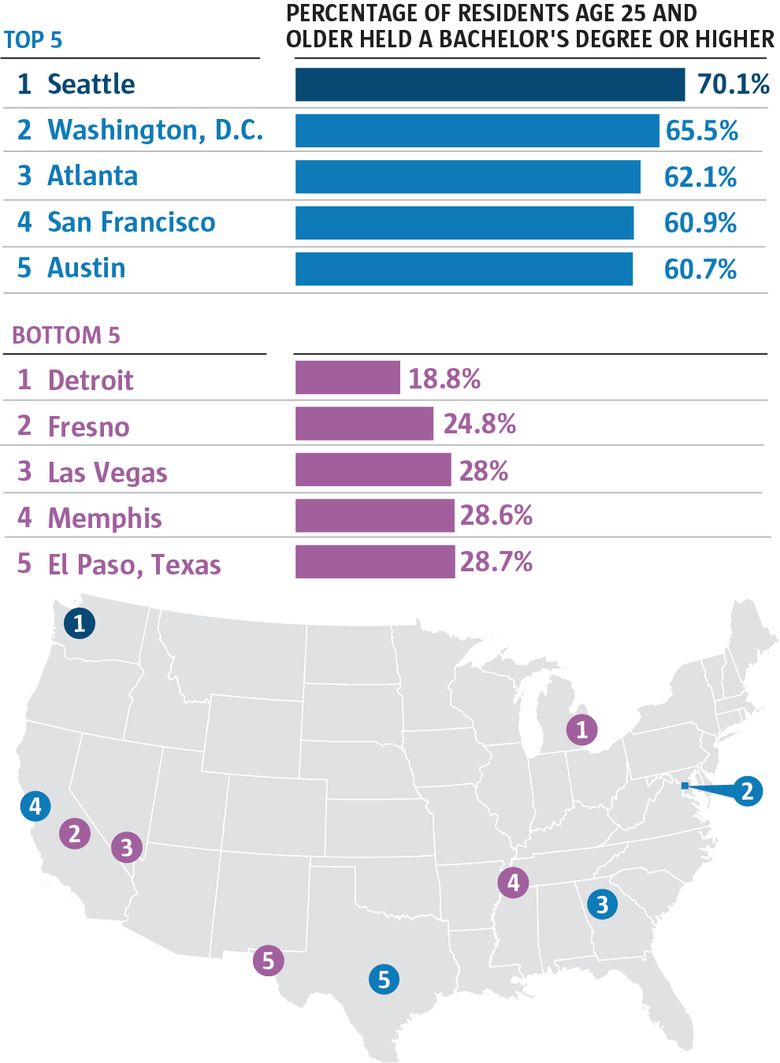
According to newly released 2024 data from the U.S. Census Bureau, around 416,000 Seattle residents 25 and older, or 70.1% of the 595,000 people in that age group, held at least a bachelor’s degree. Among the 50 most populous U.S. cities, Seattle had the highest share of college graduates.
It’s also the first time the city has topped 400,000 college graduates. In 2023, the Census Bureau estimated 397,000 Seattle residents 25 and older held at least a Bachelor of Arts, which was just under 70% of the population in that age bracket.
Seattle ranks No. 1 for share of adults with college degrees
In 2024, 70% of Seattle residents age 25 and older held a bachelor’s degree of higher, which ranked No. 1 among the 50 most-populous U.S. cities.
The most educated age group in Seattle was young adults, with 77% of those 25-34 having completed a four-year college degree. The lowest percentage was among those 65 and older, but even there it was the clear majority, at 58%.
Seattle has long been one of the nation’s most educated big cities, but lately we’ve been pulling even further away from the pack. Washington, D.C., ranked second last year, with just under 66% of adult residents holding a bachelor’s degree or higher. Atlanta was next at around 62%, followed by San Francisco and Austin, Texas, both at around 61%.
These are cities, unsurprisingly, with mainly white-collar job bases, and all have a strong tech sector.
There are some smaller cities with an even higher share of college graduates than Seattle, including Sammamish, where 78% met the criteria in 2024. The highest percentage among all U.S. cities with at least 65,000 residents was Bethesda, Md., at 87%.
There was a huge gap between the big cities with the lowest share of college graduates and those at the top of the list. In Detroit, just 18.8% of adults have a bachelor’s degree or higher. Fresno, Calif., Las Vegas, El Paso, Texas, and Memphis, Tenn., were all under 30%. The economies in those cities are centered on manufacturing, tourism, service work, and other sectors in which college degrees are not required for many jobs.
I think it’s fair to say that Seattle’s highly educated populace is a point of civic pride here. But are there downsides to the fact that 7 in 10 adults in the city have college degrees?
One potential consequence is a mismatch between workers and jobs. Even in Seattle, many jobs do not require a four-year degree. Yet, with such a highly credentialed population, a lot of those jobs — in, for example, retail, hospitality, food service and administrative support — are filled by people who have them. The next time you tip your barista, keep in mind that you might be helping to pay off a student loan.
It might seem inevitable that, at some point, Seattle will hit “peak BA” and the share of college graduates will begin to decline. But clearly we’re not there yet.
This trend in Seattle of an ever-growing college-educated population is particularly interesting as the number of college students has been declining in the U.S. since 2010. The increasing cost of college education is a major factor in that decline, but so is a growing sense among the American public that a college education is no longer worth the cost.
In the span of a generation or two, Seattle has shifted from a city with a balance between college graduates and nongraduates to one with an overwhelmingly credentialed population. In 2000, census data shows college graduates were slightly in the minority among Seattle residents age 25 and older, at 47%. In 2010, college grads had reached a majority, at 56%. The rate of increase accelerated during the 2010s.
What that means for the city’s future — its workforce needs, its affordability, and its cultural identity — is a question Seattle might wrestle with in the years ahead.
Gene Balk / FYI Guy: gbalk@seattletimes.com. Gene Balk is a columnist at The Seattle Times, where he writes about local demographics and other data for his FYI Guy column.