The head of one of China’s leading semiconductor equipment makers believes Washington’s escalating export and investment restrictions betray the real goal of the US: keep China’s chip-making technology at least five generations behind the cutting edge.
Advanced Micro-Fabrication Equipment Inc China (AMEC) chairman and CEO Gerald Yin Zhiyao made the comments on Thursday at the China Semiconductor Equipment Annual Conference in Wuxi, a city near Shanghai in eastern China. He referred to the US export restrictions imposed last October, which came ahead of another escalation this week when the Biden administration unveiled plans to restrict investment into China in sensitive areas including semiconductors.
“The October rules really exposed the US’ true intention, which aims to fix China’s chip-making on 28-nanometre, at least five generations behind the global leading edge of 3-nm to 14-nm,” Yin said during his talk at the conference. “We can’t accept [this],” he added.
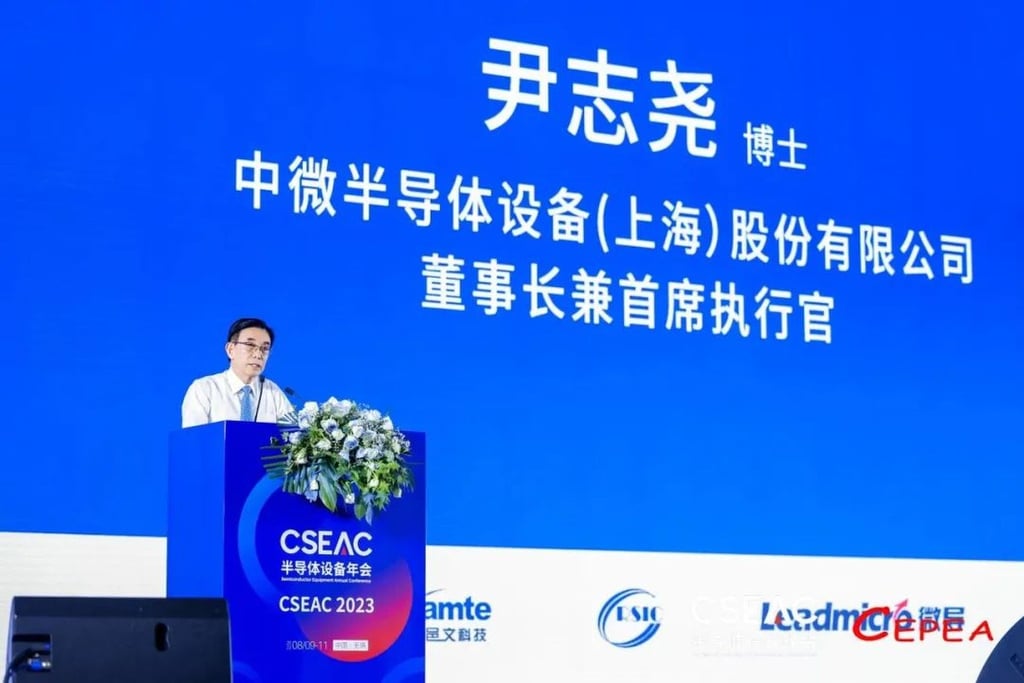
Yin described the updated US tech export controls targeting all China-based foundries as the most “lethal” ban since the US started rolling out related sanctions on China’s hi-tech firms in 2019. Yin called the latest executive order – which targets US investment into China’s semiconductor, artificial intelligence and quantum computing industries – as Washington’s “16th move” against the country since then.
The rules imposed last October aim to cap China’s logic chip-making capabilities at the 14-nm level, DRAM chips at 18-nm and 3D NAND memory at 128 layers. The US cited national security risks and the potential military applications of advanced chips.
Yin, a 20-year veteran of the US chip equipment industry including time at Applied Materials, said locally-procured semiconductor equipment in China’s foundries accounted for just 15 per cent of the total. The other 85 per cent of machines come from the US, Netherlands and Japan, he said.
“That’s why the US needed Japan and Netherlands on board to curb our development,” he told a room packed with semiconductor professionals and investors.