
People are surprisingly bad at guessing knot strength, a study found
Jen Christiansen
Join Our Community of Science Lovers!
Humans are pretty good at guessing whether a towering stack of dishes in the sink will topple over or where a pool ball will go when a cue hits it. We evolved this kind of physical reasoning to navigate our changing and sometimes dangerous environments. But a new study highlights one area of intuitive physics that’s deceptively difficult: judging how strong a knot is.
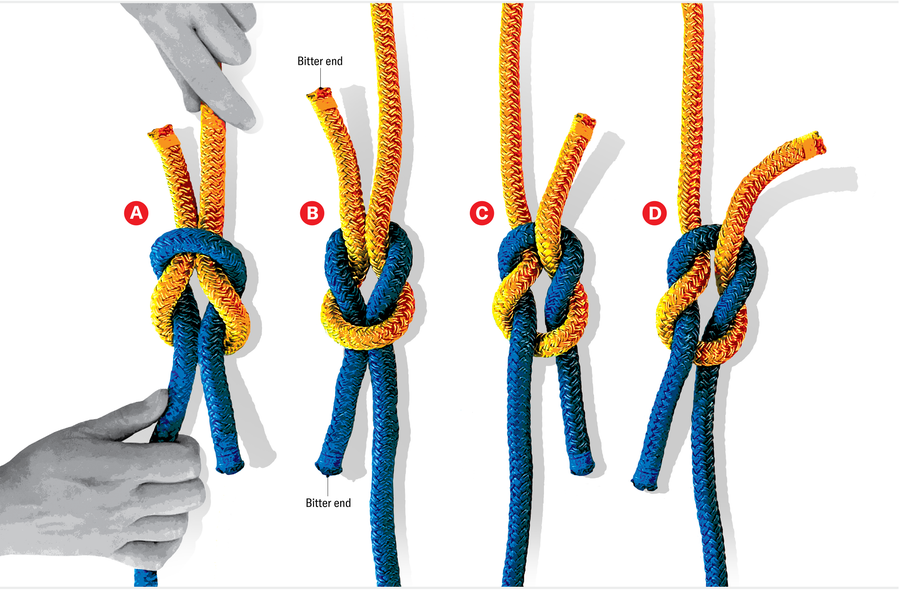
Take a look at these four knots, which may look similar but are all distinct. Which knot would be hardest to undo if you pulled on the two long ends of its ropes? Rank them in order from weakest to strongest.
Jen Christiansen; Source: “Tangled Physics: Knots Strain Intuitive Physical Reasoning,” by Sholei Croom and Chaz Firestone, in Open Mind, Vol. 8; September 2024 (reference)
On supporting science journalism
If you're enjoying this article, consider supporting our award-winning journalism by subscribing. By purchasing a subscription you are helping to ensure the future of impactful stories about the discoveries and ideas shaping our world today.
These four knots can be grouped into two pairs of similar configurations: the “thief” (A) and “reef” (B) knots, and the “granny” (C) and “grief” (D) knots. In both pairs, one knot is vastly stronger than the other. The correct weak-to-strong ranking is grief, thief, granny and reef (D, A, C, B).
If you’re surprised, you’re in good company. Researchers recently asked volunteers to look at photographs of these knots and decide which would take more force to undo. The participants consistently misjudged the strength of the ties by wide margins, Johns Hopkins University brain science researchers Chaz Firestone and Sholei Croom report in the journal Open Mind.
“Reef and thief knots were rated as similarly strong because they’re visually similar, but the position of the bitter ends”—the shorter, cut-off ends in each knot—“is really significant,” Croom says. “A knot with two bitter ends on opposite sides is a lot weaker than if the two sides are the same. The grief knot, aptly named, is so weak you could sneeze on it and it would fall apart.”
KNOT BASICS
The fact that people are bad at evaluating knot strength is surprising because we encounter them in many situations—from tangled electronic cords to hair braids, knitting stitches to medical suture ties, rock climbing to sailing. “Tying a knot properly can spell the difference between safety and peril,” Croom says. The four shown here are among the simplest knots that can be tied with two lengths of string, and they are prevalent in daily life.
PHYSICAL REASONING
Studying areas where our physical intuition fails helps scientists better understand how our brains perceive the world around us. “Knots might be an interesting case study on constraints around our physical reasoning,” Croom says. “Is it something to do with elasticity? Is it the fact that it’s a soft-body object rather than a rigid-body object?” Figuring out why tangles are so tricky could help scientists predict when people’s snap judgments about a physical situation are likely to be wrong, leading to unsafe reactions.
It’s Time to Stand Up for Science
If you enjoyed this article, I’d like to ask for your support. Scientific American has served as an advocate for science and industry for 180 years, and right now may be the most critical moment in that two-century history.
I’ve been a Scientific American subscriber since I was 12 years old, and it helped shape the way I look at the world. SciAm always educates and delights me, and inspires a sense of awe for our vast, beautiful universe. I hope it does that for you, too.
If you subscribe to Scientific American, you help ensure that our coverage is centered on meaningful research and discovery; that we have the resources to report on the decisions that threaten labs across the U.S.; and that we support both budding and working scientists at a time when the value of science itself too often goes unrecognized.
In return, you get essential news, captivating podcasts, brilliant infographics, can't-miss newsletters, must-watch videos, challenging games, and the science world's best writing and reporting. You can even gift someone a subscription.
There has never been a more important time for us to stand up and show why science matters. I hope you’ll support us in that mission.