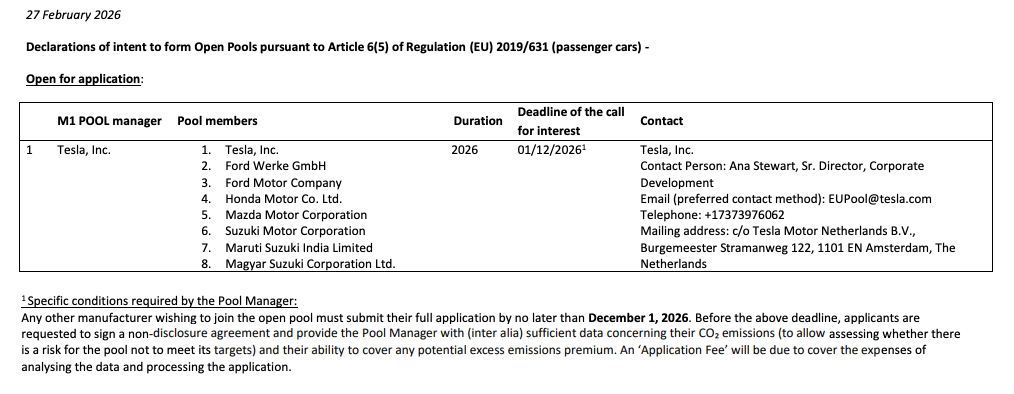
Two of Tesla's largest regulatory pool partners, and presumably the largest financial contributors to Tesla, will no longer be part of Tesla's EU regulatory CO2 fleet emission pool from 2026, at this stage.
While Ford, Suzuki, Mazda and Honda remain, both Toyota and Stellantis are no longer part of the pool.
Although EEA official fleet emission data won't be published for a further 2-3 months one can assume that Stellantis with their mainly compact fleet came close to their CO2 target during 2025, alongside Toyota that have a high hybrid mix as part of their total fleet deliveries, also likely coming close to meeting their targets last year, with that last push over the line coming from Tesla.
Stellantis is likely to benefit more from Leapmotor's regional rollout in 2026, as well as from local production utilising a Spanish Stellantis facility, and avoiding anti-subsidy tariffs in place and hedging against any further European protectionism. The Stellantis/Leapmotor (51%/49%) JV, coming under the Leapmotor International umbrella is expected to begin Spanish production of the B10 model during the final quarter of 2026, based on the LEAP 3.5 technology architecture which could end up being the underlying architecture unpinning future Stellantis models across the region. Stellantis are thought to be considering leveraging the vertically integrated Chinese brand as an architectural foundation to carry Stellantis brands in BEV guise in a cost efficient manner.
Toyota will expand its BEV model line-up in 2026, with the Urban Cruiser, among others, based on Suzuki's Indian-made eVitara.
Tesla highlighted lower regulatory credits as a headwind to profits and revenues during 2025 in their latest financial summary, while things are likely to get worse for the US brand from 2026 given manufacturers in Europe are ramping up more of their own genuine BEVs from 2026 to hit stricket EU CO2 emissions targets which have effectively been phased in between 2025 - 2027 in the form of a bank-and-borrow three year average system that was introduced at the start of last year.
Meanwhile, the US, deregulating its environmental targets, is leading to lower income from regulatory credits for Tesla, which was traditionally the main beneficiary.
Full details, data, forecasts, trends and background information can be found in our industry-leading studies, providing key context and trusted by stakeholders breaching industry divides.
Source: Schmidt Automotive Research
*Western Europe 18 Markets: EU Member States prior to the 2004 enlargement plus EFTA markets Norway, Switzerland, Iceland, plus UK