Cheap AI accelerators and simulation-trained neural policies are about to collapse the cost of autonomous delivery. The business implications are bigger than the technical ones.

The $500 Delivery Robot Is Coming — and It Will Reshape the Industry
The $500 Delivery Robot Is Coming — and It Will Reshape the Industry
The $500 Delivery Robot Is Coming — and It Will Reshape the Industry | Manvel Robotics
The hardware landscape is shifting fast
For a decade, autonomous delivery robots have been stuck in a cost ceiling. Starship, Serve, Kiwibot, and others spend $3,000–$5,000+ per unit — dominated by expensive industrial-grade sensors, and automotive-derived compute modules. At those economics, only high-density urban deployments or deep-pocketed incumbents make sense. Pilots launch, burn capital, and quietly shut down.
But the hardware stack underneath these robots is changing faster than most operators realize.
The arrival of low-cost System-on-Chip platforms with integrated neural processing units — Hailo, Rockchip, Ambarella, Jetson Orin Nano — has collapsed the price of on-device AI inference. A complete compute module with 6+ TOPS of neural inference now costs under $100 in small quantities, and far less at scale. Five years ago, equivalent inference required hardware ten times that price. The industrial supply chain behind consumer electronics, surveillance cameras, and smartphones is now pushing AI-capable silicon into the sub- $50 range for mass-produced units.
At the same time, camera sensors have become absurdly cheap. A pair of stereo cameras with rolling shutter and decent resolution costs under $30. A 2D LiDAR for auxiliary sensing is available for $20–30. IMUs are pennies.
The hardware for a capable autonomous platform — compute, cameras, motors, battery, chassis — now fits comfortably under $500 in mass production. The bottleneck is no longer the hardware. It's the software stack that runs on it.
Cheap AI replaces expensive sensors
Traditional autonomous vehicle stacks rely on expensive sensors to compensate for limited intelligence. Accurate 3D LiDAR provides reliable obstacle geometry, which lets a classical planner navigate without needing to understand the scene deeply. Precise IMUs and wheel odometry feed SLAM algorithms that build clean maps. Each added sensor removes a software problem — at the cost of dollars per unit.
Modern AI inverts this trade-off. A single pair of cheap cameras, fed into a neural network trained with reinforcement learning, can produce driving policies that generalize to noisy inputs, cluttered scenes, and unpredictable pedestrian behavior. The policy doesn't need a perfect map of the world; it learns to act sensibly under uncertainty.
The key enabler is simulation. Modern simulators can model sidewalks, pedestrians, weather, and sensor noise in enough fidelity that a policy trained entirely in simulation transfers to real-world deployment. No field data collection, no fleet of test robots, no expensive labeling operations.
We built a working sidewalk delivery robot this way. Total hardware cost: under $500. Training pipeline: custom Vulkan-based simulator, Soft Actor-Critic reinforcement learning policy, deployed SOC with NPU. The robot drives reliably on real sidewalks using a policy that never saw real-world training data.
The technical details matter less than the economic implication: the cost structure of autonomous delivery is about to change by an order of magnitude.
The business consequences
When hardware cost drops 10x, the market doesn't just grow — it reorganizes.
New deployment economics. Current delivery robot services charge $7–11 per hour of operation to compete with human labor at $25–45 per hour. The margin is thin because the capital cost of the robot is high. At $500 per unit, the same service can profitably target suburbs, campuses, business parks, and low-density neighborhoods that are uneconomical today. The addressable market expands from dense cities to essentially anywhere with sidewalks.
The "Uber for delivery robots" model becomes viable. Operating a fleet of $5,000 robots requires a vertically integrated company — hardware development, fleet management, operations, partnerships, all in one organization. This is why Starship, Serve, and Kiwibot look structurally similar. But $500 robots enable a platform model: one company builds the robots and software, hundreds of regional operators deploy them locally, platform takes a cut. Each regional operator can start with a small fleet and scale based on local demand, without raising $100M to buy hardware. This is the Uber-style unbundling of an industry that has so far only operated in vertically-integrated form.
Non-delivery use cases become economical. At $5,000 a unit, autonomous sidewalk robots are locked into delivery — the only use case that generates enough revenue per hour to justify the capital cost. At $500, the same platform becomes economical for security patrols, facility inspection, campus logistics, hospital internal transport, agricultural monitoring, and dozens of other use cases that can't support the current price point. The platform category expands from "delivery robot" to "general-purpose low-cost mobile robot."
The competitive moat shifts from hardware to data and AI. When the hardware is commodity, the differentiator becomes the neural policy, the simulator, the data pipeline, and the fleet orchestration software. This favors teams with deep AI expertise over teams with strong hardware engineering. The robotics industry is about to experience what the automotive industry has been going through for a decade: the shift from mechanical expertise to software expertise as the primary source of value.
What this means for operators and investors
The incumbents have a problem. Their cost structure is built around expensive hardware and tightly integrated operations. A $500 robot platform threatens their margins and their market. They will either acquire low-cost challengers, rebuild their stack around cheaper hardware, or watch their economics deteriorate as new entrants undercut them on unit economics.
For delivery platforms — Uber Eats, DoorDash, Glovo, Bolt Food — the calculation is different. They don't care who makes the robot. They care about the cost per delivery. A $500 robot platform, operated by regional partners, delivered through their app, offers better unit economics than either human couriers or expensive incumbent robots. Expect pilot partnerships with low-cost robot platforms to accelerate.
For investors, the window for hardware-heavy robotics companies raising at high valuations is closing. The next wave will be AI-first platforms that sell software, data, and fleet services on top of commodity hardware — much closer to SaaS economics than traditional robotics economics.
The timing
Every element needed to build a $500 autonomous delivery robot exists today: cheap SoCs with NPUs, cheap cameras, cheap actuators, simulation frameworks, open-source RL algorithms, and established sim-to-real techniques. The question is no longer whether this is technically possible — it is, we've done it as a small team in a year — but how quickly the industry restructures around the new cost basis.
Markets that depend on high hardware prices being permanent rarely notice when they stop being permanent. By the time the shift is obvious, the new entrants have already captured the economics of the next cycle.
 Manvel Avetisian is the founder of Manvel Robotics. He has 20+ years of experience leading AI/ML research at Google, Yandex, AMD, Sber AI Lab, where he managed R&D teams of up to 100+ researchers. He led the deployment of CoRSAI, a clinical AI system used across 46 medical institutions (WSIS 2021 Champion). His h-index is 9 with 292+ citations. He currently runs Manvel Robotics (manvel-robotics.com), where the team builds autonomous sidewalk delivery robots.
The content & opinions in this article are the author’s and do not necessarily represent the views of RoboticsTomorrow
Featured Product
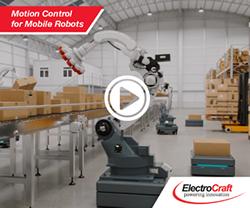
ElectroCraft's Motion Control for Mobile Robots
ElectroCraft is showcasing its award-winning mobile robot technology including their powerful and compact wheel drives, high-torque-density brushless DC motors, precision linear actuators as well as servo motor drive technology at a variety of conferences and tradeshows including the Boston Robotics Summit. Robotics Summit is the premier symposium for the sharing of ideas, technology, and market developments for robotic technologies across industries. Beyond a showcase and pitch of product, ElectroCraft is eager to participate in the collaborative discussion of challenges and opportunities that will shape the near and long-term robotic marketplace.