
Google Translate Summary (if somebody from France translate is i will edit post)
This amendment from the Socialist and affiliated group proposes the introduction of a tax on digital data producers. It aims to restore fairness between the taxation applied to established players in the economy and that applied to globalized players in the digital economy, who largely escape traditional tax mechanisms.This tax is based on a non-relocatable tax base: internet data transmitted to users. It is paid by data producers and collected by the government through measurements taken by internet service providers. It relies on existing technologies and a methodology developed with industry specialists. The majority of this tax would be paid by major international tech and digital players, representing a large share of the data transmitted to French households. At a rate of €0.055 per gigabyte, a revenue of €10 billion is expected. This model does not raise privacy concerns since the data is never accessed (only its quantity is assessed), and it also has an environmental benefit as it will naturally encourage data providers to adopt the most advanced technologies for compression and optimization of data volumes.
Reviving the French economy requires rebalancing the contribution of different economic actors to the national tax effort. On one hand, there is the established economy, comprised of businesses, industries, and the sale of goods and services. It occupies premises, employs workers in France, and finances its direct or indirect use of public services, roads, hospitals, schools, civil defense, the police, and our national defense… because its tax base is physically located within the country.
On the other hand, a deterritorialized economy, it sells to the same customers, uses the same infrastructure, benefits from the same public services, but its tax base is a self-declared profit, that is to say an accounting entry whose location it decides according to its interests.
Insofar as this new digital economy is characterized by its ability to operate across borders, with high margins and by marketing only intangible services or even, seemingly, free for the consumer, it is very difficult to bring these players into the scope of traditional taxation, justifying the creation of a specific contribution.
The idea is to use as a tax base a proxy of their activity which is the quantity of data (the "gigabytes") sent by the actors concerned (the GAFAM and others) to French consumers.
ARCEP estimates that data traffic sent to subscribers of internet service providers (ISPs) in France amounts to 200 billion gigabytes per year.
This contribution would mainly concern the very large players on the internet: Google, Meta, Amazon, Netflix and Akamai (cloud player) alone representing half of the data traffic measured by ARCEP.
VLC Makers say that this will cost them over 1M euros per year that they don't have because they are non profit.
According to Steam Stats in past 7 days French users downloaded 62.7PB
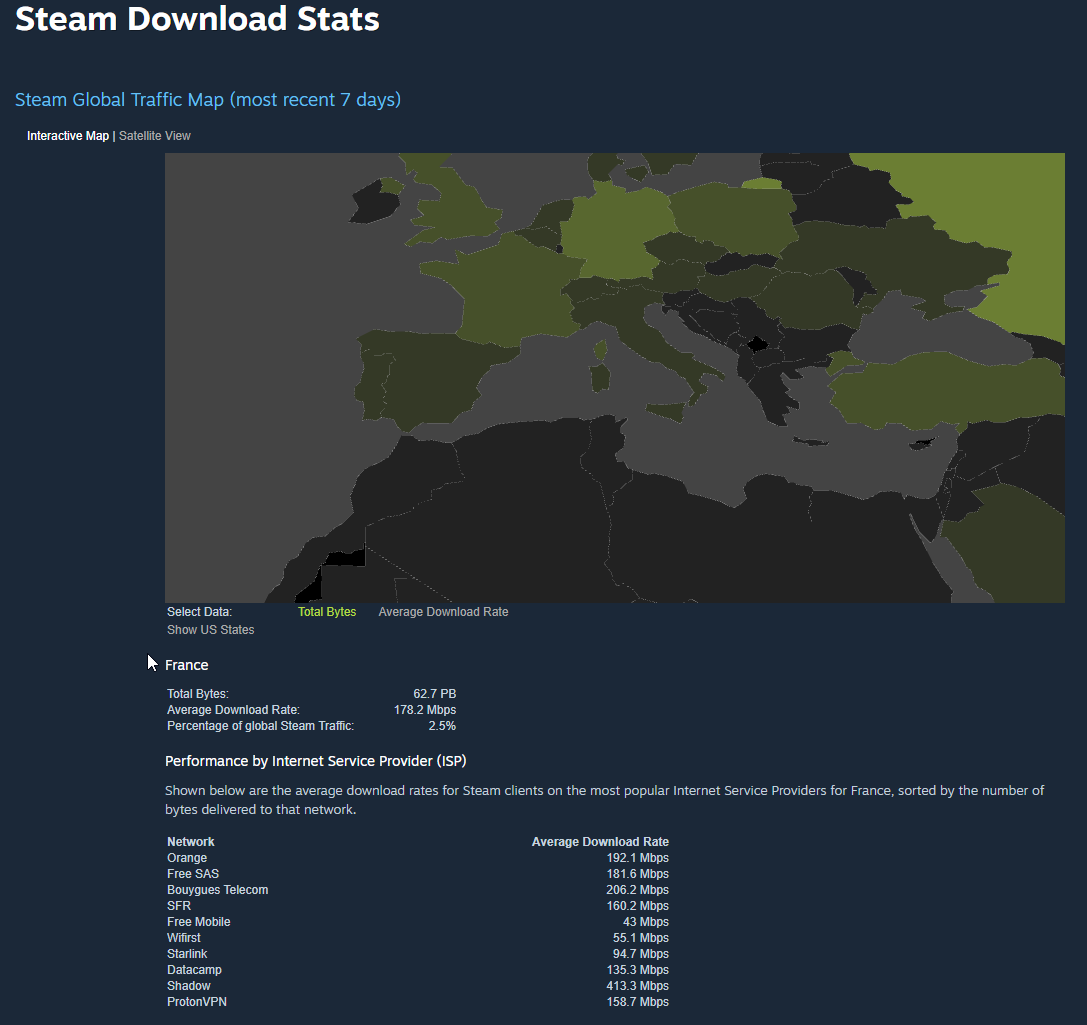
That is 62700000 x 0.055€ = 3,448,500€
So Valve alone will potentially need to pay France €3.5M per week and that is like €180M per year (if i did math correctly, pleace correct me if i am wrong :D).


