On the volcanic cliffs of El Hierro in Spain’s Canary Islands, Austrian wingsuit pioneer Peter Salzmann has taken human flight one step closer to the way birds do it. For the first time, a wingsuit pilot leveraging a foil wing has managed to soar without using engine power - maintaining and even gaining altitude - rather than simply gliding back down to Earth.
Flying with a specially designed foil wing attached to his wingsuit, Salzmann rode rising air currents along a mountain ridge, gaining up to 67m of altitude during the flight. That’s roughly the height of a 22-storey building - and something that has never been achieved before in wingsuit flight under such moderate wind conditions.
“I was able to pass a point, soar along the mountain, turn around and, after 40 seconds of flight, pass the same spot, but higher,” says Salzmann.
The key numbers behind the achievement
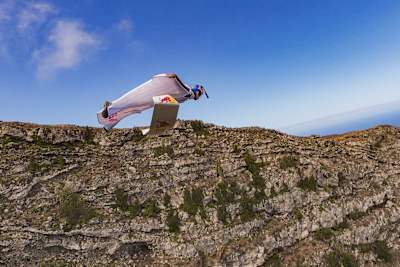
The shape of the ridge created perfect conditions for soaring with the foil
© Sebastian Marko/Red Bull Content Pool
Salzmann flew for a whole 160 seconds along the ridge, including 67m of altitude gain during his best climb. While soaring, he completed multiple 180-degree turns, with less than 200m of altitude loss. For context, a standard wingsuit flight would typically lose 10 times more altitude within the same flight duration.

Harnessing the air currents
© Sebastian Marko/Red Bull Content Pool

Salzmann achieved 67m of altitude gain during his best climb
© Sebastian Marko/Red Bull Content Pool
What is the wingsuit foil?
The key is the foil wing: a lightweight, aerodynamically engineered surface that increases lift without turning the pilot into a paraglider or hang glider, where pilots use much bigger wings to soar. The foil wing gave him the ability to soar with the wind, still giving him the feeling of a wingsuit flight.

Working with Andreas Podlipnik and Red Bull Advanced Technologies to soar
© Sebastian Marko/Red Bull Content Pool

Salzmann was able to stay in the air longer by using the foil wing
© Sebastian Marko/Red Bull Content Pool
The wing was developed with Red Bull Advanced Technologies, using the same high-precision computer simulations employed in designing Formula One race cars. Austrian wingsuit specialist Andreas Podlipnik developed and built the foil wing, defining how the foil needed to behave, so Salzmann could manoeuvre close to the ridge, where rising air is strongest, but margins are smallest.
The wingsuit foil flight was the most challenging flight Salzmann has ever done. To control the wingsuit and the foil takes incredible skill. “I had to fly the foil close to the stall point as it's creating the most lift at that high angle of attack," Salzmann explained. "As the lift and ridge aren't constant, I had to fly super sensitively and actively correct directions and angles all the time.”
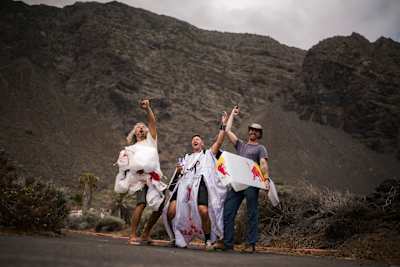
Success! A world-first achievement with a wingsuit foil
© Sebastian Marko/Red Bull Content Pool
The success marks a potential shift in wingsuit flying: from 'falling with control' to working with the air to stay aloft. A standard wingsuit flight is characterised by continuous controlled falling. However, Salzmann was able to stay in the air for longer by soaring with the foil wing. If Salzmann can refine the turning phases and consistently re-enter rising air zones, soaring loops could theoretically repeat indefinitely.
What is wingsuit flying?
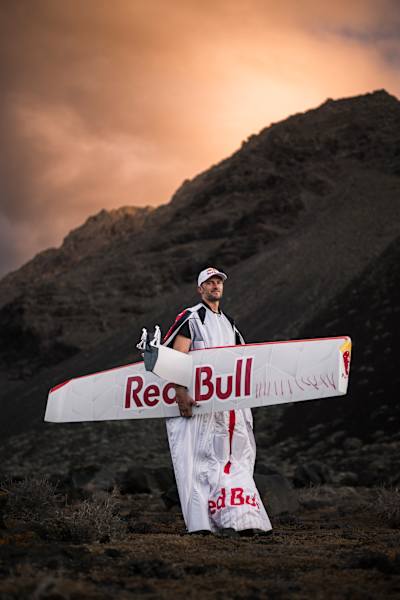
Peter Salzmann has been flying for over a decade
© Sebastian Marko/Red Bull Content Pool
Wingsuit flying is an extreme sport where a pilot wears a suit with specially designed fabric surfaces between the arms and legs. These surfaces create lift, allowing the pilot to glide forward instead of simply falling straight down.
A typical glide ratio for an elite wingsuite allows the pilot to travel 3-4m forward for every metre of descent.
Traditional wingsuits can't maintain altitude: they always lose height. The exception to this is when a skilled pilot performs a 'flare' by speeding up a descent to briefly gain altitude before descending further, such as we see here.
Salzmann’s flight used a foil wing that he first introduced in October 2024, adding aerodynamic efficiency and making soaring possible in rising air, similar to how birds and glider planes fly.