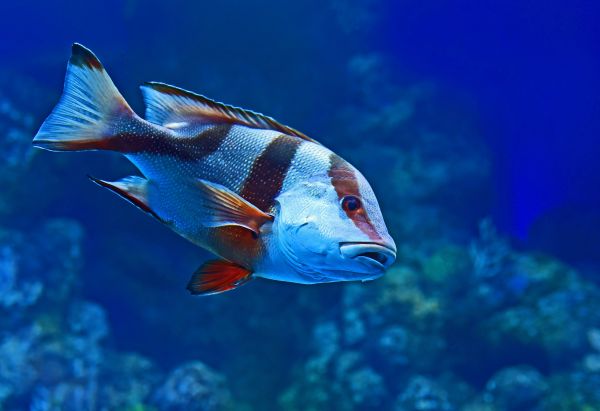
Imagine a world like ours, except that it’s fish that became the most intelligent creature. Somehow they learned to harness tools and technology, and built a fish civilization as advanced as our own.
In this world, fish travel between sea, air, and land with ease, using little hover vehicles. Their technology allows them to have fish cities, complex fish politics and fish economies, fish entertainment, fish fashion, fish philosophy, and fish science.
Modern fish are able to live lives their premodern fish ancestors couldn’t have imagined. They can be accountants and bus drivers and FR managers. They can even live in places where there’s barely any water — they just import food and water from the ocean, or ocean-like farms.
It’s been millennia since fish had to subsist by living in the open ocean, dodging sharks while cruising for food. Entire fish empires have risen and fallen since that time, and now only a few rare hobbyists, like the guy on the TV show Survivorfish, have any ability to survive on their own in the wild.
Now imagine one of these hyper-civilized fish flipping open the hatch of its hover vehicle and jumping naked into the ocean. Terrifying as it might be, wouldn’t that feel pretty exhilarating? Wouldn’t it awaken something profound in him, some ancestral memory that’s been dying to go for a swim?
And wouldn’t it seem absurd to an outside observer, such as a visiting alien, that fish had become so fully preoccupied with modern fish economics, entertainment, and politics that they barely even swim anymore?

Fish civilization has its perks, for sure — modern fish can still serve their instinctual desires to secure resources, procreate, and become big fish in their respective “ponds.” They seldom worry about predators, they enjoy an uninterrupted food supply, and they have limitless pursuits to stimulate and occupy them. But wouldn’t even those sorts of lifestyles benefit from a certain amount of swimming, underwater foraging, and doing the other things that 99.9% of the fish’s body and brain were made to do?
This is what I was thinking about on a camping trip last month. Camping is definitely not the same as reverting to a pre-technological life; I brought along mass-produced food, a bugproof sleeping vessel, a flashlight, a lighter, and perhaps fifty other nature-conquering technologies. Even my pocket supercomputer still worked if I went halfway up the trail to the parking lot.
However, camping makes for a slightly less-coddled existence. You’re in an outdoor, limited-technology situation that seems to at least tickle that vast but dormant part of the human psyche that’s built precisely for surviving in an unsympathetic natural world. You cook your food over a fire. The temperature might dip below comfortable levels. There might be bears out there. A real incident is unlikely, but the prospect of mortal combat with another mammal will enter your mind more than usual.

Bears or no, I enjoyed having a simpler and more concrete palette of concerns. Among other tasks I spent an hour or two collecting firewood from the forest floor. I was looking for fallen branches of sizeable diameter, dead but not rotten. After a while I could tell from a distance if a given piece of deadfall was likely to fit the bill. If it’s lying right on the ground, or has a dull color, it’s undoubtedly rotten. If it’s leaning on something, it might have dried out enough that it will burn. I became attuned to this simple task. As I wandered and scanned the woods, the undergrowth scraped my legs, mosquitoes bit me, and I perspired freely. There was nothing particularly comfortable about the task, but it was profoundly enjoyable.
I’ve noticed for a while now that whenever I do things a premodern human might do, I feel good. When I carry something heavy from one place to another, clamber over rocks, study a wild plant, or just search for a shady resting spot, there’s a certain instinctive peacefulness in the doing. I don’t exactly find these things “fun,” or entertaining, like I do eating Oreos or watching prestige television. I find in them a certain primordial satisfaction, a relief almost, like a fish might feel upon plunging into open water.

My suspicion is that some part of us, not necessarily a conscious part, is dying to do activities the human body and brain spent eons adapting to. Specifically, I’m talking about:
- Manual labor with visible progress — building something, gathering something (berries, firewood), whittling/carving/painting, sorting physical things, caring for durable physical possessions
- Sitting around a fire or meal (preferably both) with other people
- Exploring natural and unpredictable environments — parks are okay, wilderness is better
- Wordlessly accomplishing physical tasks; quietly attending to the doing and nothing else
- Using physically demanding modes of locomotion: walking, hiking, clambering, climbing, carrying
- Looking closely at the details of plants, animals, fungi, and insects
- Physically cooperating with another person on a task
- Searching or scanning the environment for a particular thing
- Sheltering; settling in to a physical space
Compare these to modern activities we’re not especially adapted for, which probably mess us up somewhat:
- Considering abstract moral situations all the time — i.e. politics — and the resulting rumination
- Telecommunication — the displacing of voices, faces, and words into illusory facsimiles of humans
- Rapidly jumping between tasks and topics of thinking
- Using disposable tools that command no respect or care
- Outsourcing our knowledge of the world to journalism, science, and other politicized institutions
This praise for the caveman days might sound like romance or sentimentality. I won’t pretend I want to live naked in the woods. But when you consider how differently those concrete, premodern activities feel from corralling words on a screen, entering spreadsheet formulae, or parsing a dozen news headlines in the space of a minute or two, it’s clear that there’s a categorical difference between doing what humans have been attuning to for a hundreds of thousands of years, and doing what we’ve been doing only a lifetime or two. It’s the difference between a fish swimming, and a fish operating a hover vehicle.

I’m also not saying there’s anything necessarily bad about modern activities. After all, we do them because they have benefits. But there does seem to be something innately good and healthy about doing the things for which we do have an ancient affinity, and I think you can feel it.
There are some deeply human activities modernity has not made particularly rare, although they are rarer: caring for children, eating in a group with others, using simple tools, hunting, building simple structures, climbing or clambering, and traveling on foot, especially through wilderness. These activities seem very good for us in some way, a massive relief for a system that’s nearly always being made to do things it wasn’t built for.
Pointing out this tension isn’t particularly original — Thoreau immortalized himself with his book about it — but I don’t think we make enough of it. My claim here isn’t “we should learn a bit from our ancestors,” but more like, “we’re fish flying in hover tanks who barely swim anymore, and every part of our system is dying to get back into the water, even if our conscious minds are completely unused to it.”

So when you go hiking, or you climb something, or you examine the veins on the back of a leaf, see if there’s something resonant there beyond just “getting away from the city” or “getting some fresh air.” See if it awakens not just a sense of novelty but something more stabilizing — a sense of home — inside you.
You can see a parallel version of our conundrum in the modern dog. Coco really wants to chase squirrels, as her ancestors did, even though she doesn’t need to because you feed her every day at 6pm. But unlike a wolf, she has a newer, conflicting assignment: to please you. She doesn’t want to cross you by leaping onto the dinner table and running off with the chicken carcass. Instead she sits there stiffly, eyes wide, tense and hopeful like a bad poker player with decent cards. When you get her to the big off-leash park outside the city though, she shows you what she’s always dying to do.
***
Photos by David Clode, Becca, Vadym Lebedych, and B.D. Maxham. AI art by Dall-E 2.