Rebuilt power tubes resulted in station economic savings
As several readers have echoed to Radio World, Microwave Power Products’ pending shutdown of the former Econco facility — known for rebuilding vacuum tubes for transmitters — is a big deal.
MPP announced last week that the final day to request a repair for an Econco Power Grid tube is May 12. As we reported, the company will close its Woodland, Calif., manufacturing site in September.
The development has left tube-type transmitter operators with few other alternatives for rebuilds. Those models are still powering plenty of AM and FM stations across the continent.
But, tubes do ultimately fail, and recent designs perhaps more quickly than before. And the cost savings of a rebuilt tube, versus new builds, is often significant.
We asked how the pending closure of the Econco plant might affect your station or cluster.
Time-tested
Dave Morgan is the director of engineering at Sinclair Telecable in the Hampton Roads region of southeast Virginia. Among his properties are two AM sites using tube-type transmitters and a Gates/Harris FM model that our own John Bisset sold him some 27 years ago.
“These are excellent transmitters when properly operated, maintained and understood,” Morgan told us.
The Econco closure, Morgan said, was a major development.
Vacuum power tube technology is proven and still somewhat reliable, Morgan said, though he acknowledges it is less efficient than solid-state. But he’s observed over the years that Gates/Harris, Collins/Continental and Broadcast Electronics built their tube transmitters to last.
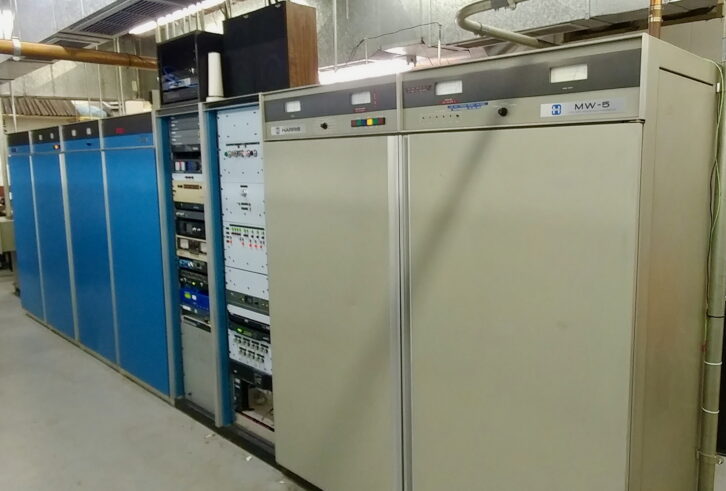
He pointed to Sinclair’s own Harris units at 850 WTAR(AM) and 790 WNIS(AM). WTAR runs off a Harris 50 kW MW-50, with a backup 5 kW MW-5 at its site near Rushmere, Va. WNIS runs off a solid-state Nautel XR6 from its site east of Hampton, but a tube-based MW-5B backs it up.
Morgan acknowledged that some engineers have reported quality control or lifespan issues from rebuilders in recent years.
“I understand that the power tube rebuilders and manufacturers might be having a harder time nowadays sourcing elements like tungsten and thorium,” he said.
But Morgan’s Sinclair properties — no relation to the large Sinclair Broadcast Group — have had no significant problems with rebuilt tubes over several decades.
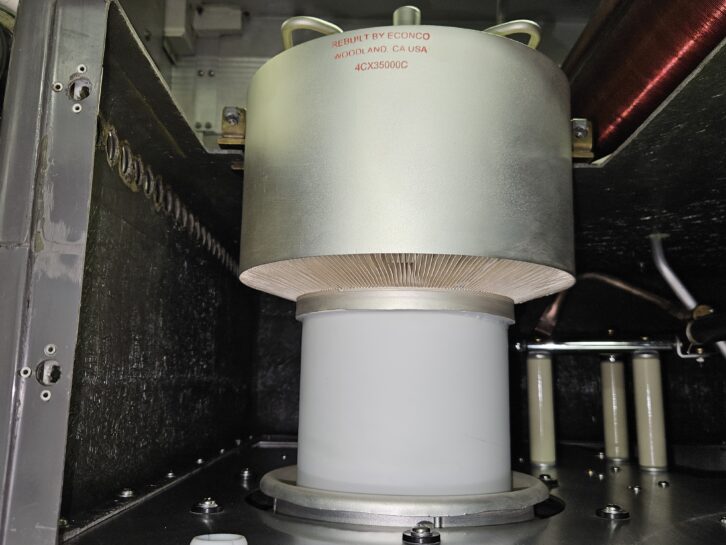
He said his stations follow the rebuilder’s break-in procedures to the letter, pay close attention to filament voltages, aim for proper tuning, monitor stack temperatures and keep the ambient air inside the transmitter buildings clean, cool and dry.
Rising costs
“Like everything else after 2020, the costs for tube rebuilding shot up,” Morgan told us. As a result, the cost for brand-new tubes followed suit.
Jim Shelden, chief engineer of a six-station cluster in Bozeman, Mont., and operator of Sweetgrass Engineering, agreed that the plant closure is a “serious issue.”
Shelden said he currently has two 4CX15000As on the shelf that need to be rebuilt. He opted for a new Eimac tube in one of his cluster’s transmitters, but at the cost of $5,200 each, he said it was a tough pill to swallow.
“Our highest billing station runs a Continental Electronics 816R-2C at 20 kW,” Shelden told us. “The Continental has been very reliable and we have no intention of replacing it — particularly when comparing the cost of a new solid-state transmitter.”
[Related: “When Your Solid-State Transmitter Fails, Have a Backup Ready”]
Longtime Bay Area engineer Bill Ruck, who performs maintenance for the historic maritime coastal radio station KPH, said the station relies on vintage transmitters, most of which use ceramic power tubes. Because it is a National Park Service Historic Site, the station is unable to switch to solid-state.
“We do have a few spare tubes, but without Econco, at some point we won’t be able to make RF,” Ruck said.
The search for alternatives
Ron Petersen Sr., president of Carthage Broadcasting Company in Joplin, Mo., told us before the MPP announcement that he was already worried about the scarcity of power tubes.
His station, 95.1 KMXL(FM), uses a Broadcast Electronics FM-30, which delivers 50 kW of ERP. The FM-30 runs a 4CX20000A / 8990 Eimac power tube. Carthage had gravitated toward Econco’s rebuilt tubes due to the higher cost of Eimac’s new units. While the current tube has served his station well, his next move is uncertain should it fail.
Petersen had posed the question to us earlier, wondering if any broadcasters had used tubes redesigned by Jingguang in China and listed on Alibaba. The list price of approximately $3,000 is quite a bit less than the new Eimac price Shelden noted for the tube in his Montana transmitter.
However, looming tariffs made Petersen wonder if those prices will eventually increase as well.
Maintenance vs. replacement
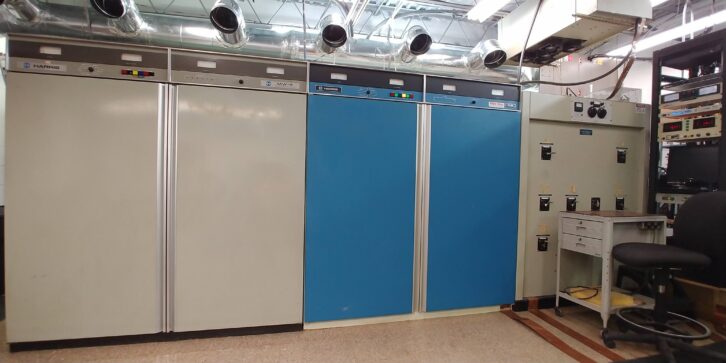
Back in Virginia, Dave Morgan noted that if transmitters are still in good condition, age is not as much of a concern — particularly if parts are available and qualified engineers are nearby to work on them.
Older transmitters are also field-serviceable, Morgan noted, whereas solid-state models often require repairs to modular assemblies or boards performed at a factory or service depot.
While Morgan realizes that the broadcast market for power tube rebuilding has shrunk, he noted that there are still other commercial, industrial, scientific and government applications for the tubes.
He hopes that the Massachusetts-based Kennetron, which we noted in our original report, will be able to thrive after the latest development.
“Is there enough business to support both Econco/MPP and Kennetron?” Morgan wondered. “Sadly, apparently MPP and their new owners don’t think so, and presumably MPP could not find a buyer for the business.”
How is your station affected? Have you secured a rebuilt tube alternative? Share with us.