Welcome to issue #2 of The Psyop Report! This week we’ve been talking about how one way to describe the September Event is that we’re “putting fluoride in the water”. As in, we’re intentionally designing & releasing something that is meant to cause a permanent change in the way people think, for everyone exposed to it.
eval laden joked that the broadcast the next morning after the event might look like1:
In this corner of the internet, we take very seriously the potential risks of engineered information campaigns having unexpected & dangerous consequences. An example of this danger was shared this week by sociologist & professor at University of California Richard M. Carpiano. The article claims a direct link between the death of a child to a specific lighthouse in the information ecosystem Children’s Health Defense2:
We call this an Infohazard3. As opposed to an “infoblessing”, which is information that improves your life upon contact with it. This week’s example of an infoblessing comes from Tyler: writing book, DMs slow, it’s called “growing the good vs fixing the bad”4.
The guard rails we have in place for September is getting social engineering companies & intelligence agencies actively monitoring what we’re doing. These are the people that have experience launching these things & disrupting engineered narratives (or organic information propagation) “in the wild”. We’re working on having a hotline to these organizations, and currently establishing ourselves as the public hotline that anyone can use to report a psyop/infohazard for intervention.
Examples of companies we would like to have “referee” or monitor here:
Social Engineer LLC. They are famous for authoring the “original social engineering book” in 2011, and have been an annual fixture at DEFCON. They are firmly a lighthouse in social engineering in corporate settings
Leverage Research’s, who study & formalize “deterministic belief change” whose work can anchor how we link cause & effect for information campaigns
Intelligence Agencies like Graphika, Palantir, and Black Cube5
The most important takeaway from today's report is that not all psyops are bad. What you should report is any change in your world that you are interested in intervening in (either because it’s good & you want more of it, or it’s bad and you want to slow its propagation). The type of changes we’re looking for are “permanent” changes to collective belief of a territory6.
The other important thing to understand is that awareness of a psyop is typically NOT sufficient to counter its effects. This is similar to how lawyers using bad rhetoric may have an “objection sustained” by the judge, and their question struck from the record, but the conclusion they put into the minds of the jury still lingers. It can only be “undone” by adding extra information to neutralize it (hence: fluoride in the water).
Next week we’ll share an example of a psyop we identified in Egypt, spread by the government through the mosques, that we deemed “a good, prosocial psyop” (its intended effect was increasing literacy rates). Documenting this good psyop would potentially break it, so we’ll discuss how to document cases like this without having undesired side effects.
A final note here is that identification of a psyop is a concrete, empirical thing, not a conspiracy theory. For example: many people believe the Graham Platner story that lead to him resigning from his political campaign was an engineered narrative. The proof we’re looking for is finding the people who conducted the campaign and seeing how they did it. We have such a case for the Justin Baldoni psyop of 2025 that the NYT reported on, where they revealed the backstage process:
Well, for instance, one PR person texts Melissa, “the narrative online is so freaking good and fans are still sticking up for Justin. You did such amazing work”.
She writes and Nathan replies, “narrative is crazy good. The majority of socials are so pro Justin and I don’t even agree with half of them. LOL.”
From: New York Times is Trying to Explain Psyops (2025)
For us this means getting a report from a lighthouse in that territory who can reveal that “backstage” record.
The September Event in Austin TX is still looking for people to apply to attend & contribute!
https://luma.com/psyop-hackathon
The current status is that it’s an “empty warehouse party”. We have Distribution Hall booked and are looking for sponsors right now to commit money to covering things like (1) high speed internet for livestreaming (2) flights & hotels of attendees & volunteers that can’t make it otherwise (3) potentially food & catering (4) most importantly, chairs, tables, & other furniture.
If we don’t get additional sponsors it will be more of a “burning man DIY / BYO” kind of event where we use this space as the HQ for the global monitoring & influence hackathon, and other sites around the country & the world can participate by hosting in-person gatherings on that same weekend (similar to the Global Game Jam).
One new thing we have this week is work-in-progress tooling that Walter has created for fingerprinting linguistic change in communities that opt in to self-monitoring. It looks like a Discord bot you can add to your community that will identify (1) words unique to your collective, and (2) report changes. Here’s a WIP:
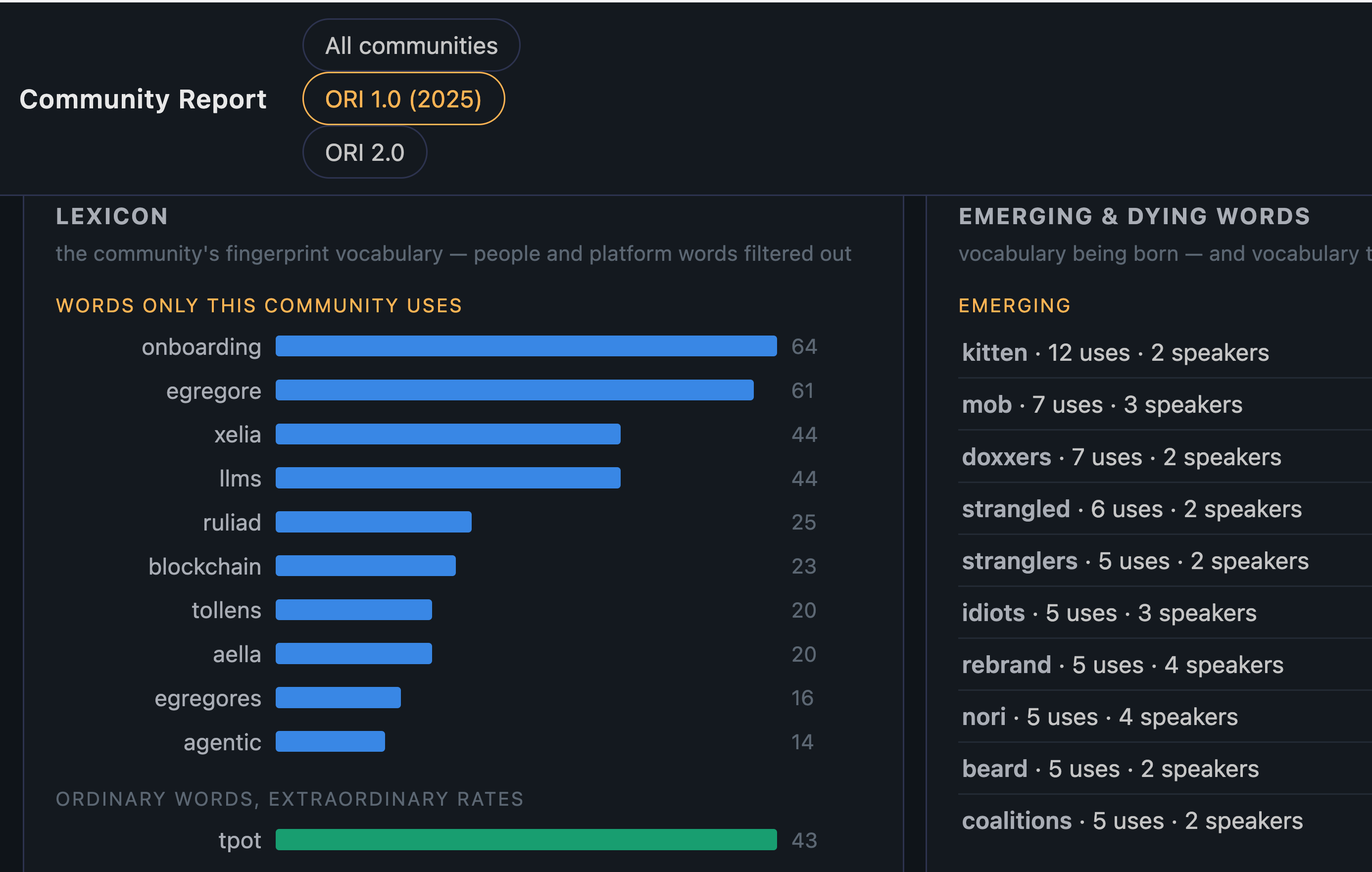
This is a continuation of our work from 2025 where we rolled out self-monitoring tools that can detect the sudden changes of language and trace their origin to specific users in the network. Here for example is the graph of the introduction of the word “psyop” for the internet community known as “tpot”:
The idea is by September 4th we’ll have a few “monitoring stations” in enough discords and internet communities, that when a word or idea suddenly starts propagating, we’ll ping the lighthouses and be able to trace its movement across society (if not in real-time, then at least retroactively as we debate whether the change was good or bad).
This will only work if enough people (1) consciously choose to self monitor and report changes in their networks (2) understand the implications of exposing their communities this way & can share as little as needed to help the global network without making themselves vulnerable to hostile surveillance & hostile intervention.