Number theory · dynamical systems · formalization overview
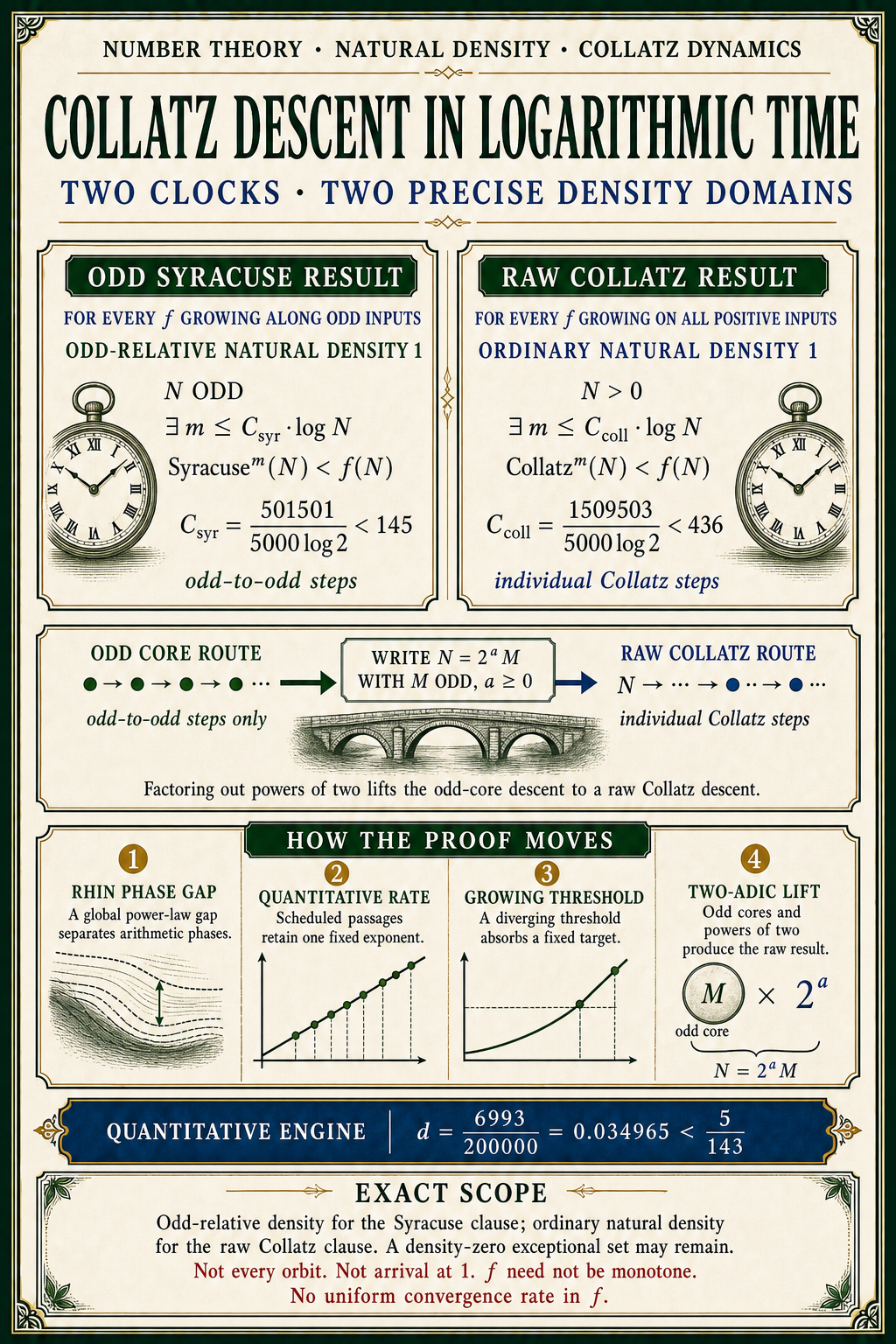
For thresholds tending to infinity along odd inputs, odd-relative-density-one many odd starts descend within 145 · log N Syracuse steps; for thresholds tending to infinity on all positive inputs, ordinary-natural-density-one many positive starts descend within 436 · log N raw Collatz steps.
Scope: The checked package gives two related logarithmic-time conclusions: odd-relative natural density one among odd starts for the Syracuse clause with f tending to infinity along odd inputs, and ordinary natural density one among positive starts for the raw Collatz clause with f tending to infinity on all positive inputs. It also records a dependent square-root raw-time bracket.
Lean checkedBuild passed
Unfinished proof stepsNone
PublicationAccepted formalization
Main theorem · featured result
Natural-Density Almost-Bounded Collatz Orbits in Logarithmic Time
For thresholds tending to infinity along odd inputs, odd-relative-density-one many odd starts descend within 145 · log N Syracuse steps; for thresholds tending to infinity on all positive inputs, ordinary-natural-density-one many positive starts descend within 436 · log N raw Collatz steps.
The theorem dossier brings together the expanded exact proposition, the theorem schematic, a step-by-step proof walkthrough, complete checked source, and checker evidence.
Two logarithmic-time density conclusions at a glance
The proof uses a global power-law phase gap and fixed quantitative rate, turns fixed-target control into an odd-relative Syracuse conclusion, then uses the two-adic lift to obtain the ordinary-density raw Collatz conclusion.
A mathematical paper developing the natural-density-one logarithmic-time Collatz descent theorem, its Rhin phase-gap input, the quantitative rate architecture, the Syracuse-to-raw-time bridge, and the square-root time-window corollary.
Hosting authorized by the rightsholder. Original ProofAtlas metadata cover; not a reproduction of a paper page.
Lech Mazur, “Natural-Density Almost-Bounded Collatz Orbits in Logarithmic Time,” version 2, 21 July 2026.
The paper is mathematical exposition linked to the same theorem family; the exact checked Lean declarations and pinned source remain authoritative if wording differs.
The paper discusses a theorem that permits a density-zero exceptional set and does not claim the full Collatz conjecture or convergence of every orbit.
Collatz results landscape
How these results relate
depends onstrengthenscomparison only
The atlas keeps proof dependencies separate from stronger sibling results and useful comparisons. The two lanes below are disconnected: neither predecessor-count family is an input to the density-and-time family.
Predecessor-count bounds
Three exact 0.90 theorem variants
Density and logarithmic time
Rhin feeds the quantitative rate engine
Exact relationship evidence
Reviewed dependency path: Rhin phase gap → ND31 main → ND31 bounds → same-exponent rate → fixed rate → the two sibling density-family endpoints. Six retained depends_on edges support this contracted path.
Comparison only: the Terras result is explicitly recorded as a separate companion, not an input to the natural-density proof.
No inferred edge: shared source files, a common subject, or historical background do not create a theorem dependency.
Scope limits
What this formalization does not claim
This does not prove the Collatz conjecture, convergence for every start, or arrival at 1; a density-zero exceptional set may remain.
The threshold must tend to infinity but need not be monotone, and the hit below it is strict.
The odd-relative Syracuse conclusion and ordinary-density raw Collatz conclusion have different domains and must not be collapsed into one claim about all positive starts.
The 145 bound counts odd-to-odd Syracuse steps, while the 436 bound counts raw Collatz steps including halvings.
The square-root lower clock belongs only to the companion square-root corollary, not to the general growing-threshold theorem.
The separate Terras power-saving finite-stopping theorem is a companion comparison, not an input to this proof.
Additional theorem and supporting-result diagrams
Theorem schematic
Two density domains within two logarithmic clocks
The Syracuse endpoint uses odd-relative density among odd starts; the raw Collatz endpoint uses ordinary density among positive starts.
odd-relative density(Syracuse hit) = 1 with C_syr < 145; ordinary density(raw Collatz hit) = 1 with C_coll < 436
For thresholds growing along odd inputs, odd-relative-density-one many odd starts have a Syracuse hit before 145 · log N odd-to-odd steps. For thresholds growing on all positive inputs, ordinary-natural-density-one many positive starts have a raw Collatz hit before 436 · log N individual steps.
Theorem schematic
A square-root hit inside a logarithmic window
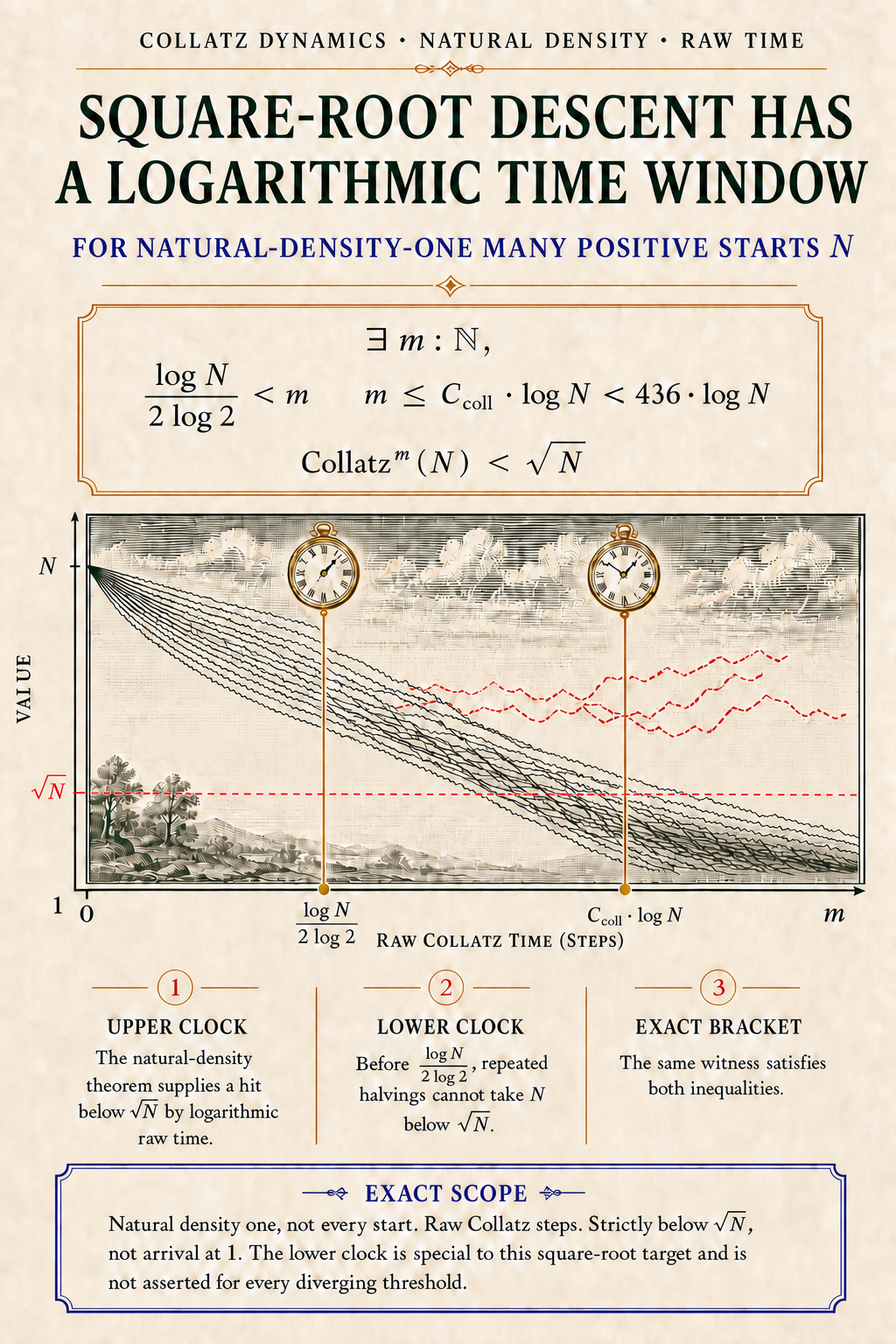
For natural-density-one many starts, a raw Collatz hit below √N occurs inside a genuine logarithmic time window.
log N/(2 log 2) < m ≤ C_coll log N < 436 log N and Collatz^m(N) < √N
The same witness time is strictly greater than log N divided by 2 log 2 and no greater than the checked raw Collatz clock, which is below 436 · log N. The lower bound is special to the square-root target.
The theorem at a glance
Square-root logarithmic time window at a glance
The natural-density theorem supplies the upper clock for the square-root threshold. A deterministic halving argument supplies the strict lower clock, and the checked corollary retains one witness satisfying both inequalities.
About these visual explanations
These AI-generated visuals explain the theorem and proof route; they are not proof evidence. Their publication review was completed separately from review of the formal result. The exact Lean proposition and checked source remain authoritative.
Continue the mathematics
Open questions and extensions
Use the checked natural-density theorem to study stronger time constants, explicit density-convergence rates for restricted threshold classes, or other dynamical systems where arithmetic phase gaps feed quantitative mixing and descent.
What the source ZIP contains
The ZIP contains the checked first-party Lean import closure, exact statements and boundaries, license, notice, evidence, source-footprint manifest, and continuation data. Mathlib and other third-party dependencies are not bundled.
Line counts exclude blank lines; comments and documentation count. The total is the deduplicated, commit-pinned first-party Lean import closure; Mathlib and other third-party dependencies are excluded. Declaration count means names covered by the artifact's recorded evidence, not every declaration in the source. Source footprint is not a difficulty or proof-quality score.
Independent review
Review record
Independent review accepted
Lean checks the exact proof. Independent reviewers accepted evidence completeness, statement alignment, scope, and public wording; the visual review covers explanation only.
01
Formal evidence
Independent review accepted the recorded build, exact declarations, unfinished-step scan, and axiom evidence.
02
Statement alignment
The formal declaration was accepted against the named theorem and its exact variant.
03
Result boundary
The accepted boundary keeps nearby stronger or commonly confused claims out of scope.
04
Public wording
Independent review accepted the retained theorem explanation and source presentation. Generated media follows a separate review and promotion gate.
05
Canonical source
The first-party source link is pinned to the checked package commit and exact Lean file.
06
Accepted result
A validated accepted-result record binds the four reviews to the checked formalization.
Credit for this release
Contributors and roles
Authorship and other contributions are recorded separately for this version.
Authorship
Paper author
Lech Mazur
Contributions
Direct contributionProofAtlas AI-agent collaboration
Unnamed ProofAtlas AI agents contributed route proposals, proof-route narrowing, finite probes, stress tests, and read-only audits.
Computation
Gap or error discovery
Proof strategy
Research direction
Direct contributionLech Mazur
Lech Mazur is the named author of the version-2 paper.
Exposition
Selected reviews
Review record
Each entry names the question reviewed, its exact scope, and the reviewer provenance recorded for this release.
This version is part of the release history. No independent external timestamp is claimed.
Scope of this release
AI development credit remains aggregate because stable historical model and run identities were not retained.
Lech Mazur is credited here as paper author; the inspected pre-authorization evidence did not support exclusive or fine-grained authorship of every proof, Lean, computation, or visual component.
No independent external priority anchor is recorded.