Today you can “trade” on the outcome of thousands of future events, from the Fed decision next month to the Grammy Awards in February. Without leaving the house, you can wager on Taylor Swift’s wedding or Time magazine’s person of the year. One of Kalshi’s MIT-trained founders says their platform is “like the stock market, but instead of buying and selling companies, you’re buying ‘yes’ or ‘no’ on whether something is going to happen.” The Gen Z billionaire at the helm of Polymarket touts his exchange as a “global truth machine.” These platforms do harness the “wisdom of the crowds,” but, to be clear, this is gambling rebranded as “prediction markets.”
Casino Economy
America was built on risk and speculation. The country could fairly be described as a “casino economy,” however, and prediction markets — alongside crypto, options trading, and sports betting — are taking it to new levels.
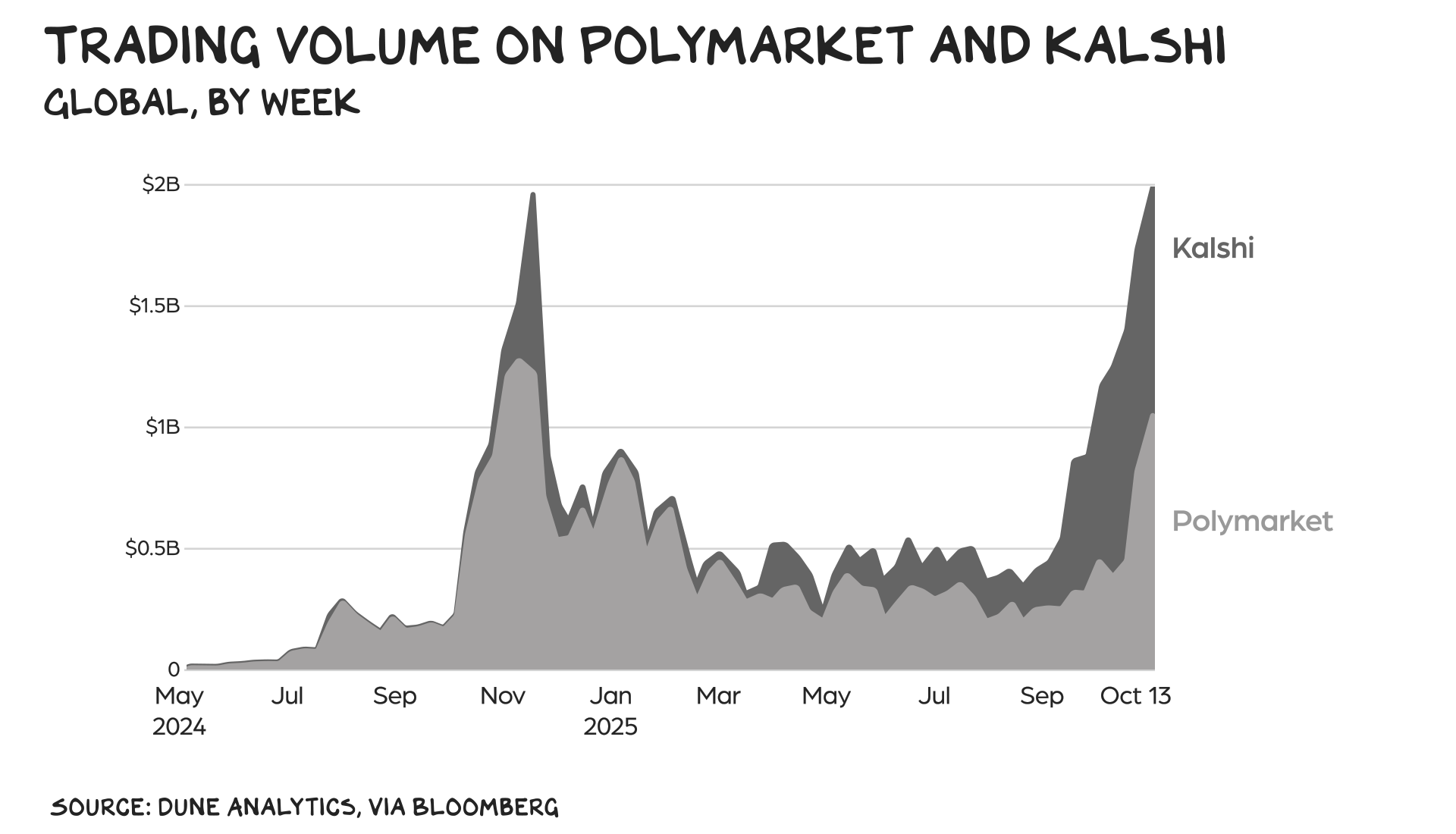
Weekly volumes for Kalshi and Polymarket breached the $2 billion mark for the first time in October, surpassing the peak reached during the last presidential election. Then came the New York City mayoral election. As residents headed to the polls, they saw billboards flashing the odds: MAMDANI (94%) — CUOMO (6%). With the race over, we can now bet on the likelihood of city buses becoming free before 2027 or rents being frozen. Leveraging its popularity, Polymarket is in talks to raise money at a valuation of $15 billion. Kalshi is attracting offers from VC investors valuing it at $10 billion.
Amid the mania, these platforms are moving deeper into the mainstream:
- Robinhood, the stock trading app, is expanding in prediction markets with Kalshi as a partner, declaring it’s the “fastest-growing business” it has ever seen.
- Google struck a deal to integrate odds from Kalshi and Polymarket into its search results so you can ask questions about future market trends.
- The owner of the New York Stock Exchange agreed to invest up to $2 billion in Polymarket, which is preparing to return to the U.S. after being kicked offshore.
- FanDuel is joining with derivatives exchange CME to launch a new platform, allowing it to bypass restrictions in states where gambling is illegal.
Sports leagues are also getting in on the action. In October the National Hockey League signed agreements in the U.S. with Polymarket and Kalshi, naming both official partners. Kalshi’s CEO said it’s a clear sign “prediction markets are here to stay.”
Doubling Down
Many people seem to have forgotten about Alex Kearns. I haven’t. I remember staring at his photo — a 20-year-old with a big smile and a fascination with the markets — and seeing my oldest son. In 2020, after receiving incorrect messages saying he owed the online trading platform Robinhood $730,000 (he owed nothing), the University of Nebraska student spent much of the night desperately trying to get in touch with the company. The next morning he left a note for his family saying he didn’t want to burden them with this debt. Then he took his own life.
That should have been a wake-up call. Instead, America has doubled down.
The operators have drawn legal challenges from state authorities. The Massachusetts attorney general sued Kalshi, arguing that the company “disguises” sports betting as “event contracts,” which are regulated by the federal Commodity Futures Trading Commission. In states where sports betting is off-limits, customers are turning to prediction markets to “invest” in sports. Sportsbooks mostly restrict access to people under 21. Prediction markets are available to anyone 18 and up.
Don’t count on the Trump administration to intervene. A week before Trump returned to the White House, Kalshi named the president’s eldest son, Donald Trump Jr., as a strategic adviser. Days later, the company publicized its entry into sports betting. Now Trump’s social media company is launching Truth Predict, allowing users to bet on events ranging from elections to inflation-rate changes.
Dopamine in a Hoodie
America’s pastime isn’t baseball but gambling.
We spend 10x more on gambling than music, Netflix, and cinema combined. Twenty million Americans struggle with or are at high risk of developing an online gambling problem. Young men are especially vulnerable. Men are more susceptible to gambling than women, just as they’re more likely to engage in illicit drug use, drink excessively, or die of opioid-related overdoses. Gambling has the highest suicide rate of all addictions. When you have a meth addiction, people notice — the sores, tooth loss. When you’re gambling, and you’re in deep, you lose your kids’ college fund or mortgage the house, but your struggles remain hidden.
The Supreme Court’s decision in 2018 to overturn a federal ban on sports betting has fueled the nation’s compulsion. Before the ruling, Americans legally wagered less than $5 billion on sports annually. Last year, with sports gambling legal in more than three dozen states and D.C., those bets ballooned to $160 billion. The mediums shapeshift to distract, but they are gambling. Some of the costumes:
- Fantasy sports are gambling in drag.
- Robinhood is gambling dressed as investing.
- Crypto? Gambling with a marketing department.
Normalizing Risk Porn
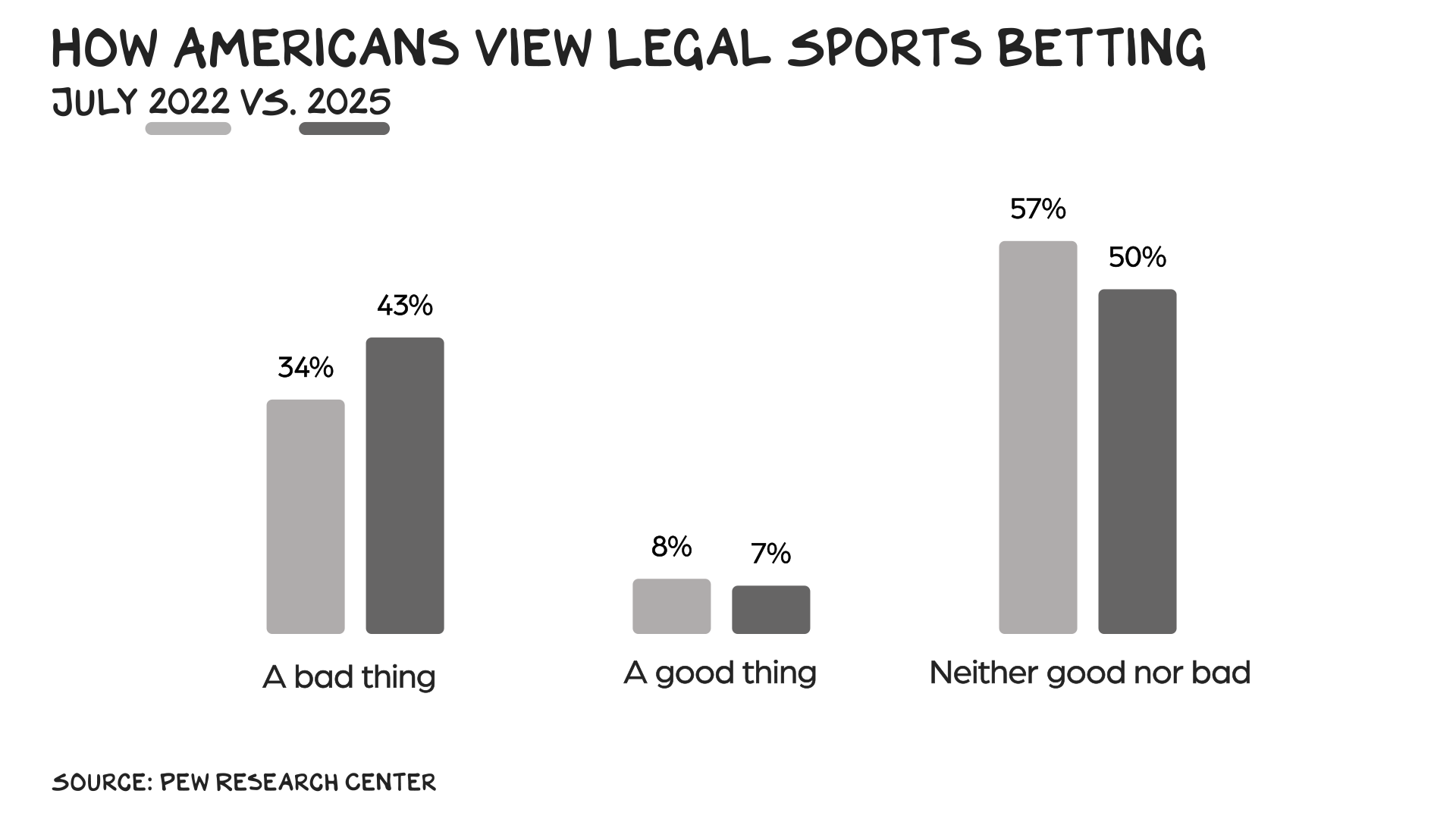
We know what happens when you give states the green light: Bankruptcies soar 30%. Americans grasp the scale of the crisis. More than 40% of adults see legalized sports betting as a “bad thing for society.” Still, the dopamine cocktail is too much to resist.
All-in
Sports leagues aren’t going to lose their zeal for gambling, despite back-to-back betting scandals in the NBA and MLB that raised concerns about the integrity of the games. Spoiler alert: The leagues will distance themselves from the alleged conspirators — but not from the gambling industry. Direct sponsorship deals between legal sportsbooks and top leagues may be worth more than $1 billion annually. A number of teams have agreed to put physical betting shops inside their stadiums and arenas.
For a moment, it appeared the NFL was concerned. In June the league announced a partnership with the International Center for Responsible Gaming to support research into gambling among college athletes and students. But this is a league that aligned with Caesars, FanDuel, and DraftKings and hosted its first Superbowl in Vegas last year. Just as we’ve made a conscious decision to transfer wealth from young to old and poor to rich, we’ve accepted a system in which money flows from fans to leagues.
Industry Checks
There are solutions, if we have the courage to implement them. We could do more to educate consumers about the dangers and impose tougher regulations, including age restrictions. Limiting annual losses, restricting advertising, and setting up firewalls between research into gambling’s impact and the industry itself are all on the table. Paul Tonko and Richard Blumenthal, Democratic lawmakers, have proposed measures that would be a good start. However, it’s an uphill battle. The most profitable firms in history are squatting in a building (our economy) that has no scaffolding on its instincts … any sort of dopa regulation trails institutional production.
Innovation vs. Exploitation
Prediction marketplaces say they aren’t on the other side of the trade — users are trading with their peers, not against the “house.” As traders buy and sell, prices fluctuate to reflect the “collective sentiment and knowledge of market participants.”
But whether you’re putting money on the Mets or Mamdani, this is gambling, and whatever you want to call it, users can develop an addiction. I am not immune. I find these markets fascinating — I tried to bet on the presidential race but couldn’t, as I’m an American citizen living in the U.K. My documented worker status saved me from myself: I was convinced Kamala Harris had a greater-than-37% likelihood of capturing the White House. And there is a solid argument we shouldn’t infantilize grown-ups — and we should let them spend their hard-earned money as they see fit.
In the U.S. we’ve monetized healthcare, the White House, and the pardon process. However, these are dwarfed by the opportunity to monetize the less developed prefrontal cortex of a young man. Once Polymarket starts expanding in the U.S., more Americans will be swept up by the wave. Not because everyone will be in Vegas, but because Vegas will be in everyone. If policymakers aren’t motivated by the threat to Americans’ finances and mental health, they should worry about the risk of foreign governments using the platforms to influence elections and public perception.
The Right Risks
The most profitable companies all do the same thing: They tap into our flaws and monetize them, then pretend it’s innovation rather than exploitation. We need to have a wider debate about the society we want. Rather than celebrating gambling, we should embrace a different kind of risk: asking someone out, approaching a stranger, investing in relationships with friends and potential mates. This is what I ask myself when I mentor young men: How can I increase their risk appetite for the real world? How do we create a societal movement to convince people to bet on each other, not platforms? Will there be thoughtful regulation?
I don’t know, but I’m certain we’ll be able to bet on it.
Life is so rich,

P.S. I’ll reveal my Predictions for 2026 on December 4th at a free live event hosted by Section. Sign up here.