Until my forties, I was known … but not famous. Known in grad school at Berkeley, known in the e-commerce scene in the Bay Area, and, after having taught 5,000 students, known around NYU’s campus. Day 1 of “fame” came in 2016. The team at L2 (my business intelligence firm) was headed to our weekly team lunch when, from across the street, we heard: “Prof G … we love your videos!” Two Indian men in their twenties hurriedly crossed the street to tell me they never missed our “Winners & Losers” videos and that I had a following in India. Then they asked for a selfie. The whole team thought it was odd and amusing that people from several thousand miles away not only knew our work, but also that the work inspired affection and admiration.
Every day since then, it’s grown. Messengers swerve onto the sidewalk and high-five me. Women, visiting from Michigan, run out of restaurants to ask if I can wait a minute while they get their (horrified) son to take a selfie with me: “We listen to your pod together.” And today, I’ll receive dozens of emails and hundreds of comments from people I’ve never met or been in the same room with. Fame. Fred Allen said a celebrity is someone who works hard to become well known, then wears dark glasses to avoid being recognized. I have never donned dark glasses as … I love being recognized. I can’t think of a time when it didn’t make me feel good, even if I was in a hurry. It has, no joke, made me feel better about the world, and myself — people are so wonderful to me, and (almost) convince me we’re having an impact.
The real joy is people recognizing me when I’m with my kids or friends. Years ago, whenever anything good happened, I would call my mom and tell her first. She was inevitably more excited about my first mortgage or dog than I would ever be. The audible joy on the other end of the line made the achievement and the moment real. Even though she’s gone, my first instinct whenever anything good happens is still to call her. To make that good thing real. But she’s not around, so many great things feel as if they aren’t real, as if they didn’t really happen. People recognizing me, saying something nice, makes some of the nicer things in my life feel (once again) as if they actually happened. If I sound a bit fucked up, trust your instincts.
There is a dark lining to the silver cloud — one I try not to dwell on. I read recently that for every person who comes up to a celebrity and says something, 50 other people recognize the person but don’t approach. In crowded cities and locations, someone might say hi to me every 20 minutes. That converts to 150 additional people an hour who see me, though I don’t see them. The panopticon of fame. I understand why truly famous, A-list people feel they can’t leave the house.
Still, the saving grace is that, in person, people are wonderful. Online, they’re significantly less wonderful. A non-zero percentage of online recognition is really ugly. The inevitable corollary of success is that people feel the need to take you down, and online media has tapped into that instinct like nothing else. There seems to be a cottage industry for correcting or calling people out once they have (any) fame. I’d like to say it just rolls off of me, but it doesn’t. Some of it is just downright disturbing. Recently, I’ve been receiving emails from (purportedly) young men experiencing suicidal ideation who need help (i.e., money). Not just “a Nigerian prince needs your help” — these are closely tailored to my publicly stated views and concerns. They’re clearly fakes (possibly AI-generated), but still … disturbing. Fame has validated for me what almost every study shows: Anything that happens in real life is profoundly better, kinder, and more human than its online facsimile.
Innate
Fame is increasingly embedded in our economy and daily lives and thus garnering more research attention. One finding: it’s about our fear of death. Empirical studies confirm that our desire for fame increases with greater awareness of our mortality. Which makes sense: The only thing that can outlive your body is the memory of you.
That drive can inspire great achievements. Charles Dickens was famously obsessed with fame — and that obsession coursed through his characters. Ovid admitted his mission was for his “fame to live to eternity.” Some people, though, try to skip over the “great achievement” part. As Harry & Meghan subject us to their worldwide privacy tour, we’re not as much interested in them — both brighten up a room by leaving it — but in the hypocrisy of pursuing privacy on Instagram and Netflix. (Q: Is it wrong to wish they could be mowed down by a psychotic skier who makes vagina-scented candles?) Or maybe they wish for a more modern approach to fame: I hate fame. Look at me. Please. See how much I hate it? Look at me.
Regardless, these people know we only truly die when people stop knowing who we are.
Who
Despite what Instagram and the Daily Mail indicate, becoming famous is not most people’s No. 1 priority. In fact, only 1 in 10 Americans admit that fame is important to them.
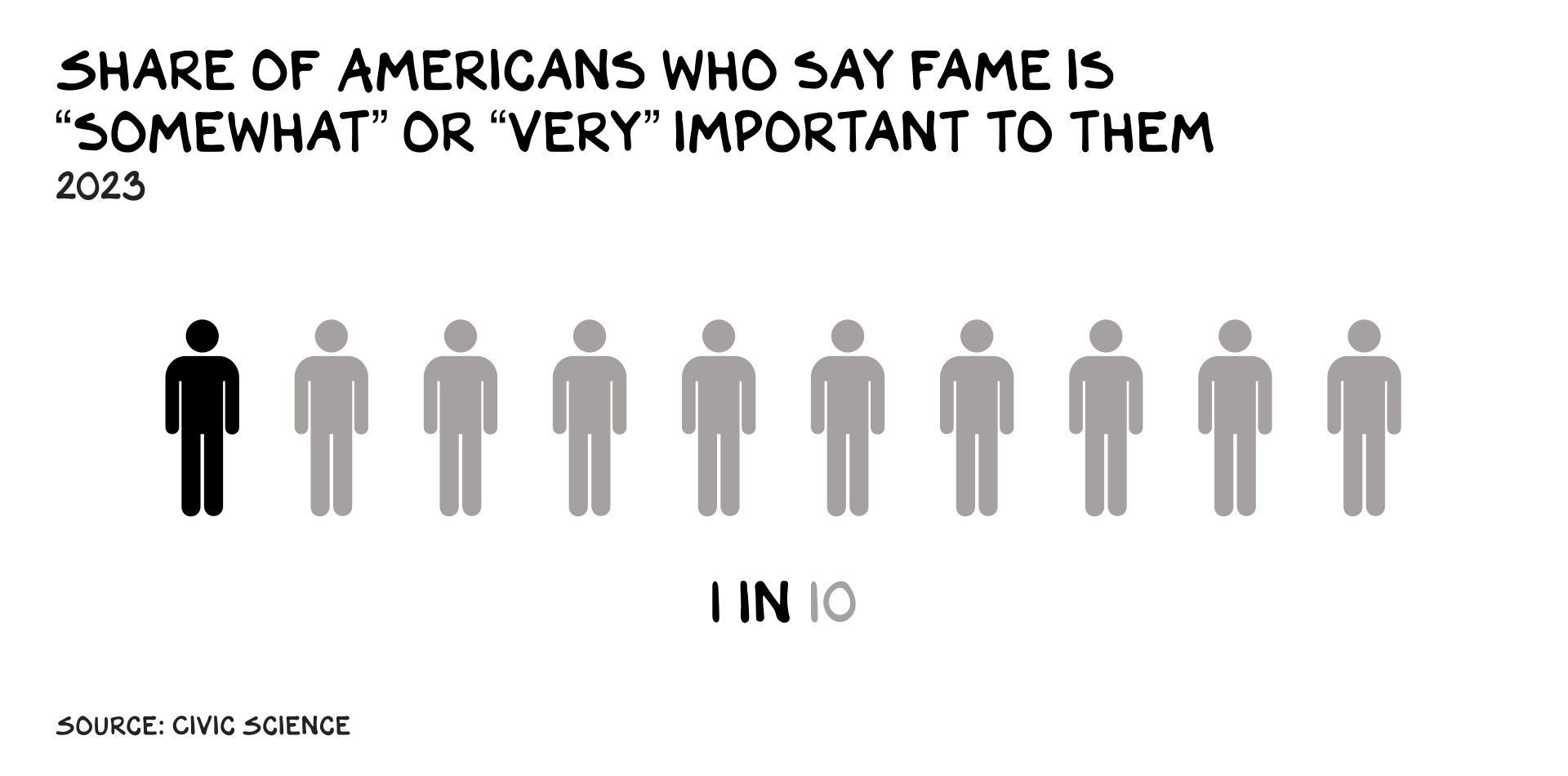
Who are the 10% who want to be famous? Ambitious, attention-seeking, conceited, and psychologically vulnerable folks. Psychologically vulnerable, meaning they feel they have issues that fame will help them overcome. The other term for this is low self-esteem. I just read the previous paragraph and … feel seen.
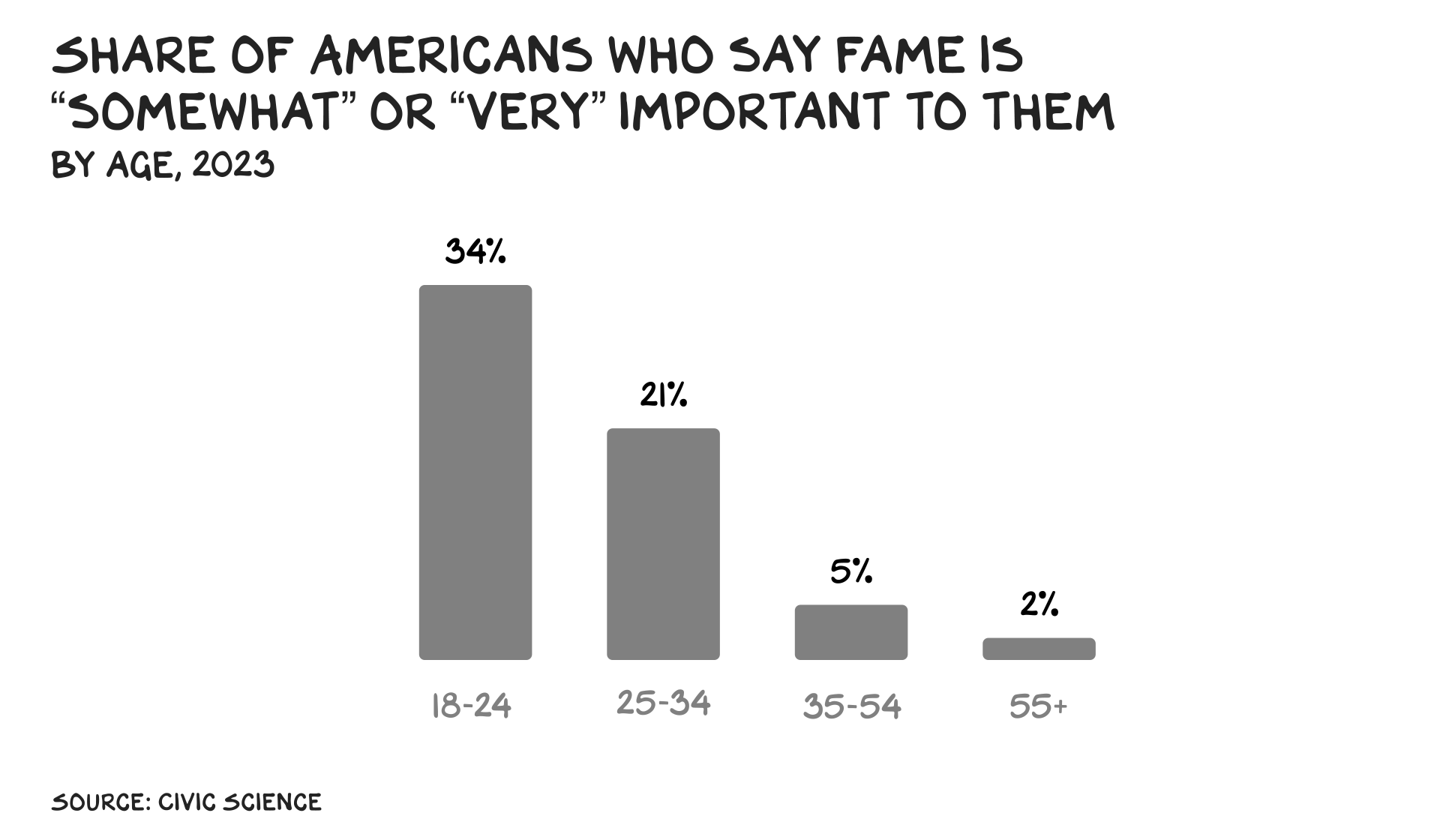
This may explain why young people are especially interested in fame. Compared to 2% of boomers, more than a third of 18- to 24-year-olds say fame is important to them. Becoming a celebrity is akin to sitting at the cool kid’s table. It’s the “perfect balm for the sting of social exclusion.” The social media cocktail stirs into this follower counts and like buttons, escalating young people’s emotional tumult to dangerous levels.
Externalities
If fame is a treatment for feeling inadequate, it’s likely not a good one. It turns out fame, like power, is an addictive substance. Many famous people report feeling fearful they’ll lose their notoriety — and when they do, the transition out of the public eye creates a psychological burden. As with heroin, getting hooked is the easy part. Actors, singers, musicians, and athletes on average die younger. The upside? They cement their fame. Neither James Dean nor Marilyn Monroe was that talented. Kurt Cobain would still be famous. But I digress.
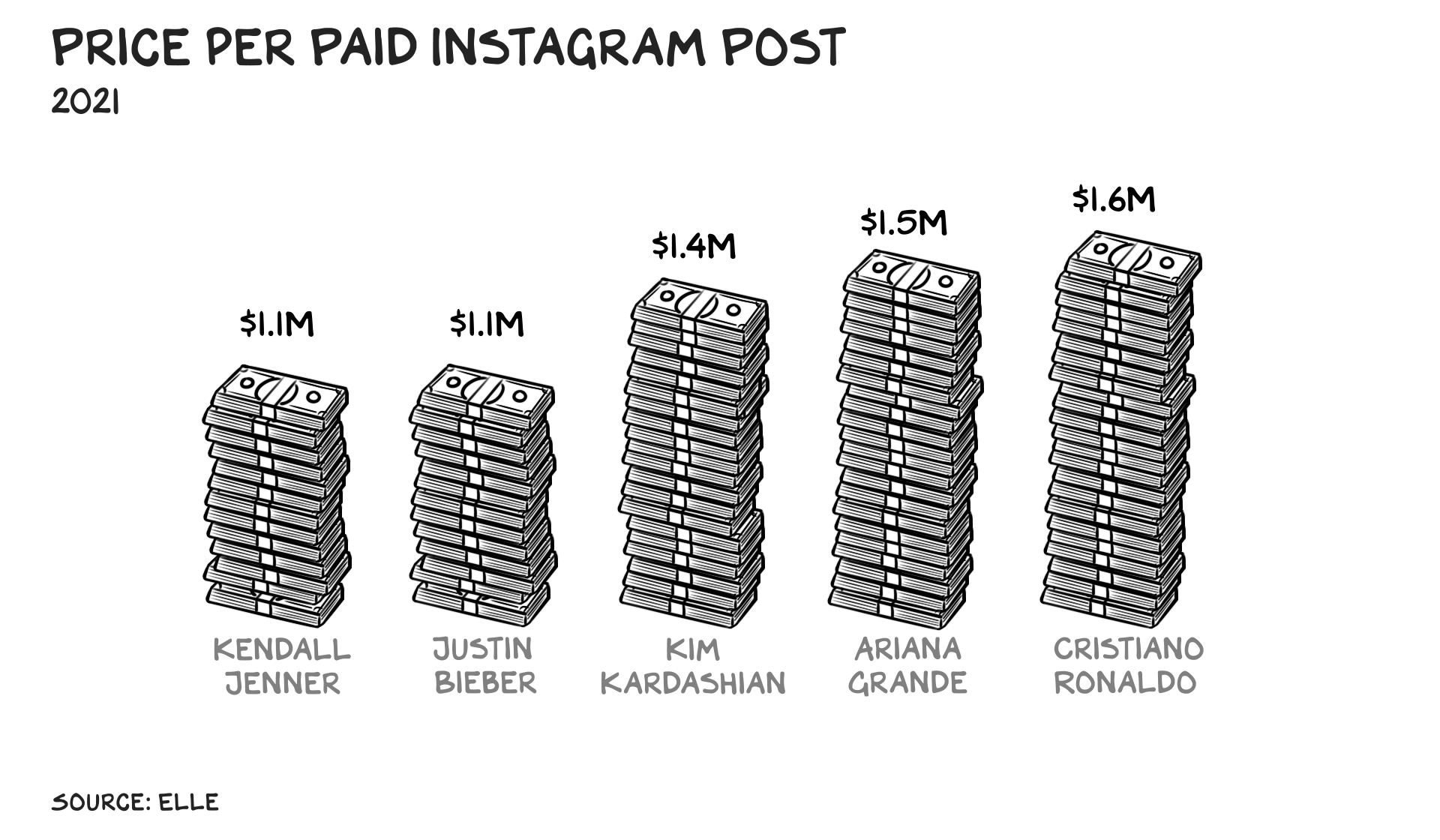
Fame is a drug increasingly laced with the fentanyl of fame itself. Almost any position or attribute is a positive if you can be famous for it. Whether it’s homemade porn, catastrophizing on Twitter, or mocking the disabled, if it makes news you’ve won. And in an attention economy you can monetize that. The wheel spins. BTW, it’s the dealer who wins.
Goldilocks
I have just the right amount of fame. On a regular basis, someone approaches me and says something nice about our work, and it’s rewarding. At the same time, I can eat at a restaurant bar alone and feel (mostly) anonymous. Knowing that some people likely do recognize me triggers the Hawthorne effect — I am now more conscious of my actions, as I assume I am being observed. Probably a good thing.
I’m a high functioning fame-aholic. I love alcohol and THC but am not addicted. Neither gets in the way of my life, and I don’t crave them. I am, however, addicted to the affirmation of strangers. I hope that makes me more like Dickens, less like a Windsor. I’ve accepted I’ll never be a serious scholar, because as Zhuangzi noted, “He who pursues fame at the risk of losing himself is not a scholar.” I don’t do peer-reviewed research as (almost) nobody reads it. But I believe the work we do makes a difference in other ways.
The allure of fame takes some people to dark places, so it matters where the void that people try and fill with fame comes from. For me, I believe the void is that, growing up, I was invisible. Not a good or bad student, neither a loner nor especially social, athletic but not talented, funny but not hilarious. At big public schools it was pretty easy to blend into the ecosystem as a defense mechanism against predators who were more popular, mean, or even violent. An especially bad acne week? Rejection from a person/group beyond my social reach? No problem, just retreat and go invisible.
Our research on struggling young men largely distills to one determining factor: The presence, or lack thereof, of a male role model. I had one — my handsome, sharp-witted dad was the most impressive man I knew — but he moved away when I was 8 and (often) didn’t seem that interested in me. And why would he be? I was barely there. And if my dad didn’t see me, why would anybody else?
So my limited fame fills a hole, an old fear that I’d never amount to anything, I’d remain invisible and … alone. The hole leaks, though, so it never fills up. Recognition from strangers, as you age, feels increasingly like empty calories. The affection people have for you is for your public representative … it’s not really for you — they don’t know you. And if they did, they’d likely be disappointed. I believe the last sentence illustrates what people call impostor’s syndrome.
15:15
I’m 15 seconds past my 15 minutes and still trying to determine how — regardless what demons inspired my pursuit of fame — to turn chicken shit into chicken salad. So we highlight the work of other academics; catalyze the conversation on important issues; help people feel more connected to each other and the country; and (most important) call attention to others’ achievements. Fame, like compassion, is not a zero-sum game. It’s so easy to share and means so much to people.
Fame and atheism go well together because the only thing that survives death is living people’s memory of you and if/how it influences their actions. In 50 years, I’ll be gone. When I think about that (which is often) I am reminded that I don’t need the recognition of strangers to make me immortal. There are two men who’ll then be 62 and 65, who lived with me the first 18-plus years of their life, who will remember me. They’ll remember how intense, yet goofy, I was. I’d also like to believe they’ll be more kind and secure than I was, as, every day, their father confirmed they were wonderful and immensely loved. They won’t remember my books, the TV networks I helped kill, or any other accomplishments. They will feel me, though. They’ll tell stories about me, I’m certain of it. I’ll be famous.
Life is so rich,

P.S. This week on The Prof G Pod I spoke with California Representative Ro Khanna about TikTok, SVB, and a vision for America.
P.P.S. To celebrate Section’s rebrand, we’re offering 100 class passes to take an upcoming workshop for free. Enroll here.