One of the most daunting things when I first started looking for a gun was deciding what size bullet to get.
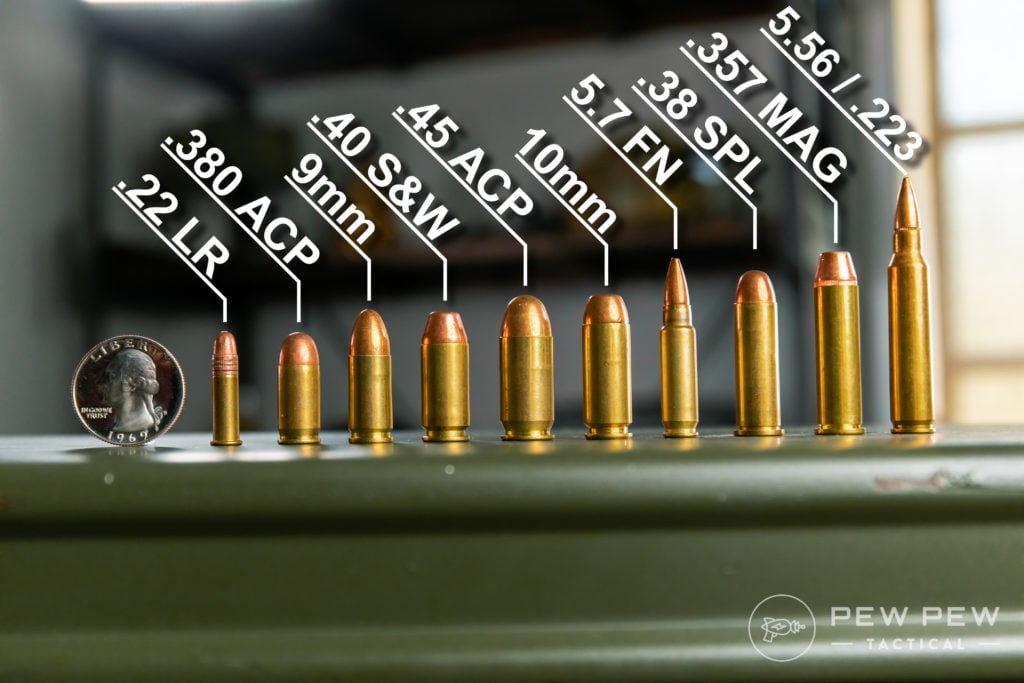
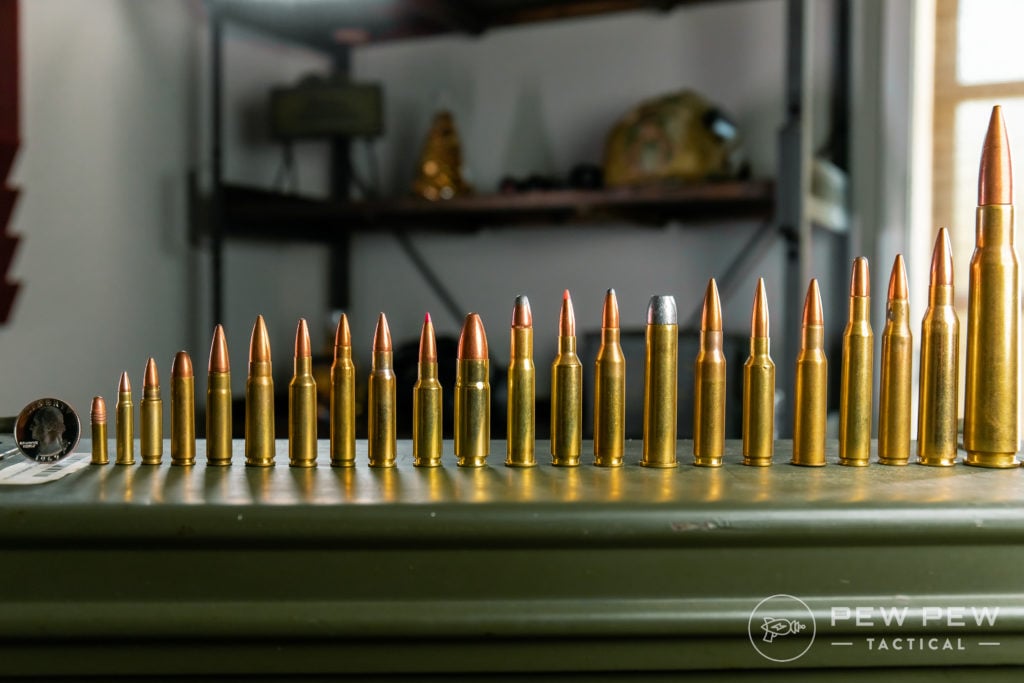
Things got even crazier when I started to look at rifles…
But don’t worry, we’ll be covering some of the most popular handgun, rifle, and shotgun calibers out there and going over the benefits and weaknesses of each.
Then we’ll follow up with some bullet terminology and the different types of bullet tips (hollow point, etc), how shotgun shell sizes work, and a breakdown of the components of a round.
By the end, you’ll be a bullet pro!
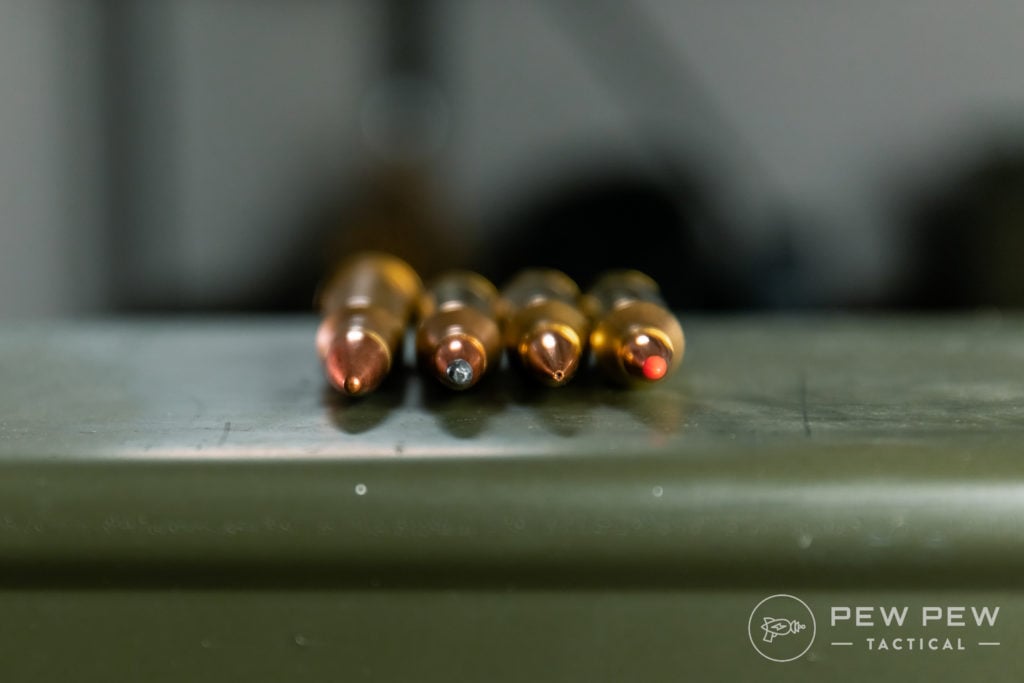
Table of Contents
Loading…
Bullet Size & Caliber
For guns, “caliber” means the diameter of the barrel and, thus, the diameter of the bullet that is going through it. Usually in inches or mm, like 9mm for pistols and .223 for rifles.
Also, for terminology’s sake, “bullet” just means the metal projectile, while the entire thing is called a cartridge.
Rimfire vs. Centerfire
The first differentiator is between rimfire and centerfire cartridges.
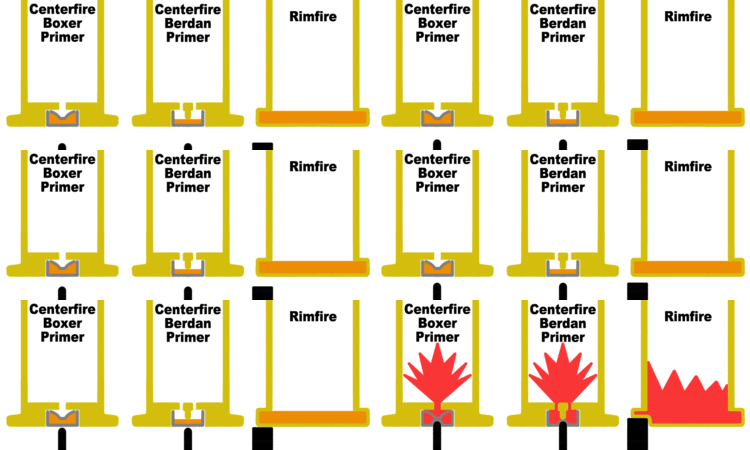
The rimfire’s primer is built into the rim, while the centerfire cartridge has the primer in the center. Pro tip: If you can see a circle in the middle, it’s a centerfire cartridge.
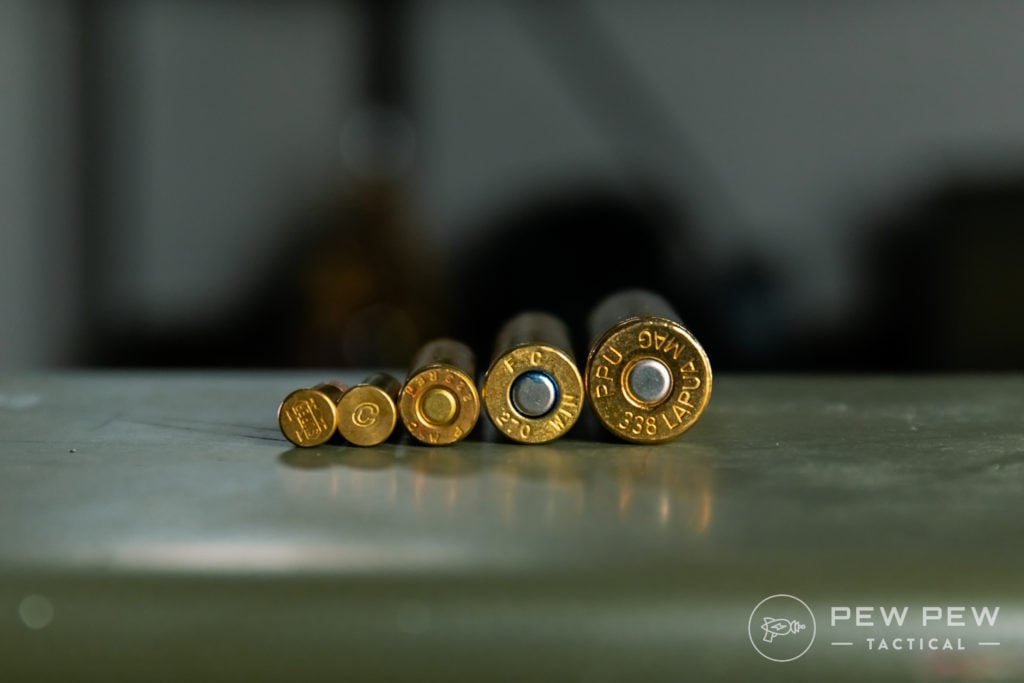
Rimfires are extremely cheap (a few cents each), and the .22LR is the most popular rimfire caliber.
This animation shows how the firing pin hits the primer in a cartridge.
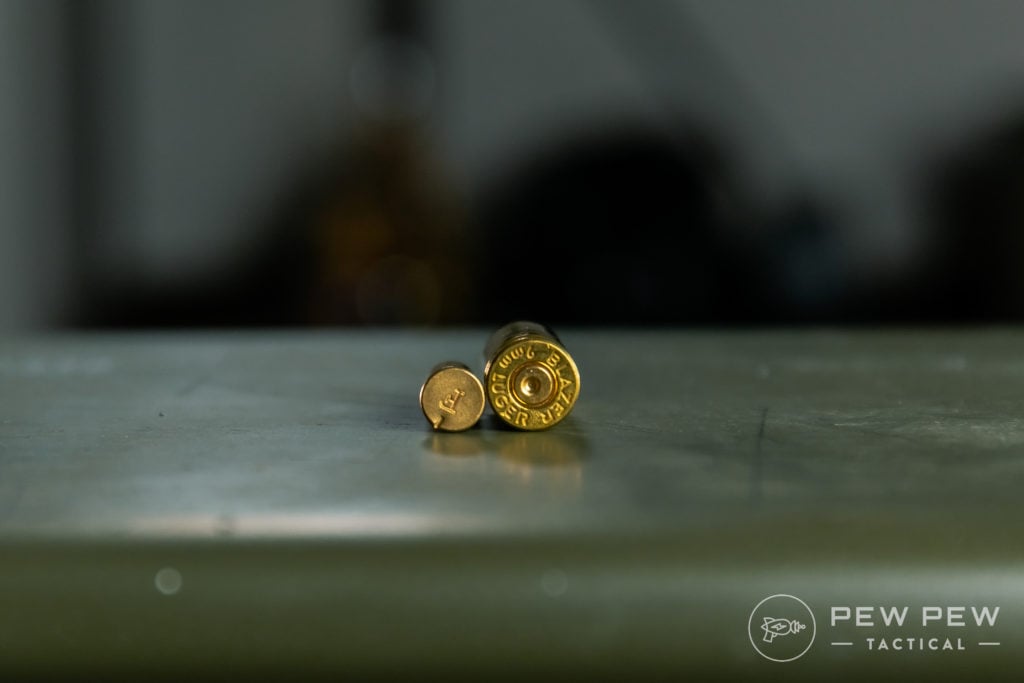
Here are some expended casings from a rimfire vs centerfire. You can see the primer strikes on the rim for the rimfire and the center for centerfire.
For even more differences, see our article on Rimfire Ammo or familiarize yourself with How Guns Work.
Common Bullet Calibers
To make things a little more confusing, there’s a mixture of measurements in inches and millimeters.
There’s also a unit of weight called a “grain,” which is used to denote the weight of bullets and gunpowder. A “grain” is really small since 7,000 grains make up one pound.
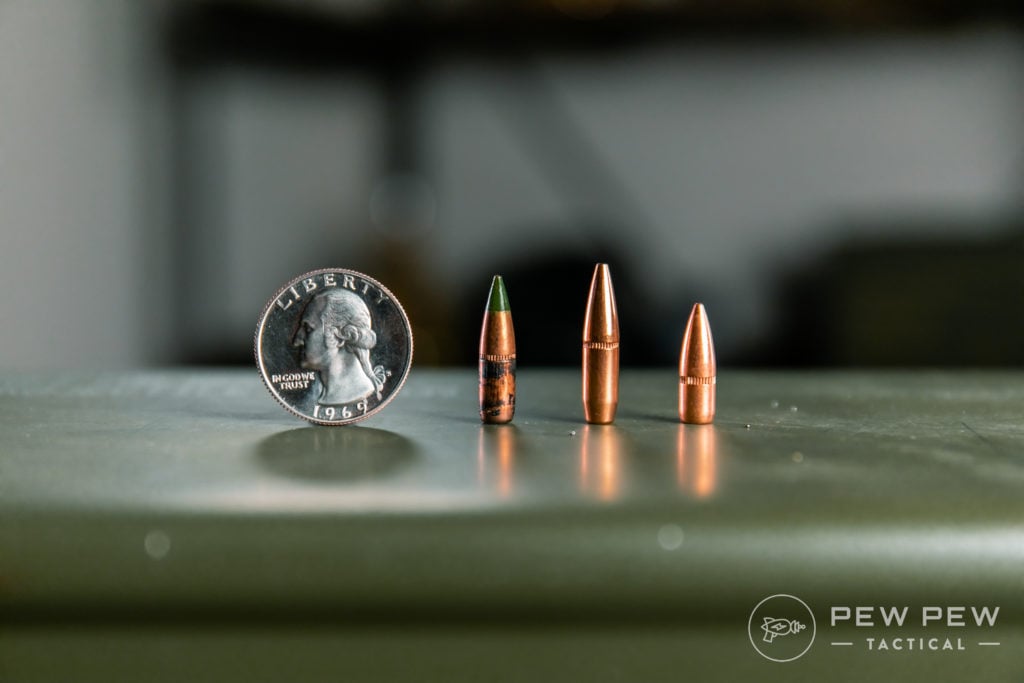
Now, let’s go through some rounds!
1. .22LR
Pros
- Affordable
- Very little recoil
- Great for plinking and critters
Cons
- Not great for self-defense
The “twenty-two” long rifle is the most common caliber in terms of units sold.
It has a bullet weight of around 30 to 40 grains and is extremely mild shooting in both pistols and rifles.
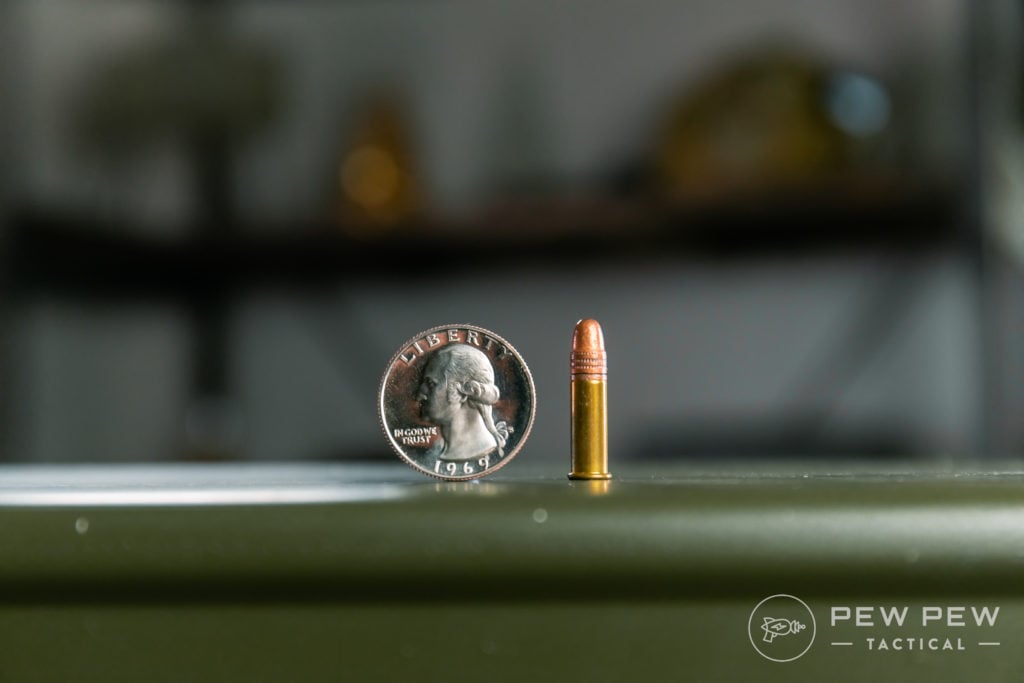
The recoil is almost non-existent, which makes it a great starter round for someone who has never shot a gun or is uncomfortable with the noise.
The low price of the bullets is also great for learning sight pictures.
It is traditionally the starting caliber for shooters. These things are only a few steps up from a pellet gun round, especially in a rifle (Ruger 10/22) shown below.
They’re mostly for taking care of rats, snakes, and birds. They’ll be useful for self-defense, but it might take a shot or six.
For more info:
2. .380 ACP
Pros
- Adequate for self-defense
- Low recoil
- Smaller handguns
Cons
- Could have more oomph for defensive use
- Many of the guns chambered in .380 can be harder to shoot due to their size
Now we’re getting into slightly beefier sizes.
Personally, I would never use a gun with anything smaller than a .380 as my primary carry weapon.
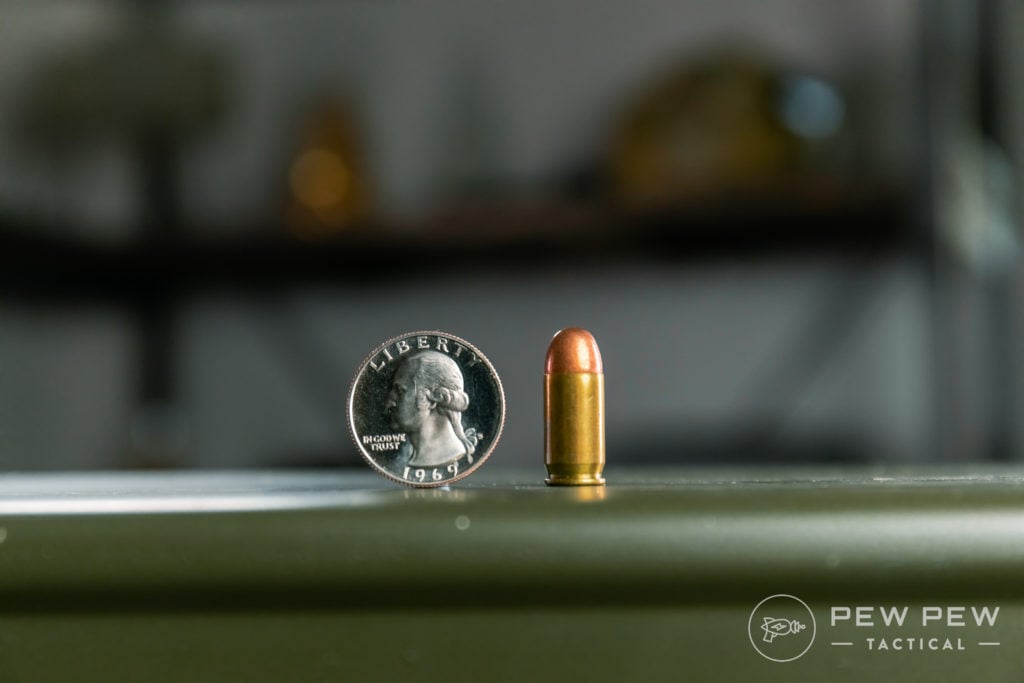
Sometimes called a “9mm Short”, it has seen a major boost in popularity recently thanks to the various “pocket pistols” that have come on the market.
This bullet has relatively low recoil and, at close range, good penetration.
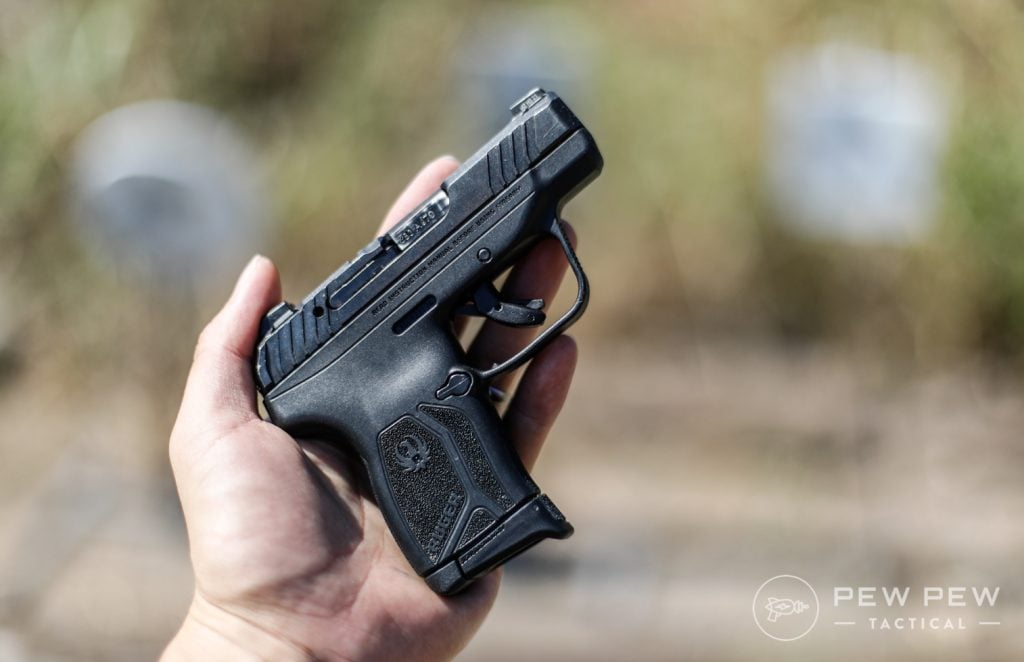
Gun author Massad Ayoob once said of the .380, “Some experts will say it’s barely adequate, and others will say it’s barely inadequate.” This is a low-power round.
Because of the nature of the bullet and the guns that shoot it, its effectiveness is relatively limited beyond close-ish range, even with good defensive rounds.
For more info:
3. 9mm Luger
Pros
- Good for self-defense
- Affordable
- Lots of different bullets and loads
- Good capacity handguns
This pistol round is officially known as the “9x19mm Parabellum” or “9mm Luger” to distinguish it from other 9mm rounds. But you will be fine just saying “nine millimeter” or “nine mil” for those in the know.
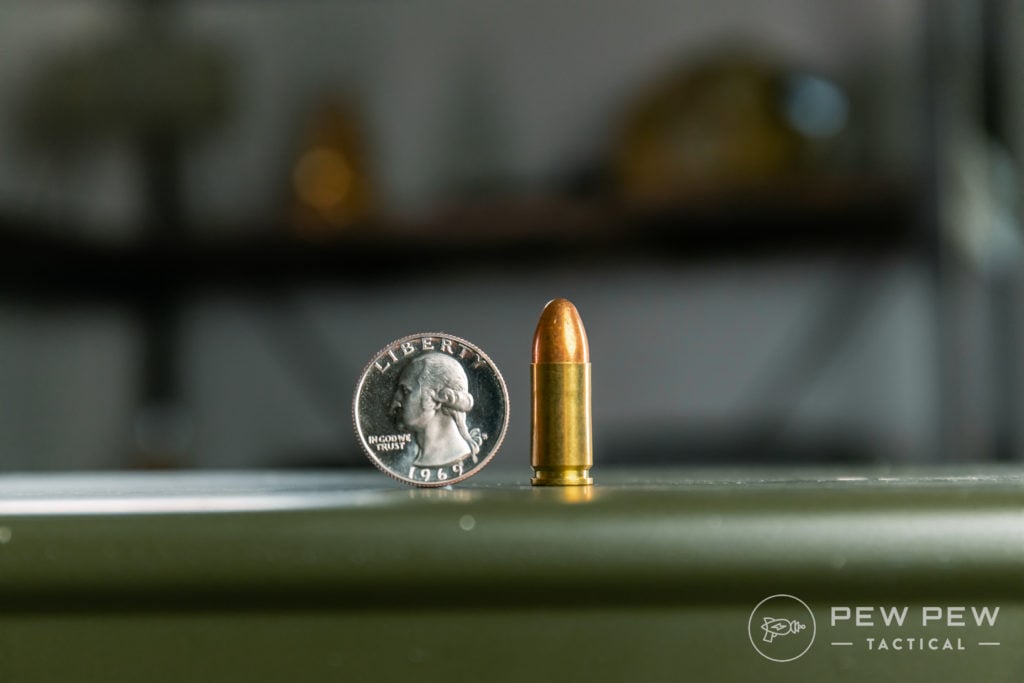
9mm is my personal favorite, and if there were a “Goldilocks” round, this would be it.
They’re fun at the range. They’re good for defense.
Believe it or not, the 9mm bullet is the same diameter as the bullet used in the .380 and the .38 Special.
The difference between the three is the amount of gunpowder behind it and the bullet weight.
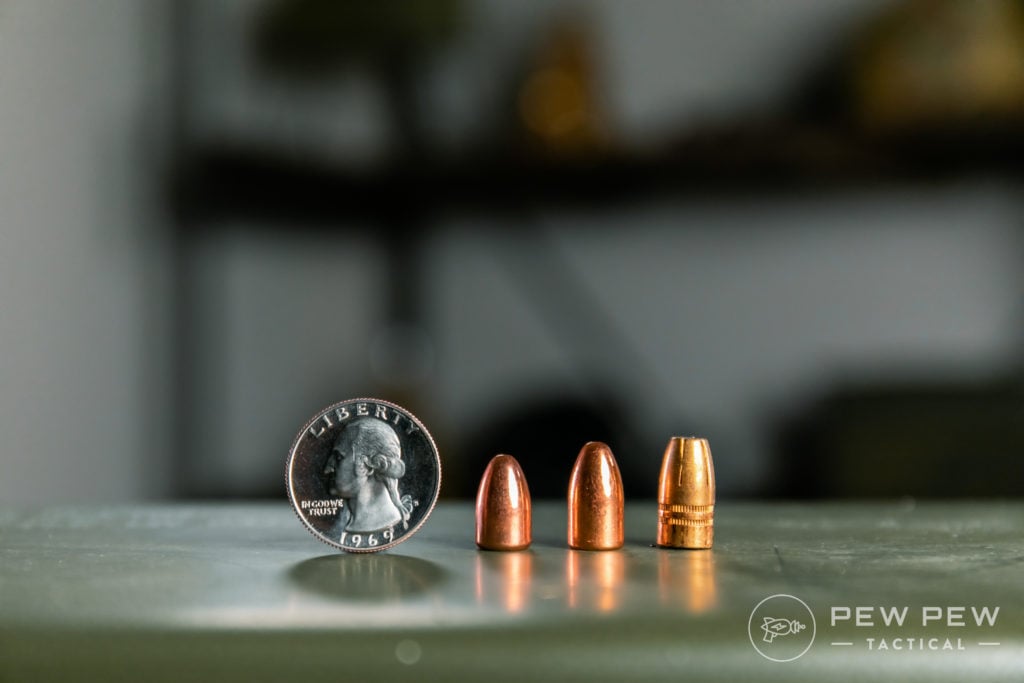
It is the standard round for NATO countries and the majority of police forces around the world.
It is mild shooting, can vary in weight from 115 to 147 grains, and has varying stopping power based on the type of bullet (hint: go with hollow points).
Many, many guns use this size as well. A compact 9mm gun can be used for concealed carry. Most of the guns that use this size can hold, on average, 15 to 17 rounds in the magazine.
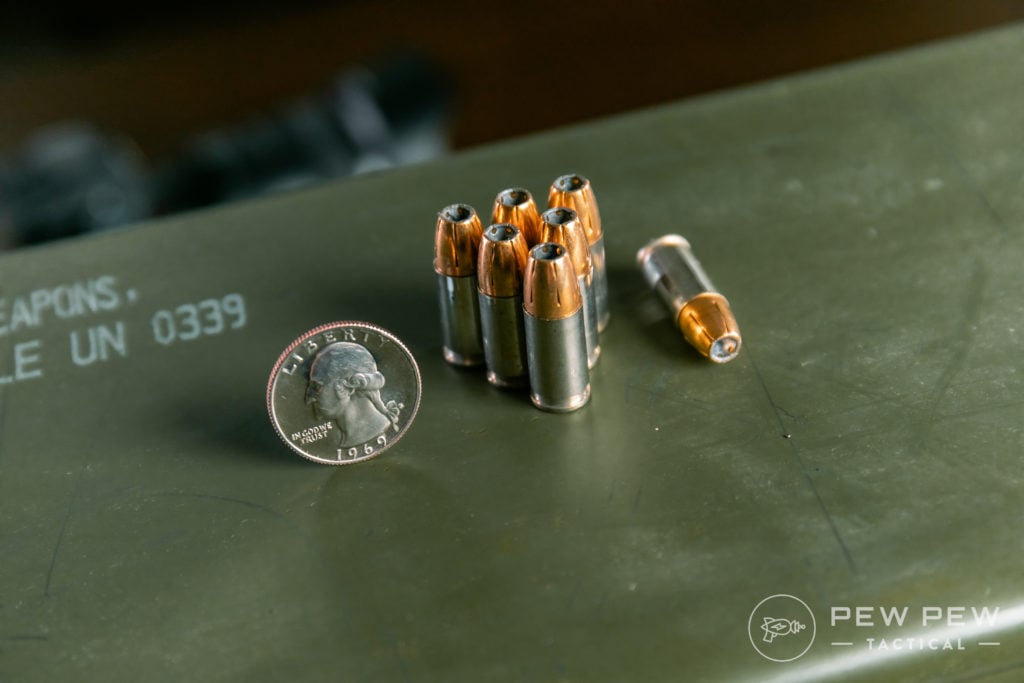
And now, there’s been a huge rise in the popularity of Pistol Caliber Carbines (or PCC). Get the nice ergonomics of a rifle but with the price and hollow points of the 9mm.
For more info:
4. .40 S&W
Pros
- More power than 9mm
- Lots of affordable LE trade-in guns available
Cons
- Snappier recoil
- More expensive than 9mm
- Lower capacity than 9mm
Remember how I said the 9mm was the “Goldilocks Round?” If that’s the case, then the .40 is her big, angry, whiskey-drinking sister.
Originally designed for the FBI as a reduced 10mm cartridge and has been popular with other law enforcement agencies ever since.
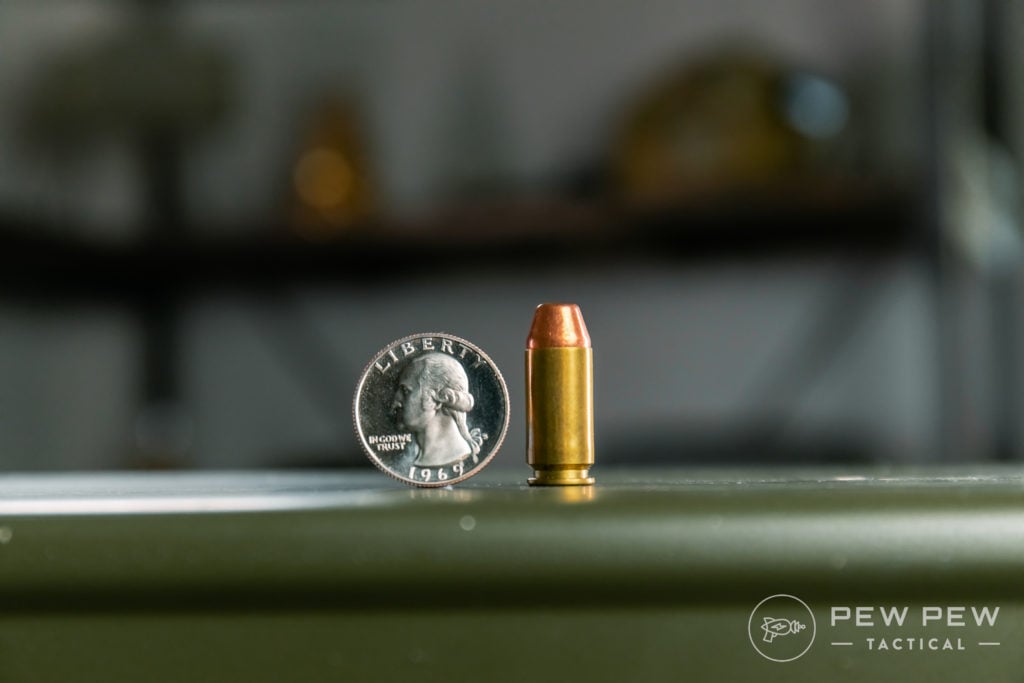
It has more kick when compared to the other popular handgun cartridge, the 9mm. Weights typically vary from 155 to 180 grains, although some specialty rounds will fall outside that range.
It is worth mentioning that the FBI recently decided to move back to the 9mm since agents are able to shoot more quickly and more accurately with 9mm compared to the .40 S&W.
Many other law enforcement agencies have followed suit, as has the general public. This has led to a pretty steep decline in the popularity of .40 S&W in recent years.
For more info:
5. .45 ACP
Pros
- Big heavy round
- 1911 nostalgia
Cons
- Lower capacity guns
- More recoil
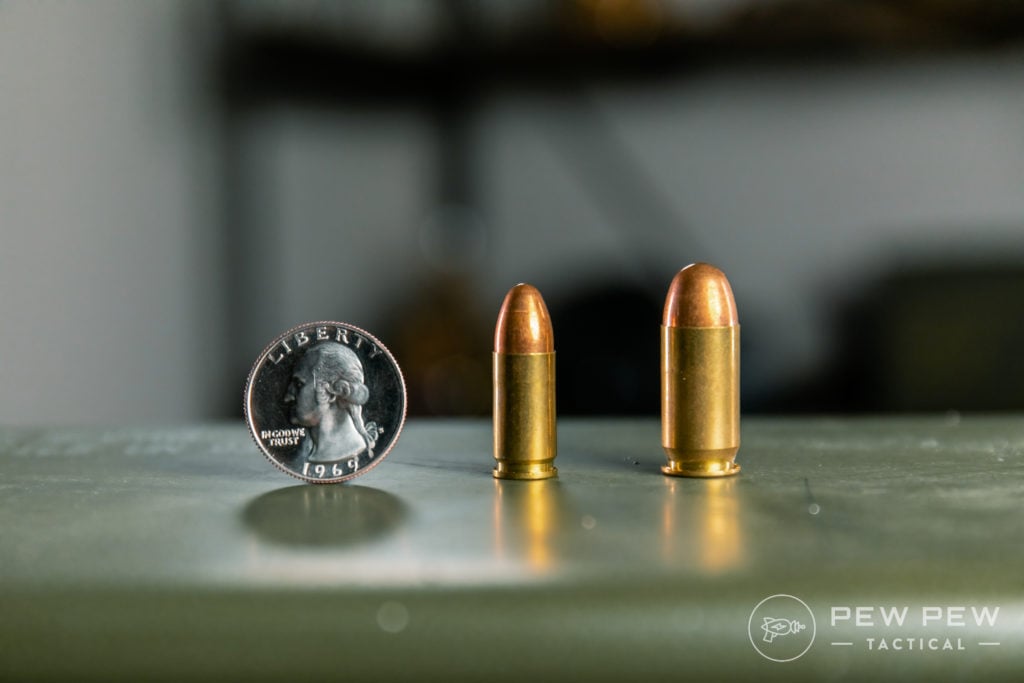
Designed in 1904 by Mr. John Browning himself for the famous 1911 pistol, this round has one heck of a history.
This thing is a big bullet with stopping power to spare.
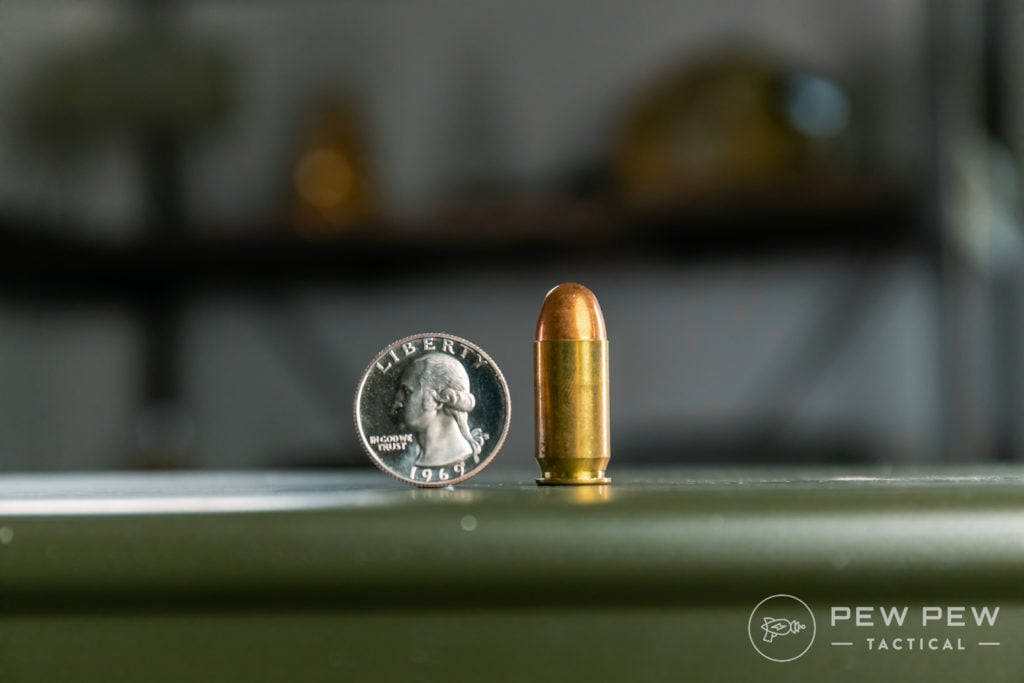
The choice of many police officers and military personnel for years, the .45 caliber round has proven itself time and time again. I could probably do an entire article on just this bullet.
It has a large bullet of around 230 grains and has moderate recoil.
I can tell you from personal experience that this is not a round to hand to someone who’s never fired a gun before. Its stopping power is renowned, and it has a nostalgic fanbase.
For more info:
6. .38 Special & .357 Magnum
Pros
- Most common revolver calibers
- Good effectiveness
- Lots of bullets and loads
Cons
- Not for use in most semi-autos
The “thirty-eight special” is most commonly found in revolvers.
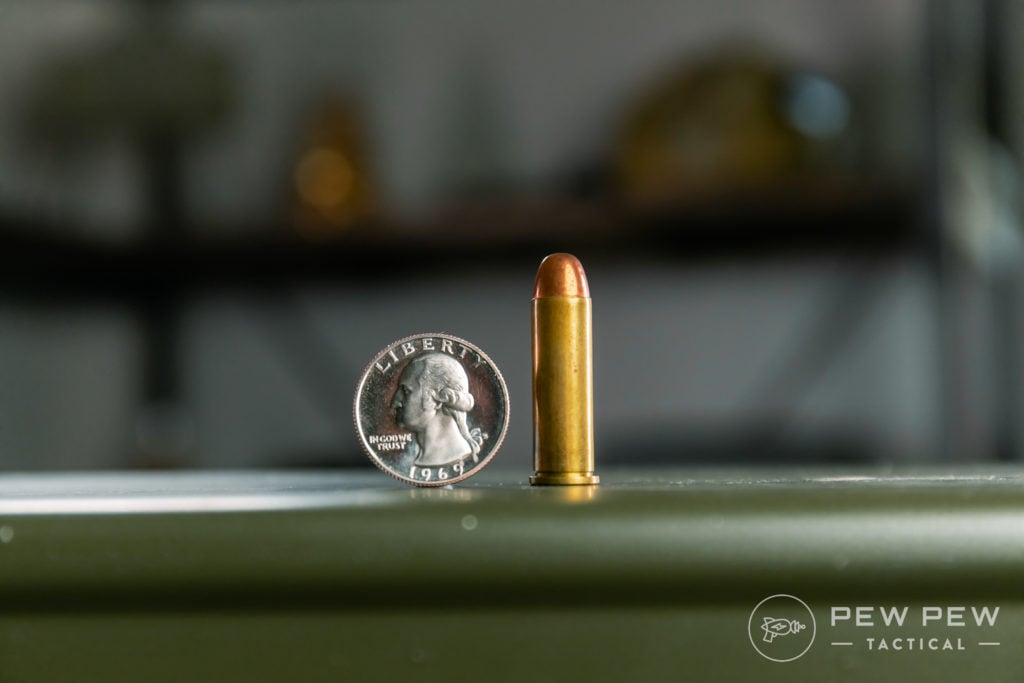
It has manageable recoil but is still quite a handful when in a very light/small revolver. It has a longer cartridge and more powder in said cartridge, but it is a slower, heavier bullet than the 9mm.
The FBI used this cartridge as its standard issue for a very long time.
The .357 Magnum is identical to the round except for being slightly longer.
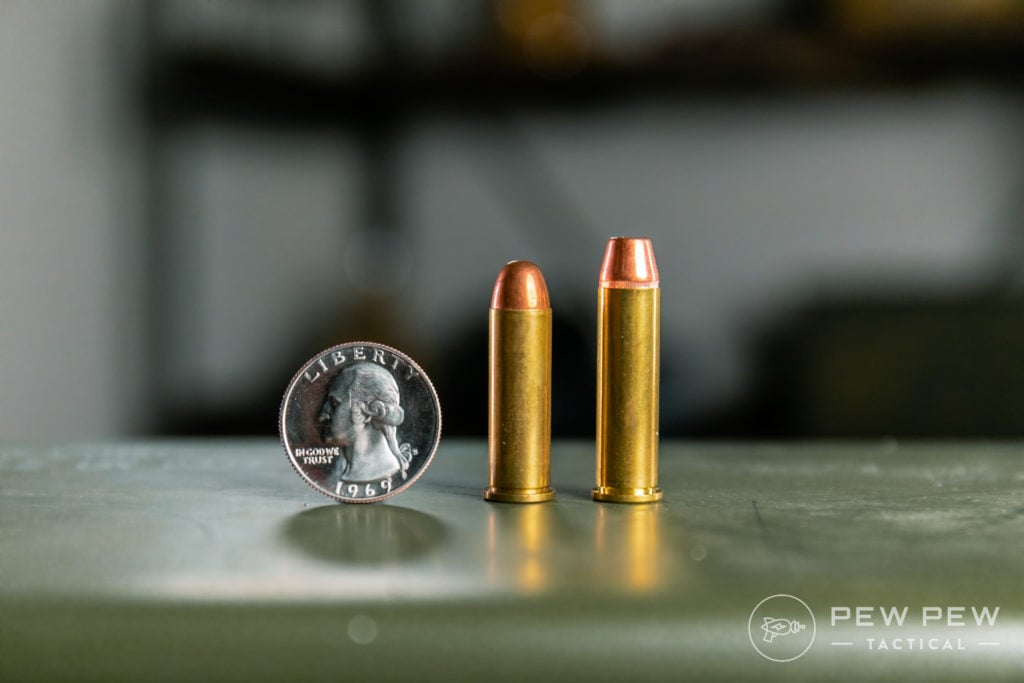
You can safely fire a .38 Special in a .357 Magnum gun, but don’t try the other way around due to size and pressure constraints.
Bullet weights typically range between 110 and 158 grains.
For more info:
7. 7.62x39mm
Pros
- Standard AK round
- Solid stopping power at normal combat ranges
- Common
Cons
- More recoil than 5.56
- Surplus has dried up
This is the Soviet round used in the standard AK-47 line of rifles.
It has moderate recoil and good knockdown power. The bullet weight is usually 123 grains or very close.
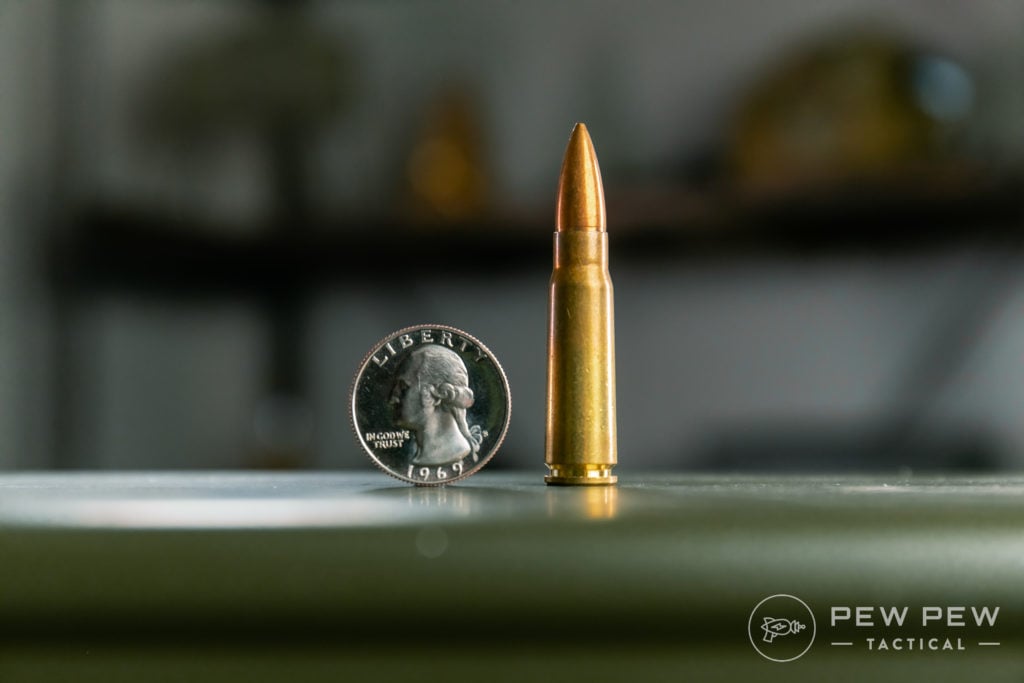
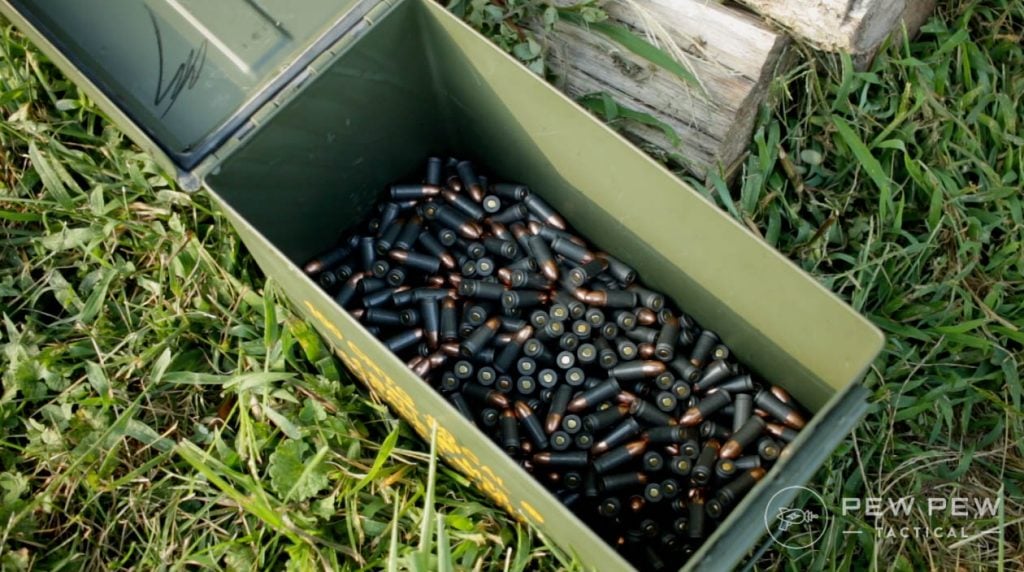
There used to be a high availability of military surplus ammo, which made the rounds very affordable. This led to an increased popularity of the round, and a few other manufacturers started chambering guns in this caliber as a result.
However, due to dwindling surplus supply and import sanctions, 7.62x39mm has increased notably in cost over the last five or so years. Despite this, it still remains a favorite of shooters due to the growing number of quality AKs available on the market.
For more info:
8. .223 Remington / 5.56x45mm NATO
Pros
- AR-15 standard round
- High velocity
- Light recoil
Cons
- May be to small for some applications
The “two-two-three” (inch) Remington has almost the exact dimensions as the “five-five-six” (mm) NATO cartridge.
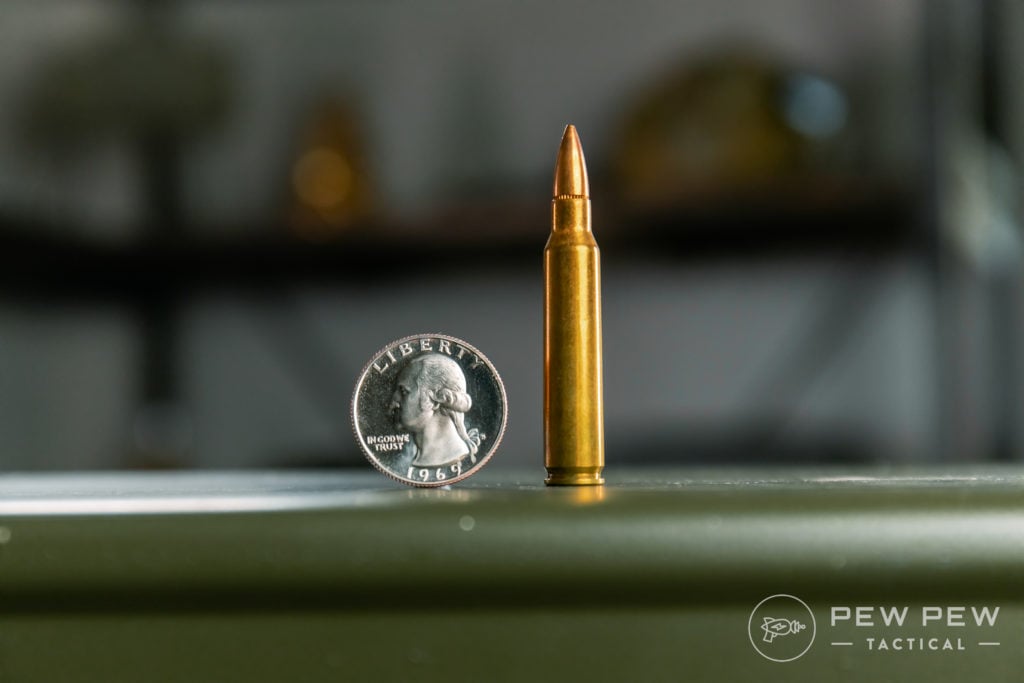
The 5.56 usually has slightly higher pressures than the .223 Remington, but both rounds are interchangeable in most modern rifles (~1990 and newer) unless otherwise specified.
Bullets are usually between 40 and 77 grains, with 55-grain rounds being the most common. The 5.56 cartridge is known for its light recoil.
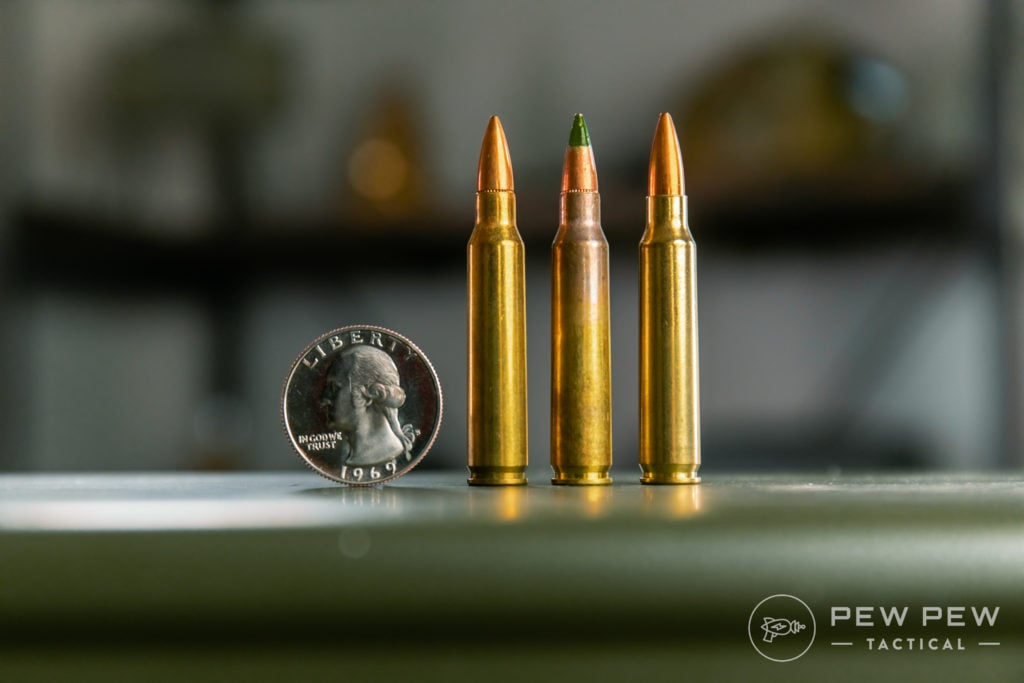
It is the ammunition used in the standard M16/M4/AR-15 line of rifles, making it one of the, if not the most popular, centerfire rifle cartridges today.
For more info:
9. .308 Winchester / 7.62x51mm NATO
Pros
- Great stopping power
- Excellent all-purpose cartridge
- Inherently accurate
Cons
- Heavy recoil
- Higher price
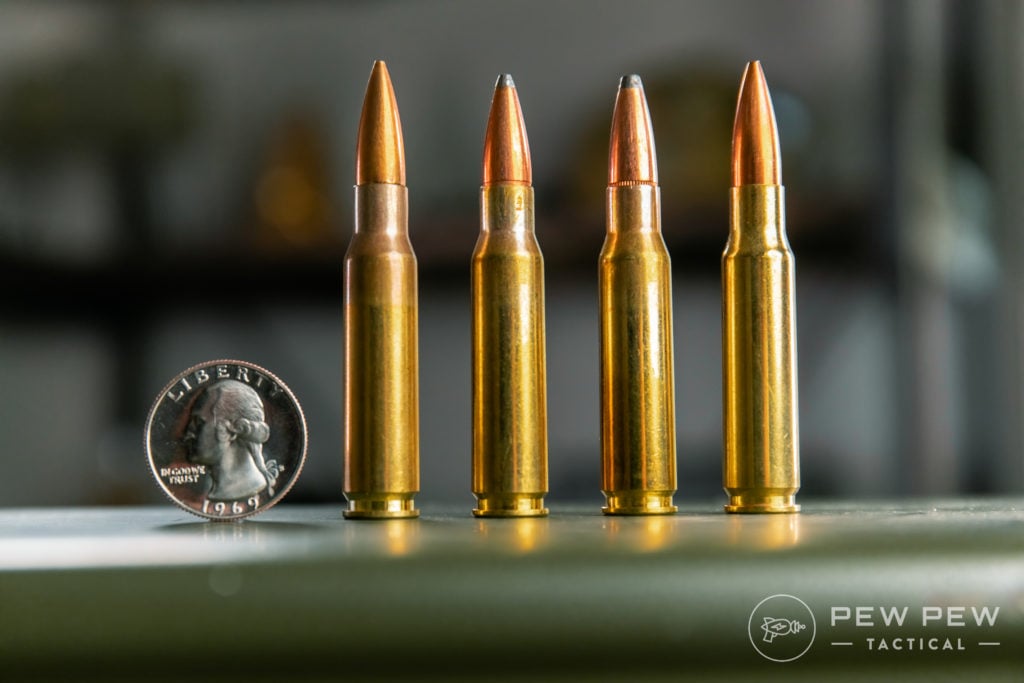
The “three-oh-eight” (inch) Winchester is almost the same dimensions as the “seven-six-two” (mm) NATO round.
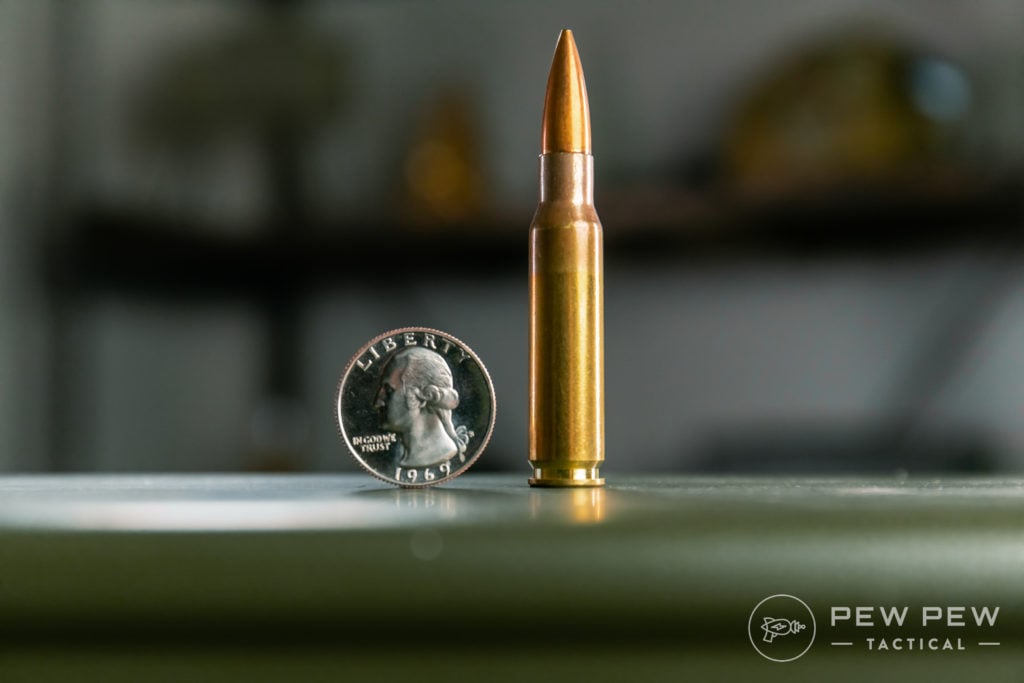
There are special considerations when mixing the rounds, but unless you know what you are doing, stick with the round intended for your rifle.
It is a popular hunting round with moderate recoil, high stopping power, and a wide range of bullets available from 110 to 220 grains.
Plus, it is one of the most popular heavier caliber machine gun and sniper rounds for many militaries and law enforcement agencies around the world.
For more info:
10. .50 BMG
Pros
- Massive stopping power
- Extreme range capabilities
- It's the .50 BMG
Cons
- Harsh recoil
- Expensive rounds
While .50 BMG is not really common for civilians, we had to add it in here due to its fame and cool factor.
It is a common round for heavy machine guns and anti-material rifles, as well as specialty long-range sniper rifles. It has been seen use in everything from small arms to tanks to airplanes, and has been in use since 1921.
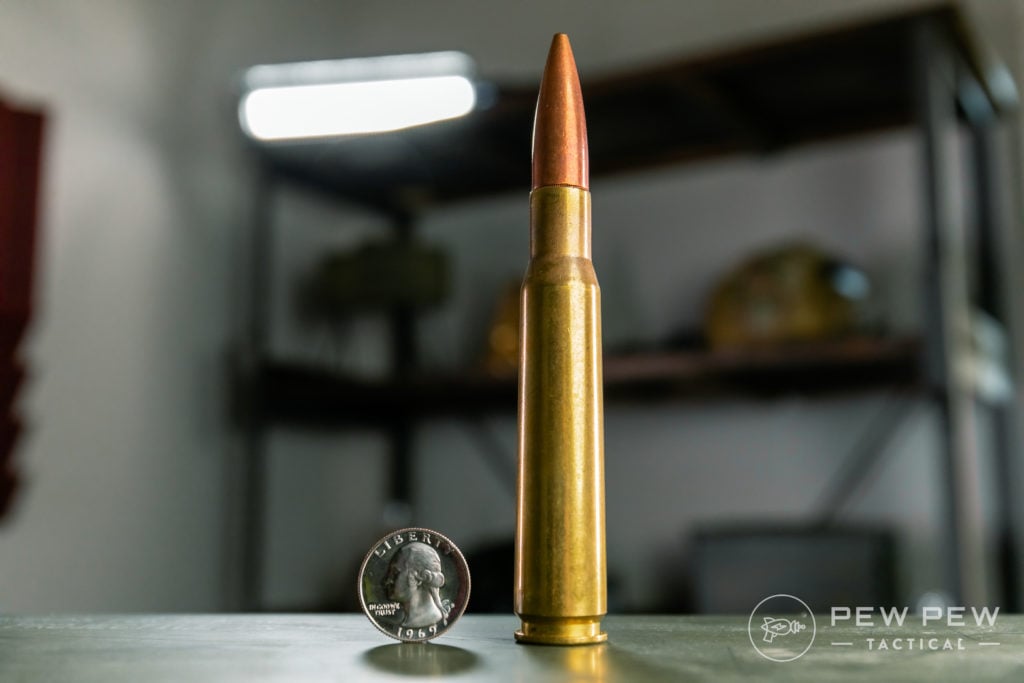
It’s huge and has huge recoil with awesome range (confirmed kills at 2,000+ meters). You definitely don’t want to be on the receiving end of this bullet and its 660 grains of pure stopping power.
This Barrett was OK because I was standing, and it had a suppressor!
Still with me?
Common Bullet Types & Terminology
Full Metal Jacket (FMJ)
This is the most common type of bullet and consists of a soft metal core, such as lead, fully encapsulated by a harder metal, such as copper.
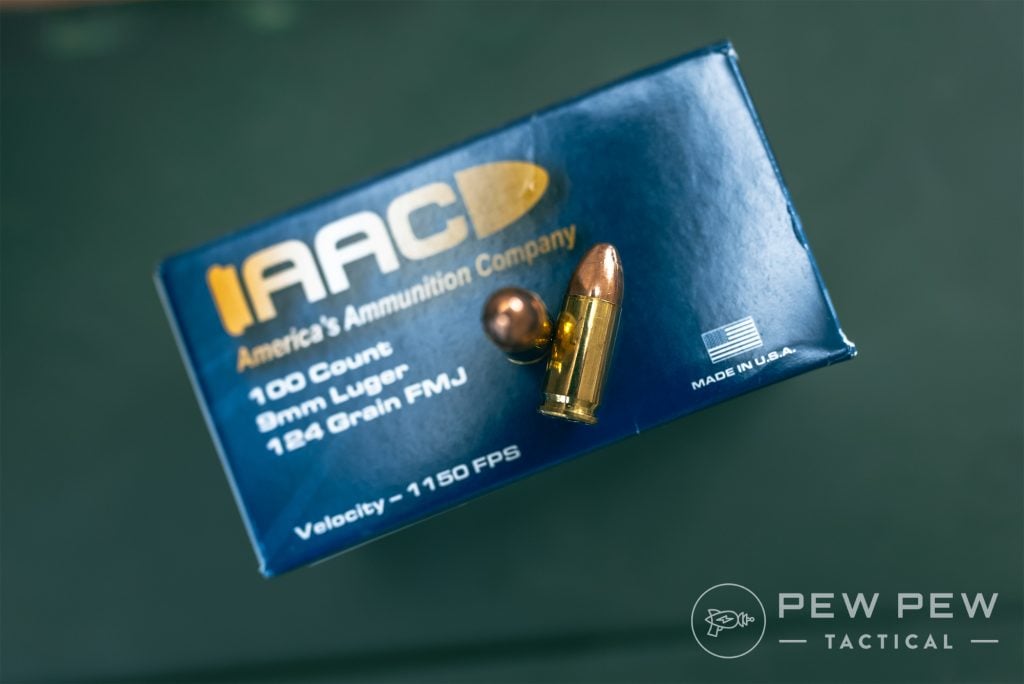
They are usually pointy, round, or even flat. Wound channels are typically small and go through a target.
While they are the go-to and great for general range use, they are not well-suited as defensive rounds.
Hollow Point (HP)
Hollow points, often referred to as Jacketed Hollow Points (JHP), are rounds with hollow tips that are made to expand once they hit something.
They are the go-to round for police officers, concealed weapon carriers, and home defense guns because of their increased effectiveness against live targets.
Open Tip Match (OTM)
Open-tip bullets may look like hollow points since they have a small opening at the top, but don’t be fooled. The openings are too small to expand effectively.
Regular FMJs are created from small copper cups where the bottom of the cup becomes the tip of the bullet. Open-tip bullets are the opposite, with the bottom of the cup becoming the bottom of the bullet.
The small opening at the top on these bullets is called a meplat and is used to help stabilize the bullet in flight. This manufacturing process creates a more consistent round than regular FMJ rounds. These small differences can be important when you’re shooting at long distances.
Ballistic Tip
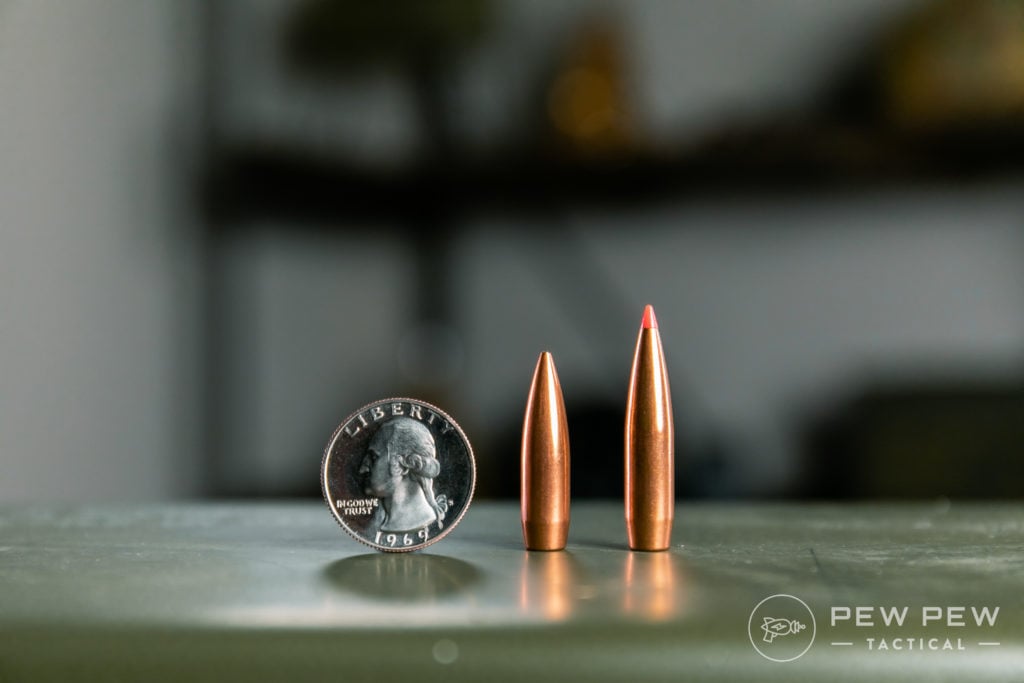
This is what you get when you combine the aerodynamics of an FMJ with the stopping power of a hollow point. This is a hollow point covered with (usually red) plastic to mimic the profile of an FMJ.
They are mostly used in hunting, precision shooting, or self-defense.
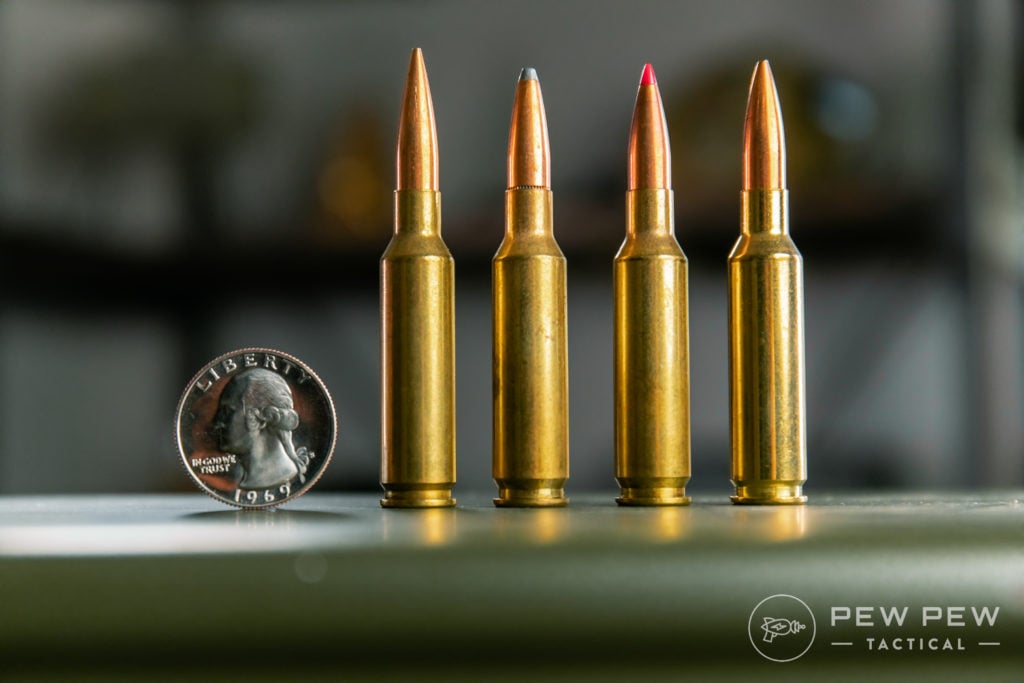
Below, you’ll see that the bottoms of the bullets are more streamlined. This design is called “boat tail” and produces less drag as the bullet flies through the air. HPBT is short for “hollow point boat tail.”
Soft-Point
Soft-point bullets also mimic the profile of an FMJ while offering better expansion.
These rounds have part of the lead exposed at the tip. The softer lead is designed to flatten better when the bullet hits a target.
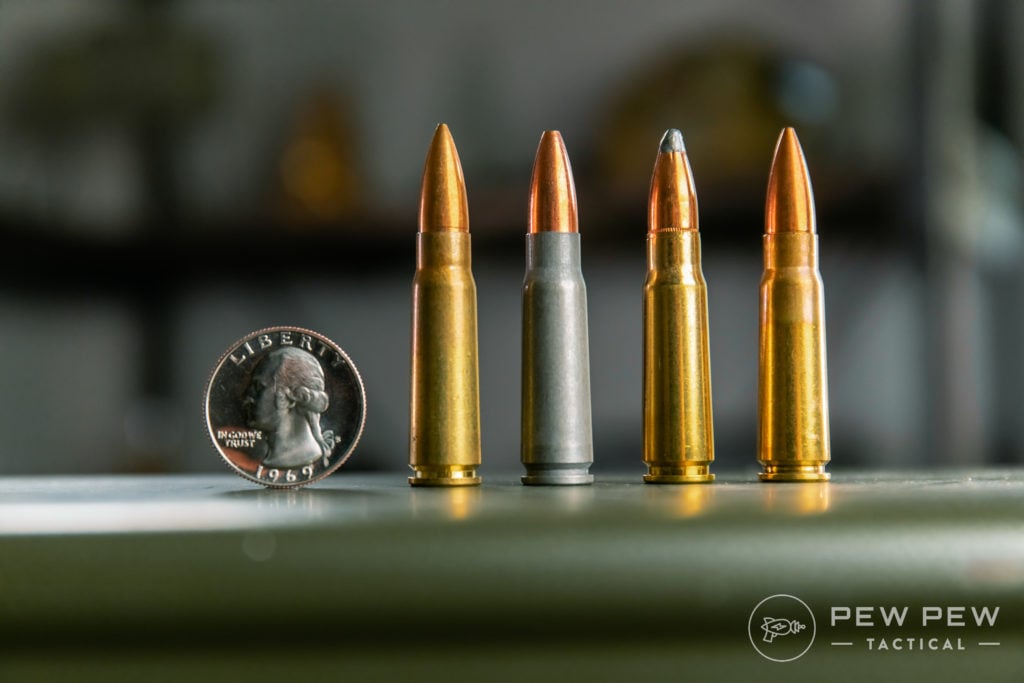
They are mostly used in hunting applications, although some defensive rounds still use soft-point bullets.
But for the most part, ballistic tips have surpassed the performance of soft points. The hard plastic tip deforms less during manufacturing, storage, and feeding over the softer, exposed lead.
Common Shotgun Ammo Types
Without a doubt, shotguns are the most versatile guns out there — and they have versatile ammo to match.
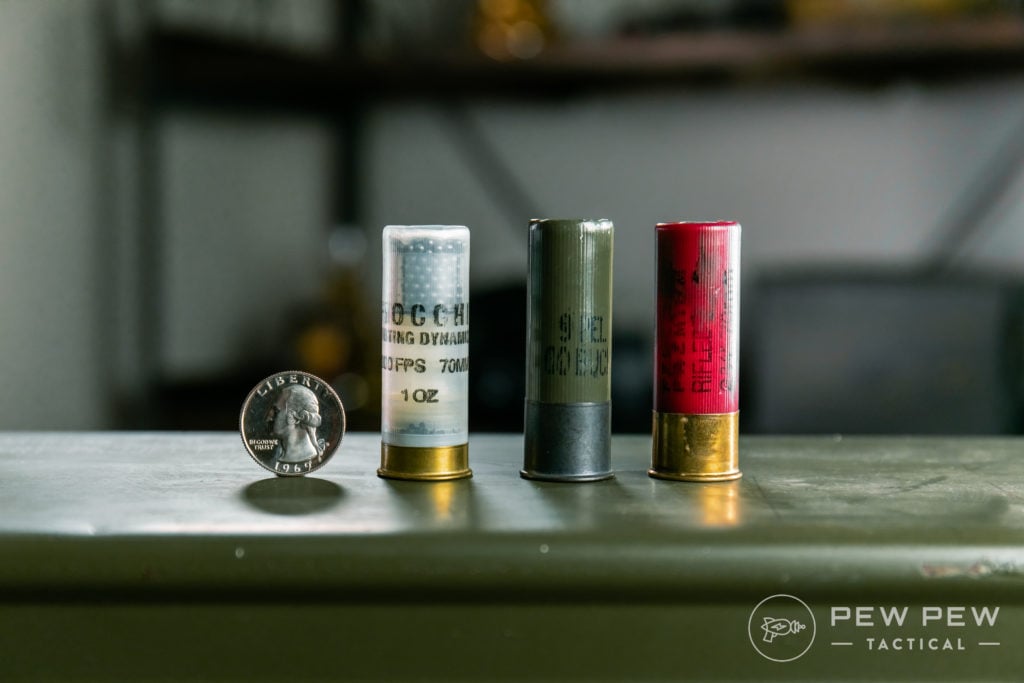
There are all sorts of crazy speciality rounds for shotguns, but by far, there are three types that are the most common.
Birdshot
Birdshot consists of a large number of pretty small pellets, numbering in the dozens in each shell. The terms “lead-shot” and “steel-shot” are also used to commonly refer to birdshot.
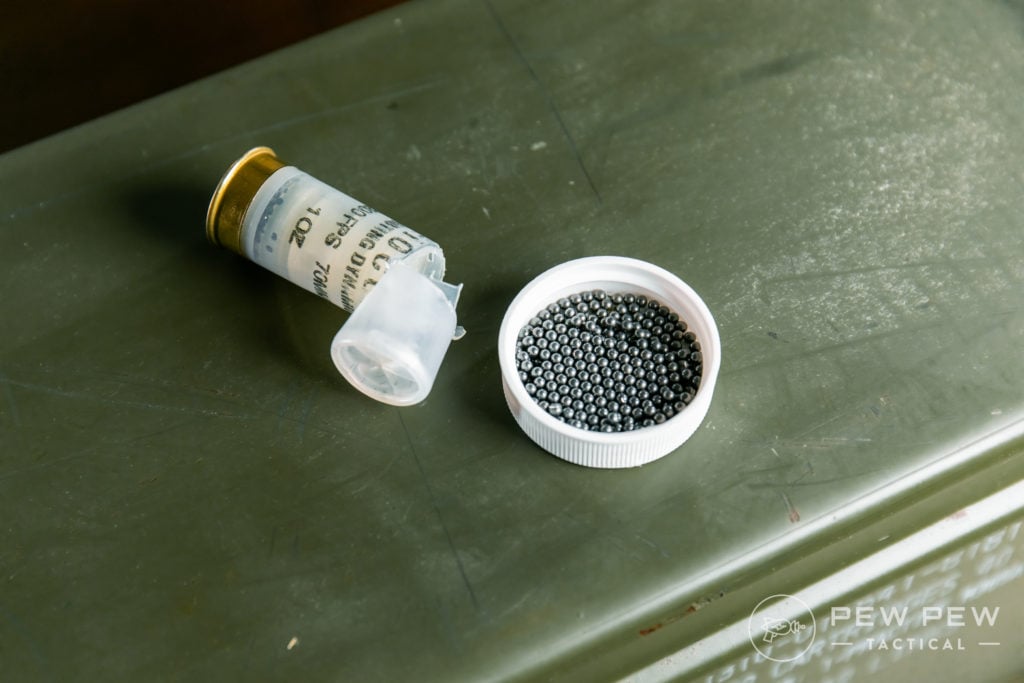
As the name implies, they are great for hunting birds, target shooting, and blasting clay pigeons due to the sheer amount of pellets and spread you get.
However, these pellets are small and lack stopping power for anything other than very small game. This means they make for poor defensive rounds despite the large number of pellets.
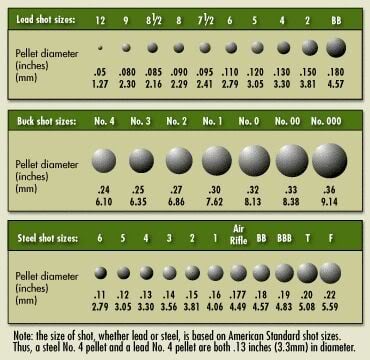
Most birdshot has lower recoil than buckshot, although some magnum loads for larger birds like turkey and geese can still have considerable amounts of recoil.
Buckshot
Buckshot is the most common shotgun round when it comes to defense usage.
The overwhelming majority of defense rounds are going to be 00 Buck (“double-aught buck”), which uses .33-caliber pellets.
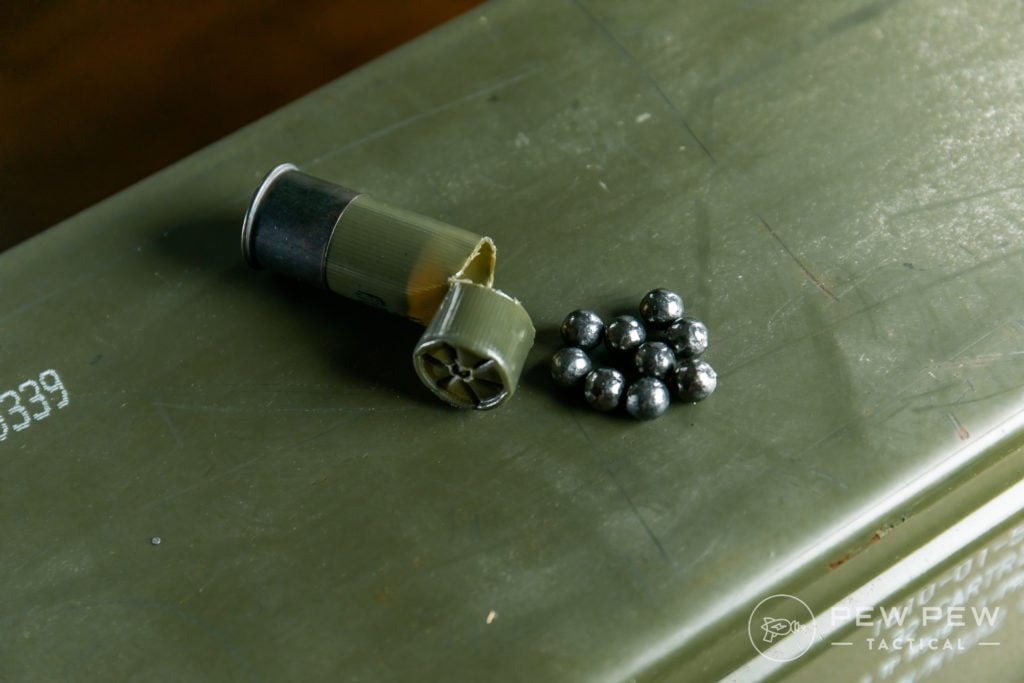
Depending on the load and size of the shell, most 00 Buck has 8-18 solid lead pellets that are each nearly the same diameter as a single 9mm round.
These rounds usually have much more recoil than birdshot, but you can also find reduced-recoil buckshot rounds, as well as buckshot that is smaller than 00 in size.
Slugs
Slugs are typically 7/8 to 1 1/4 ounce single solid metal projectiles that really bring the hurt.
However, they don’t have the spread of birdshot or buckshot. But, in the hands of a solid shooter, they can be accurate up to 100 yards.
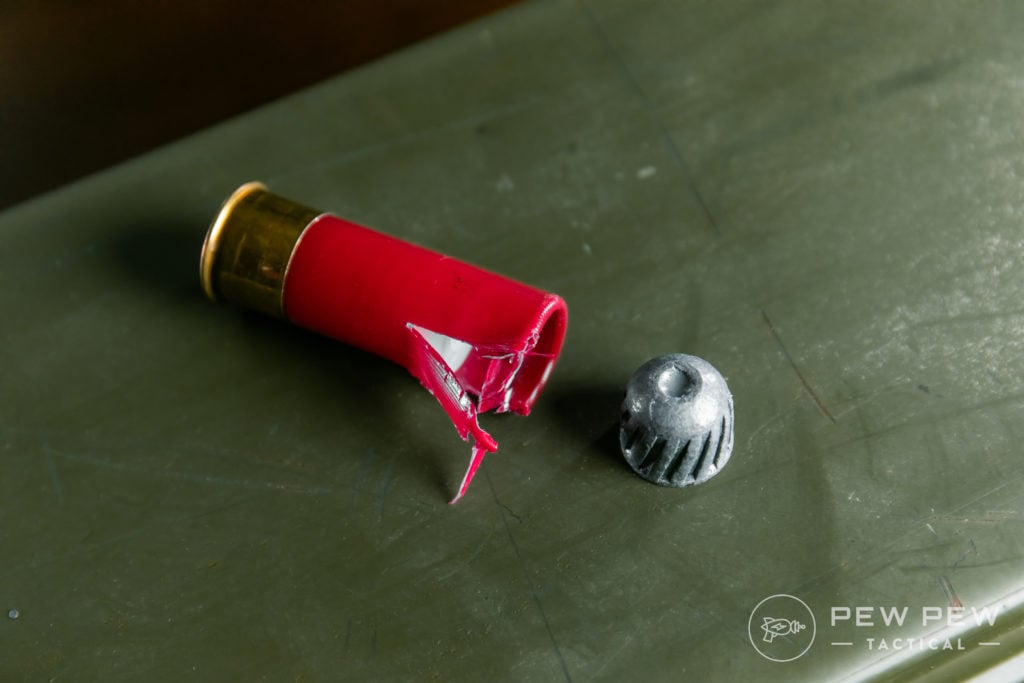
Slugs are typically more suited to hunting applications where a lot of energy and slightly more range and accuracy is required.
While some people elect to use them for self-defense purposes due to their sheer power, it should be done so with caution, as they require more precision and are prone to extreme over-penetration.
For more info:
Components of Common Cartridges
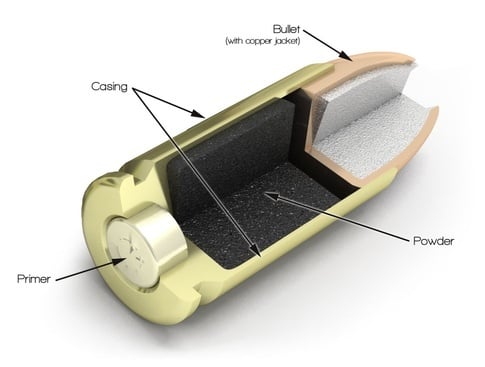
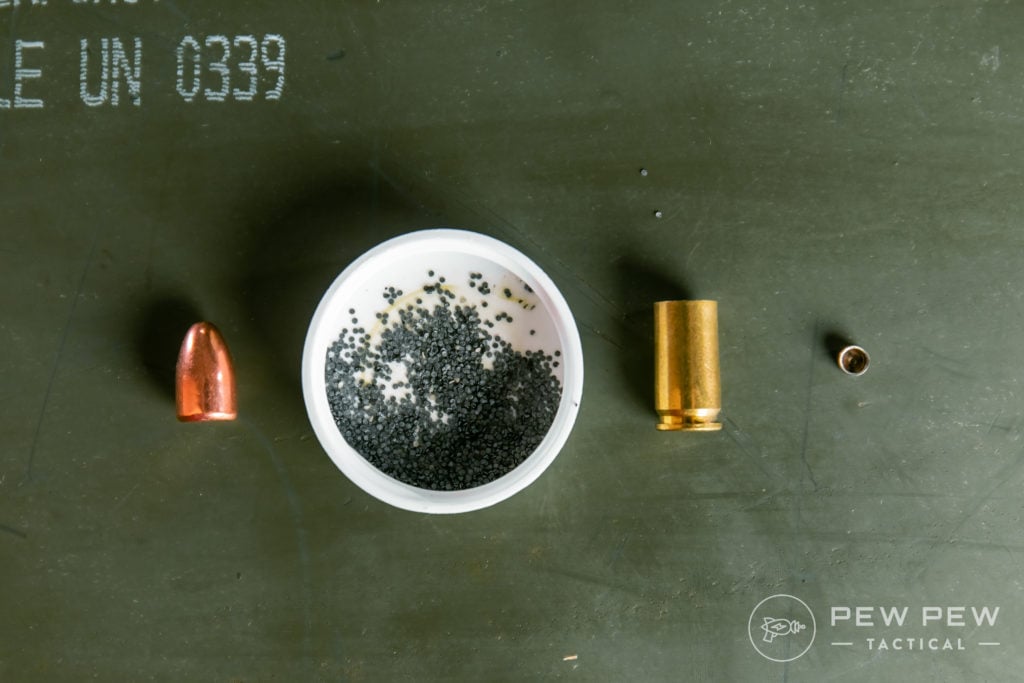
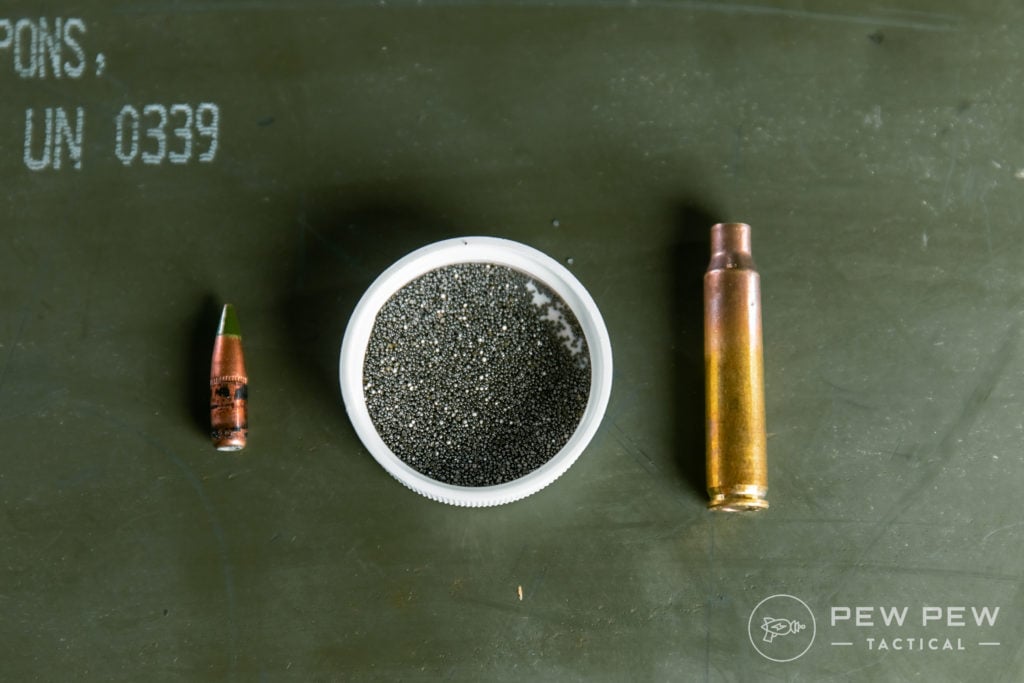
What makes up a cartridge?
- Bullet: This is the actual projectile that is propelled through the barrel and exits the gun
- Powder: The propellant that is ignited by the primer, which then pushes the bullet forward.
- Primer: A small cap that contains a compound that ignites that when struck, ignites the powder.
- Casing: Metal casing that holds all of the components of the cartridge together.
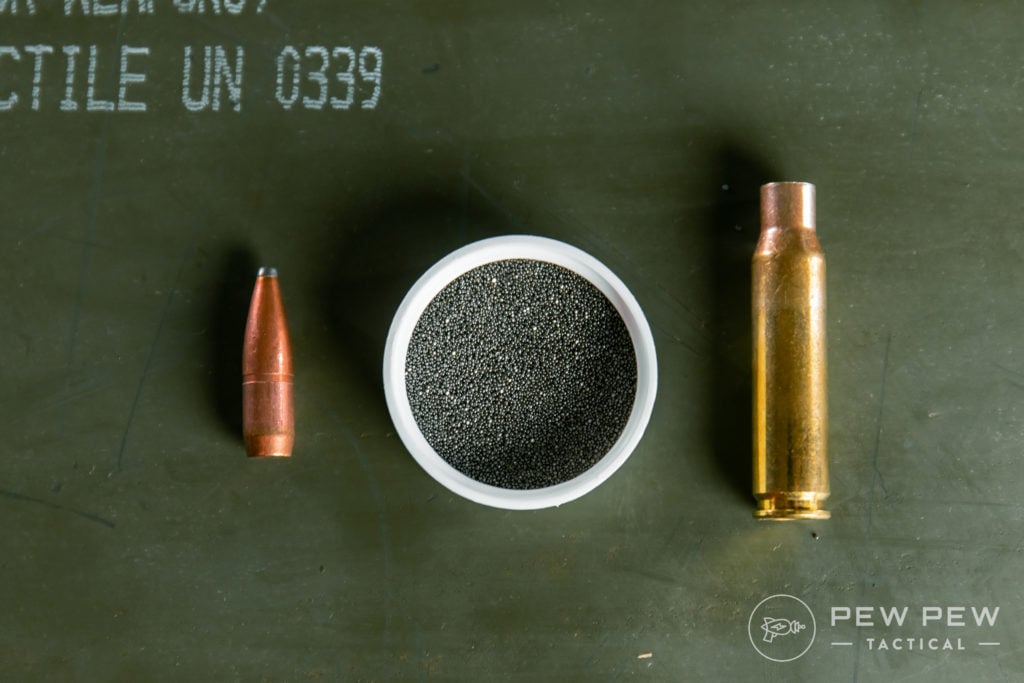
Here are just a couple of breakdowns of super popular calibers. You can see the difference in powders & bullets for each type.
Why You Should Trust Pew Pew Tactical
This article was written by PPT Founder and CEO Eric Hung. Eric is an NRA-certified pistol instructor and a USPSA/3-Gun/NRL22 competitor. He has also researched and written over 250 articles on firearms and gear. Over the years, he has acquired quite a few guns, as well as a small mountain of safes to test and store said guns in. He used hands-on experience to create this list.
Editing and adding to this article is editor Wyatt Sloan. Wyatt is an NRA-certified instructor with previous experience as a USPSA competitor. Wyatt personally owns over 200 firearms in over 50 different chamberings and has 10 years of home-based FFL firearm sales. He has used his extensive experience with firearms to test guns and gear for Pew Pew Tactical.
Editor-in-Chief Jacki Billings runs our experienced team of reviewers. She is a National Rifle Association Basic Pistol Instructor as well as a member of the Society of Professional Journalists, ACES: Society for Editing, and the Professional Outdoor Media Association. Jacki has a bachelor’s degree in journalism and has worked as a media professional for close to 20 years, specializing in gun media for almost 10 years. With 2,000+ articles to her name, she uses her professional journalism and editing experience to set testing protocols and editorial standards for Pew Pew Tactical.
Final Thoughts
There you have it. Now you’re a bullet pro!
Continue on with a deeper dive into Popular Handgun Calibers, Popular Rifle Calibers, or the difference between Steel-Cased and Brass Ammo.
And if an expertly created beginner handgun course is what you’re looking for, check out our article, Gun Noob to Gun Slinger!
LATEST UPDATES
- March 2025 – Updated pros/cons. Tweaked article layout and information throughout. Additional sections added.
- June 2024 – Added pros/cons to calibers and minor tweaks throughout.