Building a robot that can wipe a table and also open a door seems pretty trivial. But according to a project under Google’s parent company Alphabet, it’s actually a major advancement that might pave the way for general-purpose robots capable of helping humans throughout the day.
Imagine owning an affordable robot butler that can tidy up your home or take care of the elderly. That’s what Everyday Robots, a moonshot under Alphabet, is trying to create. On Friday, the team behind the effort reported that its prototype robots were now smart enough to autonomously operate at Google offices in Mountain View, California.
But perhaps more importantly, the bots can learn to perform not one, but a variety of tasks. “The same robot that sorts trash can now be equipped with a squeegee to wipe tables and use the same gripper that grasps cups can learn to open doors,” wrote Hans Peter Brøndmo, Chief Robot Officer for Everyday Robots.
The team’s goal is to create robots that can learn, eliminating the need to program the machines over and over again for a specific task under certain conditions. “Imagine trying to script all the possible ways to pick up a cup of coffee, anticipate the lighting or open a door. It simply wouldn’t scale,” Brøndmo added.
To pull this off, the team has been relying on machine learning algorithms, which can involve training the robot to achieve a desired goal by going through trial-and-error simulations. The machines from Everyday Robots will actually practice wiping tables in a 3D simulation before practicing in the real world.
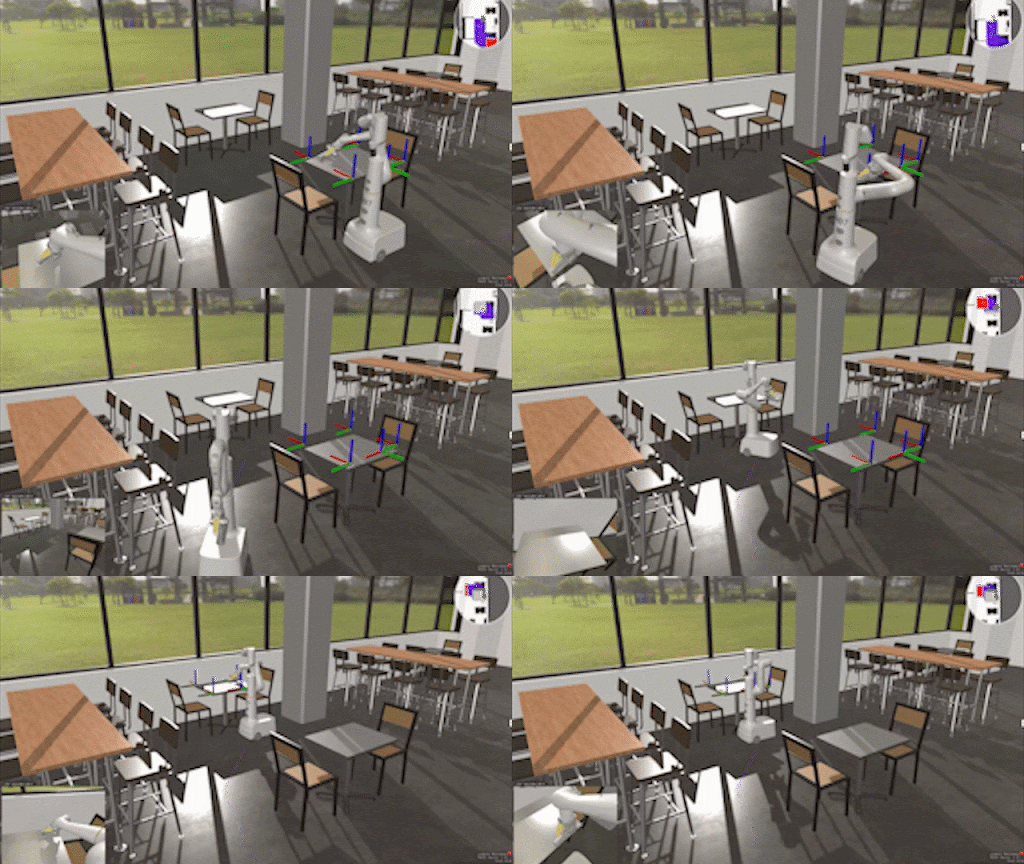
According to Brøndmo, the approach can drastically cut down the time it takes to train a robot. “Back in 2016, when we weren’t using simulation and were using a small lab-configuration of industrial robots to learn how to grasp small objects like toys, keys and everyday household items, it took the equivalent of four months for one robot to learn how to perform a simple grasp with a 75% success rate,” he wrote. “Today, a single robot learns how to perform a complex task such as opening doors with a 90% success rate with less than a day of real-world learning.”
Recommended by Our Editors
The other advancement involves the robot’s ability to learn one task and apply it to another. “Even more excitingly, we’ve shown that we can build on the algorithms and learnings from door opening and apply them to a new task: straightening up chairs in our cafes,” Brøndmo wrote. “This progress gives us hope that our moonshot for building general purpose learning robots might just be possible.”
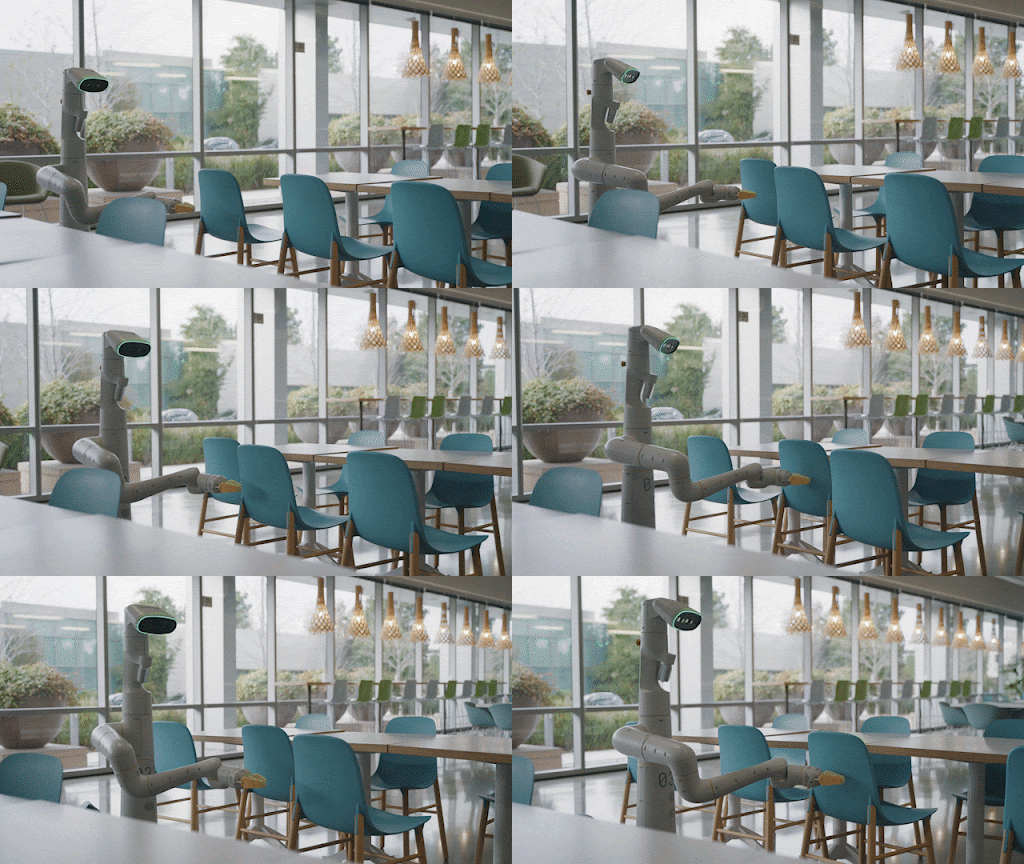
To better train the robots, the team now plans on expanding their use across Google’s offices in the San Francisco Bay area. However, Brøndmo is cautioning progress may at times be slow. “For now we’re focused on teaching the robots new tasks and making sure they don’t get stuck in the corridor on their way to help us out,” he added.
About Our Expert

Michael Kan
Principal Reporter
Experience
I've been a journalist for over 15 years. I got my start as a schools and cities reporter in Kansas City and joined PCMag in 2017, where I cover satellite internet services, cybersecurity, PC hardware, and more. I'm currently based in San Francisco, but previously spent over five years in China, covering the country's technology sector.
Since 2020, I've covered the launch and explosive growth of SpaceX's Starlink satellite internet service, writing 600+ stories on availability and feature launches, but also the regulatory battles over the expansion of satellite constellations, fights with rival providers like AST SpaceMobile and Amazon, and the effort to expand into satellite-based mobile service. I've combed through FCC filings for the latest news and driven to remote corners of California to test Starlink's cellular service.
I also cover cyber threats, from ransomware gangs to the emergence of AI-based malware. In 2024 and 2025, the FTC forced Avast to pay consumers $16.5 million for secretly harvesting and selling their personal information to third-party clients, as revealed in my joint investigation with Motherboard.
I also cover the PC graphics card market. Pandemic-era shortages led me to camp out in front of a Best Buy to get an RTX 3000. I'm now following how the AI-driven memory shortage is impacting the entire consumer electronics market. I'm always eager to learn more, so please jump in the comments with feedback and send me tips.