AI Figures Out the Rules of a Mysterious 2,000-Year-Old Board Game from Ancient Rome
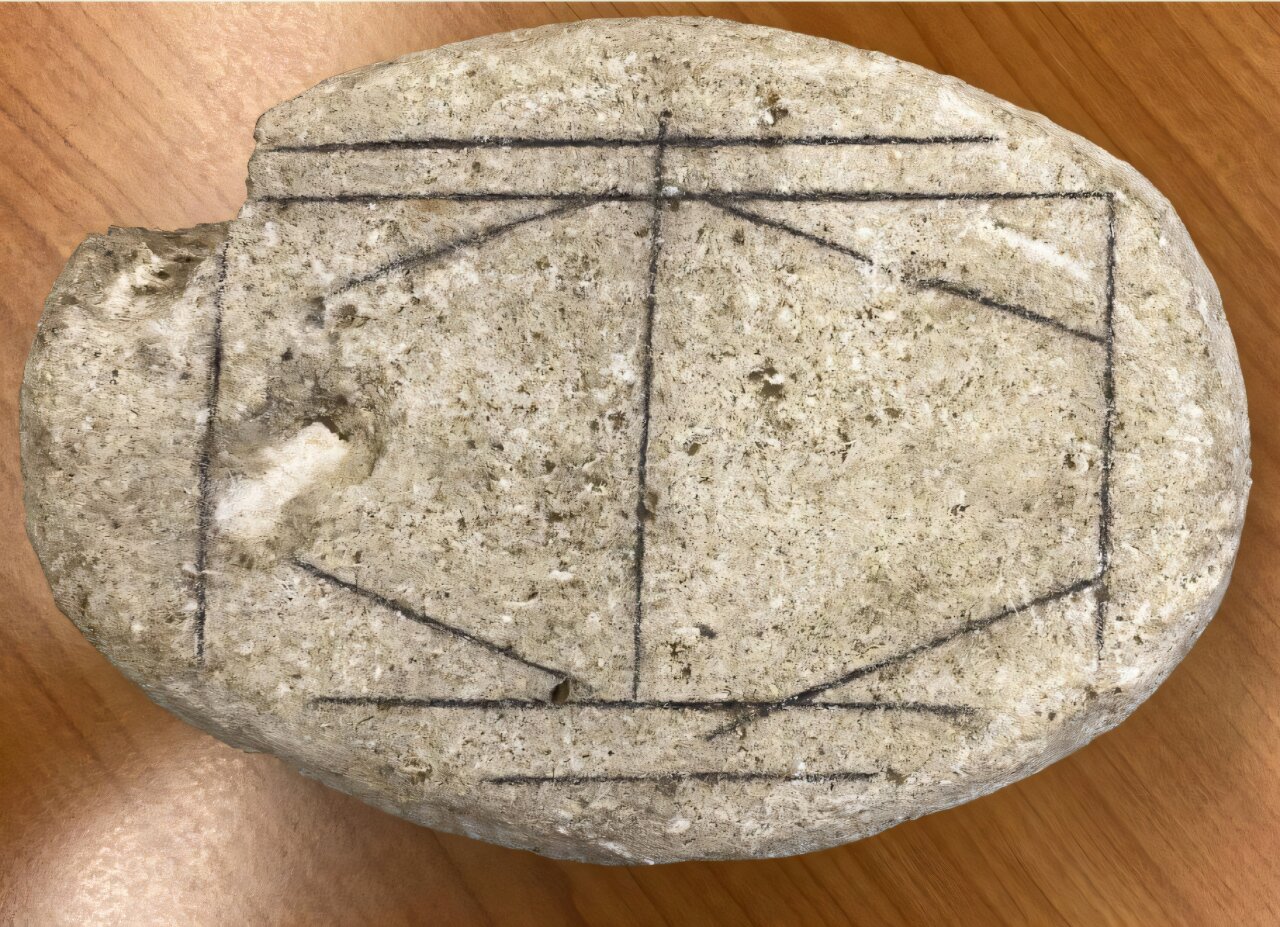
Image by Walter Crist
As far as enthusiasm for board games goes, no continent has yet outdone Europe. Its advantage could lie in the highly developed culture of low-cost leisure evident in quite a few of its societies; it could also owe to the fact that board games seem to have been played there continuously since antiquity. We’ve long had evidence of examples like the “Roman mill game,” better known today as nine men’s morris, which Ovid appears to mention in his Ars Amatoria of the very early first century. Not that modern knowledge of Roman tabletop gaming is complete. In one puzzling case, the stone board above was unearthed in a former Roman town in the Netherlands, but how a game was played on it remained a mystery — until machine learning came along.
“To examine whether the object may have been used as a game board, we performed use-wear analysis to identify evidence for gameplay and we simulated play using artificial intelligence (AI),” write the team of researchers who recently published a paper on the subject in the journal Antiquity. They used a system called Ludii, engineered to analyze board-game rules.
“This software allows for AI-driven playout simulation, where two AI agents play a game against one another, which can generate quantitative data on gameplay. In this instance, we explored whether the rules of a game would produce the wear pattern seen on the stone.” The idea, in other words, was to let the computer play against itself using different rules until it came upon a game that would continue to abrade away the surface of the board in the same fashion as it already was.
This process narrowed it down to games “in which the goal is to block the opponent from moving, and those in which the goal is to place three pieces in a row.” These have a fairly long documented history, from Scandinavia’s haretavl, to Italy’s gioco dell’orso to Spain’s liebre perseguida, to Greece’s kinégi tou lagoú. You can download what the research suggests is the most plausible rule set for this particular Roman board game here, board design included. One player takes the side of the “hunter,” with four pieces, and the other the side of the “prey,” with two. The former tries to trap the latter’s pieces, moving only along the board’s lines; in the next round, the roles reverse. The hunter who does the job in the fewest moves wins. Why not invite friends over to spend an evening playing like a Roman? For a thoroughly ancient good time, first reconstruct as best you can the ambience of the thermopolium at home.
Related content:
Behold the First American Board Game, Travellers’ Tour Through the United States (1822)
Monopoly: How the Original Game Was Made to Condemn Monopolies & the Abuses of Capitalism
Kurt Vonnegut’s Lost Board Game Is Finally for Sale
The Fear and Loathing in Las Vegas Board Game, Inspired by Hunter S. Thompson’s Rollicking Novel
Based in Seoul, Colin Marshall writes and broadcasts on cities, language, and culture. He’s the author of the newsletter Books on Cities as well as the books 한국 요약 금지 (No Summarizing Korea) and Korean Newtro. Follow him on the social network formerly known as Twitter at @colinmarshall.
Inside the Automats Where Coin-Operated Machines Created a Modern, Democratic Dining Experience
in Food & Drink, History | March 9th, 2026
“Good evening,” said Alfred Hitchcock to the television viewers of America on March 25, 1959. “Tonight I’m dining at my favorite club. There are many advantages here. As you can see, informality is the rule. There is also the stimulation of intellectual companionship without the deafening quiet that pervades most clubs. Best of all, I like its privacy: only four persons are allowed at a table, and, of course, no one pays any attention to you.” This was an example of the deadpan irony with which the filmmaker introduced each broadcast of Alfred Hitchcock Presents, for the “club” of which he spoke was clearly an automat. Today, many readers under about 50 will never have heard the word, but at the time, it referred to a seemingly permanent institution in American life.
Or rather, an institution of urban American life, and above all in two cities, Philadelphia and New York. There, no one could think of automats without thinking of Horn & Hardart, in its heyday the largest restaurant chain in the world. The concept, which co-founder Joseph Horn imported over from Berlin in the early nineteen-tens, was of a restaurant with no waiters: rather, you could choose your dish à la carte from a wall of coin-operated compartments, paying the nickel or two that would allow you to take the food inside.
Salisbury steak, creamed spinach, baked beans, a ham-and-cheese sandwich, macaroni and cheese, chocolate pudding, strawberry rhubarb pie: whatever it was, the behind-the-scenes staff would replace it just as soon as you put the last one on your tray.
Smack of modernity though it once did (and in a way, still does), the term automat is somewhat misleading. We might describe the experience of visiting one as dining inside a giant vending machine, but the actual running of the operation was quite labor-intensive. Most of the work was performed out of the customer’s sight, as far away as in the large central commissaries that prepared many of the dishes to be transported daily to Horn & Hardart’s 88 locations. This sheer scale of operation allowed the chain to offer some of the cheapest meals commercially available, with the result that its automats boomed even — indeed, especially — during the Great Depression. Their economic barrier was low, and of sex and race, nonexistent; those who remember them describe them becoming some of the most democratic institutions in postwar America.
You can hear such memories recalled in the recent documentary The Automat by figures like Ruth Bader Ginsburg, Colin Powell, and Mel Brooks, who rhapsodizes about Horn & Hardart’s coffee, dispensed for just a nickel from elaborate dolphin-headed spigots. That degree of detail was standard in the interiors, whose marble, chrome, and glass look palatial by the standards of the fast-food joints that ultimately replaced the automat. That glory was one casualty of postwar suburbanization and hollowing-out of central cities that resulted. What with the American urban renaissance of the past few decades, attempts have been made to revive the automat concept, but perhaps, as Brooks puts it, “the logistics and the economics of today won’t allow anything that simple, naïve, and eloquent and beautiful to flourish again.” Ordering a meal brought straight to your door may be more convenient, but even delivery-app addicts have to admit that it will never have the same romance.
Related content:
How Edward Hopper’s Paintings Inspired the Creepy Suspense of Alfred Hitchcock’s Rear Window
Watch the “Biblio-Mat” Book-Vending Machine Dispense Literary Delight
How Fast Food Began: The History of This Thoroughly American (and Now Global) Form of Dining
Based in Seoul, Colin Marshall writes and broadcasts on cities, language, and culture. He’s the author of the newsletter Books on Cities as well as the books 한국 요약 금지 (No Summarizing Korea) and Korean Newtro. Follow him on the social network formerly known as Twitter at @colinmarshall.
Roman Statues Weren’t White; They Were Once Painted in Vivid, Bright Colors
in Art, History | March 6th, 2026
The idea of the classical period—the time of ancient Greece and Rome—as an elegantly unified collection of superior aesthetic and philosophical cultural traits has its own history, one that comes in large part from the era of the Neoclassical. The rediscovery of antiquity took some time to reach the pitch it would during the 18th century, when references to Greek and Latin rhetoric, architecture, and sculpture were inescapable. But from the Renaissance onward, the classical achieved the status of cultural dogma.
One tenet of classical idealism is the idea that Roman and Greek statuary embodied an ideal of pure whiteness—a misconception modern sculptors perpetuated for hundreds of years by making busts and statues in polished white marble. But the truth is that both Greek statues and their Roman counterparts—as you’ll learn in the Vox video above—were originally brightly painted in riotous color.
This includes the 1st century A.D. Augustus of Prima Porta, the famous figure of the Emperor standing triumphantly with one hand raised. Rather than left as blank white marble, the statue would have had bronzed skin, brown hair, and a fire-engine red toga. “Ancient Greece and Rome were really colorful,” we learn. So how did everyone come to believe otherwise?

It’s partly an honest mistake. After the fall of Rome, ancient sculptures were buried or left out in the open air for hundreds of years. By the time the Renaissance began in the 1300s, their paint had faded away. As a result, the artists unearthing, and copying ancient art didn’t realize how colorful it was supposed to be.
But white marble couldn’t have become the norm without some willful ignorance. Even though there was a bunch of evidence that ancient sculpture was painted, artists, art historians and the general public chose to disregard it. Western culture seemed to collectively accept that white marble was simply prettier.
White statuary symbolized a classical ideal that “depends highly on the greatest possible decontextualization,” writes James I. Porter, professor of Rhetoric and Classics at the University of California, Berkeley. “Only so can the values it cherishes be isolated: simplicity, tranquility, balanced proportions, restraint, purity of form… all of these are features that underscore the timeless quality of the highest possible expression of art, like a breath held indefinitely.” These ideals became inseparable from the development of racial theory.
Learning to see the past as it was requires us to put aside historically acquired blinders. This can be exceedingly difficult when our ideas about the past come from hundreds of years of inherited tradition, from every period of art history since the time of Michelangelo. But we must acknowledge this tradition as fabricated. Influential art historian Johann Joachim Winckelmann, for example, extolled the value of classical sculpture because, in his opinion, “the whiter the body is, the more beautiful it is.”
Winckelmann also, Vox notes, “went out of his way to ignore obvious evidence of colored marble, and there was a lot of it.” He dismissed frescoes of colored statuary found in Pompeii and judged one painted sculpture discovered there as “too primitive” to have been made by ancient Romans. “Evidence wasn’t just ignored, some of it may have been destroyed” to enforce an ideal of whiteness. While many statues were denuded by the elements over hundreds of years, the first archaeologists to discover the Augustus of Prima Porta in the 1860s described its color scheme in detail.
Critiques of classical idealism don’t originate in a politically correct present. As Porter shows at length in his article “What Is ‘Classical’ About Classical Antiquity?,” they date back at least to 19th century philosopher Ludwig Feuerbach, who called Winckelmann’s ideas about Roman statues “an empty figment of the imagination.” But these ideas are “for the most part taken for granted rather than questioned,” Porter argues, “or else clung to for fear of losing a powerful cachet that, even in the beleaguered present, continues to translate into cultural prestige, authority, elitist satisfactions, and economic power.”
Note: An earlier version of this post appeared on our site in 2019.
Related Content:
Why Most Ancient Civilizations Had No Word for the Color Blue
Why Ancient Romans Paid a Fortune for the Color Purple — More Than Even Silver
Watch Art on Ancient Greek Vases Come to Life with 21st Century Animation
Josh Jones is a writer and musician based in Durham, NC.
Seven Wonders of the Ancient World: From the Walls of Babylon to the Sewers of Rome
in History | March 5th, 2026
You may not be able to name all, or even most, of the seven wonders of the ancient world. But you almost certainly know that there were seven of them. In a way, that aligns well enough with the worldview of the Greeks who first made reference to such a list, given their near-reverence for that number. Seven were the strings of the lyre (unless there happened to be eight or nine), seven were the gates of Thebes, and seven were the “wandering stars” in the night sky (if you count the sun and moon). The identity of the wonders was less important than the length of their list, and indeed, as ancient-history YouTuber Garrett Ryan explains in his Told in Stone video above, additions and changes were proposed since the beginning.
The classic seven-wonders roster includes the Hanging Gardens of Babylon, the Statue of Zeus at Olympia, the Temple of Artemis at Ephesus, the Mausoleum at Halicarnassus, the Colossus of Rhodes, the Lighthouse of Alexandria, and the Great Pyramid of Giza, that last being the only one still in existence today.
Ryan’s alternative list includes the Egyptian labyrinth at Hawara, which Herodotus considered superior even to the Pyramids; the Temple of Zeus at Cyzicus, which Pliny the Elder described as lined by gold tubes to let in the sunlight (surely stripped out as soon as the place fell into disuse); the sewers of Rome, a civilizational achievement unto themselves; and the Theater of Scaurus, which, though constructed out of wood for temporary use, seated an astonishing 80,000 people.
Ryan completes his seven other wonders with the Altar of Horns at Delos, held in myth to have been built by Apollo himself; the Walls of Babylon, which actually appear on the earliest known version of the list; and, finally, the good old Colosseum. As over-familiar (not to mention over-toured) as it may be, the Flavian Amphitheater, as the Colosseum was known in its day, does make for a welcome presence among the ancient wonders, being the only other one apart from the Great Pyramid that we can still visit today. But if you get into the mood to go marvel at thaumata, to borrow the Greek word, by no means limit yourself to selections already curated by others. The world is full of wonders, and your own personal seven may not be far away.
Related content:
A Walking Tour Around the Pyramids of Giza: 2 Hours in Hi Def
Ten Lost Roman Wonders: The World’s Longest Tunnel, Tallest Dam, Widest-Spanning Bridge & More
How the Ancient Greeks Built Their Magnificent Temples: The Art of Ancient Engineering
Take a Virtual Tour of Machu Picchu, One of the New 7 Wonders of the World
Based in Seoul, Colin Marshall writes and broadcasts on cities, language, and culture. He’s the author of the newsletter Books on Cities as well as the books 한국 요약 금지 (No Summarizing Korea) and Korean Newtro. Follow him on the social network formerly known as Twitter at @colinmarshall.
Bertrand Russell’s Advice For How (Not) to Grow Old: “Make Your Interests Gradually Wider and More Impersonal”
in Life, Philosophy | March 5th, 2026

Image by National Portrait Gallery, via Wikimedia Commons

Advice on how to grow old frequently comes from such banal or bloodless sources that we can be forgiven for ignoring it. Public health officials who dispense wisdom may have good intentions; pharmaceutical companies who do the same may not. In either case, the messages arrive in a form that can bring on the despair they seek to avert. Elderly people in well-lit photographs stroll down garden paths, ballroom dance, do yoga. Bulleted lists punctuated by dry citations issue gently-worded guidelines for sensible living. Inoffensive blandness as a prescription for living well.
At the other extreme are profiles of exceptional cases—relatively spry individuals who have passed the century mark. Rarely do their stories conform to the model of abstemiousness enjoined upon us by professionals. But we know that growing old with dignity entails so much more than diet and exercise or making it to a hundred-and-two. It entails facing death as squarely as we face life. We need writers with depth, sensitivity, and eloquence to deliver this message. Bertrand Russell does just that in his essay “How to Grow Old,” written when the philosopher was 81 (sixteen years before he eventually passed away, at age 97).
Russell does not flatter his readers’ rationalist conceits by citing the latest science. “As regards health,” he writes, “I have nothing useful to say…. I eat and drink whatever I like, and sleep when I cannot keep awake.” (We are inclined, perhaps, to trust him on these grounds alone.) He opens with a drily humorous paragraph in which he recommends, “choose your ancestors well,” then he issues advice on the order of not dwelling on the past or becoming a burden to your children.
But the true kernel of his short essay, “the proper recipe for remaining young,” he says, came to him from the example of a maternal grandmother, who was so absorbed in her life, “I do not believe she ever had time to notice she was growing old.” “If you have wide and keen interests and activities in which you can still be effective,” Russell writes. “you will have no reason to think about the merely statistical fact of the number of years you have already lived, still less of the probable shortness of your future.”
Such interests, he argues, should be “impersonal,” and it is this quality that loosens our grip. As Maria Popova puts it, “Russell places at the heart of a fulfilling life the dissolution of the personal ego into something larger.” The idea is familiar; in Russell’s hands it becomes a meditation on mortality as ever-timely as the so-often-quoted passages from Donne’s “Meditation XVII.” Philosopher and writer John G. Messerly calls Russell’s concluding passage “one of the most beautiful reflections on death I have found in all of world literature.”
The best way to overcome it [the fear of death]—so at least it seems to me—is to make your interests gradually wider and more impersonal, until bit by bit the walls of the ego recede, and your life becomes increasingly merged in the universal life. An individual human existence should be like a river: small at first, narrowly contained within its banks, and rushing passionately past rocks and over waterfalls. Gradually the river grows wider, the banks recede, the waters flow more quietly, and in the end, without any visible break, they become merged in the sea, and painlessly lose their individual being. The man who, in old age, can see his life in this way, will not suffer from the fear of death, since the things he cares for will continue. And if, with the decay of vitality, weariness increases, the thought of rest will not be unwelcome. I should wish to die while still at work, knowing that others will carry on what I can no longer do and content in the thought that what was possible has been done.
Read Russell’s “How to Grow Old” in full here. And see many more eloquent meditations on aging and death—from Henry Miller, André Gide, Ursula K. Le Guin, and Grace Paley—at The Marginalian.
Note: An earlier version of this post appeared on our site in 2018.
Related Content:
Simone de Beauvoir’s Philosophy on Finding Meaning in Old Age
Josh Jones is a writer and musician based in Durham, NC.
The First Robot Movie: Watch a Newly Discovered Georges Méliès Film from 1897
in Film, History | March 4th, 2026
Metropolis, Forbidden Planet, 2001: A Space Odyssey, Star Wars, Blade Runner, The Terminator, Short Circuit, RoboCop, Ghost in the Shell, The Iron Giant, WALL‑E, Ex Machina: there is a parallel history of cinema to be told entirely through its robots. That such a history must begin with the work of Georges Méliès may not come as a surprise, given that he invented so many of the techniques of science-fiction filmmaking. But until recently, we didn’t actually know that the cinema pioneer who “invented everything” ever put a robot onscreen. The evidence turned up among a collection of “old and battered” reels of film that were “from before World War I and had been shuttled around from basements to barns to garages and had just been dropped off at the Library.”
So writes the Library of Congress’ Neely Tucker, who goes on to describe the action of one of the films involving “a magician and a robot battling it out in slapstick fashion. It took a bit, but then the gasp of realization: They were looking at ‘Gugusse and the Automaton,’ a long-lost film by the iconic French filmmaker Georges Méliès at his Star Film company.”
Méliès himself plays the magician, who “winds up an automaton dressed like the famous clown Pierrot, which is standing on a pedestal. Once wound up, the clown begins to beat the magician with his walking stick. The magician retaliates by getting a huge sledgehammer and bashing the automaton over the head, with each blow seeming to shrink it in half, until it is just a small doll.”
In just 45 seconds, this simple film would have astonished audiences back in 1897 — and indeed retains the power to impress, provided you consider that none of the techniques to realize its effects were widely known before Méliès attempted them. He did so five years before ‘A Trip to the Moon,’ a hugely ambitious cinematic endeavor by comparison, and by far the single film that best represents his legacy.’ Yet it and Gugusse and the Automaton are clearly the work of the same artist-inventor, one who possessed that rare combination of technical know-how and artistic daring, and who understood the need for an organic relationship between spectacle and narrative. Not that either the spectacle or the narrative are highly evolved at this stage, but, as Méliès may have suspected, the cinema of robots has as long an evolution ahead of it as automata themselves.
Related content:
Watch “The Birth of the Robot,” Len Lye’s Surreal 1935 Stop-Motion Animation
Watch the Sci-Fi Short Film “I’m Not a Robot”: Winner of a 2025 Academy Award
Based in Seoul, Colin Marshall writes and broadcasts on cities, language, and culture. He’s the author of the newsletter Books on Cities as well as the books 한국 요약 금지 (No Summarizing Korea) and Korean Newtro. Follow him on the social network formerly known as Twitter at @colinmarshall.
Download 60,000 Works of Art from the National Gallery, Including Masterpieces by Van Gogh, Gauguin, Rembrandt & More
in Art | March 4th, 2026

As a young amateur painter and future art school dropout, I frequently found myself haunted by the faces of two artists, that famously odd couple from my favorite art history novelization—and Kirk Douglas role and Iggy Pop song—Lust for Life. Vincent van Gogh and Paul Gauguin, above and below respectively, the tormented Dutch fanatic and burly French bully—how, I still wonder, could such a pair have ever co-existed, however briefly? How could such beautifully skewed visions of life have existed at all?
Van Gogh and Gauguin’s several self-portraits still inspire wonder. My younger self had the luxury of seeing these particular two up close and in person at the National Gallery of Art in Washington, DC: Van Gogh’s gaunt and piercing visage, Gauguin’s sneering self-parody.
Now, thanks to the wonders of digital technology, my older self, and yours, can view and download high-resolution photos of both paintings, and over 60,000 more from the museum’s vast holdings, through NGA Images, “a repository of digital images of the collections of the National Gallery of Art.”
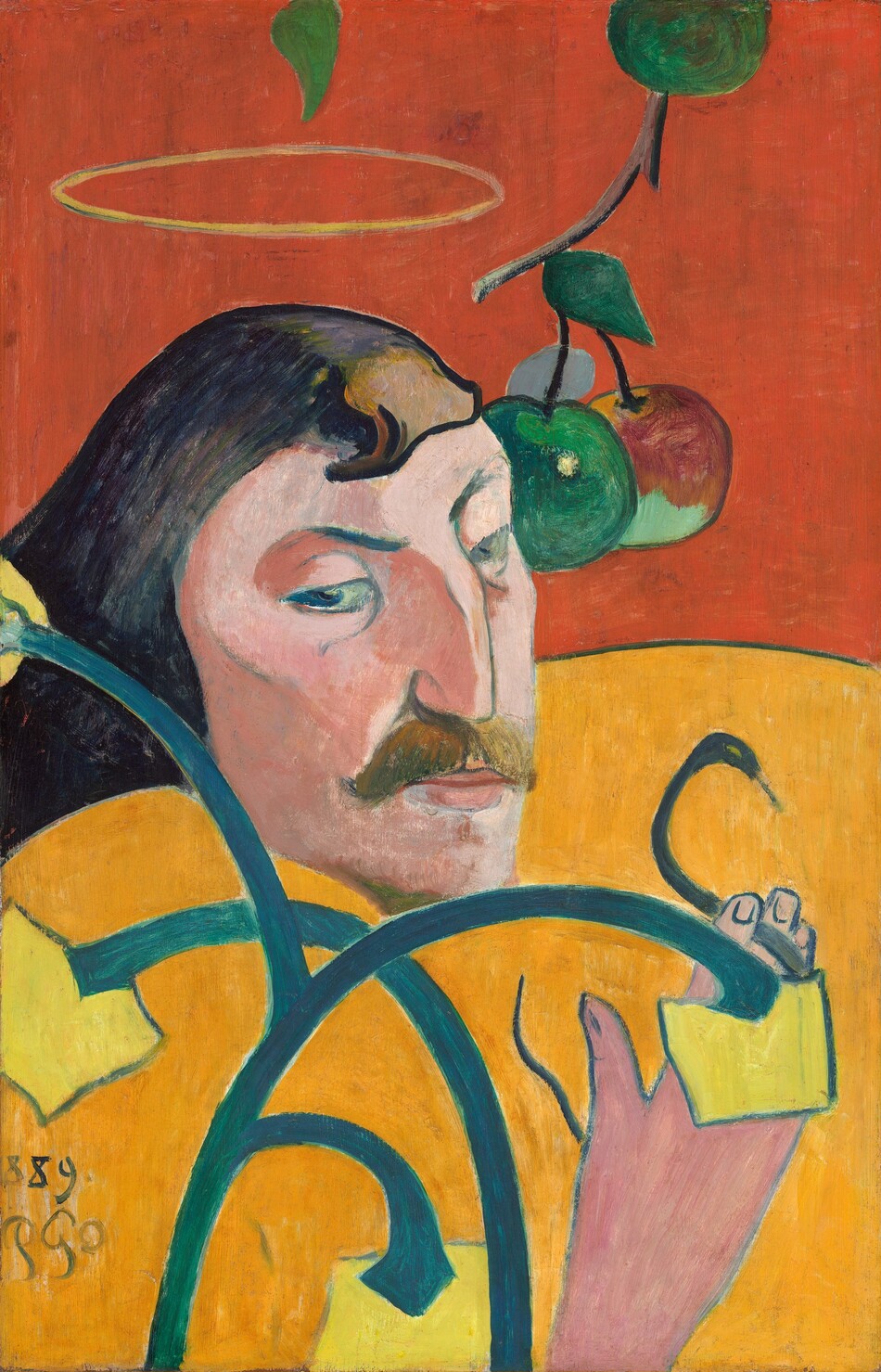
There you’ll find works by another obsessive Dutch self-portraitist, Rembrandt van Rijn, such as the lush 1659 painting below. You’ll find paintings from the heroes of the various Renaissances and French Impressionism, from movements modern and colonial, pastoral and urban. The collection is dizzying, and a lover of art could easily lose hours sorting through it, saving “open access digital images up to 3000 pixels each […] available free of charge for download and use.” The purpose of NGA Images is “to facilitate learning, enrichment, enjoyment, and exploration,” and there’s no doubt that it satisfies all of those goals and then some.

Browse the various collections, including one devoted to self-portraits. Conduct advanced searches, if you have more knowledge of the Gallery’s many treasures. You are the curator! And the lucky beneficiary of the National Gallery’s beneficence. While I can tell you from experience that it’s nothing like standing face to face with these paintings in their in-real-life dimensions, textures, lines, and colors—despite the throngs of disinterested tourists—it’s at least a close second. And for students and educators of the visual arts, NGA Images offers an opportunity like no other to view and share great works of art often hidden away from even the museum’s visitors. Enter the collection here.
Note: An earlier version of this post appeared on our site in 2014.
If you would like to sign up for Open Culture’s free email newsletter, please find it here. It’s a great way to see our new posts, all bundled in one email, each day.
If you would like to support the mission of Open Culture, consider making a donation to our site. It’s hard to rely 100% on ads, and your contributions will help us continue providing the best free cultural and educational materials to learners everywhere. You can contribute through PayPal, Patreon, and Venmo (@openculture). Thanks!
Related Content:
The Metropolitan Museum of Art Puts 490,000 High-Res Images Online & Makes Them Free to Use
The Louvre’s Entire Collection Goes Online: View and Download 480,00 Works of Art
The Getty Makes Nearly 88,000 Art Images Free to Use However You Like
Download 100,000 Free Art Images in High-Resolution from The Getty
Josh Jones is a writer and musician based in Durham, NC.
The Adventures of Prince Achmed, the Oldest Surviving Animated Feature Film, Is Now in the Public Domain (1926)
in Animation, History | March 3rd, 2026
Die Abenteuer des Prinzen Achmed, or The Adventures of Prince Achmed, lays fair claim to being the earliest animated feature film in existence. If we do grant it that title, it beats the next contender by more than a decade. While Prince Achmed came out a century ago, in 1926, Snow White and the Seven Dwarfs, whose production was presided over by a certain Walt Disney, didn’t reach theaters until 1937. The latter picture holds great distinction in the history of cinema, of course, not least that of being the first feature made with cel animation: the dominant technique throughout most of the twentieth century, and one whose digital replacement has been lamented by classic animation enthusiasts. But the quivering silhouettes of Prince Achmed show an alternative.
The making of Snow White was, by the standards of the day, a vast undertaking, requiring Disney to marshal artistic and industrial resources at a scale then unknown in animation. Prince Achmed, by contrast, owes its existence mostly to the work of one woman: Lotte Reiniger, who first learned the craft of scherenschnitte silhouette-making as a little girl in Berlin.
Scherenschnitte was inspired by what was thought to be ancient Chinese arts of paper-cutting and puppetry, but when watched today, Prince Achmed or the other animations Reiniger created bring more readily to mind traditional Javanese wayang kulit shadow puppet theater: an aesthetic that, in a sense, suits the source material ideally.
The episodes that constitute Prince Achmed’s narrative are drawn in large part from One Thousand and One Nights, a text whose centuries-long evolution bears the marks of not just many distinct cultures across Asia and the Middle East, but also those of more dramatic transformation through its folktales’ cultural transposition into French, then other European languages. What Reiniger brings to enchanting handmade life isn’t any particular place at any particular time, but rather an elegant, mysterious, quite literally arabesque realm that never really existed. In other words, Prince Achmed takes place in what can only be called the Orient — which, now that the film has fallen into the public domain, we can all visit whenever we like. And if such visits happen to inspire a new generation of Lotte Reinigers in this world of market-researched mega-budget animation, so much the better.
Related content:
The First Animated Feature Film: The Adventures of Prince Achmed by Lotte Reiniger (1926)
Watch the Oldest Japanese Anime Film, Jun’ichi Kōuchi’s The Dull Sword (1917)
Based in Seoul, Colin Marshall writes and broadcasts on cities, language, and culture. He’s the author of the newsletter Books on Cities as well as the books 한국 요약 금지 (No Summarizing Korea) and Korean Newtro. Follow him on the social network formerly known as Twitter at @colinmarshall.
Rome in 1890 Captured in Color Photographs: The Colosseum, Forum, Trevi Fountain & More
in History, Photography, Travel | March 3rd, 2026
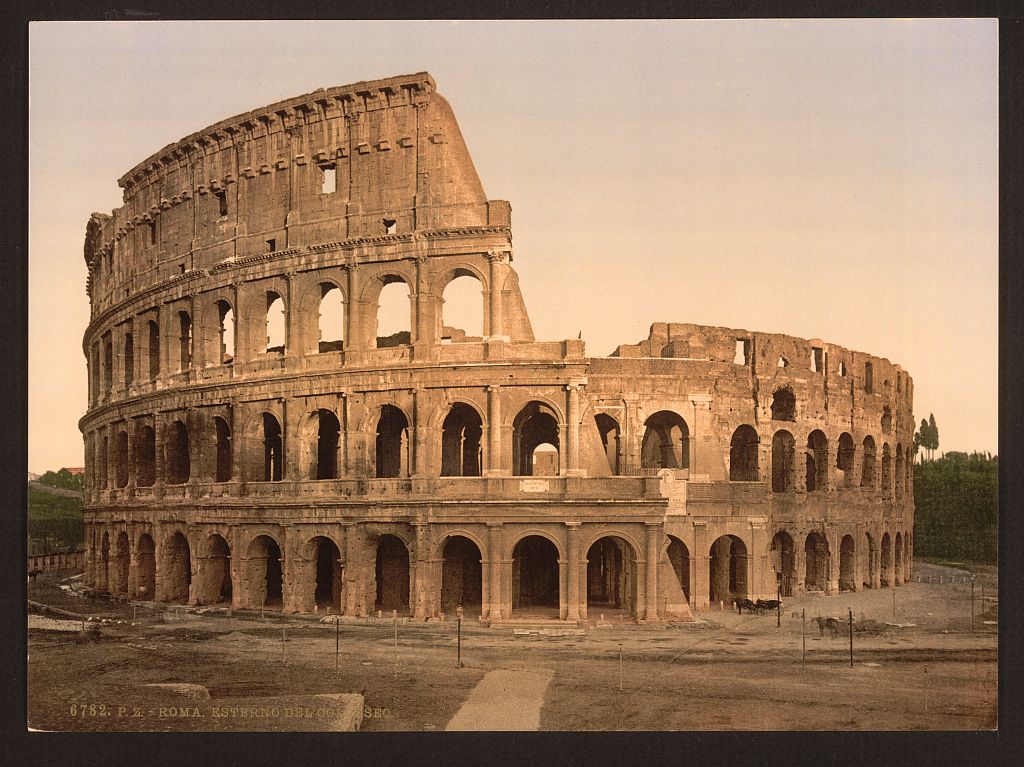
For almost two hundred years, English gentlemen could not consider their education complete until they had taken the “Grand Tour” of Europe, usually culminating in Naples, “ragamuffin capital of the Italian south,” writes Ian Thomson at The Spectator. Italy was usually the primary focus, such that Samuel Johnson remarked in 1776, perhaps with some irony, “a man who has not been to Italy is always conscious of an inferiority.” The Romantic poets famously wrote of their European sojourns: Shelley, Byron, Wordsworth… each has his own “Grand Tour” story.
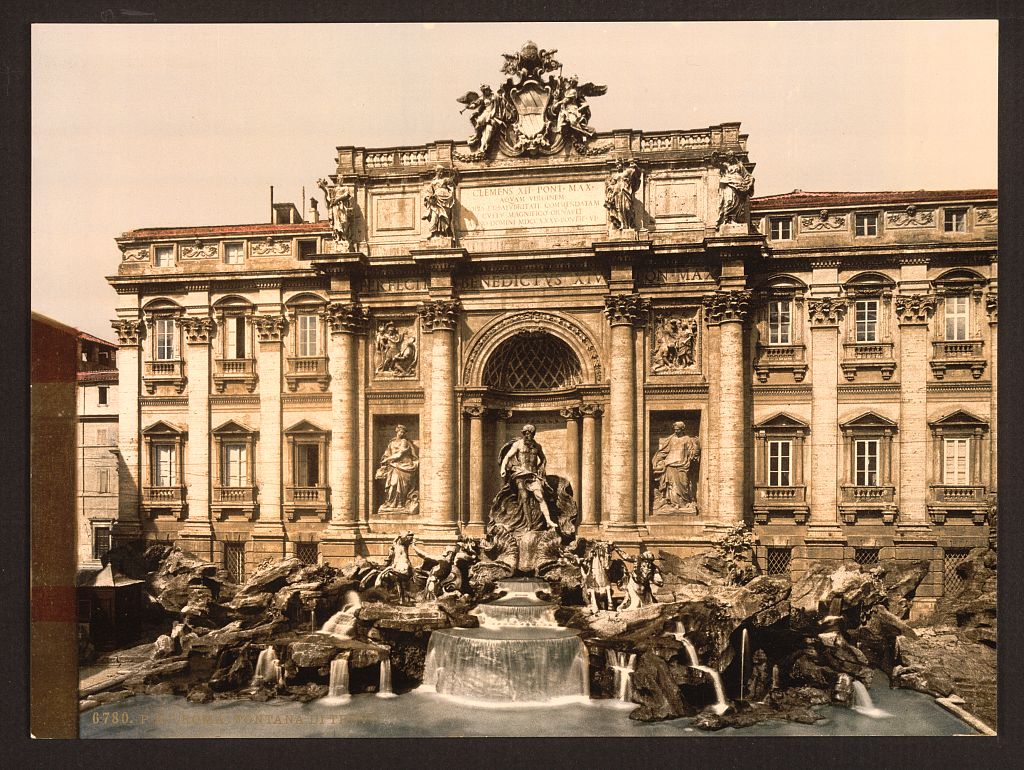
Shelley, who traveled with his wife Mary Godwin and her stepsister Claire Clairmont, did not go to Italy, however. And Byron sailed the Mediterranean on his Grand Tour, forced away from most of Europe by the Napoleonic wars. But in 1817, he journeyed to Rome, where he wrote the Fourth Canto of Childe Harold’s Pilgrimage:
Oh Rome! my country! city of the soul!
The orphans of the heart must turn to thee,
Lone mother of dead empires! And control
In their shut breasts their petty misery.
For the traveling artist and philosopher, “Italy,” Thomson writes, “presented a civilization in ruins,” and we can see in all Romantic writing the tremendous influence visions of Rome and Pompeii had on gentlemen poets like Byron. The Grand Tour, and journeys like it, persisted until the 1840s, when railroads “spelled the end of solitary aristocratic travel.”
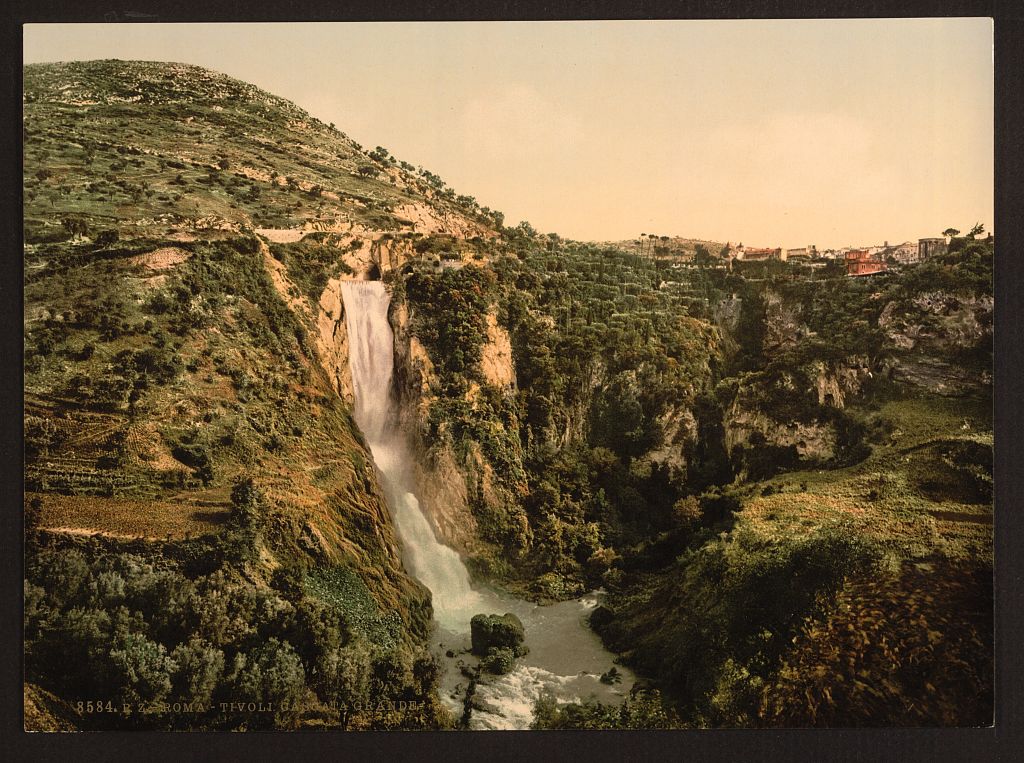
But even decades afterward, we can see Rome (and Venice) the way Byron might have seen it—and almost, even, in full color. As we step into the vistas of these postcards from 1890, we are far closer to Byron than we are to the Rome of our day, before Mussolini’s monuments, notorious snarls of Roman traffic, and throngs of tourists.
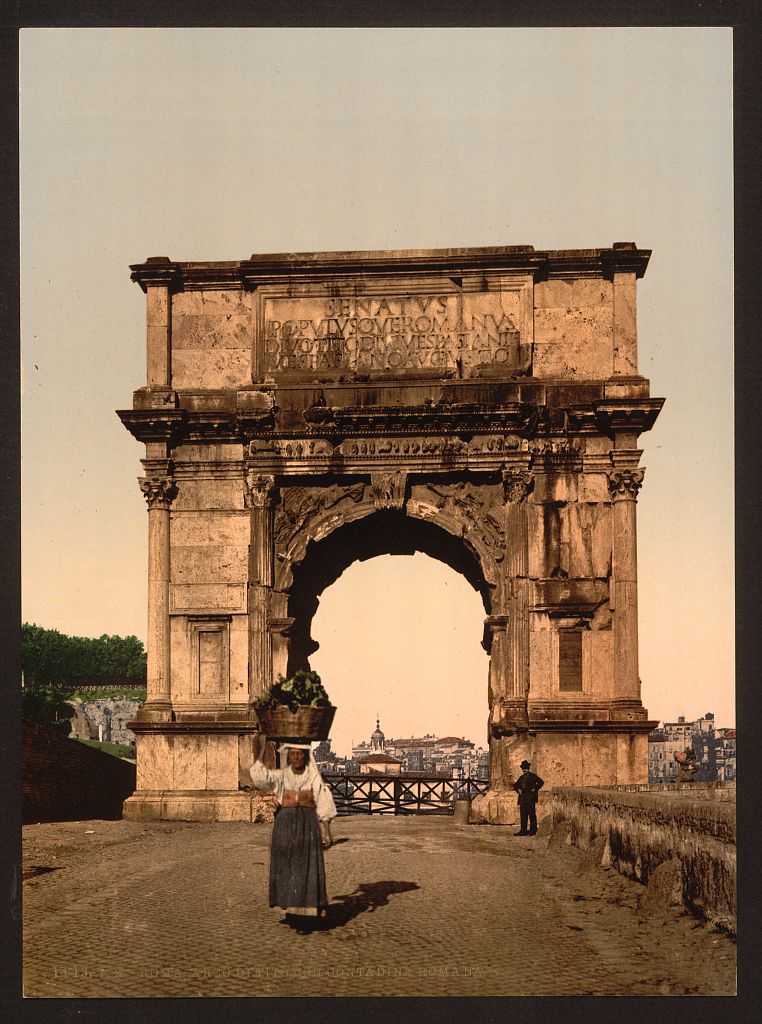
“These postcards of the ancient landmarks of Rome,” writes Mashable, “were produced… using the Photochrom process, which adds precise gradations of artificial color to black and white photos.” Invented by Swiss printer Orell Gessner Fussli, the process involved creating lithographic stone from the negatives—“Up to 15 different tinted stones could be involved in the production of a single picture, but the result was remarkably lifelike color at a time when true color photography was still in its infancy.”
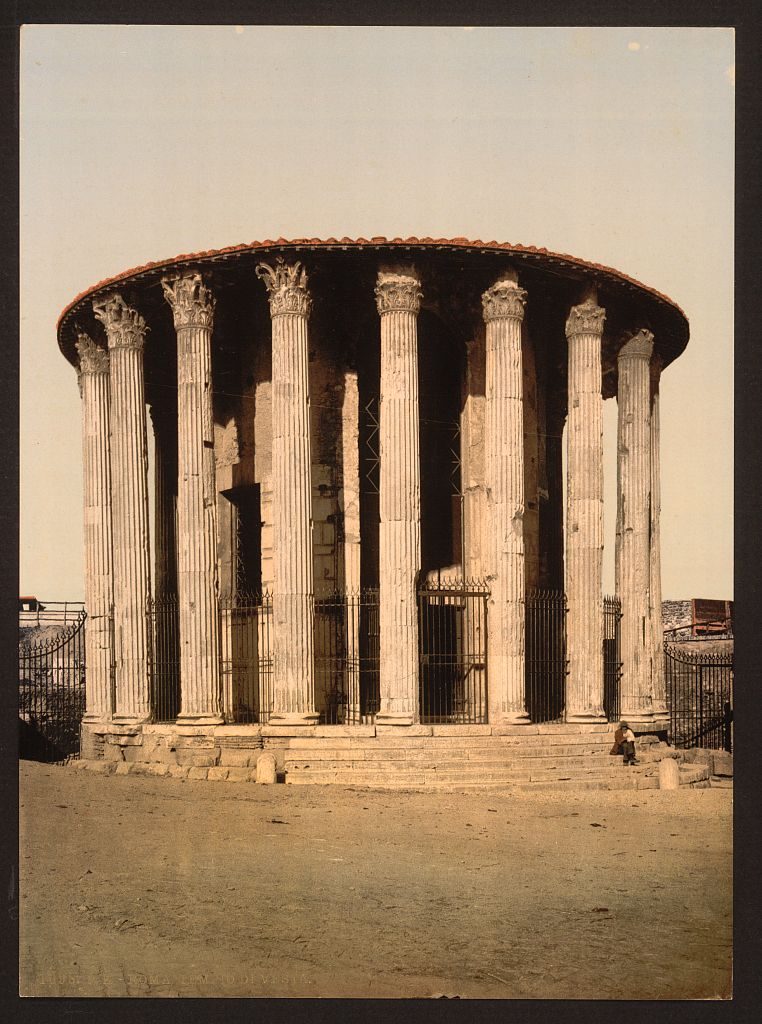
The Library of Congress hosts forty eight of these images in their online catalog, all downloadable as high quality jpegs or tiffs, and many, like the stunning image of the Colosseum at the top (see the interior here), featuring a pre-Photocrom black and white print as well.
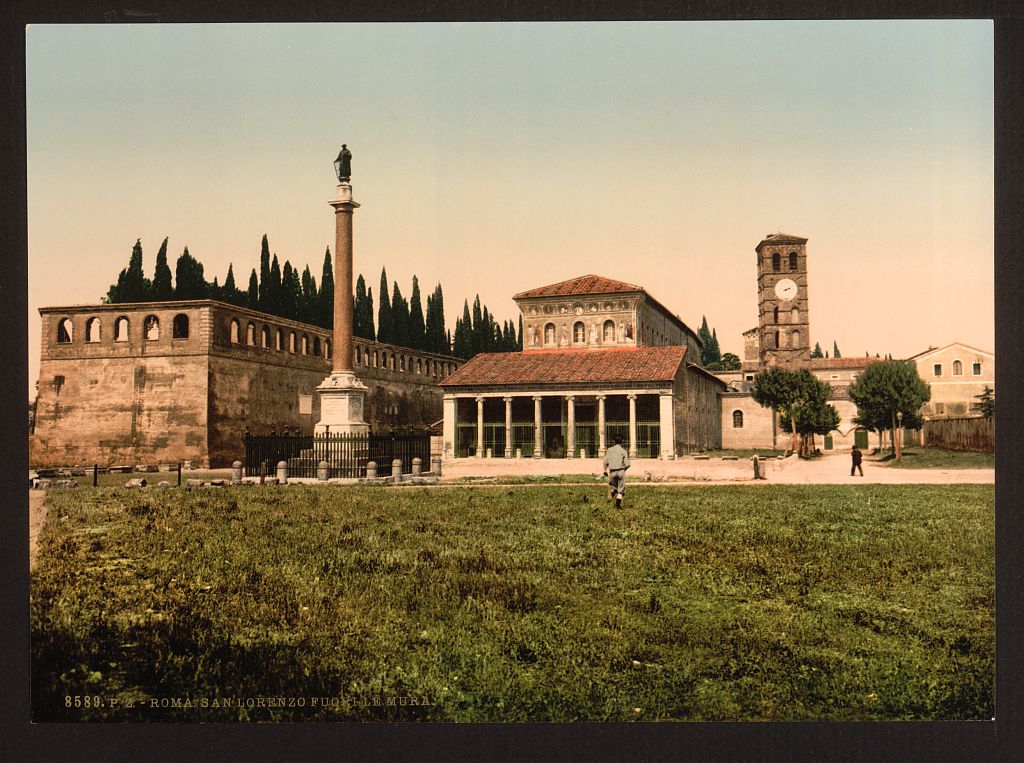
Aside from a rare street scene, with an urban milieu looking very much from the 1890s, the photographs are void of crowds. In the foreground of the Triumphal Arch further up we see a solitary woman with a basket of produce on her head. In the image of San Lorenzo, above, a tiny figure walks away from the camera.
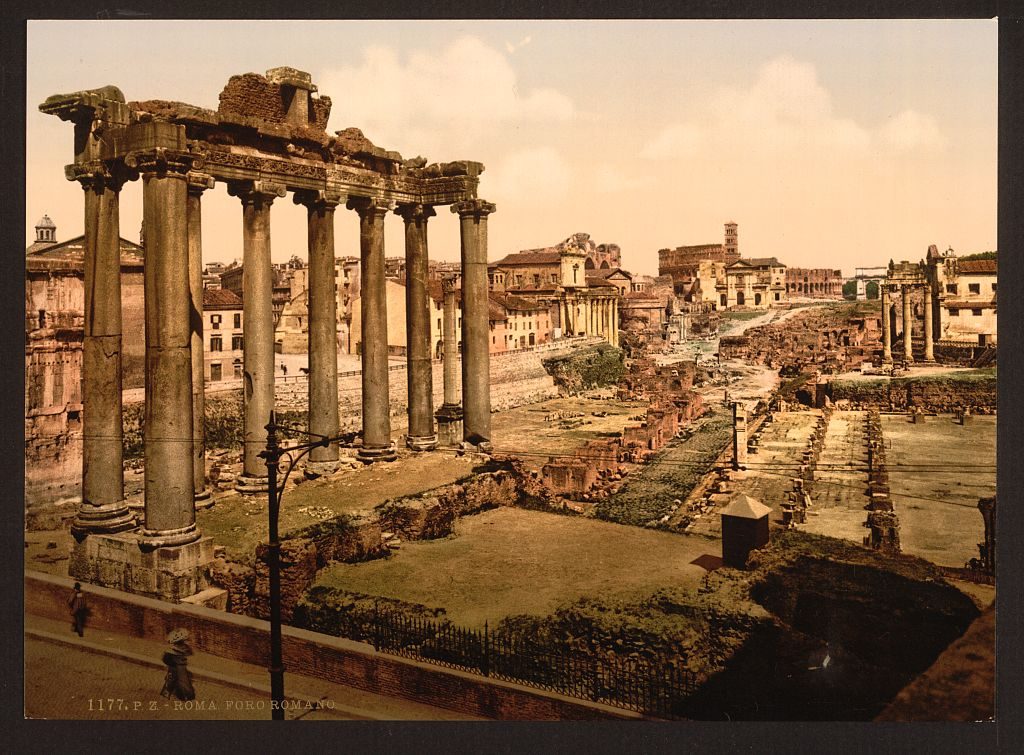
In most of these images—with their dreamlike coloration—we can imagine Rome the way it looked not only in 1890, but also how it might have looked to bored aristocrats in the 17th and 18th centuries—and to passionate Romantic poets in the early 19th, a place of raw natural grandeur and sublime man-made decay. See the Library of Congress online catalog to view and download all forty-eight of these postcards.
Note: An earlier version of this post appeared on our site in 2016.
Related Content:
Bringing Tsarist Russia to Life: Vivid Color Images from 1905–1915
Josh Jones is a writer and musician based in Durham, NC.
Behold the First Realistic Depiction of the Human Face (Circa 25,000 BCE)
in Art, History | March 2nd, 2026
?si=HOvgnTtB4xSNqpNE
In 1894, archaeologist Édouard Piette discovered the “Venus of Brassempouy,” otherwise known as the “Lady with the Hood.” Unearthed in southwestern France and dating to around 25,000 BCE, this carving represents the earliest realistic depiction of a human face. The figure’s forehead, nose, and brows are carefully carved in relief, as is the hair, arranged in a neat geometric pattern. But what happened to the mouth? Or the eyes? We’re not sure.
The Venus is carved from mammoth ivory, likely using a stone flint, and stands just 3.65 cm tall. For some, it marks a major development in figurative art. Or, as historian Simon Schama has suggested, this figurine may well be the “dawn of the idea of beauty” in human culture.
Related Content
The World’s Oldest Cave Art, Discovered in Indonesia, Is at Least 67,800 Years Old
Algerian Cave Paintings Suggest Humans Did Magic Mushrooms 9,000 Years Ago
Was a 32,000-Year-Old Cave Painting the Earliest Form of Cinema?
A Stylish 2,000-Year-Old Roman Shoe Found in a Well
Exquisite 2300-Year-Old Scythian Woman’s Boot Preserved in the Frozen Ground of Siberia
The Greatest Double Agent Ever: How a Spanish Chicken Farmer Became the Most Important Double Agent in WWII
in History | March 2nd, 2026
Juan Pujol García was one of the rare individuals whose participation in World War II made him a Member of the Order of the British Empire and earned him the Iron Cross. He gained that unlikely distinction in perhaps the riskiest of all roles in espionage, that of a double agent. Despite ultimately working for the Allied cause, he created an elaborate fictional persona — complete with an invented spy network operating across Great Britain — who professed loyalty to the Nazi cause. Not only did Pujol get this character plugged into the real German intelligence system, he also got him on its payroll, receiving what came to the equivalent of more than $6 million in today’s U.S. dollars for supplying information — information that ultimately contributed to the Axis’ loss of the war.
The story of how this chicken farmer from Barcelona became the most important double agent of World War II is told in the animated Primal Space video above. Unlike many of the spies history has remembered more clearly, Pujol didn’t begin his espionage career in the employ of any government in particular.
Radicalized, if that be the word, by the experience of having been drafted into the Spanish Civil War, he vowed to dedicate his life to “the good of humanity.” Turned away by the British embassy, to which he’d offered his services because Britain opposed Nazi Germany, he went freelance, re-inventing himself as a Third Reich-loyal Spanish military man seeking an assignment in the U.K. Taken on by Germany, he instead decamped to Lisbon, where he began manufacturing ersatz intelligence reports using newsreel footage and tourist brochures.
However makeshift, Pujol’s craft proved impressive to both Germany and Britain, which launched an international spy hunt for him. He thus accomplished his goal of becoming an official British double agent, in which capacity he arrived at his finest hour: misleading the Germans as to the 1944 “D‑Day” invasion of Normandy in an effort called Operation Fortitude. In Spanish, that would be Fortaleza, which became the title of an RTVE documentary about Pujol’s long-untold story a few years ago. But if any single word reflects Pujol’s contribution to history, that word must be Garbo, the code name assigned him by his first British case officer. After all, what other name — at least in 1942 — could quite so evocatively befit an agent whose skills of crafting and inhabiting invented characters made his handlers regard him as “the best actor in the world”?
Related content:
The CIA’s Former Chief of Disguise Show How Spies Use Costumes in Undercover Operations
The French Designed a Fake Replica of Paris to Fool German Bombers During World War I
Based in Seoul, Colin Marshall writes and broadcasts on cities, language, and culture. He’s the author of the newsletter Books on Cities as well as the books 한국 요약 금지 (No Summarizing Korea) and Korean Newtro. Follow him on the social network formerly known as Twitter at @colinmarshall.