Every citrus fruit in Sicily descends from four wild fruits.
The Citrus Kingdom followed eight fruits across Sicily, from the citron in Palermo to the late mandarin of Ciaculli. This is how they are related.
Roman numerals mark each fruit’s chapter in The Citrus Kingdom. Tap a fruit to read it. A dotted line is a sport: one branch of one tree that mutated, the way the late mandarin of Ciaculli began. The bottom three rows are not new crosses either: they are selections and mutations of the sweet orange and the lemon.
Sweet orange: pomelo × mandarin, crossed back to mandarin. Tarocco, Moro and Sanguinello, the three blood oranges of Etna, are red mutations of it. Part IV, Taormina
Verdello: a Femminello lemon forced into a summer crop. Part VI, Ortigia
Femminello: Sicily’s main lemon. Monachello and Lunario are its neighbors; Limone dell’Etna is Femminello and Monachello grown on the volcano. Part VII, Modica
Tardivo di Ciaculli: the late mandarin, a sport of an Avana mandarin tree, ripening from January into March. Part VIII, Conca d’Oro
Mandarino: the Mediterranean mandarin, called Avana in Sicily. Part VIII, Conca d’OroClementine: mandarin × sweet orange.
Lemon: sour orange × citron, a hybrid of a hybrid.
Biondo Comune, Ovale, Valencia, Navelina and Ribera: the blond sweet oranges grown in Sicily. Part IV, Taormina
Bergamot: sour orange × lemon. Chinotto: a mutation of the sour orange.
Cedrino: a smaller, historically recognized form of the cedro, the citron.
Pompia: sour orange × citron, from Sardinia. Lumia: an old citron hybrid, most often citron × pomelo.
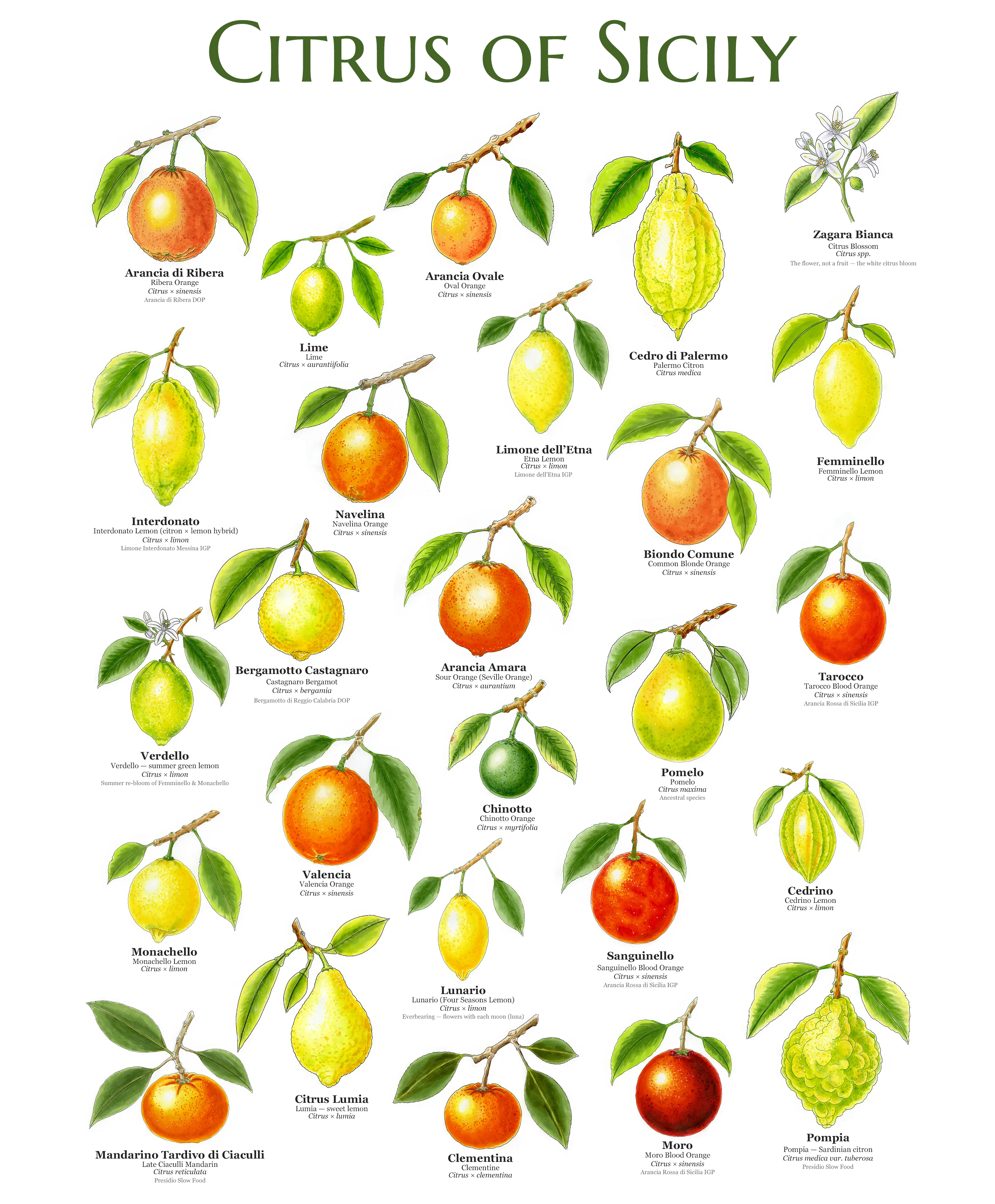
My Copic, liner pen and pencil drawing of the key citrus players in Sicily’s history—some are Sicilian icons, others the ancestral species that made them possible.