ⓘ Apple, edited
HOMOLAB's FIO benchmarks show the 1TB iPhone 18 Pro Max's QLC storage can drop below microSD-card speeds once its cache is exhausted, with performance getting notably worse as the drive fills up
Bilibili channel HOMOLAB has put the 1TB iPhone 18 Pro Max through real-world storage benchmarks, and the results suggest its flash storage can slow down dramatically once you push it hard, especially as the drive fills up.
Most phones today use TLC (triple-level cell) flash storage, which stores 3 bits of data per memory cell and, following the introduction of 3D NAND, offers a solid balance of speed, capacity, and durability. The 1TB iPhone 18 Pro Max instead uses QLC (quad-level cell) storage, which packs in 4 bits per cell. That means more capacity from the same physical chip, but each cell has to distinguish between more possible states, which typically makes QLC slower and less durable than TLC.
HOMOLAB backed this up with a direct comparison against a 512GB TLC-based iPhone 18 Pro. In weighted 4K read tests, the two were close: 46,045 for the QLC unit versus 51,282 for TLC. The gap widened in mixed read/write workloads, where the TLC model led by roughly 38% at low queue depths (11,285 vs. 8,168), narrowing to about 12% under heavier, more demanding loads (35,992 vs. 32,219).
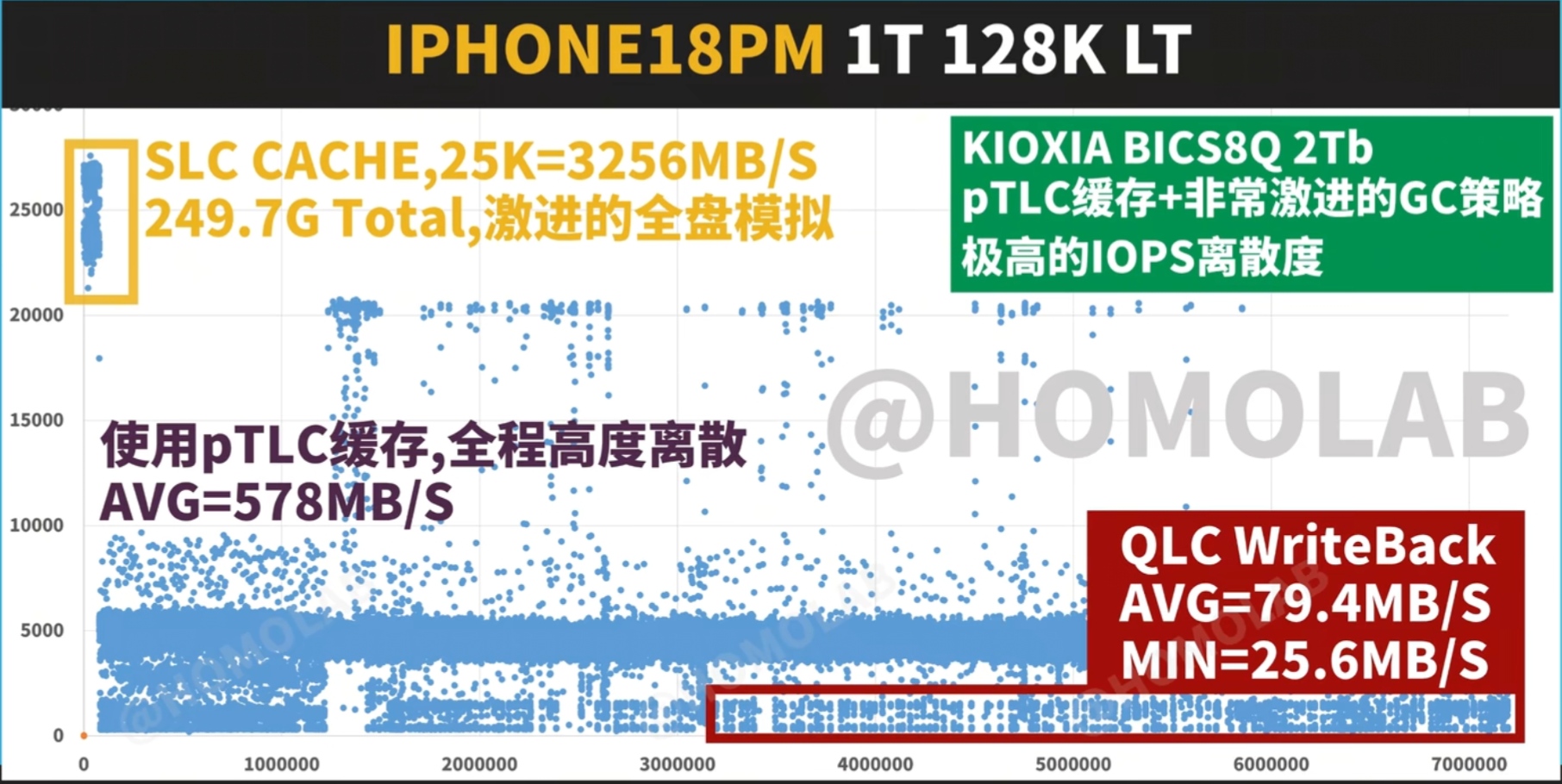
Like most modern phones, the iPhone 18 Pro Max uses a small, fast SLC (single-level cell) cache to absorb quick bursts of data, hitting speeds above 3,000 MB/s while that cache has room. Once that cache is exhausted, the phone falls back to a secondary buffer that simulates TLC-like storage and remains faster than raw QLC, averaging 578 MB/s but exhibiting substantial variation. Only after that secondary buffer is also exhausted does the phone write directly to raw QLC storage, where HOMOLAB measured sustained speeds dropping to an average of just 79.4 MB/s and bottoming out at 25.6 MB/s—worse than many budget microSD cards.
ⓘ Homolab
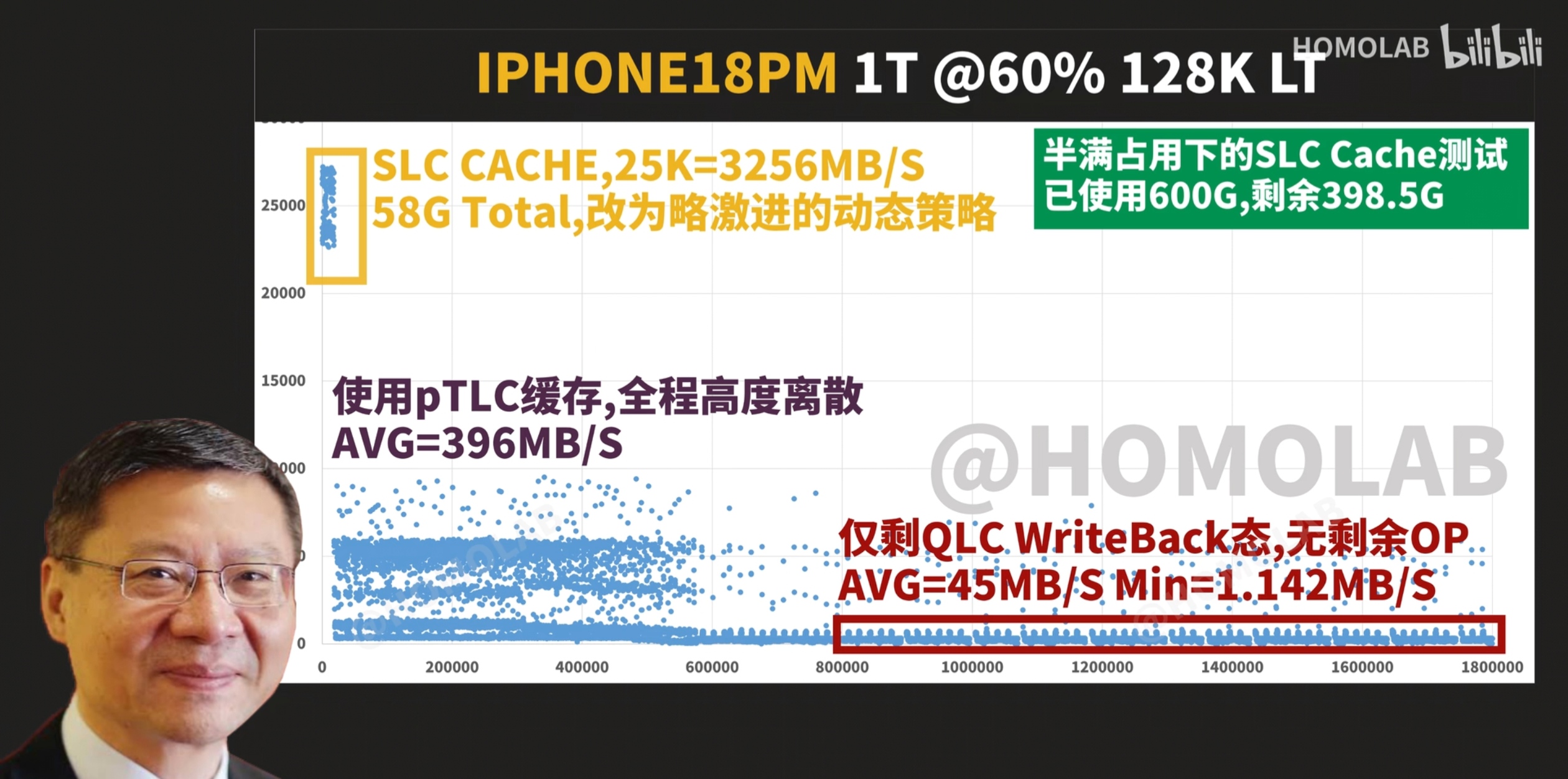
It gets worse as the drive fills up. At 60% capacity, the reduced free space leaves less room for the fast cache, and the available SLC cache drops sharply from around 250GB on an empty drive to just 58GB. The TLC-simulating buffer also slowed, averaging 396 MB/s compared with 578 MB/s when empty, and the raw QLC write-back stage fell further, averaging 45 MB/s and bottoming out at a mere 1.1 MB/s—well behind competing TLC-based UFS 4.0 storage in other flagship phones under similarly heavy loads.
ⓘ Homolab
Pricing-wise, the 1TB variant carries one of the steepest storage upcharges in the industry, despite using a storage type that's generally considered a step down from those used in the lower-capacity configurations.
For most everyday tasks—texting, browsing, and taking casual photos—this likely won't be noticeable, since the cache handles typical bursts well. It becomes a real issue during sustained heavy writes, such as long 4K or ProRes video recordings, large file transfers, or backup restores. These are exactly the use cases that buyers of the high-capacity model are most likely to encounter.
Related Articles

Giang Bùi - Tech Writer - 150 articles published on Notebookcheck since 2026
Instead of sports, I spent my school years buried in researching about everything tech, looking into chips and specs instead of doing whatever normal kids did. I am now writing for NotebookCheck, hoping that research finally reaches more people than just me and a text file.
Bùi Giang, 2026-09-21 (Update: 2026-09-21)