Meteor Lake doesn't stand a chance against Zen 5.
Around one month after the launch of Qualcomm’s latest ARM chips, AMD has now release its new Zen 5 mobile processors codenamed Strix Point. We tested out the new Ryzen AI 9 HX 370 with various TDPs.
AMD recently launched its new Zen 5 mobile processors under the name Ryzen AI 300 (Strix Point). Besides having an improved GPU, the latest chips boast a more powerful NPU, allowing new AMD laptops to carry the Windows Copilot+ branding and offer extra AI features. In this article, we’ll delve into the performance and efficiency of the new Zen 5 processors. We have already done a detailed analysis of the new AMD Radeon 890 iGPU in a separate article.
The naming convention of previous AMD mobile processors was already complicated enough, especially since consumers need to pay close attention to which core generation is actually used on a processor (i.e. Zen 2, Zen 3, Zen 3+ or Zen 4). But there was at least still some sort of continuity, for instance the 6000 series is succeeded by the 7000 series and then the 8000 series. This is no longer the case: the new AMD mobile processors are called Ryzen AI 300. However, this isn’t where the changes end. The previous performance classes U/HS/HX are also completely gone. Instead, the new Ryzen AI 9 HZ 370 now covers a TDP range of 15 to 54 watts and replaces the old U and HS performance classes. At the same time, it has nothing in common with past HX chips – AMD can’t make things any more complicated for consumers. The following three models are available at launch:
| Model | CPU cores | Threads | Base clock | Turbo clock | L2 cache | L3 cache | TDP range | Base TDP | iGPU | GPU cores | max. CPU clock | NPU |
|---|---|---|---|---|---|---|---|---|---|---|---|---|
| Ryzen AI 9 HX 375 | 12 (4+8) | 24 | 2 GHz | 5.1 Ghz | 12 MB | 24 MB | 15-54 Watt | 28 Watt | Radeon 890M | 16 | 2.9 GHz | 55 TOPS |
| Ryzen AI 9 HX 370 | 12 (4+8) | 24 | 2 GHz | 5.1 Ghz | 12 MB | 24 MB | 15-54 Watt | 28 Watt | Radeon 890M | 16 | 2.9 GHz | 50 TOPS |
| Ryzen AI 9 365 | 10 (4+6) | 20 | 2 GHz | 5 GHz | 10 MB | 24 MB | 15-54 Watt | 28 Watt | Radeon 880M | 12 | 2.8 GHz | 50 TOPS |
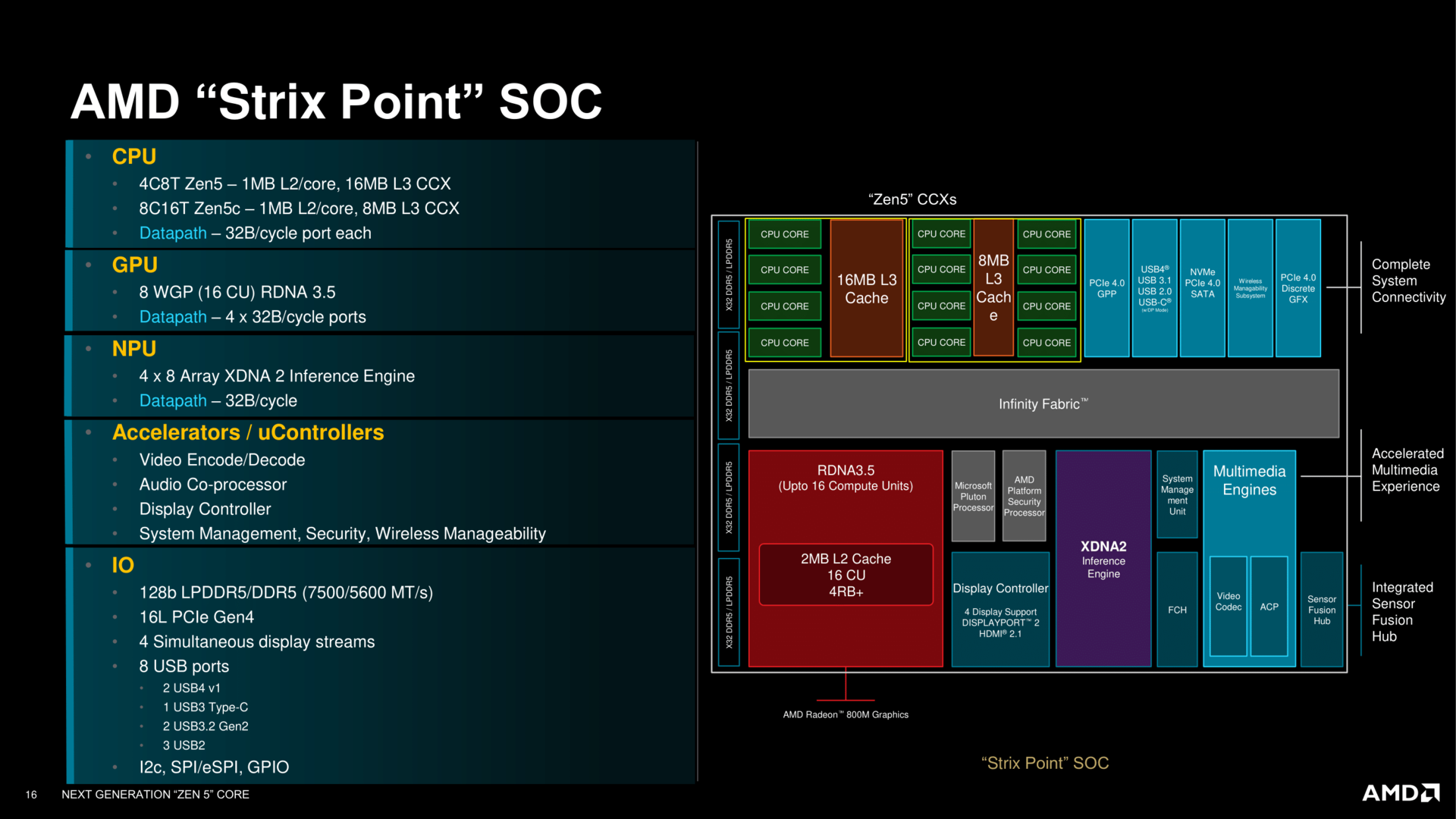
AMD sticks to a monolithic design along with a 4nm FinFet fabrication process by TSMC, but the new mobile processors feature a combination of fully fledged Zen 5 cores and slightly less powerful Zen 5c cores. The two core types fundamentally offer the same feature set, but the Zen 5c cores have less cache and also deliver less performance. Both HX models are equipped with four full-fat and eight compact Zen 5 cores, whilst the Ryzen AI 9 365 has four Zen 5 cores, but only six Zen 5c cores, resulting in reduced cache. Additionally, the lower-tier model features the weaker Radeon 880M with 12 CUs.
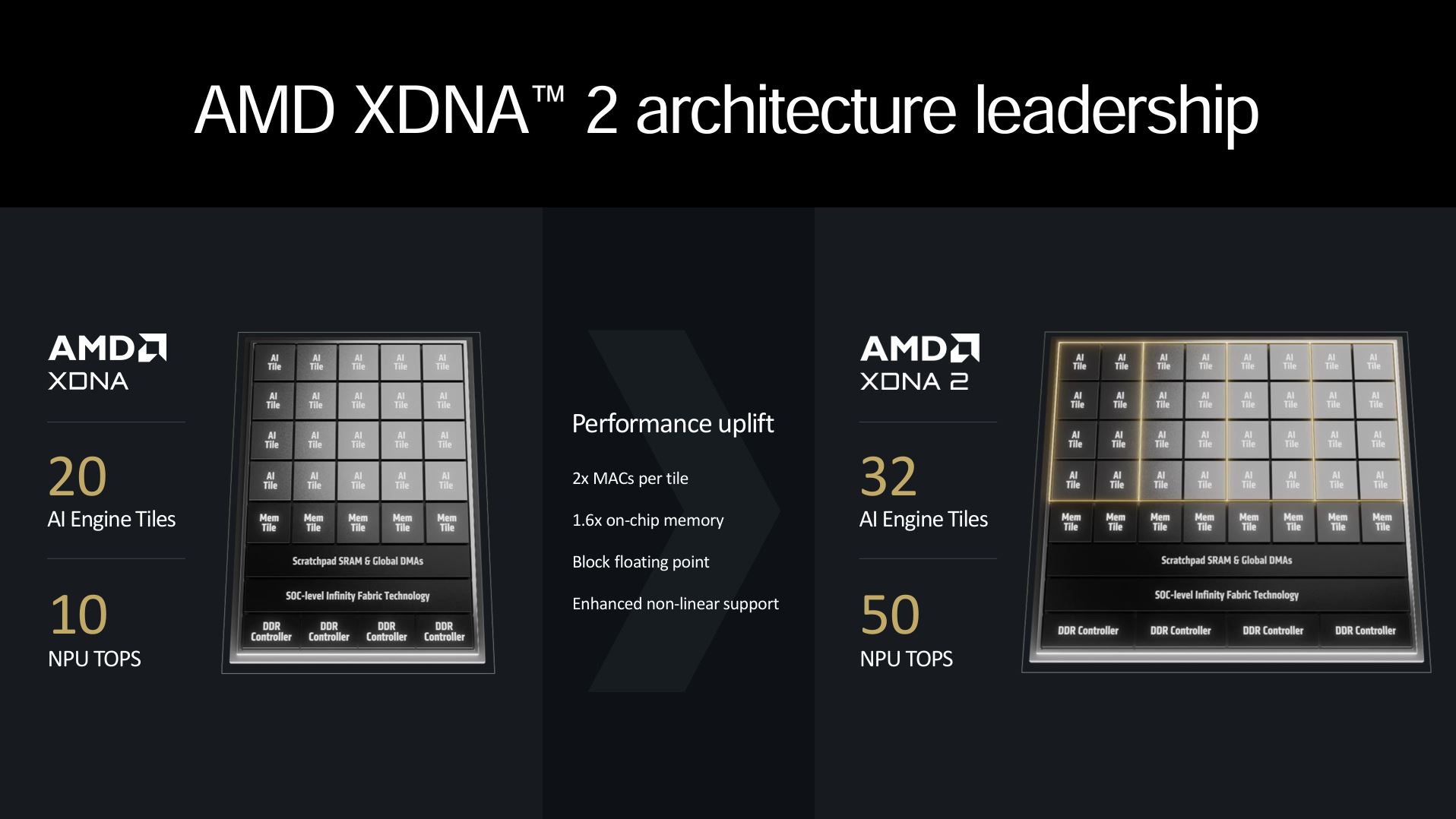
Another crucial component is the new XDNA 2-based NPU. Compared with the previous XDNA NPU, the number of AI tiles has increased from 20 to 32, and the compute capacity has quintupled from 10 to 50 TOPS. On the Ryzen AI 9 HX 375, the NPU can even reach 55 TOPS. As a result, the new AMD mobile processors also meet the minimum 40 TOPS required for a Windows Copilot+ PC. This means that Copilot+ is no longer exclusive to laptops with Qualcomm Snapdragon processors after just a few weeks.
Three new Asus laptops, all equipped with the AMD Ryzen AI 9 HX 370, were available for us to test out. The Zenbook S 16 and the ProArt PX13 come with 32 GB of LPDDR5X-7500 RAM, whilst the larger ProArt P16 features 64 GB of the same RAM type. We disabled the dedicated Nvidia GPU in the two ProArt models using the ProArt software. This was to ensure that the laptops’ efficiency figures were not affected by their dGPU when they were connected to an external display.
The three notebooks have very different TDP configurations, enabling us to cover a wide range of performance. The AMD Ryzen AI 9 HX 370 operates at 33/23 watts in the Zenbook, 80/65 watts in the ProArt PX13, and 80 watts in the large ProArt P16. The two ProArt laptops thus run the Ryzen chip at a much higher wattage than the specified 54 watts. However, at a maximum of 80 watts, the power draw is still significantly lower than the 115 watts that Intel’s current Meteor Lake mobile processors can consume.
In order to meaningfully compare the different processors, we examined their pure performance in synthetic benchmarks as well as their power usage, which let us determine their efficiency. For our power usage measurements, the laptops were connected to an external display so that we can eliminate the internal displays as an influencing factor. Nonetheless, we measured the systems’ total power consumption rather than simply comparing just their TDP values.
Starting off with single-core performance, the highest CPU package power was around 19-21 watts in the single-core tests. In Cinebench R23, we saw an 8-15% improvement over the old Ryzen 8000 CPUs (Hawk Point), and the new Zen 5 chips were neck and neck with Apple’s M3 SoCs. Only the Intel Raptor Lake HX CPUs had an edge over the new Ryzens in this regard. You can disregard the Snapdragon SoCs in Cinebench R23, as the required emulation process reduces performance.
The newer Cinebench 2024 paints a slightly different picture. The Zen 5 processors delivered around a 10-12% improvement over the older Zen 4 CPUs and even beat the current Meteor Lake CPUs. The Intel HX chips were once again faster. Interestingly, even though the base Snapdragon X Elite model without Dual-Core Boost was outperformed by the Ryzen AI 9 HX 370, the higher-end model with Dual-Core Boost (i.e. the X1E-80-100) was faster than the Ryzen. That said, Apple’s M3 chips still offers the best performance in Cinebench 2024.
For our efficiency analysis, we once again made use of Cinebench R23 and Cinebench 2023 and, as previously mentioned, measured the total power usage of a system. We noticed the three new Zen 5 laptops have some of the highest power draws in our comparison, despite having a considerably lower CPU package power of 19-21 watts. This may be because the new Zen 5 chips haven’t been fully optimised yet or the three Asus laptops overall require quite a lot of power due to their faster memory. As you may expect, such factors have a more apparent effect on efficiency particularly in single-core tests. The new Ryzen chips are roughly 10% more efficient than the older ones, but there is certainly room for improvement.
| Power Consumption / Cinebench R23 Single Power Efficiency - external Monitor | |
| Apple M3 Pro 11-Core Apple MacBook Pro 14 2023 M3 Pro | 198.6 Points per Watt +237% |
| Apple M3 Apple MacBook Air 15 M3 | 190.4 Points per Watt +223% |
| Apple M3 Pro 12-Core Apple MacBook Pro 16 2023 M3 Pro | 142.2 Points per Watt +141% |
| Apple M3 Max 16-Core Apple MacBook Pro 16 2023 M3 Max | 113.8 Points per Watt +93% |
| Qualcomm Snapdragon X Elite X1E-78-100 Asus Vivobook S 15 OLED Snapdragon | 78.5 Points per Watt +33% |
| Qualcomm Snapdragon X Elite X1E-80-100 Samsung Galaxy Book4 Edge 16 | 71.1 Points per Watt +21% |
| Intel Core Ultra 7 155H Xiaomi RedmiBook Pro 16 2024 | 62.8 Points per Watt +7% |
| AMD Ryzen AI 9 HX 370 Asus Zenbook S 16 UM5606-RK333W | 62.6 Points per Watt +6% |
| AMD Ryzen AI 9 HX 370 Asus ProArt PX13 HN7306 | 62.6 Points per Watt +6% |
| Qualcomm Snapdragon X Elite X1E-80-100 Microsoft Surface Laptop 7 13.8 Copilot+ | 61.2 Points per Watt +4% |
| AMD Ryzen AI 9 HX 370 Asus ProArt P16 H7606WI | 58.9 Points per Watt |
| Intel Core Ultra 7 155H Lenovo ThinkPad P14s G5 21G3S00A00 | 57.4 Points per Watt -3% |
| AMD Ryzen 7 8845HS Schenker VIA 14 Pro (M24) | 56.7 Points per Watt -4% |
| Intel Core Ultra 7 155H Schenker XMG Evo 15 (M24) | 51.4 Points per Watt -13% |
| Power Consumption / Cinebench R23 Single (external Monitor) | |
| AMD Ryzen AI 9 HX 370 Asus ProArt P16 H7606WI | 34.8 (32.6min, 32.7P1 - 59max) Watt * |
| Intel Core Ultra 7 155H Schenker XMG Evo 15 (M24) | 33.9 (27.2min, 30.1P1 - 43max) Watt * +3% |
| AMD Ryzen AI 9 HX 370 Asus ProArt PX13 HN7306 | 32.5 (31.1min, 31.3P1 - 47.5max) Watt * +7% |
| AMD Ryzen 7 8845HS Schenker VIA 14 Pro (M24) | 31.3 (28.2min, 28.8P1 - 39max) Watt * +10% |
| AMD Ryzen AI 9 HX 370 Asus Zenbook S 16 UM5606-RK333W | 31.2 (27.4min, 28.4P1 - 48max) Watt * +10% |
| Intel Core Ultra 7 155H Lenovo ThinkPad P14s G5 21G3S00A00 | 31.1 (24min, 25.6P1 - 51.7max) Watt * +11% |
| Intel Core Ultra 7 155H Xiaomi RedmiBook Pro 16 2024 | 28 (20.8min, 22.2P1 - 47max) Watt * +20% |
| Qualcomm Snapdragon X Elite X1E-80-100 Microsoft Surface Laptop 7 13.8 Copilot+ | 21.6 (19.4min, 19.8P1 - 37.4max) Watt * +38% |
| Qualcomm Snapdragon X Elite X1E-80-100 Samsung Galaxy Book4 Edge 16 | 18.1 (14.8min, 15.6P1 - 24.1max) Watt * +48% |
| Apple M3 Max 16-Core Apple MacBook Pro 16 2023 M3 Max | 17.3 (16.2min, 16.2P1 - 21.4max) Watt * +50% |
| Qualcomm Snapdragon X Elite X1E-78-100 Asus Vivobook S 15 OLED Snapdragon | 14.4 (7.26min, 11.8P1 - 26.2max) Watt * +59% |
| Apple M3 Pro 12-Core Apple MacBook Pro 16 2023 M3 Pro | 13.9 (12.1min, 12.2P1 - 15.8max) Watt * +60% |
| Apple M3 Apple MacBook Air 15 M3 | 9.98 (9.45min, 9.58P1 - 12.1max) Watt * +71% |
| Apple M3 Pro 11-Core Apple MacBook Pro 14 2023 M3 Pro | 9.78 (8.94min, 9P1 - 10.8max) Watt * +72% |
| Power Consumption / Cinebench 2024 Single Power Efficiency - external Monitor | |
| Apple M3 Apple MacBook Air 13 M3 8C GPU | 12.7 Points per Watt +274% |
| Qualcomm Snapdragon X Elite X1E-78-100 Lenovo ThinkPad T14s Gen 6 21N10007GE | 7.25 Points per Watt +113% |
| Qualcomm Snapdragon X Elite X1E-80-100 Samsung Galaxy Book4 Edge 16 | 7.15 Points per Watt +110% |
| Qualcomm Snapdragon X Elite X1E-78-100 Asus Vivobook S 15 OLED Snapdragon | 6.39 Points per Watt +88% |
| Qualcomm Snapdragon X Elite X1E-80-100 Microsoft Surface Laptop 7 13.8 Copilot+ | 5.89 Points per Watt +73% |
| AMD Ryzen AI 9 HX 370 Asus Zenbook S 16 UM5606-RK333W | 3.64 Points per Watt +7% |
| AMD Ryzen AI 9 HX 370 Asus ProArt P16 H7606WI | 3.4 Points per Watt |
| Intel Core Ultra 7 155H Schenker XMG Evo 15 (M24) | 3.13 Points per Watt -8% |
| AMD Ryzen 7 8845HS Schenker VIA 14 Pro (M24) | 3.11 Points per Watt -9% |
| Power Consumption / Cinebench 2024 Single Power (external Monitor) | |
| Intel Core Ultra 7 155H Schenker XMG Evo 15 (M24) | 34.5 (26.9min, 30.5P1 - 46.1max) Watt * -1% |
| AMD Ryzen AI 9 HX 370 Asus ProArt P16 H7606WI | 34.1 (30.9min, 32.1P1 - 51.4max) Watt * |
| AMD Ryzen 7 8845HS Schenker VIA 14 Pro (M24) | 32.8 (26.6min, 27.7P1 - 71.3max) Watt * +4% |
| AMD Ryzen AI 9 HX 370 Asus Zenbook S 16 UM5606-RK333W | 31.2 (28.6min, 29.4P1 - 41max) Watt * +9% |
| Qualcomm Snapdragon X Elite X1E-80-100 Microsoft Surface Laptop 7 13.8 Copilot+ | 20.9 (18.2min, 19P1 - 39.3max) Watt * +39% |
| Qualcomm Snapdragon X Elite X1E-80-100 Samsung Galaxy Book4 Edge 16 | 17.2 (14.3min, 14.9P1 - 33.7max) Watt * +50% |
| Qualcomm Snapdragon X Elite X1E-78-100 Asus Vivobook S 15 OLED Snapdragon | 16.9 (9.4min, 10.4P1 - 51.6max) Watt * +50% |
| Qualcomm Snapdragon X Elite X1E-78-100 Lenovo ThinkPad T14s Gen 6 21N10007GE | 14.9 (12.5min, 14P1 - 25.3max) Watt * +56% |
| Apple M3 Apple MacBook Air 13 M3 8C GPU | 11.1 (9.69min, 10.4P1 - 14max) Watt * +67% |
* ... smaller is better
The new Ryzen AI 9 HX 370 truly shines when it comes to multi-core performance and naturally benefits from having more cores than the older Zen 4 chips. Even the Zen 5 processor (33/28 watts) in the Zenbook S 16 delivered highly respectable results in the R23 Multi test, beating the Ryzen 7 8845HS (54 watts) in the Schenker Via 14 Pro and falling just slightly behind the Core Ultra 7 155H (90/45 watts) in the RedmiBook Pro 16. The two more powerful Zen 5 models managed to beat even the Core i7-14700HX (157/95 watts) and outperformed the Core Ultra 9 185H (120/83 watts) in the Lenovo Yoga Pro 9i 16 by more than 20%.
In Cinebench 2024, the comparison with the Snapdragon chips and Apple’s M3 CPUs is particularly interesting. Starting off with the Zenbook S 16, the Ryzen AI HX 370 in this device ranked higher than most of the Snapdragon competitors. Only the Vivobook S 15 offers slightly better performance. However, in the higher performance profiles (45 & 50 watts), the Vivobook S 15 achieved excellent results and can keep pace with the two faster Zen 5 chips. The Intel HX CPUs and Apple Max CPUs were likewise faster, but the M3 Pro was beaten by the two Zen 5 processors.
In terms of efficiency in Cinebench R23 Multi, even the 80-watt variant of the Ryzen AI 9 HX 370 provided a slight improvement over the Ryzen 7 8845HS running at 54 watts. The Zen 5 chip had a really great showing at 28 watts, breaking into the territory of Apple’s M3 lineup. The Snapdragon processors fell behind due to emulation. However, things were different in Cinebench 2024, where most of the Snapdragon laptops ran more efficiently.
| Power Consumption / Cinebench R23 Multi Power Efficiency - external Monitor | |
| Apple M3 Pro 11-Core Apple MacBook Pro 14 2023 M3 Pro | 394 Points per Watt +89% |
| Apple M3 Apple MacBook Air 15 M3 | 383 Points per Watt +84% |
| Apple M3 Pro 12-Core Apple MacBook Pro 16 2023 M3 Pro | 358 Points per Watt +72% |
| AMD Ryzen AI 9 HX 370 Asus Zenbook S 16 UM5606-RK333W | 354 Points per Watt +70% |
| Apple M3 Max 16-Core Apple MacBook Pro 16 2023 M3 Max | 306 Points per Watt +47% |
| Qualcomm Snapdragon X Elite X1E-78-100 Lenovo ThinkPad T14s Gen 6 21N10007GE | 254 Points per Watt +22% |
| Qualcomm Snapdragon X Elite X1E-80-100 Microsoft Surface Laptop 7 13.8 Copilot+ | 247 Points per Watt +19% |
| Intel Core Ultra 7 155H Schenker XMG Evo 15 (M24) | 238 Points per Watt +14% |
| Qualcomm Snapdragon X Elite X1E-80-100 Samsung Galaxy Book4 Edge 16 | 231 Points per Watt +11% |
| AMD Ryzen AI 9 HX 370 Asus ProArt PX13 HN7306 | 227 Points per Watt +9% |
| AMD Ryzen AI 9 HX 370 Asus ProArt P16 H7606WI | 208 Points per Watt |
| AMD Ryzen 7 8845HS Schenker VIA 14 Pro (M24) | 203 Points per Watt -2% |
| Qualcomm Snapdragon X Elite X1E-78-100 Asus Vivobook S 15 OLED Snapdragon | 199.2 Points per Watt -4% |
| Intel Core Ultra 7 155H Xiaomi RedmiBook Pro 16 2024 | 182.6 Points per Watt -12% |
| Intel Core Ultra 7 155H Lenovo ThinkPad P14s G5 21G3S00A00 | 152.7 Points per Watt -27% |
| AMD Ryzen 7 8845HS Schenker XMG Core 15 (M24) | 134.6 Points per Watt -35% |
| Power Consumption / Cinebench R23 Multi (external Monitor) | |
| Intel Core i9-14900HX Schenker XMG Neo 16 (Early 24) | 288 (258min, 262P1 - 296max) Watt * -152% |
| Intel Core i9-14900HX Schenker XMG Pro 16 Studio (Mid 24) | 154 (147.4min, 147.4P1 - 167.4max) Watt * -35% |
| AMD Ryzen 7 8845HS Schenker XMG Core 15 (M24) | 134 Watt * -17% |
| Intel Core Ultra 7 155H Lenovo ThinkPad P14s G5 21G3S00A00 | 115.3 (108.5min, 108.7P1 - 121.9max) Watt * -1% |
| AMD Ryzen AI 9 HX 370 Asus ProArt P16 H7606WI | 114.3 (113.5min, 113.6P1 - 115.5max) Watt * |
| AMD Ryzen AI 9 HX 370 Asus ProArt PX13 HN7306 | 102.5 (96.8min, 96.9P1 - 119.1max) Watt * +10% |
| AMD Ryzen 9 8945H Asus TUF Gaming A15 FA507UV | 101.2 (98.9min, 99P1 - 107.5max) Watt * +11% |
| Intel Core Ultra 7 155H Xiaomi RedmiBook Pro 16 2024 | 95.3 (89.8min, 89.8P1 - 114.6max) Watt * +17% |
| AMD Ryzen 7 8845HS Schenker VIA 14 Pro (M24) | 80.6 (78.6min, 78.7P1 - 82.8max) Watt * +29% |
| Apple M3 Max 16-Core Apple MacBook Pro 16 2023 M3 Max | 78.6 (71.7min, 73.3P1 - 80.2max) Watt * +31% |
| Intel Core Ultra 7 155H Schenker XMG Evo 15 (M24) | 62.8 (62.3min, 62.3P1 - 64max) Watt * +45% |
| Qualcomm Snapdragon X Elite X1E-78-100 Asus Vivobook S 15 OLED Snapdragon | 54.5 (50.4min, 50.5P1 - 69.3max) Watt * +52% |
| AMD Ryzen AI 9 HX 370 Asus Zenbook S 16 UM5606-RK333W | 46.7 (45.1min, 45.1P1 - 52.7max) Watt * +59% |
| Apple M3 Pro 12-Core Apple MacBook Pro 16 2023 M3 Pro | 42.2 (41.4min, 41.5P1 - 43.6max) Watt * +63% |
| Qualcomm Snapdragon X Elite X1E-80-100 Samsung Galaxy Book4 Edge 16 | 40.7 (38.2min, 38.2P1 - 61.9max) Watt * +64% |
| Qualcomm Snapdragon X Elite X1E-80-100 Microsoft Surface Laptop 7 13.8 Copilot+ | 40.6 (40.4min, 40.4P1 - 40.7max) Watt * +64% |
| Qualcomm Snapdragon X Elite X1E-78-100 Lenovo ThinkPad T14s Gen 6 21N10007GE | 39.3 (23.6min, 23.7P1 - 67.1max) Watt * +66% |
| Apple M3 Pro 11-Core Apple MacBook Pro 14 2023 M3 Pro | 33.8 (33min, 33.1P1 - 36.3max) Watt * +70% |
| Apple M3 Apple MacBook Air 15 M3 | 26.9 (23.5min, 23.6P1 - 30.5max) Watt * +76% |
| Power Consumption / Cinebench 2024 Multi Power Efficiency - external Monitor | |
| Apple M3 Apple MacBook Air 13 M3 8C GPU | 28.3 Points per Watt +177% |
| Qualcomm Snapdragon X Elite X1E-78-100 Lenovo ThinkPad T14s Gen 6 21N10007GE | 23.1 Points per Watt +126% |
| Qualcomm Snapdragon X Elite X1E-80-100 Microsoft Surface Laptop 7 13.8 Copilot+ | 22.2 Points per Watt +118% |
| Qualcomm Snapdragon X Elite X1E-80-100 Samsung Galaxy Book4 Edge 16 | 22.1 Points per Watt +117% |
| AMD Ryzen AI 9 HX 370 Asus Zenbook S 16 UM5606-RK333W | 19.7 Points per Watt +93% |
| Qualcomm Snapdragon X Elite X1E-78-100 Asus Vivobook S 15 OLED Snapdragon | 18 Points per Watt +76% |
| Intel Core Ultra 7 155H Schenker XMG Evo 15 (M24) | 13.3 Points per Watt +30% |
| AMD Ryzen 7 8845HS Schenker VIA 14 Pro (M24) | 11 Points per Watt +8% |
| AMD Ryzen AI 9 HX 370 Asus ProArt P16 H7606WI | 10.2 Points per Watt |
| Power Consumption / Cinebench 2024 Multi Power (external Monitor) | |
| AMD Ryzen AI 9 HX 370 Asus ProArt P16 H7606WI | 119.3 (113.6min, 113.9P1 - 121.7max) Watt * |
| AMD Ryzen 7 8845HS Schenker VIA 14 Pro (M24) | 82.6 (78.1min, 79.9P1 - 85.1max) Watt * +31% |
| Intel Core Ultra 7 155H Schenker XMG Evo 15 (M24) | 66.3 (63.8min, 64.8P1 - 68.1max) Watt * +44% |
| Qualcomm Snapdragon X Elite X1E-78-100 Asus Vivobook S 15 OLED Snapdragon | 53 (46.4min, 47.4P1 - 84.1max) Watt * +56% |
| AMD Ryzen AI 9 HX 370 Asus Zenbook S 16 UM5606-RK333W | 46.7 (28.4min, 29.3P1 - 55.2max) Watt * +61% |
| Qualcomm Snapdragon X Elite X1E-80-100 Microsoft Surface Laptop 7 13.8 Copilot+ | 40.4 (36.8min, 37.1P1 - 40.8max) Watt * +66% |
| Qualcomm Snapdragon X Elite X1E-80-100 Samsung Galaxy Book4 Edge 16 | 38.8 (35.3min, 35.9P1 - 62max) Watt * +67% |
| Qualcomm Snapdragon X Elite X1E-78-100 Lenovo ThinkPad T14s Gen 6 21N10007GE | 31.1 (11min, 25P1 - 67max) Watt * +74% |
| Apple M3 Apple MacBook Air 13 M3 8C GPU | 21.2 (17.1min, 17.7P1 - 33max) Watt * +82% |
* ... smaller is better
Although the three Zen 5 laptops cover a wide range of TDPs, we still wanted to find out more by testing their performance at other power levels. For this purpose, we made use of Universal x86 Tuning Utility for both the AMD- and Intel-based laptops. The program allows users to easily configure a processor’s TDP. In the two tables below, we compared the new Ryzen AI 9 HX 370 with the Ryzen Z1 Extreme (similar to the Ryzen 7 7840U) within a range of 9-28 watts and subsequently with the Ryzen 9 8945HS from 35 watts onwards, by running Cinebench R23 in both cases. The results clearly demonstrate that the Ryzen AI 9 HX 370 offers substantially more performance at all TDP values.
| TDP | Ryzen AI 9 HX 370 | Ryzen Z1 Extreme |
|---|---|---|
| 15 Watt | 10,435 points | 8,635 points |
| 20 Watt | 12,627 points | 10,798 points |
| 28 Watt | 15,849 points | 13,002 points |
| Ryzen AI 9 XH 370 | Ryzen 9 8945HS | |
| 35 Watt | 17,990 points | 14,423 points |
| 45 Watt | 20,113 points | 15,506 points |
| 55 Watt | 21,625 points | 16,482 points |
| 65 Watt | 22,960 points | 17,077 points |
| TDP | Ryzen AI 9 HX 370 | Intel Core Ultra 7 155H |
|---|---|---|
| 15 Watt | 621 points | 271 points |
| 20 Watt | 760 points | 438 points |
| 28 Watt | 927 points | 637 points |
| 35 Watt | 1,022 points | 752 points |
| 45 Watt | 1,107 points | 887 points |
| 55 Watt | 1,166 points | 966 points |
| 65 Watt | 1,200 points | 1,024 points |
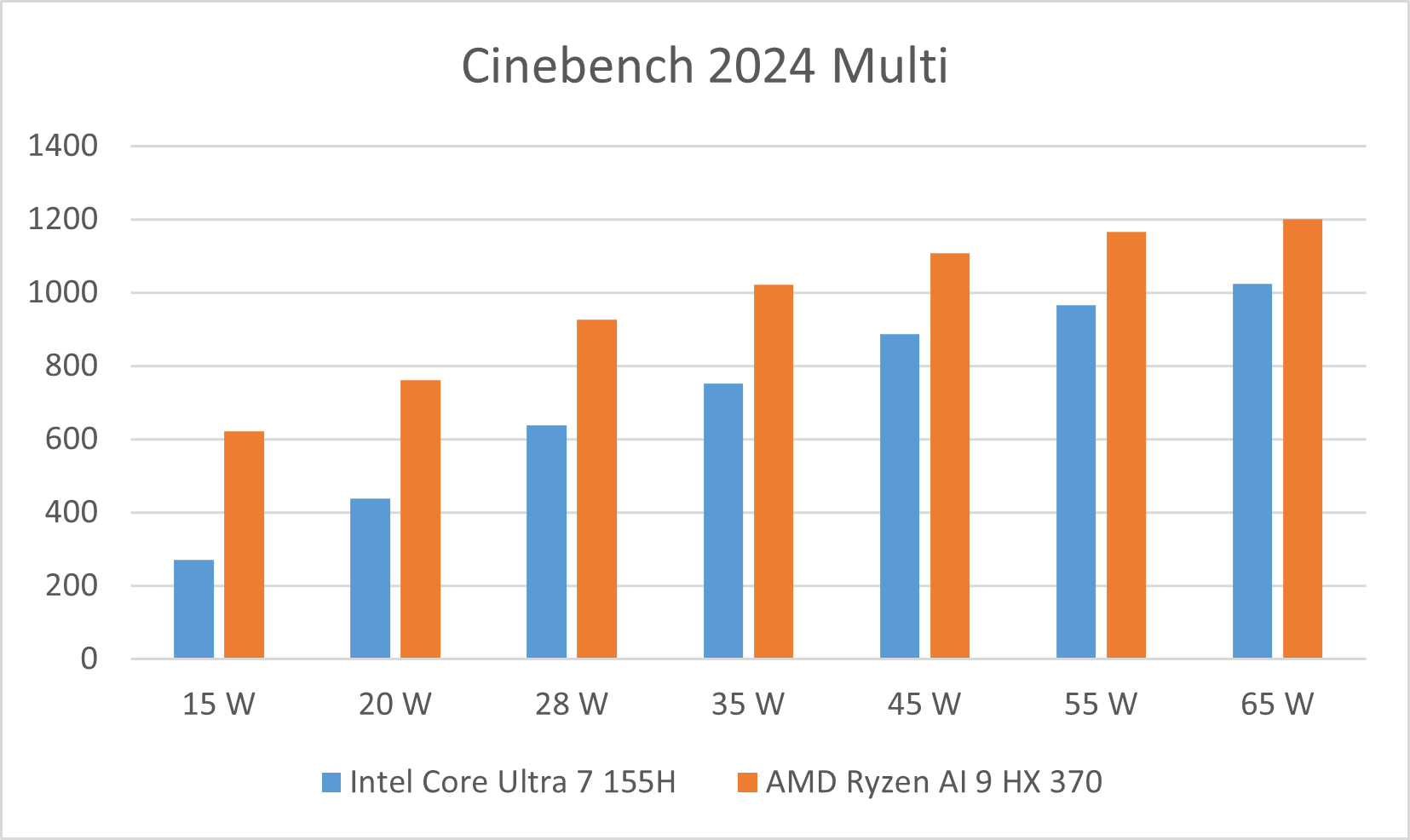
The comparison with the Intel Core Ultra 7 155H at 16-65 watts makes things even clearer, but this time in Cinebench 2024. It is extremely apparent that there is a massive gap between the two processors, and the Ryzen is in a performance class of its own. The Intel processor only became slightly more competitive from 45 watts onwards.
During our benchmark runs at various TDPs, we ran our multimeter in parallel to evaluate the Zen 5 laptops’ efficiency and compare them with other devices, which we also tested out with different performance profiles. Unsurprisingly, efficiency improved as power limits decreased. The Snapdragon X Elite in the Vivobook S 15 continued to be more efficient even at low TDPs. But it is crucial to keep in mind that the TDP values provided for the Qualcomm chips include the power usage of not just the CPU, but also the RAM and controllers.
| Power Consumption / Cinebench 2024 Multi Power Efficiency - external Monitor | |
| Qualcomm Snapdragon X Elite X1E-78-100 Vivobook S 15 OLED Snapdragon Whisper Mode 20W | 21.8 Points per Watt +114% |
| AMD Ryzen AI 9 HX 370 ProArt P16 15W TDP | 21.3 Points per Watt +109% |
| AMD Ryzen AI 9 HX 370 ProArt P16 20W TDP | 21.1 Points per Watt +107% |
| AMD Ryzen 7 8845HS VIA 14 Pro (M24) Quiet 20W | 20.5 Points per Watt +101% |
| AMD Ryzen AI 9 HX 370 Zenbook S 16 | 19.7 Points per Watt +93% |
| AMD Ryzen AI 9 HX 370 ProArt P16 28W TDP | 19.5 Points per Watt +91% |
| Qualcomm Snapdragon X Elite X1E-78-100 Vivobook S 15 OLED Snapdragon Balanced 35W | 18 Points per Watt +76% |
| AMD Ryzen AI 9 HX 370 ProArt P16 35W TDP | 17.9 Points per Watt +75% |
| Qualcomm Snapdragon X Elite X1E-78-100 Vivobook S 15 OLED Snapdragon Performance 45W | 16.6 Points per Watt +63% |
| AMD Ryzen AI 9 HX 370 ProArt P16 45W TDP | 15.7 Points per Watt +54% |
| AMD Ryzen 7 8845HS VIA 14 Pro (M24) Balanced 40W | 14.8 Points per Watt +45% |
| Intel Core Ultra 7 155H RedmiBook Pro 14 2024 35W | 14.5 Points per Watt +42% |
| Intel Core Ultra 7 155H RedmiBook Pro 14 2024 20W | 14.1 Points per Watt +38% |
| AMD Ryzen AI 9 HX 370 ProArt P16 55W TDP | 13.9 Points per Watt +36% |
| Qualcomm Snapdragon X Elite X1E-78-100 Vivobook S 15 OLED Snapdragon Max Performance 50W | 13.1 Points per Watt +28% |
| Intel Core Ultra 7 155H RedmiBook Pro 14 2024 50W | 12.7 Points per Watt +25% |
| AMD Ryzen AI 9 HX 370 ProArt P16 65W TDP | 12.3 Points per Watt +21% |
| AMD Ryzen 7 8845HS VIA 14 Pro (M24) Performance 54W | 11 Points per Watt +8% |
| AMD Ryzen AI 9 HX 370 ProArt P16 80W TDP | 10.2 Points per Watt |
| Power Consumption / Cinebench 2024 Multi Power (external Monitor) | |
| AMD Ryzen AI 9 HX 370 ProArt P16 80W TDP | 119.3 (113.6min, 113.9P1 - 121.7max) Watt * |
| AMD Ryzen AI 9 HX 370 ProArt P16 65W TDP | 97.8 (94.1min, 95.5P1 - 100max) Watt * +18% |
| Qualcomm Snapdragon X Elite X1E-78-100 Vivobook S 15 OLED Snapdragon Max Performance 50W | 86.3 (70.1min, 74.3P1 - 91.7max) Watt * +28% |
| AMD Ryzen AI 9 HX 370 ProArt P16 55W TDP | 84.1 (82min, 82.3P1 - 85max) Watt * +30% |
| AMD Ryzen 7 8845HS VIA 14 Pro (M24) Performance 54W | 82.6 (78.1min, 79.9P1 - 85.1max) Watt * +31% |
| AMD Ryzen AI 9 HX 370 ProArt P16 45W TDP | 70.6 (69.1min, 69.4P1 - 71.9max) Watt * +41% |
| Intel Core Ultra 7 155H RedmiBook Pro 14 2024 50W | 68.9 (65.4min, 66.4P1 - 74.5max) Watt * +42% |
| Qualcomm Snapdragon X Elite X1E-78-100 Vivobook S 15 OLED Snapdragon Performance 45W | 62.1 (53.4min, 56.2P1 - 86.9max) Watt * +48% |
| AMD Ryzen AI 9 HX 370 ProArt P16 35W TDP | 57 (56.1min, 56.2P1 - 57.7max) Watt * +52% |
| AMD Ryzen 7 8845HS VIA 14 Pro (M24) Balanced 40W | 56.8 (53.7min, 54P1 - 68.2max) Watt * +52% |
| Qualcomm Snapdragon X Elite X1E-78-100 Vivobook S 15 OLED Snapdragon Balanced 35W | 53 (46.4min, 47.4P1 - 84.1max) Watt * +56% |
| Intel Core Ultra 7 155H RedmiBook Pro 14 2024 35W | 52 (49min, 50.3P1 - 53.8max) Watt * +56% |
| AMD Ryzen AI 9 HX 370 ProArt P16 28W TDP | 47.6 (46.5min, 46.8P1 - 48.6max) Watt * +60% |
| AMD Ryzen AI 9 HX 370 Zenbook S 16 | 46.7 (28.4min, 29.3P1 - 55.2max) Watt * +61% |
| Qualcomm Snapdragon X Elite X1E-78-100 Vivobook S 15 OLED Snapdragon Whisper Mode 20W | 36.1 (32.6min, 33.3P1 - 79.8max) Watt * +70% |
| AMD Ryzen AI 9 HX 370 ProArt P16 20W TDP | 36 (33.9min, 34.8P1 - 37.8max) Watt * +70% |
| Intel Core Ultra 7 155H RedmiBook Pro 14 2024 20W | 31.1 (28.7min, 29.8P1 - 34.1max) Watt * +74% |
| AMD Ryzen AI 9 HX 370 ProArt P16 15W TDP | 29.2 (27.2min, 28.1P1 - 30.2max) Watt * +76% |
| AMD Ryzen 7 8845HS VIA 14 Pro (M24) Quiet 20W | 27.7 (25.7min, 26P1 - 41max) Watt * +77% |
* ... smaller is better
In a separate article, we have already extensively discussed the Ryzen AI 9 HX 370’s gaming performance with the new Radeon 890M. When paired with a dedicated Nvidia GPU, the new processor also demonstrated impressive gaming capabilities during our initial benchmarks on the Asus ProArt PX13, effortlessly handling all the games we tested except for F1 24. This particular title shows a bluescreen after launch, which AMD says is related to EA’s anti-cheat software and SecureBoot. A driver or software update is likely to be released soon to fix this issue.
Despite having a confusing naming scheme, the new AMD Zen 5 processors have enjoyed a compelling debut. Overall, the CPU section of the new Ryzen AI 9 HX 370 ends up being more impressive than the integrated Radeon 890M. The chip offers exceptional multi-core performance even at relatively low TDPs and is able to compete with far more power-hungry processors. By contrast, at high TDPs, the Ryzen can sometimes reach the performance level of Intel’s HX processors and Apple’s M3 Max chips. This is an advantage for laptop manufacturers, allowing them to make quieter devices. Of course, companies can also pare back the cooling system, especially on very thin devices, but every notebook model must be considered individually. We also saw efficiency gains as a whole, but there still seems to be untapped potential in this area. The two ProArt models, in particular, consume quite a lot of power.
The new AMD Ryzen AI 9 HX 370 with Zen 5 cores is faster and also more efficient than its predecessor, easily capable of keeping Intel’s Meteor Lake processors at bay.
The current Meteor Lake offerings don’t stand a chance against the new Zen 5 processor. Additionally, Intel is the only chip maker that still doesn’t offer any laptop-class solution for Windows Copilot+ devices. This will only change with Lunar Lake chips, which are expected to arrive in the upcoming months with considerably higher efficiency. But it remains to be seen what their overall performance is going to be like.
The Snapdragon X Elite processors continue to be competitive against the new Zen 5 processors, especially with regard to CPU performance. In particular, the ARM-based chips also have a significant edge in terms of single-core efficiency.
The situation is quite simple with the Apple CPUs. They are still ahead when it comes to both performance and efficiency. Judging by the basic Apple M4 in the latest iPad Pro, the upcoming M4 Pro and M4 Max SoCs are quite certainly going to raise the bar a whole lot higher.

I grew up with modern consumer electronics and my first computer was a Commodore C64, which encouraged my interest in building my own systems. I started working as a review editor for Notebookcheck during my dual studies at Siemens. Currently, I am mainly responsible for dealing with business laptops and mobile workstations. It’s a great experience to be able to review the latest devices and technologies and then compare them with each other.

After graduating with a bachelor’s degree in environmental engineering, I moved from Singapore to Cologne in 2014 and began pursuing a career as a freelance translator. Much of my translation work focuses on science, engineering and technology. My fascination with computers and mobile electronics began when I was young. And I have fond memories reading countless tech and gaming magazines. Working with Notebookcheck gives me the opportunity to incorporate my personal interests into my professional work.
Andreas Osthoff, 2024-07-29 (Update: 2026-02-18)