After years of trudging through forests and peering into the hidden lives of tiny creatures, the number of lifers I get should rightfully decline but 2025 proved to be remarkably defiant. This year delivered an extraordinary run of lifers — each one earned through planning, patience, persistence, luck, and lots of grit.
This post highlights my favourite images and firsts from the year, a reminder that even familiar forests can still astonish when you stay curious and keep looking closer.
In 2025, I used the same lightweight setup, relying largely on the entry-level Olympus EM10 Mark 4 and Laowa 50mm 2:1 lens.

Orb weaver spider (Araneidae)
This large male orb weaver remains a mystery in its taxonomic placement. Probably the largest male araneid that I’ve ever seen, this species is as large as a female Parawixia dehaani and can be found in a variety of morphs.

Spider egg sac (Poltys sp.)
Amber found this mysterious egg sac covered with a drizzle of pink silk. After several rounds of discussions and investigations on iNaturalist, appearing on observation of the week and with help from our friends in Japan, we finally concluded that this egg sac belonged to a Poltys! This story was covered the the Straits Times: How a mystery spider’s candyfloss-like egg sac in Singapore spun a worldwide web of connections.

Caterpillar (Ambulycini)
Classic evil caterpillar pose.

Long-horned moth (Lecithocera biferrinella)
One of my favorite group of micro moths. They usually exhibit brilliant colours!

Slug moth caterpillar (Limacodinae)
Dazzling ember-coloured slug moth caterpillar. These should be painful to the touch. Accidentally brushed against one before and wouldn’t try again!

Huntsman spider (Heteropoda borneensis)
The “big-orange” huntsman now has a name – Heteropoda borneensis.

Broad-headed bark spider (Caerostris sp.)
We found this pair in the same area, but not on the same web. The male still mounted the female anyway, but this does not imply that they are conspecific.

Big-jawed spider (Leucauge fastigata)
Leucauge fastigata is a really common species, but I’ve always wanted to take close-ups of the stiff hairs on the chelicerae of the male.

Planthopper nymph (Fulgoridae)
This planthopper nymph has an interesting upward arch on its apical process.

Jumping spider (Pancorius dentichelis)
A fragile moment as this jumping spider is in the final stages of squeezing itself out of its old exoskeleton.

Crab spider (cf. Thomisus sp.)
I’ve only ever seen this species once many years ago. It has been provisionally placed under Thomisus but does not fit very well into this genus.

Crab spider (Epidius sp.)
I rarely see Epidius in Singapore so this was quite a surprising find!

Cicada (Chremistica sp.)
I rekindled my UVIVF project (ultraviolet-induced visible fluorescence) by modifying some of my flashes for UV-induced fluorescence photography. This method allows me to use a high shutter speed, takes much less time to get my shots, and allows for handheld stacking. I will probably do a video and/or blog post about this soon. Meanwhile, feel free to comment if you have questions on this.

Land snail (Amphidromus sp.)
Another example of UV fluorescence using my modified flash. This is the first time I’m seeing ultraviolet fluorescence on a snail!

Moth-like planthopper (Ricaniidae)
The wings of freshly moulted insects fluoresce under ultraviolet as well!

Crab spiderlings (Thomisidae)
With some experimentation, I realised that I could expose the spiderlings hidden under a sheet of silk using ultraviolet as well.

Harvestman (Beloniscus albiephippiatus)
Tack sharp ultraviolet fluorescence shots are so much easier to achieve now!

Black-femur tarantula (Selenocosmia sp.)
On one of our night hikes, this big black tarantula was just hanging out, chilling under the moonlight.

Bee fly (Systropus sp.)
This bee fly has exceptionally long hind legs that dangle while in flight, much like robber flies from the subfamily Leptogastrinae.

Planthopper (Lophopini)
I really like the colours on this lophopid planthopper. Check out the Fulgoromorpha Checklist: Planthoppers.

Tortoise beetle (Rhacocassis sp.)
Tortoise beetles are always part of the highlights of my trips. Always excited to add lifers to Cassidinae Checklist: Tortoise Beetles.

Treehopper (Pyrgauchenia cf. colorata)
I revisited Gunung Trusmadi this year, and found new trails to visit. Found lots of these cool looking treehoppers. Do check out Membracidae Checklist: Treehoppers.

Jumping spider (Hyllus sp.)
The Hyllus at Trusmadi are huge, and wouldn’t hesitate to take down larger huntsmen spiders.

Rolled-leaf orb weaver (Poltys cf. idae)
The rolled-leaf orb weaver had been on my wish list for many years, having only seen a juvenile the year before. This was a lucky find as it wove its orb web across a mountain path and our vehicle ran into it. We didn’t stop in time to photograph it on its web, but thanks to Alvin who spotted it, we still managed a few memorable shots!

Jellybean bird dung spider (Pasilobus sp.)
Cham found a jellybean-like spider that actually belongs to the genus Pasilobus, which typically represents the bird dung spiders. Such a stark difference! Super happy to add this to the Araneidae Checklist: Orb Weaver Spiders.

Huntsman spider (Gnathopalystes sp.)
We saw this large Gnathopalystes from a distance and was pleasantly surprised to see the blue that turned up on our camera screens!

“Jabba the Hutt” Snail-mimicking orb weaver (Cyrtarachne sp.)
Cham also found this snail-mimicking orb weaver and nicknamed it “Jabba the Hutt”.

Dragon mantis (Paratoxodera meggitti)
We were disappointed that we didn’t see any dragon mantises last year, but it was made up with 2 species this year!

Dragon mantis (Toxodera fimbriata)
The dragon mantis is also called the “Feather Mantis” for its svelte body and ultra-thin legs.

Orchid mantis (Hymenopus coronatus)
We met a family from Korea who shared this adult orchid mantis with us.

Rhino beetle (Trichogomphus simson)
This rhinoceros beetle is yet another lifer – such awesome creatures!

Stag beetle (Hexarthrius mandibularis)
Ah Gui kindly shared this male Hexarthrius mandibularis that has long, curved, antler-like mandibles.

Darkling beetle (Stenochiini)
This darkling beetle had interesting cyan patches.

Shining leaf chafer beetle (Ceroplophana malaysiana ssp. nobuyukii)
Such an interesting find! This resembles many of the classical beetle cartoon drawings from Japan.

Stag beetle (Odontolabis brookeana)
Some mandibles are thick and chonky. I realised that I had quite a few species of stag beetles after this trip, and published the Lucanidae Checklist: Stag Beetles.

Velvet ant-mimicking checkered beetle (Strotocera grandis)
I was quite excited to see this checkered beetle that mimics a velvet ant.

Tiger beetle larva (Cicindelidae)
Somehow, there were many tiger beetle larvae along the mud wall this year. We didn’t see any at all last year.

Long-neck longhorn beetle (Cylindrepomus sp.)
Hands down the longest neck on a longhorn beetle so far. The head and thorax are longer than its abdomen!

Longhorn beetle (Glenea itzingeri)
Most species of Glenea have pretty patterns and this was no exception.

Comb-footed spider (Meotipa sp.)
After Gunung Trusmadi, we adjourned to Gunung Alab to meet up with our macro-photography friends from Sabah – Alen, Simon and his son.

Huntsman spider (Heteropoda lunula)
I brought my daughters out to the mangrove at night to photograph the “big purple spiders” as I wanted to get better shots of the male. We were not disappointed!

Jumping spider (Rhene sp.)
Vincent found this panda-like Rhene from Panti Forest. We do have another similar Rhene in Singapore. Got to check if it is indeed different. View the Salticidae Checklist: Jumping Spiders.

Blue mangrove viper (Trimeresurus purpureomaculatus)
Laowa kindly loaned their new Laowa 15mm 1:2 wide angle macro lens, but I was too busy to do enough testing for a review. Incidentally, the blue mangrove pit viper was sighted recently and I was lucky to get some test shots. Thanks to Marcus for this!

Comb-footed spider (Dipoenura sp.)
We found a few individuals of this species at Fraser’s Hill, which looked like a derpy face. Some of the guys had a Cantonese name for this that sounded much more vulgar. IYKYK. Check out Theridiidae Checklist: Comb-Footed Spiders.

Mite (Penthaleus sp.)
I saw 2 of these tiny mites, but they just refused to stand still!

Siamese peninsular pitviper (Trimeresurus sabahi ssp. fucatus)
The Penang herping group was at Fraser’s Hill as well, and shared some of their finds.

Bird dung crab spider (Phrynarachne decipiens)
Thanks to Ayim for sharing this white bird dung crab spider!

Bent-toed gecko (Cyrtodactylus australotitiwangsaensis)
Pretty little gecko at MCM Nature Discovery Villa. This is without doubt the best place to stay in Fraser’s Hill for nature lovers, and especially so for invertebrate enthusiasts as their owner Stephen would have light traps running at the villa every night.

Giant armored spider (Perania sp.)
We’d normally find Perania in the same habitat as Liphistius and it was no exception at Fraser’s Hill. The males have a weird anterior process that most of us call the “nose”.

Jungle nymph stick insect (Heteropteryx dilatata)
Wei found this large jungle nymph, which was a perfect candidate for wide angle shots. Note: Do not let her climb on your arms. The claws are SHARP!

Leafhopper (Gununga jacobsoni)
One of the prettier leafhoppers from Fraser’s Hill. Check out the Cicadellidae Checklist: Leafhoppers

Flying frog (Rhacophorus bipunctatus)
I don’t usually take much pictures of frogs, but this was posing so nicely~

Treehopper (Pyrgauchenia tristaniopsis)
There were a few species of treehoppers along some of the roads, and we chanced upon some of them while waiting for everyone to come out from the trails.

Orb weaver spider (Araneidae)
This was my favourite find from Fraser’s Hill, thanks to James! A year ago, James found the female and we thought that it should be a Phoroncidia. It resembled P. altiventris but this species should have been in the family Araneidae as it was spotted in Japan with orb webs. We still don’t know the species, but it is just provisionally placed under Phoroncidia or Araneidae.

Treehopper (Ebhul varius)
Before we left Fraser’s Hill, we stopped by some of the trees on the roadside for more treehoppers!

Ant-mimic Jumping spider (Emertonius cf. exasperans)
This beautiful jumping spider appears to be seasonal. Thanks to Melvyn, we were lucky to see it while it was in season!

Ant-mimic Jumping spider (Emertonius cf. exasperans)
Here’s the male of the above species.

Comb-footed spider (Janula sp.)
Caught a rare sight of these tiny little comb-footed spiders mating. See if you can spot the swollen pedipalp of the male being inserted into the female’s epigyne.

Singapore Blue Tarantula (Omothymus violaceopes)
This was a captive individual in Malaysia. I managed to document some shots of the beautiful blue feet pads.

Singapore Blue Tarantula “Paw” (Omothymus violaceopes)
The claw tufts on its feet were particularly captivating!

Red velvet mite (Trombidiidae)
Super cute red velvet mite guarding over an ootheca.

Tortoise beetle (Notosacantha sp.)
This Notosacantha from Panti Forest looked slightly different from the usual one that we saw in Singapore.

Big-jawed spider (Leucauge sarawakensis)
Our main target in Panti Forest was this red and blue Leucauge sarawakensis (previously Opadometa sarawakensis). We did see several individuals, but it was also really easy for the web to get destroyed with us walking around carelessly.

Spiders of Southeast Asia – Turning Fear to Fascination Through Macro Photography
I was in the organising committee of the 9th Asian Conference of Arachnology last month in Vang Vieng, Laos. Peter Jäger asked if I could also present a public talk, and I chose to focus on Southeast Asian Spiders, and how macro photography bridges the fear of spiders towards fascination. Despite designing the talk for the general public, 99% of the attendees were arachnologists and it was a different level of appreciation for what I presented.
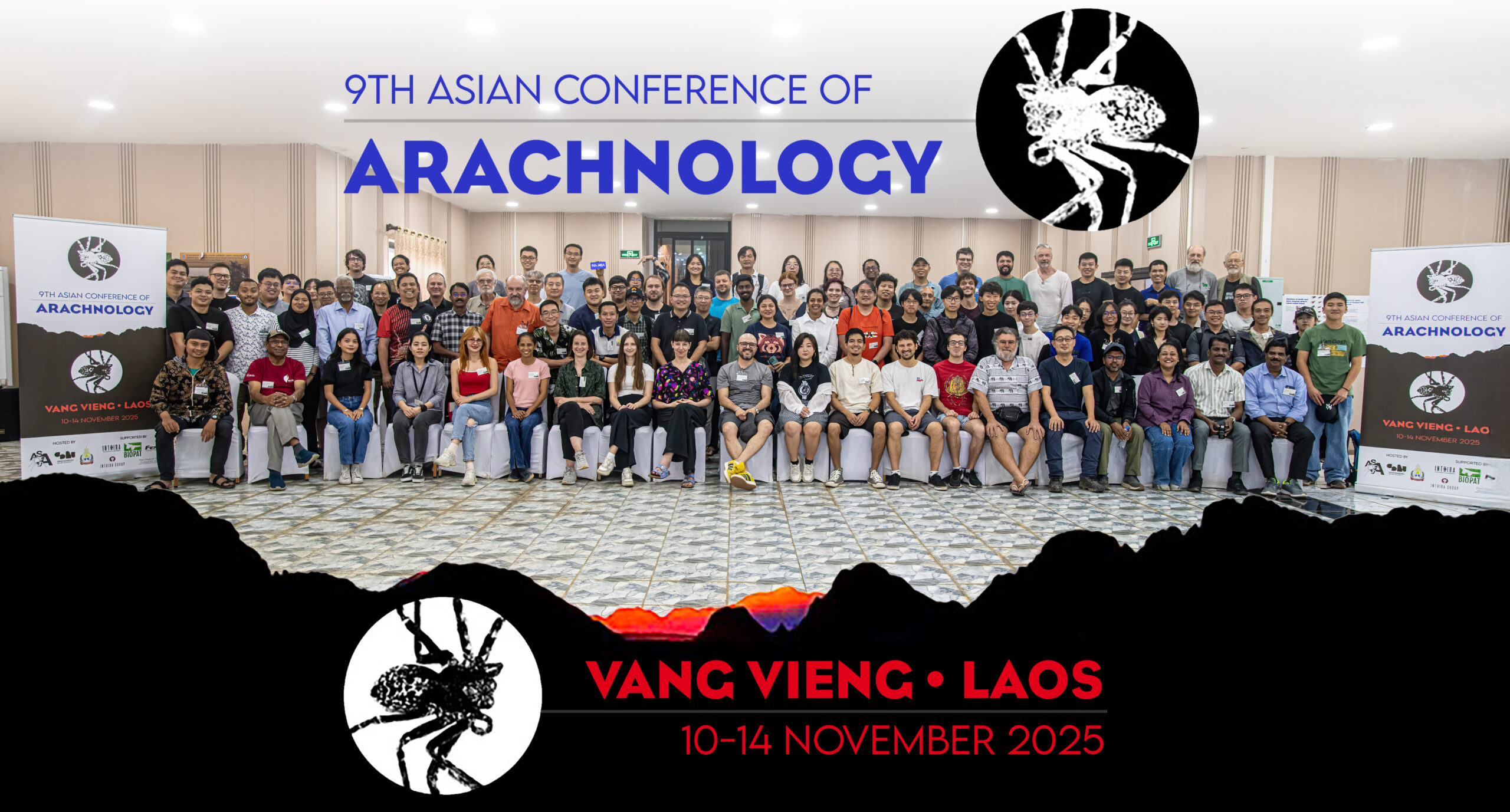
9th Asian Conference of Arachnology, Laos
At the 9th Asian Conference of Arachnology, I met many arachnologists whom I’ve only communicated with via email over the years. Really nice to finally put faces to the names and go out to the field together.

Sac fungus (Cordycipitaceae)
First time seeing so many fungus outgrowths on a robber fly.

Weevil (Peribleptus sp.)
This weevil appeared to be dead and covered with fungus, but it was very much alive and we saw many more of them!

Wolf spider (Lycosidae)
We saw quite a few of these large wolf spiders on the dry river bed.

Woodlouse (Armadillidae)
One of the few isopods that I saw on the cave walls of Laos.

Blind Huntsman Spider (Sinopoda caeca)
My top targets in Laos were the blind spiders. This is an adult female Sinopoda caeca, found in the caves of Vang Vieng, Laos. It is pale, almost beige, and either has reduced eyes or is completely devoid of eyes. This is due to the process of regressive evolution. In an environment without light, vision provides no advantage in finding prey or avoiding predators. The loss of their eyes means that energy and resources once used for eyes are instead allocated to other traits. The legs exhibit structural colours as they appear blue when light is incident at certain angles. Check the full dorsal view and see if you notice the blue.

Blind Guardstone Spider (Otacilia tham)
Thanks to Peter Jäger, I was able to photograph some blind guardstone spiders as well. These were really tiny and almost impossible to spot. It was only possible to find them using Peter’s “scientific blowjobs”. Blow gently on the cave walls and look for them running around!

Feather-legged Assassin Bug (Ptilocerus sp.)
Paul found this feather-legged assassin bug, really hairy legs they have! It is a little obscure, but I have a small Reduviidae Checklist: Assassin Bugs.

Rolled-leaf orb weaver spider (Poltys cf. idae)
This juvenile rolled-leaf orb weaver had a different abdominal pattern from the adult that we saw in Sabah. Just wished that we could have seen the adult. Thanks to Matjaž Kuntner for the find!

Huntsman spider (Thelcticopis sp.)
We saw a few of these very handsome Thelcticopis. Check out the Sparassidae Checklist: Huntsman Spiders.

Crab spider (cf. Angaeus sp.)
Zoe found this intriguing crab spider. It looks close to Angaeus but not quite. Look at the weird details on the dorsal view. Glad to add new records to Thomisidae Checklist: Crab Spiders.

Albino scorpion (Scorpiops sp.)
Angelique was very excited with the scorpions on the cave walls and found an albinistic individual! Really cool that the tips of the claws remained dark.

Midget ground weaver (Speocera sp.)
This really tiny mother was carrying some eggs that hatched recently.

Long-legged red velvet mite (Erythraeidae)
Some of the cave mites were really cool too!

Tarantula (Chilobrachys sp.)
There were visible traces of trash in the touristic caves, and we found a tarantula making a home under a disposed plastic cup.

Ray spider (Wendilgarda sp.)
Several years ago, Darko told us that Wendilgarda should be everywhere. They are found at the edges of freshwater streams, often with some vegetation to block the flow of water. They build a unique web structure where each strand of silk is anchored onto the water surface. When a prey is captured, the web is destroyed but it rebuilds everything in just a few minutes! Thanks to Suzuki Yuya for finding these for us!
I also shared on BlueSky that my 9 year-old daughter actually knew about Wendilgarda and its hunting techniques before I did, through an excellent science comic Spiders: Worldwide Webs.

Ant-loving Beetle (Tmesiphorini)
At Kyaeng Nyui Waterfall, I found a few of these little ant-loving beetles behind tree bark.

Trilobite Beetle (Platerodrilus sp.)
We were surprised to find this charming trilobite beetle outside one of the caves. Really happy to add another species to Platerodrilus Checklist: Trilobite Beetles!

Tiger Marshmallow Orbweaver (Acusilas malaccensis)
Just next to the trilobite beetle, this Tiger Marshmallow Orb Weaver was busy tending to her babies.

Spiky Leaf-rolling Weevil (Hoplapoderus sp.)
Not the first time seeing this awesome spiky weevil, but still super excited to spot it!

Harvestmen (Systenocentrus sp.)
The line of dorsal spikes caught my eye. Unfortunately, this harvestman suffered a lot of injuries — even the eyes were destroyed.

Pill Millipede (Hyleoglomeris sp.)
In the caves, I thought that I had found a blind armadillid, but it turned out to be a colourless pill millipede. Still a cool find!

Harvestman (Assamiidae)
At Interpark, there were a few of these large assammids on the cave walls. It was my first time seeing assamiids of this size. Note the row of tubercles along its anterior margin! Check out Opiliones Checklist: Harvestmen.

Water Penny Beetle (Schinostethus sp.)
At the entrance of Interpark, Sean pointed out this very cool water penny beetle with its fanned antennae.

Orb weaver spider (Cyrtarachne sp.)
During one of our night hikes, Yuya spotted this lovely Cyrtarachne on its web.

Bolas spider (Ordgarius sexspinosus)
Our friends from Korea ventured to the streams off Nam Song River, and found a huge Ordgarius sexspinosus. Good chance for me to test my UV flash setup!

Longhorn beetle (Aristobia cf. approximator)
Paul spotted this longhorn beetle with fluffy pompom brushes on its antennae.

Sunburst candy spider (Cyrtarachninae)
My favourite surprise find of the year thanks to Adrian, and to Natapot for facilitating everything! I had my doubts that this was real when I first saw photos of this spider many years ago. These doubts would undeniably surface amongst others with the onslaught of AI-generated creatures popping up on social media. This forced me to declare that the photos of this spider are not AI-generated. Earlier this year, I highlighted how AI was used to steal photographs from nature photographers.
On iNaturalist, this spider is often labeled as Pasilobus. There are doubts on this genus placement, so I’m leaving it at the subfamily Cyrtarachninae for now, and nicknaming it the Sunburst Candy Spider.

Qilin Isopod (Armadillidae)
An unexpected species to cap off the year, this isopod is from Northern Vietnam but photographed in captivity. This is one of the very few hairy isopods out there — the hairs appear to be able to attach particles from mould to give it this fuzzy appearance. The mancae (babies) on the other hand, have just a faint layer of such particles on the edges. They seem to be in the early stages of collecting the mould particles. Promptly added to Isopoda Checklist: Pillbugs & Sowbugs and Isopod.Site.
With nearly a hundred images in this post, one thing is clear: the forests are nowhere near done revealing themselves. 2026 is going to shape up to push my lifer list up with new habitats, ambitious trips, and fresh opportunities to meet the unseen. My lenses stay ready (but not my back nor wrist), and the best surprises are still ahead!