The work developing and improving quantum processors continues to accelerate as companies big and small push to reach the point of fault-tolerant quantum systems. We have written about a number of the advancements, such as breakthroughs over the past year or more by Google, Microsoft, and Amazon Web Services to create quantum chips that can address the issue of error correction, a significant hurdle that needs to be cleared before commercial, fault-tolerant quantum systems can become a reality.
More recent efforts have been undertaken in quantum processor development. A group of scientists at the International Quantum Academy in Shenzhen, China, this week published a paper in Nature Nanotechnology unveiling a superconductor-based quantum chip to address such issues as errors from “environmental noise” like noise, light, and movement – which can lead to errors – as well as the amount of resources needed when managing and encoding logical qubits. The scientists addressed this by using dual-rail encoding that uses two physical superconducting qubits to create a single logical qubit.
In a paper earlier this month published in Nature Electronics, SEEQC showed how digital superconducting digital control circuits can reliably integrate with quantum chips at millikelvin temperatures, a step forward in addressing the challenge of scaling superconducting quantum architectures.
Scientists with Bangledash, India-based QpiA this week said they created a scalable error correction system – a decoder – that uses a rotated surface code architecture to allow for fast and scalable error correction. It can operate in real time next to superconducting qubits and is another step on the way to fault-tolerant quantum systems, according to the company.
The Challenge Of Simulating Quantum Materials
However, while quantum chip development is going at a rapid pace, a question has been whether today’s quantum processors and their relatively limited number of qubits can realistically simulate quantum materials, a key goal in quantum computing that will drive the ability to do what proponents say such systems need to do. This includes simulating the structures of molecules, proteins, and catalysts for drug discovery, the behavior of materials for better superconductors, and even their own error correction codes to maintain qubit coherence – the ability to keep a fixed phase relationship – in noisy environments.
To do that, they need to understand quantum behavior, something that can’t always be done using classical computing methods.
A group of scientists from IBM, the US Department of Energy-funded Quantum Science Center at Oak Ridge National Laboratory, Purdue University, the University of Illinois at Urbana-Champaign, Los Alamos National Laboratory, and the University of Tennessee showed that a superconducting 50-qubit IBM Heron r2 quantum processor can simulate real magnetic materials that match the results of experiments run on classical computers.

They wrote in a 49-page preprint paper on arXiv that this means that quantum hardware available now, used with new algorithms and quantum-centric supercomputing workloads, can simulate the properties of materials, putting them on the path to being useful tools for scientific discovery.
Advances in methods used by classical computers has allowed them to accurately predict properties of quantum materials, the scientists wrote, but that “strongly correlated systems with long-range entanglement and complex dynamics remain beyond the reach of these approaches. Quantum computers offer a potential alternative to addressing this.”
That’s because quantum systems align with the physical rules of such materials, making them a natural fit for simulating quantum systems. It’s something that physicist Richard Feynman proffered years ago.
However, while in quantum computing, the growing numbers of qubits and improve gate fidelity have led to studies of static and dynamical properties of many-body systems at scales beyond what classical systems can do, the feeling has been that today’s quantum systems don’t have the necessary capabilities – such as circuit depths and error rates – to simulate such realistic materials, they wrote.
“It has therefore been unclear whether current, pre-fault tolerant quantum computers can ever perform quantitatively reliable many-body simulations of quantum materials that can be closely compared with laboratory measurements,” the scientists wrote.
Running The Test
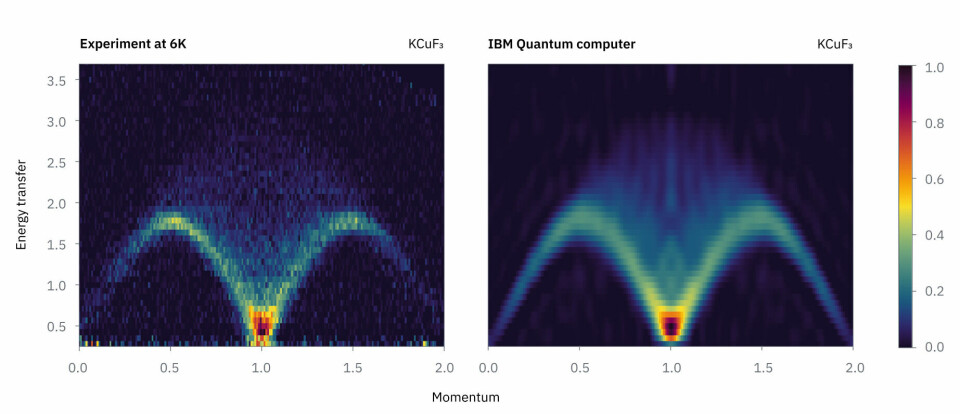
For the experiment, they targeted a sample of KCuF₃, a magnetic compound whose measurements had been captured through neutron scatting experiments to show the internal behavior of materials. Neutron scattering works, but it’s difficult to compute classically, according to the scientists.
The work was run on the Heron processor, with the experimental data gathered from neutron sources at the Spallation Neutron Source at Oak Ridge (shown in the feature image at the top of this story) and the UK’s Rutherford Appleton Laboratory. To reduce the circuit depth of the quantum circuits, the scientists also used a noise-robust algorithm and classical computing resources at the Illinois Campus Cluster.
The simulation of the KCuF₃ sample run on the IBM quantum system (on the right, below) matched the results of the neutron scattering experiments (left).
It falls in line with what IBM and other quantum vendors see as the likely scenario of quantum computers working with classical HPC systems in a hybrid-computing fashion, with the quantum systems taking on workloads and equations that are beyond the reach of their classical brethren.
The plan for the researchers moving forward is to use this type of simulation with quantum materials that are more dimensioned and more complex than KCuF₃.
The scientists wrote that their work demonstrates that “quantum simulation of real materials on pre-fault-tolerant, programmable quantum hardware is no longer an elusive goal. ... These quantum simulations faithfully capture key emergent quantum phenomena observed in real materials, including the two-spinon continuum and the manner in which anisotropy and realistic next-nearest-neighbor couplings reshape this continuum. Together, these results establish that quantum computers are moving beyond proof-of-principle testbeds and are beginning to function as practical scientific tools for the study of quantum materials.”
A Roadmap For Hybrid ModSim And Quantum Systems
It also gives quantum computing vendors a roadmap for assessing quantum simulations in increasingly complex settings. There eventually will be a time in which quantum simulation shifts from a benchmarking practice to a key tool for “condensed-matter physics,” allowing scientists to use quantum devices to delve into areas that are beyond the reach of classical simulation, they wrote.
“Looking ahead, as quantum devices scale to larger lattices, support longer time evolutions, and address generic two-dimensional non-integrable models, this framework positions quantum simulation as an engine for constructing comprehensive equilibrium descriptions of quantum materials,” the scientists wrote.
The quantum simulation work is the latest in a string of quantum-related announcements by IBM this month. The vendor joined with The University of Manchester, Oxford University, ETH Zurich, EPFL and the University of Regensburg to create a half-Möbius electronic topology in a single molecule – something never seen before – and then used an IBM quantum system to determine why it worked, a job that would be difficult for classical computers.
Earlier this week, IBM announced that in research run with the Cleveland Clinic, they used a Heron quantum chip and a quantum-centric supercomputing workflow to simulate the electronic structure of a protein.