NASA is monitoring a plane-sized asteroid that’s heading towards Earth at around 20,000 miles per hour, according to the Center for Near Earth Object Studies (CNEOS).
Measuring around 230 feet in diameter, the space rock known as “2025 YH6” is expected to come as close as within 1.26 million miles from the Earth on Tuesday, according to NASA’s Jet Propulsion Laboratory (JPL).
2025 YH6 is among several other asteroids being monitored by NASA this week, including three other plane-sized ones. One of the smaller plane-sized asteroids called “2025 YK6,” measuring around 73 feet in diameter, is forecast to make its closest approach on Monday at about 3.23 million miles from the Earth, hurtling towards our planet at nearly 35,000 miles per hour, according to the CNEOS.
Two plane-sized asteroids, “2025 YZ4” and “2025 YQ5,” are also due to make their closest approaches on Tuesday, coming as close as within 1.86 million miles and 3.39 million miles, respectively, from the Earth, according to the JPL.
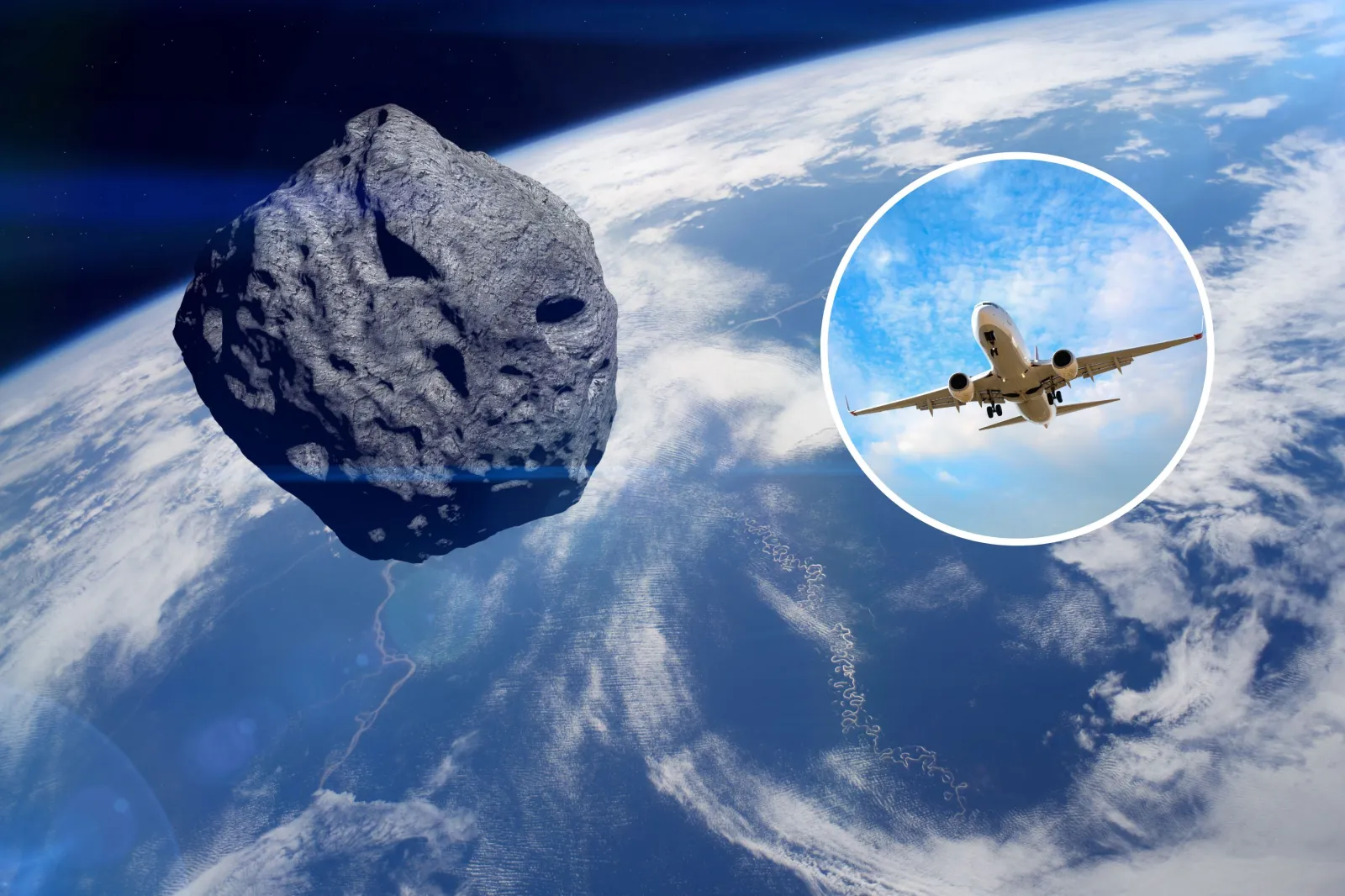
Asteroids are small, rocky masses left over from the formation of the solar system about 4.6 billion years ago. They are found concentrated in the main asteroid belt, which lies around the sun between the orbits of Mars and Jupiter.
The so-called "near-Earth objects" are asteroids, of which the orbits bring them within 120 million miles of the sun and into the Earth’s “orbital neighborhood.”
Earlier this year in February, data from the CNEOS found that the impact probability of an asteroid known as “2024 YR4” in 2032 was at 3.1 percent, which was “the highest impact probability NASA has ever recorded for an object of this size or larger,” the space agency said at the time.
Further studies showed that “the object poses no significant impact risk to Earth in 2032 and beyond,” the space agency noted.
The NASA said: “Asteroid 2024 YR4 is now too far away to observe with either space or ground-based telescopes. NASA expects to make further observations when the asteroid’s orbit around the Sun brings it back into the vicinity of Earth in 2028.”
“The majority of near-Earth objects have orbits that don’t bring them very close to Earth, and therefore pose no risk of impact,” according to NASA.
However, a small portion of them, known as potentially hazardous asteroids (PHAs), do require closer monitoring. Measuring more than 460 feet in size, PHAs have orbits that bring them within 4.6 million miles of the Earth’s orbit around the sun, the space agency says.
Despite the number of PHAs out in our solar system, none are likely to hit our planet any time soon.
"The 'potentially hazardous' designation simply means over many centuries and millennia the asteroid's orbit may evolve into one that has a chance of impacting Earth. We do not assess these long-term, many-century possibilities of impact," Paul Chodas, manager of the CNEOS, previously told Newsweek.
Do you have a tip on a science story that Newsweek should be covering? Do you have a question about asteroids? Let us know via science@newsweek.com.