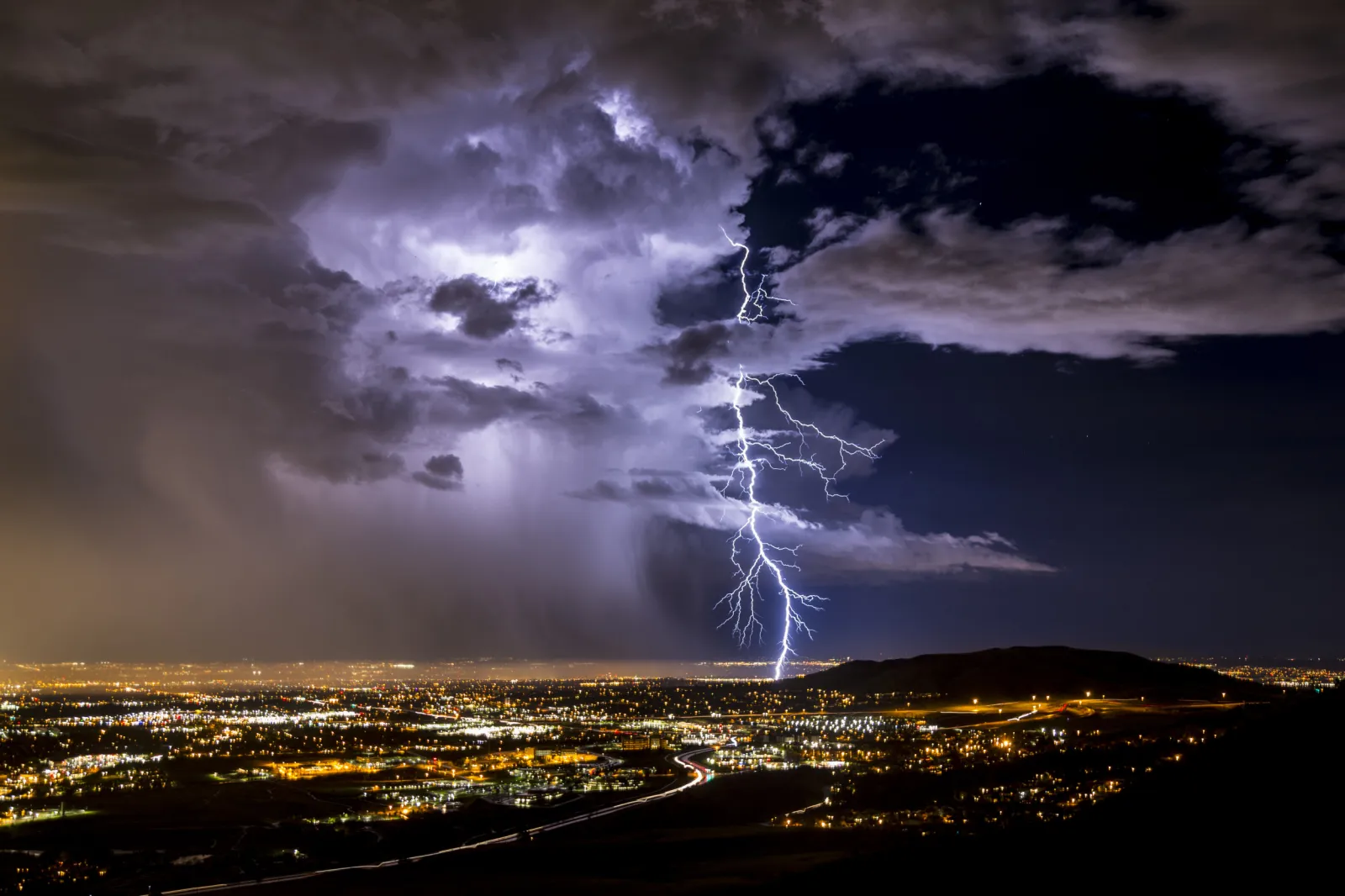
Scientists have revealed a hidden trigger of lightning that could resolve a centuries-old weather mystery.
Earth is struck by some 44 bolts of lightning each second, on average. Despite this, physicists have long been unsure exactly how most flashes get started.
It is well-established that lightning occurs after clouds build up—and then dramatically release—electrical energy. But a puzzle lies in how clouds' electric fields that are simply too weak to overcome the insulating properties or air can they cause the "initial breakdown event," which sparks off a powerful discharge.
In a new study, researchers from the Los Alamos National Laboratory in New Mexico argue that this spark is often provided by cosmic ray showers.
These are cascades of subatomic particles and ionized nuclei produced in the Earth's atmosphere by high-energy particles ("cosmic rays") from both our sun and violent events like supernova explosions in our Milky Way and even beyond.
In their study, the researchers set out to investigate the earliest moments of lightning discharge using a specially built "radio interferometer"—an array of antennas (eight, in this case) that each measure the radio waves released by lightning.
By comparing the data from each antenna, the team was able to reconstruct a three-dimensional image of the lightning, mapping out the path of the bolts.
The researchers imaged out more than 300 lightning bolts during a 90-minute storm that passed over the Los Alamos-based interferometer on July 30, 2022.
The team found that some of the lightning strikes began with a positive fast discharge, rapidly followed by a larger and faster negative discharge. Moreover, the signals of each of the initial discharges were found to be polarized both at different directions to each other, and to the direction in which the discharges spread through the sky.
This, the researchers explain in their paper, shows "that the initiating fast discharges were not solely driven by the storm electric field."
"We analyzed these observations with a cosmic ray shower (CRS) and found that these seemingly strange features can be consistently explained," they added.
"A CRS provides an ionized path in the cloud that directs and enables the fast propagation of the discharges.
"The shower's high-energy positrons and electrons are deflected differently in the electric field and they respectively affect the two opposite discharges, explaining the polarization rotation between the two discharges."
This trigger, they added, can also explain the more common cases in which there is only an initial positive discharge—and therefore can clarify how most lightning bolts begin.
Further experiment and model-based studies will be needed to refine our understanding of this lightning trigger phenomenon, the researchers note.
"To directly relate lightning initiation with CRS, it is necessary to detect the CRS on the ground with an array of particle detectors—and to correlate the detected CRS time and direction with the lightning initiation," the researchers wrote.
The difficulty with this, they explain, is that while lightning radio frequency signals can be mapped using ground sensors from any direction, the cosmic rays cannot.
Instead, they could come from random directions into the cloud and easily land outside of any detection array placed on the ground, making correlated observation challenging.
"To directly confirm CRS lightning initiation with such a setup, a long-term correlated observation is necessary and a careful statistical analysis of the correlation probability is needed."
Do you have a tip on a science story that Newsweek should be covering? Do you have a question about lightning? Let us know via science@newsweek.com.
Reference
Shao, X.-M., Jensen, D. P., Ho, C., Caffrey, M. P., Raby, E. Y., Graham, P. S., Haynes, W. B., & Blaine, W. G. (2025). 3D Radio Frequency Mapping and Polarization Observations Show Lightning Flashes Were Ignited by Cosmic‐Ray Showers. JGR Atmospheres. https://doi.org/10.1029/2024JD042549