A U.S. Department of Energy webpage advising Americans to keep indoor temperatures between 75 and 78 degrees Fahrenheit during summer days appears to have been removed, days after New York City Mayor Zohran Mamdani urged residents to adopt a similar thermostat setting to help reduce strain on the city's power grid.
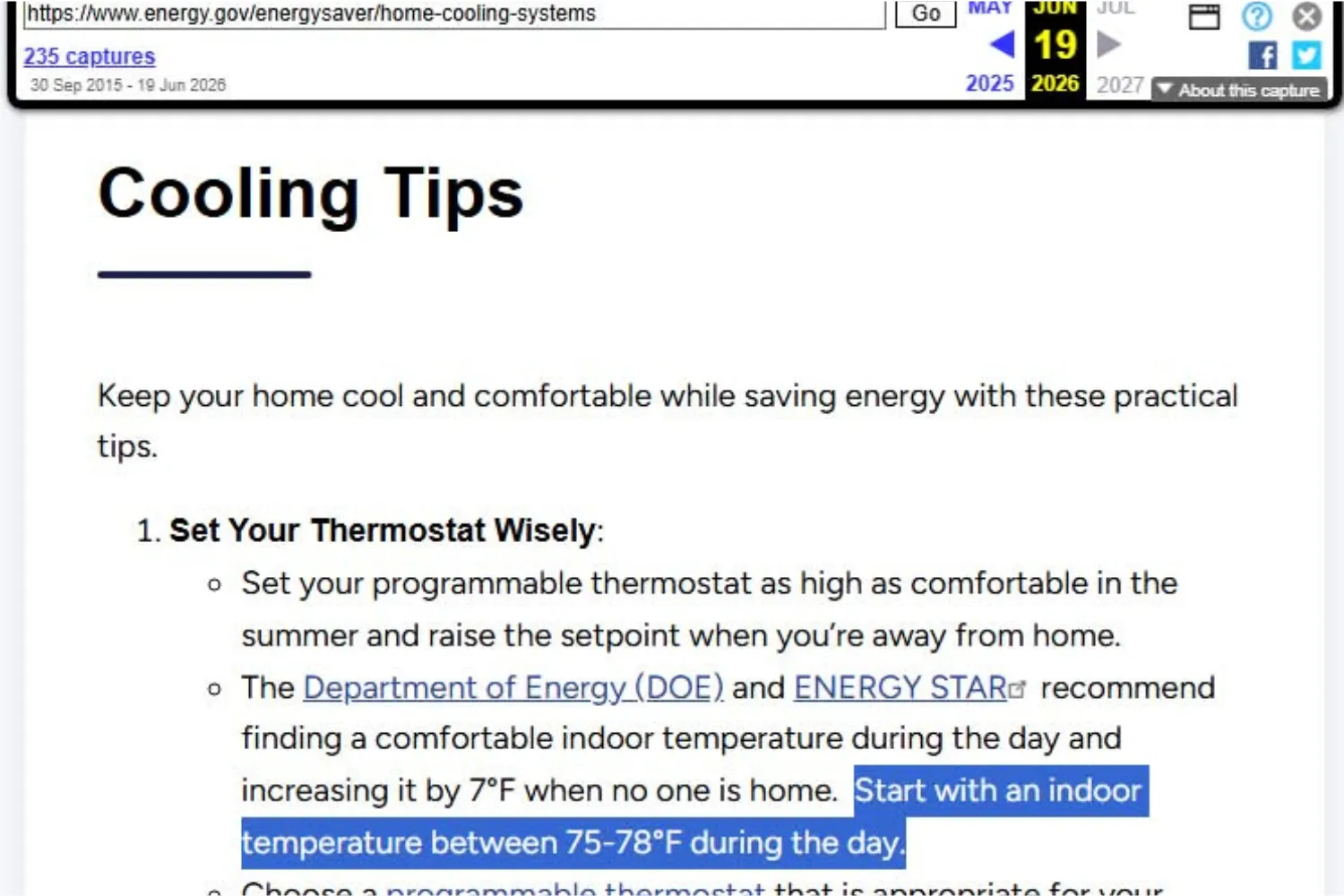
Archived versions of the Department of Energy's "Home Cooling Systems" page show the agency recommending that homeowners "start with an indoor temperature between 75-78°F during the day" as part of broader energy-saving advice. Captures of the page indicate that it remained accessible through at least late June and early July. At the time of writing, the webpage returns a "Page not found" message.
Newsweek has contacted the Department of Energy for comment on whether the page was intentionally removed, relocated elsewhere on its website, or updated as part of a broader review.
What the Missing DOE Page Said
The page formed part of the department's Energy Saver consumer guidance and offered tips for reducing energy use while keeping homes comfortable during hot weather.
According to archived copies, the agency advised homeowners to set thermostats "as high as comfortable" during summer months and increase the temperature further when nobody was at home.
"The Department of Energy (DOE) and ENERGY STAR recommend finding a comfortable indoor temperature during the day and increasing it by 7°F when no one is home. Start with an indoor temperature between 75-78°F during the day,” the site read.
The recommendation appeared alongside other energy-efficiency measures including weatherization, window coverings, air conditioner maintenance and the use of programmable thermostats.
Why the Timing Is Drawing Attention
The page's disappearance has attracted attention because it came shortly after Mamdani encouraged New Yorkers to set air conditioners to 78 degrees as the NWS warned that a "significant and dangerous heat wave" was affecting large parts of the country.
"New York: it's hot out there, and the power grid is working overtime to keep us cool. Set your AC to 78 degrees, turn off lights/electronics you're not using, and unplug what you can," Mamdani said in a statement, adding: "Our City is doing its part too: maintaining the 78 degrees rule in our buildings, dimming/turning off our lights during peak electricity demand, asking private partners to do the same, and powering down non-essential equipment. A stable grid means the AC stays on, and lives are saved. Let's ease demand—and get through the heat—together."
The recommendation quickly became a flashpoint as conservative lawmakers mocked Mamdani’s recommendation as “socialism” or “communism.”
Kentucky Sen. Rand Paul wrote on X: “Proof that communism is (unfortunately) alive and well.” Florida Sen. Rick Scott said, “This is Communism at work,” while Sen. Lindsey Graham of South Carolina wrote on X: “Socialist Democrats are coming for your AC. This is the future that WOKE Democrats want not just for NYC but for South Carolina too!”
Florida Gov. Ron DeSantis also weighed in, writing: “Is this what was meant by the warmth of collectivism?”
Sen. Ted Cruz of Texas responded to Mamdani on X, writing: “In a first-world country, you could turn on the A/C.” But evidence shows that Cruz’s own state has made similar calls for Texans, like in 2015 when Gov. Greg Abbott made an appeal for Texans to “set air conditioning thermostats to 78 degrees or higher.”
Extreme Heat Warnings Issued Across 26 States
The thermostat debate comes as a prolonged and dangerous heat wave grips much of the central and eastern United States ahead of the July 4 holiday weekend.
The National Weather Service has issued Extreme Heat Warnings across 26 states and Washington, D.C., with heat index values forecast to reach as high as 115 degrees in some areas.
Cities including New York, Philadelphia, Boston and Washington have experienced record-breaking temperatures, while power disruptions, transportation delays and emergency heat-response measures have been reported across the region.
There is currently no evidence that the Department of Energy removed the webpage because of Mamdani's comments, and the agency has not publicly explained the status of the page.
However, the archived guidance shows the federal government had previously recommended a temperature range that overlaps with the one recently promoted by the New York mayor.
The key unanswered questions are whether the removal was intentional, whether the department still endorses the 75-78°F recommendation, and whether updated cooling guidance will replace the missing page.
Contact Newsweek editors on this story: Rebecca Flood and Emma Lee-Sang.