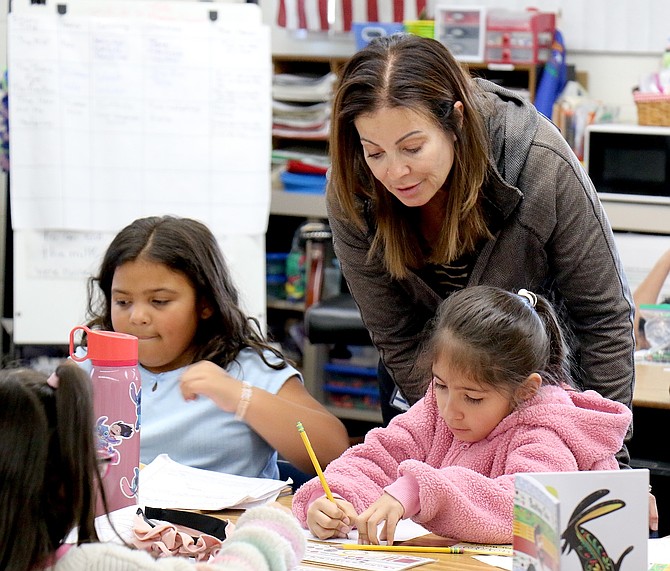
Fritsch Elementary School second-grade teacher Patricia Valdespino encourages Zara Aguirre, right, during a class assignment, with Grace Jadidi to the left in October 2025.
Photo by Jessica Garcia.
Five Carson City School District sites recently received the highest statewide recognition through the Nevada MTSS Project for improving student academic success and positive behavior based on data-guided practices.
Al Seeliger, Bordewich Bray, Fremont, Fritsch and Mark Twain elementary schools were among 73 schools in the state to be awarded for their practices in the Multi-Tiered System of Support framework during the 2024-25 school year. MTSS is a tiered, targeted approach designed to help students achieve academically and behaviorally with consistency for schools.
The Carson schools earned the “Diamond Recognition” for exemplary implementation of MTSS and Positive Behavioral Interventions and Supports that reinforces prevention over punishment. Fritsch earned its third Diamond award while Mark Twain earned its second, said Stephanie Keating, MTSS coordinator.
“It’s the highest level that you can apply for and you have to provide a plethora of artifacts and data narratives about your work and your impact on student outcomes, whether academic or behavior, or some schools did a blend of both,” Keating said.
Christie Perkins, CCSD director of MTSS and student wellness, said all districts are required to engage in some form of implementation that strengthens how they’re improving student success. Nevada’s Assembly Bill 275 in 2017 aligned with the federal Every Student Succeeds Act and put into place the MTSS components along with other school reforms.
Most districts use MTSS in ways that best fit the needs and culture of their schools, Keating said. In Carson, campuses have had intervention blocks built into their school day to address specific gaps or issues in learning. Groups are held to help second-graders with anger management and are struggling at recess, Keating said as an example.
“There’s different components of (MTSS), but I do think we’re seeing schools are doing it to some level across the state,” Perkins said. “And that's why we’re recognized because we’re really trying to do all the pieces: the behavioral health piece, the mental health, the social emotional piece, the academic piece, the attendance — all of those things wrapped together rather than just one subsection of that.”
Because MTSS encourages consistency, changes made for students at one school also can be tracked and carried with them if they switch to another campus.
“If your child needs support in first grade and then they move to another site … we’re not starting over,” she said. “We’re going to say, ‘OK, we’ve already done these things. These things were successful. Let’s continue this with the child.’
Keating said schools were recognized at a Nevada Association of Positive Behavior Support Conference from Feb. 3 to 5 at the University of Nevada, Reno held to help school teams with their MTSS strategies. About 30 CCSD staff members attended.
But even though schools receive certain designations, the work continues and it’s an ongoing process to improve data systems, student interventions and coaching efforts, Keating said.
“Just because you get it doesn’t mean you’ll be a ‘Diamond’ school forever,” she said. “So they’re really putting in the work to maintain that status.”