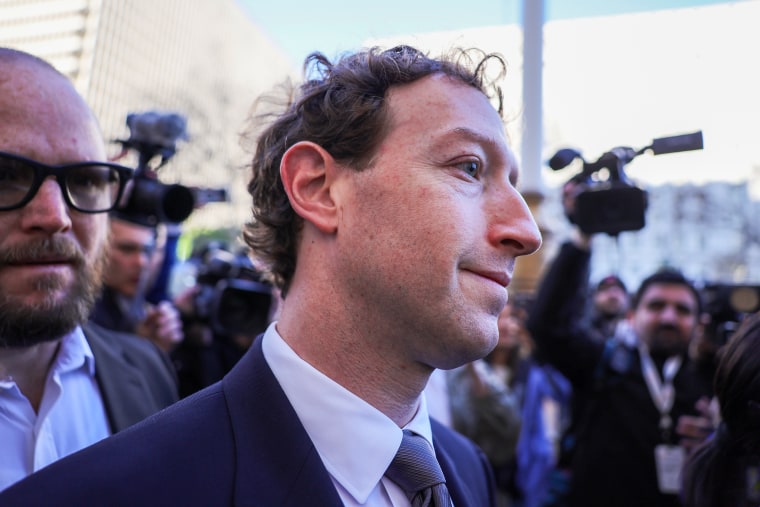
LOS ANGELES — In his first time testifying about child safety in front of a jury, Meta CEO Mark Zuckerberg said the company does not seek to make Instagram addictive to younger users, pushing back against claims that the social media app is designed to be harmful to children.
“I’m focused on building a community that is sustainable,” he said Wednesday when he was asked whether Meta wants people to be addicted to its social media platforms. “If you do something that’s not good for people, maybe they’ll spend more time [on Instagram] short term, but if they’re not happy with it, they’re not going to use it over time. I’m not trying to maximize the amount of time people spend every month.”
Zuckerberg shut down a question about whether he believes people tend to use something more if it’s addictive.
“I’m not sure what to say to that,” he said. “I don’t think that applies here.”
The landmark trial is the first of a consolidated group of cases — from more than 1,600 plaintiffs, including over 350 families and over 250 school districts — scheduled to be argued before a jury in Los Angeles County Superior Court. Plaintiffs accuse the owners of Instagram, YouTube, TikTok and Snap of knowingly designing addictive products harmful to young users’ mental health.
Historically, social media platforms have been largely shielded by Section 230, a provision added to the Communications Act of 1934 that says internet companies are not liable for content users post. TikTok and Snap reached settlements with the first plaintiff, a 20-year-old woman identified in court as K.G.M., before the trial. The companies remain defendants in a series of similar lawsuits expected to go to trial this year.
K.G.M., who was a minor at the time of the incidents outlined in her lawsuit, claims that her early use of social media led to addiction and worsened her mental health problems. Her lawsuit alleges that social media companies made deliberate design choices to make their platforms more addictive to children for purposes of profit.
The plaintiff was in the courtroom Wednesday for part of Zuckerberg’s testimony but did not take the stand. Her attorney, Mark Lanier, appeared optimistic when they arrived at court, telling reporters it was "going to be a good day."
During his questioning of Zuckerberg, Lanier cited a review from Meta that estimated that more than 4 million people under 13 were using Instagram in 2015.
Lanier spent much of the day pressing Zuckerberg about the company’s age verification policies. Asked about the volume of underage users on the app, Zuckerberg said that despite Meta’s longtime policy prohibiting kids under 13 from making accounts, he believes there are kids “who lie about their age in order to use the services.”
At one point during the line of questioning, Zuckerberg said: “I don’t see why this is so complicated. ... We have rules, and people broadly understand that."
Meta has developed measures over time to try to detect underage users, Zuckerberg said. But Lanier noted that the age verification features were not available when many children first joined Instagram. K.G.M. got on the app at age 9.
“I always wish we could have gotten there sooner,” Zuckerberg said of the safety tools Meta added in recent years.
“I don’t think we identified every single person who tried to get around restrictions, but you’re implying we weren’t trying to work on it, and that’s not true," he added.

Lanier also questioned Zuckerberg about his media training, pointing to an internal communications plan that advised him to “be authentic, direct, human, insightful, real,” rather than “fake, robotic, corporate, cheesy.”
Zuckerberg noted that he is “well known to be bad at this,” referring to media appearances, and said he values his team’s advice.
He suggested Lanier was taking many of his statements out of context, including some comments he made when he addressed lawmakers in Congress. At various points, Zuckerberg accused Lanier of "mischaracterizing" his remarks.
Matt Bergman, founding attorney of the Social Media Victims Law Center — which is representing about 750 plaintiffs in the California proceeding and about 500 in the federal proceeding — said Zuckerberg's day in court was "more than a legal milestone — it is a moment that families across this country have been waiting for."
"For the first time, a Meta CEO will have to sit before a jury, under oath, and explain why the company released a product its own safety teams warned were addictive and harmful to children," Bergman said in a statement ahead of the testimony, adding that the moment "carries profound weight" for parents "who have spent years fighting to be heard."
"They deserve the truth about what company executives knew," he said. "And they deserve accountability from the people who chose growth and engagement over the safety of their children.”
Tammy Rodriguez, a mother from Connecticut, was among the parents standing outside the courthouse Wednesday. She is one of Bergman's clients in a different social media case against Meta and Snap, in which she alleges the tech platforms caused the death of her 11-year-old daughter.
Though she is not a plaintiff in the Los Angeles case, she told reporters that hearing Zuckerberg's statements did not give her “any satisfaction."
"I can’t say there’s anything new I heard," she said. "I just know that more children have died since my daughter died in 2021, so things are not any better."
In 2024, while he was addressing Congress, Zuckerberg apologized to parents whose lives had been upended by tragedies they believed were caused by social media, saying, “This is why we invest so much and are going to continue doing industry-leading efforts to make sure that no one has to go through the types of things that your families have had to suffer.”
A Meta spokesperson declined to comment on Zuckerberg’s remarks on Wednesday and repeated the company’s public statement about the Los Angeles proceedings.
“The question for the jury in Los Angeles is whether Instagram was a substantial factor in the plaintiff’s mental health struggles,” the spokesperson wrote. “The evidence will show she faced many significant, difficult challenges well before she ever used social media.”
Adam Mosseri, the head of Meta’s Instagram, defended the platform in court last week, arguing that social media platforms are not intentionally engineered to be addictive.
YouTube's chief executive, Neal Mohan, was scheduled to testify this week, but his name has been removed from the witness list for the week. A spokesperson for Google, which owns YouTube, confirmed that plaintiffs removed Mohan from testifying this week. After the testimony wrapped, Lanier said he has no more plans to call Mohan.
Meta faces a separate trial in New Mexico, which began next week and also had proceedings that took place Wednesday.