He left Harvard to take a job as chief of staff to Democratic Boston Mayor Kevin White, serving in the role from 1968 to 1971 during a period of racial tumult in the city. Then came a staff assistant position in the office of Rep. Michael F. Harrington, a Democrat who represented Massachusetts’ 6th Congressional District.
In 1972, Frank entered electoral politics, winning an open seat in the Massachusetts Legislature. He was re-elected three times, earning a J.D. from Harvard Law School while he was serving in the state House, before he climbed the next rung in his political career: a bid for the U.S. House.
In 1980, he was narrowly elected to represent Massachusetts’s 4th Congressional District, winning just under 52% of the vote. The tight margin in his first House race proved to be an anomaly; Frank won his 15 re-election bids handily and became a familiar liberal mainstay in the lower chamber of Congress.
In 1987, during his fourth term in the House, Frank became the first member of Congress to voluntarily come out as gay. (The first was outed during the congressional page scandal four years earlier.) “If you ask the direct question: ‘Are you gay?’ the answer is yes,” Frank told The Boston Globe. “So what?”
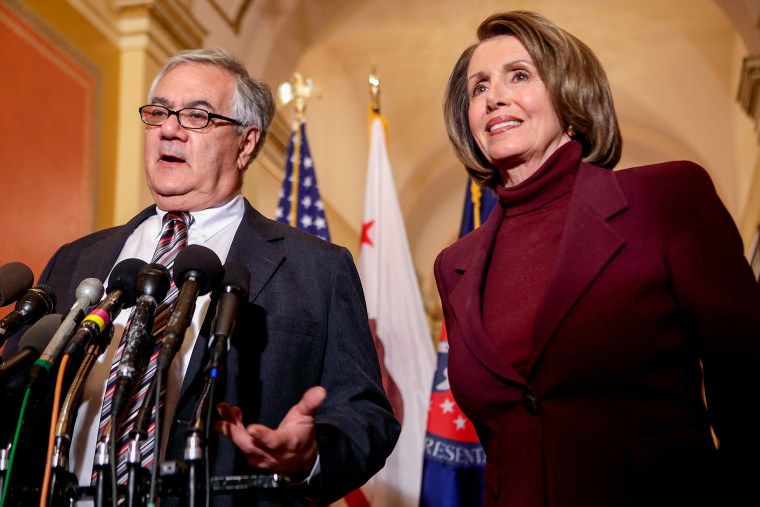
“I’ve said all along that if I was asked by a reporter and I didn’t respond, it would look like I had something to hide, and I don’t think I have anything to hide,” Frank told the Globe. “I don’t think my sex life is relevant to my job, but on the other hand, I don’t want to leave the impression that I’m embarrassed about my life.”
Frank’s political career was imperiled in 1989 after a news report detailed his relationship with a male sex worker who worked for him as a personal aide. Frank acknowledged that he paid the escort, Steve Gobie, for sex but fired him after he learned that Gobie had been using Frank’s apartment in Washington to run a prostitution service.
In 1990, the House voted 408-18 to reprimand Frank after the Ethics Committee found that he had fixed some of Gobie’s parking tickets; an attempt to censure Frank failed to gain traction. Frank’s constituents remained loyal to him, and he won re-election in 1990 with a comfortable 66% of the vote.
Frank amassed a staunchly liberal record in the House over three decades, publicly advocating for abortion rights, environmental protections, anti-discrimination measures in employment and housing, and LGBTQ equality, including pushing for the repeal of “don’t ask, don’t tell,” a policy that barred openly gay and bisexual people from serving in the U.S. armed forces.
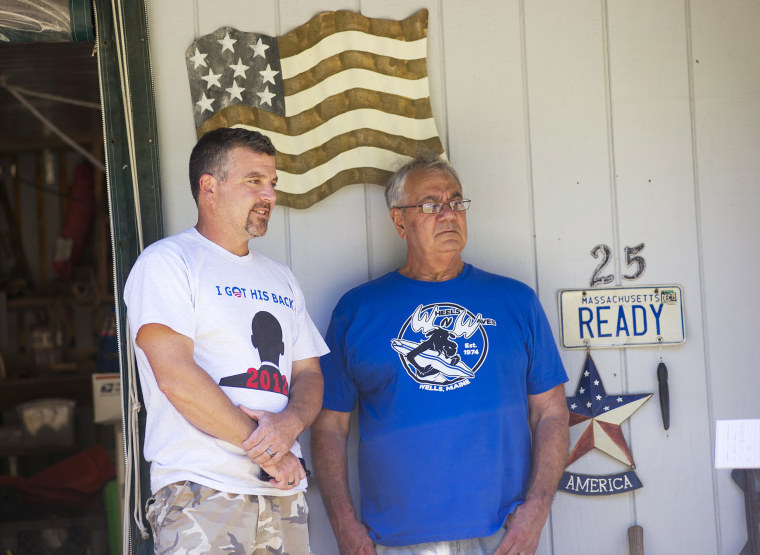
“He was a fighter and fearless,” said Mary Bonauto, the senior director of civil rights and legal strategies at GLAD Law, who was one of the lawyers who argued before the Supreme Court in the historic decision that legalized same-sex marriage nationwide.
“When you look at his record more generally, you see his advocacy for people of color, women — you know, it wasn’t just gay people,” Bonauto added. “He had his sharp eye on a lot of people and a lot of issues, and I think it’s partly from his own journey.”
Frank’s most notable piece of legislation was the one that bears his name: the Dodd–Frank Wall Street Reform and Consumer Protection Act, Congress’ response to the 2008 financial calamity. The bill sought to stabilize the markets, end the era of “too big to fail” Wall Street institutions and shield U.S. consumers from predatory practices.
Obama signed it into law July 10, 2010 — with Frank and his co-author, Sen. Chris Dodd, D-Conn., standing at his side.
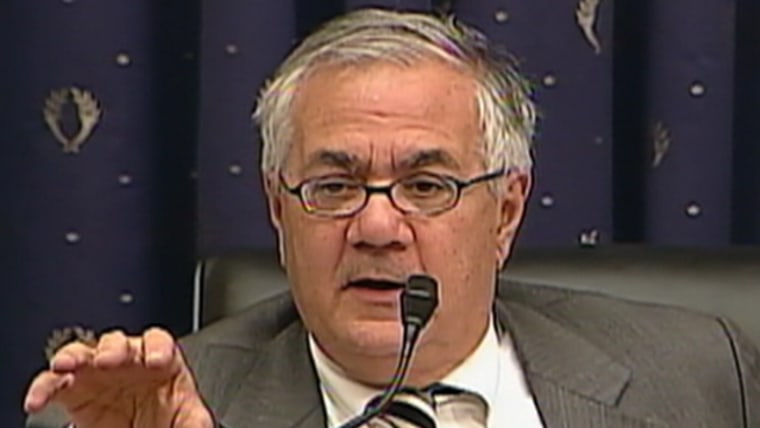
In the years that followed, Dodd-Frank proved divisive on both ends of the ideological spectrum, decried by the Obama administration’s progressive critics as insufficiently tough on Wall Street banks and blasted by Republicans and some business interests as overly burdensome.
Frank also drew scrutiny for having advocated for Fannie Mae and Freddie Mac, which were privately owned but had implicit government backing. Frank supported giving mortgages to lower-income customers through the companies, which critics say led to their near collapse and contributed to the housing crisis.
In 2010, Frank faced an unexpectedly strong challenge from Sean Bielat, a Republican tea party candidate. Frank ultimately prevailed, though with a more modest vote share than usual (roughly 54%), and he decided not to seek re-election in 2012. (He was succeeded by Joe Kennedy III, a fellow Democrat.)

The same year, Frank married Ready. “It’s nice,” Frank said of married life in an exit interview with the Harvard Law Bulletin. “Life really hasn’t changed day to day, but I still feel that afterglow from the ceremony.”
Three years later, Frank published an autobiography, “Frank: A Life in Politics from the Great Society to Same-Sex Marriage.” That summer, on the day the Supreme Court legalized same-sex marriage nationwide in the landmark Obergefell v. Hodges decision, Frank tweeted a simple hashtag: “#lovewins.”
In addition to Ready and Breay, he is survived by another sister, Ann Lewis, and a brother, David Frank.