The motion of fluids is described by the Navier–Stokes equations, the focus of one of the thorniest problems in mathematics.Credit: Kertlis/Getty
For the first time, a truly major open problem in mathematics has been solved by a computer, according to OpenAI, which says it has cracked one of the Millennium Problems, related to the motion of fluids.
The artificial-intelligence company in San Francisco, California, announced on 8 September that it has generated a solution to the most commonly used physical model of fluids — the Navier–Stokes equations — showing that they can break down. Whether this could happen was one of the seven Millennium Prize Problems selected by the Clay Mathematics Institute in Denver, Colorado, at the turn of the twenty-first century. Solutions to the puzzles, considered some of the thorniest in mathematics, come with a prize of US$1 million. OpenAI posted a preprint describing the result on its website.
“It is certainly an exciting day, as we contemplate the announcement of major advances in the human understanding of mathematics,” says mathematician Martin Bridson, president of the Clay Mathematics Institute.
The puzzle is known as the Navier–Stokes existence and smoothness problem. “Our proof does show that there exist fluids which start out perfectly normal, and under the Navier–Stokes equations, actually achieve infinite speed in a finite amount of time,” said OpenAI computer scientist Ven Chandrasekaran at a press briefing. Because this behaviour is physically impossible for a real fluid — such as a liquid or a gas — it suggests that under certain circumstances, the equations might not be a reliable mirror of physical reality, Chandrasekaran said.
“This is, to me, the spectacular culmination of the arc we have seen over the last 12 months” as AI has solved problems of increasing complexity and importance, OpenAI mathematician Sébastian Bubeck told reporters.
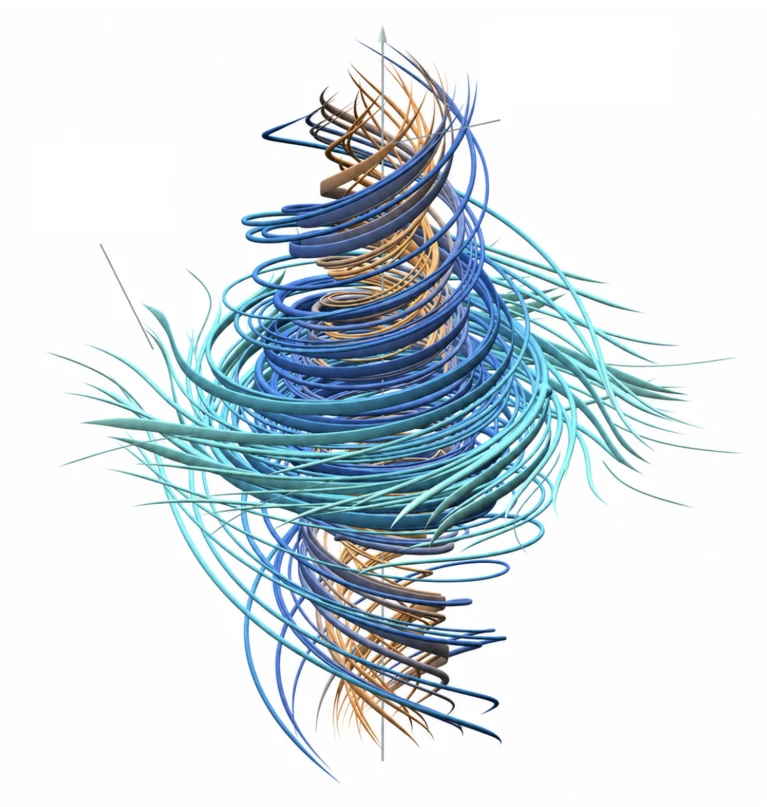
A swirling vortex — involved in the solution to the Navier–Stokes existence and smoothness problem.Credit: OpenAI
“I think it is a truly remarkable result,” says Luis Martínez Zoroa, a mathematician at CUNEF University in Madrid, who has done seminal work on the problem.
Rumoured progress
The OpenAI researchers said that they had been testing the ability of their latest AI prototype on all six unsolved Millennium Problems. They then decided to focus their resources on the Navier–Stokes problem on 1 September, after hearing rumours that two mathematicians, Levent Alpöge at Harvard University in Cambridge, Massachusetts, and Tristan Buckmaster at New York University in New York City, had solved a version of the fluid-motion puzzle using AI models from Anthropic, based in San Francisco.
On 7 September, Alpöge and Buckmaster released a paper in which they say they had found a solution for the fluid equations that also achieved infinite speed, but in the simplified case in which the fluid has no viscosity. To do so, they used Anthropic’s Claude and OpenAI’s Codex and Astra models. They also said they had obtained a solution to the more general problem, to be released soon.
On the same day, Anima Anandkumar, a computer scientist at the California Institute of Technology in Pasadena, and her collaborators also released a solution for the zero-viscosity problem, which they obtained using a “physics-informed neural network“, rather than a general-purpose large language model.
Bubeck told reporters that to attack the problem, OpenAI put an unprecedented amount of resources on a single task. Their model first answered a simplified version of the question in 50 hours using 1,000 AI agents. “Then we decided to go for the full Navier–Stokes, and we increased the amount of compute,” Bubeck said, putting 10,000 agents on the problem.