- NEWS AND VIEWS
In the Indian Ocean, a deep-sea area roughly 1,200 kilometres long and 7 kilometres deep was found to harbour an ecological landmark site of whale remains.
By
-
Stephen J. Godfrey
-
Stephen J. Godfrey is in the Department of Paleontology, Maryland State Paleontology Collections and at the Research Center, Calvert Marine Museum, Solomons, Maryland 20688, USA.
-
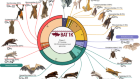
There are many examples of sites with vast accumulations of preserved fossils. Some of these fossil ‘graveyards’ (meaning sites with an accumulation of remains, rather than chosen locations associated with death) formed in marine settings and became accessible only through the uplift of tectonic plates. These sites formed at various times, but none is still actively forming. Writing in Nature, Peng et al.1 describe a newly discovered, unique graveyard of whale remains (also called whale falls), deep in the southeastern Indian Ocean along the length of what is known as the Diamantina fracture zone.
Nature 654, 869-870 (2026)
doi: https://doi.org/10.1038/d41586-026-01581-x
References
Peng, X. et al. Nature 654, 978–983 (2026).
Smith, J. L. B. Nature 143, 455–456 (1939).
Corliss, J. B. et al. Science 203, 1073–1083 (1979).
Competing Interests
The author declares no competing interests.
Related Articles
-
 Read the paper: A 5.3-million-year-old deep-sea whale necropolis in the Diamantina Zone
-
 A whale of an appetite revealed by analysis of prey consumption
 An innovative way for whales to sing