Trump team’s new rule could make firing government scientists easier
Researchers serving on the National Science Board, which advises the US National Science Foundation, received a brief e-mail on Friday telling them that they had been dismissed.Credit: Briscoe Savoy for Nature
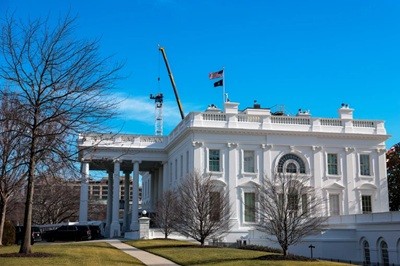
All 22 members of the advisory board that oversees the US National Science Foundation (NSF), a leading funder of fundamental science, were fired on 24 April without explanation. Every member of the NSF’s National Science Board (NSB) received an e-mail on Friday afternoon saying that “on behalf of President Donald J. Trump”, their positions were “terminated, effective immediately”.
Members of the NSB are appointed by the president and serve six-year terms that are staggered, avoiding complete turnover. Asked about the reason for the termination, a White House spokesperson said that the 2021 Supreme Court decison United States v. Arthrex, Inc. “raised constitutional questions about whether non-Senate confirmed appointees can exercise the authorities that Congress gave the National Science Board.” Members of the NSB were initially confirmed by the Senate, but have not been since 2012.
“This action to dismiss the NSB is unprecedented,” says Dan Reed, a computer scientist at the University of Utah in Salt Lake City and chair of the NSB from 2022 to 2024. “We need a vibrant, independent NSB, one representative of the broad science and engineering enterprise.”
Trump team’s new rule could make firing government scientists easier
Zoe Lofgren, a member of the US House of Representatives from California and the ranking Democrat on the House Committee on Science, Space, and Technology, criticized the move. “This is the latest stupid move made by a president who continues to harm science and American innovation,” she said in a statement. “It unfortunately is no surprise a president who has attacked NSF from day one would seek to destroy the board that helps guide the Foundation.”
But House science committee chairman Brian Babin, a Republican from Texas, said, “Every President expects advisors to serve in a manner consistent with executive and legislative priorities. I look forward to seeing whom President Trump selects to fill the NSB and refocus our science agencies on their core mission: pursuing science.”
This is not the first time the Trump administration has ousted federal science advisers en masse. Last year, the administration fired all 17 members of the Advisory Committee on Immunization Practices, which played a crucial part in US vaccine policy, and eliminated 14 advisory committees at the NSF. Also last year, Trump issued an order eliminating several advisory committees, including one on long COVID, to reduce government spending and “promote American freedom and innovation”.
The NSF and the NSB were established by Congress in 1950. The board meets five times a year and publishes reports on the state of US science and engineering that help to guide the president and Congress. Its next meeting was set for 5 May, and members say a report about the United States ceding scientific ground to China was set to be released.
“Where will advice come from?” asks Roger Beachy, a biologist at Washington University in St. Louis, Missouri. He was appointed to the NSB by US President Barack Obama in 2014 and reappointed by Trump in 2020 before being terminated on Friday. “Who will help with what is the future of science in this nation?”
Keivan Stassun, an astrophysicist at Vanderbilt University in Nashville, Tennessee, says that the termination of NSB members fits into a pattern of the Trump administration’s approach to science advice, which is being “systematically either dissolved or eviscerated”, he says. “It felt like only a matter of time” before that happened to the NSB, he says.
Because the NSB was established by an act of Congress, the board can officially be dissolved only by Congress. Furthermore, its members are required to be ‘eminent’ in scientific fields, according to the founding legislation.
The firing of NSB members comes amid other turmoil at the NSF. The Trump administration proposed two years in a row to cut the NSF budget by more than half. (Congress declined to approve that proposal for the 2026 budget.) The agency has lost more than 30% of its staff since January 2025, and in December, it had to cede its headquarters to another federal agency. This year, new grants at the agency have been issued at a trickle, as the agency prepares major cuts to its divisions.
One of the NSB’s key statutory roles is to approve the NSF’s budget. But multiple NSB members say that the White House Office of Management and Budget (OMB), which oversees federal spending, told NSF leadership not to share details about the agency’s spending with board members.