- POLICY BRIEF
Two comprehensive data sets concerning students who graduated from 141 business schools over 29 years and 200 law schools over 21 years show that higher racial diversity is associated with higher median salary at graduation. Policies that promote racial diversity seem likely to enhance education and benefit society overall.
By
-
Debanjan Mitra
-
Debanjan Mitra is at the University of Connecticut, Storrs, Connecticut, USA.
-
-
Peter N. Golder
-
Peter N. Golder is at Dartmouth College, Hanover, New Hampshire, USA.
-
-
Mariya Topchy
-
Mariya Topchy is at Travelers Insurance, Hartford, Connecticut, USA.
-
You have full access to this article via your institution.
Messages for policy
• Graduates’ salary data indicate that having more racial diversity in higher-education institutions is associated with learning and economic benefits.
• Legislators and civil-society organizations could use these findings in their advocacy work to promote the benefits of affirmative action and diversity, equity and inclusion (DEI) policies.
• University administrators should continue to admit students from racially diverse backgrounds by considering how race has affected each applicant’s life, as permitted by the 2023 US Supreme Court decision.
The policy problem
Affirmative-action policies designed to promote opportunities for students from under-represented backgrounds or those from groups that have historically been discriminated against were in place for decades in the United States. However, a 2023 US Supreme Court decision1 ruled against the use of such policies, sparking a debate about the importance of diversity, equity and inclusion (DEI) guidelines in higher-education and other institutions. To begin to address the impact of policies that promote racial diversity, we focused on higher education by looking at graduating classes of students in business-school programmes (master of business administration, MBA) and law-school programmes (juris doctor, JD). We investigated whether having a higher racial diversity in these programmes was associated with lower or higher median salaries at graduation compared with starting salaries of graduates of less racially diverse programmes. The amount that employers are willing to pay graduating students should reflect the learning benefits from diversity in educational settings. If lower racial diversity is associated with lower starting salaries, policies that lead to less racial diversity will reduce learning benefits, too.
The findings
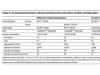
We found that MBA and JD students graduating from schools with higher racial diversity were paid higher median salaries than were graduates from less racially diverse institutions (Table 1). Conversely, lower racial diversity was associated with lower median salaries. Salary data measure the human-capital value of employees in labour markets: the contributions of graduates who are paid more are valued more highly than those of graduates who are paid less by their employers. Because graduates of racially diverse programmes are paid more than are those of less racially diverse programmes, policies that result in reduced racial diversity2 are likely to decrease learning, lower graduates’ human-capital value and reduce other benefits that can be attributed to diversity (such as cross-racial understanding, the breaking of stereotypes and the remediation of racial injustice).
Our results are likely to generalize to other contexts in which individuals from a variety of racial backgrounds learn from each other. However, we note that these learning benefits probably occur through meaningful interactions between individuals from distinct backgrounds, as opposed to mere exposure to people from minority ethnic groups.
The study
Our findings are based on comprehensive data sets: 2,964 classes of MBA students graduating from 141 business schools over 29 years and 3,386 classes of JD students graduating from 200 law schools over 21 years. We used statistical models that tested for the association between racial diversity and median salary. Previous studies3,4 relied on smaller self-reported data sets and therefore could not isolate the relationship between racial diversity and cohort salary. We selected cohort-based programmes because students interact regularly with others in their class over the course of their studies. We measured the labour-market value of each class through its median starting salary after graduation. We included other control data (including undergraduate grades and entrance-exam scores) and considered many other statistical models to examine potential causes of higher salaries other than racial diversity. We consistently found evidence for a positive association between the racial diversity of an education cohort and its median graduate salary.
doi: https://doi.org/10.1038/d41586-026-01273-6
Funding statement D.M. acknowledges support from a University of Connecticut’s Office of the Vice President for Research (OVPR) Research Excellence Program Grant and an endowed chair established by Voya Financial.
References
Students for Fair Admissions, Inc v. President and Fellows of Harvard College 600 US 181 (2023). The US Supreme Court’s decision highlights the lack of compelling evidence regarding the educational benefits of racial diversity as one of the main reasons for overturning the affirmative-action policies.
Saul, S. At many top law schools, Black student enrollment continues to drop. The New York Times (16 December 2025). This news article reports that, after the affirmative-action ban, there has been a substantial drop in the number of Black students at 14 out of 18 leading law schools.
Arcidiacono, P. & Vigdor, J. L. Econ. Inq. 48, 3 537–557 (2010). This article examines survey data on individual respondents’ salaries and cohort racial diversity.
Boisjoly, J., Duncan, G. J., Kremer, M., Levy, D. M. & Eccles, J. Am. Econ. Rev. 96, 1890–1905 (2006). This paper finds that white university students who were randomly assigned to live with Black roommates were more likely to endorse affirmative action and to interact with people from minority ethnic groups than were white students who had white roommates.
Competing Interests
The authors declare no competing interests.
Related Articles
-
 Read the paper: Racial diversity in higher education is associated with higher student salaries
-
 Socio-economic status explains one-third of the racial disparity in top academic achievement
-
 Pay gap between nationals and migrants mainly due to unequal access to high-paying jobs
 The social connections that shape economic prospects