- NEWS
- Correction 16 October 2025
A consensus is emerging that the dots, sometimes called rubies, are an entirely new type of object in the Universe.
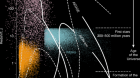
When the James Webb Space Telescope (JWST) looked back in time to observe the Universe’s earliest moments, it presented astronomers with something most peculiar: hundreds of ‘little red dots’ that inexplicably freckled the ancient cosmos.
Nature 646, 779-780 (2025)
doi: https://doi.org/10.1038/d41586-025-03352-6
Updates & Corrections
-
Correction 16 October 2025: An earlier version of this article contained an incorrect reference.
References
De Graaff, A. et al. Astron. Astrophys. 701, A168 (2025).
Inayoshi, K, & Maiolino, R. Astrophys. J. 980 L27 (2025).
Schindler, J.-T. et al. Nature Astron. https://doi.org/10.1038/s41550-025-02660-1 (2025).
Lin, X. et al. Preprint at arXiv https://arxiv.org/html/2507.10659v1 (2025).
Taylor, A. J. et al. Astrophys. J. 989, L7 (2025).
Related Articles
-
 Four revelations from the Webb telescope about distant galaxies
-
 These six distant galaxies captured by JWST are wowing astronomers
-
 Supernova mystery solved: JWST reveals the fate of an iconic stellar explosion
-
 These ‘green pea’ galaxies might have helped to end the Universe’s dark age