- NEWS FEATURE
Scientists are beginning to crack the fiendishly complex code that helps us to sense odours.
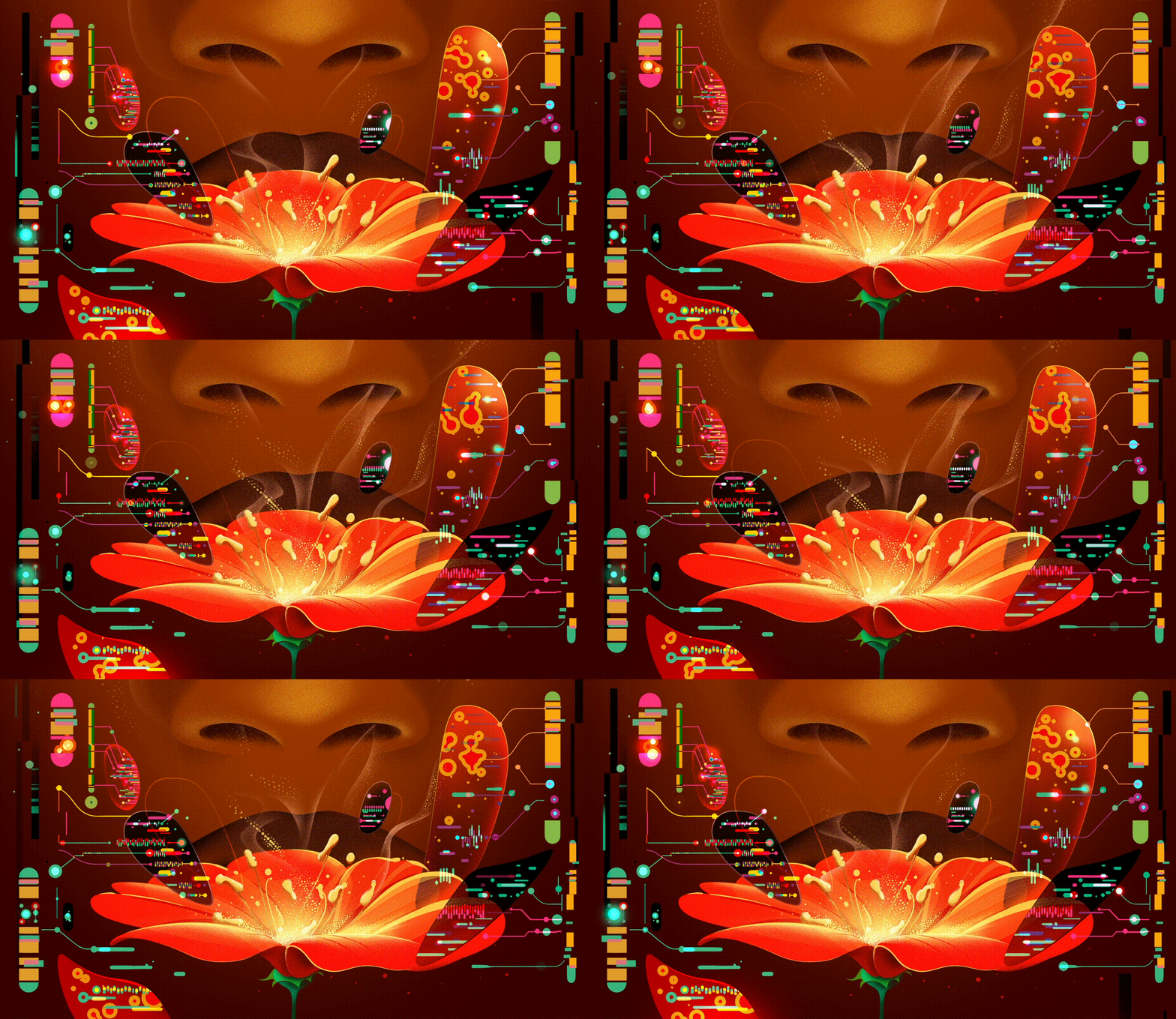
Illustration by Adrià Voltà
The smell in the laboratory was new. It was, in the language of the business, tenacious: for more than a week, the odour clung to the paper on which it had been blotted.
Nature 633, 26-29 (2024)
doi: https://doi.org/10.1038/d41586-024-02833-4
References
Ravia, A. et al. Nature 588, 118–123 (2020).
Keller, A. et al. Science 355, 820–826 (2017).
Lee, B. K. et al. Science 381, 999–1006 (2023).
Buck, L. & Axel, R. Cell 65, 175–187 (1991).
Butterwick, J. A. et al. Nature 560, 447–452 (2018).
del Mármol, J., Yedlin, M. A. & Ruta, V. Nature 597, 126–131 (2021).
Guo, L. et al. Nature 618, 193–200 (2023).
Gusach, A. et al. Preprint at bioRxiv https://doi.org/10.1101/2023.07.07.547762 (2023).
Billesbølle, C. B. et al. Nature 615, 742–749 (2023).
de March C. A. et al. Preprint at bioRxiv https://doi.org/10.1101/2023.11.16.567230 (2023).
Akdel, M. et al. Nature Struct. Mol. Biol. 29, 1056–1067 (2022).
Jabeen, A., de March, C. A., Matsunami, H. & Ranganathan, S. Int. J. Mol. Sci. 22, 11546 (2021).
Shor, E. et al. Biosens. Bioelectron. 195, 113664 (2022).
Related Articles
-
 How do we smell? First 3D structure of human odour receptor offers clues
-
 Could rats and dogs detect disease better than the finest lab equipment?
 Human nose can detect 1 trillion odours