- NEWS AND VIEWS
By analysing the ancient genomes of individuals from Rapa Nui, researchers have overturned a contentious theory that the remote Pacific island experienced a self-inflicted population collapse before European colonization.
By
-
Stephan Schiffels
-
Stephan Schiffels is in the Department of Archaeogenetics, Max Planck Institute for Evolutionary Anthropology, 04103 Leipzig, Germany.
-
-
Kathrin Nägele
-
Kathrin Nägele is in the Department of Archaeogenetics, Max Planck Institute for Evolutionary Anthropology, 04103 Leipzig, Germany.
-
Few stories in our human past spark as much imagination as the discovery of the most remote islands in the vast Pacific Ocean. Rapa Nui, sometimes known by its colonial name of Easter Island, is perhaps an extreme example, being one of the most isolated places on Earth. It was peopled more than 800 years ago by Polynesian seafarers, who sailed against the prevailing winds and currents and with masterful navigation. Writing in Nature, Moreno-Mayar et al.1 report a genetic study that greatly advances scientists’ understanding of the island’s inhabitants and their ancestors.
Nature 633, 290-291 (2024)
doi: https://doi.org/10.1038/d41586-024-02620-1
References
Moreno-Mayar, J. V. et al. Nature 633, 389–397 (2024).
Ioannidis, A. G. et al. Nature 583, 572–577 (2020).
Fehren-Schmitz, L. et al. Curr. Biol. 27, 3209–3215 (2017).
Matisoo-Smith, E. J. Hum. Evol. 79, 93–104 (2015).
Diamond, J. Collapse: How Societies Choose to Fail or Succeed (Viking, 2005).
Boersema, J. J. The Survival of Easter Island: Dwindling Resources and Cultural Resilience (Cambridge Univ. Press, 2015).
Davis, D. S., DiNapoli, R. J., Pakarati, G., Hunt, T. L. & Lipo, C. P. Sci. Adv. 10, eado1459 (2024).
Competing Interests
The authors declare no competing interests.
Related Articles
-
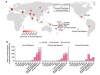 Read the paper: Ancient Rapanui genomes reveal resilience and pre-European contact with the Americas
-
 Modern Polynesian genomes offer clues to early eastward migrations
 Native South Americans were early inhabitants of Polynesia