- COMMENT
Large language models such as that used by ChatGPT could soon become essential tools for diagnosing and treating patients. To protect people’s privacy and safety, medical professionals, not commercial interests, must drive their development and deployment.
By
-
Augustin Toma
-
Augustin Toma is a graduate student at the Vector Institute, Toronto, and at the University of Toronto, Canada.Senthujan Senkaiahliyan
-
-
Senthujan Senkaiahliyan
-
Senthujan Senkaiahliyan is a graduate student at the Institute of Health Policy, Management and Evaluation, Dalla Lana School of Public Health, University of Toronto, Canada.
-
-
Patrick R. Lawler
-
Patrick R. Lawler is a cardiologist at the McGill University Health Centre, Montreal, Canada.
-
-
Barry Rubin
-
Barry Rubin is medical director at the Peter Munk Cardiac Centre, University Health Network, Toronto, Canada.
-
-
Bo Wang
-
Bo Wang is chief AI scientist at the University Health Network and an assistant professor at the University of Toronto, Canada.
-
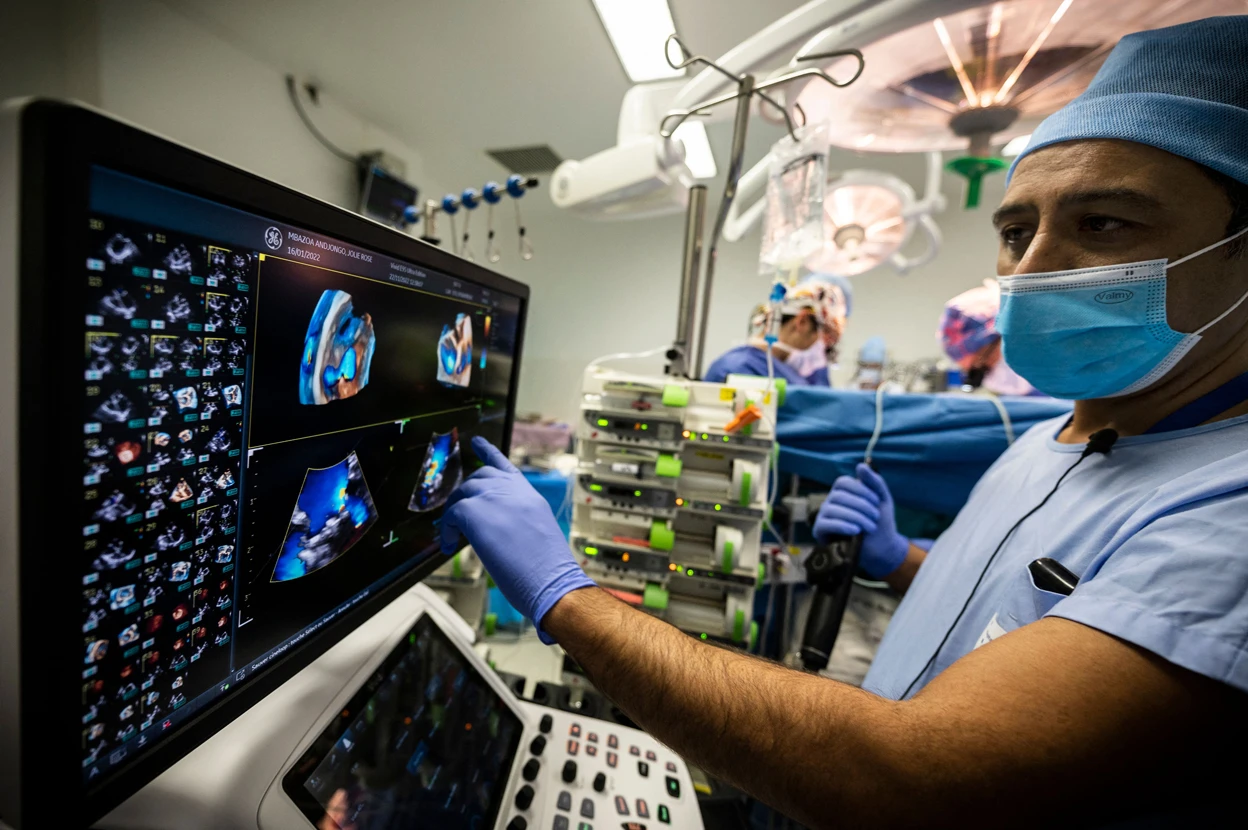
Generative AI could help to diagnose conditions. Credit: Lionel Bonaventure/AFP via Getty
ChatGPT was released by the technology company OpenAI for public use on 30 November 2022. GPT-4, the large language model (LLM) underlying the most advanced version of the chatbot1, and others, such as Google’s Med-PaLM2, are poised to transform health care.
Nature 624, 36-38 (2023)
doi: https://doi.org/10.1038/d41586-023-03803-y
References
Lee, P., Bubeck, S. & Petro, J. N. Engl. J. Med. 388, 1233–1239 (2023).
Singhal, K. et al. Nature 620, 172–180 (2023).
Executive Office of the President. Fed. Regist. 88, 75191–75226 (2023).
Toma, A. et al. Preprint at https://arxiv.org/abs/2305.12031 (2023).
Nori, H., King, N., McKinney, S. M., Carignan, D. & Horvitz, E. Preprint at https://arxiv.org/abs/2303.13375 (2023).
Giorgi, J. et al. in Proc. 5th Clin. Nat. Lang. Process. Workshop (eds Naumann, T., Ben Abacha, A., Bethard, S., Roberts, K. & Rumshisky, A.) 323–334 (Association for Computational Linguistics, 2023).
Ali, R. et al. Neurosurgery 93, 1353–1365 (2023).
Holmes, J. et al. Front. Oncol. 13, 1219326 (2023).
Kanjee, Z., Crowe, B. & Rodman, A. JAMA 330, 78–80 (2023).
Eriksen, A. V., Möller, S. & Ryg, J. N. Engl. J. Med. https://doi.org/10.1056/AIp2300031 (2023).
Ali, R. et al. Preprint at bioRxiv https://doi.org/10.1101/2023.05.06.23289615 (2023).
Huang, L. et al. Preprint at https://arxiv.org/abs/2311.05232 (2023).
Carlini, N. et al. Preprint at https://arxiv.org/abs/2012.07805 (2020).
Omiye, J. A., Lester, J. C., Spichak, S., Rotemberg, V. & Daneshjou, R. NPJ Digit. Med. 6, 195 (2023).
Wornow, M. et al. NPJ Digit. Med. 6, 135 (2023).
Chen, L., Zaharia, M. & Zou, J. Preprint at https://arxiv.org/abs/2307.09009 (2023).
Touvron, H. et al. Preprint at https://arxiv.org/abs/2302.13971 (2023).
Jiang, A. Q. et al. Preprint at https://arxiv.org/abs/2310.06825 (2023).
Rieke, N. et al. NPJ Digit. Med. 3, 119 (2020).
Competing Interests
The authors declare no competing interests.
 ChatGPT one year on: who is using it, how and why?
 Science and the new age of AI: a Nature special
 An AI revolution is brewing in medicine. What will it look like?
 AI will transform science — now researchers must tame it