- COMMENT
- Correction 09 April 2020
The growing threat of abrupt and irreversible climate changes must compel political and economic action on emissions.
By
- Johan Rockström1,
- Owen Gaffney2,
- Stefan Rahmstorf3,
- Katherine Richardson4,
- Will Steffen5 &
- …
- Hans Joachim Schellnhuber
-
Timothy M. Lenton
-
Timothy M. Lenton is director of the Global Systems Institute, University of Exeter, UK.
-
-
Johan Rockström
-
Johan Rockström is director of the Potsdam Institute for Climate Impact Research, Germany.
-
-
Owen Gaffney
-
Owen Gaffney is a global sustainability analyst at the Potsdam Institute for Climate Impact Research, Germany; and at the Stockholm Resilience Centre, Stockholm University, Sweden.
-
-
Stefan Rahmstorf
-
Stefan Rahmstorf is professor of physics of the oceans at the University of Potsdam; and head of Earth system analysis at the Potsdam Institute for Climate Impact Research, Germany.
-
-
Katherine Richardson
-
Katherine Richardson is professor of biological oceanography at the Globe Institute, University of Copenhagen, Denmark.
-
-
Will Steffen
-
Will Steffen is emeritus professor of climate and Earth System science at the Australian National University, Canberra, Australia.
-
- Hans Joachim Schellnhuber

An aeroplane flies over a glacier in the Wrangell St Elias National Park in Alaska. Credit: Frans Lanting/Nat Geo Image Collection
Politicians, economists and even some natural scientists have tended to assume that tipping points1 in the Earth system — such as the loss of the Amazon rainforest or the West Antarctic ice sheet — are of low probability and little understood. Yet evidence is mounting that these events could be more likely than was thought, have high impacts and are interconnected across different biophysical systems, potentially committing the world to long-term irreversible changes.
Nature 575, 592-595 (2019)
doi: https://doi.org/10.1038/d41586-019-03595-0
Updates & Corrections
-
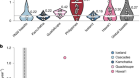
Correction 09 April 2020: The figure ‘Too close for comfort’ in this Comment incorrectly synthesized and interpreted data from the IPCC. The graph labelled the temperatures as absolute, rather than rises; misrepresented the levels of risk; misinterpreted data as coming from a 2007 IPCC report; extrapolated the focus of a 2018 report; and was not clear about the specific sources of the data. The graphic has been extensively modified online to correct these errors.
References
Lenton, T. M. et al. Proc. Natl Acad. Sci. USA 105, 1786–1793 (2008).
IPCC. Global Warming of 1.5°C (IPCC, 2018).
IPCC. IPCC Special Report on the Ocean and Cryosphere in a Changing Climate (IPCC, 2019).
Cai, Y., Lenton, T. M., & Lontzek, T. S. Nature Clim. Change 6, 520–525 (2016).
Feldmann, J. & Levermann, A. Proc. Natl Acad. Sci. USA 112, 14191–14196 (2015).
Aschwanden, A. et al. Sci. Adv. 5, eaav9396 (2019).
Drijfhout, S. et al. Proc. Natl Acad. Sci. USA 112, E5777–E5786 (2015).
Lovejoy, T. E. & Nobre, C. Sci. Adv. 4, eaat2340 (2018).
Walker, X. J. et al. Nature 572, 520–523 (2019).
Rogelj, J., Forster, P. M., Kriegler, E., Smith, C. J. & Séférian, R. Nature 571, 335–342 (2019).
Steffen, W. et al. Proc. Natl Acad. Sci. USA 115, 8252–8259 (2018).
Schneider, T., Kaul, C. M. & Pressel, K. G. Nature Geosci. 12, 163–167 (2019).
Tan, I., Storelvmo, T. & Zelinka, M. D. Science 352, 224–227 (2016).
Rocha, J. C., Peterson, G., Bodin, Ö. & Levin, S. Science 362, 1379–1383 (2018).
Caesar, L., Rahmstorf, S., Robinson, A., Feulner, G. & Saba, V. Nature 556, 191–196 (2018).
 ‘Ecological grief’ grips scientists witnessing Great Barrier Reef’s decline
 Permafrost collapse is accelerating carbon release
 Greenland is losing ice at fastest rate in 350 years
 The hard truths of climate change — by the numbers
 Why I welcome a climate emergency