- NEWS AND VIEWS
In 1947, scientists found a previously unseen particle, which is now called a neutral kaon. This work led to the discovery of elementary particles known as quarks, and ultimately to the establishment of the standard model of particle physics.
By
-
Taku Yamanaka
-
Taku Yamanaka is in the Department of Physics, Osaka University, Toyonaka, Osaka 560-0043, Japan.
-
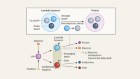
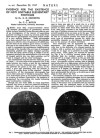
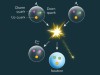
In the late 1940s, the physicists George Rochester and Clifford Butler1 observed something unusual in their charged-particle detector. They were studying the interactions between high-energy cosmic rays and a lead plate in the detector when they spotted V-shaped particle tracks (Fig. 1a). The small gap between the lead plate and the vertex of the tracks indicated that an invisible neutral particle had been produced in the plate, had travelled for a short distance and had then decayed into two visible charged particles. The mass of the neutral particle was about 1,000 times that of an electron, implying that it must be a previously unreported type of particle. This discovery paved the way for many puzzles and surprises in particle physics in the decades that followed.
Nature 575, 36-38 (2019)
doi: https://doi.org/10.1038/d41586-019-02841-9
References
Rochester, G. D. & Butler, C. C. Nature 160, 855–857 (1947).
Yukawa, H. Proc. Phys.-Math. Soc. Jpn 17, 48–57 (1935).
Perkins, D. H. Nature 159, 126–127 (1947).
Lattes, C. M. G., Muirhead, H., Occhialini, G. P. S. & Powell, C. F. Nature 159, 694–697 (1947).
Neddermeyer, S. H. & Anderson, C. D. Phys. Rev. 51, 884–886 (1937).
Leprince-Ringuet, L. & L’Héritier, M. C.R. Acad. Sci. 219, 618–620 (1944).
Gell-Mann, M. Phys. Rev. 92, 833–834 (1953).
Nakano, T. & Nishijima, K. Prog. Theor. Phys. 10, 581–582 (1953).
Wu, C. S., Ambler, E., Hayward, R. W., Hoppes, D. D. & Hudson, R. P. Phys. Rev. 105, 1413–1415 (1957).
Garwin, R. L., Lederman, L. M. & Weinrich, M. Phys. Rev. 105, 1415–1417 (1957).
Christenson, J. H., Cronin, J. W., Fitch, V. L. & Turlay, R. Phys. Rev. Lett. 13, 138–140 (1964).
Gell-Mann, M. Phys. Lett. 8, 214–215 (1964).
Zweig, G. CERN Rep. No. CERN-TH-401 (1964).
Kobayashi, M. & Maskawa, T. Prog. Theor. Phys. 49, 652–657 (1973).
Alavi-Harati, A. et al. (KTeV Collaboration) Phys. Rev. Lett. 83, 22–27 (1999).
The NA48 Collaboration. Eur. Phys. J. C 22, 231–254 (2001).
Aubert, B. et al. (BABAR Collaboration) Phys. Rev. Lett. 87, 091801 (2001).
Abe, K. et al. (Belle Collaboration) Phys. Rev. Lett. 87, 091802 (2001).
Ahn, J. K. et al. (KOTO Collaboration) Phys. Rev. Lett. 122, 021802 (2019).
The NA62 Collaboration. Phys. Lett. B 791, 156–166 (2019).
 10 extraordinary Nature papers
 The paper: Evidence for the Existence of New Unstable Elementary Particles
 Quarks fuse to release energy
 Long-sought decay of the Higgs boson seen