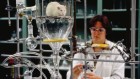
Machine-learning software trained on masses of chemical-safety data is so good at predicting some kinds of toxicity that it now rivals — and sometimes outperforms — expensive animal studies, researchers report.
Nature 559, 163 (2018)
doi: https://doi.org/10.1038/d41586-018-05664-2
References
Related Articles
Subjects
Latest on:






Jobs
-
-
Postdoctoral Fellow
Postdoctoral Fellow focus on ferroic smart materials: shape-memory alloys, piezoelectric ceramics, and magnetostrictive materials, etc
Ningbo, Zhejiang (CN)
Center for Advanced Smart Materials (CASM), Yongjiang Laboratory (Y-Lab)
-
Principal Investigator/ Associate Professor
PI & Associate Professor class focus on innovative research about ferroic smart materials or technology transfer
Ningbo, Zhejiang (CN)
Center for Advanced Smart Materials (CASM), Yongjiang Laboratory (Y-Lab)
-
Assistant/Associate Professor (Genomics
The Department of Biology in the College of Science, at the University of Texas at Arlington (UTA) (http://www.uta.edu/biology/),...
University of Texas, Arlington
University of Texas at Arlington, Department of Biology
-
News Intern, Nature News
Job Title: News Intern, Nature News Location: Washington, D.C or New York — Hybrid Working Application Deadline: September 23, 2026 About Springe...
Washington D.C.
Springer Nature Ltd