Modeloop is the only visual environment that brings modern DevOps and built-in verification
to model-based design.
Want the native desktop app?
Join the waitlist for early desktop access
10xFaster to Production
0Binary Lock-in — models are plain JSON
2Codegen Targets — Python & C from one model
2Platforms - Available on Web and Desktop
What Modeloop Actually Does
One engineering loop from visual model to generated code.
Modeloop is not just a canvas and it is not just a simulator. It is a model-based
engineering workflow where diagrams become source code, tests, and reviewable artifacts.
Generated deliverables
Code, tests, and traceability stay together.
01The Convergence
MBSE Rigor
Source of truth, not documentation.
Model‑Based Systems Engineering has historically meant heavy
artifacts and static reviews. Modeloop reframes the model as a
live, executable contract: every block is bound to a
requirement, every connection is type‑checked, every change
re‑validates the system in seconds.
Agile Velocity
Continuous integration, not waterfall.
Embedded verification has always meant multi-month cycles.
Modeloop collapses them to seconds — generate the code, run the tests, on every commit and every branch, without leaving the editor.
↻ The synthesis
The two principles are usually treated as opposites.
Modeloop treats them as two halves of the same loop.
02The Missing Piece
The V‑Model defines the shape of safety‑critical engineering.
Modeloop closes it.
Architecture FrameworkV-Model & The Modeloop Bridge
Phase ASpecification
Phase BVerification
Design
Generative Loop
Verified Asset
Specification descends the left arm. Verification ascends the
right. Historically, a chasm runs between them — engineers
manually translating models into code, then manually authoring
tests against the code they just wrote. The chasm is where bugs
are born. Modeloop replaces it with a generator: the model is the
design, and the model emits both the implementation and the test
harness that closes the V.
03The Complexity Mandate
At nine figures of code,
every keystroke is a defect site.
Fig. 03 — Estimated lines of code, embedded systemsSource: industry estimates · visual log scale
1969Apollo 11 Guidance Computer
145K
1997F‑22 Raptor avionics
1.7M
2011Boeing 787 Dreamliner
6.5M
2020Premium passenger vehicle
100M
2025Modern ADAS · autonomous stack
500M+
Modern embedded software has crossed a threshold. Manual edits do
not scale linearly — they compound. A change in one file
silently breaks an integration contract three layers away. A unit
test passes while the integrated build regresses in ways no human
reviewer can catch in time. At 108 lines, the
probability of a defect‑free manual change approaches zero.
01 /Models
02 /State Machines
03 /Mathematical Verification
04 /Testing
05 /Simulation
pid_controller.mdl
supervisor.sfc
formal-mapping
unit-testing
PlotLab — results
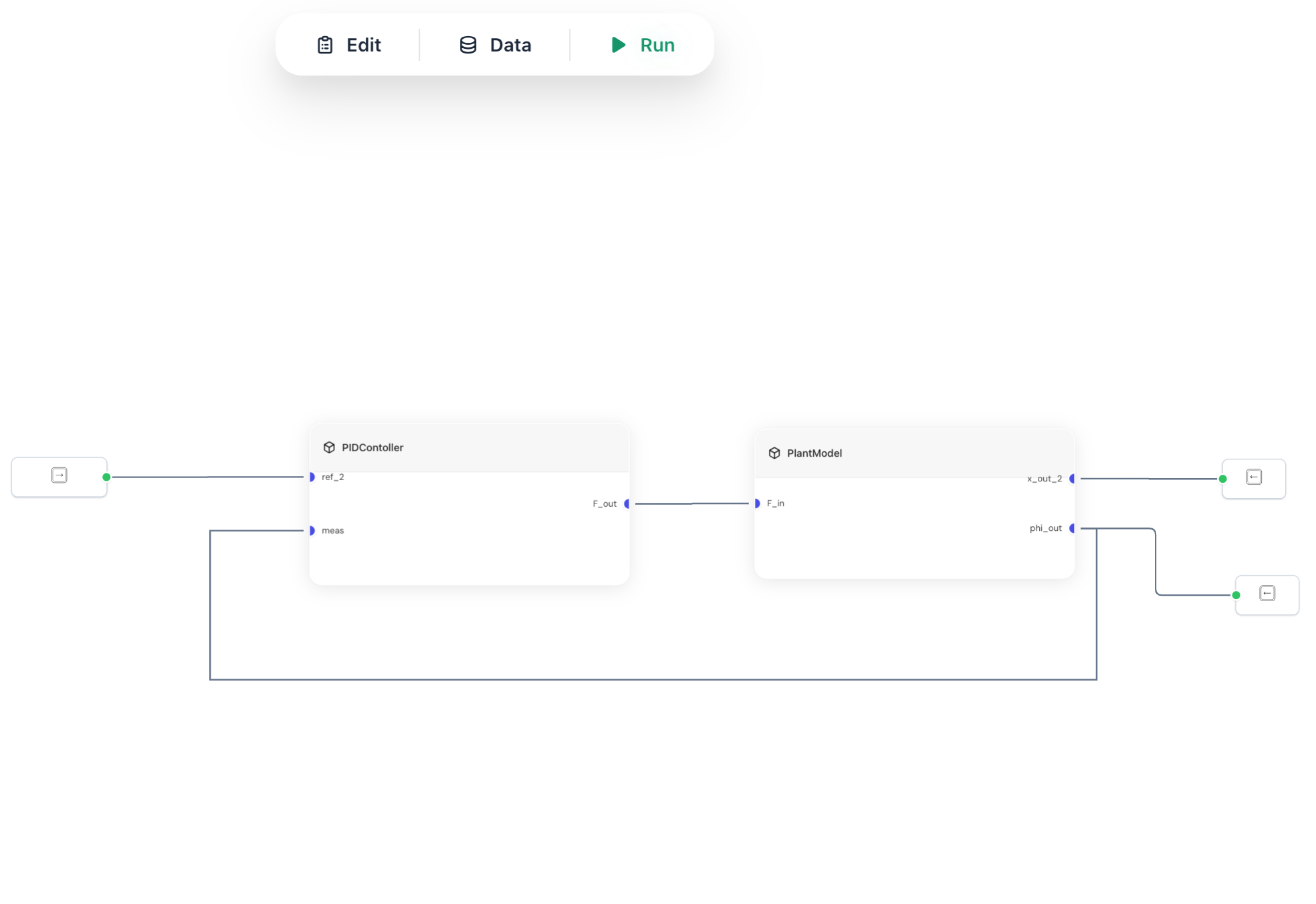
Compose hierarchical block diagrams. Wrap any subsystem into a single reusable block.
Embed hierarchical StateCharts directly in your signal flow — every transition visualized.
Every block diagram is strictly associated with a mathematical representation, guaranteeing correct C code generation by design.
Write unit tests and run simulations to validate the functional correctness of your model.
Run your model and inspect every signal trace in real time
Built Different, For a Reason
Every feature was designed to eliminate a specific pain point in embedded systems engineering.
Hierarchical Containerization
Without Modeloop: In C, nothing stops you from connecting everything to everything. Spaghetti is the default.
Wrap any subsystem into a single block with explicit inputs and outputs. Reuse it anywhere. Modeloop makes modularity the path of least resistance — at any scale.
Visual State Machines
Without Modeloop: Writing nested switch/if-else for FSMs by hand is error-prone. Edge cases get missed. Bugs live at transitions.
Embed StateCharts directly into your signal flow. Hierarchical states, event-driven transitions, every corner case visualized — before a single line of C is generated.
Bus Management System
Without Modeloop: Passing 50+ arguments to functions or managing massive global structs. Change one value, risk breaking everything else.
Group hundreds of signals into a single Bus line. Update one field inside a complex bundle without touching the rest. Object-Oriented wiring for embedded systems.
Live Parameter Tuning
Without Modeloop: Gain too low? Stop → find #define → recompile → reflash → restart. Feedback loop: 10–15 minutes.
Mark any value as CALIBRATION. Change it at runtime via dashboard, JSON, or script — no recompile, no reflash. A 15-minute engineering cycle collapses into milliseconds.
Generated Code You Can Inspect
Modeloop turns diagrams into readable Python and C artifacts that can be reviewed, tested, and integrated into embedded workflows.
Engineered for Critical Systems
Transparent, reliable, and qualified for the most demanding industries.
Functional Reliability
Our C-Code Generator is architected for predictability and performance. We focus on **Deterministic Execution** and rigorous validation.
✓100% Deterministic Signal Flow
✓Zero Dynamic Memory Allocation
✓Fixed-Step Solver Precision
Mathematical Truth
Modeloop utilizes advanced Back-to-Back Testing to ensure the generated C code behaves exactly like the Python reference.
Numerical Precision
ε < 10⁻⁷
*Verified across 100+ Golden Models.
Data Sovereignty
Your models and intellectual property never leave your machine.
Modeloop runs entirely local (via Electron or Pyodide). We do not upload your diagrams to cloud servers for simulation or code generation, ensuring maximum confidentiality for industrial R&D.
Modeloop is built by engineers, for engineers. We prioritize transparency and deterministic behavior in every line of generated code.