New Yorkers love the Empire State Building, the Brooklyn Bridge, and the subway (even if that last relationship is complicated). But if anyone proposed projects like those today, there’s a good chance they wouldn’t get built.1 And if our modern legal regime existed in the past, we might not have any of them.
Whatever you love about New York City today, someone didn’t want to happen. Thankfully our past law and politics did not ultimately side with the naysayers in those cases.
But our current law does; it embraces naysayer deference. This is done usually—but not exclusively—via a seemingly infinite profusion of veto points. The New York City of today exists without many new projects, buildings, parks, and more, all because they died by the naysayers’ sword throughout the latter half of the twentieth century and the beginning of the twenty-first.
I’ll give you two examples: the Empire State Building, and New York City itself.
The endangering modern factors: zoning and historic preservation laws
It was the tallest building in the world when it was completed. The key legal aspect enabling this height was that, after a certain amount of distance from the street, the Empire State Building could rise as high as it wanted.2 This affordance would be decisively closed when New York adopted its 1961 zoning resolution, which we still live under today. That resolution would make much of the New York we know today illegal.
Of course, NYC now has several new buildings that rise higher than the Empire State Building—and more on the way. The recently completed One Vanderbilt, the in-progress JPMorgan Chase Tower, and the soon-to-come Commodore Tower all rise above it. But they are only able to do that because, among other things, they purchased the development rights from properties around them. This required the New York City Council to accept rezonings, which is never a guarantee, and makes building many things a “no” by default. It also restricts future development on other sites, because their development rights were sold off.
But mid-century zoning might not be the Empire State Building’s biggest hurdle.
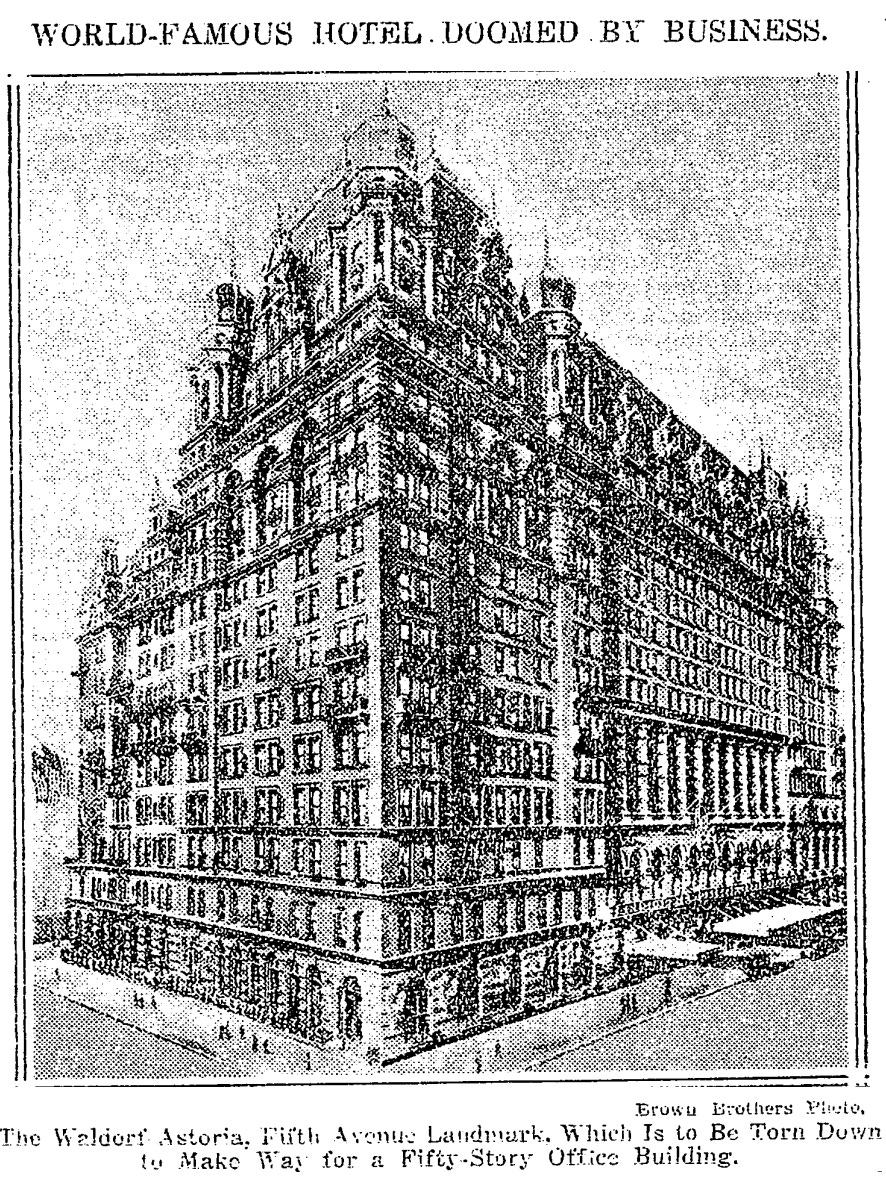
Mid-century historic preservations laws might prove more lethal to the skyscraper, which replaced the original Waldorf-Astoria Hotel. As The New York Times put it: “WORLD-FAMOUS HOTEL DOOMED BY BUSINESS.”3 The Landmarks Preservation Commission, which was established in 1965 and grew tremendously in power thereafter, might have blocked the hotel’s demolition.4 I’d say the odds are good they would have—they’ve landmarked about 38,000 buildings in NYC, show no signs of stopping, and have an extreme bias in favor of stopping further development through the process of “landmarking.” They don’t even have a formal process to remove a historic designation.5
The endangering modern factor: state deference to local governments, even when local governments are not performing as they should6
Prior to January 1, 1898, there were no five boroughs. Brooklyn was an independent city, “New York City” referred to modern-day Manhattan and the Bronx, Queens was just a county name, and Staten Island was a small collection of far-flung towns.
The project to unite them, which I wrote about here, would have failed if New York State deferred to localities the way it does (legally and politically) today. In fact, the mayors of both New York City and Brooklyn vetoed their own merger (emphasis added):
In a non-binding 1894 referendum on the question of consolidation, almost every polled municipality—including Brooklyn, by 277 votes—voted in favor of it. While this certainly added momentum to the movement, it wasn’t until May 11, 1896, that the New York state government passed the consolidation bill, overriding vetoes from both the mayors of New York and Brooklyn to do so. And it wasn’t until 1897 that the state government ratified the new city charter, boroughs and all, overriding yet another veto from New York’s mayor to do so.
(You can read about the final charter bill fight between the mayor and the state within footnote seven that follows this sentence.)7
The ultimate problem was this: consolidation and foundational charter creation are not easy points to come to. If they fail once, it is unlikely they’ll be taken up again. In political circumstances like that, it’s often worth accepting a suboptimal version of a policy, knowing you can amend it later, than it is waiting for an ideal policy, which you likely won’t have a chance to pass. Further: if you wait for the naysayers to quiet down before you proceed, you will be waiting forever. Even after NYC was created, people immediately began arguing for its dissolution (and not just modern Staten Islanders, but Queens!).
Thankfully New York State recognized this, and generally took the side of the prominent Brooklyn lawyer William C. De Witt, who criticized New York’s Mayor Strong in ways that are easily applicable to many modern city (and state) leaders. Indeed, the consolidation charter of 1898 was significantly altered in 1901, and would be regularly amended thereafter,8 with the most recent large-scale overhaul in 1989.
A final legal note: when I explain this history, people often ask me how a mayor could veto state legislation. At the time of the consolidation bill, New York operated under the recently ratified 1894 constitution; it said that if the state passes a bill that targets one or more municipalities specifically (rather than municipalities generally), then those municipalities get the opportunity to approve or veto that bill. If it is vetoed, the state can override that veto by re-passing the bill itself. You can find the municipal veto provisions in Article XII, Section 2 of the 1894 constitution.9
This post was inspired by John Arnold’s tweet about a petition circulated by the French art world to protest the Eiffel Tower:
Honored compatriot, we come, writers, painters, sculptors, architects, passionate lovers of the beauty of Paris — a beauty until now unspoiled — to protest with all our might, with all our outrage, in the name of slighted French taste, in the name of threatened French art and history, against the erection, in the heart of our capital, of the useless and monstrous Eiffel Tower.
Are we going to allow all this beauty and tradition to be profaned? Is Paris now to be associated with the grotesque and mercantile imagination of a machine builder, to be defaced and disgraced? Even the commercial Americans would not want this Eiffel Tower which is, without any doubt, a dishonor to Paris.
I have no doubt the commercial Americans (a compliment) would have loved the Eiffel Tower, just as the world loves it today.