There’s always a crisis or what seems to be a crisis or people trying to make something a crisis. Sometimes the crisis is real, sometimes is a manipulation, sometimes it’s a genuine danger that could become a crisis. It is often hard to sort these things out and my coping strategy for dealing with some new crisis is to take that moment to learn about things in detail.
For example: have you heard that the Newworld Screwworm is threatening to infect our livestock supply? This sounds bad. Fortunately, I was able to research this and discover that it is very bad and there is a whole fascinating story about this horrific creature, how we eradicated it, and how Covid, open borders, and a stunning and frankly inexcusable amount of institutional incompetence has managed to take a solved problem and allow it become a fresh danger.
Unlike most flies that lay eggs in dead and rotting organic matter, the Newworld Screwworm lays eggs in the open wounds and mucus membranes of living animals. The maggots then eat the animal (or human!) alive. Its scientific name is cochleomyia hominivorax which literally means “man-eating snail”.
These little monsters have plagued livestock and humans in tropical and subtropical regions of the Americas for centuries. This includes the southern US, the Caribbean, and most of Central and South America. The devastation of these terrible creatures amounted to billions of dollars of yearly damage on top of the fact that they are extremely gross and cause massive human and animal suffering.
So why am I not already familiar with this thing? I’ve lived most of my life in a region of the US that is the historic breeding ground for the screwworm, why have I not heard anything about it?
That’s because, similar to the eradication of small pox, we used science and massive international institutional coordination to destroy this nasty little pest.
In the 1930’s, Raymond Bushland and Edward Knipling were studying the screwworm in Texas where it was devastating livestock herds. These two scientists proposed and developing the “sterile insect technique” (SIT), which involves breeding the insects, sterilizing them with radiation, and releasing them into the wild. Because the female screwworm fly mates only once, if she mates with a sterile male fly any eggs she lays will not produce maggots.
This has the immediate benefit of stopping the maggots from killing livestock but also has the long term benefit of eradicating these little assholes. Of course this would mean intentionally breeding sterile flies on an industrial scale and releasing millions of them into the wild. So that is what they decided to do.
In 1954, this strategy was tested on a small island of Curaçao. The screwworm was eliminated from the island in the space of seven weeks.
Over the next 30-40 years, the there was a major push for screwworm eradication in North America. It was driven out of the US in the 60’s. With enormous international cooperation, they were pushed out of Mexico and Belize in the 80’s and eradication was pushed down to Panama by the 1990’s.
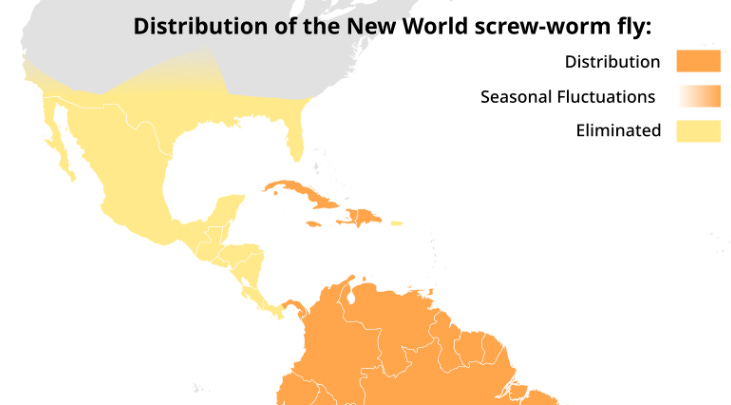
By a happy accident of geography, Panama was an excellent choke-point for the screwworm eradication. We could effectively maintain a screwworm border in Panama with a minimal effort because the geographic area to sterilize was physically small and politically stable. This also meant that screwworm control could be maintained through limited screwworm production facilities based in Panama and managed by COPEG, a joint commission between Panama and the US. COPEG is an institution specifically founded to maintain control over the screwworm barrier in Panama.
It wasn’t plausible to push screwworm elimination past Panama for a number of reasons that include political instability and the fact that Brazil is an enormous and terrifying place.
But then something went wrong.
Apparently in 2022, the screwworm barrier was breached. I say “apparently” because there seems to be wide agreement that 2022 is when this happened but no one can point to an event or any form of data about when this happened. The year 2022 seems to be a backward extrapolation from the fact that in 2023 there were 6,500 screwworm cases in Panama. Since then, cases have spread up through Central America and into Mexico.
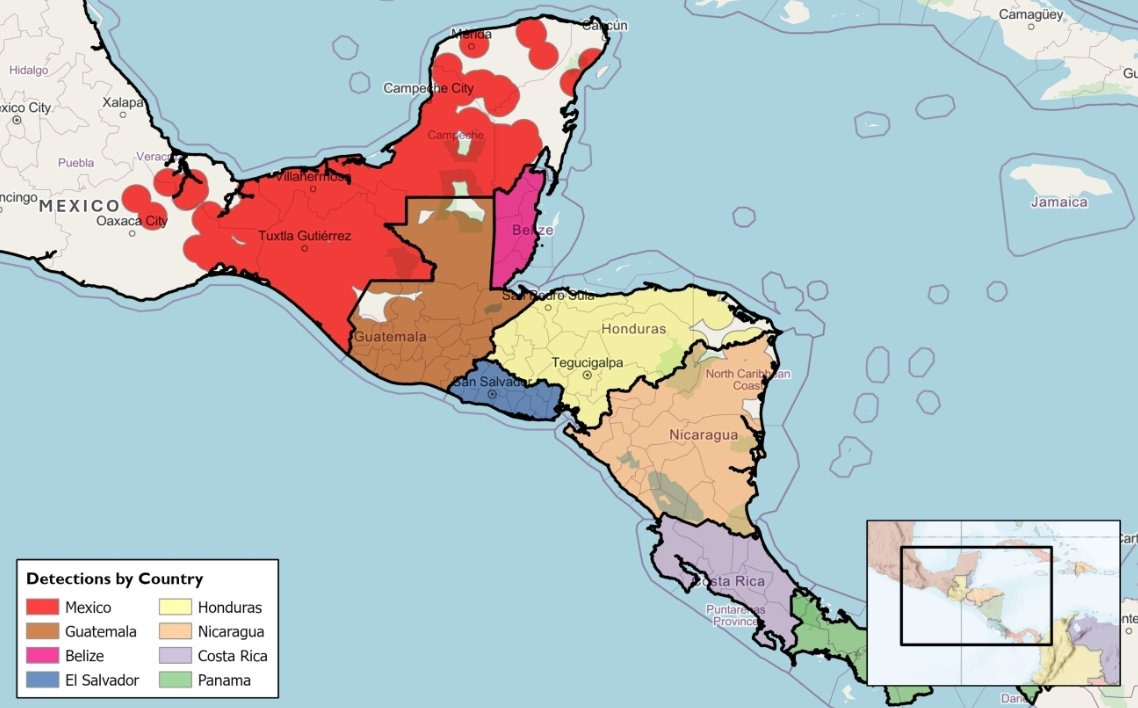
How did this happen? That’s an interesting and mysterious story. The official line is that there were supply chain disruptions associated with the Covid pandemic that limited the Panama production of sterile flies necessary for screwworm containment.
I’m skeptical that this is a complete explanation because it sounds a lot like a faultless excuse. No one can blame anyone for Covid supply chain disruptions. No one gets fired for Covid supply chain disruptions.
It seems very likely that unchecked northward migration of livestock herds in 2022-2023 was a big factor in this ongoing disaster. Expert entomologists have looked at the pattern with exasperation and concluded that this is really the only plausible explanation since the flies themselves simply do not spread that quickly on their own. They were almost certainly transported via unchecked northward migration of people and animals.
My frustration with this is less about how it started and more about how it has gone on for so long unchecked. I have a long-standing grudge against people who think that the good things we enjoy in a rich first-world civilization just landed here by accident and are not the result of relentless efforts from determined people who take very seriously the responsibility of holding back the chaos of nature red in tooth and claw.
Some group of people were in charge of holding the line on the screwworm barrier. They failed. And, having failed, they then failed to act quickly enough to fix the problem. Maybe they didn’t raise the alarm or maybe the alarm wasn’t loud enough. Maybe the people in power who were supposed to hear the alarm didn’t realize how severe this problem was. This is a problem that should have never gotten this bad. It always seems that, in situations like this, everyone and no one is to blame.
It’s agonizing to see something like the screwworm go from a “solved problem” to “oh no” this quickly. Great effort, determination, organization and (of course) money can win great victories but no victory is so complete that it can not be undone by a handful of careless middle managers who don’t grasp the importance of the system they have been charged with maintaining.
The screwworm barrier in Panama cost $15 million a year. This is zero dollars to the US government. This program was basically free and it protected an entire continent from billions of dollars of yearly damage.
The solution to this problem seems fairly straightforward. On the defensive side, we need to quickly ramp up surveillance so that we know where the infestations are coming from. We need to stop livestock herds from moving great distances and we need better herd inspection so that infected animals are identified and treated.
We also need to be prepared to fight back any infestations in local livestock. A cattle group (RCALFUSA) is begging the FDA to approve their plan to add ivermectin to livestock feed in order to protect US livestock from possible infection. This needs to happen sooner rather than later.
On the offense, the Department of Agriculture has said they are going to ramp up the SIT production. When we had the screwworms contained to Panama, we were dropping about 14 million flies weekly. That might seem like a lot, but it is not even 3% of the number of flies that were produced at the height of the eradication campaign in the 1980’s. The fact that the flies have spread so far north means that we need to spin up fly production facilities in Mexico and Central America very quickly in order to push these bastards back to the south.
We need to get sterile fly production up and running at a massive scale. The original elimination campaign from Mexico to Panama took 21 years to complete and that was with 500 million flies per week. The USDA’s plan to fix this sounds good on paper. It looks like we may be able to ramp fly production back up to the half billion per week, but it will take years to fully execute. Even if this problem gets the attention, funding, and urgency it deserves, this 2-3 year failure in screwworm containment will likely take at 5-10 years to re-establish the eradication we enjoyed for nearly three decades.
It is long-standing wisdom that everything is monocausal and specifically results from whatever crap I’m on about at any given time. But this kind of devastating and expensive failure is exactly the sort of institutional failure that I expect when people don’t take the details of their own work seriously, don’t recognize the severity of the situation, and don’t have the appropriate respect for the hard work that brought us the good things that we have. These failures run up and down the institutional decision chain and the fact that there isn’t any specific person to blame actually exacerbates the distrust in institutions. No one will be fired or will resign for a preventable problem that we didn’t even hear about until it had spun completely out of control.
They say “success has many fathers but failure is an orphan” and that’s true. But institutional failures like this aren’t just the aggregate failure of a number of irresponsible people, they are a failure of a cultural attitude that doesn’t demand excellence from everyone in order to get the job done.
And before you ask, yes, I get most of my worldview from Calvin and Hobbes.

New subscribers: I end every piece with a short cartoon. I started this as a way of keeping myself sane during Covid, but I’ve come to enjoy it. Come for the data but stay for the cartoons.
I’ve actually done this one before but it’s been four years and I absolutely adore it. It’s a riot and an emotional roller coaster. There are subsequent “Marc Anthony and Pussyfoot” shorts but none of them are quite as perfect as this one.