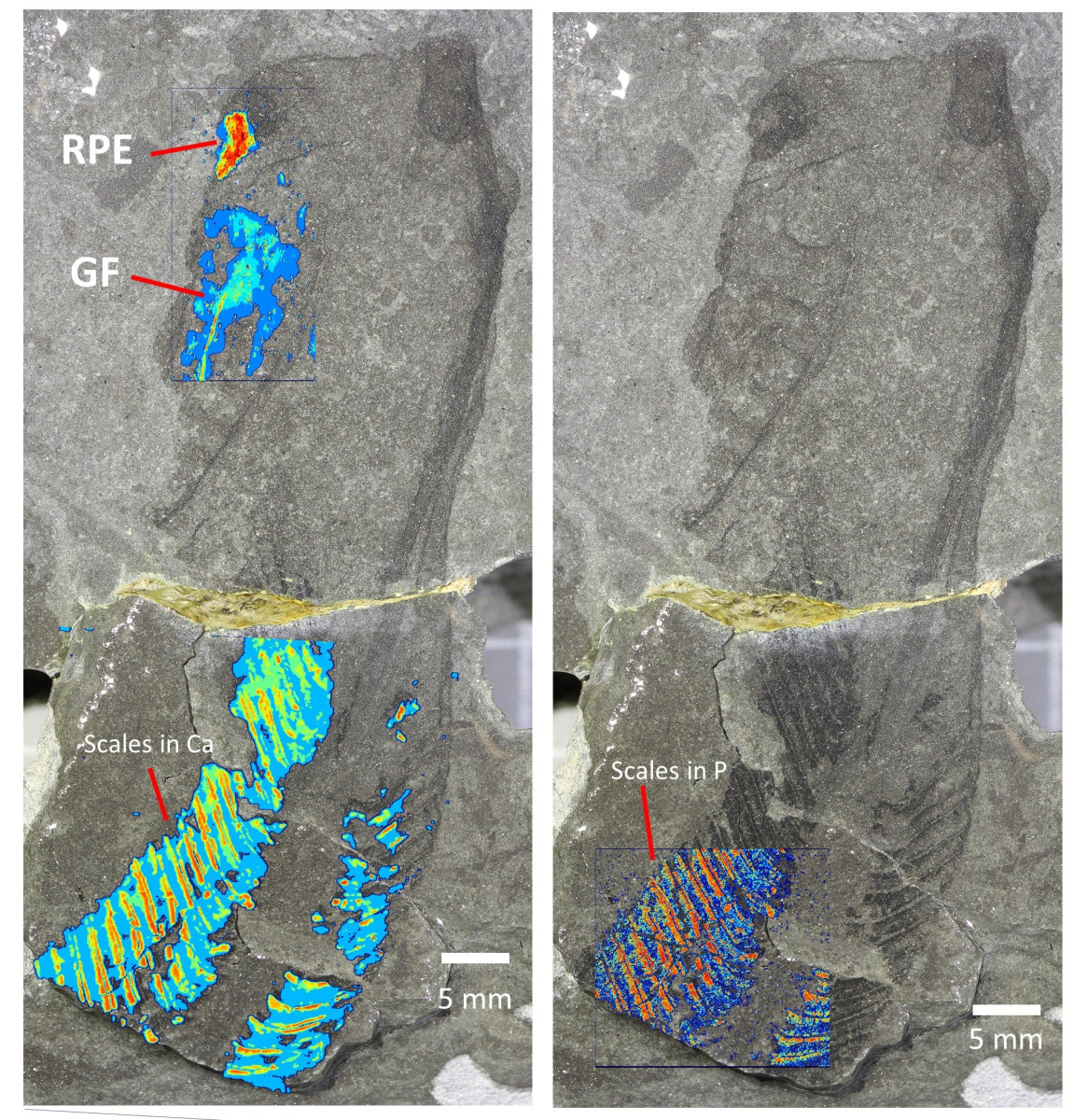
A photograph of a second Jamoytius specimen, again with a zinc X-ray map overlain at top, where the eye structure is visible but less well preserved. In this specimen the body scales were also preserved and when mapped for the elements calcium (bottom left) and phosphorous (bottom right) the scales are shown to have the same chemistry as bone.   Credit: Reeves/Wogelius/Sansom 
A photograph of a second Jamoytius specimen, again with a zinc X-ray map overlain at top, where the eye structure is visible but less well preserved. In this specimen the body scales were also preserved and when mapped for the elements calcium (bottom left) and phosphorous (bottom right) the scales are shown to have the same chemistry as bone.  Credit: Reeves/Wogelius/Sansom 

Download

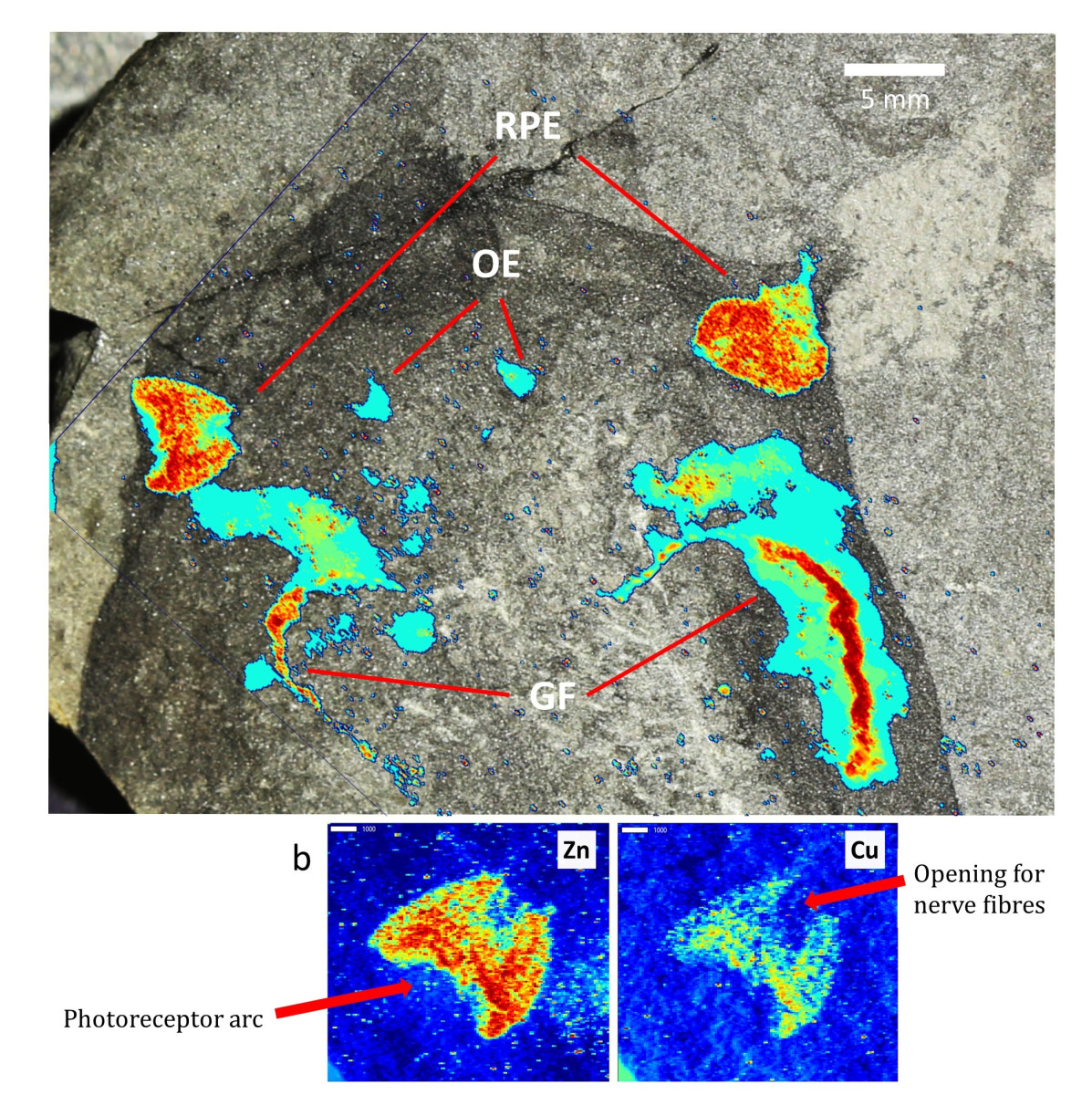
Photograph of Jamoytius kerwoodi, an early Silurian (~440 million year old) fossil fish from Scotland, with a colour overlay of X-ray maps of the element zinc. Zinc maps reveal the structure of the camera-type eyes by showing the retinal pigmented epithelium (RPE), as well as the olfactory epithelium (OE), and gill filaments (GF). The inset images at the bottom highlight the RPE structure as shown by the distribution of both zinc and copper, two metals associated with pigmentation, and give details of the photoreceptor arc as well as the opening at the rear of the eye for nerve fibres.  Credit: Reeves/Wogelius/Sansom 

Photograph of Jamoytius kerwoodi, an early Silurian (~440 million year old) fossil fish from Scotland, with a colour overlay of X-ray maps of the element zinc. Zinc maps reveal the structure of the camera-type eyes by showing the retinal pigmented epithelium (RPE), as well as the olfactory epithelium (OE), and gill filaments (GF). The inset images at the bottom highlight the RPE structure as shown by the distribution of both zinc and copper, two metals associated with pigmentation, and give details of the photoreceptor arc as well as the opening at the rear of the eye for nerve fibres. Credit: Reeves/Wogelius/Sansom 

Download