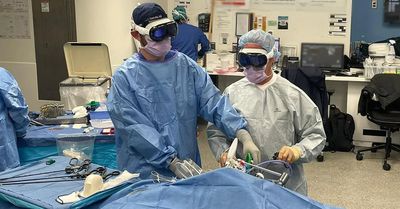
Surgeons at the University of California, San Diego have been testing the Apple Vision Pro for surgeries, and have performed more than 20 minimally invasive operations while wearing the headsets. Surgeon and director of the Center for Future Surgery at UCSD, Santiago Horgan, recently spoke with Time to provide some commentary on the Vision Pro's performance.
According to Horgan, the Vision Pro could be "more transformative" than robotic devices that are used to assist in surgeries. While the Vision Pro is expensive for consumers, it is affordable for hospitals compared to most medical equipment, and it is widely available technology that many hospitals around the country will be able to take advantage of.
During laparoscopic surgeries, doctors send a camera through a small incision, and the camera's view is shown on a nearby screen. Doctors have to watch the screen while also operating on the patient, a process that the Vision Pro streamlines. Horgan says that surgeons need to look over at CT scans, monitor vitals, and more while doing these surgeries, and all of that information can be viewed through the Vision Pro instead.
This prevents surgeons from having to contort their bodies in odd positions, cutting down on discomfort while performing surgeries.
While Horgan has tried other headsets like Google Glass and Microsoft's HoloLens, the displays were not good enough. But the Vision Pro has high-resolution OLED displays, and the result has turned out to be "better than [UCSD surgeons] even expected."
In surgeries that involve the Vision Pro, doctors, assistants, and nurses all wear the headsets instead of looking at screens, and no patients have opted out of the Vision Pro surgeries.
UCSD is also testing the Vision Pro's ability to create 3D radiology imaging, and the team may also test it in other medical applications. More on how the Vision Pro and other similar devices are being tested for medical use is outlined in the full Time article.