To understand Walter Benjamin’s life, it is best to begin with his death. Attempting to flee Nazi-occupied France, he died by suicide on 26 September 1940, in the village of Portbou, Catalonia. Born into a wealthy Berlin family in 1892, he had been a prodigious intellectual force as a student, anti-war activist and journalist. After Hitler came to power in 1933, however, he became an impoverished and isolated exile in Paris, writing and researching at the Bibliothèque Nationale. His friend Gershom Scholem later wrote of him:
He had nothing of the bohemian about him. In those days, he had a little belly that protruded slightly … I don’t believe I ever saw him without a tie … Sometimes he had an owlish, profound expression behind his round spectacles, and it took time to decide if he was mocking what he had just said aloud.
When the Germans invaded France, Benjamin made his way south to Lourdes with a group of refugees that included another friend, Hannah Arendt. In the refugee camp he had a dream that foretold his end:
We found ourselves in a pit. I saw that there were some strange beds almost at the bottom of it. They had the shape and the length of coffins; they also seemed to be made of stone. Upon kneeling down halfway, however, I saw that one could sink gently into them as if getting into bed. They were covered with moss and ivy.
Although he was only 48, he looked like an old man. Weakened by cardiac failure, he nonetheless proved his mettle to his guides by laboriously climbing a trail into the mountains, heading for the Spanish border. Lisa Fittko, a member of the group crossing with him and the last person to see him alive, recalled: ‘He planned his crossing carefully, and at regular intervals – about every ten minutes, I think – he would stop and rest for perhaps a minute.’ He told her: ‘With this method I’ll be able to go all the way. I rest at regular intervals – before I become exhausted. Never spend yourself entirely.’
‘What a strange man,’ she thought. ‘A crystal-clear mind, unbending inner strength, yet hopelessly clumsy.’ Just as salvation seemed within reach, the Spanish authorities announced that no new refugees would be admitted. Benjamin took the single dose of morphine he carried. He had kept a briefcase with him but it was found empty. What had been in it? Perhaps, according to the psychoanalyst George Makari, ‘the roaring voices of history’s refugees and exiles, all their lamentations, their laughter and their stories, all their accusations and confessions, all free from oblivion’. The next day, the authorities, possibly responding to his suicide, reopened the border.
At the time of Benjamin’s death, three friends were trying to rescue him. The first was Scholem, who was from the same assimilated German-Jewish Berlin milieu as Benjamin. Scholem was six years younger than Benjamin and the two men had shared a passionate adolescent friendship, studying the Hebrew Bible, the Kabbalah and mystical theories of language together. What Benjamin called, in a letter to the philosopher Martin Buber, the ‘problem of Jewish spirit’ appears frequently in his subsequent thought. Scholem emigrated from Germany to Palestine in 1923. There he maintained an archive of Benjamin’s writing and dedicated his first masterwork, Major Trends in Jewish Mysticism (1941), to his friend. Throughout the 1930s, Scholem had tried to get Benjamin to emigrate, and even obtained a position for him at the Hebrew University. But Benjamin was not a Zionist and was not eager to relocate to Palestine.
The second friend who tried to save Benjamin was Bertolt Brecht, with whom he explored the relations of technology, art and mass society in an era of incipient fascism. The two became friends after Benjamin was forced to leave academia in 1925, when his Habilitationsschrift (a qualification for the highest university degree) was rejected. Plunged into avant-garde currents that were oriented towards both the Soviet Union (where Benjamin lived for two months) and the United States, Benjamin met Brecht in 1929. A committed Marxist, Brecht saw the mainstream theatre as a kind of purgative for bourgeois society, fostering conformity and self-satisfaction. He rejected the idea that spectators should identify emotionally with characters and sought instead to strip the theatrical event of its ‘self-evident, familiar, obvious quality’. His aim was to create astonishment, curiosity and political awareness rather than catharsis.
Brecht had a home in Denmark, which Benjamin often visited. ‘Whenever Benjamin and Brecht were together in Denmark,’ a member of Brecht’s circle wrote, ‘they played chess wordlessly, and when they stood up, they had had a conversation.’ Like Scholem, Brecht tried to help Benjamin, inviting him to Denmark for years before the Nazi invasion, but Benjamin did not want to leave Paris. When Brecht heard about Benjamin’s death, he wrote a poem, ‘To Walter Benjamin Who Killed Himself While Fleeing from Hitler’:
Tactics of attrition are what you enjoyed
At the chessboard seated in the pear tree’s shade.
The Enemy then drove you from your books;
The likes of us? Ground down, outplayed.
Benjamin’s third would-be rescuer was Theodor Adorno, who, along with Max Horkheimer, represented the Frankfurt School’s Institute for Social Research in exile in New York City.
Benjamin’s relations with the Frankfurt School were complicated. Adorno, a student of avant-garde music and literature eleven years younger than Benjamin, thought of Benjamin as his ‘only teacher’. On the other hand, Benjamin was economically dependent on Adorno, who was trying to secure a teaching position for him in Cuba. Benjamin was heading for New York via Spain to take up Adorno’s offer when he died.
These three friends represent the three poles of Benjamin’s intellectual trajectory: Scholem embodied the messianic legacy of Judaism, Brecht the radical potential of the avant-gardes, and Adorno the attempt to turn Marxism into a theory of culture and what Benjamin called the ‘structure of experience’. All three sought to keep the critical-revolutionary tradition alive in the face of fascism. Each of them forged heterodox alternatives to both liberalism and communism. Each contributed to the mutation that produced today’s left: messianic Judaism, avant-garde performance art and Freudo-Marxist critical theory. Benjamin, who was trying to explain how the capitalist economy ‘expresses’ itself, drew on – and differed from – all of them.
A clue to the affinity among his three friends is Paul Klee’s Angelus Novus, the oil-transfer watercolour monoprint that Benjamin bought for a thousand marks – about $30 in today’s money – in Munich in 1921. A friend recalled how this ‘gauche and inhibited man behaved as if something marvellous had been given to him’. Benjamin hung the drawing in every apartment he lived in, named his literary journal after it, and used it to draw a connection between the artistic avant-garde of the period and a Talmudic legend about angels who are being constantly created and destroyed. ‘This,’ he wrote, ‘is how one pictures the angel of history.’
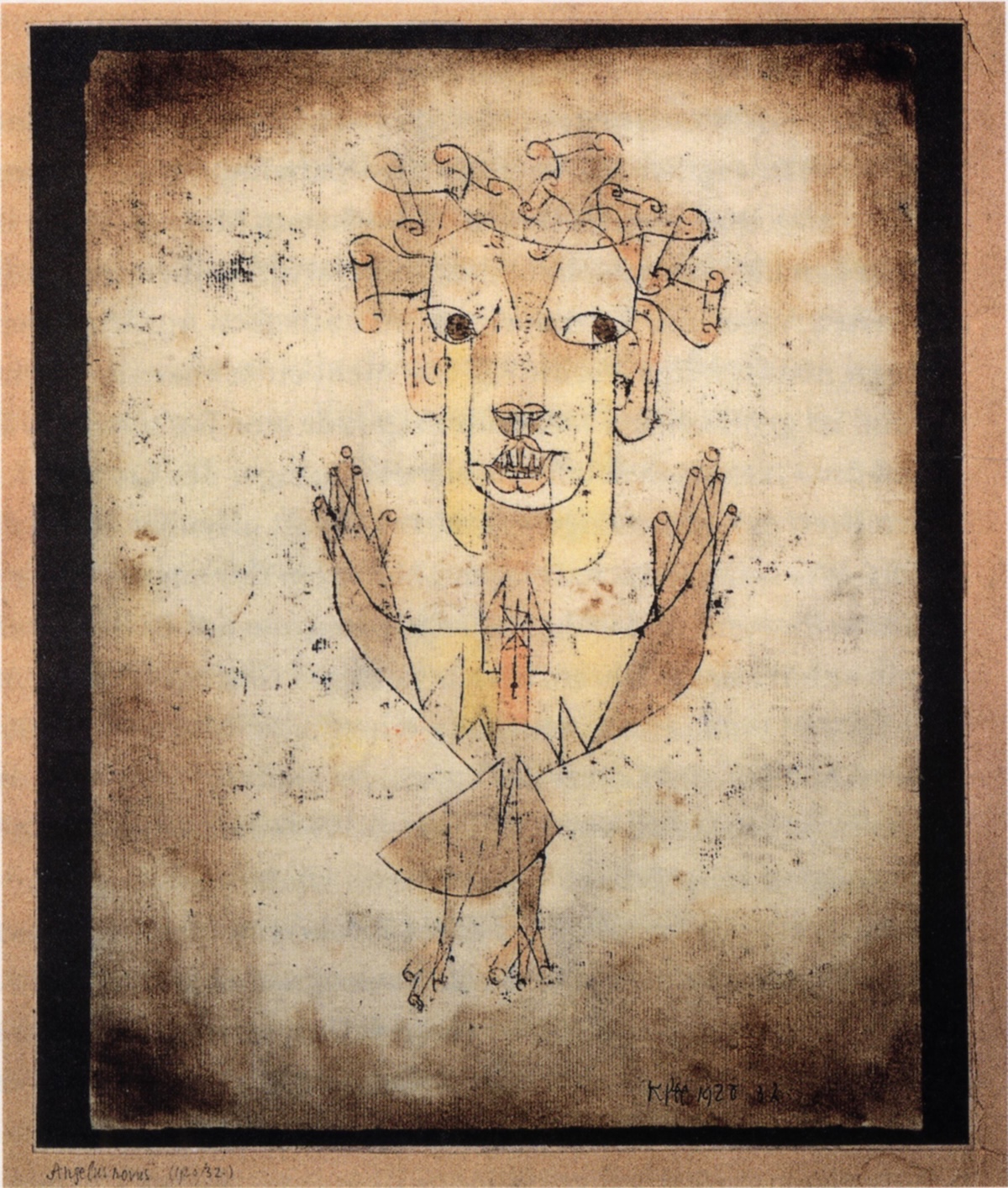
‘Angelus Novus’ by Paul Klee (1920)
When Benjamin fled Germany in 1933, he left the painting behind: ‘The angel … resembles all from which I had to part: persons and, above all, things.’ But it assumed an important place in his last essay, ‘Theses on the Philosophy of History’, a manuscript which he carried to Portbou, and in which he wrote of the angel:
His face is turned toward the past. Where we perceive a chain of events, he sees one single catastrophe which keeps piling wreckage upon wreckage and hurls it in front of his feet. The angel would like to stay, awaken the dead, and make whole what has been smashed. But a storm is blowing from Paradise; it has got caught in his wings with such violence that the angel can no longer close them. The storm irresistibly propels him into the future to which his back is turned, while the pile of debris before him grows skyward. This storm is what we call progress.
When Benjamin died, Arendt retrieved the manuscript and had the ‘Theses’ published. The painting was entrusted to Georges Bataille, then passed to Adorno and finally to Scholem, who gave it to the Israel Museum in 1987.
Three great figures – Scholem, Brecht and Adorno – tried to save Benjamin, and all failed. Benjamin understood our times in terms of ruins, remnants, still-warm embers, not in the terms dictated by the victors. ‘Only that historian will have the gift of fanning the spark of hope in the past,’ he once wrote, ‘who is firmly convinced that even the dead will not be safe from the enemy if he wins. And the enemy has not ceased to be victorious.’ Perhaps what we can do today is fan the sparks he left behind.
Eli Zaretsky’s ‘Walter Benjamin: A Very Short Introduction’ will be published by Oxford in the US in June and in the UK in September.