Before celebrating China’s Spring Festival, my husband and I were talking about new sources of local economic growth thanks to President Xi Jinping’s visit to Tengchong right after his first overseas trip to Myanmar in 2020. Tengchong, where I conducted fieldwork for my PhD about the language learning experiences of Burmese students in Chinese high schools, is a border town, located in the most peripheral southwest of China. It has recently acquired much strategic attention from China’s national government and numerous business opportunities are available to explore. However, our expectations and imaginations were stopped in their tracks by the official confirmation of the coronavirus epidemic on January 20. Since then, our family conversations have shifted from economic growth and individual development to the epidemic-related events. The epidemic not only changes family discourses but also provides a space for a new perspective on linguistic diversity. Over the past five weeks, I have observed the increasing visibility and audibility of linguistic diversity in China, both online and offline.
Communicating health information in non-standard Chinese

Bilingual health dialogue in Putonghua and Hubei Mandarin
Putonghua is the standard variety of Chinese Mandarin but the majority of Mandarin speakers speak non-standard varieties for daily communication. They and ethnic groups whose mother tongue is not Mandarin have to learn to speak Putonghua as a lingua franca.
Up until the outbreak of the coronavirus, Putonghua was conceptualized as capital for improving the labor force and individual employment prospects in China. The language policy “Promoting Putonghua to Eradicate Poverty” has been implemented nationwide in minority-centered remote areas and many Putonghua learning programs have been designed to facilitate access to Putonghua, particularly in China’s peripheral regions.
In short, Putonghua reigned supreme until the virus outbreak. However, the status of other dialects and languages changed almost immediately with the disease.
After the lockdown of Wuhan in Hubei Province, the center of the virus outbreak, the institutions which used to promote Putonghua to eradicate poverty have come to shift their strategy by developing language resources for the learning of non-standard Mandarin varieties. For instance, a bilingual audio-brochure in Putonghua and Hubei Mandarin was produced for medical staff and volunteers recruited to answer emergency calls and inquiries. The brochure provides model conversation between doctors and patients in both varieties. The necessity of speaking and understanding Hubei Mandarin has become more prominent as an increasing number of medical workers and volunteers from other parts of China have headed for Hubei: by February 20, over 60,000 medical workers from 29 provinces of China have been sent to Hubei to fight together with the local medical staff and infected patients.
The shifting linguistic focus from Putonghua to other Chinese varieties not only helps to improve medical care and save lives but also helps to build solidarity with the over 59 million Hubei residents hardest hit by the epidemic. The attempt to improve communication by speaking non-standard Chinese has raised the awareness of Chinese language policy makers regarding the importance of conducting more applied research on language and health communication in real-world contexts.
Communicating health information in minority languages

Bilingual video in Putonghua and Jingpo how to self-protect
In addition to the increased prominence of non-standard Chinese to save lives and serve the community, minority languages are also gaining in importance in many peripheral regions of China. Before the virus outbreak, there were some bilingual social media portals targeting minority groups and these media portals were designed to announce Chinese government policies, advertise successful minority elites and promote cultural festivals. One such example is the WeChat micro-community of Jingpo users, which I have been following since my PhD research. The micro-community accommodates both Jingpo and Kachin speakers, who are the same ethnic group living on different sides of the border in China and Myanmar respectively. Since the outbreak of the coronavirus epidemic, this Jingpo WeChat group has not only increased its daily circulation messages but has also added specific information such as the tips how to prevent the spread of the virus and regular updates on the progress of the epidemic.
Of course, not all minority languages can get technical support from the local government and many minority speakers, particularly in the older generation, do not have access to social media, as described by Yu Lha in her recent post about the use of Tibetan minority languages. In such cases, epidemic-related information may also be circulated in more bottom-up ways, as described by Gegentuul Baioud in her post about the use of Mongolian fiddle stories to combat the spread of the disease and keep up morale. Other traditional methods include villagers broadcasting in minority languages via public loudspeakers, recording minority folk songs for locals to listen to repeatedly, or using traditional musical instruments like bamboo clappers to broadcast the key message via mobile trumpets.
Information brochures how to fight the coronavirus have now been published by China’s provincial language publishing houses in 39 minority languages.
In addition to health information being now published in minority languages what is noteworthy is their sudden increase to prominent visibility promoted by local and provincial governments. Multilingual circulation of health-related information has been cited and highlighted by local and even provincial governments to show their loyalty and responsibility to the national call to spread virus-related information to the remote areas. Just type “multilingual” (多语) and “epidemic”(疫情) as key words in Mandarin to search on Baidu for relevant reports, and hundreds of results will pop up and link to local government websites emphasizing their support and determination to fight the coronavirus together with the national government. Unsurprisingly, however, these official reports about multilingual circulation are exclusively written in Mandarin.
Communicating health information to foreigners in China and worldwide
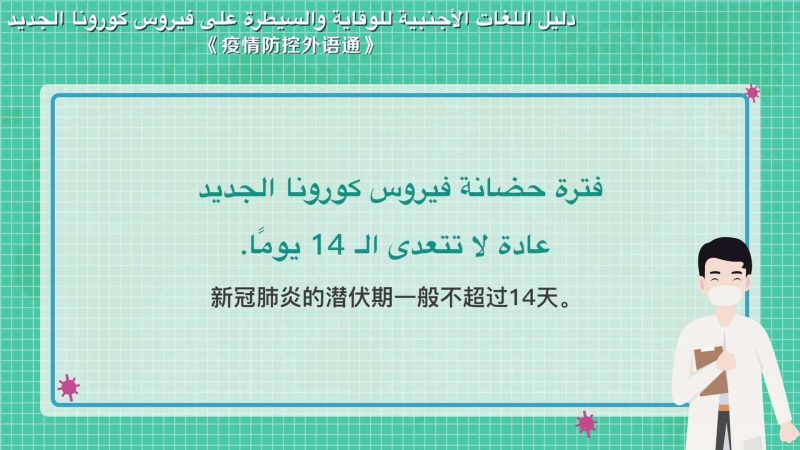
Bilingual health information in Chinese and Arabic
Apart from the revitalization of non-standard Chinese varieties and minority languages, another shift can be observed with regard to foreign languages and communication targeted at foreigners studying and living in China.
At the initial stage of the outbreak, English was the only foreign language in which news about the coronavirus were circulated online. Many Chinese universities and the provincial offices in charge of foreign affairs just followed this language choice and provided relevant public service messages in Mandarin and English. This language choice seems to be based on the assumption that foreign students and workers in China are able to read and understand either English or Mandarin. However based on our longitudinal research with migrant students and workers from Bangladesh, Laos, Myanmar, and Vietnam (here, here, and here), many foreigners are actually struggling to understand either English or Mandarin. Some even lack survival linguistic proficiency in these languages.
Given the large number of foreign students and workers in China, it is of vital importance to communicate health information in the languages that are familiar to these audiences. My university, Yunnan University, for instance, has a high level of foreign language resources available because, since 2013, Yunnan University has established ten degree programs in the languages of Southeast Asia and South Asia. Therefore, my colleagues and I prepared to activate these language resources to circulate health information for foreigners without (high levels of) proficiency in Mandarin and English. So far, our offer to translate official reports has not yet received any official feedback. As ordinary teachers, there is little we can do without official and technical support, particularly while we are still in quarantine.
Since early February, some information in foreign languages other than English has started to appear on official websites. The same institution that published the audio-bilingual brochure in Standard Chinese and Hubei Chinese has now also published Arabic, Italian, and Korean versions.

Burmese-Chinese eulogy praising China’s public health efforts
Examining the effectiveness of multilingual communication will need to be the next step. In Yunnan, for example, the daily reports from the local foreign affairs office have started to circulate in five languages in addition to Mandarin and English (Burmese, Cambodian, Laotian, Thai, and Vietnamese) since February 05. However, the majority of foreign students are from Southeast Asia and South Asia, which suggests that information in South Asian languages is missing. Additionally, the content of the daily reports is only about the number of people who are infected and dead in different parts of Yunnan. However, there is nothing about self-protection or any other information on how to seek help and support.
Compared to the simplified report of the foreign affairs office, other multilingual reports have emerged with the narratives of foreigners’ experiences with the epidemic. However, these stories all seem to convey “nice” viewpoints on how safe they feel and how grateful towards the care they are receiving from their local government and university leaders, and how obedient they are staying in their dormitory preparing for the HSK (standard Chinese proficiency test) and writing up their graduation theses.
It is reasonable to assume that panic and anxiety are the normal reaction of people exposed to an epidemic like COVID-19, as described by Zhang Jie. Such narratives seem to be missing entirely from official multilingual communication. Rather than building solidarity by sharing the pain and suggestions on how to deal fear and uncertainty, multilingual reports contain nothing but eulogizing discourses.
In a similar way, foreign languages are employed to produce China-related knowledge on the back of health information. Reporting how China fights the coronavirus in the national languages of neighboring countries is such a case in point. For instance, one of my colleagues wrote an article in Nepalese about the specific efforts of the Chinese government to build new hospitals within a short period of time, their success in guaranteeing food and other daily necessities, and the support of the armed forces for the epidemic center of Hubei. That article made the front page of the top online Nepali news portal. Multilingual reports such as this not only contribute to the fight against the disease but foreign languages are also employed as a battle resource to construct a positive image of China and to disseminate the story of China’s successful control of the epidemic spread.
COVID-19 as an opportunity to challenge the global hegemony of English as language of science
Just as Zhang Jie states, fighting the coronavirus is like a battle field without gunfire. When 1.4 billion Chinese are shaped in one mind and one heart to fight the epidemic together, patriotism via mass media circulation can be a powerful tool in the fight to safeguard the national interest. Language can become both the weapon and the shooting target to unify billions of hearts. The emerging discourse of nationalism is also contesting the legitimacy of English as the global medium for the dissemination of medical and technical knowledge.

Cartoon suggesting that research published in English is highly overrated vis-a-vis research published in Chinese
Producing medical knowledge in English has turned out to be a crime against patriotism and words like “traitor” or even “killer” have been used for Chinese researchers publishing journal papers in English. Several Chinese scholars publishing their research on the coronavirus in The New England Journal of Medicine (see here and here) have become the target of such attacks. It is argued that, because of English, their warnings and suggestions could not be heard by the Chinese people. If their research had been published in Chinese, it is claimed, many effective measures could have been taken earlier and the scale of the disaster could have been prevented. Because they published in a highly-ranked international journal in English instead of in Chinese, these researchers are now being blamed for using Wuhan as a laboratory to satisfy their selfish desire for academic promotion and rewards.
Apart from the moral and ethical blame put on these medical researchers, English as medium of academic publication has itself come under fire and the huge cost Chinese scholars pay in tribute to the US-dominated academic world is coming under scrutiny. The public is now paying attention to the fact that, in 2016 alone, there were 321,266 SCI (Science Citation Index) journal articles written by Chinese scholars. The total amount of publication fees and experiment costs these Chinese scholars paid for their research and publications was about 29.556 billion RMB, equal to buying an aircraft carrier from the USA.
Confronting the pressure from the masses and to reduce public anger, China’s Ministry of Education has now issued a new policy which forbids any key universities to use SCI as driving mechanism evaluating university reputation and individual performance. Aligned with challenging English hegemony in research publications, many voices have been raised to suggest using Mandarin as preferred medium for research publication and knowledge dissemination to increase national cultural confidence (see, e.g., here and here).

As the number of new coronavirus cases in China is beginning to slow down, the discussion on how to resume China’s economic vitality has started to return to the public. As we begin to look towards the future again with cautious optimism, one thing is for sure: COVID-19 has forced us to rethink many of our assumptions, including beliefs we may have held about the role of Putonghua as the dominant language of China, the importance of multilingual communication in smaller languages, and the role of English as the global language of science.