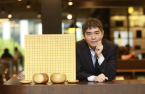
The world’s top Go player notches a 2-1 comeback win against the most powerful Go engine, raising hope for human intellect in the AI era
Shin Jin-seo, the world's top-ranked Go player, reviews the game board following his victory over AI engine KataGo in the final game of a three-match series at The Korea Economic Daily headquarters in Seoul on July 21, 2026 (Photo by Hyuk Choi)
2026-07-21 15:02:25
Artificial intelligence
Shin Jin-seo, the world's top-ranked Go player, on Tuesday completed a dramatic comeback against the world’s premier artificial intelligence Go engine, KataGo, claiming a historic human victory over AI.
Shin, who holds the game's highest achievable rank of nine-dan, dealt KataGo a decisive 11.5-point defeat playing black in 221 moves in the series finale, which took three hours and five minutes.
The 26-year-old South Korean grandmaster became the first human to win an official series against a state-of-the-art Go engine under a two-stone handicap, a margin considered the absolute boundary for human competition against modern AI.
“I believe this series holds immense significance because it clearly demonstrated that humans can still hold their own against AI,” Shin told reporters after the match.
“Early on, I simply copied AI moves, which led to heavy fighting and frequent, easy losses. This series taught me that rather than trying to imitate AI, it is far more important to build the board according to my own style.”
Shin Jin-seo poses for a photo after defeating AI engine KataGo in the final game of a three-match series at The Korea Economic Daily headquarters in Seoul on July 21, 2026 (Photo by Hyuk Choi)
DECISIVE ATTACK ON MOVE 80 AFTER FOCUSING ON DEFENSE
Unlike earlier matches filled with sharp tactical clashes, the third game developed into a territory-focused contest with little fighting through the middle stages.
Shin focused on defense and territory preservation rather than pursuing risky counterattacks, maintaining an initial 18.5-point advantage.
But he launched a measured attack against KataGo on move 80, building a massive framework that spanned from the upper board to the center.
By converting this framework into solid territory, Shin maintained a 99% win probability from mid-game through to the final move.
“I noticed KataGo tends to match moves if I open on the opposite komoku, but I didn't want to win that way,” Shin said. Komoku is the Japanese term for the three-to-four point on a Go board.
“I knew even a one-space difference could be significant, so I started on the opposite side from KataGo. Even so, I was satisfied with how the opening developed.”
Shin won 250 million won ($170,000) in match fees and prize money, along with a Genesis G90, Hyundai Motor Co.’s luxury sedan, as a performance award.
UNEXPECTED VICTORY
Heading into the event, few had expected Shin to beat KataGo in the landmark series, especially given that the AI engine is more sophisticated than previous models that had thwarted other Go grandmasters in the past.
The Go match between AlphaGo and South Korean legend Lee Sedol in March 2016 (Courtesy of Yonhap)
In 2016, Google DeepMind's AlphaGo defeated Korean Go legend Lee Sedol 4-1.
Reflecting on that landmark match, Shin noted that taking even a single game against AI at the time felt like a monumental feat.
“My victory may fall short when compared to the single win achieved by master Lee Sedol,” he said.
No human Go player had defeated AI engines in an official series before Shin.
AlphaGo Master, an upgraded version of AlphaGo, beat then-world No. 1 Go player Ke Jie 3-0 in a legendary match at the Future of Go Summit in Wuzhen, China, in May 2017. That marked a definitive moment in which artificial intelligence surpassed humanity at the ancient board game, with the closest game ending in a razor-thin 0.5-point margin.
Ke was unable to contain his frustration and even shed tears during the final game when it became clear he had no chance of winning.
TAKING ON DISADVANTAGEOUS CONDITIONS
Shin’s victory is significant because, even with a two-stone handicap, holding a lead against a near-flawless AI requires an elite player to suppress tactical instincts and defend with extreme patience and restraint, Go experts said.
Given the widely acknowledged skill gap between modern AI and human professionals, the series was played under handicap conditions.
Handicaps in Go are adjustments made to level the playing field when two players have a difference in skill, offsetting these differences so players of different ranks can have an exciting game. The weaker player takes the black stones and places from two to nine preset stones on the board before the game begins.
Shin, who placed two stones on the board before each of the three games, hinted at wanting to further test his limits.
“At future events, I want to take on new challenges, such as starting under more disadvantageous conditions against AI.”
Shin speaks to the press after defeating AI engine KataGo in the final game of a three-match series at The Korea Economic Daily headquarters in Seoul on July 21, 2026 (Photo by Hyuk Choi)
HOPE FOR HUMANITY
Shin’s victory offered a rare reminder that human players can still push the boundaries of Go in the AI era.
Hong Beom-jun, CEO of Truebook Sinsago, which co-sponsored the series with The Korea Economic Daily, said the historic victory served as a key turning point in restoring human confidence, which had been damaged by AlphaGo’s victory in 2016.
“The significance of this match lies not in the win or loss between humans and artificial intelligence, but in the process of how humans continually adapt their approach to achieve their goals,” Hong said.
Referencing Shin’s opening loss, Hong emphasized the resilience needed to overcome superior computing power.
“There was a problem with the method in the first match, but the goal itself was not wrong. Shin shifted his strategy in the second and third matches toward a defensive, disciplined style, and ultimately prevailed.”
“That is the true lesson of this series.”
Hong announced plans to host the same event again next year, adding that organizers are working to level the playing field between human players and machine intelligence.
(Updated with comments, details, background and new pictures)